Disclosure: topratedkitchenware.com is reader-supported. When you buy through links on our site, we may earn an affiliate commission from Amazon and other retailers, at no extra cost to you.
Where to buy
The best midsize table top microwaves are bought for a surface, not a cabinet: a kitchen table corner, a worktop run, a utility shelf that has to earn its keep every day. All six verified models below are freestanding table top designs, reviewed in full, with the two that fall outside the midsize capacity band marked prose-only so the shortlist stays truthful.
- TOSHIBA 1.6 Cu. Ft. Inverter Microwave — 1.6 cu. ft., 1250W. Best for Large Portions (Above the Band) (reviewed in full below as a prose-only pick in this guide: at 1.6 cu. ft. it is a full-size oven above the roughly 0.9 to 1.4 cu. ft. midsize band this guide is built on.)
- Panasonic 1.2 Cu. Ft. Inverter Microwave NN-SN67QS — 1.2 cu. ft., 1250W. Best Overall
- TOSHIBA 1.2 Cu. Ft. Microwave, Stainless Steel — 1.2 cu. ft., 1000W. Best for Shared Spaces
- Chefman 0.7 Cu. Ft. Microwave — 0.7 cu. ft., 700W. Best Compact Alternative (Below the Band) (reviewed in full below as a prose-only pick in this guide: at 0.7 cu. ft. it is a compact oven below the roughly 0.9 to 1.4 cu. ft. midsize band this guide is built on.)
- BLACK+DECKER 0.9 Cu. Ft. Microwave — 0.9 cu. ft., 900W. Best Simple Table Top Pick
- TOSHIBA 0.9 Cu. Ft. Microwave — 0.9 cu. ft., 900W. Best for Apartments
Read the full guide ↓
The best midsize table top microwaves answer a slightly different question from their countertop cousins, even though the ovens themselves overlap. Table top means the machine lives on a surface you can see and reach from any side, a worktop, a kitchen table, a sturdy shelf in a rented flat or a staff room, with no cabinet closing over it and no installation beyond a socket. That freedom changes what matters. Stability on the surface, a door you can open without shuffling the machine backwards, controls you can read standing in front of it, and a footprint that respects a surface other people also use all move up the list, while raw capacity, still judged on the same roughly 0.9 to 1.4 cu. ft. midsize band, shares the stage with manners.
This guide therefore judges the six verified models as table top citizens first. How much of your surface does each one really take once the cord, ventilation and door swing are counted? Which ones behave in shared spaces, with mute functions, locks and one-touch operation? And which dishes does each cavity genuinely accept, judged by turntable figures where a maker states them rather than by capacity headlines? The two out-of-band models, a 1.6 cu. ft. full-size oven and a 0.7 cu. ft. compact, are kept in the guide as prose-only measuring sticks, because on a table the cost of oversizing and the limits of undersizing are both immediately visible. For the counter-first view of the same class, see Best Midsized Countertop Microwaves and Best Midsized Microwaves.
Key Takeaways
- Table top ownership is a surface budget: count body depth, cord room, ventilation clearance and full door swing, not just the footprint on the box.
- The midsize band still applies, about 0.9 to 1.4 cu. ft.; the 1.6 and 0.7 cu. ft. models here are prose-only edges, reviewed so you can feel both limits.
- Stated turntable sizes are gold on a table top brief: the apartment TOSHIBA prints 10.6 inches, so plate fit can be checked before the box arrives.
- Shared surfaces reward manners: mute functions, child locks and ECO modes matter more on a table everyone uses than in a private fitted kitchen.
- Sensor and inverter models, the Panasonic and the larger TOSHIBAs, reheat most evenly for households whose table top oven is the main oven.
In this guide
Quick Picks
Badges here reward table top behaviour as much as cooking power: stability of format, surface manners and honest dish fit. Every figure comes from the verified listings, and out-of-band models are labelled prose-only in the table itself rather than hidden in footnotes.
| Pick | Badge | Capacity | Power | Standout verified feature | Check |
|---|---|---|---|---|---|
| TOSHIBA 1.6 Cu. Ft. Inverter Microwave | Best for Large Portions (Above the Band) | 1.6 cu. ft. | 1250W | 13.6-inch turntable, inverter (above the midsize band) | Prose-only in this guide |
| Panasonic 1.2 Cu. Ft. Inverter Microwave NN-SN67QS | Best Overall | 1.2 cu. ft. | 1250W | Genius Sensor, inverter, 1250W | Check on Amazon |
| TOSHIBA 1.2 Cu. Ft. Microwave, Stainless Steel | Best for Shared Spaces | 1.2 cu. ft. | 1000W | Humidity sensor, 12 menus, mute | Check on Amazon |
| Chefman 0.7 Cu. Ft. Microwave | Best Compact Alternative (Below the Band) | 0.7 cu. ft. | 700W | Mute button, compact footprint (below the midsize band) | Prose-only in this guide |
| BLACK+DECKER 0.9 Cu. Ft. Microwave | Best Simple Table Top Pick | 0.9 cu. ft. | 900W | Push-button door, child lock | Check on Amazon |
| TOSHIBA 0.9 Cu. Ft. Microwave | Best for Apartments | 0.9 cu. ft. | 900W | Stated 10.6-inch turntable, mute, LED lighting | Check on Amazon |
How These Picks Were Chosen
The pool behind this guide was verified on 2026-11-20, and this guide uses only what those verified listings state: capacity, power, any printed turntable diameter, and named features such as sensors, inverter delivery, mute functions, locks and lighting. No prices, scores or invented dimensions appear anywhere in the reviews. Where a listing does not state a detail, the review says the detail is not stated, which on a table top brief matters, because surface planning runs on real numbers or it does not run at all.
The midsize band was enforced exactly as a buyer would enforce it with a tape measure. Models between roughly 0.9 and 1.4 cu. ft. are linked. The 1.6 cu. ft. TOSHIBA exceeds the band and would dominate most tables, and the 0.7 cu. ft. Chefman falls below it into compact territory, so both are reviewed in full without purchase links or product images, with the reason printed in their sections. Keeping them in the guide is deliberate: a table top buyer needs to see the oversize and undersize options clearly labelled, because those are precisely the two mistakes a surface punishes fastest.
No hands-on testing is claimed anywhere in this guide. The judgements are research-led, comparing verified specifications with the practical realities of freestanding use: surface depth, door swing, shared-space noise, and the dish sizes that decide whether a cavity works. Every recommendation names who it suits and who it does not, and the sibling treatment at Best Multifunctional Microwaves is worth reading if your table must also host the jobs a second appliance would normally do, since it starts from versatility rather than placement.
The 6 Best Midsize Table Top Microwaves for Real Surfaces
Read these reviews with your surface in mind. Each one covers the verified specification, the way the oven behaves as a freestanding table top machine, one honest limitation, and a verdict. If a model is prose-only, its section explains the band decision in plain terms.
TOSHIBA Countertop Microwave Oven with Inverter Technology, 1.6 Cu.Ft, 1250W, Black Stainless Steel
Badge: Best for Large Portions (Above the Band)
Strengths
- The largest cavity in this pool, with a 13.6-inch turntable that takes big dinner plates and family dishes
- Inverter delivery plus a Smart Sensor is the strongest reheating and defrosting combination in the group
- 1250W is the joint-highest power here, so big portions heat through quickly
Trade-offs
- A 1.6 cu. ft. footprint is a full-size countertop commitment and overwhelms smaller counters
- Power this high overshoots package directions written for 700W to 1000W ovens unless you adapt times
- Black stainless steel is a specific look that does not match every kitchen
Key specs from the verified listing:
- Capacity: 1.6 cu. ft.
- Power: 1250W
- Inverter technology
- Smart Sensor and auto defrost
- 13.6-inch turntable
This is the big TOSHIBA of the pool, and it does not pretend otherwise: a 1.6 cu. ft. interior, a 13.6-inch turntable and 1250W of inverter power. The inverter matters most at the extremes of family cooking, holding a steady low output to defrost a large joint without grey edges, then reheating a deep casserole quickly and evenly with help from the Smart Sensor. Auto defrost is listed separately in the verified title, which suits households that freeze in bulk. Where this model asks for honesty is placement. Full-size countertop ovens need depth, ventilation clearance and a counter that can spare the footprint permanently, because nobody moves a machine this size twice a day. If your kitchen has that space and your portions justify it, the combination of capacity, turntable diameter and inverter control is the most complete in this group; if it does not, the same money buys frustration in a smaller room.
As a table top proposition this big TOSHIBA is a commitment device: a 1.6 cu. ft. body with a 13.6-inch turntable wants a table or worktop section it can own outright, ideally against a wall where its depth stops being traffic. Households with that surface gain the easiest plate fit in the guide and inverter pace on family portions. Households measuring a shared kitchen table should treat its presence in this guide as a boundary marker: this is what too big looks like, drawn precisely so you can step back from it.
Why this pick is prose-only in this guide: at 1.6 cu. ft. it is a full-size oven above the roughly 0.9 to 1.4 cu. ft. midsize band this guide is built on. It is reviewed in full so you can judge it, but it carries no purchase link and no product image here.
Best for: households with a dedicated, deep surface and large dinnerware / Not suited for: shared tables or small rooms where the oven must not dominate

Panasonic Countertop Microwave Oven, 1.2 Cu. Ft., 1250W, Inverter Technology, Stainless Steel — NN-SN67QS
Badge: Best Overall
Strengths
- 1250W of inverter power in a 1.2 cu. ft. body is the strongest power-to-size ratio in this pool
- Genius Sensor reheating judges food rather than the clock, which suits varied leftovers
- A named model number, NN-SN67QS, makes comparing listings and finding the manual straightforward
Trade-offs
- The verified title lists no mute function, so beeps are part of the package
- No preset count is stated in the title, so menu depth cannot be judged from the verified spec alone
- High power in a mid capacity means small portions need reduced power or shorter times to avoid overshooting
Key specs from the verified listing:
- Capacity: 1.2 cu. ft.
- Power: 1250W
- Inverter technology
- Genius Sensor
- Model NN-SN67QS
Panasonic pairs the two things it is known for in this category: inverter power delivery and its Genius Sensor, here in a 1.2 cu. ft. stainless steel body at a full 1250W. The inverter is the meaningful spec for daily cooking, because reheating soup, melting butter or defrosting mince at a genuinely steady low power produces noticeably more even results than pulsed full-power cycling. The Genius Sensor watches the food side of the equation and adjusts reheating so the clock matters less. At 1250W this is also a fast oven, and that speed cuts both ways: family portions move quickly, while a small mug or a delicate sauce deserves a lower power level and a shorter first run. The verified title does not list a mute function or a preset count, so this guide credits neither; what is verified, power, capacity, inverter and sensor, is already a strong, focused package.
The Panasonic earns the top linked place here because it behaves like a main oven while asking for a midsize share of the surface. At 1.2 cu. ft. it takes family plates, its 1250W inverter output keeps a busy table moving, and sensor reheating means the person using it, owner, partner, teenager or guest, gets a good result without learning the machine. On a table in an open-plan room its one gap is audible: with no mute function stated, plan its beeps into shared-space life or choose a muted sibling below.
Best for: households whose table top oven is the main oven / Not suited for: quiet-hours users who need a stated mute mode

TOSHIBA Countertop Microwave Oven, 1.2 Cu.Ft, 1000W, Stainless Steel
Badge: Best for Shared Spaces
Strengths
- Twelve auto menus plus a Smart Humidity Sensor is the deepest guided-cooking set in this pool
- Mute function and ECO mode cover both quiet hours and standby running costs
- Easy clean interior is a stated feature, not an assumption, which matters for a family workhorse
Trade-offs
- No inverter delivery is claimed, so low-power work pulses rather than running continuously
- 1000W is mid-pack power, slower on large portions than the 1200W and 1250W models here
- Stainless steel in a 1.2 cu. ft. body still needs a full mid-size counter footprint
Key specs from the verified listing:
- Capacity: 1.2 cu. ft.
- Power: 1000W
- Smart Humidity Sensor
- 12 auto menus
- Mute function and ECO mode
- Easy clean interior
If one model in this pool reads like a checklist of what households ask for, it is this 1.2 cu. ft., 1000W TOSHIBA. Smart Humidity Sensor cooking, twelve auto menus, a mute function, ECO mode and an easy clean interior are all stated in the verified title, and together they describe an oven designed around reheating leftovers well, quietly and without a cleaning penalty afterwards. The stainless steel finish keeps it neutral in most kitchens. The honest limitation is power delivery: with no inverter claimed, low settings pulse full power on and off, which is fine for vegetables and ready meals and less elegant for a slow, gentle defrost. Buyers who defrost daily should compare the inverter TOSHIBA and Panasonic models here; buyers who reheat, cook by menu and value quiet, efficient running will find this the most complete conventional package in the group.
If the table is communal, this is the oven that respects it. The mute function silences the end-of-cycle chorus in a flatshare or a family kitchen at midnight, ECO mode trims the standby draw of a machine that sits visible all day, and the humidity sensor with twelve menus means different cooks get consistent results from the same surface. Its footprint is the standard 1.2 cu. ft. table commitment, no smaller than the Panasonic, so the surface budget is identical; what you are choosing here is manners and guidance over raw pace.
Best for: flatshares and families sharing one surface / Not suited for: daily defrosters who need inverter low power
Chefman Countertop Microwave Oven 0.7 Cu. Ft., 700 Watts, Black
Badge: Best Compact Alternative (Below the Band)
Strengths
- The smallest footprint in this pool, sized for dorms, desks, caravans and genuinely tight counters
- A mute button is rare at this size and makes it the considerate choice for shared and quiet spaces
- Six presets with one-touch express cook keep a compact oven genuinely quick to use
Trade-offs
- 0.7 cu. ft. limits plate and bowl size, and many family dishes simply will not fit
- 700W cooks noticeably slower than 900W to 1250W models, so package times need extending
- No sensor cooking is listed, so results depend on timed power levels
Key specs from the verified listing:
- Capacity: 0.7 cu. ft.
- Power: 700W
- 10 power levels
- 6 cooking presets with one-touch express cook
- Child safety lock
- Mute button
Chefman builds this model for the spaces the rest of this guide cannot serve: a 0.7 cu. ft., 700W cavity in a black countertop body that fits a dorm shelf, a studio corner or a crowded break room. Within that brief it is well judged. Ten power levels give real control rather than a single full-power blast, six cooking presets with one-touch express cook cover the mug, bowl and plate jobs compact ovens actually do, and both a child safety lock and a mute button are included, the mute being a feature many larger ovens in this pool do not offer. The limits are the physics of the format. A 0.7 cu. ft. cavity restricts dish diameter, and 700W needs longer times than the 900W-plus models here, with package directions adjusted upward. As a compact specialist it is coherent; as a family oven it is the wrong tool, and this guide scores it as the specialist it is.
The Chefman tests the opposite boundary. On a genuinely small table, a dorm desk run or a caravan surface, 0.7 cu. ft. may be all the surface there is, and its mute button makes it a considerate neighbour in that setting. But a table top buyer should name the trade plainly: single servings, slower 700W reheats, and plates that must be checked before they are promised. It is a good compact; it is not a midsize oven, and this guide will not pretend otherwise for the sake of a link. Buyers whose surface truly is this small may also want the perspective of Best New Microwaves, where compact newcomers are judged as compacts rather than as failed midsizes.
Why this pick is prose-only in this guide: at 0.7 cu. ft. it is a compact oven below the roughly 0.9 to 1.4 cu. ft. midsize band this guide is built on. It is reviewed in full so you can judge it, but it carries no purchase link and no product image here.
Best for: desks, dorms and caravans with minimal surface / Not suited for: anyone reheating family plates
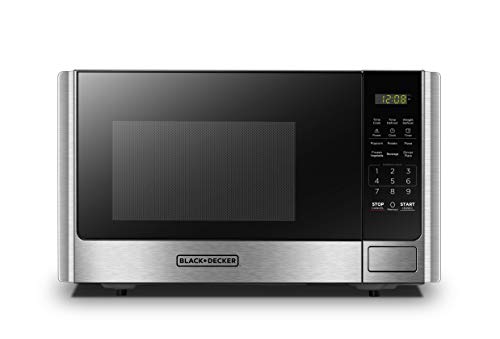
BLACK+DECKER Countertop Microwave Oven, 0.9 Cu.Ft, 900W, Stainless Steel
Badge: Best Simple Table Top Pick
Strengths
- 0.9 cu. ft. and 900W is the classic apartment balance of footprint, plate size and cooking speed
- Push-button door and child safety lock make it an easy shared-household and family choice
- Six presets and ten power levels cover everyday cooking without menu overload
Trade-offs
- No sensor or inverter technology is claimed, so cooking is timed and power-cycled
- No mute function is listed for late-night use
- Large serving dishes and tall containers can still exceed a 0.9 cu. ft. cavity
Key specs from the verified listing:
- Capacity: 0.9 cu. ft.
- Power: 900W
- 10 power levels
- 6 auto cook presets
- Push-button door
- Child safety lock
BLACK+DECKER aims this 0.9 cu. ft. model at the largest real audience in the category: renters and small households who need a proper plate to fit, reasonable speed at 900W, and controls nobody has to learn. Six auto cook presets handle the staples, ten power levels handle everything else, and the push-button door plus child safety lock make it practical in shared and family kitchens. Stainless steel keeps it presentable on an open counter. The spec sheet is equally clear about what is absent. No humidity sensor judges your reheating, no inverter smooths low-power delivery, and no mute mode is listed. Those absences are the price of the format and the tier, and for the reheating, defrosting and simple cooking this size class is bought for, most owners will never miss them. It is the safe, central recommendation whenever 0.9 cu. ft. is the right answer to the space question.
This BLACK+DECKER is the table top traditionalist: a 0.9 cu. ft., 900W body that one person can position, level and, if the household moves, carry to the next kitchen without drama. The push-button door is a genuine surface virtue, opening without the pull that can walk a lighter oven across a smooth table, and the child lock suits a machine that lives at elbow height in a family room-kitchen. It asks for the least surface of any linked model here while still taking a proper plate, which is exactly the compromise most renters are shopping for.
Best for: renters who move and want a portable midsize format / Not suited for: buyers who need sensor-guided cooking

TOSHIBA Microwave Oven, 0.9 Cu.Ft, 900W, Black Stainless Steel
Badge: Best for Apartments
Strengths
- The only 0.9 cu. ft. model here with a stated turntable size, 10.6 inches, so plate fit can be judged before buying
- Mute function and LED lighting make it the best-mannered apartment oven in this pool
- Positioned by the maker for apartments, and the spec matches that brief honestly
Trade-offs
- Six auto menus is a modest menu count next to the twelve-menu TOSHIBA models
- No sensor or inverter technology is claimed in the verified title
- Black stainless steel is a distinctive finish that will not match silver stainless appliances
Key specs from the verified listing:
- Capacity: 0.9 cu. ft.
- Power: 900W
- 6 auto menus
- Mute function and child lock
- LED lighting
- 10.6-inch removable turntable
TOSHIBA positions this 0.9 cu. ft., 900W model for apartments, and unusually, the verified details back the positioning up. The 10.6-inch removable turntable is stated outright, so you can measure your favourite plate against a real number instead of guessing from capacity. Six auto menus cover the staples, a mute function respects thin walls and sleeping flatmates, LED lighting makes the cavity easy to check mid-cook, and a child lock is included for young families in small spaces. The black stainless steel finish gives a compact oven a more deliberate look than basic black or white. What is not claimed is sensor cooking or inverter delivery, so this remains a timed oven, and six menus is a shorter list than the twelve offered by its larger TOSHIBA siblings. For a renter choosing on fit, manners and verifiable plate size, it is the most specifically suitable compact-mid option in this pool.
TOSHIBA built this model for apartments and the table top brief suits it perfectly. The stated 10.6-inch turntable lets you verify plate fit against your own dinnerware before ordering, the mute function respects the neighbours on the other side of a thin wall, and LED lighting helps when the oven sits in the dim corner of a worktop that most small flats assign it. At 0.9 cu. ft. it shares the smallest linked footprint in this guide with the BLACK+DECKER, and between the two, this is the one specified for small-space life rather than merely sized for it.
Best for: apartment dwellers who can verify fit from the stated turntable / Not suited for: households cooking for three or more
Comparison Table
The comparison below keeps the table top lens: verified capacity and power, the cooking system that decides reheating quality, and the shared-surface details, mute, locks and lighting, that decide whether housemates love or resent the machine.
| Model | Capacity | Power | Sensor / inverter | Quiet and family notes | Check |
|---|---|---|---|---|---|
| TOSHIBA 1.6 Cu. Ft. Inverter Microwave | 1.6 cu. ft. | 1250W | Smart Sensor; inverter | No mute or lock stated in the verified title | Prose-only |
| Panasonic 1.2 Cu. Ft. Inverter Microwave NN-SN67QS | 1.2 cu. ft. | 1250W | Genius Sensor; inverter | No mute or lock stated in the verified title | Check on Amazon |
| TOSHIBA 1.2 Cu. Ft. Microwave, Stainless Steel | 1.2 cu. ft. | 1000W | Smart Humidity Sensor; no inverter stated | Mute function; ECO mode | Check on Amazon |
| Chefman 0.7 Cu. Ft. Microwave | 0.7 cu. ft. | 700W | No sensor or inverter stated | Mute button; child safety lock | Prose-only |
| BLACK+DECKER 0.9 Cu. Ft. Microwave | 0.9 cu. ft. | 900W | No sensor or inverter stated | Push-button door; child lock; no mute listed | Check on Amazon |
| TOSHIBA 0.9 Cu. Ft. Microwave | 0.9 cu. ft. | 900W | No sensor or inverter stated | Mute function; child lock; LED lighting | Check on Amazon |
How to Choose a Midsize Table Top Microwave That Earns Its Surface
Budget the surface in four dimensions, not one. The footprint is only the start: add the cord and ventilation room behind the body, the clearance above it if a shelf or cupboard hangs over the table, and the full door swing in front, because a table top oven is approached from the front by people carrying hot dishes. Then subtract honestly. If the remaining surface cannot hold a chopping board and a resting plate at the same time, the oven is too big for that table whatever its capacity, and the right move is down the band toward the 0.9 cu. ft. models, not a hopeful squeeze.
Judge dish fit by turntable numbers wherever they exist. A stated diameter, 10.6 inches on the apartment TOSHIBA in this guide, converts the vaguest question in the category, will my plate fit, into a measurement you can make tonight with your own dinnerware. Where no diameter is stated, capacity is a weaker guide and large dinnerware argues for stepping up a size or choosing a model whose maker prints the figure. Remember that a plate must not only fit but rotate freely; a plate that stalls against the wall cooks unevenly and can stress the turntable motor over time.
Weigh manners as heavily as menus on a shared surface. A mute function decides whether a midnight reheat wakes the flat. A child lock decides whether a toddler at table height can start an empty oven. ECO mode decides what a permanently visible clock display costs across a year. One-touch and express operation decide whether guests and colleagues use the machine correctly without instruction. None of these appear in capacity headlines, and all of them decide daily satisfaction in exactly the homes that buy table top ovens, a point the emissions-aware discussion at Best New Microwaves For Emf makes from the construction side as well.
Match power to the surface role. If this oven is the main cooker for one or two people, 900W to 1000W covers the workload comfortably and matches the timing assumptions of most packaged foods. If it is the family main oven on a worktop, the 1200W to 1250W inverter models reheat large portions noticeably faster and defrost more gently. If it is a secondary oven for drinks and single plates, even the prose-only compact pace is survivable, but be honest that you are buying a compact and read the compact guides rather than stretching a midsize shortlist to cover it.
Finally, think about the next home, because table top buyers move. A 0.9 cu. ft. oven is a one-person carry and fits almost any future kitchen; a 1.2 cu. ft. oven is a two-hand lift that needs its surface planned in every new flat. Renters in short leases should weight the smaller linked models more heavily than their current table suggests, while settled households should buy for the surface they have and enjoy the capacity. The best table top purchase is the one that is still right after the move, the job change or the new baby, not only on delivery day.
How to Place, Level and Live With a Table Top Microwave
Choose a surface that is flat, heat-tolerant and boringly stable, then level the oven on it and check the turntable ring sits true before the first cook. Keep the maker clearances behind, above and beside the body, route the cord directly to a socket without crossing a hob, a sink or a walkway, and open the door fully ten times in the first hour of ordinary kitchen life. If you dodge it, move it now, on day one, while moving it is still easy. A table top oven placed by habit rather than by hope gets used more and resented less.
Build a small landing zone into the surface budget: room for the hot dish to land the second it leaves the cavity, a trivet or board within one step, and nothing stored on top of the oven, where it blocks ventilation and slides when the door opens. In shared homes, agree the house rules early: no metal, no sealed containers, wipe spills the day they happen. Sensor models in particular read a clean cavity more accurately, and a shared oven with a dirty sensor teaches everyone to distrust its menus within a month.
Calibrate your timings in the first week, because a table top move usually also means a wattage move. Reheat one familiar plate, defrost one familiar portion, and note both against the old machine. Stepping from 700W to 900W or 1000W shortens everything; stepping to 1250W shortens it again and punishes inattention. A note on the fridge with your three personal conversion results will outperform any generic chart, because it is written in your dishes, your portions and your oven.
Problem: the oven walks or rattles on the surface when the door is pulled. Check the feet and the surface for grease, level the body, and prefer push-button or gentler door habits; a non-slip mat rated for appliance use can help on very smooth tables. Problem: food on one side cooks faster. Stir or rotate halfway, spread food in an even ring, and confirm the turntable is seated and turning. Problem: steam and smells linger in an open-plan room. Cover food with a vented lid, wipe the cavity after strong dishes, and run a mug of water with a slice of lemon for a few minutes to loosen odours before they set.
Table Top, Countertop and Built-In: Choosing the Right Home for the Oven
The three homes for a microwave ask different things of the buyer. Built-in and over-range models are installation projects with cabinets, vents and fitters. Countertop models are worktop residents, usually tucked under wall cupboards. Table top models are freestanding citizens of any sturdy surface, which is why renters, students, staff rooms and annexes default to them. The ovens overlap heavily, the same verified models appear across these guides, but the buying questions differ: installation cost there, under-cupboard clearance there, and here, surface budget, stability and shared-space manners.
That is also why this guide refuses to stretch its band. A table forgives nothing: an oversize oven visibly eats the room, and an undersize oven visibly fails the plate. Readers planning a fitted kitchen instead should start from Best Midsized Countertop Microwaves, where the same class is judged against cabinets and worktop runs, and treat this table top treatment as the freestanding companion piece.
Small Tables, Big Plates: Solving the Fit Problem at 0.9 Cu. Ft.
The most common table top dilemma is a small surface feeding people with large dinnerware, and the 0.9 cu. ft. pair in this guide exists precisely for it. Both take a proper plate at apartment scale; they differ in how they prove it and how they behave. The TOSHIBA prints its turntable diameter, 10.6 inches, so the plate question is answered by measurement. The BLACK+DECKER answers with simplicity, a push-button door, ten power levels and a lock, in a body that is easy to place and easier to move. Neither is a compromise in the pejorative sense; both are the correct tool for a defined surface.
If your largest plate defeats even the stated 10.6 inches, the honest options are a 1.2 cu. ft. model with a larger turntable, the flatbed layout covered in the countertop guide, or new dinnerware, and only one of those requires a bigger table. What does not work is forcing an oversized plate into a small cavity and blaming the oven for the uneven result. Fit is a system, plate, turntable and cavity together, and the buyers who measure all three are the ones who never write the angry review. The newest models in the class are tracked at Best New Microwaves For Emf Emissions from a construction angle, which is a useful cross-check on door and finish quality at this size.
Common Buying Mistakes
Mistake one: measuring only the footprint. Cord room, ventilation and door swing routinely add the depth of a dinner plate to the real estate a table top oven consumes. Budget the working volume, not the box dimensions.
Mistake two: putting the oven where the door cannot open fully. A door that stops against a wall, a fridge or a pile of post turns every use into a sideways shuffle with a hot dish. Test the swing in the exact spot before the first cook.
Mistake three: storing things on top of the oven. The top surface is a ventilation zone and a slide zone. Boards, post and fruit bowls stored there block airflow and end up on the floor the first time the door opens briskly.
Mistake four: ignoring noise in a shared home. An oven without a mute option on a table in an open-plan flat will be heard in every room, every night. If quiet matters, buy the mute function now rather than apologising for the beeps later.
Mistake five: buying compact pace for a family job. A 700W compact on a family table does not fail loudly; it fails in queues, with the third plate still cold when the first eater finishes. Match the oven to the headcount it actually serves.
Final Recommendation
The first choice for most table top buyers is the Panasonic NN-SN67QS: main-oven cooking quality, inverter pace and sensor judgement in a midsize surface share. Households sharing the surface should choose the TOSHIBA 1.2 cu. ft. in stainless steel instead, trading a little pace for a mute function, ECO mode and the deepest guided menus in the guide.
At the smaller end, pick between the two 0.9 cu. ft. models by proof and by plan: the TOSHIBA apartment model if you want the stated turntable figure and small-space manners, the BLACK+DECKER if you want the simplest, most portable format. Respect the prose-only edges as the measurements they are, tape your surface before you order, and the oven that arrives will fit the life it has to live.
Frequently Asked Questions
What is the difference between a table top and a countertop microwave?
In practice, very little in the oven and a lot in the placement. Both are freestanding models with no installation. Countertop guides judge a machine as a worktop resident, usually under wall cupboards, while a table top guide judges it as a citizen of any sturdy surface, a kitchen table, a utility shelf, a staff-room sideboard, where stability, door swing and shared-space manners matter more. The verified models overlap, which is why the same names appear in both guides with different emphases.
How much table space does a midsize microwave really need?
Plan for the working volume: the body footprint, room behind for the cord and ventilation, clearance above and at the sides as the maker directs, and a full door swing in front plus a landing spot for the hot dish. In practice that working volume is noticeably larger than the box footprint, and it is the reason this guide recommends taping the full outline, swing included, onto the table for a day before ordering.
Will a standard dinner plate fit a 0.9 cu. ft. table top microwave?
Usually, yes, and in one case here you can prove it before buying. The apartment TOSHIBA in this guide states a 10.6-inch removable turntable, so measure your plate against that figure directly. The BLACK+DECKER at the same capacity states no diameter, so allow a margin if your dinnerware is oversized. A plate must rotate freely, not merely squeeze in, so a plate that touches the walls is a plate that needs the next size up.
Is a mute function worth prioritising on a table top oven?
In shared and open-plan homes, yes, out of all proportion to its cost in the feature list. A table top oven is rarely behind a kitchen door; it sits in the living space, and its beeps carry. Two linked models here, both TOSHIBAs, and the prose-only Chefman compact offer mute or sound control. In a detached family kitchen it is a nicety; in a flatshare, a studio or a home with a sleeping baby it is close to a necessity.
Can a table top microwave go on a shelf instead of a table?
Yes, if the shelf is genuinely up to the job: flat, stable, rated for the weight of a midsize oven plus a full casserole, deep enough for the body, cord and ventilation clearances, and at a height where a hot dish can be lifted out safely without reaching up. Eye-level or just below is the safe band. A shelf that flexes, a shelf above head height, or a shelf in a steamy corner with no airflow are all poor homes for any model in this guide.
Why is the largest model in this guide not linked?
Because at 1.6 cu. ft. it is a full-size oven, and on a table top brief that distinction is the whole point. It is reviewed in full, with its 13.6-inch turntable and inverter power stated plainly, so households with a dedicated deep surface can judge it. But presenting it as a midsize table top pick would mislead the majority shopping for a shared surface, so it carries no purchase link and no product image in this guide.


