Disclosure: topratedkitchenware.com is reader-supported. When you buy through links on our site, we may earn an affiliate commission from Amazon and other retailers, at no extra cost to you.
Where to buy
These six verified countertop models are the realistic shortlist behind the search for the best powerful microwaves. Five are linked to their Amazon listings so you can check the latest price on Amazon and confirm the current finish before deciding. The sixth — a small 700-watt compact — is reviewed in full but deliberately unlinked: it is a decent small-space machine, yet it does not belong to the powerful class, and this guide will not pretend otherwise.
- TOSHIBA Countertop Microwave Oven with Inverter Technology, 1.6 Cu.Ft, 1250W, Black Stainless Steel — Best Overall. Check on Amazon for the current listing details.
- Panasonic Countertop Microwave Oven, 1.2 Cu. Ft., 1250W, Inverter Technology with Genius Sensor, Stainless Steel – NN-SN67QS — Best for Even Results. Check on Amazon for the current listing details.
- TOSHIBA Countertop Microwave Oven, 1.2 Cu.Ft, 1000W, Stainless Steel — Best Family All-Rounder. Check on Amazon for the current listing details.
- TOSHIBA Microwave Oven, 0.9 Cu.Ft, 900W, Black Stainless Steel — Best for Apartments. Check on Amazon for the current listing details.
- BLACK+DECKER Countertop Microwave Oven, 0.9 Cu.Ft, 900W, Stainless Steel — Best Simple Stainless. Check on Amazon for the current listing details.
- Chefman Countertop Microwave Oven 0.7 Cu. Ft., 700 Watts, Black — Reviewed Prose-Only: included as an honest contrast so you can see where the powerful class begins.
Read the full guide ↓ for how each machine handles the jobs that actually test power — frozen dinners, defrosting, family-size reheats — and where each one asks you to compromise.
Most people searching for the best powerful microwaves are not chasing a specification for its own sake. They are chasing a feeling they have lost: dinner that is ready when the package says it will be, leftovers that reheat in one run instead of three, chicken that defrosts in time for the recipe they started too late. Power is the difference between a microwave that keeps up with a household and one the household works around. But power shows up differently in different kitchens. A family reheating casserole dishes needs watts and cavity together. A cook who defrosts daily needs the kind of power that can also go gentle. A renter in a small apartment needs as much honest output as a modest footprint allows. This guide therefore judges six verified models task by task — what each machine does to the food and the routine you actually have — rather than treating the wattage figure as the whole review.
The shortlist is built to show the shape of the market honestly. At the top sit two 1250W inverter models that define the current countertop power class. Below them is a full-size 1000W sensor model that most households would experience as properly quick, then two 900W machines that trade a little pace for smaller footprints, and finally the 700W compact, reviewed without a link as the calibration point for the whole guide. If you arrived here from the common misspelling of this search, the method is the same one used there; readers comparing the price side of this class can continue to Best Prices On Countertop Microwaves once they know which size and output they need.
Key Takeaways
- Power is a task, not a number: match output and cavity to the heaviest job your household repeats weekly.
- The TOSHIBA 1.6 Cu.Ft 1250W inverter is Best Overall because it is the only pick that is top-class on speed, capacity and gentle low-power work at once.
- The Panasonic NN-SN67QS matches the top output in a smaller body and is the defrosting and delicate-reheat specialist.
- The 1000W TOSHIBA with the humidity sensor is the balanced family choice; the two 900W models suit apartments that still cook real meals.
- The 700W Chefman is reviewed prose-only — a compact for drinks and single portions, honestly labelled as outside the powerful class.
- Inverter delivery is the feature that turns raw power into even results; for defrost-heavy households it outranks a small wattage gap.
In this guide
Quick Picks
| Pick | Badge | Capacity | Power | Standout feature |
|---|---|---|---|---|
| TOSHIBA 1.6 Cu.Ft Inverter Microwave | Best Overall | 1.6 cu ft | 1250W | Auto defrost, 13.6 inch turntable |
| Panasonic NN-SN67QS 1.2 Cu. Ft. Microwave | Best for Even Results | 1.2 cu ft | 1250W | Genius Sensor inverter cooking |
| TOSHIBA 1.2 Cu.Ft Stainless Microwave | Best Family All-Rounder | 1.2 cu ft | 1000W | Humidity sensor, 12 auto menus, ECO mode |
| TOSHIBA 0.9 Cu.Ft Microwave | Best for Apartments | 0.9 cu ft | 900W | Mute function, LED lighting, 10.6 inch turntable |
| BLACK+DECKER 0.9 Cu.Ft Microwave | Best Simple Stainless | 0.9 cu ft | 900W | Push-button door, 6 presets |
| Chefman 0.7 Cu. Ft. Microwave (prose-only) | Honest Contrast Pick | 0.7 cu ft | 700W | Express cook, mute button |
How These Picks Were Chosen
All six models come from a verified pool checked against Amazon’s catalogue data on 2026-11-20. Every specification in this article — wattage, capacity, turntable size, named features — is taken from the product’s verified listing title and nowhere else. No output figure has been rounded up, no feature has been assumed from a sibling model, and no price or rating appears anywhere in the guide.
The evaluation lens is task load. For each model we asked how it would handle the five jobs that separate powerful machines from adequate ones: a frozen dinner cooked exactly to its printed time; a family-size dish of leftovers reheated in a single run; a portion of raw meat defrosted evenly enough to cook immediately; a weeknight vegetable or rice side cooked while something else occupies the stove; and the small daily work — drinks, soup, popcorn — done without overshoot or fuss. Headline wattage predicts the first two jobs. Inverter delivery predicts the third. Cavity and turntable size predict the second and fourth. The fifth is about controls, and it is why simple machines still earn places in a power guide.
Two honesty decisions shape the list. The first is the Chefman compact. At 700 watts it delivers a little over half the leaders’ output, which places it in a different class of appliance — fine for a dorm, wrong for this title. It is therefore reviewed in full but carries no link and no image, and its review explains the gap in minutes-and-results terms rather than adjectives. The second decision concerns the 900W pair. They are linked, because 900 watts is a legitimate output that cooks real meals respectably, but their reviews never borrow the leaders’ language: they are the apartment-sized step of the class, and their trade-offs are stated as such.
This is a research-led guide. We do not claim hands-on testing, and no invented timings appear below; where a job is described, it is described from the verified specification and the well-understood behaviour of the technology involved — inverter versus cycling delivery, sensor versus clock timing, turntable versus cavity geometry. Prices change too quickly to print responsibly, so the guide speaks in qualitative tiers and points you to check the latest price on Amazon when you are ready to decide. The brand-specific price view at Best Prices Lg Microwaves sits in the same cluster for readers narrowing by maker after choosing a power class.
The 6 Best Powerful Microwaves for Real Kitchen Workloads

TOSHIBA Countertop Microwave Oven with Inverter Technology, 1.6 Cu.Ft, 1250W
Badge: Best Overall
Strengths
- 1250W with inverter delivery: fastest class here, and gentle when turned down.
- 1.6 cubic foot cavity and 13.6 inch turntable take the family dishes other powerful models reject.
- Smart sensor and auto defrost remove the timing guesswork from the heaviest jobs.
Trade-offs
- The biggest footprint in the guide; small counters will feel it.
- Black stainless needs gentler cleaning than plain finishes.
- Its speed makes small single portions easy to overshoot until habits adjust.
Key specs from the verified listing: Capacity 1.6 cu ft; Power 1250W; Inverter technology; Smart sensor; Auto defrost; Turntable 13.6 inch; Finish black stainless steel.
Run the five test jobs through this Toshiba and it is the only machine in the guide that passes all of them without an apology. Frozen dinners finish on their printed times because 1250 watts is the class those times quietly assume. A family casserole reheats in one run because the cavity and the 13.6 inch turntable can actually carry it. Defrosting works because the inverter can hold a genuinely low output instead of pulsing, so the outside of the chicken waits for the inside. A rice or vegetable side cooks while the stove is busy because there is room for a real dish, not a token bowl. And the daily small jobs are handled by the sensor, which judges steam rather than forcing you to memorise seconds per mug size.
That combination — top output, true low-power control, biggest cavity — is rarer than it should be. Many strong machines are strong only in one direction; many large machines are merely adequate in output. This one is the reference point because it refuses both compromises, and in a household that cooks seriously, the reference point is usually the right purchase.
The costs are physical and habitual. Physically, it is a large appliance that needs depth, width and breathing room, and it will crowd a compact worktop. Habitually, its pace punishes autopilot: timings carried over from a weaker machine will overcook small portions until you recalibrate, which takes about a week of annoyed learning. Neither cost is hidden in its review because both are exactly the kind of thing owners discover after the return window. Measure first, recalibrate once, and the machine disappears into the routine — which is the highest praise a kitchen appliance earns.
Best for: families and serious home cooks whose microwave does real cooking, not just reheating / Not suited for: small kitchens, or single-person households whose loads are mostly mugs and bowls
Check on Amazon for the latest price and current listing details.

Panasonic Countertop Microwave Oven, 1.2 Cu. Ft., 1250W, NN-SN67QS
Badge: Best for Even Results
Strengths
- Full 1250W output in a moderate 1.2 cubic foot body.
- Inverter plus Genius Sensor is the most controlled cooking in this guide.
- Defrosting and delicate reheating are noticeably more even than cycling machines manage.
Trade-offs
- Wide family dishes are a tighter fit than in the 1.6 cubic foot Toshiba.
- Sensor cooking rewards trust; habitual timers may find it hands-off to a fault.
- Stainless finish shows marks and asks for a soft cloth.
Key specs from the verified listing: Capacity 1.2 cu ft; Power 1250W; Inverter technology; Genius Sensor; Model NN-SN67QS; Finish stainless steel.
Where the big Toshiba wins on workload, the Panasonic wins on workmanship. It matches the leader’s output exactly, then spends that output more carefully. The inverter delivers continuous power at any level, and the Genius Sensor reads the steam coming off the food to judge where the cooking actually is. The jobs that benefit read like a list of microwave failure modes: rice that reheats without a gummy crust, sauces that warm without splitting, a frozen entrée whose centre arrives hot at the same moment as its edges, fish that defrosts without its thin tail cooking through.
Defrosting deserves its own sentence because it is where this machine builds its case week after week. Conventional defrost cycles alternate between blasting and resting, and the food pays for it at the corners. A true inverter defrost sits at a steady, gentle level, and meat comes out pliable and raw rather than pliable and half-poached. If your freezer is your pantry and dinner routinely starts frozen, that steadiness is the single most valuable trait in this guide — worth more, in lived experience, than the raw speed that wins headlines.
The compromise is geometry. At 1.2 cubic feet the cavity is honest family size for plates and medium dishes, but the widest casserole that glides into the Toshiba will not rotate here, and batch cooking for a crowd means rounds. Judge it by your largest dish, not your average one. Households whose cooking is plate-based, defrost-heavy and quality-sensitive will find this the most satisfying machine in the guide; households feeding six from one dish should take the larger Toshiba and its extra room.
Best for: defrost-heavy cooks and anyone whose reheats involve delicate, sauce-based or quality-sensitive food / Not suited for: very large dishes or crowd-size batch reheating
Check on Amazon for the latest price and current listing details.

TOSHIBA Countertop Microwave Oven, 1.2 Cu.Ft, 1000W, Stainless Steel
Badge: Best Family All-Rounder
Strengths
- 1000W is the class packaged food is timed for, so printed instructions simply work.
- Humidity sensor plus 12 auto menus is the deepest automation in this guide.
- Mute, ECO mode and an easy-clean interior are the details families actually use.
Trade-offs
- Dense and heavy loads run slower than the 1250W pair.
- No inverter: low-power work cycles, so defrosting needs more supervision.
- Twelve menus take a week to learn; casual users will ignore half of them.
Key specs from the verified listing: Capacity 1.2 cu ft; Power 1000W; Smart humidity sensor; 12 auto menus; Mute function; ECO mode; Easy clean interior; Finish stainless steel.
Most households do not need the top of the power class; they need the middle of it, done properly. That is this Toshiba’s argument. Its 1000 watts match the assumption printed on nearly every frozen meal and microwave side dish in the supermarket, which removes a whole category of friction: no conversions, no shortened bursts, no standing-time arithmetic — the box says a time, you enter the time, dinner happens. For a busy family, that predictability across hundreds of packaged products is a form of power the headline figure understates.
The humidity sensor then covers the unpackaged half of family life. Leftovers are the real workload of most microwaves, and they fail in predictable ways — dried edges, cold centres, vegetables cooked past saving. A sensor that reads released moisture and adjusts the run rescues more weeknight plates than any preset list, and twelve auto menus mean the repeated household jobs are likely to have a program shaped for them. Add a mute function for the parent reheating coffee before the house wakes, an ECO mode for the standby hours, and an interior that wipes clean after the inevitable soup eruption, and you have the most liveable machine in this guide.
Where it steps back from the leaders is equally clear. Heavy, dense loads — a big dish of lasagne from cold, a thick casserole — take longer, and without an inverter its defrosting pulses rather than glides, so meat needs turning and checking. If defrosting is a daily ritual in your kitchen, the Panasonic above is the honest recommendation. If defrosting is occasional and reheating is constant, this is the balanced buy, and the money-tier difference between it and the leaders is better spent elsewhere in the kitchen. The price-checking companion at Best Pric Eon Microwaves walks through how to compare this tier without being misled by shifting listings.
Best for: families whose workload is packaged meals, leftovers and sides, cooked constantly and without fuss / Not suited for: daily defrosters or anyone chasing maximum speed on dense loads
Check on Amazon for the latest price and current listing details.

TOSHIBA Microwave Oven, 0.9 Cu.Ft, 900W, Black Stainless Steel
Badge: Best for Apartments
Strengths
- 900W cooks real meals respectably in a 0.9 cubic foot apartment footprint.
- Mute function and LED lighting are unusually considerate at this size.
- Child lock and six auto menus cover the everyday basics without clutter.
Trade-offs
- A step slower than full-size machines on frozen and dense foods.
- The 10.6 inch turntable limits plate and dish diameter.
- No sensor or inverter stated — timing judgement stays with the cook.
Key specs from the verified listing: Capacity 0.9 cu ft; Power 900W; 6 auto menus; Mute function; Child lock; LED lighting; Turntable 10.6 inch removable; Finish black stainless steel; Positioned for apartment use in the verified listing.
Apartment microwaves usually fail in one of two directions: they are compacts too weak to cook, or full-size machines that eat the counter. This Toshiba threads the gap. At 900 watts it is close enough to the standard class that packaged meals need only modest patience rather than a conversion chart, and at 0.9 cubic feet it fits the counters that student housing, first flats and small rental kitchens actually have. The 10.6 inch turntable still takes a standard dinner plate, which is the threshold that separates a real microwave from a drinks warmer.
The detailing is what lifts it above the generic apartment box. A mute function in a thin-walled flat is not a luxury; it is neighbourliness. LED interior lighting sounds trivial until you are checking whether soup is simmering at midnight without turning on the kitchen light. The child lock matters in shared and family-visited spaces, and six auto menus is an honest count — the jobs exist, the padding does not.
Be clear-eyed about the ceiling, though. Dense frozen food will take longer than the box hopes, the turntable diameter caps your dishware, and with no sensor or inverter in the verified specification, even results depend on your stirring, turning and standing-time habits. For one or two people cooking real but modest meals, those are fair trades for the footprint. For a family, they are not — step up to the 1.2 cubic foot models and accept the counter cost.
Best for: renters and small households that cook genuine meals in limited space / Not suited for: families, large dishes, or defrost-heavy routines
Check on Amazon for the latest price and current listing details.
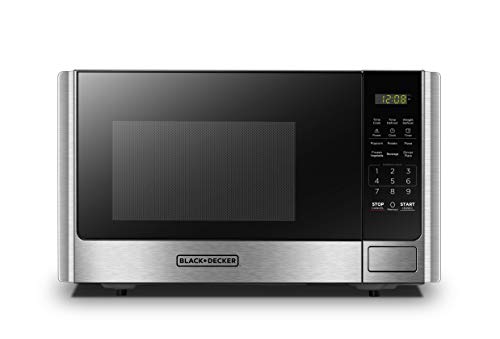
BLACK+DECKER Countertop Microwave Oven, 0.9 Cu.Ft, 900W, Stainless Steel
Badge: Best Simple Stainless
Strengths
- The same apartment-friendly 900W output as the Toshiba above, with simpler controls.
- Push-button door opens easily with full or messy hands.
- Stainless finish looks like a permanent appliance in a small kitchen.
Trade-offs
- No mute function stated in the verified listing — beeps are part of the deal.
- No sensor or inverter; even cooking depends on your technique.
- Six presets cover the basics and nothing beyond them.
Key specs from the verified listing: Capacity 0.9 cu ft; Power 900W; 10 power levels; Push-button door; Child safety lock; 6 auto cook presets; Finish stainless steel.
Put the two 900W models side by side and the choice becomes a personality test. This BLACK+DECKER offers the same output and footprint class as the Toshiba above, wrapped in stainless and stripped of frills: six presets, ten power levels, a child lock, and a push-button door that opens with the heel of a hand when you are holding a hot dish in the other. For shared kitchens — housemates, guests, grandparents — a panel that needs no explanation is worth real money, and this is the panel in the guide that needs the least.
Cooking performance follows the class honestly. Reheats are brisk, packaged meals land close to their printed times, and single-person cooking — the actual workload of most 0.9 cubic foot machines — is handled without drama. The absence of a sensor means the machine will not save a mistimed plate of leftovers, and the absence of an inverter means defrosting is a supervised job. Neither absence is disguised here, and neither matters much if your cooking is reheating, melting, popcorn and the occasional frozen dinner.
Choose between this and the Toshiba 0.9 by details, not by power: the Toshiba’s mute and LED lighting suit quiet, late routines; this model’s push-button door and stainless face suit shared, daytime ones. Either way, you are buying the strongest output that a genuinely small footprint offers, and for a lot of apartments that is exactly the right definition of powerful. Cross-checking what this tier should cost across big retailers is the subject of Best Prices For Microwaves From Walmart, which treats retailer claims with the scepticism they deserve.
Best for: shared small kitchens that want stainless looks and zero learning curve / Not suited for: quiet-hours reheating or sensor-dependent cooks
Check on Amazon for the latest price and current listing details.
Chefman Countertop Microwave Oven 0.7 Cu. Ft., 700 Watts, Black — Reviewed Prose-Only
Badge: Honest Contrast Pick
Strengths
- The smallest footprint here — dorms, offices and bedsits where nothing larger fits.
- Express cook, mute button and child lock are generous features at this size.
- Ten power levels allow gentler small-portion work than most compacts.
Trade-offs
- 700W is a little over half the leaders’ output; every packaged time stretches.
- The 0.7 cubic foot cavity excludes full-size plates and family dishes.
- Dense food cooks slowly enough to change what you bother making.
Key specs from the verified listing: Capacity 0.7 cu ft; Power 700W; 10 power levels; 6 cooking presets with one-touch express cook; Child safety lock; Mute button; Finish black. Status: prose-only in this guide — no purchase link, no image.
Every ranking needs its floor, and this Chefman is the floor of this one — included openly so the word powerful in the title keeps its meaning. At 700 watts it sits in the compact class: drinks reheat fine, single portions get there, popcorn works with patience. But the arithmetic compounds across a day. Each frozen meal takes meaningfully longer than its box promises, each dense dish needs supervision a stronger machine would spare you, and the small cavity quietly edits your cooking down to what fits. Households do not usually regret a compact because one meal was slow; they regret it because a thousand small waits added up.
As a compact, it is well judged — the mute button respects shared walls, express cook respects hunger, and ten power levels is proper control for small portions that stronger machines overshoot. If your space truly admits nothing bigger, it will serve you honestly. It is simply not a powerful microwave, and this guide’s refusal to link it is the guarantee that the five machines above are ranked straight. Use it as the question that sorts the market: if its pace sounds acceptable, shop compacts freely; if it sounds like a daily tax, your shortlist is above this line.
Best for: dorms, offices and the tightest counters, for drinks and single portions / Not suited for: the purpose of this guide — it is the contrast that defines the class, not a member of it
Comparison Table
| Pick | Capacity | Power | Delivery | Best workload | Link |
|---|---|---|---|---|---|
| TOSHIBA 1.6 Inverter | 1.6 cu ft | 1250W | Inverter, smart sensor | Family cooking and batches | Check on Amazon |
| Panasonic NN-SN67QS | 1.2 cu ft | 1250W | Inverter, Genius Sensor | Defrosting, delicate reheats | Check on Amazon |
| TOSHIBA 1.2 Stainless | 1.2 cu ft | 1000W | Conventional, humidity sensor | Packaged meals, leftovers | Check on Amazon |
| TOSHIBA 0.9 Apartment | 0.9 cu ft | 900W | Conventional, auto menus | Small-space real meals | Check on Amazon |
| BLACK+DECKER 0.9 | 0.9 cu ft | 900W | Conventional, presets | Shared simple cooking | Check on Amazon |
| Chefman 0.7 (prose-only) | 0.7 cu ft | 700W | Conventional, presets | Drinks, single portions | Reviewed without a link — see its review |
How to Choose a Powerful Microwave by Workload, Not Wattage Alone
Begin by writing down, honestly, the three jobs your microwave does most. The right machine is the one that is powerful at those jobs, which is not always the one with the biggest number on the box. If the list is frozen dinners, leftover plates and vegetable sides, the standard full-size class with a good sensor — the 1000W Toshiba here — will feel fast every day, because its output matches packaged timings and its sensor rescues reheats. If the list includes defrosting meat several times a week, delivery outranks output: an inverter that can hold a gentle level, like the Panasonic or the large Toshiba, will outperform any cycling machine regardless of a small wattage gap. If the list is family dishes and batch cooking, cavity is power: a turntable that cannot carry your casserole turns a strong machine into a slow one by forcing rounds.
Then apply the constraints in the right order. Space first, because a machine that does not fit is not a candidate at any wattage — measure width, depth and door swing, and leave the ventilation clearance the manual specifies. Dishware second: compare your largest plate and your go-to casserole against turntable diameter and cavity height. Controls third: a mute function for thin walls, a push-button door for full hands, a child lock for family kitchens. Only then compare headline watts within the survivors, and let the difference between adjacent classes be decided by how dense and how large your typical load is. Readers who have settled a class and want the tier-by-tier price picture can use Best Prices On Countertops Microwaves as the follow-up read.
How to Get Even Results From a Powerful Microwave
Strong machines reward technique and punish carelessness faster than weak ones. These habits close most of the gap between specification and supper.
- Match the power level to the food, not the clock. Water-heavy foods — soup, vegetables, frozen dinners — take full power happily. Delicate foods — fish, eggs, sauces, pastry, chocolate — want a lower level and a little more time, especially on an inverter that can hold that level steadily.
- Stir, turn or rearrange halfway on anything dense. Microwaves heat unevenly by nature; the midpoint intervention is the cheapest evenness upgrade that exists, and it matters more as loads get bigger.
- Use standing time deliberately. Covered standing lets heat migrate from hot edges to cold centres. On a powerful machine, finishing two minutes early and standing for three beats blasting until the edges bubble.
- Defrost in stages. Separate pieces as soon as they loosen, turn the portion over, and shield thin edges if they start to cook. On cycling machines, shorter bursts with checks beat one long defrost program.
- Cover loosely and vent. A vented cover speeds cooking, evens moisture and keeps the cavity clean; a sealed one builds pressure and paints the walls.
Troubleshooting. Problem: leftovers with dried edges and a cold middle → the portion is too thick for one run; spread it thinner, stir halfway, and let it stand covered. Problem: defrosted meat cooking at the corners → lower the level, shorten the bursts, and separate pieces earlier. Problem: soup boiling over while the centre lags → use a larger vessel, lower the power for the last stretch, and stir before the final burst.
The Weeknight Test: One Evening, Five Jobs
To see the class differences concretely, walk a single ordinary evening through each tier. At six, a parent reheats coffee while starting dinner: every machine here does it, the compact included, though the powerful ones need a shorter, watched burst. At six-fifteen, chicken for a stir-fry needs defrosting: the inverter pair finish with raw, pliable meat; the sensor Toshiba manages with supervision; the 900W pair need staged bursts; the compact turns the job into a project. At six-thirty, rice and vegetables cook while the stove is occupied: the big cavities take real dishes in one run, the small ones queue. At seven, a child’s leftover plate reheats: sensor machines judge it, simple machines depend on the parent’s memory of seconds. At ten, someone reheats a drink before bed: the mute-equipped models do it silently, the rest announce it to the flat. No tier wins every moment — but the evening shows why households that cook seriously drift upward in class, and why the drift stops being worth it when the evening is mostly drinks and single plates.
Keeping a Powerful Microwave Performing Like One
Power fades in practice long before it fades in the machine, usually through neglect rather than failure. Wipe spills promptly: baked-on food absorbs microwave energy that should be cooking dinner, and a dirty cavity genuinely slows results. Keep the turntable and its roller ring clean and correctly seated — a plate that wobbles or sticks rotates unevenly and cooks unevenly. Leave the vents unobstructed and the door seals clean; a seal fouled with food residue is both a performance and a hygiene issue. Avoid running the machine empty, which stresses components with nowhere for the energy to go. And if cooking times creep upward over the years despite a clean cavity and correct technique, treat that as information: magnetrons age, and a machine that has slowed noticeably is telling you its class has quietly dropped — which is the honest moment to shop this guide again rather than to keep adding minutes.
Power Levels, Explained in Food Terms
The ten power levels on these machines are not ten speeds of the same thing; they are ten different tools, and powerful machines make the distinctions bigger, not smaller. At the top levels, you are boiling: water-based foods, vegetables in their own moisture, frozen dinners, anything sturdy and wet. The middle levels are the reheating and cooking band — casseroles, rice, pasta in sauce — where full power would punish the edges before the centre wakes up. The lower-middle levels are where defrosting, proofing dough, softening butter and melting chocolate live, and this is the band where inverter and cycling machines part company: an inverter genuinely works down there, while a cycling machine visits full power in bursts and rests between them, which is why the same nominal setting produces gentler results on the Panasonic and the large Toshiba. The lowest levels are holding and softening territory — keeping a plate warm, taking the chill off, softening ice cream to scoopable.
Two habits unlock the whole dial. The first is defaulting one level lower than instinct on anything you have not cooked in this machine before; a powerful microwave forgives undercooking with another thirty seconds and forgives overcooking not at all. The second is pairing lower power with longer time for anything dense or delicate rather than treating time as the only variable. New owners of strong machines typically use two settings — full, and defrost — for the first month, then slowly discover the middle of the dial is where most good microwave cooking actually happens. The guides that come with sensor models try to automate exactly this judgement; whether you use the automation or the dial, the underlying skill is the same: matching delivered energy to the food’s tolerance, which is the real definition of cooking power.
Shared Kitchens, Rentals and Other People’s Habits
A powerful microwave rarely lives alone with one careful cook. It lives with housemates who slam timings in by guesswork, children who reheat pizza until it squeaks, guests who have never met a sensor menu, and landlords who provided the counter space but not much of it. That social reality changes what powerful should mean. In a shared house, the simple 900W BLACK+DECKER earns its place not despite its basic panel but because of it: nobody needs a tutorial, nobody can misconfigure much, and the push-button door survives full-handed, half-asleep use. In a family kitchen, the mute functions on the Toshiba models are a peace treaty — the machine stops announcing every midnight reheat to the whole house. In a rental, the 0.9 cubic foot class is powerful enough to cook honestly while remaining movable when the lease ends, which is a practical virtue no specification sheet lists.
There is also a fairness point about who learns the machine. Sensor and inverter models reward the person who reads the manual and quietly tax everyone else until habits form. If your household will not form those habits — and many will not, and that is fine — a mid-class machine with honest presets may deliver better average results across all its users than a flagship delivers across one expert and four improvisers. Judge the household, not the brochure.
Common Buying Mistakes
- Judging by wattage while ignoring cavity. A strong machine that cannot fit your dishes cooks in rounds and feels slow; power and capacity are one decision.
- Ignoring delivery type. Two machines with the same watts cook defrosts completely differently depending on inverter versus cycling delivery.
- Buying top power for a drinks-and-popcorn life. If your loads are small and light, the leaders’ speed becomes overshoot management; a mid-class sensor model will please you more.
- Treating a compact as a cheaper powerful machine. The prose-only Chefman marks the truth: compacts are a different tool, and the saving is repaid in waiting.
- Forgetting the circuit and the vents. A full-size machine sharing a circuit with a kettle, or boxed in without clearance, will underperform its specification through no fault of its own.
Final Recommendation
Buy the TOSHIBA 1.6 Cu.Ft 1250W Inverter if your microwave is a real cooking appliance: it is the fastest here, the largest here, and gentle when the job asks for gentle. Buy the Panasonic NN-SN67QS if your cooking leans on defrosting and delicate reheating and your counter is ordinary-sized — same power, finer control. Buy the TOSHIBA 1.2 Cu.Ft 1000W if your workload is the classic family rotation of packaged meals and leftovers and you want the machine to judge the timing. In apartments, take the Toshiba 0.9 for quiet hours or the BLACK+DECKER 0.9 for shared simplicity. And let the little Chefman do its one job in this guide: proving that if its pace would satisfy you, you never needed the powerful class at all.
Frequently Asked Questions
What is the difference between a powerful microwave and a regular one in daily use?
Three things you can feel: packaged meals finish on their printed times instead of needing extensions; dense and large loads cook through in one run instead of needing rounds; and, on inverter models, low-power jobs like defrosting stop being a compromise. Drinks and small portions feel similar on any machine, which is why light users can honestly buy smaller.
Are the 900W apartment models powerful enough for frozen dinners?
Yes, with modest patience. They sit close to the standard class, so frozen meals cook respectably with a small time allowance beyond the box’s optimism, and standard dinner plates still fit their turntables. What they do not offer is the leaders’ speed on dense loads or any sensor or inverter help — technique carries more of the load.
Why does this guide refuse to link the 700W Chefman?
Because the guide’s title promises powerful machines, and 700 watts — a little over half the leaders’ output, in a cavity that excludes family dishes — is the compact class, not the powerful one. The Chefman is reviewed fully and fairly as a compact, but linking it here would quietly redefine the promise. Its presence, unlinked, is how you can trust the other five rankings.
Does inverter technology matter if I mostly reheat?
Mostly reheating is mostly forgiving, so the honest answer is: less than the marketing suggests. Where you will still notice it is reheating delicate leftovers — sauces, rice, anything that dries or splits — because continuous low power is gentler than pulses. If your reheats are soups and sturdy plates, a good sensor on a conventional machine, like the 1000W Toshiba, serves you as well.
How do I convert cooking times between power classes?
Work in proportion and verify by checking early. Moving up a class, start with noticeably less time and add short bursts; moving down, extend the time rather than raising the power level. Standing time is part of the conversion — powerful machines finish the job during the stand. Recalibrate your three most common foods deliberately in the first week and write the new times on the cupboard door.
Can a powerful microwave replace other appliances?
Partly, and the boundary is texture. A strong microwave with good low-power control handles reheating, defrosting, steaming vegetables, cooking rice and grains, and melting and softening better than most alternatives, and it does them quickly. It does not brown or crisp, so anything whose appeal is a crust still belongs in an oven or an air fryer. Buy power for the jobs microwaves genuinely win, and the machine earns its counter space every day.
Which pick suits a household that defrosts meat almost every day?
An inverter model, without hesitation. Between the two here, the Panasonic’s sensor-led inverter cooking in a moderate footprint suits most kitchens, while the larger Toshiba adds family capacity for the same style of cooking. Daily defrosting is precisely the job where cycling machines frustrate, so let that single habit decide if it dominates your routine.


