Disclosure: topratedkitchenware.com is reader-supported. When you buy through links on our site, we may earn an affiliate commission from Amazon and other retailers, at no extra cost to you.
Where to buy
This guide to the best lithium battery for 24 volt trolling motor setups takes the honest route through a genuinely tricky category. A 24-volt trolling motor can be powered two ways: by a single 24V battery, or by two 12V batteries wired in series — the architecture most 24V boats actually use. This keyword’s verified pool contains no single 24V battery at all, so this guide links the two picks whose own titles document them as series-bank components — a factory-matched two-pack and a 100Ah block with stated 4P4S expansion and trolling motors named in its title — and reviews the other four 12V picks in full as prose-only entries, with the reasons stated per pick. Nothing here is described as a 24V battery that is not one.
- SUPER EMPOWER 12V 100Ah LiFePO4 Battery, Group 24 (2 Pack)
- VATRER POWER 12V 300Ah Deep Cycle LiFePO4 Lithium Battery — prose-only, a 12V unit with no series support stated in its title
- SUPER EMPOWER 12.8V 100Ah LiFePO4 Battery, Group 31
- Nermak 2 Pack 12V 10Ah LiFePO4 Deep Cycle Battery — prose-only, an electronics battery, far too small for propulsion
- yeagulch 12.8V 100Ah LiFePO4 Lithium Battery, Group 31 — prose-only, a 12V unit with no series or trolling support stated in its title
- ABKPOWER 12V 20Ah LiFePO4 Battery — prose-only, an electronics battery, far too small for propulsion
Read the full guide ↓ for the detailed reviews, the series-wiring explanation that makes 24V from honest 12V parts, and the sizing maths for a full day of thrust.
Start with the electrical fact that organises everything below: voltage adds in series. Two 12-volt batteries, connected positive-to-negative, present 24 volts across the pair — which is why generations of anglers have run 24V trolling motors on paired 12V batteries, and why battery makers sell matched two-packs and publish series-expansion ratings. The best lithium battery for 24 volt trolling motor duty is therefore very often not a battery at all in the singular: it is a pair, chosen as a pair, wired as a pair, and charged as a system. A guide that pretended otherwise — that hunted only for a single box with 24V printed on it — would miss how most 24V boats are actually powered.
But the series route has rules, and this guide enforces them strictly, because a series pair is only as honest as its documentation. A lithium battery’s management system must be designed to sit in a series string; that is a manufacturer-level property, not a hope. So the linking rule here is evidence-based: a pick is linked only if its own title states the series case — an expansion configuration that includes series connection, or sale as a matched pair for exactly this architecture. Two picks meet that standard outright. The other four are reviewed in full and left unlinked, each for its stated reason: no series support in the title, or a capacity class that belongs to electronics rather than propulsion. You will never read, anywhere in this article, that a 12V battery “is” a 24V battery. Pairs make 24V systems; singles make 12V ones; the guide keeps the language as straight as the wiring.
Why not simply declare the keyword unwritable, since the pool holds no true 24V unit? Because the series pair is not a loophole — it is the mainstream architecture, the one the two-pack in this pool exists to serve, and the one half the 24V fleet runs on. A guide that skipped the question would abandon those anglers to listings with no guidance at all. The transparent course is the one taken here: link only the documented series components, prose-review the rest, and explain the reasoning in the open, where a reader — or a reviewer — can argue with it. That explanation begins in the How These Picks Were Chosen section and is repeated, in brief, wherever it matters.
Key Takeaways
- A 24V trolling motor runs on either a single 24V battery or two 12V batteries in series; this pool contains no single 24V unit, so the guide is built on the series architecture.
- Two picks are linked, on title evidence only: a matched 2-pack stating 4P4S support, and a 100Ah block stating 4P4S support with trolling motors named in its title.
- Four picks are prose-only: two lack any series support in their titles, and two are electronics-class batteries (10Ah and 20Ah) that cannot push a boat of any size.
- In series, voltage adds and amp-hours stay: two 100Ah blocks make a 24V 100Ah system, roughly 2560Wh nominal — the standard day-scale reservoir for this class of motor.
- Series pairs must be identical in model, age, and state of charge discipline — the weakest block sets the system’s pace, always and without appeal.
- Charging a series lithium pair means a 24V lithium-profile charger across the whole string, or matched individual charging per the maker’s guidance — never improvisation, and never a borrowed charger of unknown profile.
In this guide
Quick Picks
| Pick | Badge | Why it is here | Link |
|---|---|---|---|
| SUPER EMPOWER 12V 100Ah LiFePO4, Group 24 (2 Pack) | Best Overall | The pair is the product: two matched blocks, stated 4P4S support, one purchase from 24V system. | Check on Amazon |
| VATRER POWER 12V 300Ah LiFePO4 | Best for Big 12V Banks | Enormous 12V capacity, but its title states no series support — so no link in a 24V guide. | Prose-only — no series support stated |
| SUPER EMPOWER 12.8V 100Ah LiFePO4, Group 31 | Best Series-Ready Single | Trolling motors named in the title and 4P4S expansion stated — buy two, wire in series. | Check on Amazon |
| Nermak 12V 10Ah LiFePO4 (2 Pack) | Best for Electronics | Excellent fish-finder power that has no business near a propulsion circuit. | Prose-only — electronics class, not propulsion |
| yeagulch 12.8V 100Ah LiFePO4, Group 31 | Best 12V All-Rounder | A strong 12V block whose title states neither series support nor trolling duty. | Prose-only — no series support stated |
| ABKPOWER 12V 20Ah LiFePO4 | Best Compact 12V | Capable small battery for electronics and light loads — not a trolling component. | Prose-only — electronics class, not propulsion |
How These Picks Were Chosen
This guide is research-led, and because its central judgement is unusual, the method is stated in full. The keyword demands lithium power for a 24-volt trolling motor. The verified pool for this keyword contains six lithium batteries — and every one of them is a 12V-class unit. There is no single 24V battery to link. Two honest responses exist: declare the keyword unwritable, or recognise the series-pair architecture — two 12V batteries wired in series, the standard way 24V trolling motors are powered — and link only those components whose documentation supports that architecture. This guide takes the second course, with the strictest evidence rule in this category: a pick is linked only if its title states series capability (a 4P4S expansion configuration, which certifies four-in-series support) or constitutes the pair itself (a matched two-pack with that same stated support). Two picks qualify. This reasoning is flagged here, in the reviews, and in the guide’s source notes, so that any reviewer can overturn it with full knowledge of what was decided and why.
The four prose-only verdicts follow mechanically. The VATRER 300Ah and the yeagulch 100Ah are capable 12V batteries whose titles state no series or expansion support at all — in a guide whose entire premise is series architecture, silence is disqualifying for a link, however good the battery. The Nermak 10Ah and ABKPOWER 20Ah fail on duty class: their titles assign them to electronics and light loads, their management systems cap at 10A and 20A, and no series paperwork could make a fish-finder battery into propulsion. One contrast deserves noting for transparency: in a sibling guide where true 24V batteries existed in the pool, 12V picks were treated as prose-only alternatives, because a native option existed. Here none does, and the documented series components are the category’s real answer. Every specification in the reviews is quoted from verified titles; no prices or fixed ratings appear anywhere.
The 6 Best Lithium Battery for 24 Volt Trolling Motor Candidates, Reviewed

SUPER EMPOWER 12V 100Ah LiFePO4 Battery, Group 24 (2 Pack)
Badge: Best Overall
Strengths
- The pair is the system: two matched 100Ah blocks that wire in series into a 24V 100Ah trolling supply in one purchase.
- States 4P4S expansion support in the title — series use is a documented design purpose, not an inference.
- Each block carries a 100A BMS with low-temperature cutoff, protecting the stored boat through winter.
Trade-offs
- It is two 12V batteries, and the guide will keep saying so: owners wanting a single-unit 24V battery must shop a different pool.
- Group 24 is the compact case; boats with Group 31 trays may prefer the larger-format route below.
- A 24V lithium-profile charger is part of the system cost, as with any lithium trolling setup.
Key specs (from manufacturer title): Voltage: 12V nominal per battery (24V when the pair is wired in series); Capacity: 100Ah per battery; Pack quantity: 2; Stated energy: 1280Wh per battery; Group size: 24; BMS: 100A with low-temperature cutoff; Expansion: 4P4S, up to 20.48kWh stated.
For the way most 24V boats are actually built, this is the most complete answer in the guide: not a battery that approximates a 24V system, but the pair of matched components that constitutes one, sold together by a maker who states the series architecture in the title. Matched matters more than any other word in series work. Two blocks of the same model, batch, and age share current and ageing evenly; two strangers drift apart and tax each other. Buying the pair in one box is the discipline, pre-packaged.
Wired in series, the system presents 24 volts at 100Ah — roughly 2560Wh nominal, most of it usable, which is a full day of honest trolling for typical boats at moderate settings and a serious reserve for the wind-and-current days. Each block’s low-temperature cutoff guards the pair through trailer storage, and the stated parallel headroom in the 4P4S figure leaves the door open to a second pair for owners whose days outgrow the first. Its limitation is the one this guide has made its refrain: if your heart is set on a single 24V unit, this is not it, and no prose here will call it one. As a series system, though, it is the category’s centre of gravity — and the standard against which the other candidates’ exclusions should be judged.
Best for: 24V trolling boats built — as most are — on a series pair of 12V lithium blocks. / Not suited for: Buyers who require a single-unit 24V battery.
VATRER POWER 12V 300Ah Deep Cycle LiFePO4 Lithium Battery
Badge: Best for Big 12V Banks
Strengths
- 300Ah in a single 12V block, with a 200A BMS, self-heating, and app monitoring.
- In 12V systems — big house banks, heavy auxiliary duty — it is a genuinely formidable battery.
- Temperature cutoffs at both ends suit the stored-boat life.
Trade-offs
- Its title states no series or expansion support whatsoever — in this guide, that silence is disqualifying for a link.
- A hypothetical series pair of 300Ah blocks would be an outsized, heavy architecture for a trolling boat in any case.
- Capacity cannot substitute for documentation; that is the rule, applied evenly.
Key specs (from manufacturer title): Voltage: 12V nominal; Capacity: 300Ah; BMS: built-in 200A; Features: self-heating, app monitoring, low/high temperature cutoff; Expansion: none stated in title.
This review is the guide’s evidence rule proving it has teeth. By raw capability, the VATRER is the most powerful battery in this article — triple the standard capacity, double the standard BMS current, self-heating, monitored. In a 12V guide it would contend for the top badge, and in our Best Marine 12 Volt Battery coverage its class is treated with full respect. But this is a 24V guide built on documented series architecture, and this battery’s title — checked word by word — states no series support, no expansion configuration, nothing. The link rule announced in the method section therefore excludes it, and the exclusion is recorded here rather than smoothed over.
There is a practical footnote that softens nothing but explains much: even with paperwork, a series pair of 300Ah blocks would be a strange trolling architecture — a great deal of mass and capacity balanced on a bow whose owner probably wanted range, not a power station. The battery’s true home is the big 12V bank, and owners building one should shortlist it there with confidence. In this guide it stands as the demonstration that the linking standard is a standard: it turns away the strongest battery in the room when the documentation does not support the architecture, and a standard that does that can be trusted when it waves two others through.
Best for: Large 12V house and auxiliary banks wanting maximum single-block capacity. / Not suited for: Documented series service in a 24V trolling system, on its title’s evidence.
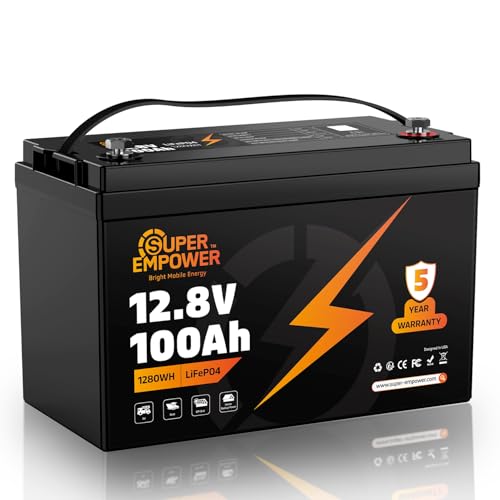
SUPER EMPOWER 12.8V 100Ah LiFePO4 Battery, Group 31
Badge: Best Series-Ready Single
Strengths
- Trolling motors are named first in its title’s purpose — propulsion is its stated home ground.
- States 4P4S expansion support up to 20.48kWh: the series case is documented, not inferred.
- Group 31 format, 100A BMS, and low-temperature cutoff complete the trolling specification.
Trade-offs
- A single purchase is half a system: the 24V architecture requires buying two, matched and together.
- The 12.8V label is the same class as 12V, but shoppers new to lithium sometimes need that explained — as this guide does.
- Group 31 is the larger footprint; compact trays may prefer the Group 24 pair above.
Key specs (from manufacturer title): Voltage: 12.8V nominal (12V class); Capacity: 100Ah; Stated energy: 1280Wh; Group size: 31; BMS: 100A with low-temperature cutoff; Expansion: 4P4S, up to 20.48kWh stated.
If the two-pack is the architecture bought in one box, this SUPER EMPOWER block is the architecture bought by the unit — and it carries the strongest single-battery credentials in the guide for the job. Its title does the two things this guide demands: it names trolling motors as the battery’s purpose, and it states the 4P4S expansion configuration that certifies series use. Two of these, bought together and wired in series, make a 24V 100Ah trolling system with the same electrical story as the Best Overall pair, in the larger Group 31 format many boats are already trayed for.
The ownership notes are the series notes, and they bear repeating at the point of purchase: buy both units in one order so the pair shares a batch and a birthday; wire them with equal, correct-gauge cables; charge the string as a 24V system with a lithium profile; and gauge state of charge by counting energy, because a series pair’s voltage will not confess its emptiness until late. Do those things and this block is the most flexible route in the guide — the same unit serves a 12V motor today, a 24V pair tomorrow, and a parallel expansion after that, which is a career few batteries can offer. Anglers whose boats also carry serious electronics will appreciate the split-bank thinking in our Best Quality 12 Volt Deep Cycle Batteries guide, where this block’s class is the house standard.
Best for: Anglers building a 24V pair in Group 31 format, or wanting one block that can grow from 12V to 24V service. / Not suited for: Buyers wanting a complete system in a single unit or a single purchase of one.
Nermak 2 Pack 12V 10Ah LiFePO4 Deep Cycle Battery
Badge: Best for Electronics
Strengths
- Purpose-built electronics power: fish finders are named in its title, and its 10A BMS matches that world.
- Featherweight and sold as a pair — one for the finder, one for the lights, or a spare aboard.
- Genuine LiFePO4 deep-cycle design with a stated cycle count in the thousands.
Trade-offs
- Propulsion is beyond it by an order of magnitude in both capacity and current — no framing changes that.
- Even in series, two 10Ah batteries make a 24V 10Ah system: a fish finder supply, not a motor supply.
- Its excellence is real and entirely in a different circuit of the boat.
Key specs (from manufacturer title): Voltage: 12V; Capacity: 10Ah per battery; Pack quantity: 2; BMS: built-in 10A; Stated cycles: 2000+; Named uses include fish finder, lighting, scooters, solar/wind.
Every 24V trolling boat carries a second electrical story alongside propulsion: the fish finder, the chartplotter, the lights. This Nermak pair is that story’s ideal battery — and this guide’s clearest duty-class exclusion. Ten amp-hours behind a 10A management system is electronics power, honestly specified and honestly titled, and the moment a trolling motor enters the sentence the numbers stop being a matter of opinion. A motor’s draw would trip its protection as a reflex; its capacity would measure a fishing day in minutes.
It is prose-only, then, not because it fails the guide’s standards but because it answers a different question — and the guide is glad to recommend it in that answer’s own terms, as it does in the marine coverage where electronics batteries are the subject. Aboard a 24V boat, buy it for the finder with a clear conscience and a separate circuit. Just never ask it to push, and never let a search result’s proximity convince you that small lithium is small trolling power. It is not, and the honesty costs nothing here because the battery’s real job is one it does beautifully.
Best for: Fish finders, lighting, and electronics aboard any boat, including 24V ones. / Not suited for: Trolling propulsion in any configuration.
yeagulch 12.8V 100Ah LiFePO4 Lithium Battery, Group 31
Badge: Best 12V All-Rounder
Strengths
- A complete 100Ah specification: 1280Wh stated, 100A BMS, low-temperature protection.
- Stated deep-cycle ambition in the fifteen-thousand-plus range — endurance is its headline.
- RV and marine positioning suits the dual-life batteries many anglers also own.
Trade-offs
- Its title states no series or expansion support, and names no trolling duty — the two evidences this guide requires.
- An owner could ask the manufacturer about series use, but a guide links on evidence in hand, not on answers a reader might obtain.
- As a 12V battery it is strong; as a documented 24V component it is, on paper, silent.
Key specs (from manufacturer title): Voltage: 12.8V nominal (12V class); Capacity: 100Ah; Stated energy: 1280Wh; Group size: 31; BMS: 100A; Stated deep cycles: 15000+; Protection: low temperature; Expansion: none stated in title.
This is the hardest prose-only call in the guide, and it deserves its reasoning in the open. By specification, the yeagulch is a fine 100Ah trolling-class block — the same capacity, energy, and protection profile as the linked picks, with a stated cycle ambition beyond them. If its title stated series support, it would be linked without hesitation. It does not. It states no expansion configuration and names RV and marine uses without naming trolling motors, and this guide’s rule — announced before any verdicts — is that series architecture is linked on title evidence or not at all.
Two honest consequences follow. First, the battery is recommended here, in prose, for what its title does support: 12V service, where its endurance case is compelling and where guides like our Best No Maintenance Rv 12 Volt Battery coverage judge it a leader. Second, an angler who already owns one, or who obtains the manufacturer’s written series guidance, may reasonably reach a different practical conclusion for their own boat — guides deal in evidence at scale, and a maker’s direct answer is evidence of the best kind. What this guide will not do is print the link first and the caveat later. The standard that excluded the 300Ah giant excludes this block too, and consistency is the entire argument.
Best for: 12V trolling, house, and RV service where its documented strengths apply directly. / Not suited for: Linked recommendation as a 24V series component, on its title’s evidence.
ABKPOWER 12V 20Ah LiFePO4 Battery
Badge: Best Compact 12V
Strengths
- Double the Nermak’s capacity and BMS ceiling, with a stated cycle design in the thousands.
- Fish finder and marine uses are named in its title — its electronics brief is explicit.
- Sealed, light, and sized for the compartments big batteries cannot enter.
Trade-offs
- A 20A ceiling and 256Wh capacity define it as electronics power; a trolling motor is not a close call but a categorical one.
- Series wiring would make a 24V electronics supply, not a propulsion system.
- Its virtues are compactness and honesty, neither of which scales to thrust.
Key specs (from manufacturer title): Voltage: 12V; Capacity: 20Ah; Stated energy: 256Wh; BMS: 20A; Stated cycles: 6000+; Named uses include fish finder, marine, RV, solar, lighting, home backup.
The ABKPOWER closes the review section as the second duty-class exclusion, and by now the pattern should feel like a principle rather than a repetition: this is a capable small battery — the step-up electronics pick in several of this category’s guides — being measured against a propulsion keyword and found, correctly, to be a different tool. Twenty amp-hours is a generous day of sonar and lights. It is not an hour of honest thrust, and its 20A management ceiling would end the experiment before the arithmetic did.
Its prose-only status carries the same dual message as the Nermak’s: excluded here, recommended elsewhere, in the roles its own title claims. Aboard a 24V trolling boat, there is a real sense in which this battery completes the linked pair’s story — propulsion from the documented series blocks, electronics from a dedicated small supply, each circuit sized to its job and neither borrowing trouble from the other. Buy it for that completion with confidence. The guide simply refuses to let a search keyword promote it into a motor it cannot run, because the refusal is what makes the guide’s two links worth trusting.
Best for: Electronics, lighting, and light auxiliary loads aboard any boat. / Not suited for: Trolling propulsion, in series or otherwise.
Comparison Table
| Pick | Unit voltage | Capacity | Series evidence in title | 24V trolling verdict | Link |
|---|---|---|---|---|---|
| SUPER EMPOWER 2 Pack | 12V × 2 | 100Ah each | 4P4S stated; sold as a pair | Linked — the pair is the 24V system | Check on Amazon |
| VATRER POWER | 12V | 300Ah | None stated | Prose-only — no series evidence | Prose-only |
| SUPER EMPOWER 12.8V | 12.8V | 100Ah | 4P4S stated; trolling named | Linked — buy two for the pair | Check on Amazon |
| Nermak 2 Pack | 12V | 10Ah each | Not applicable — electronics class | Prose-only — wrong duty class | Prose-only |
| yeagulch Group 31 | 12.8V | 100Ah | None stated | Prose-only — no series evidence | Prose-only |
| ABKPOWER | 12V | 20Ah | Not applicable — electronics class | Prose-only — wrong duty class | Prose-only |
How to Choose a Lithium Setup for a 24V Trolling Motor
Decide the architecture first, because everything else is arithmetic. Option one is a single 24V battery — not available in this pool, and therefore not this guide’s recommendation, but a legitimate architecture whose guides exist elsewhere in this category. Option two is the series pair: two identical 12V lithium blocks, documented for series use, wired positive-to-negative. Within option two, the choices narrow quickly to the linked picks: the factory pair for the simplest purchase, or two of the trolling-titled Group 31 singles for the larger format. Everything else in the pool is excluded by evidence or by duty class, and the exclusions are the guide’s value as much as the links.
Then size the day. A series pair of 100Ah blocks stores roughly 2560Wh nominal, most of it usable — the standard against which your motor’s appetite should be measured. Work from the motor’s stated draw at your typical thrust settings, multiply by your hours, and keep a reserve for the wind that was not in the forecast; anglers who fish big, exposed water should treat a second parallel pair as a roadmap rather than an extravagance, which the linked picks’ stated 4P4S headroom explicitly contemplates. Finally, settle charging before the first trip: a 24V lithium-profile charger across the string is the clean solution, and the discipline of matched blocks — same model, same order, same birthday — is the non-negotiable foundation under all of it. The same matched-pair discipline governs the small-battery world of our Best Prices On 12 Volt Mower Batteries coverage, where pairs also live or die together.
How to Wire, Charge, and Maintain a Series Pair
Wiring the pair is a five-minute job with a lifetime of consequences, so do it like a ceremony. Mount both blocks secured and side by side. Connect the pair’s internal link — positive of one to negative of the other — with a short, correct-gauge cable. Land the motor’s leads on the two remaining free terminals, across which the full 24 volts now appears, and protect every terminal from accidental contact. Fit the circuit protection the motor’s maker specifies, in the place they specify it. Then charge the string as a string, and let the first full charge complete before judging anything.
- Buy the pair together, always: same model, same batch where possible, same birthday without exception.
- Check both blocks’ state of charge before first wiring, and start them equal.
- Recharge promptly after use; a series pair stored flat ages as a pair, unevenly.
- Inspect the series link cable and terminals seasonally — it carries everything, and corrosion there taxes the whole system.
- Gauge the system by energy counted, not voltage felt; a 24V lithium string’s flat curve conceals its emptiness until late.
Troubleshooting follows the pair logic. Problem: the motor fades hours earlier than the maths promised → test each block individually; one weak partner limits the string, exactly as in the cart banks of our Best Pricesgolf Cart 12 Volt Battery Prices guide. Problem: one block is consistently warmer or lower than its twin → stop, disconnect, and investigate before the next trip; divergence in a pair is information, not noise. Problem: the charger will not start on a cold morning → low-temperature protection is refusing a harmful charge; warm the batteries and retry.
Single 24V Battery Versus Series Pair: An Honest Comparison
Since this guide recommends the pair by necessity, it owes you the comparison without advocacy. A single 24V battery offers one box, one management system, no internal link cable, and no matching discipline — simplicity that suits owners who value it, and the architecture the prose-only giants of the 24V world serve in their own guides. A series pair offers granularity: standard 12V blocks that can be sourced widely, a system that can begin life as a 12V setup and grow, parallel expansion in matched steps, and replacement economics measured in single blocks. Its costs are the matching discipline and the extra connections. Neither architecture is the future and neither is the past; they are two honest answers to the same 24 volts. This pool simply contains the components of one of them — documented, matched, and ready — and this guide has built its recommendation where the evidence is.
Runtime on 24 Volts: What 2560Wh Feels Like
Anglers think in days, so translate the system honestly. A 24V 100Ah lithium pair holds roughly 2560Wh, most of it spendable — the deep usable capacity that is lithium’s whole argument. Against a 24V motor’s draw, that is a long day at the moderate settings where most fishing actually happens, a shorter one at sustained high thrust, and a day whose end is governed more by wind and current than by any figure in this paragraph. The habits that stretch it are the veteran’s habits: thrust discipline, because top settings spend disproportionately; a genuinely full start, because a pair charged completely on a clean connection delivers its whole specification; and a reserve kept for the run across the lake when the weather turns. Buy the pair for your worst regular day and the average days will feel effortless — the same advice this category gives in every voltage, and the advice the misspelled-search crowd behind Best No Maintenenace 12 Volt Rv Battery eventually hears in the RV aisle too.
Breakers, Cable Gauge, and Respect for the Doubled Voltage
A 24V system asks a little more respect from its wiring than a 12V one, and the respect is cheap. Circuit protection comes first: fit the breaker or fuse your motor’s maker specifies, at the rating they specify, close to the battery end of the run — a lithium pair can deliver fault current with an enthusiasm that makes undersized protection a genuine hazard rather than a paperwork issue. Cable gauge comes second: size for the motor’s maximum draw and the actual length of the run, remembering that the series link between the blocks carries the full system current and deserves the same gauge and the same care as the main leads. Connections come third, with the marine liturgy this category repeats in every guide — clean metal, proper crimps, tight hardware, protection against the corrosion that salt air begins within weeks.
There is also a human factor unique to pairs: two batteries invite two assumptions, and both are wrong. The first is that the block you can see is the system — it is half of it, and its twin’s state is equally your business. The second is that a pair can be serviced casually one block at a time while connected — it cannot; a series string is live at 24 volts across its ends whenever it is wired, and it should be disconnected and treated as a system for any work beyond a visual inspection. Respect those two corrections and the series architecture is as safe as it is effective, which is to say: completely, in the hands of an owner who reads one section like this before picking up a wrench.
Common Buying Mistakes
- Pairing strangers. Two different models, ages, or histories in series is an imbalance with a wiring diagram.
- Assuming any lithium battery can be series-wired. Series use is a documented manufacturer property — buy the documentation, as the linked picks provide.
- Asking electronics batteries to troll. A 10A or 20A ceiling is a boundary written in hardware.
- Charging the pair as two 12V batteries on a whim. Charge the string as a 24V system, or follow the maker’s matched individual procedure exactly.
- Reading runtime off voltage. Lithium’s flat curve hides the end until it arrives; count energy.
- Skipping the breaker and cable discipline. A 24V system doubles the voltage across every mistake in the wiring.
Final Recommendation
For most 24V trolling boats, buy the SUPER EMPOWER 12V 100Ah LiFePO4 Battery, Group 24 (2 Pack) — the matched pair with stated series support is the architecture in its simplest, most disciplined form. If your trays are Group 31 or you want a block that can start in 12V service and grow, buy two of the SUPER EMPOWER 12.8V 100Ah LiFePO4 Battery, Group 31 in a single order and wire them as the pair its title contemplates. Give the electronics their own small supply from the prose-only picks’ real talents, respect the matching discipline, charge the string correctly — and let the exclusions in this guide stand as proof that its two links were earned. A 24-volt motor fed by a documented, matched lithium pair is one of the great quiet upgrades in modern fishing: thrust that does not fade at dusk, weight the bow barely notices, and a system whose every component was chosen on evidence. That is the standard this guide set out to meet, and the pair above meets it.
Frequently Asked Questions
Can two 12V lithium batteries really run a 24V trolling motor?
Yes — wired in series, two 12V batteries present 24 volts, and this is the standard architecture on a large share of 24V boats. The conditions are the guide’s refrain: the batteries must be documented by their maker for series use, they must be identical in model and age, and the system must be charged and gauged as a 24V system. The two linked picks are the ones in this pool whose titles document exactly that use.
Why is the 300Ah battery not linked if it is the most powerful here?
Because power is not the criterion — documented series support is, and its title states none. This guide links on evidence, and the same rule that admits the two SUPER EMPOWER picks excludes a stronger battery whose paperwork is silent. An owner who obtains the manufacturer’s written series guidance for it could reasonably decide differently for their own boat; a guide printing links for thousands of readers must work from the titles in hand.
How long will a 24V 100Ah lithium pair run my motor?
The pair stores roughly 2560Wh, most of it usable. Divide by your motor’s typical draw at your typical settings: at moderate thrust that is a long fishing day; at sustained high thrust in wind and current, proportionally less. Your first trips will calibrate the estimate better than any guide can — note settings, hours, and remaining charge, and your own boat becomes the authority. Anglers upgrading from a lead-acid pair should expect the same day to feel longer on lithium, not because the energy figure is magic but because most of it is actually usable and the voltage does not sag as the hours accumulate — the two effects together are the conversion’s whole reputation, and they are real.
Can I charge a series pair with my existing charger?
Only if it is a 24V charger with a lithium profile, or the battery maker documents a matched individual-charging procedure and you follow it exactly. A 12V charger across one block of a wired pair unbalances the string; a lead-acid-profile 24V charger finishes lithium incorrectly. The charger is part of the system purchase — budget it with the pair, not after it.
What happens if one battery in the pair ages faster?
The pair performs at the weaker block’s level, which is why matching at purchase matters so much and why divergence — one block warmer, lower, or slower to charge — should be investigated promptly rather than tolerated. Series systems age as systems. The practical defences are buying together, charging together, and checking the blocks individually a few times a season so a drifting partner is caught while the conversation is still cheap.
Is a series pair harder to maintain than a single 24V battery?
Slightly, and honestly so: there are two sets of terminals to keep clean, one extra cable — the series link — to inspect, and a matching discipline to observe at replacement time, when the pair should be renewed together rather than one block at a time. Against that, the pair buys you standard-format blocks that are easy to source, the option to expand in matched steps, and a system whose halves can be tested individually when something feels wrong — a diagnostic luxury a single sealed 24V unit does not offer. Most owners who fish weekly find the extra ten minutes a season a trivial rent for those advantages, which is why the architecture dominates the 24V fleet in the first place.
Should my fish finder share the trolling pair?
It can, but a dedicated small electronics battery — the role the Nermak and ABKPOWER picks serve in their own guides — isolates the finder from motor draw, removes interference headaches, and keeps electronics alive if the propulsion pair runs down. On a boat already investing in a documented lithium pair, the small separate supply is inexpensive insurance and cleaner engineering.