Disclosure: topratedkitchenware.com is reader-supported. When you buy through links on our site, we may earn an affiliate commission from Amazon and other retailers, at no extra cost to you.
Where to buy
The six models below are the verified picks for this guide to the best river toilets. Each name links to its Amazon listing, where you can check the latest price on Amazon, confirm the current configuration, and read the newest owner feedback before a trip. River use is hard on gear, so confirm the tank size, the seal type, and what bags, sprayers, or funnels are included in the box before you order — those small parts decide how the toilet behaves at a muddy put-in.
- SereneLife 5.2 Gal Portable Camping Toilet — Check on Amazon
- MODIWELL LE-310 Compact Dry Flush Toilet
- Portable Toilet with Urine Gel and Leak-Proof Bags by LuckyNov
- TRIPTIPS Upgrade Retractable Portable Toilet
- Kohree Portable RV Toilet, 5.8 Gallon
- Hapoon XL Portable Folding Camping Toilet
Read the full guide ↓ for the ranking logic, the honest limitations of every pick, and the pack-it-out rules that matter more on a river than any headline feature.
Choosing the best river toilets is really choosing a waste system you can live with for days at a time, far from a flush toilet, a dump station, or a forgiving place to make a mistake. On a raft, a canoe, or a drift boat, every land manager’s rule is the same in spirit: human waste gets packed out, sealed, and carried to the take-out. That single rule shapes everything in this guide. A river toilet has to seal tightly enough to ride in a boat without leaking or smelling, it has to be stable on sand and gravel bars, it has to be simple enough to set up in the dark with cold hands, and it has to be easy to empty and disinfect at the end of the trip without contaminating the water it travelled on.
The six picks here cover the three systems river runners actually use. The SereneLife and the Kohree are cassette-style flush portables with separate fresh and waste tanks, the closest thing to a normal toilet on a gravel bar. The MODIWELL LE-310 is a dry flush design that seals each use without water. The LuckyNov, TRIPTIPS, and Hapoon are bag-and-frame or gel-based designs that trade flush comfort for extreme packability. None of them is a plumbed toilet, and that is the point: on the river, the best toilet is the one your group will actually use correctly, every time, for the whole trip.
Key Takeaways
- Cassette flush portables such as the SereneLife and Kohree feel most like home and suit base camps and raft-supported trips where weight and bulk are manageable.
- Dry flush and gel-bag systems remove the dump-station problem almost entirely, because waste leaves the river sealed in bags rather than as liquid in a tank.
- Capacity is a group-size calculation, not a comfort feature: count users, count days, and size the waste tank or bag supply with a real margin.
- A leak-resistant seal matters more than any other single feature on moving water; a toilet that weeps in a boat is worse than no toilet at all.
- Stability on uneven ground decides whether a toilet gets used at night — wide bases and low centres of gravity beat tall, narrow designs on sand.
- Whatever system you choose, the routine around it — placement away from the water, a hand-washing station beside it, and a sealed transport plan — matters as much as the hardware.
In this guide
Quick Picks
| Pick | Badge | System | Why it stands out | Link |
|---|---|---|---|---|
| SereneLife 5.2 Gal Portable Camping Toilet | Best Overall | Cassette flush, 3.2 gal fresh tank | Full flush routine, hand sprayer, and a carry bag in one river-ready kit | Check on Amazon |
| MODIWELL LE-310 Compact Dry Flush Toilet | Best Waterless Option | Dry flush, rechargeable, foldable | Seals waste without water or plumbing and folds down for storage | Check on Amazon |
| LuckyNov Portable Toilet with Urine Gel and Bags | Best for Pack-It-Out Simplicity | Gel and leak-proof bag system | Waste leaves the river already bagged, with gel controlling odour | Check on Amazon |
| TRIPTIPS Upgrade Retractable Portable Toilet | Best for Tight Storage | Retractable frame, adjustable height | Collapses flat for a dry bag or a crowded raft frame | Check on Amazon |
| Kohree Portable RV Toilet, 5.8 Gallon | Best Capacity | Cassette flush, detachable waste tank | The largest waste tank here, with a level indicator for group trips | Check on Amazon |
| Hapoon XL Portable Folding Camping Toilet | Best Lightweight Backup | Folding frame with lid, bag-based | XL seat size in a featherweight folding package | Check on Amazon |
Badges are used consistently through the detailed reviews below, so the pick that wins a badge here is the same pick carrying that badge in its full review.
How These Picks Were Chosen
This is a research-led guide, not a lab test. We compared the verified listings for portable toilets suited to river, raft, and boat use, and judged every model against the realities of pack-it-out travel: seal integrity, waste capacity per person per day, stability on soft ground, how the waste leaves the river, and how the unit is cleaned at the take-out. We read the manufacturer descriptions closely for the details that matter on water — tank sizes, flush counts, whether a sprayer or funnel is included, whether the design folds, and whether the waste path is a liquid tank, a sealed dry-flush wrap, or a disposable bag.
We weighted seal and containment first. A river toilet rides in the same boat as food and sleeping gear, often tilted, sometimes briefly swamped at the edges, and always one bad seal away from ruining a trip. Capacity came second, because a tank that fills on day three of a five-day float turns a sanitation plan into an emergency. Ease of emptying came third: systems that empty into a vault toilet or a bag that goes straight into the trash are simply more likely to be handled correctly by a tired crew. Comfort and seat height mattered, but they never outranked containment.
We were also honest about what a listing cannot tell us. No product page can prove how a seal behaves after a season of grit and sand, so where long-term durability is unknowable from the listing, we say so and lean on design logic instead: fewer moving parts, wider bases, and simpler waste paths age better on rivers. If your group also camps from a vehicle between river days, the space logic in our guide to Best Rv Composting Toilets is a useful companion, because it covers the waterless end of the same decision.
The 6 Best River Toilets
Each review follows the same pattern: what the verified listing actually states, where the design is strong, where it honestly falls short on a river, and who should carry it. Specs are taken only from the listing titles and descriptions in the verified pool — nothing is invented to fill a box.

SereneLife 5.2 Gal Portable Camping Toilet
Badge: Best Overall
Strengths
- A genuine flush routine from a 3.2 gallon fresh water tank, rated by the maker for a high flush count per fill, which keeps a group camp feeling civilised.
- The included hand sprayer makes bowl rinsing and end-of-trip cleaning far easier than with a bare cassette toilet.
- A leak-resistant valve and a carry bag are included, which is exactly the combination a boat-based toilet needs for transport.
Trade-offs
- A filled waste tank is heavy and awkward to carry up a bank to a vault toilet.
- The flush system uses river-camp water you must carry or treat, unlike waterless designs.
- More seals and moving parts than a bag system, so it rewards a careful rinse-and-dry routine after every trip.
Mini spec box
- Waste capacity: 5.2 gallons
- Fresh water tank: 3.2 gallons
- Included: hand sprayer, carry bag, funnel
- Seal: leak-resistant valve
For most raft-supported groups, this is the toilet that disappears into camp life fastest. People sit down, flush, and move on, and that normality matters on day four when novelty has worn off. The separate fresh tank means the flush does not draw on your drinking supply, and the sprayer earns its place twice: once for keeping the bowl decent during the trip, and once at the take-out, where a pressurised rinse makes disinfecting the waste tank a much less grim job. Set it on the flattest ground you can find, ideally on a tarp or a flat rock, because a cassette toilet that rocks will eventually splash.
The honest limitation is weight and process. Liquid waste is heavy, the tank must be emptied into a proper facility — never into the river or a cat hole on a permitted river corridor — and the crew member who draws emptying duty needs gloves and a plan. Groups that accept that routine get the most home-like river toilet in this guide.
Best for: raft-supported groups and base camps that want a real flush / Not suited for: self-support kayak trips where every pound and inch is contested

MODIWELL LE-310 Compact Dry Flush Toilet
Badge: Best Waterless Option
Strengths
- Dry flush operation seals waste without any water, so there is no liquid tank to slosh in the boat.
- Self-contained and rechargeable, with no plumbing setup at all — it works on a gravel bar exactly as it works in a van.
- Foldable design stores flat, which is rare in a powered toilet and valuable on a loaded raft.
Trade-offs
- It depends on its sealing consumables, so a trip is only as long as your supply of refills.
- A rechargeable unit needs a charging plan on longer trips.
- Per-use cost in consumables is higher than a cassette toilet that only needs water and treatment.
Mini spec box
- System: dry flush, waterless
- Power: rechargeable, self-contained
- Design: foldable, no plumbing setup
- Stated uses: RVs, road trips, cabins, marine
The dry flush idea is almost perfectly matched to river rules. Each use is wrapped and sealed by the unit, so what travels in your boat is a series of closed packages rather than a tank of liquid, and what leaves at the take-out goes into the trash stream your permit allows rather than into a dump station you may not pass. The foldable body is the detail that makes this one river-viable where other powered toilets are not: it can ride low in a gear pile instead of demanding its own rigid bay.
Plan around its two dependencies. Count your sealing refills the way you count meals, with a margin for guests and delays, and treat the battery like any other camp electronics — charge before the trip and know your recharge option if the float runs long. Do that, and this is the cleanest-feeling system here for small groups who hate dump stations.
Best for: small groups and couples who want sealed, waterless waste handling / Not suited for: large groups whose consumable count would balloon
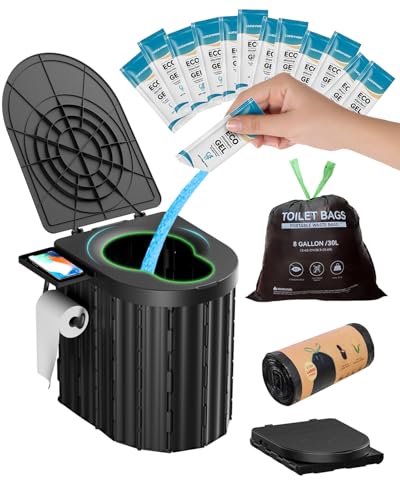
LuckyNov Portable Toilet with Urine Gel and Leak-Proof Bags
Badge: Best for Pack-It-Out Simplicity
Strengths
- Waste is captured in leak-proof bags with urine gel, so odour and liquid movement are controlled at the source.
- Nothing to empty, rinse, or disinfect at the take-out — used bags are sealed and packed out whole.
- Ergonomic design aims at a more natural seated posture than a plain bucket, for adults and kids alike.
Trade-offs
- Bag supply is the capacity limit, and running out mid-trip is not an option on a permitted river.
- A bag system never feels as substantial underfoot as a moulded cassette toilet.
- Ongoing bag and gel purchases are part of the real cost of ownership.
Mini spec box
- System: disposable leak-proof bags with urine gel
- Odour control: gel-based
- Users: adults and kids
- Use: outdoor travel potty
If your priority is a sanitation system that a whole crew can operate correctly with zero training, this is it. There is no tank to gauge, no valve to baby, and no end-of-trip washout — the used bag is sealed and becomes one more piece of packed-out trash, which is precisely what river permits ask for. The gel does real work here: it firms up liquid and holds odour down inside a closed boat far better than a dry bag alone.
The discipline this system demands is arithmetic. Estimate uses per person per day honestly — river mornings after camp coffee are not the time for optimism — then pack bags and gel well past that number, split across two dry bags so a single lost bag cannot end your sanitation plan. Within that discipline, it is the simplest river toilet in the guide.
Best for: canoe and small-raft groups who want the simplest legal pack-out / Not suited for: long expeditions where bag volume becomes its own cargo problem

TRIPTIPS Upgrade Retractable Portable Toilet
Badge: Best for Tight Storage
Strengths
- Retractable body collapses down for transport, then opens to a usable toilet at camp.
- Adjustable height lets you set a lower, stable profile for kids or a taller one for adults.
- Foldable format suits car-and-river combinations, from roadside put-ins to overnight camps.
Trade-offs
- A collapsible structure has more joints to keep clean and grit-free than a one-piece moulding.
- It is a bag-based toilet at heart, so it shares the bag-supply arithmetic of that class.
- Heavier users should set the height thoughtfully, since stability depends on full, even extension.
Mini spec box
- System: retractable portable toilet, bag-based
- Height: adjustable
- Design: foldable for camping and car travel
- Users: adults and kids
Storage is the whole argument for this toilet, and on a river it is a good argument. A toilet that collapses can ride inside a dry bag, under a raft frame, or in the footwell of a shuttle vehicle, then open into a surprisingly civilised seat at camp. The adjustable height is not a gimmick on uneven ground: dropping the unit a notch on a sloping gravel bar can be the difference between a stable seat and a nervous one.
Treat the mechanism kindly. River sand gets into every joint ever made, so brush the legs and locks down before collapsing it, and fully extend and lock each side before use — a half-locked frame is the one honest weakness of the type. Kept clean and set up deliberately, it is the most packable full-seat option here.
Best for: paddlers and drivers short on storage who still want a real seat / Not suited for: groups who want a flush and a tank rather than bags
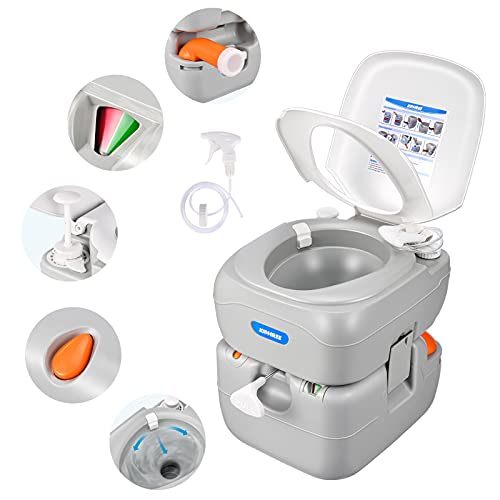
Kohree Portable RV Toilet, 5.8 Gallon
Badge: Best Capacity
Strengths
- The largest waste tank in this guide at 5.8 gallons, which stretches the interval between emptying stops.
- A detachable waste tank and a level indicator take the guesswork out of group-trip planning.
- Leak-proof construction is stated for indoor and outdoor use, on boats as well as in RVs.
Trade-offs
- Capacity cuts both ways: a full 5.8 gallon tank is a serious carry.
- It is the bulkiest cassette here, so small boats will feel its footprint.
- Like all cassette toilets, it needs a proper emptying facility at the end of the trip.
Mini spec box
- Waste tank: 5.8 gallons, detachable
- Indicator: waste level indicator
- Seal: leak-proof design
- Stated uses: RV travel, boat, home use, trips
Big groups and long floats are a capacity problem before they are anything else, and this is the pick built for that maths. The level indicator sounds like a small thing until you have guessed wrong about a cassette tank on a river morning; knowing exactly where you stand lets a trip leader schedule a vault-toilet stop or a take-out rinse before it becomes urgent. The detachable tank keeps the carry to one sealed unit rather than the whole toilet.
Be realistic about the carry. Plan who empties it, where, and with what gloves and rinse water, and do not let it fill to the brim simply because it can — a three-quarter tank carried early beats a brimming tank carried late. For a multi-boat group camp that stays put for days, that trade is easily worth it.
Best for: larger groups and multi-day base camps that need tank capacity / Not suited for: lightweight or self-support trips
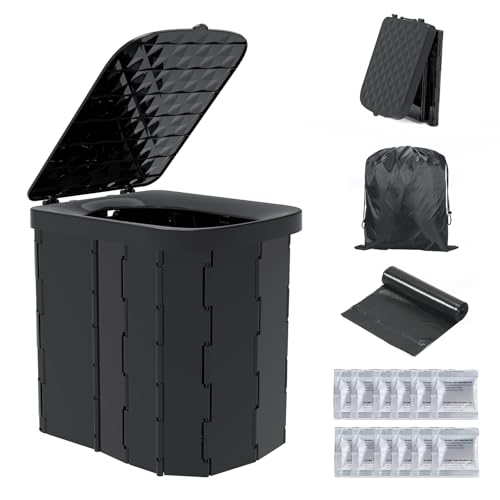
Hapoon XL Portable Folding Camping Toilet
Badge: Best Lightweight Backup
Strengths
- XL seat size in a folding, lightweight frame — a rare combination that suits bigger users.
- A lid keeps the unit closed and tidier in camp than open bag frames.
- Folds down to ride as a second toilet or an emergency backup with almost no cargo penalty.
Trade-offs
- Bag-based, so it needs a steady supply of suitable bags and a pack-out plan.
- A folding frame will never feel as planted as a moulded cassette toilet on soft ground.
- Best treated as a simple system — there is no flush, sprayer, or tank to lean on.
Mini spec box
- System: folding portable toilet with lid, bag-based
- Size: XL seat
- Design: lightweight, folding
- Users: adults and kids
Every experienced river crew has a story about the trip where one toilet was not enough — the second boat, the scout camp upstream, the morning queue that ate the day’s first hour. This Hapoon is the answer to that story: a full XL seat that folds to almost nothing, so carrying a second unit costs you very little space and buys you a calmer camp. It also makes a sensible primary toilet for a solo or duo trip where a cassette system is more hardware than the trip needs.
Set it on the firmest ground available and pair it with good bags; a folding frame on soft sand benefits from a groundsheet or a flat board underneath. Used that way, it is honest, simple gear that does exactly one job well.
Best for: a second camp toilet, solo trips, and lightweight kits / Not suited for: users who want a flush system as their only toilet
Comparison Table
| Pick | System | Capacity signal | Packability | Link |
|---|---|---|---|---|
| SereneLife 5.2 Gal Portable Camping Toilet | Cassette flush | 5.2 gal waste, 3.2 gal fresh | Moulded unit with carry bag | Check on Amazon |
| MODIWELL LE-310 Dry Flush Toilet | Dry flush, waterless | Limited by sealing refills | Folds flat | Check on Amazon |
| LuckyNov Gel and Bag Toilet | Bag and gel | Limited by bag supply | Compact frame | Check on Amazon |
| TRIPTIPS Retractable Toilet | Bag-based frame | Limited by bag supply | Retracts flat, adjustable height | Check on Amazon |
| Kohree Portable Toilet, 5.8 Gallon | Cassette flush | 5.8 gal waste, level indicator | Largest unit here | Check on Amazon |
| Hapoon XL Folding Toilet | Bag-based frame | Limited by bag supply | Folds flat, lightweight | Check on Amazon |
How to Choose the Right River Toilet for Your Trip
Start with your permit, not with a product page. Many permitted rivers specify the kind of system you must carry — commonly a washable, reusable container with a tight-fitting lid, or an approved bag system — and a toilet that breaks the rule can end a trip at the ramp. Once you know the legal frame, the choice narrows to three honest questions.
First, how does the waste leave the river? Cassette toilets like the SereneLife and Kohree hold liquid waste in a sealed tank that must be emptied into a vault toilet, a dump station, or a home toilet — ideal when your route passes those facilities, awkward when it does not. Dry flush and bag systems turn waste into sealed solid packages that travel out as trash, which suits remote take-outs. Neither is morally better; the right answer is the one your route and your permit support.
Second, do the capacity maths in people and days. A group of eight on a four-day float will use a toilet well over a hundred times. Compare that against a waste tank measured in gallons or a bag count measured in dozens, and keep a margin of at least a quarter in reserve — appetites, altitude, and river coffee all push usage up, never down. The same discipline about matching a fixture to a tight space applies at home, which is why readers planning a small remodel often cross-check our notes on Best Small Toilets For Small Bathroom before they buy anything.
Third, think about the boat. A moulded cassette toilet needs a level, protected spot and adds real weight when full. A folding or retractable unit rides anywhere but asks for careful setup. A dry flush unit needs its battery and refills protected from water like any other electronic. Match the toilet to the craft — raft, canoe, drift boat, or powerboat — and to the person who will set it up each evening, because a system that is fiddly in the dark will be skipped, and a skipped system fails the whole group.
Finally, budget for the system, not the unit. Bags, gel, sealing refills, treatment for cassette tanks, gloves, and a dedicated hand-washing setup are all part of the true cost, and they are the parts that run out. A slightly simpler toilet with a generous consumables budget beats a premium unit with a thin one on every river.
How to Set Up and Run a River Toilet Camp
A good river toilet routine is a small piece of camp choreography, and it is worth rehearsing once at home so the first real setup is not happening at dusk on a gravel bar.
- Choose the spot first: well away from the water’s edge and from the kitchen, on the firmest, flattest ground available, with a natural screen or a tarp for privacy. Local rules set minimum distances from water — follow them.
- Level the unit. Shim a cassette toilet with flat stones or a board so it cannot rock, and fully extend and lock any folding or retractable legs.
- Prepare the system before the first use: fill the fresh tank on a flush model, load the first bag and gel on a bag model, or confirm the dry flush unit is charged and loaded.
- Set up hand washing beside the toilet, every time — a water container with a spigot, soap, and a towel, or an equivalent sanitising station. Toilet hygiene fails at the hands, not at the seat.
- Agree the signals: an occupied sign, a paddle across the path, or a simple call-out, so nobody walks in on anyone and the unit is never left in a used, unsealed state.
- Each morning, check the level indicator or bag count, seal and stow used bags in the designated trash dry bag, and confirm the transport seal before the boats are loaded.
- At the take-out, empty cassette tanks only into an approved facility, rinse and disinfect away from the river, and let everything dry fully before storage so seals and frames survive to the next trip.
Troubleshooting on the river follows the same pattern as anywhere: identify the failure, contain it, and simplify. Problem: a cassette toilet smells in camp → check the seal is fully closed, the tank is not overfilled, and the unit is sited downwind of the kitchen; odour is almost always a seal or a siting issue, not a mystery. Problem: a folding toilet feels unstable → re-level the ground, re-extend the legs to their locks, and add a groundsheet or board under the feet. Problem: you are using bags faster than planned → ration by consolidating the toilet’s location so nobody improvises, and shorten the remaining plan honestly rather than letting anyone use the riverbank. The space-saving mindset behind these fixes is the same one behind choosing Best Toilets For A Small Bathroom at home: measure first, then commit.
Pack-It-Out Rules and River Etiquette
Leave-no-trace practice on rivers is stricter than in most camping, because a river corridor concentrates every visitor into the same narrow band of beaches. Everything in this guide assumes waste is contained and carried out; burying waste near water is not an acceptable fallback on popular or permitted rivers, and on many it is simply prohibited. Keep the toilet far from the waterline, keep grey water from rinses out of the river, and strain and scatter wash water on land well away from camp, following local rules.
Etiquette matters as much as rules. Site the toilet so the walk to it is easy in the dark — a toilet that is hard to reach will be avoided at 2 a.m., and the evidence will be found behind the nearest bush. Keep it stocked, keep the hand-washing station filled, and rotate the emptying duty so it is a shared job rather than one person’s punishment. Groups that treat the toilet as shared infrastructure, like the kitchen, have cleaner camps and happier mornings. Readers who split their year between rivers and road trips will find the same etiquette thinking in our coverage of Best Toilets For Small Bathrooms, where small-space discipline is the whole game.
River Toilets for Families and Mixed-Ability Groups
A toilet that works for a confident adult may fail a six-year-old or a grandparent, and on a river there is no alternative fixture down the hall. Adjustable-height designs like the TRIPTIPS help here, because a lower setting gives a child stable footing, while the XL seat of the Hapoon and the familiar flush routine of the SereneLife help users who need a seat that feels like the one at home. Think about the approach path as well: a toilet up a steep, loose bank is a fall risk at night, whatever its seat height.
For mixed groups, the winning move is usually a primary cassette or dry flush toilet at a well-chosen central spot, plus a lightweight folding backup so nobody is caught out when the main unit is occupied or being serviced. It is the same layered thinking people use when they compare Best Short Height Toilets for a home bathroom shared by kids and adults — height, stability, and familiarity decide whether a fixture actually gets used.
River Toilets by Craft: Raft, Canoe, Drift Boat, and Powerboat
The same toilet can be the right answer on one boat and a liability on another, because each craft gives you a different floor, a different centre of gravity, and a different amount of protected dry storage. Rafts are the most forgiving platform: a flat floor or a beaver tail can take a moulded cassette toilet, and the tubes forgive a surprising amount of splashing. Even so, lash a cassette toilet down or wedge it into the gear pile — a loose toilet that migrates in a rapid becomes a very memorable problem. Canoes narrow the choice sharply. Floor space is curved and contested, weight sits high if you let it, and the folding and retractable designs earn their keep by riding low and flat when they are not open on the bank. Most canoeists use the toilet ashore anyway, so packability matters more than flush comfort.
Drift boats sit between the two: there is usually a flat spot for a compact cassette or a dry flush unit, and the fishing rhythm of the day — long stops at runs and pools — makes a slightly more civilised toilet worth its footprint. Powerboats and small cruisers add one more consideration, which is motion at speed. A sealed cassette or a dry flush unit that locks closed will travel happily; an open bag frame will not, and should be stowed rather than set up while underway. Across all four craft, the rule is identical: the toilet travels sealed, low, and secured, and it is set up on land, on the level, every single time.
Cold Mornings, Hot Beaches, and High Altitude
River conditions stress a toilet in ways a product page never mentions. Cold makes plastics less forgiving and makes every user hurry, which is when lids get slammed and seals get half-closed; a pre-trip briefing that slows people down by ten seconds is worth more than any feature in this guide. Cold also thickens the contents of a cassette tank and makes the take-out rinse slower, so build time for it rather than discovering it in a freezing car park. Heat works the other way: a sealed tank or bag left in full sun on a beach will announce itself by midday, so site the toilet in shade where the bank allows it, and never store used bags inside a sealed boat compartment that bakes.
Altitude quietly changes the maths too. Groups drink more, eat differently, and use the toilet more often than their sea-level habits predict, which is another reason the capacity margin in the buying guide is not pessimism. If your river runs high and cold, or low and hot, adjust the consumables count before you adjust anything else — the toilet itself rarely fails, but the plan around it fails constantly.
Cleaning, Storage, and Making a River Toilet Last
A river toilet that is cleaned properly after every trip will serve for years; one that is put away wet and sealed will punish you at the next put-in. The routine is unglamorous and entirely learnable. Empty the waste tank or dispose of sealed bags through the proper stream first, while you are still at a facility. Rinse with clean water away from the riverbank’s edge, using the sprayer on models that include one, and disinfect the bowl, seat underside, seals, and the outside of the waste tank — the parts hands actually touch. Work grit out of valves and folding joints with a soft brush, because sand is an abrasive that eats seals a grain at a time.
Dry everything completely before storage, and store cassette toilets with lids and valves open so air can move; a sealed, damp tank grows the smell you will blame on the product next season. Keep bags, gel, and dry flush refills in a labelled dry box with the toilet, along with gloves and hand-washing supplies, so the system reassembles itself next trip instead of being scavenged from three different cupboards. Finally, inspect seals before the season’s first trip rather than at the first camp: a seal replaced at home costs an errand, while a seal that fails on day two costs the whole group’s goodwill.
The Support Kit: What to Pack Alongside the Toilet
No river toilet works alone, and the difference between a system a crew trusts and one they quietly avoid is usually the small kit packed around it. Start with hand hygiene: a water container with a hands-free spigot, liquid soap, and a dedicated towel, or a well-stocked sanitising alternative, positioned so that using it is easier than skipping it. Add a headlamp left permanently at the toilet spot, because the 2 a.m. visit is where good systems go to be tested, and a toilet nobody can find in the dark will not be used correctly.
Pack a privacy answer as well — a lightweight tarp and cord, or a pop-up screen for open beaches — since a toilet with no screen on a treeless bar creates exactly the avoidance behaviour that leaves waste where it should never be. Consumables belong in the same box as the unit: bags and gel for bag systems, sealing refills and a charging cable for dry flush units, treatment and a funnel for cassette toilets, plus disposable gloves in more than one size and a small roll of heavy rubbish bags for the inevitable odd jobs. A flat board or groundsheet sized to the toilet’s footprint stabilises soft sand, and a short length of cord lets you secure a light folding toilet against the evening wind that every river seems to produce.
Finally, pack a small repair and dignity kit: a spare seal or valve part where the maker offers one, tape for a torn bag, spare batteries or a power bank for a rechargeable unit, and a change-of-clothes dry bag stored with the group gear rather than the toilet kit. None of this is expensive or heavy. All of it converts a product into a system, and systems are what actually keep a river clean.
Common Buying Mistakes
- Buying for the advertised flush count or seat size and ignoring the waste path — how the waste leaves the river is the decision that follows you all trip.
- Under-counting consumables. Bags, gel, and dry flush refills are capacity; running out is a permit problem, not an inconvenience.
- Choosing a tall, narrow toilet for soft ground. Rivers give you sand and gravel, and stability beats elegance on both.
- Skipping the hand-washing station to save space, then wondering why camp stomachs suffer.
- Never test-assembling a folding or retractable toilet before the trip. The put-in is the worst classroom on earth.
- Letting a cassette tank fill completely before emptying it. A partial tank carried early is lighter, cleaner, and kinder.
Final Recommendation
For most river groups, start with the SereneLife 5.2 Gal Portable Camping Toilet: it is the closest thing to a normal toilet that a gravel bar can offer, and its sprayer, funnel, and carry bag show a maker who understands the take-out as well as the camp. If your group is large or your float is long, step up to the Kohree Portable RV Toilet for its 5.8 gallon tank and level indicator. If you hate dump stations more than you love a flush, the MODIWELL dry flush route is the cleanest waterless answer, and the bag-based LuckyNov, TRIPTIPS, and Hapoon picks cover small boats, tight storage, and second-toilet duty respectively. Match the system to your permit and your route, pack consumables with a margin, and the toilet will be the least interesting part of your trip — which is the highest praise river gear can earn.
Frequently Asked Questions
Are portable toilets actually required on river trips?
On most permitted and heavily used rivers, yes — land managers commonly require a washable, reusable waste system or an approved bag system, and rangers may check at the put-in. Even where it is not required, packing waste out is the practice that keeps beaches usable, so treat a river toilet as standard kit rather than an optional extra.
Can I empty a cassette toilet at the take-out?
Only into an approved facility such as a vault toilet or a dump station, and never into the river or onto the ground. If your take-out has no facility, the sealed tank travels home or to the nearest facility with you — which is exactly why the tank’s seal quality matters so much when you buy.
How many bags or flushes should I plan per person per day?
Plan generously and count every use, including the quick night-time ones. Most groups underestimate by a wide margin, so take your honest estimate and add at least a quarter more in bags, gel, or refills. Splitting the supply across two bags or boats protects the plan if one stash is lost or soaked.
Do dry flush toilets work on a boat?
Yes, provided the unit is kept dry, charged, and stocked with its sealing refills. The MODIWELL in this guide is explicitly built for marine and RV use among its stated applications, and its foldable body helps it ride in a boat. What it cannot survive is being treated like a bucket — it is an appliance, and it needs its consumables and its battery looked after.
What is the best river toilet for a small canoe or kayak trip?
The bag-based designs win on small craft, because they weigh little and pack flat. The TRIPTIPS retracts for storage, the Hapoon folds to almost nothing, and the LuckyNov keeps the system down to bags and gel. A moulded cassette toilet is excellent gear on a raft and poor geometry in a kayak.
How do I control odour in camp?
Seal discipline first: close every lid and valve, seal every bag promptly, and site the toilet downwind and away from the kitchen. Gel in bag systems and a not-overfilled cassette tank do most of the remaining work. Persistent odour is diagnostic — it almost always means a seal, a full tank, or a badly sited unit.
How should I clean a river toilet after a trip?
Empty it at an approved facility, rinse it away from any waterway, disinfect the waste-contact parts, and dry everything fully before storage with lids and valves open. Sand and grit should be brushed out of folding joints and seals, because grit left in a seal is next trip’s leak already scheduled.


