Disclosure: topratedkitchenware.com is reader-supported. When you buy through links on our site, we may earn an affiliate commission from Amazon and other retailers, at no extra cost to you.
Where to buy
The six models below are the picks for this guide to the best toilets for a small bathroom. Linked picks go straight to their verified Amazon listings, where you can check the latest price on Amazon and confirm dimensions against your renovation drawings before you order. One pick — the Thetford Aqua-Magic VI — is covered in prose only because it is an RV toilet, not a household fixture; it appears without a link, and its review explains why it does not belong in a bathroom renovation at any budget. Order of operations matters in a remodel, so read the installation section before the delivery arrives, not after.
- DeerValley Compact One Piece Toilet, Standard Seat Height — Check on Amazon
- WinZo WZ5081 Elongated One Piece Toilet, Low Profile
- DeerValley Small One-Piece Toilet, 12-Inch Rough-In
- Thetford Aqua-Magic VI Low Profile — covered in prose only in this guide (see its review for why)
- PeacefulHues Round Front Two Piece Toilet, 15-Inch Seat Height
- WinZo Compact One Piece Toilet, 22.8-Inch Depth (WZ5079)
Read the full guide ↓ for the ranking logic, the honest limitations of every pick, and the renovation sequence that keeps a small bathroom project from painting itself into a corner.
A small bathroom renovation is a game of millimetres played for keeps. The tiles are cut once, the flange is set once, and the toilet you choose will be looked at, sat on, and cleaned around for a decade or more — in the smallest room in the house, where there is nowhere for a mediocre decision to hide. Choosing the best toilets for a small bathroom is therefore less about hunting for a miniature fixture and more about matching a toilet’s three dimensions — depth, overall height, and seat height — to a room whose walls, door, and window have already made most of the decisions for you. Get the match right and the renovated room feels inevitable, as if it could never have been otherwise. Get it wrong and you will re-measure the same door swing every day for years.
The six picks here were chosen from the compact end of the verified household pool with renovation in mind: a skirted dual-flush one-piece that modernises a room in a single object, a low profile elongated model for bathrooms under windows and eaves, a small one-piece made for tight spaces, a classic round front two-piece with a stated seat height for traditional remodels and tight budgets, and a short-depth specialist whose dimension is printed in its name. One RV toilet is reviewed in prose only, because renovations attract category mistakes like no other project. If your remodel spans several rooms rather than one, the multi-room strategy in Best Toilets For Small Bathrooms builds directly on the choices made here.
Key Takeaways
- In a renovation, choose the toilet before the flooring is finished: its footprint and rough-in decide details that are expensive to revisit.
- The DeerValley Compact is the moderniser’s default — skirted, dual flush, and sized for small bathrooms.
- Depth is the renovation measurement that matters most; the WZ5079 states 22.8 inches, the shortest household body here.
- Low profile designs like the WZ5081 unlock shelves and window lines that a tall tank would forbid.
- The PeacefulHues offers a stated 15-inch seat and two-piece serviceability for traditional or budget-led remodels.
- The Thetford Aqua-Magic VI is an RV toilet — prose only, and never part of a household renovation.
In this guide
Quick Picks
| Pick | Badge | Renovation role | Why it stands out | Link |
|---|---|---|---|---|
| DeerValley Compact One Piece Toilet | Best Overall | The modern default | Skirted one-piece, dual flush 1.1/1.6 GPF, small-bathroom sizing | Check on Amazon |
| WinZo WZ5081 One Piece Toilet | Best Low Profile | The under-window answer | Low profile body with an elongated bowl and soft close seat | Check on Amazon |
| DeerValley Small One-Piece Toilet | Best for Powder Rooms | The tight-space specialist | Compact design for tight spaces, soft closing seat included | Check on Amazon |
| Thetford Aqua-Magic VI | Best RV Low Profile (Prose Only) | No role in a house | An RV toilet that appears in small-bathroom searches; see its review | Covered in prose only |
| PeacefulHues Round Front Two Piece Toilet | Best Classic Two-Piece | The traditional remodel | Stated 15-inch seat, round front, siphonic 1.28 GPF flush | Check on Amazon |
| WinZo WZ5079 Compact One Piece Toilet | Best Short Depth | The door-swing solver | Stated 22.8-inch depth in a dual-flush one-piece body | Check on Amazon |
Badges are used consistently through the detailed reviews below, so the pick that wins a badge here carries the same badge in its full review.
How These Picks Were Chosen
This guide is research-led, built from verified listings rather than hands-on testing claims. We judged compact household toilets on published evidence — stated depths and seat heights where makers provide them, bowl shape, flush system, rough-in, and construction — and then re-judged the shortlist as renovation objects: how a fixture interacts with new flooring, finished walls, door swings, window lines, and the trades who have to install it in a room with no spare floor to stand on.
Two disciplines from this series apply with full force. First, dimensions are quoted only where a listing states them: the WZ5079’s 22.8-inch depth and the PeacefulHues’ 15-inch seat are facts; compact and low profile are class descriptions, reported as such. Second, category errors are handled in the open. The Thetford Aqua-Magic VI is a low profile RV toilet for a vehicle flange and black tank; in a household renovation it is not a budget option or a clever hack, it is an uninstallable object, so it is reviewed in prose only with no link and no image.
Flush systems were weighed as renovation decisions, because a remodel is the one moment when changing flush class costs nothing extra. Dual flush designs convert a main bathroom’s traffic into water savings for the life of the fixture; simple siphonic designs at 1.28 GPF minimise parts and suit secondary rooms. Neither is a luxury tier — they are fits for different rooms, and the reviews assign them accordingly. Readers whose small bathroom lives outside a conventional house — a cabin, a trailer — will find those worlds covered in Best Toilets For Cabins and Best Toilets For Travel Trailers Cemacal Vs Compost.
The 6 Best Toilets for a Small Bathroom
Each review follows the same pattern: what the verified listing actually states, where the design is strong, where it honestly falls short in a renovation, and who should build their remodel around it. Specs come only from the pool data — nothing is invented to fill a box.

DeerValley Compact One Piece Toilet, Standard Seat Height
Badge: Best Overall
Strengths
- Skirted one-piece body delivers the modern renovated look in a single fixture — no tank seam, no exposed trapway.
- Dual flush at 1.1/1.6 GPF locks in water savings for the life of the remodel.
- Made for small bathrooms, with a standard seat height that suits the widest range of users.
Trade-offs
- Skirted bases demand careful alignment of fixings and supply during installation.
- Dual flush parts are model-specific when service is eventually needed.
- Its height is a class — standard — rather than a stated measurement.
Mini spec box
- Seat height class: standard
- Flush: dual flush 1.1/1.6 GPF
- Rough-in: 12 inches
- Design: one-piece, skirted
If a renovation has a centrepiece, in a small bathroom it is the toilet — the largest object in the room and the one every sightline crosses. This DeerValley is the pick that understands the assignment. The skirted one-piece body reads as a single calm sculpture against new tile, the flat sides wipe clean where the old toilet’s trapway curves collected a decade of evidence, and the dual flush gives the renovated room a running cost to match its looks. The maker emphasises a powerful, quiet flush, and in a small flat or a thin-walled house, quiet is a renovation outcome as real as any tile choice.
Plan its installation with the respect skirted designs require. The mounting system and supply connection are accessed with less room than an exposed design allows, so the dry-fit matters: set the body in place, confirm the alignment and the wall clearance, and only then commit the seal. A renovator who does that work patiently is rewarded with the easiest-cleaning base in this guide for the next decade.
Choose it as the default for a modern small-bathroom remodel. Drop to the PeacefulHues only if budget or tradition argues for a two-piece, and reach for the WZ5079 only if the door swing leaves you no choice — which is to say, let this toilet be the plan and the others be the exceptions.
Best for: modern small-bathroom renovations where one fixture must carry the room / Not suited for: installers who want open access to every fixing
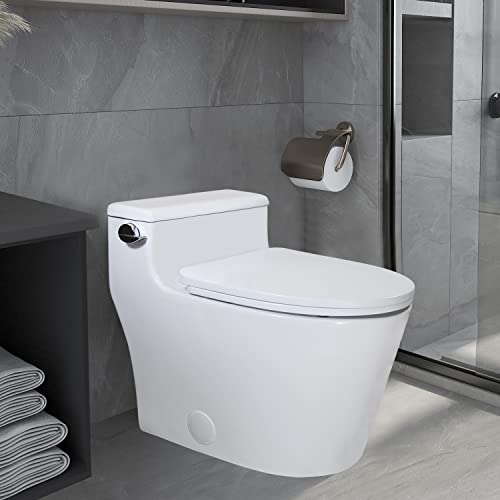
WinZo WZ5081 Elongated One Piece Toilet, Low Profile
Badge: Best Low Profile
Strengths
- Low profile silhouette frees the wall above the tank for a window line, a shelf, or a sloping ceiling.
- Elongated bowl preserves adult seating comfort that compact remodels usually sacrifice.
- Side flush at 1.28 GPF stays reachable where a top button would clash with shelving; soft close seat included.
Trade-offs
- Elongated depth must be measured against the door arc like any full-size front.
- Low profile is a silhouette description, not a published seat figure.
- One flush volume for all uses.
Mini spec box
- Profile: low profile
- Flush: side flush, 1.28 GPF
- Bowl: elongated
- Seat: soft close, included
- Design: one-piece
Renovations are full of vertical negotiations: the window that begins too low, the eaves that slope too early, the shelf the owners refuse to surrender. The WZ5081 is the toilet that wins those negotiations. Its low profile body ducks under lines that a conventional tank would cross, and it does so without shrinking the seat — the elongated bowl is the full-size article, which makes this the rare compact-room toilet that asks adults for no compromise at the point of use.
In design terms, it pairs naturally with the floating shelves and uninterrupted tile lines that small-bathroom renovations favour, because the fixture’s own line is low and unbroken. The side flush is part of the same intelligence: controls belong where hands can reach them, not where a shelf needs to be. At 1.28 GPF, its single flush meets the modern efficiency standard with a mechanism simple enough to forget about, and the soft close seat suits the ensuite hours when this toilet will mostly be used.
Its one demand is honesty about depth. An elongated front in a shallow room is a door problem wearing a comfort badge, so measure the swing before falling for the silhouette — and if the inches are not there, take the same maker’s WZ5079 and keep the renovation coherent.
Best for: renovations under windows, eaves, or shelf lines / Not suited for: shallow rooms where the door arc is already tight

DeerValley Small One-Piece Toilet, 12-Inch Rough-In
Badge: Best for Powder Rooms
Strengths
- Compact design for tight spaces — the natural centre of a powder room or under-stairs renovation.
- One-piece body keeps a small, highly visible room free of seams and ledges.
- Soft closing seat included, and a standard 12-inch rough-in that rarely forces plumbing changes.
Trade-offs
- A compact seat for short visits; not the main bathroom choice for larger users.
- Compactness is the listing’s claim rather than a headline dimension.
- White finish only, per the listing.
Mini spec box
- Design: small one-piece, compact
- Rough-in: 12 inches
- Seat: soft closing, included
- Finish: white
Powder room renovations are where budgets go to be charmed: a tiny room, a jewel-box ambition, and a guest list that will judge the result at conversational distance. This DeerValley is the right scale of ambition for that room. Its compact one-piece body leaves floor and air around it for the details that make a powder room feel designed — the statement tile, the good mirror, the shelf that a bulkier toilet would have crowded out — while its own lines stay clean enough to disappear into the composition.
The practical renovation virtues are just as strong. A standard rough-in means the remodel budget goes to surfaces rather than to moving a flange, and a one-piece body means the room’s most-scrutinised fixture has the fewest places to look tired in five years. The soft closing seat protects the room’s acoustics, which in a powder room off a living space is a courtesy to everyone on both sides of the door.
Keep it in its role. As the only toilet in a small flat it would be asked to do a main bathroom’s work on a powder room’s seat; as the jewel of a half-bath renovation, it is perfectly cast.
Best for: powder room and half-bath renovations / Not suited for: serving as a household’s only, main toilet for larger users
Thetford Aqua-Magic VI Low Profile
Badge: Best RV Low Profile (Prose Only)
Strengths
- Low profile and space-saving, with a foot flush — as an RV toilet, it is well designed for its world.
- Residential-sized slow-close seat and a deep bowl, per the maker.
- Easy installation onto the flange a vehicle actually provides.
Trade-offs
- It requires an RV flange and a black-water tank; a renovated bathroom has a floor rough-in and a sewer line instead.
- Its water system assumptions belong to a vehicle.
- There is no renovation scenario in a house where this is the right purchase.
Mini spec box
- Profile: low profile, space-saving
- Flush: foot flush
- Seat: residential-sized slow-close
- Application: RV (per the listing)
Renovation research is done at speed, across dozens of listings, often with a contractor’s deadline pressing — and that is exactly how an RV toilet ends up in a bathroom mood board. The Aqua-Magic VI looks the part: low, compact, space-saving. But its part is in a motorhome, where it bolts to a vehicle flange and empties into a black tank, flushed by a pedal from the vehicle’s water system. A bathroom renovation offers it none of those things, and no tile choice or budget line can change that.
It is therefore reviewed here in prose only, with no purchase link and no image, as the guide’s standing example of the most expensive mistake in small-bathroom shopping: buying the right dimensions in the wrong category. If your project includes an actual vehicle, this toilet deserves your attention in its own category — the vehicle side of small-space living is explored in the trailer comparison linked from this guide’s buying section. For the bathroom, the five household picks divide every realistic renovation brief between them.
Best for: RV owners who met it during bathroom research / Not suited for: any household renovation

PeacefulHues Round Front Two Piece Toilet, 15-Inch Seat Height
Badge: Best Classic Two-Piece
Strengths
- Round front bowl — the traditional small-bathroom shape — returns inches to the room.
- Stated 15-inch seat height, published in the title, suits shorter users and children.
- Siphonic 1.28 GPF flush with cUPC certification stated, soft close seat, and two-piece parts any plumber stocks.
Trade-offs
- A tank joint to assemble and a ledge to clean, in exchange for that serviceability.
- Round front seat area is smaller than elongated.
- A traditional side-handle look that modern schemes may find plain.
Mini spec box
- Seat height: 15 inches (stated)
- Flush: 1.28 GPF siphonic, side handle
- Bowl: round front
- Rough-in: 12 inches
- Certification: cUPC (per the listing)
- Seat: soft close, included
Not every renovation wants to look renovated. In a period house, a rental refresh, or a budget-led remodel where the money is earmarked for tile and light, the right toilet is the one that has always belonged in such rooms — and the PeacefulHues is that toilet, updated. The round front respects the room’s inches, the stated 15-inch seat restores the standard height that children and shorter adults manage best, and the siphonic flush runs at the modern 1.28 GPF standard behind a familiar side handle.
Its renovation economics are the strongest in the guide. Two-piece toilets are lighter to carry into a small room one piece at a time, their tank internals are the most standardised parts in plumbing, and a future repair is a parts-bin errand rather than a model hunt. In a remodel where the toilet is one line item among twenty, that predictability is worth real money and real weekends.
Accept its two honest costs: the cleaning ledge where tank meets bowl, and a seat that larger adults may find snug. For the traditional or budget-led small bathroom, both are fair prices for a fixture that will simply work, quietly, for years — and if the household later wants a bidet function in this room, that is a separate category decision covered in Best Toilets Bidet.
Best for: traditional, rental, and budget-led small-bathroom remodels / Not suited for: design-led schemes chasing a skirted silhouette
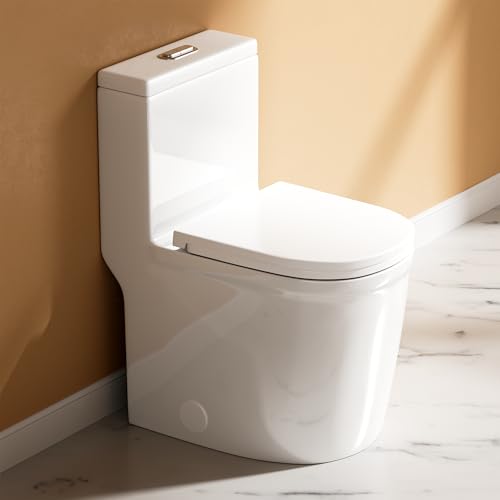
WinZo Compact One Piece Toilet, 22.8-Inch Depth (WZ5079)
Badge: Best Short Depth
Strengths
- Stated 22.8-inch depth — the renovation answer when the door, the drawer, or the knees say no.
- Dual flush gives the small room a modern water profile.
- One-piece body keeps the tightest floor area in the house easy to clean.
Trade-offs
- The most compact seat in the guide.
- Depth is its headline; seat height is not stated as its virtue.
- Tight bodies give the installer less hand room — in the room with the least of it.
Mini spec box
- Depth: 22.8 inches (stated)
- Flush: dual flush
- Rough-in: 12 inches
- Design: compact one-piece, short design
- Model: WZ5079
Every renovator of small bathrooms eventually meets the room that defeats the standard catalogue: the door that must close, the vanity drawer that must open, the bath panel that must be reached — all claiming the same floor the toilet needs. The WZ5079 is the fixture that ends that argument, with a stated depth of 22.8 inches that its maker aims squarely at small, tiny, and mini bathrooms. In renovation terms, those saved inches are not a compromise; they are what allows the rest of the room’s design to survive contact with reality.
The supporting specification is properly modern: dual flush for the room’s water profile, a one-piece body for its cleaning profile, and the standard 12-inch rough-in that keeps the plumber’s scope to a swap rather than a relocation. Installed in the problem room, it converts the renovation’s most anxious measurement into its most satisfying one — the door closing, fully, with room to spare, for the first time in the house’s memory.
Its seat is the honest price, and in a problem room it is a price worth paying knowingly rather than discovering. Larger households should treat this as the specialist it is: perfect where depth is law, unnecessary where depth is plentiful.
Best for: renovations where door swing or drawer clearance is the binding constraint / Not suited for: rooms with depth to spare and users who prize seat size
Comparison Table
| Pick | Form | Flush | Renovation strength | Link |
|---|---|---|---|---|
| DeerValley Compact | One-piece, skirted | Dual 1.1/1.6 GPF | Modern default, easy-clean sides | Check on Amazon |
| WinZo WZ5081 | One-piece, elongated | 1.28 GPF side flush | Low profile for windows and eaves | Check on Amazon |
| DeerValley Small | One-piece, compact | Not headlined in listing | Powder-room scale | Check on Amazon |
| Thetford Aqua-Magic VI | RV toilet | Foot flush, RV system | None in a house | Covered in prose only |
| PeacefulHues Round Front | Two-piece, round front | 1.28 GPF siphonic | Stated 15-inch seat, easy service | Check on Amazon |
| WinZo WZ5079 | One-piece, compact | Dual flush | Stated 22.8-inch depth | Check on Amazon |
How to Choose a Toilet During a Small Bathroom Renovation
Sequence is the whole secret. Choose the toilet at the design stage, not at the fitting stage, because its rough-in, footprint, and height reach backwards into decisions about flooring thickness, wall finish, and even door handing. Begin with the survey: rough-in from the finished wall surface you will actually have (tile and plaster change the number), the depth envelope set by door swing and vanity clearance, the vertical envelope set by windows, shelves, and slopes, and the seat height your household’s legs vote for. With those four numbers, this guide’s picks sort themselves: the skirted DeerValley for the modern default, the WZ5081 where the ceiling argues, the WZ5079 where the door argues, the PeacefulHues where budget and tradition argue, and the DeerValley Small where the room is a powder room.
Decide the flush class while the walls are open in your imagination. A main bathroom’s dual flush is a lifetime water decision made for the price of choosing one model over another; a secondary room’s simple siphonic design is a lifetime maintenance decision made the same way. Renovations are the one moment these choices are free, so make them deliberately rather than inheriting whatever the showroom had in stock.
Then interrogate the unglamorous interfaces. Will the new flooring raise the floor enough to leave the flange low, and does the budget include a flange extension if so? Does the skirted model you love still let a hand reach the supply stop in an emergency? Does the door, rehung or replaced, still clear the bowl front you measured against the old door? Every one of these questions is cheap at the design stage and expensive at the fitting stage, which is the entire economics of renovating a small bathroom. Shoppers also weighing a bidet model for the renovated room should treat that as its own shortlist — the current sale landscape is surveyed in Best Toilets Bidets Sale.
How to Sequence the Installation in a Renovation
- Before demolition, measure and record the existing rough-in, supply position, and floor structure, and photograph what the walls hide once they are opened.
- Choose the toilet from the survey numbers, and confirm its rough-in and dimensions against the finished wall and floor thicknesses in the design — not the bare ones in the stripped room.
- Complete flooring and wall finishes first, protecting the flange opening throughout; a toilet installed before the floor is finished inherits every height error the floor makes.
- Inspect and, if needed, repair or raise the flange so it sits correctly relative to the new finished floor — this is the renovation moment when flange problems are cheap.
- Dry-fit the toilet: level, door swing, tank or body clearance, and supply reach, all checked before the seal is committed.
- Fit the seal, set the toilet in one straight movement, tighten evenly and gently, connect the supply, and fill while checking every joint with a dry tissue.
- Flush repeatedly, fit and test the soft close seat, and leave the back of the base unsealed if you seal the front and sides, so any future seep announces itself visibly.
- Record the model, the seal type used, and the install date in the project file before the room’s finishing touches bury the details.
Troubleshooting a renovated room is mostly about interfaces. Problem: the new toilet rocks on the beautiful new floor → the floor or flange is out of level; shim the base rather than forcing the fixings. Problem: the flush seems weak in a brand-new installation → check the supply stop is fully open and the tank’s fill level is set as the maker intends before questioning the fixture. Problem: the door now kisses the bowl it used to clear → the new bowl’s depth differs from the old one’s; a door stop is a bandage, while the short-depth WZ5079 is the cure the survey should have prescribed.
Flooring, Flanges, and the Hidden Half of a Toilet Renovation
Half of every toilet renovation happens below the fixture, in the few inches of floor and flange that nobody photographs. Flooring changes the flange’s effective height: tile and underlayment added over an old floor can leave a flange sitting low, which asks a standard wax seal to span a gap it was never meant to span. The renovation answer is boring and correct — assess the flange when the old toilet comes up, repair cracks, and set its height properly for the new floor before the new toilet arrives. It is the cheapest insurance in the entire project, bought at the only moment it is sold.
The floor itself deserves a toilet-specific thought. Continuous flooring run under the fixture, rather than cut tightly around an old base’s footprint, frees you to choose any footprint in this guide — including a smaller one — without inheriting a ghost outline of the previous toilet. Water resistance at the base matters more than anywhere else in the room, and a renovator who seals and details that junction properly will never learn why. Attend to the hidden half, and the visible half — the calm skirted body, the low profile, the short depth — gets to be the whole story, which is what a renovation is for.
Designing Around the Toilet: Light, Storage, and Sightlines
In a small renovated bathroom, the toilet is the largest uninterrupted surface in the room, so design around it honestly. A one-piece or skirted body gives the eye a single quiet form; a low profile body returns the wall above it to the design, where a shelf, a niche, or a run of tile can do visual work a tall tank would have blocked. Keep storage off the floor where possible — every object standing around the base shrinks the room and complicates cleaning — and let the wall above a low tank carry the room’s necessities instead.
Lighting decides whether the result feels renovated or merely replaced. Even, shadow-free light at the mirror flatters users and makes the room read larger; a warm, dimmable option respects the ensuite’s night hours. Run flooring continuously beneath the fixture, keep the palette calm at floor level where the toilet sits, and spend the room’s one dramatic gesture — a tile, a colour, a mirror — at eye level, where it will be seen. The toilet’s job in the composition is to be well chosen and then to disappear, and every pick in this guide was selected partly for how gracefully it can do exactly that.
Where the Toilet Sits in a Renovation Budget
Small bathroom budgets are usually argued over tile and glass, while the toilet is treated as a commodity line to be filled in at the end. That ordering is backwards in one specific way: the toilet is the only object in the room that is simultaneously furniture, appliance, and plumbing, and it is the object whose failure modes — a rocking base, a weak flush, a door collision — are lived with daily and remembered longest. The sensible budget treats the fixture, its seat, its seal and supply, and the flange work beneath it as one indivisible line, funded properly, and then lets the decorative budget compete for what remains.
Within that line, the picks in this guide span a rational range of strategies rather than a ladder of quality. The two-piece PeacefulHues concentrates spending on the room’s surfaces by keeping the fixture conventional and serviceable. The skirted DeerValley Compact moves money into the fixture itself, buying a decade of easier cleaning and a modern silhouette. The specialists — the WZ5079’s depth, the WZ5081’s profile — spend money only where the room’s geometry demands it, which is the definition of a renovation budget working correctly. What none of them justifies is the false economy of the cheapest possible fixture in a renovated room: a remodel amortises over years, and a toilet that disappoints daily is the most expensive object in the house per unit of regret.
Hold a contingency for the hidden half. Flange repairs, a supply stop that must be replaced, a floor that needs local levelling — these are discovered mid-project in older small bathrooms with metronomic regularity, and a budget that has already spent its last unit on tile has nowhere honest to go. Ten percent held back for the plumbing realities is not pessimism; it is the renovation’s experience speaking in advance.
Living Through the Works: Timing and Temporary Arrangements
A small bathroom is frequently the only bathroom, which makes the renovation a logistics exercise as much as a design one. Sequence the toilet work to the end of the project, as the installation section prescribes, and the household’s inconvenience compresses into the shortest possible window: old fixture out, flange attended to, new fixture in, room back in service — often within a single day once the surfaces are ready. Everything before that day can proceed with the old toilet still flushing, which is a quality-of-life fact worth planning the whole schedule around.
For the gap itself, plan like a grown-up: a neighbour arrangement, a gym membership’s showers, or — for longer projects — a portable toilet of the kind covered in this site’s outdoor guides, sited with the same care as a river camp’s. Order the new fixture to arrive before demolition begins, inspect it on delivery for transit cracks while a return is still painless, and store it out of the work zone; porcelain and building sites are enemies. Finally, keep the old toilet’s fate simple — most are not worth rehoming once removed, and a clean break lets the renovation end with the new room, the new fixture, and a household file that records what was installed and when. The first flush in a finished room is a small ceremony; a well-run project earns it on schedule.
After the Renovation: The First Year With a New Small-Bathroom Toilet
A renovation ends twice: once when the last tradesperson leaves, and once a year later, when the room has survived four seasons of real use. The toilet’s first year is mostly uneventful by design, but three small habits protect the investment. First, re-check the base and connections after the first few weeks: new seals settle, floors flex microscopically under a new fixture’s weight, and a mounting nut that wants a gentle quarter-turn will ask for it early or not at all. Second, learn your flush’s normal voice — the fill time, the sound of a complete flush, the silence that should follow — because the first symptom of a running seal or a tired fill valve is a change in that voice, audible long before it is visible on a water bill.
Third, keep the room’s cleaning routine matched to the fixture you chose: skirted and one-piece bodies want a cloth and five minutes, two-piece ledges want a brush’s attention, and every base wants a monthly fingertip check at its unsealed back edge, where a failing seal will announce itself as dampness while the announcement is still cheap. Do those three things and the renovated bathroom’s toilet crosses the line from new purchase to household infrastructure — the quiet state every pick in this guide was chosen to reach, and to hold for the decade the room was renovated for.
Common Buying Mistakes
- Choosing the toilet after the flooring, then discovering the flange height or rough-in no longer suits the favourite model.
- Measuring the rough-in against the stripped wall instead of the finished one.
- Falling for a low profile listing that turns out to be an RV toilet.
- Letting the door swing be an installation-day surprise.
- Spending the whole budget on the fixture and nothing on the flange repair the renovation was the perfect moment to make.
- Copying a showroom’s elongated statement piece into a room whose inches were already spent.
Final Recommendation
For the modern small-bathroom renovation, build around the DeerValley Compact One Piece Toilet — skirted, dual flush, and sized for the room — unless your survey names a different winner: the WinZo WZ5079 where depth rules, the WZ5081 where the ceiling rules, the PeacefulHues where budget and tradition rule, and the DeerValley Small in the powder room. Choose at the design stage, attend to the flange while the floor is open, and keep RV toilets in RVs. A small bathroom renovated in that order stops being the house’s apology and becomes its most considered room. Live with the result for a full week before judging the details — a new toilet rearranges small habits of knee, hand, and ear — and by the second week the right fixture will have disappeared into the room, which is the surest sign the renovation chose well.
Frequently Asked Questions
When in a renovation should I choose the toilet?
At the design stage, before flooring and wall finishes are finalised. The toilet’s rough-in, footprint, and height influence flange setting, flooring runs, and door decisions. Choosing late turns each of those into a potential rework; choosing early makes the toilet a fixed point the rest of the room is designed around.
Does new flooring affect toilet installation?
Yes — added flooring thickness raises the floor around a flange that was set for the old surface, which can leave the flange too low for a standard seal. A renovation is the right moment to inspect the flange and set its height correctly for the new floor before the toilet is installed.
Which toilet style suits a modern small-bathroom remodel?
Skirted one-piece designs, like the DeerValley Compact in this guide, suit modern schemes best: a single clean form, flat sides that wipe down quickly, and no tank seam. Low profile one-piece models suit schemes that need the wall above the tank for shelves or a window line.
Can I keep my old toilet in a renovation?
You can, if it flushes well, its parts are available, and its dimensions suit the new layout. But a renovation is the cheapest moment to replace a toilet — the room is already apart — and an old fixture with a tall tank or a deep bowl can quietly veto the new design. Most renovators replace, and use the occasion to fix the flange as well.
Why must I not use an RV toilet in a bathroom renovation?
Because the connections are incompatible standards. An RV toilet mounts to a vehicle flange and discharges into a black tank; a bathroom provides a floor rough-in and a sewer connection. The Thetford in this guide is a good RV toilet and an impossible bathroom one, which is why it carries no purchase link here.
How do I stop the door hitting the new toilet?
Measure the door’s swing arc against the new bowl’s depth at the design stage, using the manufacturer’s stated depth — the WZ5079 publishes 22.8 inches for exactly this problem. If the arc and the bowl still collide, options are a shorter toilet, a round front bowl, or rehanging the door — in that order of cost.
Is dual flush worth specifying in a remodel?
In a main bathroom, yes: the renovation is the one moment the choice costs nothing extra, and the savings compound across every day of the fixture’s life, because most flushes are liquid-only. In a rarely used guest bathroom, a simple single-flush design at 1.28 GPF is an equally rational specification.
Should the toilet match the other fixtures in the renovated room?
Visually, coherence helps a small room feel designed: a white toilet from this guide will sit comfortably with almost any suite, and matching the seat style and the flush control’s finish to the room’s other fittings is a cheap form of polish. Functionally, matching matters less than fit — a toilet chosen for the room’s measurements in a slightly different white will serve better than a perfectly matched one whose depth defeats the door. Renovators should also note that specialty bidet models, surveyed in our guide to Best Toilets For Bidets, are a separate category with their own rough-in and electrical questions, best decided at the same design stage as everything else in this section.


