Disclosure: topratedkitchenware.com is reader-supported. When you buy through links on our site, we may earn an affiliate commission from Amazon and other retailers, at no extra cost to you.
Where to buy
The best toilets eco friendly households can install today share one trait: they do the whole job — bulk removal and bowl wash — on 1.28 gallons per flush or less, or they split the flush so liquid waste costs even less. The six verified models below were ranked on exactly that basis. Four flush at a flat, efficient 1.28 GPF, one adds a dual-flush choice with a 1.1-gallon light option, and one pairs an efficient-flush design with a glazed trapway, with its exact volume flagged honestly where the listing leaves it unstated. Every pick links to its Amazon page so you can check the latest price on Amazon and confirm the specifications that matter to your home.
- HOROW 17 Inch High Elongated Toilet, 1.28 GPF
- Garvee Two Piece Elongated Toilet, 1.28 GPF
- TOTO Drake Two-Piece Elongated 1.28 GPF Toilet, 10-Inch Rough-In
- HOROW 17 Inch Comfort Height Toilet, Dual Flush
- Los Flexi 19 Inch High Toilet, 1.28 GPF
- Gerber Maxwell Crest Elongated Two-Piece Toilet
Read the full guide ↓
A toilet is the largest single water user inside most homes, and it is also the most invisible one: nobody watches the tank refill. That combination — big impact, zero attention — makes the toilet the highest-leverage eco upgrade in the house, ahead of showerheads and faucets that get far more press. The best toilets eco friendly shoppers choose today cut flush volume by twenty to forty percent against the 1.6-gallon legal ceiling, and they do it without reviving the bad old days of low-flow toilets that needed two or three flushes to clear, quietly erasing their own savings. The engineering is what changed: siphon geometry, larger flush valves, glazed trapways and rim systems that wash the bowl properly mean a modern 1.28-gallon flush can out-clear an older toilet using half again as much water.
This guide ranks six verified models by their efficiency engineering first and their other virtues second. It also stays honest about the limits of listing data: where a brand publishes an exact flush volume, we rank on it; where a listing says only “efficient flush,” as one pick here does, we say so and place it accordingly. Eco buying rewards that kind of precision, because a green claim you cannot quantify is just a color. If your household’s other bathroom serves very different users, the priorities shift — our guide to the Best Toilets For A Church, for example, ranks durability under heavy traffic ahead of per-flush volume.
Key Takeaways
- Five of the six picks state an exact efficient volume: four at 1.28 GPF and one dual-flush model with a 1.1 GPF light flush — the numbers an eco buyer should rank on.
- The HOROW 1.28 GPF single-flush model leads because it pairs the efficient volume with a MaP 1000g bulk-removal claim: low water, proven clearance.
- Dual flush saves the most water in real households only when the light flush is actually used; a fixed 1.28 GPF flush saves automatically, with no behavior required.
- The TOTO Drake variant here brings a bowl glaze that reduces cleaning water and chemical use — but it fits 10-inch rough-ins only, so measure before falling for it.
- The Gerber is ranked last on eco evidence, not quality: its listing states an efficient flush and a glazed trapway but no exact GPF in the title data, so its savings cannot be quantified from the verified data.
- Longevity is an eco feature: a durable, repairable two-piece toilet that serves for decades beats a disposable fixture on lifetime footprint, whatever its flush volume.
In this guide
Quick Picks
| Pick | Badge | Format | Flush | Best for |
|---|---|---|---|---|
| HOROW 17 Inch High Elongated, 1.28 GPF | Best Overall Eco | Two-piece, elongated | 1.28 GPF single flush, MaP 1000g claim | Efficient volume with proven clearance |
| Garvee Two Piece Elongated, 1.28 GPF | Best Straightforward Eco Buy | Two-piece, elongated | 1.28 GPF side push flush | Certified, simple, water-saving basics |
| TOTO Drake 1.28 GPF, 10-Inch Rough-In | Best Eco for 10-Inch Rough-Ins | Two-piece, elongated | 1.28 GPF TORNADO FLUSH | Efficiency plus an easy-clean glaze, where it fits |
| HOROW 17 Inch Comfort Height, Dual Flush | Best Dual-Flush Flexibility | Two-piece, elongated | Dual flush 1.1/1.6 GPF | Households that will use the light flush faithfully |
| Los Flexi 19 Inch High, 1.28 GPF | Best Eco for Tall Households | Two-piece, elongated | 1.28 GPF siphonic | Extra height without extra water |
| Gerber Maxwell Crest Elongated | Best Anti-Clog Eco Runner-Up | Two-piece, elongated | Efficient flush, glazed trapway | Clog resistance with an efficiency-minded design |
How These Picks Were Chosen
This is a research-led guide, not a metered lab comparison. We did not run these toilets on a test rig, and no water savings figure in this article is presented as our own measurement. Each model was verified against its listing data — brand, format, bowl shape, flush architecture, stated flush volume, seat height and rough-in — and then ranked by a strict evidence order. Stated exact volumes outrank described efficiency; published bulk-removal claims outrank adjectives, because an eco toilet that needs a second flush is not eco at all; and design features with a real resource mechanism — dual flush, glazed trapways that resist clogs, bowl glazes that reduce cleaning inputs — outrank green vocabulary.
Two honesty rules shaped the list. First, no pick is described as certified by any program unless its listing data says so: the Garvee’s cUPC certification is stated in its title, while other models’ certification status is left for the buyer to confirm on the product page, and this guide does not upgrade a 1.28 GPF volume into a certification claim on its own. Second, fit constraints are treated as eco-relevant facts, not fine print: the TOTO’s 10-inch rough-in is flagged wherever it appears, because a toilet returned for fit reasons carries a real logistics footprint and helps nobody’s water bill. Readers who want the flush-strength view of a similar pool can compare our Best Toilets Flushers ranking.
The 6 Best Toilets Eco Friendly Households Can Buy

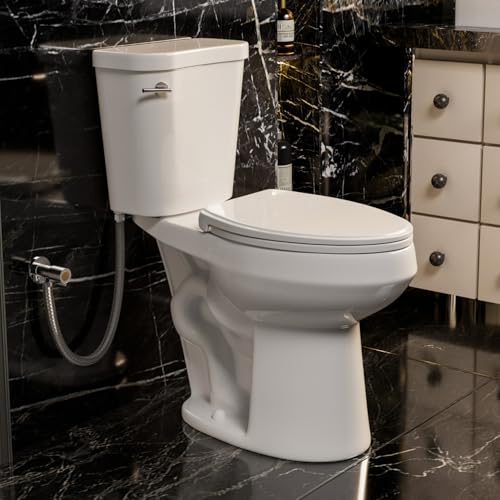
HOROW 17 Inch High Elongated Toilet with 1.28 GPF Single Flush
Badge: Best Overall Eco
Strengths
- 1.28 GPF on every flush — automatic savings with no button discipline required — paired with a MaP 1000g bulk-removal claim.
- 17-inch ADA chair height and an extra-tall elongated bowl suit the adults in most households.
- Two-piece format keeps parts standard and repairs simple, extending the fixture’s useful life.
Trade-offs
- Single flush means liquid waste uses the same 1.28 gallons; a faithfully used dual flush can average lower.
- The listing title does not claim a soft-close seat or a bowl glaze, so confirm inclusions on the product page.
- Chair height is tall for shorter users and young children without a stool.
Spec box: Format: two-piece | Bowl: elongated, extra tall | Flush: 1.28 GPF single flush, MaP 1000g claim | Height: 17-inch ADA chair height | Rough-in: not stated in listing title — confirm on product page
This HOROW takes the top eco ranking because it solves the category’s central tension in the simplest possible way. The historical failure of low-flow toilets was behavioral as much as mechanical: weak flushes got pressed twice. A published MaP 1000g figure — the top of the standardized bulk-removal scale, quoted directly in the listing — is the strongest available signal that this 1.28-gallon flush clears in one press, which is what makes the saving real rather than theoretical. Because the volume is fixed, the saving is also automatic: every user, every guest, every distracted morning flushes 1.28 gallons, not a drop of discipline required. Layer on chair-height elongated comfort and a conventional two-piece build that any plumber can service with shelf parts, and you have the eco pick for households that want the decision to disappear into daily life.
Its limitation is the ceiling on its own savings: households willing to work a dual-flush button can average below 1.28 gallons across a day, and this model cannot. It also asks buyers to confirm a few unstated details — rough-in and seat inclusions — on the product page. Neither point dents its ranking for the majority of homes.
Best for: households wanting automatic, proven water savings / Not suited for: disciplined dual-flush users chasing the lowest possible average

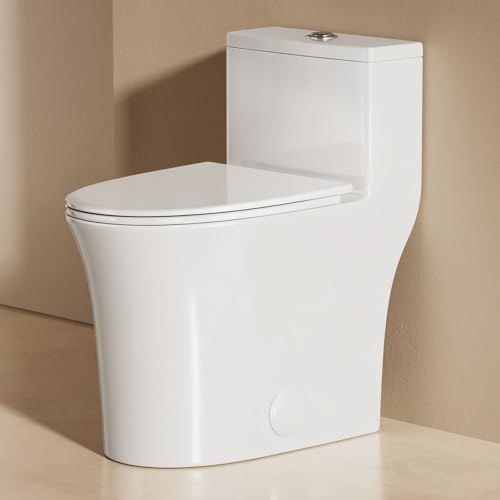
Garvee Two Piece Elongated Toilet with 1.28 GPF
Badge: Best Straightforward Eco Buy
Strengths
- 1.28 GPF water-saving flush with cUPC certification stated in the listing — verified compliance, not just a claim.
- Locking soft-close seat included, and a side push flush that is simple and familiar for every user.
- 15-inch comfort-height ceramic bowl at a standard 12-inch rough-in fits the most common bathroom layout.
Trade-offs
- No published MaP figure in the listing data, so bulk-removal confidence rests on the siphonic-class design rather than a score.
- Single flush only; no light-flush option for liquids.
- The brand is less established than TOTO or Gerber, so long-term parts support is a fair question to weigh.
Spec box: Format: two-piece | Bowl: elongated | Flush: 1.28 GPF, side push, water-saving | Height: 15-inch comfort height | Rough-in: 12 inches | Seat: locking PP soft close | Certification: cUPC (per listing)
The Garvee is the eco pick for buyers who like their green credentials documented. Its listing states the two things that matter most plainly: a 1.28 GPF water-saving flush and cUPC certification, which means the model’s performance claims sit inside a recognized compliance framework rather than floating as marketing copy. Around that core it is a sensible, unfussy toilet — elongated ceramic bowl, soft-close seat that locks in place, a side push flush anyone can operate, and the standard 12-inch rough-in that fits most American bathrooms without drama. In eco terms it is the low-risk route: known volume, certified listing, universal fit.
Its limitations are about depth of evidence and brand tenure. Without a published bulk-removal score in the verified data, clog-averse households may prefer the HOROW above, and buyers who weight decades-long parts ecosystems will note the newer brand name. As a certified, efficient, standard-fit toilet, though, it makes the eco decision easy — which, as the Best Toilets Ever debates among long-term owners show, is often what separates the upgrades people complete from the ones they postpone.
Best for: buyers who want certified, standard-fit efficiency without fuss / Not suited for: shoppers who require a published MaP score or a legacy brand

TOTO Drake Two-Piece Elongated 1.28 GPF Toilet with 10-Inch Rough-In
Badge: Best Eco for 10-Inch Rough-Ins
Strengths
- 1.28 GPF TORNADO FLUSH: efficient volume delivered through a circulating rim system that washes the whole bowl.
- CEFIONTECT glaze reduces how much residue sticks, which cuts cleaning frequency — and the water and cleaner that cleaning consumes.
- SoftClose seat included and WASHLET+ Ready, leaving a documented path to add bidet functionality later, which can reduce paper use.
Trade-offs
- 10-inch rough-in only: it cannot be installed on a standard 12-inch flange. This is an absolute fit constraint.
- Universal Height is tall for shorter users and young children without a stool.
- As a variant model, confirming exact included components on the product page is worthwhile before ordering.
Spec box: Format: two-piece | Bowl: elongated | Flush: 1.28 GPF, TORNADO FLUSH | Height: Universal Height | Rough-in: 10 inches | Surface: CEFIONTECT glaze | Seat: SoftClose included | Model: MS776124CEFG.10#01
This Drake variant makes the eco case on two fronts at once. The flush front is straightforward: 1.28 gallons delivered by TOTO’s circulating rim system, which uses the water it has more completely — washing the bowl walls as it clears — instead of simply using more water. The second front is quieter: the CEFIONTECT glaze keeps the bowl cleaner between scrubbings, and cleaning is itself a water and chemical input that eco accounting usually forgets. Over years, a bowl that needs less aggressive, less frequent cleaning saves a real, if unglamorous, stream of both. The WASHLET+ Ready note adds a future option: households that later add a compatible bidet seat typically cut toilet-paper consumption substantially, and designing that path in is smarter than retrofitting it.
The constraint, stated as plainly as possible: this toilet fits a 10-inch rough-in and nothing else. Older homes — including the vintage bathrooms discussed in our Best Toilets For A 1920 Remodel guide — are exactly where 10-inch rough-ins hide, and for those rooms this may be the only full-featured eco pick that fits. Measure from the finished wall to the flange bolts; if the answer is 12 inches, choose another pick and do not look back.
Best for: older homes with a verified 10-inch rough-in wanting top-tier eco engineering / Not suited for: any 12-inch rough-in bathroom


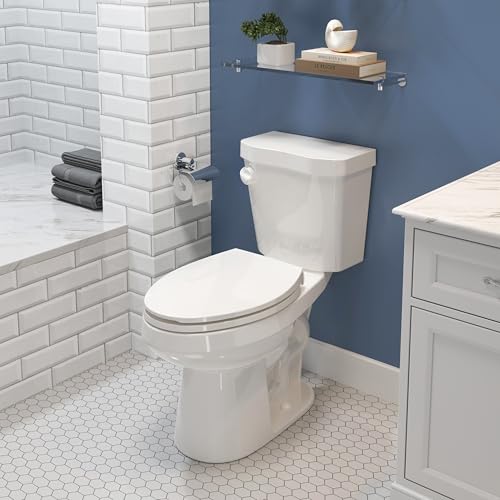
HOROW 17 Inch Comfort Height Toilet with Dual Flush
Badge: Best Dual-Flush Flexibility
Strengths
- Dual flush 1.1/1.6 GPF: the 1.1-gallon light flush handles the majority of daily visits, which is where household water actually goes.
- MaP 1000g claim behind the full flush, so choosing the light flush is a saving, not a gamble.
- 17-inch chair height, elongated bowl and soft-close seat complete a comfortable, modern specification.
Trade-offs
- The full flush is 1.6 GPF — the highest single volume here — so undisciplined use erases the dual-flush advantage.
- Savings are behavioral: guests and children who always press full flush get none of them.
- Dual-flush mechanisms have more components than a simple flapper, a minor long-term service consideration.
Spec box: Format: two-piece | Bowl: elongated | Flush: dual flush 1.1/1.6 GPF, MaP 1000g claim | Height: 17-inch ADA chair height | Rough-in: 12 inches | Seat: soft close
Dual flush is the eco idea with the best arithmetic and the worst dependency: it depends on people. Most household flushes are for liquid waste, so a 1.1-gallon light flush, used faithfully, pulls a home’s average flush volume well below any fixed 1.28 GPF model — the math is not close. The HOROW makes that bet safer than most, because its full flush carries a MaP 1000g claim: when a load genuinely needs the big button, the big button delivers in one press, so nobody develops the double-flush habit that quietly destroys dual-flush savings. Add chair-height elongated comfort and a soft-close seat, and this is the eco pick for a household of adults who will actually play along.
Its limitation is printed in its own spec: press the wrong button every time and you own a 1.6 GPF toilet, the thirstiest configuration in this guide. Households with young children, frequent guests or simple skepticism about their own discipline should take the fixed-volume picks above and bank the automatic saving instead. Our Best Toilets Flush And Clean guide explores the bowl-washing side of this same trade-off in more depth.
Best for: disciplined households that will use the light flush / Not suited for: high-guest-traffic homes where the full button will rule

Los Flexi 19 Inch High Toilet with 1.28 GPF
Badge: Best Eco for Tall Households
Strengths
- Full 1.28 GPF efficiency at a 19-inch extra-tall height — proof that accessibility sizing does not require extra water.
- Siphonic flush with an S-trap design and a soft-close seat, at a standard 12-inch rough-in.
- Elongated bowl suits the tall users the height is designed for.
Trade-offs
- Nineteen inches is genuinely tall: shorter adults and children will find it impractical without a step, which is an accessibility cost in mixed households.
- No published MaP figure in the listing data, so bulk-removal confidence is design-based rather than score-based.
- Single flush only, with no light-flush option.
Spec box: Format: two-piece | Bowl: elongated | Flush: 1.28 GPF siphonic, S-trap | Height: 19 inches, extra tall, ADA-oriented | Rough-in: 12 inches | Seat: soft-close
Height and efficiency are usually treated as separate shopping trips, and households that need an extra-tall toilet often assume they must accept whatever flush volume comes with it. The Los Flexi refutes that: its siphonic flush runs at the same 1.28 GPF as the efficiency leaders in this guide, at a full 19-inch seat height designed for tall adults and for users who need maximum height to sit and rise comfortably. For a tall household, that combination means the eco upgrade does not require a comfort downgrade — the water saving arrives in the exact physical format the home needs, on a standard rough-in, with a soft-close seat included.
The limitation is the flip side of its specialty: in a mixed-height household, a 19-inch seat is a daily inconvenience for everyone shorter, and children will need a step for years. Buy it for the users it describes and it is an excellent eco choice; buy it as a general family toilet and the height will argue with you daily.
Best for: tall adults and users who need extra seat height, without giving up efficiency / Not suited for: mixed-height families or homes with young children

Gerber Maxwell Crest Elongated Two-Piece Toilet
Badge: Best Anti-Clog Eco Runner-Up
Strengths
- Efficient flush described in the listing as clearing the bowl with ease — efficiency intent stated by the manufacturer.
- Glazed trapway prevents clogs, and every avoided clog is avoided double-flushing, plunging and chemical drain treatments.
- Tool-free install kit with wax ring included reduces installation waste and extra trips; soft-close seat included.
Trade-offs
- The listing title data does not state an exact GPF, so its water saving cannot be quantified or ranked precisely — the reason it sits last in an eco guide.
- Seat height and rough-in are likewise unstated in the title data; confirm all three figures on the product page.
- No published MaP figure in the verified data.
Spec box: Format: two-piece | Bowl: elongated | Flush: efficient flush (exact GPF not stated in listing title) | Seat: soft-close | Extras: tool-free install kit with wax ring included; glazed trapway | Color: White
The Gerber’s eco case is real but indirect, and this guide ranks it last precisely to demonstrate the difference. What the listing verifies is an efficient-flush design intent and a glazed trapway that prevents clogs. The clog point deserves respect in eco accounting: a toilet that clogs gets flushed again, plunged, and sometimes dosed with chemical treatments, so a smooth waste path is a genuine resource-saving mechanism over a fixture’s life. The included install kit also trims the small waste stream of a typical installation — no duplicate wax ring bought and discarded, no extra hardware run.
What the listing does not verify is the number at the center of this category. Without a stated GPF in the title data, a rigorous eco ranking cannot place it above models whose 1.28 gallons are printed in black and white. Confirm the figure on the product page; if it reads 1.28 or lower, this toilet’s practical eco standing rises to match its clog-resistant design. Until then, it is the honest runner-up — and a reminder that in green buying, the missing number is information too.
Best for: clog-prone households that value verified design features and will confirm the GPF / Not suited for: buyers ranking strictly on published flush volume
Comparison Table
| Model | Format / Bowl | Flush | Height | Rough-in | Link |
|---|---|---|---|---|---|
| HOROW 1.28 Single Flush | Two-piece / elongated | 1.28 GPF, MaP 1000g claim | 17 in chair height | Confirm on listing | Check on Amazon |
| Garvee | Two-piece / elongated | 1.28 GPF, cUPC per listing | 15 in comfort height | 12 in | Check on Amazon |
| TOTO Drake 1.28 (10-in) | Two-piece / elongated | 1.28 GPF TORNADO FLUSH | Universal Height | 10 in | Check on Amazon |
| HOROW Dual Flush | Two-piece / elongated | Dual 1.1/1.6 GPF, MaP 1000g claim | 17 in chair height | 12 in | Check on Amazon |
| Los Flexi 19-Inch | Two-piece / elongated | 1.28 GPF siphonic | 19 in extra tall | 12 in | Check on Amazon |
| Gerber Maxwell Crest | Two-piece / elongated | Efficient flush (GPF not in title) | Confirm on listing | Confirm on listing | Check on Amazon |
How to Choose an Eco Friendly Toilet
Rank on stated numbers, in this order: flush volume, bulk-removal evidence, then everything else. A stated 1.28 GPF beats a described “efficient flush” every time, because only one of them can be entered into a water bill calculation. Within equal volumes, prefer the model with published clearance evidence — a MaP figure or a proven flush architecture — because the greenest flush is the one that happens once. Then weigh the secondary mechanisms: dual flush if your household will use it, glazes that cut cleaning inputs, trapway glazing that prevents clog-driven waste.
Do the household math honestly. A dual-flush toilet in a disciplined adult household can average meaningfully below 1.28 gallons per flush across a day, because most flushes are liquid. The same toilet in a house with young children and constant guests will average close to its full-flush figure. A fixed 1.28 GPF model asks nothing of anyone and delivers its number to every user. Choose the system your household will actually operate, not the one that wins on a spec sheet — eco performance is a behavior multiplied by an engineering figure, and either factor can zero the other out.
Fit and longevity close the decision. Confirm the rough-in before anything else: the most efficient toilet in this guide is useless in your home if its 10-inch rough-in meets your 12-inch flange. Then think in decades. A repairable two-piece with standard parts — the format of every pick here — can be kept at peak efficiency with inexpensive flappers and valves, while a neglected toilet of any volume leaks its savings away through a worn seal. A running toilet can waste more water in a month than an efficient flush saves in a year, which makes maintenance the final eco feature.
How to Install and Maintain an Eco Toilet for Real-World Savings
Installation follows the standard sequence — water off, old fixture out, flange inspected, fresh wax ring, toilet set straight and tightened evenly, supply connected, leak check after several flushes — with one efficiency-specific step: set the tank water level exactly to the manufacturer’s marked line. An overfilled tank silently converts a 1.28-gallon toilet into a thirstier one on every flush, and it is the most common reason a new eco toilet underperforms its listing. On dual-flush models, also confirm the button linkage actuates the light flush fully; a half-engaged light flush that needs a second press is a saving that exists only on paper.
Maintenance is where eco performance is defended. Replace a worn flapper at the first phantom refill, keep rim jets clear of mineral scale so bowl wash stays effective at low volumes, and use non-abrasive cleaners so glazes keep doing their low-effort work. Three problems dominate:
- Problem: the water bill does not fall after installing an efficient toilet → check for a silent tank leak by adding food coloring to the tank and watching the bowl; a leaking flapper can erase the entire upgrade’s saving.
- Problem: the low-volume flush starts leaving the bowl less clean → descale the rim jets and confirm the tank level has not dropped below the marked line as parts aged.
- Problem: household members keep double-flushing → treat it as information, not defiance: check for a partial trapway obstruction first, then review whether the chosen model’s clearance genuinely suits the household’s loads.
Water Pressure, Wells and Off-Grid Considerations
Gravity-flush toilets — every pick in this guide — are the eco-friendly architecture partly because they ask nothing of the home’s systems beyond ordinary water pressure: no electricity, no pumps, no pressure-assist vessels to maintain. That makes them equally at home on municipal supply and on well systems, where each gallon flushed is also a gallon pumped. Households on wells or with water-hauling arrangements feel flush volume twice — once at the tap and once at the pump or the tank — which strengthens the case for the fixed 1.28 GPF picks and for fixing tank leaks promptly. Pressure-assist and macerating designs have their niches, but they sit outside this verified pool and outside the simple, repairable, low-input profile this keyword is really asking for. When the goal is the smallest ongoing footprint with the fewest dependencies, a well-engineered gravity toilet at 1.28 gallons is a hard design to beat, and the six models above are its current shortlist.
Beyond the Flush: The Rest of a Toilet’s Footprint
Flush volume dominates eco discussions because it is measurable, but a complete accounting includes the fixture itself. A vitreous china toilet is heavy, energy-intensive to fire, and expensive to ship — which is an argument for buying once and buying durably. Every pick in this guide is a mainstream two-piece format with standard service parts, the configuration most likely to still be repairable in twenty years; that repairability is a genuine environmental feature, because the greenest toilet is usually the one that never becomes landfill. The same logic applies at installation: a toilet that fits the first time — rough-in measured, specifications confirmed — avoids the return freight and repackaging waste of a wrong order, which is why this guide repeats its fit warnings without embarrassment.
Cleaning chemistry is the last quiet input. Bowls with low-friction glazes, like the TOTO’s CEFIONTECT, typically need milder cleaners used less often, and households can compound that by skipping drop-in tank tablets, which degrade rubber seals and shorten parts life. None of this rivals flush volume in scale, but eco buying done well is a stack of modest, verified advantages — exactly the standard this shortlist was built to.
The Average-Flush Math, Worked Through Honestly
Eco comparisons go wrong when they compare a dual-flush toilet’s light setting against a single-flush toilet’s only setting. The honest comparison is average against average. In a typical household, liquid flushes outnumber solid flushes by roughly three or four to one. A dual-flush model at 1.1 and 1.6 gallons, used perfectly, therefore averages somewhere around 1.2 gallons per flush — better than a fixed 1.28, but by a modest margin, not the dramatic one the light-flush number suggests. Used imperfectly — say the full button handles half of all flushes — the same toilet averages around 1.35 gallons, worse than the fixed efficient model it was bought to beat. A fixed 1.28 GPF toilet, by contrast, has no distribution at all: every flush is 1.28, for every user, forever.
Neither result argues against dual flush; it argues for matching the mechanism to the household with clear eyes. Two adults who find the two-button rule trivial will bank the dual-flush advantage for decades. A rental property, a guest-heavy home or a kids’ bathroom will quietly donate the advantage back. This is also why the HOROW dual-flush pick’s strong full flush matters: on the occasions the big button is pressed, a one-and-done clearance protects the average from the silent killer of eco math, the habitual second flush.
Sequencing an Eco Bathroom: What to Replace First
Households often ask whether the toilet is really the first eco upgrade in the bathroom, and for water the answer is usually yes, with one exception: fix leaks first, always, because a running toilet or a dripping valve wastes water around the clock and makes every later calculation dishonest. After leaks, the toilet leads because it combines the largest indoor water share with the longest service life — an efficient model installed today is still saving water when fixtures bought later have been replaced twice. Showerheads and faucet aerators follow: cheap, quick, worthwhile, but smaller in both volume and lifespan. Within the toilet decision itself, sequencing means choosing the fixture before the finish work around it, confirming the rough-in while the floor is accessible, and setting the tank level correctly at installation rather than discovering an overfill a year later on a water bill. The greenest remodel is the one done once, in the right order, with measurements taken before orders are placed.
When Replacement Beats Repair on Eco Grounds
Eco instinct says repair what you own, and for toilets that instinct is usually right — a flapper, a fill valve and an afternoon can restore a sound toilet to full efficiency. The exception is the genuinely old high-volume toilet. Homes still running pre-standard fixtures that use three gallons or more per flush are spending, on every single flush, more than double the water of the 1.28 GPF models in this guide, and no adjustment brings a toilet designed around a large volume down to modern performance without wrecking its clearance. For those fixtures, replacement is the eco act: the new toilet’s manufacturing footprint is repaid in water terms faster than for almost any other appliance swap, and the removed fixture’s porcelain can often be recycled as aggregate rather than landfilled — ask your installer or local waste authority what is available. Between the extremes sits the 1.6 GPF toilet in good order: repair it, maintain its tank parts, and replace it at the end of its natural life rather than on an eco impulse. Judgment, as usual, is a volume figure plus a condition report.
One more replacement trigger deserves mention: the toilet that runs. A worn flapper can pass a surprising volume silently, day and night, and households routinely blame their efficient fixtures while the old toilet in the second bathroom donates the savings back to the sewer. Before upgrading anything, walk the house at a quiet hour and listen at each tank. The cheapest eco toilet upgrade in many homes is a flapper.
Common Buying Mistakes
- Believing the adjective instead of the number. “Eco,” “efficient” and “water-saving” are unregulated adjectives in listing copy. Rank on stated GPF and published clearance evidence, as this guide does.
- Buying dual flush for an undisciplined household. If the full button will be pressed by default, a fixed 1.28 GPF model saves more water in practice.
- Ignoring the second flush. A weak low-volume toilet that needs two presses uses more water than a strong 1.6 GPF model that needs one. Clearance evidence matters as much as volume.
- Forgetting the rough-in in the excitement. The most efficient pick in this guide fits 10-inch rough-ins only. Measure before ordering, every time.
- Neglecting the tank after installation. A worn flapper or an overfilled tank can silently cancel an efficient toilet’s advantage within a year.
- Assuming certification from volume alone. A 1.28 GPF figure and a formal certification are different claims; this guide credits only what each listing actually states.
Final Recommendation
For most households, the HOROW 1.28 GPF single-flush is the eco buy: automatic savings, a published bulk-removal claim, and chair-height comfort in a serviceable two-piece. The Garvee is the close alternative when certified, standard-fit simplicity is the priority, and the TOTO Drake 1.28 is the finest eco engineering here for the homes whose 10-inch rough-in it fits. Choose the dual-flush HOROW if your household will genuinely work the light button, the Los Flexi if height is your household’s defining need, and the Gerber if clog resistance tops your list and you confirm its flush volume first. The eco toilet is the one whose number you verified, installed at the level line, and maintained — everything else is vocabulary.
A closing piece of perspective: the toilet is a rare purchase where the eco choice, the economical choice and the comfortable choice have converged. The models above are not austerity fixtures — they are chair-height, elongated, soft-close toilets that happen to use a fifth less water than the legal ceiling on every flush, with engineering that clears better than the thirstier toilets they replace. When a category reaches that point, the remaining work is not sacrifice but selection: verify the number, match the fit, and maintain the machine. That is the whole assignment, and it is entirely doable from the six listings above.
Frequently Asked Questions
Should I replace a working 1.6 GPF toilet just to save water?
Usually not immediately. A sound 1.6 GPF toilet is a legal, functional fixture, and replacing it early spends money and manufacturing footprint to save a fifth of its flush volume. The stronger eco moves are to maintain it perfectly — no leaks, correct tank level — and to choose a 1.28 GPF or dual-flush model when it reaches the end of its life or a remodel makes replacement natural anyway. The exception is the much older high-volume toilet, where per-flush use can be double the modern efficient figure and replacement pays back far sooner.
Do eco toilets work in older homes with old drain lines?
In the great majority of cases, yes. Modern 1.28 GPF designs move waste with trapway geometry and siphon action rather than raw volume, and they are installed in older homes constantly. The caution applies to unusual layouts — very long, nearly flat drain runs with a history of sluggishness — where mentioning the layout to a plumber before choosing the lowest-volume model is prudent. Ordinary older plumbing is not a barrier to any pick in this guide.
How much water does an eco friendly toilet actually save?
Against a 1.6 GPF toilet, a 1.28 GPF model saves about a fifth of flush water on every flush; against older 3.5-gallon toilets still in service, the saving is far larger. Dual-flush models used faithfully can average lower still, because most flushes are for liquid waste. The exact household figure depends on flush counts, which is why this guide ranks verifiable per-flush volumes rather than promising a bill amount.
Is 1.28 GPF enough to clear the bowl properly?
With modern engineering, yes — siphon geometry, flush-valve size and rim delivery now do work that volume once did. The evidence to look for is a published bulk-removal figure such as the MaP 1000g claim on the HOROW models here, or a proven flush system like TOTO’s circulating design. Volume alone, high or low, is a weak predictor; architecture plus evidence is a strong one.
Dual flush or single flush: which is greener?
Dual flush has the lower theoretical average, because its light flush handles the majority of visits. Single-flush 1.28 GPF has the lower guaranteed figure, because it needs no correct choices from anyone. The greener option is the one matched to your household’s real behavior — disciplined homes win with dual flush, busy or guest-heavy homes often save more with the fixed efficient flush.
Are eco toilets a good choice for septic systems?
Generally yes: less water per flush means less hydraulic load on the tank and drain field, which septic systems appreciate. The picks here are conventional gravity designs of the type septic households routinely use. If your system is old or marginal, a quick conversation with your septic service provider before choosing the lowest-volume option is cheap reassurance.
What does cUPC certified mean on the Garvee listing?
cUPC indicates the product has been certified to applicable plumbing standards for the US and Canadian markets by an accredited body. For an eco buyer it matters because it places the model’s stated performance — including its 1.28 GPF volume — inside a compliance framework. This guide credits certifications only where a listing states them, which is why the Garvee’s is mentioned and no other pick is assigned one.
Does an eco toilet need special maintenance to stay efficient?
Only ordinary maintenance, done on time. Keep the tank water level at the marked line, replace flappers when they begin to leak, and keep rim jets free of mineral scale so the bowl wash stays effective at low volume. The efficiency of a modern toilet lives in small tolerances; neglecting them is how a 1.28-gallon toilet quietly becomes a 1.6-gallon one.
Is a taller toilet less eco friendly?
No — height and water use are independent specifications. The 19-inch Los Flexi in this guide flushes at the same 1.28 GPF as the efficiency leaders, which is the general pattern: manufacturers apply their current flush engineering across their height range. Choose height for the users, volume for the planet, and check that your chosen model offers both, as the picks here do.
Can an eco toilet still clog?
Any toilet can clog under enough load, but design decides how often. Glazed trapways reduce the friction where blockages start, strong siphons clear decisively, and published bulk-removal scores quantify the margin. If an efficient toilet clogs repeatedly, check for a partial obstruction and review paper habits before blaming the flush volume — the cause is usually mechanical or behavioral, not the 1.28 gallons.