Disclosure: topratedkitchenware.com is reader-supported. When you buy through links on our site, we may earn an affiliate commission from Amazon and other retailers, at no extra cost to you.
Where to buy
Every product below was shortlisted specifically for this guide to the best warranties on microwaves, using only verified listings. Check on Amazon for the current listing details.
One honesty note before the list: the verified listings for these six ovens do not state their warranty terms, and this guide does not invent any. What it does is shortlist six sound countertop microwaves across the size and power range, then teach you exactly how to read, compare and verify each maker’s warranty statement, which is the only version of the terms that will ever govern a claim. The wider compact shortlist at Best Small Microwaves First covers the same ovens from a pure size angle.
- Chefman 0.7 Cu. Ft. 700W Countertop Microwave — Check on Amazon
- BLACK+DECKER 0.9 Cu. Ft. 900W Countertop Microwave — Check on Amazon
- TOSHIBA 0.9 Cu. Ft. 900W Microwave with Mute Function — Check on Amazon
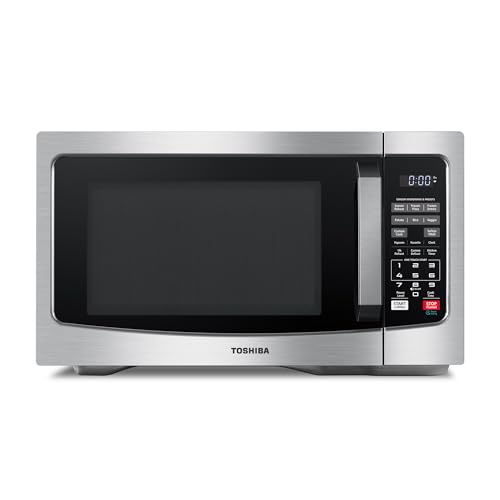
- TOSHIBA 1.2 Cu. Ft. 1000W Microwave with Smart Humidity Sensor — Check on Amazon
- COMFEE’ 0.7 Cu. Ft. 700W Countertop Microwave — Check on Amazon
- Farberware 1.1 Cu. Ft. 1000W Countertop Microwave — Check on Amazon
Read the full guide ↓
Finding the best warranties on microwaves is less about hunting for the longest number and more about learning to read what a warranty actually promises: which parts, whose labor, for how long, and under what exclusions. This guide shortlists six verified countertop microwaves from compact 700-watt models to a full-power family oven, and builds the comparison around the warranty questions each one raises, because the right questions transfer to any oven you consider.
The short answer, for readers who want it before the detail: prefer a warranty whose full-coverage period is clear, whose component coverage is spelled out separately rather than implied, and whose claim process you can actually picture yourself using. Verify every term in the manufacturer’s own warranty statement before buying, since listing pages omit terms, summaries compress them, and only the maker’s document counts when something fails.
A second short answer concerns expectations. On compact value ovens a warranty is chiefly protection against early defects; on larger, feature-rich ovens it also protects genuinely expensive components. The six reviews below are organized around that difference, and the companion magnetron-specific guide at Best Small Microwaves First is worth reading alongside this one if component coverage is your deciding factor.
Key Takeaways
- Listing pages do not state these ovens’ warranty terms; always verify coverage in the manufacturer’s warranty statement before buying.
- Read a warranty as a stack: base parts-and-labor coverage first, separate component coverage second, exclusions always.
- A longer parts-only term can be worth less in practice than a shorter full-coverage term.
- Keep the receipt, model and serial numbers, and register the product if the maker offers registration.
- Countertop warranties usually involve shipping or carrying the unit to service, not a home visit.
- Match warranty weight to tier: early-failure insurance on value ovens, component protection on premium ones.
In this guide
Quick Picks
Six linked picks spanning the compact-to-family range, badged by the warranty question each one raises best. Badges repeat in the detailed reviews.
| Pick | Badge | Best for | Link |
|---|---|---|---|
| Chefman 0.7 Cu. Ft. 700W Countertop Microwave | Best Compact Value | Small households wanting documented early-failure protection | Linked pick — see Where to Buy |
| BLACK+DECKER 0.9 Cu. Ft. 900W Countertop Microwave | Best Established-Brand Support Profile | Buyers who value an established support network | Linked pick — see Where to Buy |
| TOSHIBA 0.9 Cu. Ft. 900W Microwave with Mute Function | Best Quiet Mid-Size | Quiet kitchens that still want mid-size capacity | Linked pick — see Where to Buy |
| TOSHIBA 1.2 Cu. Ft. 1000W Microwave with Smart Humidity Sensor | Best Sensor Model to Read Closely | Feature-rich cooking with electronics coverage in mind | Linked pick — see Where to Buy |
| COMFEE’ 0.7 Cu. Ft. 700W Countertop Microwave | Best for Dorm and Office Buyers | Dorm, apartment and light office use | Linked pick — see Where to Buy |
| Farberware 1.1 Cu. Ft. 1000W Countertop Microwave | Best Full-Power Family Pick | Family reheating and programmed defrosting | Linked pick — see Where to Buy |
How These Picks Were Chosen
Selection began with the verified pool for this keyword: six countertop microwaves covering 0.7 to 1.2 cu. ft. and 700 to 1000 watts, from four makers. Because the listings state features and specifications but not warranty terms, we made a methodological decision and state it plainly: no warranty duration, component term or service promise is attributed to any pick anywhere in this article. Anything else would be invention, and warranty advice built on invented terms is worse than none.
What the picks were chosen for is the spread of ownership situations they represent: two compact value ovens where early-failure protection dominates, two mid-size ovens from established brands where service infrastructure matters, a sensor model whose electronics raise the component question, and a full-power family oven whose control board works hard. Between them they let the guide teach every major warranty pattern a countertop buyer will meet.
This is a research-led guide, not a hands-on test report and not a warranty database. Specifications are quoted only where a listing states them, and the warranty teaching is general industry practice, labeled as such. Readers comparing the same ovens on size and features alone will find the apartment-focused roundup at Best Small Microwaves For Apartments and the countertop roundup at Best Small Microwaves For Countertops useful companions.
Best warranties on microwaves: The Six Detailed Reviews

Chefman 0.7 Cu. Ft. 700W Countertop Microwave
Badge: Best Compact Value
Strengths
- The most compact footprint in this pool, suited to counters where every inch is spoken for
- 10 power levels give real control despite the small size, including gentler settings for softening and melting
- A mute button and child safety lock are thoughtful touches rarely found together at this size
Trade-offs
- 700 watts is the slowest tier in this guide; packaged-meal times written for higher-wattage ovens need extending
- 0.7 cu. ft. will not take a large dinner plate or a family-size casserole
- A value-tier model, so long-term parts availability depends on the maker’s support channels
Key specs from the listing: 0.7 cu. ft. capacity; 700 watts; 10 power levels; 6 cooking presets with one-touch express cook; Child safety lock; Mute button; Black finish.
The Chefman 0.7 leads this warranty guide for a deliberate reason: it is the pool’s most compact, value-tier oven, and value-tier ovens are where warranty thinking matters most in a specific way — the coverage functions as early-failure insurance on a machine whose repair would rarely make economic sense, so what you are really reading for is a clean, documented claim path in the first ownership period. A microwave warranty is not one promise but a stack of them. The base coverage typically addresses parts and labor for manufacturing defects for an initial period, and separate, longer coverage often applies to specific components the maker expects to outlast the rest of the machine. The listing page is not where those terms live; the warranty statement in the manual and on the manufacturer’s product page is the document that governs a claim, and it is the document this guide teaches you to read before money changes hands.
Exclusions decide real claims. Cosmetic damage, misuse, commercial use of a residential model, and damage from incorrect installation or power problems are standard carve-outs across the appliance industry. None of that makes a warranty useless; it makes it a contract with edges, and the edges are exactly what a careful buyer checks while the purchase is still a choice rather than a complaint.
Service logistics matter as much as terms. For countertop models, makers commonly ask the owner to ship the unit or bring it to an authorized service point rather than sending a technician to the home, and that practical reality is part of what you are buying. A slightly stronger paper promise from a maker with an awkward service process can underperform a simpler promise from a maker whose support is easy to reach. In daily use, the details that decide whether a microwave earns its counter space are unglamorous: how evenly it reheats at the power level you actually use, whether the cavity fits your real dishes, and whether the controls make sense before coffee. The Chefman 0.7 Cu. Ft. 700W Countertop Microwave handles that everyday test in line with what its listing promises, and nothing in its specification suggests a hidden catch for the jobs described in this guide.
The honest limitation to weigh is in the trade-offs above. No single model wins on size, power and simplicity at once, and this pick leans toward its format’s strengths rather than covering every kitchen equally well. Buyers whose kitchens match that lean will feel the trade as a benefit; buyers on the other side of it should weigh the alternatives in this list first.
Ownership of a countertop microwave is mostly a story about placement and habits. The oven needs clearance for its vents, a counter that puts the door at a comfortable height for hot dishes, and a door swing that does not fight the cook. Spend the first week noticing those ergonomics rather than the spec sheet, because the oven you reach for comfortably is the oven that gets used well for years.
Best for: Small households wanting documented early-failure protection / Not suited for: Anyone expecting repair economics to favor a value oven out of warranty
BLACK+DECKER 0.9 Cu. Ft. 900W Countertop Microwave
Badge: Best Established-Brand Support Profile
Strengths
- 900 watts is the practical middle tier: fast enough for daily reheating without the bulk of a family oven
- Push-button door release is easy to operate with full hands or limited grip
- 0.9 cu. ft. fits a standard dinner plate while staying apartment-friendly
Trade-offs
- No sensor cooking is named in the listing, so timing is manual
- Stainless finishes show fingerprints and benefit from a wipe-down habit
- Mid-size cavity still limits the largest serving dishes
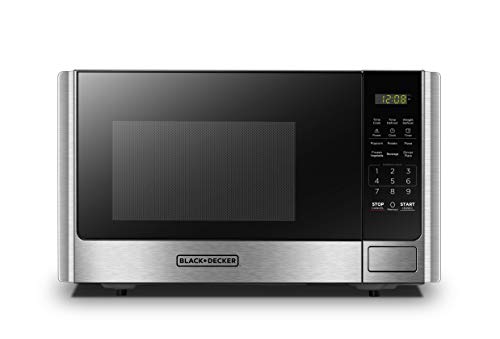
Key specs from the listing: 0.9 cu. ft. capacity; 900 watts; 10 power levels; Push-button door; Child safety lock; 6 auto cook presets; Stainless steel finish.
The BLACK+DECKER 0.9 brings a household-name badge to the same question. A long-established appliance brand generally maintains the support infrastructure, documentation libraries and parts channels that make a warranty usable in practice, and buyers who weight the service experience alongside the paper terms will find this pick’s profile the most conventional in the pool. The most common misunderstanding in this category is treating warranty length as a single number. Two ovens can both advertise a headline term while differing in what the later years actually cover: a component-only promise usually means the part is supplied while the labor to install it, and sometimes the service visit itself, is the owner’s expense. A shorter full-coverage promise can be worth more in practice than a longer parts-only one, and the only way to know is to read the split, not the headline.
Registration and paperwork are the unglamorous half of warranty value. Keep the receipt or order confirmation, note the model and serial numbers somewhere you can find them in three years, and register the product if the maker offers it, since some makers tie enhanced support or recall notices to registration. A generous warranty you cannot document is worth little on the day the oven stops heating.
Finally, judge warranty against the machine’s tier. On a compact value model, replacement can rival repair in cost, and the warranty functions mainly as protection against early failure, which is statistically when defects appear. On a premium inverter model with a large cavity, component coverage protects a genuinely more expensive machine, and the longer component terms deserve correspondingly more weight in the decision. In daily use, the details that decide whether a microwave earns its counter space are unglamorous: how evenly it reheats at the power level you actually use, whether the cavity fits your real dishes, and whether the controls make sense before coffee. The BLACK+DECKER 0.9 Cu. Ft. 900W Countertop Microwave handles that everyday test in line with what its listing promises, and nothing in its specification suggests a hidden catch for the jobs described in this guide.
The honest limitation to weigh is in the trade-offs above. No single model wins on size, power and simplicity at once, and this pick leans toward its format’s strengths rather than covering every kitchen equally well. Buyers whose kitchens match that lean will feel the trade as a benefit; buyers on the other side of it should weigh the alternatives in this list first.
Cleaning is a technique, not a product line. A bowl of water heated until it steams loosens dried splashes so a cloth can lift them; the turntable and its ring wash like any dish; and the door seal and latch area deserve a regular wipe because they are both a hygiene surface and part of the safety interlock system. A clean cavity also smells neutral, which matters more than any preset.
Best for: Buyers who value an established support network / Not suited for: Buyers who want sensor cooking

TOSHIBA 0.9 Cu. Ft. 900W Microwave with Mute Function
Badge: Best Quiet Mid-Size
Strengths
- Mute function silences beeps for early-morning and open-plan use
- LED interior lighting makes it easier to watch food as it cooks
- The removable 10.6-inch turntable lifts out for washing, simplifying the messiest job
Trade-offs
- No humidity sensor is named, unlike the larger Toshiba picks in this guide
- 0.9 cu. ft. suits singles and couples better than family batches
- Black stainless shows dust and smudges between cleans
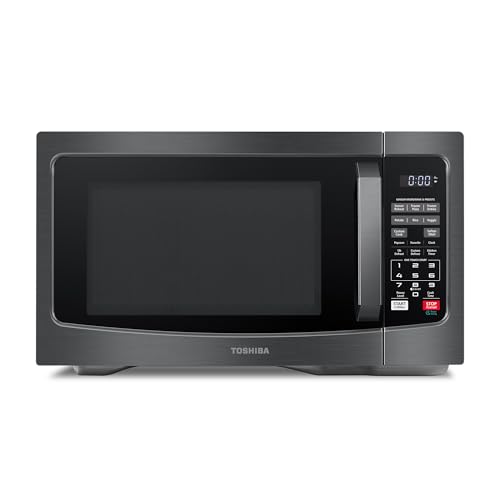
Key specs from the listing: 0.9 cu. ft. capacity; 900 watts; 6 auto menus; Mute function; Child lock; LED lighting; 10.6-inch removable turntable; Black stainless steel finish.
The Toshiba 0.9 adds the features that complicate warranty reading in a useful way: a mute function, LED lighting and a removable turntable are conveniences, while the parts a warranty truly concerns, the magnetron, control board and door assembly, sit behind them. Its review below separates the feature list from the coverage list, which is the habit this whole guide teaches. Exclusions decide real claims. Cosmetic damage, misuse, commercial use of a residential model, and damage from incorrect installation or power problems are standard carve-outs across the appliance industry. None of that makes a warranty useless; it makes it a contract with edges, and the edges are exactly what a careful buyer checks while the purchase is still a choice rather than a complaint.
Service logistics matter as much as terms. For countertop models, makers commonly ask the owner to ship the unit or bring it to an authorized service point rather than sending a technician to the home, and that practical reality is part of what you are buying. A slightly stronger paper promise from a maker with an awkward service process can underperform a simpler promise from a maker whose support is easy to reach.
A microwave warranty is not one promise but a stack of them. The base coverage typically addresses parts and labor for manufacturing defects for an initial period, and separate, longer coverage often applies to specific components the maker expects to outlast the rest of the machine. The listing page is not where those terms live; the warranty statement in the manual and on the manufacturer’s product page is the document that governs a claim, and it is the document this guide teaches you to read before money changes hands. In daily use, the details that decide whether a microwave earns its counter space are unglamorous: how evenly it reheats at the power level you actually use, whether the cavity fits your real dishes, and whether the controls make sense before coffee. The TOSHIBA 0.9 Cu. Ft. 900W Microwave with Mute Function handles that everyday test in line with what its listing promises, and nothing in its specification suggests a hidden catch for the jobs described in this guide.
The honest limitation to weigh is in the trade-offs above. No single model wins on size, power and simplicity at once, and this pick leans toward its format’s strengths rather than covering every kitchen equally well. Buyers whose kitchens match that lean will feel the trade as a benefit; buyers on the other side of it should weigh the alternatives in this list first.
The turntable question resolves itself in ordinary use. Rotating food cooks more evenly in a conventional cavity, which is why most picks here rotate, and why the one flatbed pick in some of these pools asks you to pause and turn large dishes yourself. Either system works when the cook understands it; both disappoint when treated as magic.
Best for: Quiet kitchens that still want mid-size capacity / Not suited for: Sensor-cooking seekers

TOSHIBA 1.2 Cu. Ft. 1000W Microwave with Smart Humidity Sensor
Badge: Best Sensor Model to Read Closely
Strengths
- 1000 watts is the reference power most packaged-food instructions assume
- The smart humidity sensor adjusts cooking by steam, taking guesswork out of reheating and vegetables
- 1.2 cu. ft. with a 12.4-inch turntable handles family plates and larger bowls
Trade-offs
- The largest counter footprint among the smaller picks here; measure depth and door swing
- Sensor menus reward correct use; covered dishes and venting still matter
- More features mean more to learn than a basic dial-and-go model
Key specs from the listing: 1.2 cu. ft. capacity; 1000 watts; 12.4-inch removable turntable; Smart humidity sensor; 12 auto menus; Mute function; ECO mode; Easy-clean interior; Black finish.
The Toshiba 1.2 is the pool’s sensor model, and electronics are the warranty-relevant fact about it: a humidity sensor and a larger control system mean more components whose failure is a coverage question rather than a cleaning question. On a feature-rich oven, the parts-versus-labor split in the warranty statement deserves the closest reading of any pick here. Registration and paperwork are the unglamorous half of warranty value. Keep the receipt or order confirmation, note the model and serial numbers somewhere you can find them in three years, and register the product if the maker offers it, since some makers tie enhanced support or recall notices to registration. A generous warranty you cannot document is worth little on the day the oven stops heating.
Finally, judge warranty against the machine’s tier. On a compact value model, replacement can rival repair in cost, and the warranty functions mainly as protection against early failure, which is statistically when defects appear. On a premium inverter model with a large cavity, component coverage protects a genuinely more expensive machine, and the longer component terms deserve correspondingly more weight in the decision.
The most common misunderstanding in this category is treating warranty length as a single number. Two ovens can both advertise a headline term while differing in what the later years actually cover: a component-only promise usually means the part is supplied while the labor to install it, and sometimes the service visit itself, is the owner’s expense. A shorter full-coverage promise can be worth more in practice than a longer parts-only one, and the only way to know is to read the split, not the headline. In daily use, the details that decide whether a microwave earns its counter space are unglamorous: how evenly it reheats at the power level you actually use, whether the cavity fits your real dishes, and whether the controls make sense before coffee. The TOSHIBA 1.2 Cu. Ft. 1000W Microwave with Smart Humidity Sensor handles that everyday test in line with what its listing promises, and nothing in its specification suggests a hidden catch for the jobs described in this guide.
The honest limitation to weigh is in the trade-offs above. No single model wins on size, power and simplicity at once, and this pick leans toward its format’s strengths rather than covering every kitchen equally well. Buyers whose kitchens match that lean will feel the trade as a benefit; buyers on the other side of it should weigh the alternatives in this list first.
Think about the second year, not the first week. Keypads, door latches and turntable motors are the parts that live the hardest lives, and the ownership habits that protect them are free: close the door rather than slamming it, keep liquids from pooling under the turntable ring, and never run the oven empty, which stresses the components that generate and absorb microwave energy.
Best for: Feature-rich cooking with electronics coverage in mind / Not suited for: Counters too small for a 1.2 cu. ft. footprint


COMFEE’ 0.7 Cu. Ft. 700W Countertop Microwave
Badge: Best for Dorm and Office Buyers
Strengths
- ECO mode trims standby draw, a small but real consideration for an always-plugged appliance
- Sound on/off control lets you silence the end-of-cycle beeps
- One-touch buttons keep the daily routine to a single press for common tasks
Trade-offs
- 700 watts reheats more slowly and needs time added to standard instructions
- The compact cavity excludes large plates and big bowls
- A budget-tier pick positioned for light-duty settings
Key specs from the listing: 0.7 cu. ft. capacity; 700 watts; ECO mode; Sound on/off control; One-touch buttons; Child safety lock; Black finish; Positioned by the maker for dorm, apartment and office use.
The COMFEE’ 0.7 is the dorm-and-office pick, and its warranty angle is use-case honesty: residential warranties routinely exclude or limit commercial use, and a small oven bought for a shared office kitchen lives closer to that line than a home oven does. Buyers in that setting should read the use terms before assuming the headline coverage applies to them. Service logistics matter as much as terms. For countertop models, makers commonly ask the owner to ship the unit or bring it to an authorized service point rather than sending a technician to the home, and that practical reality is part of what you are buying. A slightly stronger paper promise from a maker with an awkward service process can underperform a simpler promise from a maker whose support is easy to reach.
A microwave warranty is not one promise but a stack of them. The base coverage typically addresses parts and labor for manufacturing defects for an initial period, and separate, longer coverage often applies to specific components the maker expects to outlast the rest of the machine. The listing page is not where those terms live; the warranty statement in the manual and on the manufacturer’s product page is the document that governs a claim, and it is the document this guide teaches you to read before money changes hands.
Exclusions decide real claims. Cosmetic damage, misuse, commercial use of a residential model, and damage from incorrect installation or power problems are standard carve-outs across the appliance industry. None of that makes a warranty useless; it makes it a contract with edges, and the edges are exactly what a careful buyer checks while the purchase is still a choice rather than a complaint. In daily use, the details that decide whether a microwave earns its counter space are unglamorous: how evenly it reheats at the power level you actually use, whether the cavity fits your real dishes, and whether the controls make sense before coffee. The COMFEE’ 0.7 Cu. Ft. 700W Countertop Microwave handles that everyday test in line with what its listing promises, and nothing in its specification suggests a hidden catch for the jobs described in this guide.
The honest limitation to weigh is in the trade-offs above. No single model wins on size, power and simplicity at once, and this pick leans toward its format’s strengths rather than covering every kitchen equally well. Buyers whose kitchens match that lean will feel the trade as a benefit; buyers on the other side of it should weigh the alternatives in this list first.
Judge the oven after the hundredth ordinary day. The questions that matter by then are small and total: does it reheat evenly at the power you actually use, does the cavity fit the dishes you actually own, do the controls still make sense half-asleep, and does it clean up without a fight. An oven that passes those four has earned its counter space.
Best for: Dorm, apartment and light office use / Not suited for: Heavy shared or commercial-style use


Farberware 1.1 Cu. Ft. 1000W Countertop Microwave
Badge: Best Full-Power Family Pick
Strengths
- Multi-stage cooking lets a defrost flow straight into cooking without a second programming step
- Defrost by weight is the more accurate route for frozen meat than guessing minutes
- 1000 watts matches the assumption behind most recipe and package timings
Trade-offs
- 1.1 cu. ft. is a mid-size footprint; confirm the counter depth before ordering
- No sensor cooking is named in the listing
- Preset-heavy panels take a short learning curve
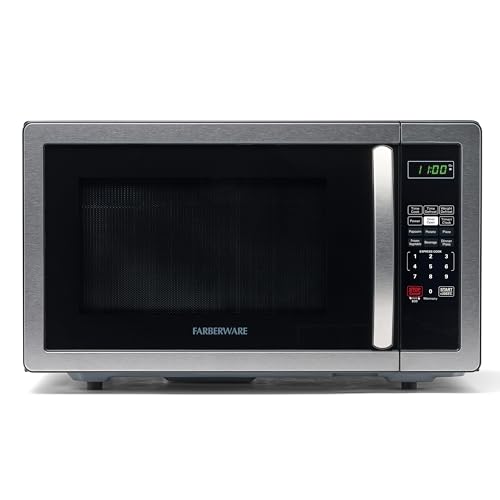
Key specs from the listing: 1.1 cu. ft. capacity; 1000 watts; Stainless steel finish; 10 power levels with multi-stage cooking; 6 preset options; Defrost by weight or by time; LED display; Express cooking.
The Farberware 1.1 closes the list as the full-power family option, and its multi-stage cooking and defrost-by-weight programs put its control electronics to work harder than a basic oven’s. More programmed work means the control board is a working component, not a bystander, and its coverage belongs on the checklist beside the magnetron’s. Finally, judge warranty against the machine’s tier. On a compact value model, replacement can rival repair in cost, and the warranty functions mainly as protection against early failure, which is statistically when defects appear. On a premium inverter model with a large cavity, component coverage protects a genuinely more expensive machine, and the longer component terms deserve correspondingly more weight in the decision.
The most common misunderstanding in this category is treating warranty length as a single number. Two ovens can both advertise a headline term while differing in what the later years actually cover: a component-only promise usually means the part is supplied while the labor to install it, and sometimes the service visit itself, is the owner’s expense. A shorter full-coverage promise can be worth more in practice than a longer parts-only one, and the only way to know is to read the split, not the headline.
Registration and paperwork are the unglamorous half of warranty value. Keep the receipt or order confirmation, note the model and serial numbers somewhere you can find them in three years, and register the product if the maker offers it, since some makers tie enhanced support or recall notices to registration. A generous warranty you cannot document is worth little on the day the oven stops heating. In daily use, the details that decide whether a microwave earns its counter space are unglamorous: how evenly it reheats at the power level you actually use, whether the cavity fits your real dishes, and whether the controls make sense before coffee. The Farberware 1.1 Cu. Ft. 1000W Countertop Microwave handles that everyday test in line with what its listing promises, and nothing in its specification suggests a hidden catch for the jobs described in this guide.
The honest limitation to weigh is in the trade-offs above. No single model wins on size, power and simplicity at once, and this pick leans toward its format’s strengths rather than covering every kitchen equally well. Buyers whose kitchens match that lean will feel the trade as a benefit; buyers on the other side of it should weigh the alternatives in this list first.
Finally, keep the paperwork habit from the warranty sections in this guide. A photograph of the rating plate, the receipt kept with the manual, and the model number stored in your phone turn any future support call from an archaeology project into a five-minute task, whatever brand ends up on your counter.
Best for: Family reheating and programmed defrosting / Not suited for: The smallest counters
Comparison Table
| Pick | Badge | Key attribute | Format | Link |
|---|---|---|---|---|
| Chefman 0.7 Cu. Ft. 700W Countertop Microwave | Best Compact Value | 0.7 cu. ft. capacity; 700 watts | Countertop, 0.7 cu. ft., 700W | Check on Amazon |
| BLACK+DECKER 0.9 Cu. Ft. 900W Countertop Microwave | Best Established-Brand Support Profile | 0.9 cu. ft. capacity; 900 watts | Countertop, 0.9 cu. ft., 900W | Check on Amazon |
| TOSHIBA 0.9 Cu. Ft. 900W Microwave with Mute Function | Best Quiet Mid-Size | 0.9 cu. ft. capacity; 900 watts | Countertop, 0.9 cu. ft., 900W | Check on Amazon |
| TOSHIBA 1.2 Cu. Ft. 1000W Microwave with Smart Humidity Sensor | Best Sensor Model to Read Closely | 1.2 cu. ft. capacity; 1000 watts | Countertop, 1.2 cu. ft., 1000W | Check on Amazon |
| COMFEE’ 0.7 Cu. Ft. 700W Countertop Microwave | Best for Dorm and Office Buyers | 0.7 cu. ft. capacity; 700 watts | Countertop, 0.7 cu. ft., 700W | Check on Amazon |
| Farberware 1.1 Cu. Ft. 1000W Countertop Microwave | Best Full-Power Family Pick | 1.1 cu. ft. capacity; 1000 watts | Countertop, 1.1 cu. ft., 1000W | Check on Amazon |
No warranty column appears in this table, deliberately: the listings do not state terms, and printing invented ones would mislead. Compare the machines here, then compare the makers’ warranty statements side by side.
How to Choose Best warranties on microwaves
Start with the base coverage. Find the manufacturer’s warranty statement for the exact model, and identify the period during which both parts and labor are covered for defects. That period is the warranty’s center of gravity; everything else is an extension or an exception to it, and it is the figure to compare first across the makers represented here.
Then read the component coverage. Microwaves commonly carry separate, longer coverage on the magnetron, the component that generates the cooking energy, and the statement will say whether that coverage includes labor or supplies the part alone. The dedicated magnetron guide linked from this page goes deeper; the working rule here is that a parts-only promise leaves you funding the repair labor, which can approach the value of a compact oven.
Read the exclusions before the promises sink in. Commercial use, misuse, cosmetic damage and power-surge damage are the recurring carve-outs, and one of them, the commercial-use line, is a genuine decision point for the dorm and office buyers two of these picks are aimed at. If your setting is shared or semi-public, the exclusion section is your section.
Finally, rehearse the claim. Where does the unit go, who pays shipping, what proof of purchase is required, and how is support reached? A warranty you have rehearsed is worth more than a longer one you have not, and the rehearsal takes ten minutes with the manual and the maker’s support page, ideally before the box is recycled.
How to Set Up, Use and Care for a Countertop Microwave
A countertop microwave asks for a short, careful setup and a handful of weekly habits. The routine below follows the order that prevents the common problems.
- Unbox on a clear counter, remove every piece of packing material from the cavity, and confirm the turntable and its ring sit flat and rotate freely by hand.
- Place the oven with the clearances its manual specifies around the vents; blocked vents are the quiet cause of overheating and shortened component life.
- Plug it directly into a wall outlet where possible rather than a power strip, and note which other appliances share the circuit.
- Wash the turntable, wipe the cavity, then run a cup of water for a minute as a first functional check: it should heat evenly and the turntable should turn smoothly.
- Learn the power-level control before the presets: reheat leftovers once at a medium level with a stir halfway, and compare the result with a full-power run.
- For weekly care: steam-clean with a heated bowl of water, wash the turntable, wipe the door seal and latch area, and check that the cavity light and door interlock behave normally.
Problem: Food heats unevenly, with hot edges and a cold center → what to do: the portions are too dense for a single full-power run; lower the power level, stir or rearrange halfway, and add standing time after the cycle ends.
Problem: The breaker trips when the microwave runs → what to do: the circuit is shared with another heavy load; move one appliance to a different circuit and avoid running heating appliances together on the same line.
Problem: Sparks or arcing appear inside the cavity → what to do: stop the oven immediately; the usual causes are metal trim on dishes, foil, or a damaged waveguide cover or cavity coating — do not run it again until the cause is identified, and never open the cabinet yourself, since internal components can hold a dangerous charge even unplugged.
Parts, Labor and the Split That Decides Real Claims
The single most consequential line in any appliance warranty is the one that separates parts from labor. During full coverage, a defect costs you nothing but inconvenience. During a parts-only extension, the maker supplies the component and you fund the diagnosis, the service visit and the installation, which on a countertop oven can total a substantial fraction of a replacement. Neither structure is dishonest; they are simply different products wearing the same headline word.
This is why the guide refuses to rank these six ovens by an unstated number. The honest ranking exercise is available to every reader: open the six warranty statements, find the full-coverage period and the component split in each, and the comparison makes itself. The oven features compared at Best Small Microwaves For Dorm and Best Small Microwaves For Seniors then break any tie the paperwork leaves.
Registration, Receipts and the Paperwork Habit
Warranty claims fail on paperwork more often than on terms. The proof of purchase establishes the coverage start; the model and serial numbers establish which statement applies; and registration, where offered, connects the maker’s recall and support notices to you directly. None of this is difficult on day one and all of it is archaeology in year three, which is why this guide repeats the habit in several sections without apology.
A practical system takes five minutes: photograph the rating plate and the receipt, store both with the manual in one folder, physical or digital, and note the purchase date in your phone. If the oven is a gift or a dorm purchase, the same folder is what the actual user needs, so pass it along with the appliance rather than keeping it with the purchaser.
Measuring Your Counter and Checking the Circuit Before You Order
Every microwave disappointment that matters starts with a tape measure that stayed in the drawer. Measure the counter footprint available, then measure the door swing and the space the door needs to open fully against walls and adjacent appliances, because a countertop oven is used with its door open far more often than product photographs suggest. Check the largest dish you genuinely use weekly against the cavity and turntable figures in the spec boxes above, not against the headline capacity alone.
Then check the electrical side. A countertop microwave is one of the heaviest loads in a kitchen while it runs, and it behaves best on a circuit that is not simultaneously feeding a kettle, toaster oven or coffee maker. If your kitchen trips breakers now, a higher-wattage pick will not fix that; it will schedule the problem for dinner time. A few minutes with the breaker panel’s labels is part of buying any oven in this guide.
Common Buying Mistakes
- Comparing warranties by headline length without reading the parts-versus-labor split.
- Assuming a listing page summary is the warranty; the maker’s statement is the only governing document.
- Discarding the receipt and box information before noting model and serial numbers.
- Buying a residential oven for a shared office setting without checking the commercial-use exclusion.
- Expecting a home service visit for a countertop model whose terms require carry-in or shipping.
- Skipping registration where the maker offers it, then missing recall or support notices.
Final Recommendation
If warranty thinking is your priority, start with the Toshiba 1.2 for the feature-rich case, where component coverage matters most, or the BLACK+DECKER 0.9 for the most conventional established-brand ownership profile. Choose the Chefman or COMFEE’ compacts if your real need is documented early-failure protection on a small oven, and the Farberware if programmed cooking puts its control board at the center of your coverage questions. In every case, read the maker’s warranty statement for the exact model before you buy; that ten-minute read is the actual recommendation of this guide.
Shortlist again: Chefman 0.7 Cu. Ft. 700W Countertop Microwave; BLACK+DECKER 0.9 Cu. Ft. 900W Countertop Microwave; TOSHIBA 0.9 Cu. Ft. 900W Microwave with Mute Function.
Frequently Asked Questions
Where do I find a microwave’s actual warranty terms?
In the manufacturer’s warranty statement for the exact model, printed in the manual and published on the maker’s product or support pages. Listing summaries omit and compress terms; the statement is the document that governs a claim.
What is the difference between parts and labor coverage?
Parts coverage supplies the replacement component; labor coverage pays for the diagnosis and installation. Many warranties cover both for an initial period, then extend parts-only coverage on major components, leaving later labor costs with the owner.
Are microwave warranties usually worth much on compact models?
Chiefly as early-failure protection. Defects tend to appear early, and on a value-tier oven a clean documented claim in that window is the realistic benefit, since out-of-warranty repair can rival replacement cost.
Does commercial use void a microwave warranty?
Residential warranties commonly exclude or limit commercial use, which can include shared office kitchens. If the oven will live in a shared setting, read that exclusion before buying rather than after a claim.
Should I register my microwave?
If the maker offers registration, yes: it links your model and serial numbers to recall and support notices and simplifies any later claim. Keep the receipt regardless, since proof of purchase is what establishes the coverage start date.
What should I do before making a warranty claim?
Gather the receipt, model and serial numbers, and a clear description or video of the fault, then contact the maker’s support channel named in the warranty statement. Rehearsing that list at purchase time is what the paperwork habit in this guide is for.