Disclosure: topratedkitchenware.com is reader-supported. When you buy through links on our site, we may earn an affiliate commission from Amazon and other retailers, at no extra cost to you.
Where to buy
Short on time? These are the six products in this guide to the best portable electric cooktops, with the linked picks carrying check-price links and any prose-only picks clearly labelled — we only link products that genuinely match what the keyword asks for. 6 of the 6 picks are linked in this guide.
- Duxtop 1800W Portable Induction Cooktop 8100MC — check the latest price on Amazon
- Duxtop Portable Induction Cooktop 9600LS — check the latest price on Amazon
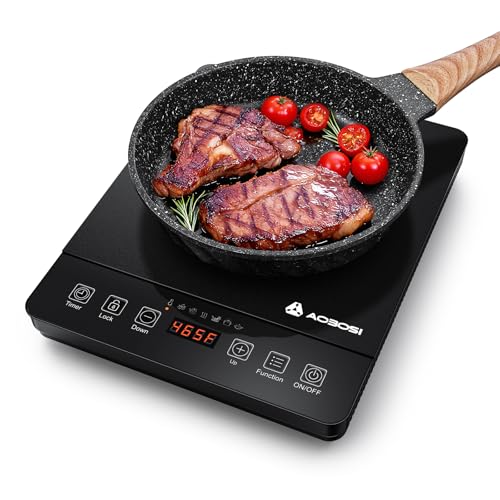
- AAOBOSI Portable Induction Cooktop 1800W — check the latest price on Amazon
- OneSetNuf 1800W Portable Induction Cooker — check the latest price on Amazon
- ChangBERT Induction Cooktop Commercial Grade — check the latest price on Amazon
- Nuwave Double Pro Induction Cooktop — check the latest price on Amazon
Read the full guide ↓
A portable cooktop earns its place by being useful in the places a fixed cooktop cannot go: the dorm room, the RV, the rental with one working burner, the holiday kitchen that suddenly needs a fifth ring. The best portable electric cooktops in this pool are all induction models, because induction is what made the category genuinely good — fast like gas, precise like electronics, and cool around the pan in a way that suits small and improvised spaces. All six picks are linked, because all six are honest examples of the thing the keyword asks for.
The ranking below weights portability in the full sense: not just weight, but storage size, circuit friendliness, control simplicity and how gracefully each unit moves between kitchen counter, campsite table and back again. The Nuwave Double Pro tops the list for households replacing a cooktop outright; the two Duxtops are the proven singles; the AAOBOSI is the apartment-and-RV specialist; and the OneSetNuf and ChangBERT are the heavy-duty options for people whose ‘portable’ still works a full shift.
One more piece of orientation before the picks: if your search is narrower than this guide, our related coverage of Best Electric And Induction Cooktops goes deeper on that specific angle.
Key Takeaways
- Top linked recommendation: Duxtop 1800W Portable Induction Cooktop 8100MC — see its full review below for the reasoning.
- 6 of the 6 pool products genuinely match the core of “best portable electric cooktops” and are linked; the rest are reviewed prose-only with the reason stated plainly.
- No static prices and no fixed ratings appear anywhere in this guide — prices move too fast to print honestly, so linked picks carry check-price links instead.
- Every product here comes from a verified pool checked on 2026-11-20; no ASIN, image or specification has been invented or borrowed from another guide.
- The buying-guide and how-to sections below the reviews are written for this product type specifically — read them before ordering, especially the sizing and compatibility notes.
In this guide
Quick Picks
All six picks for best portable electric cooktops at a glance. Badges are used consistently here and in the detailed reviews.
- Best Classic Portable: Duxtop 1800W Portable Induction Cooktop 8100MC — check the latest price on Amazon
- Best for Small Kitchens: Duxtop Portable Induction Cooktop 9600LS — check the latest price on Amazon
- Best for Apartments and RVs: AAOBOSI Portable Induction Cooktop 1800W — check the latest price on Amazon
- Most Durable Portable: OneSetNuf 1800W Portable Induction Cooker — check the latest price on Amazon
- Best Commercial Portable: ChangBERT Induction Cooktop Commercial Grade — check the latest price on Amazon
- Best Overall Portable: Nuwave Double Pro Induction Cooktop — check the latest price on Amazon
How These Picks Were Chosen
This guide is research-led. We worked from a verified product pool for this category — each product’s identity, brand and specifications confirmed against its listing data on 2026-11-20 — and then applied the keyword’s own test: does this product genuinely match what someone searching for the best portable electric cooktops is trying to buy? Products that passed are linked with their verified images. Products that failed the test on fuel, format or core attribute were not quietly dropped; they are reviewed in full as prose-only entries, with the mismatch stated in plain language, because a reader comparing options deserves to know why a familiar product is not being recommended here.
Within the matching picks, ranking weighs the factors the buying-guide section explains: core performance for this product type, build and materials as specified, safety features and certification where they exist, and the honesty of each product’s positioning — a product that claims exactly what it is scores better with us than a stronger product wrapped in inflated claims. We do not claim hands-on laboratory testing; where long-term behaviour is discussed, it is reasoned from construction, specifications and the documented experience of owners of this product class. Prices are never printed, because they change faster than any guide can be updated; tiers are compared instead. Readers weighing a narrower variant of this search may also find our guide to Best Electric Cooktops useful alongside this one.
The 6 Picks for Best Portable Electric Cooktops
Duxtop 1800W Portable Induction Cooktop 8100MC
Badge: Best Classic Portable
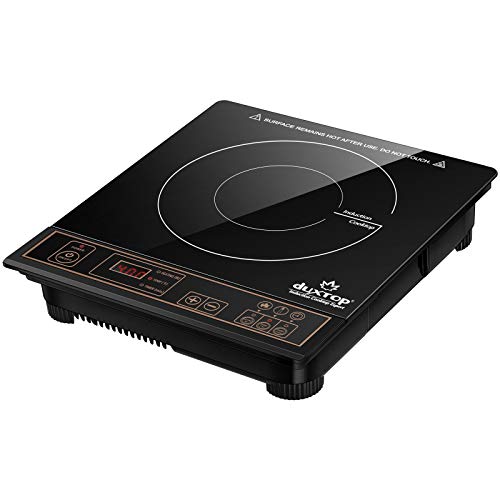
The Duxtop 8100MC is one of the longest-running portable induction burners on the market, and its appeal is simplicity: 1800 watts, a single cooking zone, and controls that do not require a manual to decode. As an electric burner it is quick — induction drives the pan itself rather than heating an element first — and the countertop stays comparatively cool around the pan, which is a genuine safety plus in a small or busy kitchen.
Its limits are structural. One burner means one pan, so it is a supplement, a dorm or office solution, a holiday-overflow burner, or a first induction trial — not a whole kitchen. And like every induction unit here, it only works with magnetic cookware; an aluminium or copper pan without an induction base will simply sit there cold while the unit reports no pan. Within those limits it is a proven, fuss-free design.
As a portable first and a cooktop second, this pick balances size, circuit manners and everyday cooking ability.
Strengths
- True countertop portability — plugs in, cooks, then stores in a cabinet
- Induction heats the pan directly, so boil times beat a coil hot plate comfortably
- A long-running, widely understood model design with simple controls
Trade-offs
- Single burner only — it supplements a cooktop rather than replacing one
- Requires induction-compatible (magnetic) cookware
- Not a gas appliance, so it cannot answer a gas-specific brief on its own
At a glance
- Format: portable countertop induction burner
- Power: 1800W
- Model: 8100MC / BT-180G3
- Finish: gold
Check on Amazon · See the Duxtop 1800W Portable Induction Cooktop 8100MC on Amazon
Best for: readers who value that it is strong on this point — true countertop portability — plugs in, cooks, then stores in a cabinet / Not suited for: readers whose needs clash with its main trade-off — single burner only — it supplements a cooktop rather than replacing one
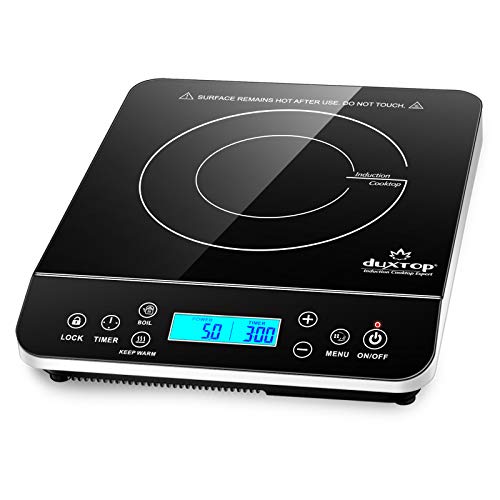
Duxtop Portable Induction Cooktop 9600LS
Badge: Best for Small Kitchens
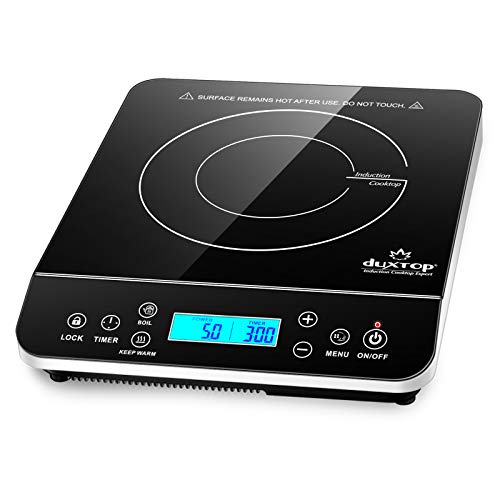
The 9600LS is Duxtop’s step-up portable: the same 1800-watt induction platform as its sibling, but with an LCD sensor-touch panel that gives more granular control over power and temperature. That granularity is what you feel when you hold a delicate sauce — induction’s low settings cycle less crudely here, and the flat glass surface makes the unit the easiest in this pool to clean: no grates, no caps, no drip trays, just a wipe.
The trade-offs are the familiar induction ones plus one ergonomic note. Sensor-touch panels and wet hands are uneasy partners, and adjusting heat with damp fingers mid-sauté can take a second tap. The cooling fan is audible under sustained high power. Neither flaw is unusual in this class, and for a renter, a small household, or anyone adding a precise extra burner, the 9600LS is the more refined of the two Duxtop designs.
As a portable first and a cooktop second, this pick balances size, circuit manners and everyday cooking ability.
Strengths
- LCD sensor-touch panel gives finer, more repeatable power and temperature steps
- Flat glass top wipes clean in seconds with no grates or burner caps to scrub
- 1800W induction output for fast boils on a standard household circuit
Trade-offs
- Touch controls can be finicky with wet or greasy fingers mid-cooking
- Single burner, and the fan noise under load is audible in a quiet kitchen
- Induction-ready cookware only — non-magnetic pans will not heat
At a glance
- Format: portable countertop induction burner
- Power: 1800W
- Controls: LCD sensor touch
- Model: 9600LS / BT-200DZ
- Finish: silver
Check on Amazon · See the Duxtop Portable Induction Cooktop 9600LS on Amazon
Best for: readers who value that it is strong on this point — lCD sensor-touch panel gives finer, more repeatable power and temperature steps / Not suited for: readers whose needs clash with its main trade-off — touch controls can be finicky with wet or greasy fingers mid-cooking

AAOBOSI Portable Induction Cooktop 1800W
Badge: Best for Apartments and RVs
The AAOBOSI competes on control density: twenty combined temperature and power levels, four preset modes and a four-hour timer in a compact 1800-watt body. For cooks who like to dial a specific level and trust it — candy work, a long gentle braise on the counter, keeping a pot at serving temperature through a party — that granularity is the reason to pick it over simpler rivals.
It is explicitly pitched at apartments, RVs and outdoor cooking, and that framing is accurate: it is a one-pan, plug-anywhere burner that stores flat. The presets are a convenience rather than a revelation, and experienced cooks will mostly live on the manual levels, but there is no penalty for having them. As with all induction here, check your pans with a magnet before assuming compatibility.
As a portable first and a cooktop second, this pick balances size, circuit manners and everyday cooking ability.
Strengths
- Twenty power/temperature levels is fine-grained control for this class
- Four preset modes simplify repeat tasks like boiling, frying and keeping warm
- Compact body suits apartments, RVs and outdoor cooking setups
Trade-offs
- Single cooking zone, like every portable in this pool
- Preset naming varies in usefulness — most cooks end up on manual levels
- Induction-compatible cookware is mandatory
At a glance
- Format: portable countertop induction cooktop
- Power: 1800W
- Settings: 20 temperature and power levels
- Modes: 4 preset modes
- Timer: up to 4 hours
Check on Amazon · See the AAOBOSI Portable Induction Cooktop 1800W on Amazon
Best for: readers who value that it is strong on this point — twenty power/temperature levels is fine-grained control for this class / Not suited for: readers whose needs clash with its main trade-off — single cooking zone, like every portable in this pool

OneSetNuf 1800W Portable Induction Cooker
Badge: Most Durable Portable
The OneSetNuf is the workhorse entry: a stainless-steel portable induction cooker with push-button controls, dual IGBT power control, eighteen temperature settings and a ten-hour timer. The push buttons deserve emphasis — in a real cooking session, with wet hands and steam everywhere, a physical button that clicks is simply more reliable than a glossy touch panel, and that is why commercial-style units keep them.
The long timer and the dual-IGBT design point the same way: this unit is built for sustained, unglamorous work — a stock simmering all afternoon, a catering holding station, a prep kitchen’s extra burner. Its honest limits are the 8-inch coil, which suits small-to-medium pans best, and a utilitarian appearance that will not win a design award. For buyers who rank durability and control over looks, it is the pool’s most serious tool.
As a portable first and a cooktop second, this pick balances size, circuit manners and everyday cooking ability.
Strengths
- Push-button controls stay usable with wet or floury hands, unlike touch panels
- A 10-hour timer is the longest in this pool — built for slow, unattended runs
- Dual IGBT power control is a durability-oriented design choice for sustained loads
Trade-offs
- Commercial styling is plain — function over kitchen-counter looks
- Single zone and an 8-inch coil cap the pan sizes it heats evenly
- The stainless body is heavier to move around than the glass-top portables
At a glance
- Format: portable induction cooker, stainless steel body
- Power: 1800W
- Heating zone: 8-inch coil (as listed)
- Control: dual IGBT power control, push-button controls
- Settings: 18 temperature settings
- Timer: up to 10 hours
Best for: readers who value that it is strong on this point — push-button controls stay usable with wet or floury hands, unlike touch panels / Not suited for: readers whose needs clash with its main trade-off — commercial styling is plain — function over kitchen-counter looks

ChangBERT Induction Cooktop Commercial Grade
Badge: Best Commercial Portable
The ChangBERT is the pool’s credentialled commercial unit: NSF certified, stainless steel throughout, a large 8-inch heating coil and 1800 watts with a ten-hour timer. NSF certification matters because it is an independent sanitation and construction standard that actual commercial kitchens are required to meet — it separates this unit from portables that merely use the word ‘professional’ in their marketing.
In practice that buys you a burner designed to be run hard every day and hosed down figuratively if not literally: seams, surfaces and controls chosen for cleaning and endurance. For a home cook it is arguably overbuilt, and its single zone means it will never replace a multi-burner top. But for a food truck, a café prep station, a caterer, or a home cook who burns through a portable every couple of years, the ChangBERT’s certification and construction are the substance behind the ‘commercial grade’ claim.
As a portable first and a cooktop second, this pick balances size, circuit manners and everyday cooking ability.
Strengths
- NSF certification is a real commercial-kitchen credential, rare at this tier
- Stainless commercial build is designed for daily, heavy-duty cycles
- Large 8-inch coil and a 10-hour timer suit long, steady cooking tasks
Trade-offs
- Commercial styling and footprint are more than a casual home user needs
- Single burner — throughput comes from endurance, not parallel pans
- Induction-ready cookware only
At a glance
- Format: commercial-grade portable induction cooker
- Power: 1800W
- Heating coil: large 8-inch
- Body: premium stainless steel
- Certification: NSF certified
- Timer: up to 10 hours
Best for: readers who value that it is strong on this point — nSF certification is a real commercial-kitchen credential, rare at this tier / Not suited for: readers whose needs clash with its main trade-off — commercial styling and footprint are more than a casual home user needs

Nuwave Double Pro Induction Cooktop
Badge: Best Overall Portable
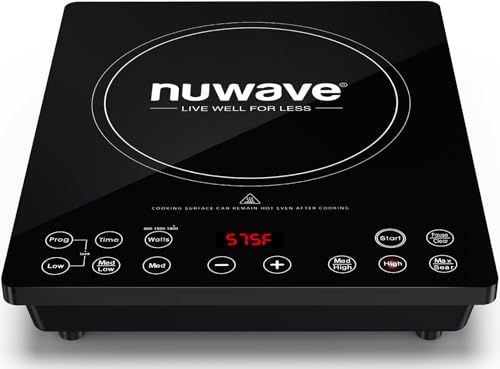
The Nuwave Double Pro solves the single-burner problem that limits every other portable here: it puts two induction zones on one countertop unit, with a stated temperature range running from a gentle 50°F keep-warm up to 575°F, and Dynamic Watt Technology that lets the unit run at 900, 1500 or 1800 watts depending on the circuit it is plugged into. That wattage flexibility is quietly valuable in RVs, older homes and event spaces where a full 1800-watt draw is not guaranteed.
Two zones change what a portable can be: pasta in one, sauce in the other; a sear happening while vegetables hold warm. The honest caveat is power sharing — two zones on one plug split the budget, so neither runs at absolute maximum simultaneously — and the unit is physically bigger than the singles. For small kitchens cooking real two-pan meals, it is the most complete portable answer in this pool.
As a portable first and a cooktop second, this pick balances size, circuit manners and everyday cooking ability.
Strengths
- Two burners — the only double in this pool — for a main pan plus a side or sauce
- A very wide stated temperature range, down to a true keep-warm and up to searing heat
- Dynamic Watt Technology lets it adapt to different circuit capacities
Trade-offs
- Two zones share the unit’s power budget, so both at maximum is not possible
- Larger footprint than the single portables — measure your counter or RV space
- Touch panel shares the usual wet-finger caveat of glass controls
At a glance
- Format: portable double induction cooktop
- Temperature range: 50°F–575°F (as listed)
- Power: 900 / 1500 / 1800W with Dynamic Watt Technology
- Heating coil: 8-inch
- Surface: shatter-proof ceramic glass
- Controls: seamless IMD touch panel
Best for: readers who value that it is strong on this point — two burners — the only double in this pool — for a main pan plus a side or sauce / Not suited for: readers whose needs clash with its main trade-off — two zones share the unit’s power budget, so both at maximum is not possible
Comparison Table
| Pick | Badge | Key attribute | Status | Link |
|---|---|---|---|---|
| Duxtop 1800W Portable Induction Cooktop 8100MC | Best Classic Portable | Power: 1800W | Linked | Check on Amazon |
| Duxtop Portable Induction Cooktop 9600LS | Best for Small Kitchens | Power: 1800W | Linked | Check on Amazon |
| AAOBOSI Portable Induction Cooktop 1800W | Best for Apartments and RVs | Power: 1800W | Linked | Check on Amazon |
| OneSetNuf 1800W Portable Induction Cooker | Most Durable Portable | Power: 1800W | Linked | Check on Amazon |
| ChangBERT Induction Cooktop Commercial Grade | Best Commercial Portable | Power: 1800W | Linked | Check on Amazon |
| Nuwave Double Pro Induction Cooktop | Best Overall Portable | Temperature range: 50°F–575°F (as listed) | Linked | Check on Amazon |
Comparing across this table is easier alongside a narrower shortlist — see Best Electric Cooktops 110v for one focused variant of this category.
How to Choose a Portable Electric Cooktop That Actually Performs
Start with the wattage and what it means. Every unit in this pool is rated at 1800 watts, the practical ceiling for a standard US household circuit, and that number is your boiling speed, your sear recovery and your ceiling all at once. Performance differences between 1800W units come from how honestly and evenly that power is delivered: the size of the induction coil relative to your pans, how finely the power levels are graduated at the low end, and whether the unit cycles crudely on and off at low settings or modulates smoothly. A wide, well-graduated level range — twenty levels on the AAOBOSI, eighteen temperature settings on the OneSetNuf — is worth more in daily use than a headline wattage they all share.
Match the coil to your cookware. An 8-inch coil heating a 12-inch skillet gives you a hot centre and cool edges. If your cooking centres on one medium pan, an 8-inch coil is fine; if you regularly use a large Dutch oven or a wide frying pan, prioritise the units whose coil and glass are sized for it, and always check the base diameter of your favourite pans before ordering. Cookware must be magnetic — cast iron and magnetic stainless steel work; aluminium, copper and glass do not, unless they carry an induction base plate. The fridge-magnet test takes five seconds and prevents the most common disappointment in this category.
Decide how many burners your cooking actually uses. A single portable is a supplement and a specialist; a double like the Nuwave changes the category into a genuine small-kitchen cooktop. Count your typical meals honestly: if two pans on the heat at once is your normal Tuesday, a single burner will frustrate you within a month, however good it is. Also consider the circuit: two zones on one plug share one power budget, and a unit with selectable wattage (900/1500/1800W) is the safer choice for RVs, dorms and older wiring.
Controls and timers are daily-life features. Touch panels look clean and wipe clean, but physical push buttons work with wet hands. Timers range from the AAOBOSI’s four hours to ten hours on the OneSetNuf and ChangBERT — the difference between a burner that can babysit a stock and one that cannot. Finally, weigh certification where it exists: the ChangBERT’s NSF listing is a construction and sanitation standard, not a marketing word, and for anyone cooking for the public it can be a requirement rather than a preference.
How to Use, Clean and Troubleshoot a Portable Induction Cooktop
Induction rewards a slightly different routine from gas or coil cooking. Work through it once and it becomes habit:
- Check the pan first. Magnet on the base — if it sticks firmly, the pan will heat. Centre the pan on the marked zone before switching on; most units will not start, or will error, without a pan present.
- Start mid-power, then adjust. Induction responds almost instantly, so overshooting is easy. Bring liquids up at a high level, then drop to your simmer level once you see movement.
- Cook with a lid when you can. Because the energy goes into the pan, a lid makes boils dramatically faster and keeps the glass cleaner.
- Lift, don’t slide. Sliding heavy cast iron across glass risks scratches. Lift pans to move them, and keep sugary spills wiped up before they bake on.
- Let the fan finish. Many units run their cooling fan briefly after switch-off. Let it — unplugging mid-cycle shortens component life.
Cleaning is the category’s gift: the glass never gets as hot as the pan, so spills rarely carbonise. Wait until the surface is warm rather than hot, wipe with a damp cloth and a drop of detergent, and use a ceramic-glass cleaner only for stubborn marks. Never use abrasive pads on the glass, and keep water out of the vents on the sides and underside.
Troubleshooting. Problem: the unit beeps and will not heat → what to do: check the pan — it is almost always non-magnetic cookware, a pan far smaller than the coil, or a pan sitting off-centre; swap or re-centre it. Problem: power drops or the unit shuts down during a long high-power run → what to do: this is thermal protection; clear anything blocking the side vents, move the unit away from a wall, and restart at a slightly lower level. Problem: a sauce will not hold a gentle simmer and keeps surging → what to do: use a heavier-based pan, which smooths the unit’s power cycling, and choose the lowest temperature-based setting rather than the lowest power level.
For readers whose project is more specific than the general routine above, Best Electric Cooktops For Cast Iron covers a closely related angle in depth.
Power Management: Getting Full Performance From a Household Circuit
Every unit in this pool draws up to 1800 watts, and a standard North American kitchen circuit is typically rated at 15 or 20 amps — which means a portable induction burner at full power is not a trivial load alongside a kettle, a microwave or a toaster oven on the same circuit. Performance complaints that blame the burner are often circuit complaints in disguise: a unit that seems to pulse or underdeliver may be sharing its circuit with another heavy appliance, or plugged into an outlet at the far end of a long run. Give a portable its own outlet where you can, and never run one from a lightweight extension lead — the voltage drop under sustained load is real, and the lead itself becomes a heat source.
This is also where selectable wattage earns its keep. The Nuwave Double Pro’s 900/1500/1800-watt settings are a deliberate answer to constrained supplies: run at 1500 watts in an older apartment and you lose a little boil speed but keep the breaker closed and every other appliance alive. In an RV the same logic applies to shore-power limits. Conversely, if your kitchen has a modern 20-amp circuit with little else on it, a fixed 1800-watt single like the Duxtop models will simply run at full song, and the simpler appliance is the better buy.
Finally, think about heat in the room rather than in the pan. Induction dumps far less waste heat into a small kitchen than a coil or radiant burner, because the energy goes into the cookware instead of the air. In a studio flat in summer, that difference is the difference between cooking dinner and heating the whole home. It is one of the quiet reasons this entire pool is induction rather than coil: for portable and small-space use, the technology’s efficiency is a comfort feature, not just a speed feature.
Induction vs Coil vs Radiant: Picking the Right Electric Technology
Portable electric cooking comes in three technologies, and this pool’s all-induction line-up is a deliberate editorial choice worth explaining. Coil burners are the oldest design: cheap, tolerant of any pan, and slow to respond in both directions — they take time to heat and time to cool, which makes simmer control an exercise in anticipation. Radiant glass-top units are faster to clean and prettier, but the element still heats glass first and pan second, so response and efficiency sit between coil and induction.
Induction heats the pan directly through a magnetic field, which is why these units boil quickly, respond almost instantly to a change of setting, and leave the surrounding surface comparatively cool. The costs of the technology are the two you have read throughout this guide: cookware must be magnetic, and the electronics include a cooling fan whose sound becomes part of your kitchen. For most portable and supplementary uses, that trade is decisively worth it — which is why credible ‘best portable’ lists have converged on induction over the past decade.
Where would we still choose otherwise? A household with a beloved set of non-magnetic pans and no wish to replace them might rationally pick a radiant portable and accept slower response. A commercial user who needs to run any vessel that comes to hand — the OneSetNuf’s coil-style presentation notwithstanding, it too is induction — faces the same logic. Technology choice is cookware choice; audit your pans first, and the right category usually chooses itself.
Portable Cooktops for RVs, Dorms and Small Apartments
Portability is a circuit question before it is a size question. RV parks, dorm rooms and older apartments often cannot spare a full 1800 watts alongside everything else on the circuit, which is why the Nuwave’s selectable 900/1500/1800-watt operation is more than a spec-sheet curiosity — it is the difference between cooking and tripping a breaker. The AAOBOSI’s compact footprint and preset modes are pitched at exactly these spaces, and its four-hour timer suits the set-and-monitor rhythm of small-space cooking.
Storage is the second test. A portable that lives in a shallow drawer gets used; one that needs a cupboard excavation does not. The glass-top singles store flattest, the stainless commercial units store heaviest, and the double needs a genuine home. Measure your storage spot with the same care you measure the counter.
Using a Portable Cooktop as Your Only Cooktop
Plenty of households now cook entirely on portables — studio flats, annexes, and kitchens mid-renovation. If that is your plan, the honest advice is to buy for the two-pan meal: either the double-zone Nuwave, or two singles on separate circuits, which also gives you redundancy if one fails. A single burner as an only cooktop works for one-pan cooking styles and patient cooks, and frustrates everyone else by the second week.
Build the rest of the station around it: a heat-safe surface, ventilation you will actually use (a window and a small fan beat nothing), and pans chosen for induction from the start. Done deliberately, a portable station is not a compromise kitchen — it is a small, fast, precise one.
Related reading: Best Electric Cooktops For Home explores the neighbouring question most readers ask next.
Packing, Travel and Storage: The Portable Details That Decide Satisfaction
Portability is tested on the worst day, not the best: the day you carry the unit up two flights of stairs, pack it into a car boot beside a cool box, or retrieve it from storage with guests arriving in an hour. Weight and handle-ability matter more than headline dimensions. The glass-top singles in this pool are the natural travellers — flat, light, and quick to wipe before packing. The stainless commercial units travel like tools: heavier, tougher, and unbothered by being stacked under other equipment. The double is a destination appliance; it moves between homes and semesters, not between picnic sites.
Protect the surface in transit. Glass tops survive years of cooking and one bad journey unprotected against a cast-iron pan. A towel or the original packaging between the unit and anything hard is the whole secret. Store the cord loosely, keep the vents unobstructed even in storage so dust does not pack into them, and if the unit will sit unused for months — a holiday home, a seasonal RV — run it for five minutes on your return before trusting it with dinner; fans and electronics appreciate the exercise, and you will hear any problem before it matters.
Finally, build the travel kit once: the unit, one proven induction pan, a spatula, and a small bottle of oil fit in a single crate and turn any socket into a kitchen. That kit, more than any specification, is what ‘portable’ was supposed to mean.
One under-discussed performance factor is pan flatness. Induction couples energy through the pan base, and a warped pan that rocks on the glass couples unevenly — you get a hot ring, a cool patch, and a burner that seems inconsistent when the pan is the problem. If a unit in this pool underperforms with one specific pan and excels with others, suspect the pan before the burner. Heavy, machined-flat bases — cast iron, quality tri-ply — are the partners these cooktops were designed for.
Noise deserves a line in any honest buying guide. All of these units use a cooling fan, and fan noise scales with power and duration: a quick boil is a brief whoosh, a two-hour braise is a long, low background hum. In an open-plan apartment that matters more than another half-level of temperature granularity. Push-button commercial-style units tend to be voiced for workshops rather than living rooms; the glass-top consumer models are usually the quieter housemates.
Think about where the cord and the unit will actually live. A portable that must be fetched from a high cupboard will be used half as often as one that lives on the counter or in a shallow drawer near the hob. Measure the storage spot before you buy, check the cord length against your socket positions, and remember that these units need a few inches of clear air around their vents in use — a burner wedged between a wall and a bread bin will thermal-throttle on long cooks.
Finally, consider the second-burner effect on your main kitchen. Many buyers purchase a portable as a supplement and discover it quietly becomes the default for breakfast, sauces and reheating, because it is fast, precise and wipes clean. That is an argument for buying the version with the controls and timer you actually like, rather than the cheapest unit that meets the wattage number — daily-touch features compound in value every single week you own the thing.
Warranty and support deserve a final word, because portable induction units are electronics in a way a gas burner is not. The failure modes are control boards, fans and sensors, and the difference between brands shows up in whether those parts and the people who fit them are reachable in year three. Established names in this pool have long product histories and deep owner communities, which is itself a form of support: almost any fault you can describe has been described, diagnosed and solved publicly by another owner. Newer brands compete on specification density, which is real value — but weigh a proven support trail alongside the extra settings when the prices are close.
One last practical check before ordering: the underside. Portable induction units breathe through vents on their sides and base, and they expect a flat, hard, heat-tolerant surface with air space around them. A unit placed on a tablecloth, a soft mat or a crowded counter with its vents against a wall will run hotter and throttle sooner. Clear, hard and level is the whole requirement — meet it, and every burner in this pool will deliver the performance its specification promises.
Common Buying Mistakes
- Buying the headline, not the product. Whether it is a total-BTU figure, a maximum temperature or a cooking-area number, the biggest printed number is rarely the one that decides daily satisfaction. Read the spread — the low end, the evenness, the usable area.
- Skipping the compatibility check. Fuel type and conversion, cutout dimensions, circuit capacity, pan magnetism, storage footprint: five minutes of measuring prevents the most common returns in this category.
- Trusting a printed price or rating from a guide. Both move constantly. Any guide that prints them as facts — including for the best portable electric cooktops — is handing you stale data; use live check-price links and judge products on construction and fit.
- Buying a mismatch because it was discounted. A product that fails your core requirement — wrong fuel, wrong size, wrong format — is not a bargain at any price. The prose-only picks in this guide exist to make that line visible.
- Ignoring the cleanup and ownership story. The product you clean easily is the product you keep using. Read the care requirements before the feature list.
Final Recommendation
Start with the Duxtop 1800W Portable Induction Cooktop 8100MC. It is the first linked pick in this guide because it passes the keyword’s core test cleanly and backs it with the strongest overall specification in the matching set — and for most readers searching for the best portable electric cooktops, it is the purchase that needs no further justification. From there, choose by your constraint: work down the linked picks in order, and let the badges steer you — each one names the household or cooking style that pick serves best.
Treat the prose-only entries as what they are: good products answering different questions, included so your comparison is complete and honest. If one of them actually matches your real requirement better than the keyword you typed, follow the requirement, not the keyword — and our guide to Best Electric Cooktops For Small Kitchens may be the better starting point for that search.
Frequently Asked Questions
Are portable induction cooktops as fast as a full-size cooktop?
At 1800 watts a good portable boils water faster than a typical electric coil burner and rivals many full-size elements for a single pan. What it cannot do is run several large pans at full power at once — that is a question of total power and zones, not of the technology.
What pans work on these burners?
Any pan with a magnetic base: cast iron, enamelled cast iron and magnetic-grade stainless steel. Aluminium, copper and glass pans need an induction-ready base plate to work. The magnet test on your existing pans is the reliable check.
Can I use a portable induction cooktop in an RV or dorm?
Yes, and it is one of the best uses — no open flame and a standard plug. Check the circuit first: a unit with selectable wattage, like the Nuwave’s 900/1500/1800W settings, avoids tripping limited supplies.
Why does my induction burner make a buzzing sound?
A light hum or buzz at high power is normal, especially with thin or multi-ply pans; the sound comes from vibration in the pan itself. Heavier pans are quieter. A loud clicking at low power usually means the unit is cycling — also normal.
Is induction safe around pacemakers and kids?
The glass around the pan stays far cooler than gas or coil surfaces, which helps with children, though the pan itself is hot. Pacemaker guidance varies by device maker, so follow your cardiologist’s advice on distance from the coil.
How long will a portable induction cooktop last?
The electronics are the lifespan limit rather than the surface. Commercial-certified and dual-IGBT designs are built for heavier daily cycling; occasional-use home units typically serve for years if their vents are kept clear.