Disclosure: topratedkitchenware.com is reader-supported. When you buy through links on our site, we may earn an affiliate commission from Amazon and other retailers, at no extra cost to you.
Where to buy
If you are shopping for the best quick brew coffee makers covered in this guide, start with the six verified picks below. Each name links to its Amazon listing so you can check the latest price on Amazon and confirm the current configuration before you decide. Prices and availability change, so we never print a fixed figure here.
- BLACK+DECKER CM2046S — Best Programmable Head Start. Check on Amazon for the current listing details.
- Cuisinart PerfecTemp DCC-3400NAS — Best Full-Pot All-Rounder. Check on Amazon for the current listing details.
- BLACK+DECKER CaféCraft — Best for Hot and Iced. Check on Amazon for the current listing details.
- Cuisinart PerfecTemp, White — Best Small-Batch Speed. Check on Amazon for the current listing details.
- BUNN Speed Brew Platinum — Best Overall for Speed. Check on Amazon for the current listing details.
- Hamilton Beach FlexBrew Advanced — Best Single-Cup Shortcut. Check on Amazon for the current listing details.
Read the full guide ↓ for how each pick performs, where each one compromises, and which households each one actually suits.
The best quick brew coffee makers are not really about a stopwatch number on a box. They are about the total distance between deciding you want coffee and actually drinking it, on a real morning, with a real schedule. That distance includes heating time, brewing time, the size of the batch you actually make, whether the machine can be programmed the night before, and whether you can pour a first cup before the cycle ends. This guide measures every pick against that whole journey rather than against a single advertised brew time.
One pick here is a genuine speed specialist: the BUNN Speed Brew Platinum, from a brand whose entire identity is fast brewing, built to turn out a ten-cup thermal pot in a fraction of the time a conventional cycle takes. The others earn their place through different kinds of quick. Programmable models remove the wait entirely by having coffee ready when you wake. A 1-4 cup setting makes small batches finish sooner because there is simply less water to move. Brew pause lets an impatient drinker pour mid-cycle. And the FlexBrew Advanced can sidestep the pot altogether with a single serving when one person needs coffee now and the household pot can wait.
Speed has a flavour price if it is bought carelessly, so this guide is equally clear about the trade-offs: cycles that rush water through grounds can under-extract, and the fastest routine in the world still tastes like the beans you put in. You will find the techniques that keep quick coffee tasting like coffee in the how-to section. If your bottleneck is really one mug for one person, also see Best Small Single Serve Coffee Makers once you have compared the pot brewers here.
Key Takeaways
- Total time to first cup matters more than rated brew time: batch size, programming and brew pause all shorten a real morning.
- The BUNN Speed Brew Platinum is the outright speed pick, built around fast full-pot brewing for households that drink together.
- Programmable models are effectively instant at wake-up time, because the work happened while you slept.
- Small batches are the hidden shortcut: a 1-4 cup setting finishes faster and extracts better than a full-size cycle run at a third capacity.
- Single-serve modes beat any pot for one urgent cup, which is the FlexBrew Advanced’s strongest quick-brew argument.
- Protect flavour at speed by keeping grind, ratio and fresh water consistent; a rushed recipe makes a fast machine taste worse, not better.
In this guide
Quick Picks
| Pick | Badge | Headline facts |
|---|---|---|
| BLACK+DECKER CM2046S | Best Programmable Head Start | Capacity: 12 cups; Carafe: thermal |
| Cuisinart PerfecTemp DCC-3400NAS | Best Full-Pot All-Rounder | Capacity: 12 cups; Carafe: double-wall stainless steel thermal |
| BLACK+DECKER CaféCraft | Best for Hot and Iced | Capacity: 12 cups; Carafe: thermal |
| Cuisinart PerfecTemp, White | Best Small-Batch Speed | Capacity: 12 cups; Carafe: PerfecTemp thermal carafe |
| BUNN Speed Brew Platinum | Best Overall for Speed | Capacity: 10 cups; Carafe: thermal |
| Hamilton Beach FlexBrew Advanced | Best Single-Cup Shortcut | Format: 5-in-1 drip and single serve; Modes: hot and iced coffee |
How These Picks Were Chosen
We selected these six from the verified pick pool and then interrogated each one on a single question: how does this machine shorten a real morning? Picks qualified through different answers — outright brewing speed, programmability that moves the work to the night before, a small-batch cycle that moves less water, a brew pause that releases a first cup early, or a single-serve mode that skips the pot entirely. A machine with no credible answer to that question did not belong in a quick brew guide, whatever else it did well.
We also weighed capacity against speed honestly. A fast ten-cup pot and a slow twelve-cup pot can deliver a first drink at surprisingly similar times once pouring and batch habits are counted, so each review describes the household rhythm a machine suits rather than declaring one universal winner. Households where counter space is the binding constraint should cross-check Best Space Saving Drip Coffee Makers alongside this guide.
Method note: this is research-led guidance drawn from manufacturer specifications and listing data, not stopwatch testing in a laboratory kitchen, and we do not print invented minute-by-minute timings for machines whose listings do not state them. Where a model’s name and line are built around speed, we say so; where a model is quick for indirect reasons, we explain the mechanism so you can judge it against your own routine.
As throughout this site, there are no static prices and no fixed ratings or review counts in this guide, because both change and neither tells you how fast coffee reaches your cup. Links go only to the verified listings in the pool.
The 6 Best Quick Brew Coffee Makers, Reviewed in Detail
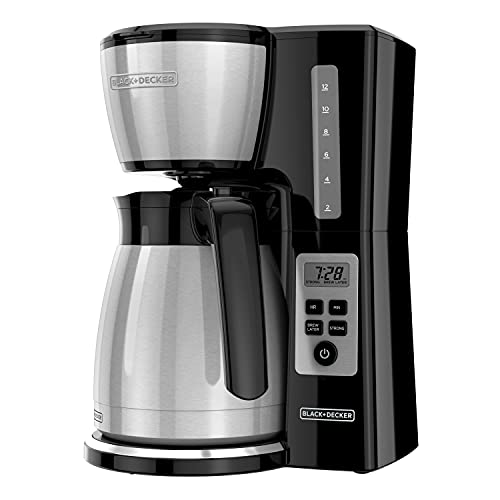
BLACK+DECKER 12-Cup Thermal Programmable Coffee Maker CM2046S
Badge: Best Programmable Head Start
Strengths
- Programmable start means the pot can be finished before your alarm finishes
- Twelve-cup thermal capacity serves a whole household in one fast morning cycle
- Brew strength control lets you keep flavour up when the routine is rushed
Trade-offs
- Not a dedicated speed brewer: its cycle is conventional, so its quickness comes from scheduling, not brewing pace
- No listed small-batch mode, so a fast two-cup start is not its strength
- VORTEX saturation is a taste feature first; it does not shorten the cycle
At a glance: Capacity: 12 cups · Carafe: thermal · Programmable: yes · Brew strength control: yes · Technology: VORTEX Technology · Colour: Black/Steel · Model: CM2046S
The CM2046S is quick the way a good alarm clock is quick: it does the work before you are awake. Programme it the night before and a twelve-cup thermal pot is waiting when you reach the kitchen, which makes its effective morning brew time zero. For households that leave together — school run, commute, shared breakfast — that head start beats any in-the-moment brewing speed, because nobody stands watching a carafe fill.
Its VORTEX saturation and strength control keep the pre-programmed pot honest on flavour, and the thermal carafe forgives a programme set slightly early. The honest limitation is that if you forget to set it, you are waiting for a conventional full-pot cycle with no shortcut. Treat the nightly set-up as part of the routine — beans, water, timer — and this machine quietly removes coffee from your morning entirely.
Best for: organised households happy to set a timer the night before / Not suited for: spontaneous brewers who decide on coffee at the last second

Cuisinart PerfecTemp 12-Cup Thermal Drip Coffee Maker DCC-3400NAS
Badge: Best Full-Pot All-Rounder
Strengths
- Hotter PerfecTemp brewing extracts efficiently, so full flavour does not require stretching the cycle
- Twelve-cup thermal pot covers a household in one cycle instead of two
- Brew strength control gives a bolder pot without a second, slower special brew
Trade-offs
- No fast-brew branding or dedicated speed mode is listed; pace is standard for its class
- No 1-4 cup setting is listed, so small urgent batches are not optimised
- Programming details are shared with its sibling model, so check the listing for the exact feature set
At a glance: Capacity: 12 cups · Carafe: double-wall stainless steel thermal · Brewing: PerfecTemp hotter brewing · Brew strength control: yes · Colour: silver · Model: DCC-3400NAS
The Cuisinart DCC-3400NAS makes a subtler speed argument: efficiency of extraction rather than raw pace. PerfecTemp hotter brewing reaches full extraction within a normal cycle, where a cooler machine tempts owners into longer, fussier routines — re-brewing, microwaving cups, or making a second pot because the first tasted weak. One cycle, done properly, is the fastest routine of all, and that is this machine’s real claim in a quick brew guide.
The twelve-cup thermal carafe supports the same logic at household scale: one morning cycle serves everyone, including the person who pours twenty minutes after the person who pours first, without the pot cooking in between. If your household’s delay problem is actually repeat brewing rather than slow brewing, this is the pick that fixes it. Readers in smaller homes may prefer the rhythm of Best Small Serving Coffee Makers, but for full-pot households this is the efficient choice.
Best for: households whose mornings involve accidental second pots and re-heated cups / Not suited for: buyers chasing the fastest possible single cycle

BLACK+DECKER CaféCraft 12-Cup Thermal Coffee Maker
Badge: Best for Hot and Iced
Strengths
- Hot and iced modes mean one machine covers the quick summer drink as well as the morning pot
- Programmable start removes the wait on scheduled mornings
- Twelve-cup thermal format serves a group in a single cycle
Trade-offs
- No dedicated speed or small-batch features are listed, so its pace is routine rather than rapid
- Iced coffee still needs ice ready, which is a freezer habit, not a machine feature
- Less extraction detail in the listing than the PerfecTemp models
At a glance: Capacity: 12 cups · Carafe: thermal · Modes: hot and iced coffee · Programmable: yes · Line: CaféCraft
The CaféCraft’s quick-brew value shows up most clearly in summer. The slowest coffee routine is the one that leaves the house: driving to a café because nobody at home can make a decent iced coffee quickly. A machine that brews hot and iced coffee, on a programmable schedule, into a twelve-cup thermal carafe keeps both drinks in the kitchen, and the time saved across a season dwarfs a few seconds of cycle time.
For ordinary mornings it is a sound, conventional performer: set it the night before, or brew a full pot for a household in one pass. It does not pretend to be a speed specialist, and we rank it accordingly — below the BUNN for pace, below the programmable-first picks for head starts. Its case is breadth of quick occasions rather than depth in any single one.
Best for: households whose quick coffee needs change with the season / Not suited for: buyers who want a dedicated fast-brew or small-batch machine

Cuisinart 12-Cup PerfecTemp Thermal Carafe Coffee Maker, White
Badge: Best Small-Batch Speed
Strengths
- 1-4 cup setting is a genuine time saver: less water, shorter cycle, coffee sooner
- Brew pause releases a first cup before the full cycle completes
- PerfecTemp hotter brewing keeps small, fast batches tasting full rather than thin
Trade-offs
- Full twelve-cup cycles run at a conventional pace; its speed lives in small batches
- White finish needs a wipe-down habit in a splash-prone morning rush
- Brew pause cups taste stronger than the finished pot, so the first pourer gets a different drink
At a glance: Capacity: 12 cups · Carafe: PerfecTemp thermal carafe · Small-batch setting: 1-4 cups · Brew strength control: yes · Brew pause: yes · Finish: stainless steel, white
This white Cuisinart is the small-batch sprinter of the group. Most weekday mornings do not need twelve cups; they need two to four, quickly, for the people actually awake. The dedicated 1-4 cup setting moves less water through a properly managed cycle, so the coffee is ready sooner and — because the setting is designed for a shallow bed of grounds — tastes better than a big cycle run at a third of its capacity. That combination of faster and better is rare and valuable.
Brew pause adds the emergency option: pour the first mug mid-cycle when the schedule truly will not wait. Combined with PerfecTemp hotter brewing, the small-batch routine loses nothing on flavour. If most of your mornings are small and hurried, this is arguably the quickest realistic pick here for you, whatever the headline speed of the biggest machines.
Best for: couples and small households brewing two to four cups on weekday mornings / Not suited for: large households that always fill the pot

BUNN 55200 CSB3T Speed Brew Platinum Thermal Coffee Maker
Badge: Best Overall for Speed
Strengths
- Speed Brew line is built around fast brewing: a full ten-cup pot in a fraction of a conventional cycle’s time
- Thermal carafe means the fast pot is ready to pour and carry, with no warming-plate wait or worry
- Simple, focused design with fewer modes standing between you and the brew button
Trade-offs
- Ten-cup capacity is the smallest full pot here, so very large households may need a second cycle
- No listed strength control, small-batch mode or programmability to fine-tune the routine
- Its speed advantage is biggest for full pots drunk together, smallest for one casual cup
At a glance: Capacity: 10 cups · Carafe: thermal · Material: stainless steel · Line: Speed Brew Platinum · Colour: black · Model: 55200 CSB3T
The BUNN Speed Brew Platinum is the only pick whose reason to exist is the subject of this guide. BUNN’s Speed Brew identity comes from commercial brewing, where holding hot water ready and moving it through grounds quickly is the whole craft, and this ten-cup thermal home model carries that approach to the counter. Press brew, and the pot is ready in the time other machines are still warming up — for a household that gathers and drinks together, the difference is felt every single morning.
The design stays focused: stainless steel, a thermal carafe, no maze of modes. That focus is itself a speed feature, because there is nothing to configure wrong at 6 a.m. The trade-offs are flexibility, not pace. If your definition of quick brew is a full pot, fast, with no planning the night before, this is the first choice in the guide and the benchmark the others are measured against. You can compare its footprint with Best Small Size Coffee Makers if counter space is tight.
Best for: households that brew a full pot on demand and drink it together / Not suited for: solo drinkers or tinkerers who want programmable modes
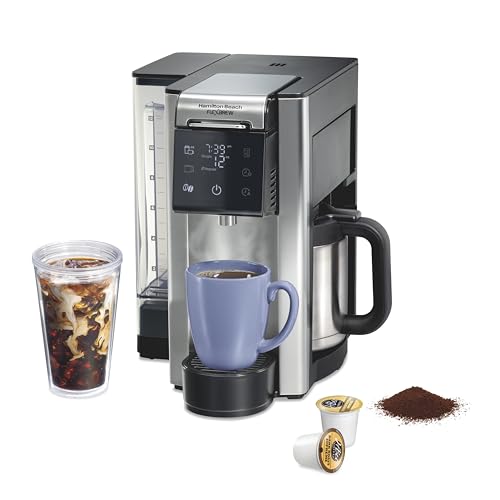
Hamilton Beach FlexBrew Advanced 5-in-1 Coffee Maker
Badge: Best Single-Cup Shortcut
Strengths
- Single-serve mode is the fastest route to one cup in this entire guide — no pot required
- Five-in-one format also brews a twelve-cup thermal pot when the household needs one
- Removable 60 oz reservoir cuts refill delays across a busy morning
Trade-offs
- Pot brewing pace is conventional; its speed advantage is in single servings, not full cycles
- Pods and grounds options mean more parts and more decisions at speed
- Single-serve convenience can quietly become the expensive habit if it replaces pots for groups
At a glance: Format: 5-in-1 drip and single serve · Modes: hot and iced coffee · Drip capacity: 12 cups, thermal, programmable · Brewing options: pods and grounds · Reservoir: removable, 60 oz · Colour: black
The FlexBrew Advanced wins the race that actually happens in many homes: one person, one cup, no time. Its single-serve side — using pods or grounds — delivers a cup without filling, brewing and washing a pot, and on a morning when only one person is leaving early, nothing else in this guide gets coffee into a travel mug faster. The removable 60 oz reservoir supports the habit by reducing the refill trips that slow repeat cups.
When the whole household is home, the same machine brews a twelve-cup thermal programmable drip pot, hot or iced, so the quick option does not come at the cost of the group option. Judged purely on pot speed it sits mid-pack, and we say so. Judged on the variety of urgent mornings it can rescue, it is the most adaptable pick here.
Best for: homes where one early riser needs a fast solo cup and weekends need a full pot / Not suited for: households that only ever brew full pots
Comparison Table
| Pick | Badge | Capacity / format | Holding / carafe | Listing |
|---|---|---|---|---|
| BLACK+DECKER CM2046S | Best Programmable Head Start | Capacity: 12 cups | Carafe: thermal | Check on Amazon |
| Cuisinart PerfecTemp DCC-3400NAS | Best Full-Pot All-Rounder | Capacity: 12 cups | Carafe: double-wall stainless steel thermal | Check on Amazon |
| BLACK+DECKER CaféCraft | Best for Hot and Iced | Capacity: 12 cups | Carafe: thermal | Check on Amazon |
| Cuisinart PerfecTemp, White | Best Small-Batch Speed | Capacity: 12 cups | Carafe: PerfecTemp thermal carafe | Check on Amazon |
| BUNN Speed Brew Platinum | Best Overall for Speed | Capacity: 10 cups | Carafe: thermal | Check on Amazon |
| Hamilton Beach FlexBrew Advanced | Best Single-Cup Shortcut | Format: 5-in-1 drip and single serve | Modes: hot and iced coffee | Check on Amazon |
How to Choose Among the Best quick brew coffee makers
Choosing a quick brewer starts with naming your actual delay. Is the pot itself slow, is the batch bigger than the morning needs, is nobody willing to set a timer, or is the real problem that one person needs one cup while everyone else sleeps? Each delay has a different cure in this guide, and buying the wrong cure leaves the morning exactly as slow as before.
Outright cycle speed
If you brew full pots on demand, a dedicated fast brewer like the BUNN changes the morning outright. This is the only factor that helps a household that refuses to plan ahead.
Programmability
A timer moves brewing into the night. For scheduled households it is effectively infinite speed at wake-up, but it only works for people who will actually set it, with beans and water loaded.
Batch right-sizing
Halving the batch roughly halves the wait and often improves extraction. A 1-4 cup setting or a smaller daily routine is the cheapest speed upgrade in this category.
First-cup access
Brew pause and single-serve modes attack the wait from the other end: they release a drink before the full cycle finishes. Useful daily, essential for staggered households.
Reservoir and workflow
Removable, larger reservoirs, simple controls and a thermal carafe you can carry to the table all remove small frictions that add up across a rushed week.
Flavour at speed
Fast water can under-extract. Prefer machines that pair pace with hotter brewing or strength control, and keep your grind and ratio consistent so speed does not taste thin.
Tiers in this category are best understood by what the money removes. Lower tiers remove the wait for a scheduled household through programmability. Middle tiers remove flavour compromises at speed, with hotter brewing and strength control. The specialist tier removes the wait itself. Decide which wait is yours before spending, and if your mornings are mostly solo, weigh this guide against Best Space Saving Coffee Makers and the single-serve cluster before choosing a full-size machine.
How to Make Your Morning Brew Faster Without Making It Worse
These habits compound with any machine in this guide. Adopt the ones that match your delay and the morning gets shorter within a week.
- Stage the night before: beans measured, filter in place, fresh water loaded, carafe seated. Whether or not your machine has a timer, staging removes every fumble except pressing the button.
- If your machine is programmable, set it to finish five minutes before you reach the kitchen, so the cycle is complete and the first pour is immediate.
- Brew the batch you will drink, not the biggest batch the machine allows. A four-cup cycle is ready far sooner than a twelve-cup cycle and usually tastes better.
- Keep grind and ratio pre-decided. Write your recipe on a card by the machine so a half-awake morning involves no measuring debates.
- Use brew pause or a single-serve mode for the genuinely urgent first cup, then let the pot finish for everyone else.
- Keep the reservoir filled with fresh water at night if your routine allows, and descale on schedule — a scaled heating element is a slow heating element, and slowness creeps in over months.
- Put cups, lids and travel mugs in one place next to the machine. More morning time is lost hunting for a lid than in any brew cycle.
Troubleshooting
Problem: Coffee is fast but tastes thin → what to do: The cycle is outrunning extraction: go slightly finer on the grind, increase the dose a little, or use the strength setting if your machine offers one.
Problem: The programmed pot tastes stale → what to do: It finished too early or sat with the lid open: set the timer closer to wake-up, keep the thermal lid closed, and load fresh water the night before rather than in the morning.
Problem: Mornings still feel slow despite a fast machine → what to do: Audit the workflow, not the brewer: staging, cup location and batch size usually hide more lost minutes than the cycle does.
What Actually Counts as Brew Time
Manufacturers measure brew time from button press to finished cycle, but your morning measures from entering the kitchen to the first sip. Those two numbers differ by heating habits, batch size, pouring, and everything you do while waiting. A programmable machine with an ordinary cycle can post the best real-world time in this guide, because its measured wait is zero — while a fast machine still asks you to fill, load and stand by.
Batch size is the silent multiplier. Water moves at a limited rate, so a twelve-cup cycle will always take roughly three times the water-moving time of a four-cup cycle on comparable machines. Households that complain their brewer is slow often discover they are brewing weekend quantities on weekday mornings.
The honest way to shop this category is to time your current routine for a week, find where the minutes actually sit, and then buy the feature that removes those specific minutes. This guide’s reviews are organised around exactly those features for that reason.
Speed Versus Extraction: Keeping Fast Coffee Honest
Extraction needs contact time. Water that rushes through grounds leaves flavour behind, which is why the worst quick coffee tastes like warm, brown regret. The machines here manage the tension differently: hotter water extracts more per second, strength settings extend or intensify the cycle, and dedicated fast brewers are engineered around the flow rates they use rather than simply hurrying a normal design.
You hold the other half of the bargain. A consistent medium grind, a measured ratio and fresh water give a fast cycle something worth extracting. Change one variable at a time when a fast pot disappoints, starting with grind, and most households land on a routine that is both quick and genuinely good within a few mornings.
Finally, remember that freshness is part of flavour. A pot brewed fast and drunk promptly will beat a theoretically perfect pot that sat for two hours, which is why speed, honestly managed, is a quality feature and not merely a convenience.
Audit Your Morning: Where the Minutes Actually Go
Before any quick-brew purchase can help, it helps to know what you are buying back. For one ordinary week, note four times each morning: when you enter the kitchen, when you start the coffee, when the first cup is poured, and when you finish drinking or leave. Most households are surprised by the shape of the result. The brew cycle itself is rarely the largest block. Filling the reservoir, finding the filter, measuring coffee, hunting for the travel-mug lid and waiting for a second pot routinely add more minutes than the difference between the fastest and slowest machines in this guide.
The audit sorts households into three honest groups. The first group loses its time before brewing starts, and needs staging and programmability — the night-before picks. The second group loses its time during brewing, usually by making weekend-sized batches on weekday mornings, and needs small-batch discipline or a dedicated fast brewer. The third group loses its time after brewing, in repeat pots and re-heated cups, and needs a full, properly extracted thermal pot that ends the repetition. Each group maps to different picks in this guide, which is why a single speed ranking would be a disservice.
Run the audit before you spend, and run it again a fortnight after any new machine arrives. The second audit is the purchase’s real review: not how fast the machine claims to be, but how many minutes your household actually recovered, and whether those minutes landed where your morning needed them.
Programming Masterclass: Getting the Most From a Timer
A programmable brewer is only as good as the routine wrapped around it, and the routine has four parts. First, load everything the night before: filter, measured coffee, fresh water, carafe seated squarely so the brew-through path is aligned. A timer cannot rescue a machine that was never loaded. Second, set the finish, not the start: work backwards from the moment the first cup is needed, allowing the cycle to complete and settle for a few minutes. Third, protect the pot: keep the thermal lid closed until the first pour, because a programmed pot opened early and often is a pot cooling on schedule. Fourth, reset the station when you empty it, so tonight’s staging takes two minutes rather than ten.
Grind timing is the one genuine compromise in a programmed routine. Coffee ground the night before loses some aroma by morning, and households that care most about flavour sometimes stage everything except the grinding, accepting a brief morning task in exchange for freshness. Others grind at night without regret, judging that a ready pot beats a theoretically fresher one that requires work at dawn. Both positions are defensible; what is not defensible is pretending the trade-off does not exist. Decide as a household, write the decision into the routine, and stop re-litigating it at six in the morning.
Finally, treat the programme as a living setting. Seasons change, school terms change, and the finish time that suited January may strand coffee in June. A ten-second timer adjustment at the weekend keeps the system honest, and a system that stays honest stays fast.
Small Batches, Full Pots and the Physics of Waiting
Water takes time to heat and time to move, and no control panel can repeal that. A full twelve-cup cycle must heat and deliver roughly three times the water of a four-cup cycle, so on comparable machines it takes roughly three times as long before the pot is ready. This simple arithmetic explains most disappointment in the quick-brew category: buyers purchase a large, well-reviewed machine, run it at full capacity every day for two people, and conclude that quick brewing is a myth. The machine was never slow. The batch was simply larger than the morning.
Small-batch settings exist to correct the physics rather than merely shrink it. A good 1-4 cup mode adjusts flow so the smaller volume still extracts properly in its shorter journey, which is why the white Cuisinart’s small batches can be both faster and better tasting than a big cycle run low. Single-serve modes go further, heating only the water one cup needs. The general rule for shoppers is to buy for the batch you brew most, and to treat full-pot capacity as an occasional feature rather than the headline.
There is also a queueing effect in group households. A fast ten-cup pot that everyone drinks from at once clears the morning queue in one event, while a slower sequence of small batches can keep the last person waiting longer than one big, brisk cycle would have. Match the strategy to the household’s shape: parallel drinkers favour the fast full pot, staggered drinkers favour small and single formats.
Keeping a Fast Machine Fast: Maintenance for People in a Hurry
Quick brewers slow down gradually, and the culprit is almost always mineral scale. Scale coats the heating element, so water takes longer to reach brewing temperature; it narrows the water pathways, so delivery slows; and it eventually makes cycles gurgle, spit and under-extract. The decline is slow enough that households adapt to it, adding a minute here and a minute there, until one day the fast machine feels ordinary. Descaling on a schedule matched to your water hardness reverses nearly all of it, and it is the highest-value ten minutes in this entire category.
Daily habits matter at the margins. Empty and rinse the carafe rather than leaving coffee to bake in it, because a fouled carafe makes the next pot taste like the last one and invites the repeat brewing that wastes mornings. Keep the reservoir fresh rather than topped up indefinitely. Wipe the shower area where coffee oils collect. None of this takes long, and all of it protects both pace and flavour.
Finally, keep the station stocked. Filters, coffee and a spare carafe lid in the cupboard above the machine are speed features, because the slowest brew of the month is always the one interrupted by a missing filter and a trip to the shop. Quick is a system property, and the system includes the cupboard.
Weekends, Guests and Other Times Quick Still Counts
Quick brewing sounds like a weekday virtue, but its hardest test arrives with a house full of guests and a host who would rather be at the table. The fast full pot is the host’s friend precisely because it is an event with an end: one brisk cycle, a thermal carafe carried out, and the coffee question is closed for the morning. The programmable picks serve the same occasion from the other direction, brewing before anyone surfaces, so the first guest to wander downstairs finds coffee rather than a project. Either way, the principle is identical — compress the work into one planned moment and spend the rest of the morning being a person, not a process.
Gatherings also expose the capacity question honestly. A ten-cup fast pot that needs a second cycle for a crowd may still beat a twelve-cup conventional machine on total time, because its cycles are short; a twelve-cup programmable pot set early may beat both, because its time cost was paid before dawn. There is no universal winner, which is why this guide keeps returning households to their own audit rather than to a league table. Count your people, count your pots, and the arithmetic usually names the machine for you.
What guests never need is a host narrating brew times. Choose the machine whose speed strategy fits your household’s ordinary week, set it up the night before visitors arrive, and let the coffee be the quiet success of the morning rather than its topic.
When Quick Is Not the Priority: Knowing the Trade-Offs
Honesty about this category requires admitting that speed is not free. The fastest routines ask something in return: programming asks for a nightly habit, fast cycling asks you to accept a fixed, focused feature set, small batches ask you to brew more often across a long morning, and single servings ask you to accept a simpler cup in exchange for an immediate one. None of these prices is unreasonable, but each household should know which currency it is paying, because the wrong trade feels like a flaw in the machine when it is really a mismatch in the brief.
There are also mornings when quick is simply the wrong goal. A slow Saturday pot, brewed when nobody is watching a clock, is one of the genuine pleasures of owning a good machine, and several picks here — the PerfecTemp models especially — are at their best when allowed to be thorough rather than hurried. The wise household does not optimise every brew for speed; it builds a fast routine for the days that need one and leaves the other days alone.
Judge any quick-brew purchase after a month, not a morning. By then the staging is habit, the recipe is written, the timer is set without thought, and the recovered minutes have quietly become part of the household’s life. That is the return this category actually pays, and it compounds every single day.
Common Buying Mistakes
- Buying the biggest capacity for weekday speed: Large cycles are slow cycles. If weekdays are small, a big machine makes every morning longer than it needs to be.
- Ignoring the timer you already have: Many slow mornings happen on programmable machines that are never programmed. One week of nightly staging fixes more than a new purchase.
- Chasing speed with a finer and finer grind: Over-fining to compensate for a fast cycle causes bitterness and basket overflow. Adjust dose and strength settings first.
- Letting scale build up: Mineral scale slows heating and lengthens cycles gradually, so the machine feels slower every season. Descale before you shop for a replacement.
- Brewing a pot for one person: A single-serve mode or a small batch is faster, fresher and less wasteful than a full pot poured mostly away.
- Judging by the first rushed morning: New routines take a few days to stage smoothly. Give any quick-brew system a week before deciding it is not quick.
Final Recommendation
If pure pace is the brief, the BUNN Speed Brew Platinum is the first choice: it is the specialist here, and check the BUNN Speed Brew Platinum on Amazon if a fast full pot with no night-before planning matches your household. It is the benchmark for quick brewing in this guide.
For scheduled households, the programmable BLACK+DECKER CM2046S removes the wait entirely, and you can check the BLACK+DECKER CM2046S on Amazon for the head-start route. Small households should seriously consider the white Cuisinart instead — check the Cuisinart PerfecTemp in white on Amazon — because its 1-4 cup setting is the fastest honest route to a small morning pot.
Match the machine to the delay you actually have, stage the night before whichever you choose, and keep the recipe consistent for the first week. Quick coffee is a routine as much as a product, and every pick here can anchor a good one.
A Note on Honest Speed Claims
Shoppers in this category meet plenty of breathless language about instant coffee and record-breaking pots, and a little scepticism is healthy equipment. A brew cycle can only be shortened so far before extraction suffers, and any claim that ignores batch size is hiding the variable that matters most. The machines in this guide make their speed claims in mechanisms you can verify — a fast-cycle design, a timer, a small-batch mode, a pause feature, a single serving — rather than in adjectives, and that is deliberate. When you compare listings, translate every speed claim into its mechanism and ask whether that mechanism fits your morning. If a listing cannot explain how it is quick, it probably is not, and the household audit described earlier in this guide will expose the truth within a week of ownership either way. Buy the mechanism, not the adjective, and the morning you planned is the morning you will get.
Related guides
Frequently Asked Questions
Which coffee maker brews the fastest full pot?
The BUNN Speed Brew Platinum is the speed specialist in this guide, built around fast full-pot brewing in a ten-cup thermal format. Other picks are quick for different reasons — programming, small batches or single servings — but for an on-demand full pot, the BUNN is the benchmark.
Is a programmable coffee maker actually faster?
At the moment you want coffee, yes: the brewing happened while you slept, so the wait is zero. The cycle itself is not faster, which is why programmability suits scheduled households and does nothing for spontaneous ones.
Does brewing faster hurt the taste?
It can, if water rushes through grounds and under-extracts. Machines that pair pace with hotter brewing or strength control manage the trade-off, and you can help with a consistent grind and ratio. Fast and fresh also beats slow and stale, so the net effect is often positive.
What is the fastest way to get one cup of coffee?
A single-serve mode, like the FlexBrew Advanced offers, or a small 1-4 cup batch. Brewing a full pot for one cup is the slowest and most wasteful route, however fast the machine is.
Why has my coffee maker slowed down over time?
Mineral scale is the usual cause: it coats the heating element, so water heats and moves more slowly, and flavour suffers too. Regular descaling restores both pace and taste, and is worth trying before replacing any machine.
Should I choose speed or capacity?
Choose for your weekday. A household that drinks a full pot together every morning benefits from a fast ten or twelve-cup machine. A household of one or two will get coffee sooner, and better, from small-batch or single-serve speed.


