Disclosure: topratedkitchenware.com is reader-supported. When you buy through links on our site, we may earn an affiliate commission from Amazon and other retailers, at no extra cost to you.
Where to buy
The picks below are the verified shortlist for this guide to best thing for cleaning toilets. Linked picks take you to their Amazon listings, where you can check the latest price on Amazon and confirm the current configuration. Where a pick is prose-only, the guide says so here and explains why in its review — that honesty is deliberate.
- Best Preventive Treatment: Green Gobbler Toilet Clog Defense — check the latest price on Amazon
- Best Everyday Bowl Cleaner: Method Antibacterial Toilet Bowl Cleaner, Spearmint — check the latest price on Amazon
- Best Plant-Based Cleaner: Better Life Toilet Bowl Cleaner, Pack of 2 — check the latest price on Amazon
- Prose-Only: Main Line, Not Bowl Cleaning: Roebic K-97 Main Line Cleaner — reviewed below, prose-only (no purchase link, for the reason stated in its review)
- Prose-Only: Drain and Grease Trap Treatment: Green Gobbler Enzyme Drain Cleaner, 1 Gallon — reviewed below, prose-only (no purchase link, for the reason stated in its review)
- Prose-Only: Build-Up Prevention, Not a Cleaner: Drano FlowGuard Build-Up Remover — reviewed below, prose-only (no purchase link, for the reason stated in its review)
Read the full guide ↓ for the ranking logic, the honest limitations of every pick, and the checks that matter more than any headline claim.
The best thing for cleaning toilets depends on which of three different problems you actually have, and this guide is organized around that unfashionable truth. A dirty bowl — stains, rings, grime under the rim — needs a bowl cleaner. A toilet that keeps clogging needs a preventive pipe treatment. Pipes that are slowly narrowing need enzyme maintenance. Products for the three jobs are not interchangeable, and the most common cleaning mistake in this category is buying a good product for the wrong job and concluding it does not work.
Three picks are linked as the genuine answers to the cleaning question. Green Gobbler’s Toilet Clog Defense handles the clogging toilet — the problem half of all ‘cleaning’ searches are really about — while Method’s antibacterial gel and Better Life’s plant-based gel cover the bowl itself, for households that prioritize sanitizing and households that prioritize non-toxic formulas respectively. Three further products are presented prose-only with their reasoning in the open: respected drain and main-line treatments that do their own jobs well and bowl cleaning not at all.
Inside you will find a complete toilet-cleaning method — the order of operations professionals use, the dwell-time mistake almost everyone makes, and the tool questions (brush, pumice, gloves) that decide results as much as chemistry does — plus a section on matching product to water type, because hard water changes what ‘clean’ requires. By the end, you will know which single product your bathroom needs first, and which of the others, if any, earns a place beside it.
Neighbouring searches lead to neighbouring decisions, and readers working through this one often also look at Best Low Flow Toilets For Septic — the criteria in this guide transfer directly.
Key Takeaways
- Match the product to the problem: gels clean bowls, preventive treatments stop clogs, enzymes maintain pipes — they are not interchangeable.
- Three picks are linked: a clog-prevention treatment for low-flow toilets, an antibacterial gel, and a plant-based gel.
- Three respected drain and main-line products are reviewed prose-only, because they do not clean bowls — the distinction is the guide’s main lesson.
- Dwell time is the free performance upgrade: gel left to work beats gel scrubbed immediately, every time.
- Weekly cleaning prevents every harder job; rings and scale are frequency problems disguised as chemistry problems.
In this guide
Quick Picks
| Pick | Badge | Why it stands out | Listing |
|---|---|---|---|
| Green Gobbler Toilet Clog Defense | Best Preventive Treatment | Prevention rather than cure: coats pipes to stop clogs forming and improves flush performance | Check on Amazon |
| Method Antibacterial Toilet Bowl Cleaner, Spearmint | Best Everyday Bowl Cleaner | Cleans and sanitizes in one step, including under the rim where brushes miss | Check on Amazon |
| Better Life Toilet Bowl Cleaner, Pack of 2 | Best Plant-Based Cleaner | Plant-based, non-toxic formula for households avoiding conventional chemical cleaners | Check on Amazon |
| Roebic K-97 Main Line Cleaner | Prose-Only: Main Line, Not Bowl Cleaning | Enzyme and bacteria formula breaks down organic buildup in main lines | Prose-only — see review |
| Green Gobbler Enzyme Drain Cleaner, 1 Gallon | Prose-Only: Drain and Grease Trap Treatment | Enzyme formula targets oils and fats in drains and grease traps | Prose-only — see review |
| Drano FlowGuard Build-Up Remover | Prose-Only: Build-Up Prevention, Not a Cleaner | Enzyme prevention for build-up in pipes, from a mainstream drain-care brand | Prose-only — see review |
How These Picks Were Chosen
This guide is research-led, and it says so plainly: the products were not bench-tested for this article, and no hands-on test results are claimed. Each candidate came from the verified pool for this category, with its identity, brand and listing details confirmed before consideration. Products were then sorted by the job their own listings declare — bowl cleaning, clog prevention, drain care, main-line maintenance — because in this category the declared job is the honest spec, and mis-sorting is the industry habit this guide exists to correct. Bowl cleaners were compared on formula type, sanitizing claims as stated, size and pack format, and scent; preventive and maintenance products were assessed in their own lanes and placed prose-only where their lane is not this page’s.
Ranking puts the reader’s most likely problem first: the bowl itself, cleaned and sanitized; then the plant-based route to the same job; with clog prevention linked alongside because weak-flushing toilets generate as many ‘cleaning’ searches as dirty bowls do. Products whose listings assign them to drains, grease traps and main lines are reviewed fully but not linked — a ranking decision explained in each review rather than hidden, so readers with pipe problems still get the information, correctly labelled.
One boundary deserves emphasis. Prices are not printed in this guide, because they change and a printed figure would mislead; where a pick is linked, its listing carries the current price on the day you look. Readers weighing a neighbouring version of the same question may also find Best Low Flow Toilets Home Depot useful alongside this guide.
The 6 Best Thing for cleaning toilets

Green Gobbler Toilet Clog Defense
Badge: Best Preventive Treatment
Strengths
- Prevention rather than cure: coats pipes to stop clogs forming and improves flush performance
- Formulated for exactly the low and slow-flow toilets that clog most often
- Septic-safe, so it suits homes that cannot use harsh chemicals
Trade-offs
- It is not a bowl cleaner — it does not scrub stains, rings or germs from porcelain
- Prevention only helps if used on schedule, before a clog exists
- Five treatments per bottle means ongoing cost for multi-bathroom homes
| Type | Preventive toilet clog treatment |
|---|---|
| Size | 60 oz, 5 treatments (per listing) |
| Compatibility | Septic-safe; aimed at old plumbing and low, slow-flow toilets (per listing) |
Green Gobbler Toilet Clog Defense earns its place in a toilet-cleaning guide by attacking the problem cleaning alone cannot solve: the clog that forms downstream. The treatment coats the pipe walls to prevent waste building up and sticking, and it is formulated specifically for old plumbing and the low, slow-flow toilets whose weak flushes leave material behind. Used on schedule, it is the difference between a toilet that gets cleaned and a toilet that also keeps working.
Be clear about what it is not. It does not remove a hard-water ring, disinfect a bowl or shine porcelain — the gel cleaners below do that work, and a complete routine pairs this preventive treatment with one of them. Its value is in the calendar, not the scrub: households with ageing pipes, a septic system, or a low-flow toilet with a history of sluggish flushes will feel the benefit in clogs that simply stop happening. Septic-safe formulation makes it usable where harsher drain products are off the table entirely.
Linked as the answer to the clogging half of this keyword: in homes where ‘cleaning the toilet’ means ‘the toilet is slow and blocks’, prevention is the cleaning that matters, and this is the pool’s purpose-built product for it.
Best for: homes with old plumbing, septic systems or chronically sluggish low-flow toilets / Not suited for: anyone whose actual problem is a stained or germy bowl
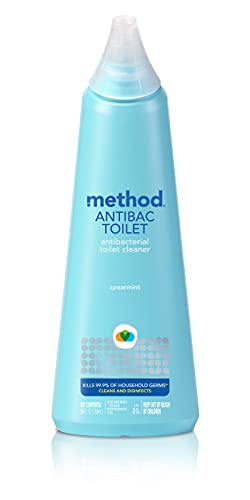
Method Antibacterial Toilet Bowl Cleaner, Spearmint
Badge: Best Everyday Bowl Cleaner
Strengths
- Cleans and sanitizes in one step, including under the rim where brushes miss
- Antibacterial action for households that want disinfection, not just stain removal
- Spearmint scent is fresher and less chemical than traditional bowl cleaners
Trade-offs
- A 24 fl oz single bottle runs out quickly in multi-bathroom homes
- Gel cleaners still need brush work on established hard-water rings
- Scent preference is personal — spearmint divides opinion
| Type | Antibacterial toilet bowl cleaner gel |
|---|---|
| Size | 24 fl oz (per listing) |
| Claim (per listing) | Kills 99.9% of household germs; cleans and sanitizes in one step |
| Scent | Spearmint |
Method’s antibacterial gel is the straightforward answer to the everyday version of this search: a bowl cleaner that cleans and sanitizes in one step, works on the bowl, the seat and under the rim, and does it with a spearmint scent instead of the chemical blast most people associate with toilet cleaning. The under-rim point matters more than marketing usually admits — that hidden channel is where grime and germs accumulate undisturbed, and a gel that clings there does work a thin liquid cannot.
As a routine cleaner it is close to ideal: apply, let it dwell, brush, flush. Its honest limits are capacity and severity. A single 24 fl oz bottle is a one-bathroom supply, which is why the same formula appears later in this list in a three-pack, and an established mineral ring built up over months will still demand repeated applications and elbow grease from any cleaner in this class. For weekly maintenance in a normal bathroom, though, this is the pick most households will be happiest living with.
Linked as the everyday bowl answer: sanitizing, clinging, under-rim capable, and usable on the seat — the complete routine cleaner in one bottle.
Best for: routine weekly cleaning where sanitizing matters as much as appearance / Not suited for: heavy mineral-ring restoration or stocking several bathrooms from one bottle
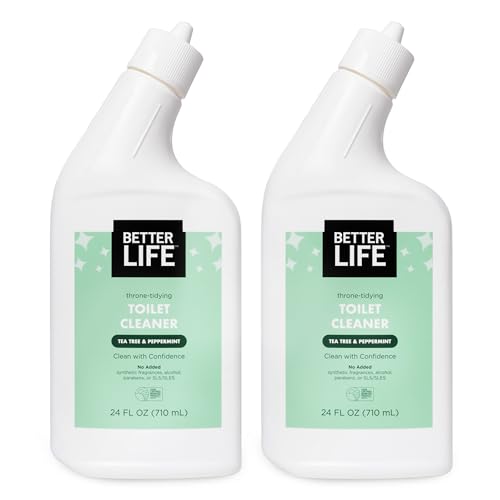
Better Life Toilet Bowl Cleaner, Pack of 2
Badge: Best Plant-Based Cleaner
Strengths
- Plant-based, non-toxic formula for households avoiding conventional chemical cleaners
- Sold as a two-pack, so the second bathroom is covered from the start
- Tea tree and peppermint scent reads as clean without smelling synthetic
Trade-offs
- Plant-based gels can need longer dwell time on stubborn stains
- No antibacterial disinfection claim — it cleans and deodorizes rather than sanitizes
- Two-pack is a commitment if you end up preferring another scent
| Type | Plant-based toilet bowl cleaning gel |
|---|---|
| Size | Pack of 2 x 24 oz (per listing) |
| Scent | Tea tree and peppermint |
| Positioning (per listing) | Non-toxic stain and odor remover |
Better Life is the plant-based entry: a non-toxic cleaning gel positioned as a stain and odor remover, scented with tea tree and peppermint, and sold as a pack of two 24-ounce bottles. For households that have moved their whole cleaning cupboard away from conventional chemicals — homes with small children, pets, or simply a preference — it is the pick that does not ask them to make an exception for the toilet, historically the last stronghold of harsh chemistry.
The trade-offs are the honest ones for the category. Plant-based gels typically reward patience: a longer dwell before brushing gets visibly better results on staining than a quick apply-and-flush. And this formula cleans and deodorizes without claiming antibacterial disinfection, so households whose priority is sanitizing a sickroom bathroom should pair it with, or choose, the antibacterial option above. Within its brief — effective everyday cleaning with a plant-based formula — it is the most complete package here, helped by the simple practicality of the two-pack.
Linked as the plant-based route to the same clean bowl, in a two-pack that covers the second bathroom — the pick for households whose cleaning cupboard has a chemistry policy.
Best for: households committed to plant-based, non-toxic cleaning products / Not suited for: situations where antibacterial disinfection is the priority
Roebic K-97 Main Line Cleaner
Badge: Prose-Only: Main Line, Not Bowl Cleaning
Strengths
- Enzyme and bacteria formula breaks down organic buildup in main lines
- Useful preventive maintenance for whole-house drainage
- A respected specialist name in septic and sewer care
Trade-offs
- It treats the main line, not the toilet bowl — no stain, ring or germ action on porcelain
- Works slowly by design; enzymes are maintenance, not rescue
- Wrong tool for the visible cleaning job most readers mean
| Type | Main line cleaner with bacteria and enzymes |
|---|---|
| Size | 32 fl oz (per listing) |
| Target | Sewer and septic main lines (per listing) |
Roebic K-97 is described here prose-only because it answers a different question than the one this page asks. It is a main line cleaner: a bacteria-and-enzyme formula that breaks down organic buildup in sewer and septic lines and helps prevent clogs at the whole-house level. That is valuable maintenance, and Roebic is a specialist name in exactly that field — but pouring it in a toilet does nothing for the ring in the bowl, the grime under the rim or the germs on the seat, which is the job the reader came for.
Keep it in mind for the right problem: slow drains throughout the house, a septic system that deserves scheduled enzyme care, or a main line with a history of organic buildup. Used there, on schedule, it can prevent the expensive emergency that no bowl cleaner could ever address. Used as a toilet cleaner, it would simply disappoint — which is why this guide separates the two jobs rather than blurring them for the sake of a longer list.
Prose-only: a main-line enzyme treatment with an honourable job that is not this page’s job. No bowl, no ring, no seat — no link.
Best for: whole-house main line and septic maintenance / Not suited for: cleaning the toilet bowl itself
Green Gobbler Enzyme Drain Cleaner, 1 Gallon
Badge: Prose-Only: Drain and Grease Trap Treatment
Strengths
- Enzyme formula targets oils and fats in drains and grease traps
- Gallon size covers up to eight treatments — economical for maintenance schedules
- A non-caustic alternative, safe for pipes
Trade-offs
- A drain and grease-trap product, not a bowl cleaner
- Enzymes work on organic matter over time, not on mineral scale or surface germs
- Gallon storage is bulky for a small bathroom cupboard
| Type | Enzyme drain cleaner |
|---|---|
| Size | 1 gallon, up to 8 treatments (per listing) |
| Target | Grease traps and septic tanks; breaks down oils and fats (per listing) |
The gallon Green Gobbler enzyme cleaner is the second prose-only entry, again because its job is adjacent rather than identical. Its stated territory is drains, grease traps and septic tanks, where its enzymes break down the oils and fats that narrow pipes over time. In a kitchen or a home with a grease trap it is a sensible maintenance product, and the gallon format — up to eight treatments — makes scheduled use economical.
None of that cleans a toilet bowl. Enzymes digest organic matter slowly and invisibly; they do not lift a hard-water ring, cut soap and grime from porcelain, or sanitize a seat. A household can reasonably own this product and a bowl cleaner, because they do different work in different parts of the plumbing. This guide keeps it unlinked on a cleaning page so that distinction stays sharp, and points readers whose real problem is slow drains toward the drain-care search where this product belongs.
Prose-only: drains and grease traps are its stated territory, and a gallon of enzyme drain care has never cleaned a toilet bowl. Described so drain-problem readers find their way, not misled.
Best for: drain, grease trap and septic maintenance schedules / Not suited for: any visible toilet-cleaning task
Drano FlowGuard Build-Up Remover
Badge: Prose-Only: Build-Up Prevention, Not a Cleaner
Strengths
- Enzyme prevention for build-up in pipes, from a mainstream drain-care brand
- Safe for pipes, septic systems and toilets per the listing
- Large 60 oz format suits scheduled whole-house use
Trade-offs
- Explicitly not for existing blockages, and not a surface cleaner
- Does nothing for bowl stains, rings or hygiene
- Prevention products only pay off when used consistently
| Type | Enzyme build-up remover / clog prevention |
|---|---|
| Size | 60 oz (per listing) |
| Note (per listing) | Helps prevent clogs; not for existing blockages; safe for pipes, septic systems and toilets |
Drano FlowGuard completes the prose-only set, and its own listing supplies the reason: it helps prevent clogs and removes build-up with enzymes, and it is explicitly not for existing blockages. It is a pipe-health product — safe for pipes, septic systems and toilets, in a generous 60 oz format — from the best-known name in drain care. As scheduled prevention for a house whose pipes slowly narrow, it has a legitimate place in the cupboard.
That place is not this page’s podium. A build-up remover leaves the bowl exactly as stained, ringed and germy as it found it, because surface cleaning was never its assignment. Readers deciding between the products on this page should ask which problem they actually have: a dirty bowl (the linked gels), a toilet that clogs (the linked preventive treatment at the top of this list), or pipes that slowly choke (this and the other prose-only entries). Matching product to problem is the entire skill this guide is trying to teach.
Prose-only: build-up prevention for pipes, explicitly not for blockages and never a surface cleaner. Its own listing draws the line this guide enforces.
Best for: scheduled pipe build-up prevention across a whole house / Not suited for: cleaning a bowl or clearing an existing blockage
Comparison Table
| Pick | Badge | Type | Key figure | Listing |
|---|---|---|---|---|
| Green Gobbler Toilet Clog Defense | Best Preventive Treatment | Preventive toilet clog treatment | 60 oz, 5 treatments (per listing) | Check on Amazon |
| Method Antibacterial Toilet Bowl Cleaner, Spearmint | Best Everyday Bowl Cleaner | Antibacterial toilet bowl cleaner gel | 24 fl oz (per listing) | Check on Amazon |
| Better Life Toilet Bowl Cleaner, Pack of 2 | Best Plant-Based Cleaner | Plant-based toilet bowl cleaning gel | Pack of 2 x 24 oz (per listing) | Check on Amazon |
| Roebic K-97 Main Line Cleaner | Prose-Only: Main Line, Not Bowl Cleaning | Main line cleaner with bacteria and enzymes | 32 fl oz (per listing) | Prose-only |
| Green Gobbler Enzyme Drain Cleaner, 1 Gallon | Prose-Only: Drain and Grease Trap Treatment | Enzyme drain cleaner | 1 gallon, up to 8 treatments (per listing) | Prose-only |
| Drano FlowGuard Build-Up Remover | Prose-Only: Build-Up Prevention, Not a Cleaner | Enzyme build-up remover / clog prevention | 60 oz (per listing) | Prose-only |
Read the table by columns, not by rows: find the type and scale that match your situation first, and the right row usually reveals itself. Shoppers whose needs point another way can cross-check Best Low Flow Toilets Rim Wash before deciding.
How to Choose for Best thing for cleaning toilets
Diagnose before you buy. Three different failures hide inside ‘my toilet needs cleaning’. The bowl is dirty: stains, ring, under-rim grime — that is a gel’s job. The toilet clogs or flushes weakly: that is flow, and a preventive treatment plus mechanical clearing is the answer. Every drain in the house is slow: that is the main line, and enzyme maintenance or a professional is the answer. Buying across these lanes is the category’s defining waste of money, and it is why this guide’s reviews keep repeating which lane each product lives in.
Choose your chemistry policy deliberately. Antibacterial gels sanitize as they clean — the priority after illness and in high-traffic bathrooms. Plant-based gels clean and deodorize without conventional chemical load — the priority in homes with small children, pets, or a whole-cupboard non-toxic policy. Enzyme products are neither: they digest organic matter in pipes over time. None of these is ‘strongest’ in the abstract; each is strongest at its stated job, and the listings in this guide say which is which.
Respect the septic line. A septic tank digests waste with living bacteria, and the household’s chemistry should not wage war on it. Septic-safe labelling on the linked preventive treatment matters, plant-based gels suit low-chemical households, and heavy antibacterial use deserves a second thought in septic homes — not a ban, a thought. Municipal-sewer homes face no such constraint and can choose purely on cleaning preference.
Buy the format your household consumes. A 24-ounce bottle is a one-bathroom, few-weeks supply; the two-packs and three-packs in this pool exist because multi-bathroom homes run dry mid-job and finish with the wrong product. Gallon enzyme formats suit scheduled whole-house maintenance, not bathroom shelves. Match the pack to the number of bathrooms and the cleaning frequency you actually keep, and the cupboard stays stocked with the right thing.
One check specific to this search. Before choosing, run the diagnostic this guide opens with: look at the bowl (dirty?), test the flush (weak?), ask the house (drains slow everywhere?). The answers, in that order, point at a gel, a preventive, or a drain product — and buying in that order saves buying twice.
Readers building a broader picture of the category may also want Best Low Flow Toilets With Enough Power for adjacent options.
How to Deep-Clean a Neglected Toilet, Step by Step
- Ventilate and glove up. Open a window or run the fan, put on cleaning gloves, and gather everything first: gel, brush, pumice stone for porcelain, cloths, and a bucket. A deep clean should not pause halfway for supplies.
- Drop the water level. Pour a bucket of water quickly into the bowl to trigger a flush that leaves the level low, or plunge the level down. Cleaner works undiluted on the ring zone only when the water is out of its way.
- Apply gel under the rim and everywhere. Work the angled nozzle under the rim first, then coat the bowl walls and the ring. This is the application the jets will spread for you if you let it dwell.
- Dwell — genuinely dwell. Leave the gel for the time its label states, longer for a neglected bowl. Use the interval to clean the seat, lid, hinges and exterior with a cloth and a suitable cleaner, top to bottom.
- Brush with intent. Under the rim, around the ring, into the trap opening. Firm, systematic strokes. If the ring survives, reapply gel and dwell again rather than escalating force.
- Escalate to pumice only if needed. A porcelain pumice stone, kept wet, worked gently on the remaining mineral line. Wet is not optional: dry pumice scratches glaze, and scratched glaze is a permanent stain magnet.
- Flush, inspect, finish the room. Flush and inspect under good light. Then the base, the floor seam and behind the tank — the places deep cleans are actually judged by — and finally the brush rinsed in fresh bowl water and set to dry.
- Set the weekly rhythm. The deep clean buys a fresh start; the five-minute weekly gel-and-brush from this guide’s method section is what makes it the last deep clean the bowl needs.
Keep the brush honest: a worn, splayed brush spreads cleaner instead of scrubbing with it, and no chemistry compensates. Replace the brush when the bristles stop springing back — it is the cheapest performance upgrade in this entire category.
Troubleshooting.
Problem: the ring keeps coming back within days → what to do: suspect the water, not the cleaner. Hard water redeposits fast; increase brush frequency to twice weekly, consider whether a jet or rim channel is partially scaled and dribbling stain, and treat the water itself if the whole house shows scale.
Problem: the toilet flushes weakly even when the bowl is clean → what to do: that is a flow problem, not a cleaning problem. Check the tank’s water level and flapper first, clear any partial blockage mechanically, and consider the preventive treatment reviewed at the top of this guide — gel in the bowl cannot restore a weak flush.
Problem: odour persists after thorough cleaning → what to do: look beyond the bowl — the base seal, the floor around the base, and the brush holder are the usual reservoirs. If a sewer smell comes through the bowl itself, the wax ring or venting needs a plumber, not a stronger scent.
For a deeper look at adjacent styles of this same decision, see Best Low Flow Toilets With Enough Power Getwaste Thru Pipes.
Tools of the Trade: Brushes, Pumice and What to Skip
The brush decides results as much as the bottle. A good toilet brush has stiff bristles that spring back, an angled or rim-reaching head, and a holder that lets it dry — a brush stored wet in its own runoff is a hygiene problem wearing a uniform. Replace it when bristles splay permanently, when the handle cracks, or after any illness-driven deep clean of the house; it is the cheapest tool in the bathroom and the one most often kept years past its competence.
Pumice for porcelain is the one abrasive with a legitimate place in this category: a natural stone, used wet, that is hard enough to shear mineral scale and — used correctly, wet and gentle — safe on glaze. Its conditions are absolute: wet stone, wet surface, light pressure, and never on coloured, coated or plastic fixtures. Everything beyond pumice in the abrasive family — scouring powders, steel wool, gritty pads — trades a clean bowl today for a permanently stain-hungry surface tomorrow.
Skip the gadget shelf with confidence: in-tank drop-in tablets bleach the tank’s rubber parts and void more warranties than any product in the bathroom, scented rim hangers perfume rather than clean, and miracle foams mostly demonstrate that foam is photogenic. The complete professional kit for this entire category is a gel you trust, a brush that works, a pumice stone in reserve, gloves and cloths — which is why this guide spends its length on matching products to problems instead of multiplying tools.
Safety, Storage and the Chemistry You Should Never Mix
One rule outranks every tip in this guide: never mix cleaning chemistries. Bleach-based products combined with acids or ammonia create gases that injure people in small bathrooms every year, and the toilet category contains both families on the same shelf. Use one product, rinse it away completely, and only then consider another. Read the label of anything new before its first use — the thirty seconds is the cheapest safety equipment in the house.
Store cleaning products as the hazardous household goods they are: capped, upright, in their original labelled containers, away from children and pets, and never decanted into drink bottles or unlabelled sprayers. The plant-based pick in this guide reduces but does not erase the storage duty — ‘non-toxic’ positioning is about the formula’s intent, not an invitation to store it at toddler height.
Disposal is the last quiet duty: rinse empty containers as the label directs, never pour mixed leftovers together into one bottle ‘to save space’, and take genuinely old or unknown products to household hazardous waste rather than the drain. A cleaning cupboard audited once a year — expired products out, duplicates consolidated, labels legible — prevents most of the accidents and all of the mystery-bottle experiments that make this category dangerous in otherwise careful homes.
The Complete Toilet-Cleaning Method
Chemistry does half the work; sequence does the rest. Start by lowering the bowl’s water level — a quick plunge or a bucket poured in drops the level so cleaner contacts the ring zone undiluted. Apply gel under the rim first, where the jets distribute it and where grime hides, then around the bowl, and then stop: the dwell time printed on the bottle is not a suggestion. Most bowl cleaners need several undisturbed minutes to dissolve mineral film and kill what they claim to kill, and the brush-first habit defeats them.
Brush with intent after the dwell: under the rim with an angled brush head, the ring line with pressure, the trap opening with a few firm strokes. Flush, inspect, and repeat the application on any surviving ring rather than scrubbing harder — a second dwell dissolves what force would only scratch at, and porcelain glaze, once scratched, stains faster forever after. For a genuinely established mineral ring, a pumice stone made for porcelain, kept wet, is the accepted escalation; dry pumice and scouring powders are how bowls get permanently damaged by kindness.
Finish outside the bowl: seat top and underside, hinges, the base and the floor seam, where the actual hygiene failures of most bathrooms live. The linked Method gel is formulated for seats as well as bowls, which simplifies the kit. Work top to bottom, rinse the brush in the fresh bowl water, store it where it can dry, and wash your hands like you mean it. Done in this order, weekly, the whole job takes minutes — because nothing was ever allowed to become a project.
Hard Water, Septic Systems and Other Deciding Factors
Water chemistry quietly decides which cleaner is ‘best’ in a given house. Hard water lays down mineral scale that traps stain and roughens the surface for the next deposit; in hard-water homes, cleaning frequency matters more than cleaning strength, because a ring removed weekly is a wipe and a ring removed quarterly is a campaign. The gels in this guide handle routine scale; homes with severe water should treat the water or accept the pumice as a periodic tool, and will benefit most from the preventive habits — a quick brush twice a week — that keep scale from ever establishing.
Septic systems draw the second line. A septic tank is a living culture that digests waste, and drowning it in harsh antibacterial chemistry works against the household’s own infrastructure. The linked picks respect that line: the Green Gobbler preventive is explicitly septic-safe, and the plant-based Better Life gel suits septic households that want to minimize chemical load. The Method antibacterial is a bowl-and-seat sanitizer used in ounces and flushed in dilution — the standard, accepted pattern — but households that prefer to keep antibacterial agents out of their tank entirely have the plant-based route open.
Household composition draws the third line. Homes with small children and pets often prioritize non-toxic storage and formulas — the plant-based pick’s home ground. Homes recovering from illness, or with immunocompromised members, prioritize verified sanitizing — the antibacterial pick’s. Rental move-outs and resale preparation prioritize visible perfection: ring gone, porcelain bright, fixtures shining. Name your line before you shop, and the right product on this page identifies itself.
The Five-Minute Weekly Routine That Prevents Everything Else
Here is the whole secret, and it is embarrassingly small: once a week, gel under the rim, a coffee’s worth of dwell time while you wipe the sink and mirror, a systematic brush, a flush, and a cloth over the seat, hinges and base. Five minutes, perhaps seven. That routine is the difference between the households in this guide’s world — the ones whose toilets are simply always clean — and the ones who stage a chemical campaign every few months and wonder why the ring always wins. The ring wins because it had ninety days to build; against a weekly routine it never gets ninety hours.
Anchor the routine to something that already happens weekly — the bathroom clean, the laundry cycle, the bin run — because habits attached to habits survive, and habits attached to intentions do not. Keep the gel and brush in the bathroom they serve; a cleaner stored two rooms away is a cleaner used half as often, which is how two-bathroom homes end up with one clean toilet and one negotiation. The two-pack and three-pack formats among the linked picks exist for precisely this logistics, and they are worth more than any marginal difference in formula.
Teach the routine to everyone in the house old enough to hold a brush, because a toilet’s cleanliness is a household system, not one person’s penance. The quick midweek swish — thirty seconds, no cleaner, just the brush around the waterline — is the junior version, and in hard-water homes it is the single habit that keeps the ring from ever forming. Products matter, and this guide has ranked them carefully; but the reader who finishes this page and changes only one thing should change the calendar, not the bottle.
Common Buying Mistakes
- Buying a drain product to clean a bowl. The category’s classic error, and the reason three products here are prose-only. Pipes and porcelain are different jobs with different chemistries.
- Scrubbing before the dwell. Gel brushed immediately is gel wasted. Apply, wait the stated time, then brush — the chemistry does the heavy work if you let it.
- Reaching for abrasives early. Scouring a ring with powder feels decisive and damages glaze permanently. Repeat gel applications first; wet pumice second; powders never.
- Using in-tank bleach tablets. They degrade flappers and seals inside the tank and can void fixture warranties — a slow, invisible cost for a blue tint.
- Cleaning the bowl and skipping the base. The seat hinges, base and floor seam hold the real hygiene failures. A sparkling bowl on a neglected base is half a clean.
- Letting weekly become quarterly. Every hard job in this category is an easy job that was postponed. Frequency is the strongest cleaner you own.
Some of these mistakes come from comparing the wrong categories in the first place; Best Low Flow Water Saving Toilets is a useful cross-check if your shortlist is drifting.
Final Recommendation
Name your problem and the answer names itself: a dirty or germy bowl — the Method antibacterial gel; a household committed to plant-based cleaning — Better Life; a toilet that clogs and flushes weakly — Green Gobbler Clog Defense, ideally alongside one of the gels. The three prose-only treatments serve pipes, not porcelain, and are labelled so. Clean weekly, respect dwell time, and the worst toilet job in the house becomes a five-minute errand.
Green Gobbler Toilet Clog Defense — Check on Amazon · Method Antibacterial Toilet Bowl Cleaner, Spearmint — Check on Amazon · Better Life Toilet Bowl Cleaner, Pack of 2 — Check on Amazon
Whichever pick you choose, verify the live listing on the day you buy, and start with the forgiving version of the job before attempting the ambitious one. Readers still torn between neighbouring categories can finish their comparison with Best Low Flush Elongated Toilets.
Frequently Asked Questions
What is the single best thing for cleaning a toilet?
For a dirty bowl, a clinging gel bowl cleaner used with proper dwell time and a good brush — the Method antibacterial gel if sanitizing matters most, the Better Life gel if a plant-based formula does. For a toilet that keeps clogging, the answer is different: a preventive treatment like Green Gobbler Clog Defense. The right ‘thing’ is the one matched to your actual problem.
Why do three products in this guide have no link?
Because they are drain, main-line and build-up treatments — good products that do not clean toilet bowls. Roebic K-97 treats main lines, the gallon Green Gobbler treats drains and grease traps, and Drano FlowGuard prevents pipe build-up. They are reviewed prose-only so readers can see the distinction this category usually blurs.
How do I remove a stubborn hard-water ring?
Lower the water level, apply gel, and give it a full dwell; brush firmly and repeat the application rather than scrubbing harder. If the ring survives two cycles, use a pumice stone made for porcelain, kept wet the whole time. Never use dry abrasives or scouring powder — scratched glaze stains faster and the damage is permanent.
Are these cleaners safe for septic systems?
The Green Gobbler Clog Defense is formulated to be septic-safe, and the Better Life plant-based gel suits households minimizing chemical load on their tank. Enzyme prose-only products here are also septic-oriented — but for their own jobs, in drains and main lines, not as bowl cleaners.
How often should I clean a toilet?
A full gel-and-brush clean weekly is the standard that prevents every harder job: rings, scale and odour are all weekly-preventable and quarterly-painful. A thirty-second brush swish midweek, without cleaner, keeps hard-water homes ahead of the ring entirely.
Can I use drain cleaner as a toilet cleaner?
No — they are different chemistries for different jobs, and some drain products are unsafe for toilets outright. Drain and enzyme products treat pipes; bowl gels treat porcelain surfaces. This guide’s prose-only section exists precisely to keep that line clear, because confusing them wastes money and can damage fixtures.


