Disclosure: topratedkitchenware.com is reader-supported. When you buy through links on our site, we may earn an affiliate commission from Amazon and other retailers, at no extra cost to you.
Where to buy
This is the complete how to choose a duvet insert guide. Every linked pick below was verified against its manufacturer listing. Prose-only picks — where a product does not genuinely match what you searched for — are named honestly, with no purchase link, so you are never sent to the wrong product. Check the current price on Amazon from any linked pick.
- Bedsure Comforter Duvet Insert, Queen 88 x 88 — Best Overall. Check on Amazon for the current price.
- DOWNCOOL Comforter, Queen 88 x 92 — Best for Hot Sleepers. Check on Amazon for the current price.
- Amazon Basics Down Alternative Comforter, Full/Queen Light — Best Budget Pick. Check on Amazon for the current price.
- Utopia Bedding Duvet Insert, Queen 88 x 88 — Best for Families. Check on Amazon for the current price.
- CozyLux Queen Duvet Insert, 300GSM — Best All-Season Weight. Check on Amazon for the current price.
- Maple&Stone Feather Down Comforter, Queen 90 x 90 — Best Natural Fill. Check on Amazon for the current price.
Read the full guide ↓
Learning how to choose a duvet insert means looking past the cloud-like photographs to four measurable things: fill type, fill weight, exact dimensions, and how the insert anchors inside its cover. Get those four right and almost any well-made insert will sleep beautifully; get one wrong and you will fight a cold shoulder gap, a bunched corner or a swampy summer night for years. This guide explains each factor using six real queen-size inserts as worked examples.
The six span the genuine choices: five down alternative inserts from Bedsure, DOWNCOOL, Amazon Basics, Utopia Bedding and CozyLux, plus one true feather-down insert from Maple&Stone in a cotton shell. Fill weights range from a deliberately light summer build to a 300GSM all-season weight, and sizes vary by a few telling inches. By the end you will know how to choose a duvet insert for hot sleepers, cold bedrooms, couples and allergy-prone households — and how to keep it lofty once it is home.
Key Takeaways
- Fill type first: down alternative for easy washing and allergy-friendliness, real down for maximum loft per ounce and longevity.
- Fill weight (GSM) is the warmth dial — light builds for summer and hot sleepers, around 300GSM for all-season use.
- Queen inserts vary from 88 x 88 to 90 x 90 inches; match the insert to your cover’s internal size, not just the bed.
- Corner tabs or loops only work if your cover has ties to match — count both before buying.
- Box-stitch quilting keeps fill distributed; sewn-through designs are lighter and cooler.
- OEKO-TEX certification, where listed, speaks to tested materials — a useful tiebreaker between similar inserts.
In this guide
Quick Picks
| Pick | Badge | Why it stands out | Check |
|---|---|---|---|
| Bedsure Comforter Duvet Insert, Queen 88 x 88 | Best Overall | Eight corner tabs anchor it securely inside a cover | Check on Amazon |
| DOWNCOOL Comforter, Queen 88 x 92 | Best for Hot Sleepers | Lightweight build suits warm bedrooms and hot sleepers | Check on Amazon |
| Amazon Basics Down Alternative Comforter, Full/Queen Light | Best Budget Pick | Light weight suits summer and warm sleepers | Check on Amazon |
| Utopia Bedding Duvet Insert, Queen 88 x 88 | Best for Families | Soft microfiber shell feels finished even without a cover | Check on Amazon |
| CozyLux Queen Duvet Insert, 300GSM | Best All-Season Weight | Published 300GSM fill weight makes warmth comparisons honest | Check on Amazon |
| Maple&Stone Feather Down Comforter, Queen 90 x 90 | Best Natural Fill | Real feather down loft with a natural cotton shell | Check on Amazon |
How These Picks Were Chosen
The six inserts were selected from the verified pool to cover the real branches of this decision: synthetic versus feather fill, light versus all-season weight, and the three common queen footprints. Every specification quoted — dimensions, GSM where published, tab or loop counts, shell material, certifications named in the listing — comes from the manufacturer’s own listing data checked on the date recorded in the sources file. Nothing has been borrowed from other models in a brand’s range.
This is research-led guidance rather than a sleep laboratory report: we have not measured tog ratings or run wash cycles, and where a listing does not publish a fill weight, this guide notes the gap instead of estimating one. That honesty matters more with bedding than with most products, because warmth is personal — the buying-guide sections therefore teach you to read the numbers that are published and to match them to your bedroom temperature and sleeping style. Prices are not printed; use the check-price links on linked picks to see the current figure.
The 6 Duvet Inserts That Show What to Look For
Bedsure Comforter Duvet Insert, Queen 88 x 88
Badge: Best Overall
Strengths
- Eight corner tabs anchor it securely inside a cover
- OEKO-TEX listed materials for peace of mind
- True square 88 x 88 footprint suits standard queen covers
Trade-offs
- All-season weight may run warm for hot sleepers in summer
- White only — it relies on your cover for colour
- Synthetic fill will slowly lose loft over years of washing
Key specs (from the listing)
- Size: Queen, 88 x 88 inches
- Fill: down alternative
- Anchoring: 8 corner tabs
- Shell/feature notes: quilted bedding blanket, OEKO-TEX listed
- Care: machine washable
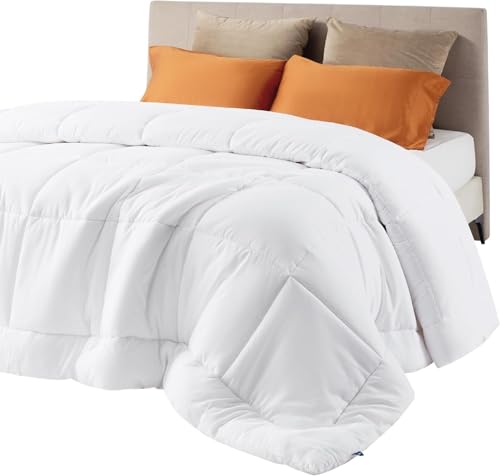
The Bedsure queen insert is the reference design for this guide: a quilted down alternative insert at 88 x 88 inches with eight corner tabs — double the anchoring of basic four-tab designs — and OEKO-TEX listed materials. Eight tabs matter more than they sound: an insert tied at eight points stays put through a week of sleep instead of migrating into one corner of the cover by Wednesday.
As an all-season down alternative it aims at the middle of the warmth range, which is where most heated bedrooms live. The honest limitation is that middle: committed hot sleepers will want the lighter DOWNCOOL or Amazon Basics builds below for summer, and cold-house sleepers in unheated rooms may layer a blanket in deep winter. For a single insert expected to work twelve months a year, though, this is the balanced starting point.
Use this insert to learn the anchoring lesson in how to choose a duvet insert: before you compare fills and prices, check that your cover has ties and count them. If it has eight, this design uses them all; if it has four, any of these inserts will work but none will stay as composed.
Best for: Most queen beds and couples wanting one all-season insert that stays anchored in its cover / Not suited for: Hot sleepers wanting a dedicated summer-weight insert
Check on Amazon — see the current price and full listing details.

DOWNCOOL Comforter, Queen 88 x 92
Badge: Best for Hot Sleepers
Strengths
- Lightweight build suits warm bedrooms and hot sleepers
- Extra length (92 inches) drapes well on taller mattresses
- Down alternative fill keeps care simple
Trade-offs
- Light fill will not be enough alone in a cold, unheated room
- Corner tabs rather than a full eight-point system
- White hotel styling depends on a cover for personality
Key specs (from the listing)
- Size: Queen, 88 x 92 inches
- Fill: down alternative
- Build: lightweight quilt
- Anchoring: corner tabs
- Positioning: all season, hotel comforter style
The DOWNCOOL insert makes the warmth argument: it is a deliberately lightweight quilt, and for the large share of sleepers who run warm, sleep in heated apartments, or live in mild climates, light is not a compromise — it is the correct specification. Its 88 x 92 inch footprint adds four inches of length over the square designs, which taller sleepers and deep mattresses quietly appreciate at the foot of the bed.
The down alternative fill keeps the same easy-care story as the other synthetic inserts, and the hotel-comforter positioning matches its crisp, uncomplicated build. The honest limitation is seasonal range: in a genuinely cold bedroom this insert becomes the base layer under a blanket rather than the whole answer. Buying light on purpose, with a blanket already owned, is a smarter system than buying one heavy insert and sweating half the year.
When deciding how to choose a duvet insert for warmth, treat this as the calibration point: if you currently kick off a medium duvet by 2 a.m., start here rather than with a 300GSM all-season model, whatever the marketing says about versatility.
Best for: Hot sleepers, warm apartments and mild climates; taller beds needing extra length / Not suited for: Cold, unheated bedrooms as a sole winter layer
Check on Amazon — see the current price and full listing details.
Amazon Basics Down Alternative Comforter, Full/Queen Light
Badge: Best Budget Pick
Strengths
- Light weight suits summer and warm sleepers
- Machine washable for low-fuss care
- Full/Queen sizing covers two bed sizes for guest flexibility
Trade-offs
- Light build is not a winter insert for cold rooms
- Fewer published specifications than premium rivals
- Basic anchoring with corner tabs only
Key specs (from the listing)
- Size: Full/Queen
- Fill: down alternative
- Weight: Light
- Anchoring: corner tabs
- Care: machine washable
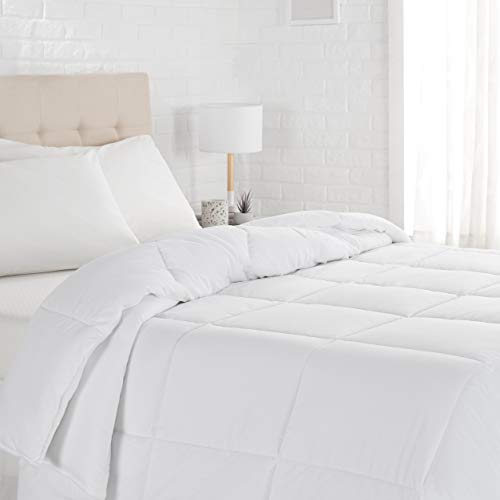
The Amazon Basics insert is the straightforward value branch: a light down alternative comforter sized Full/Queen, machine washable, with corner tabs for use as a duvet insert. It suits the very common brief of a guest room, a first apartment, or a summer swap-in that lives in the closet from October to May. Light and washable is exactly the right specification for bedding that hosts guests and gets laundered often.
Its listing publishes fewer engineering details than the premium names here — no GSM figure to compare — so judge it on its stated job: a light, washable layer. The honest limitation follows from that: do not ask it to be a four-season insert in a cold house, and do not expect the tailored anchoring of the eight-tab designs. Within its brief, those are fair trades for the gentlest tier in this guide.
This insert teaches the budget lesson in how to choose a duvet insert: spend follows contact hours. A guest bed used twenty nights a year does not need the flagship insert; it needs a clean, light, washable one — and the money saved buys the good pillows guests actually remember.
Best for: Guest rooms, first apartments and summer-weight swaps / Not suited for: Primary beds in cold bedrooms needing one all-season insert
Check on Amazon — see the current price and full listing details.

Utopia Bedding Duvet Insert, Queen 88 x 88
Badge: Best for Families
Strengths
- Soft microfiber shell feels finished even without a cover
- All-season weight aimed at whole-family use
- Square queen footprint fits standard covers
Trade-offs
- Microfiber shells can feel warmer than cotton shells
- All-season weight is a compromise at both seasonal extremes
- Tab details are less emphasised than on eight-tab rivals
Key specs (from the listing)
- Size: Queen, 88 x 88 inches
- Fill: down alternative
- Shell: soft microfiber
- Positioning: all season comforter for adults, kids and teens
Utopia Bedding’s insert is the family workhorse of the six: an all-season down alternative comforter in a soft microfiber shell, explicitly positioned for adults, kids and teens alike. The microfiber shell is the differentiator — it feels finished enough to use without a cover on a child’s or teen’s bed, which removes the whole tie-and-cover ritual from busy households.
Microfiber’s trade-off is breathability: it can sleep a touch warmer than a cotton shell, which hot sleepers should note, while cold sleepers may count it a benefit. The honest limitation is the all-season compromise itself — in a household buying one insert per bed for simplicity, accept that deep winter may add a throw and high summer may fold it down. For multi-bed households standardising on one model, that simplicity has real value.
Use this model when learning how to choose a duvet insert for a whole home: consistency, washability and a shell that survives uncovered use beat marginal warmth differences when you are buying three or four inserts at once.
Best for: Families standardising bedding across several beds, and children’s or teens’ rooms / Not suited for: Hot sleepers who prioritise a cool, cotton-shell feel
Check on Amazon — see the current price and full listing details.

CozyLux Queen Duvet Insert, 300GSM
Badge: Best All-Season Weight
Strengths
- Published 300GSM fill weight makes warmth comparisons honest
- Box-stitch quilting keeps fill evenly distributed
- Eight tabs for secure cover anchoring
Trade-offs
- 300GSM will be too warm for some sleepers in summer
- Heavier insert is more work to wash and dry at home
- Square footprint lacks the DOWNCOOL’s extra length
Key specs (from the listing)
- Size: Queen, 88 x 88 inches
- Fill: down alternative, 300GSM
- Construction: box-stitch quilting
- Anchoring: 8 tabs
- Certification: OEKO-TEX listed
The CozyLux insert earns its place by publishing the number most listings hide: a 300GSM down alternative fill. GSM — grams per square metre — is the closest thing this category has to a warmth specification, and 300 sits squarely in all-season territory for heated homes. Box-stitch quilting divides that fill into sealed squares so it cannot migrate, and eight tabs anchor the whole assembly inside its cover.
The combination of box stitching and a stated fill weight makes this the most ‘engineered’ synthetic insert in the guide, with OEKO-TEX listed materials as a further tiebreaker. The honest limitations are the flip side of its substance: a 300GSM insert is a heavy wash load that needs a large machine and thorough drying, and warm sleepers will find it too much in July. Buy it as the main insert for a cool-to-average bedroom, not as a universal answer.
Let this model anchor your sense of scale when deciding how to choose a duvet insert: light summer builds sit well below 300GSM, true winter builds above it. Any listing that will not state a weight is asking you to guess — prefer the ones that tell you.
Best for: Cool-to-average bedrooms wanting one substantial all-season insert / Not suited for: Hot sleepers, small washing machines, or summer-only use
Check on Amazon — see the current price and full listing details.

Maple&Stone Feather Down Comforter, Queen 90 x 90
Badge: Best Natural Fill
Strengths
- Real feather down loft with a natural cotton shell
- Largest footprint here at 90 x 90 inches
- Box stitch and eight loops keep fill and cover in place
Trade-offs
- Real down needs gentler, less frequent washing and thorough drying
- Feathers can occasionally work through even a good shell
- Premium-tier positioning among these six
Key specs (from the listing)
- Size: Queen, 90 x 90 inches
- Fill: feather down
- Shell: 100% cotton
- Construction: box stitch
- Anchoring: 8 loops
The Maple&Stone is the natural-fill branch of the decision: a feather down comforter in a 100% cotton shell, box-stitched, with eight loops, at the largest footprint in this guide — 90 x 90 inches. Down’s appeal is efficiency: it traps warmth with less weight on the body, breathes with temperature swings, and — cared for properly — outlasts synthetic clusters by years.
The cotton shell matters as much as the fill: it feels cool and crisp where microfiber feels soft and warm, which makes this the connoisseur’s combination for sleepers who notice shell fabrics. The honest limitations are care and cost tier. Down should be washed rarely and gently, dried completely to protect the clusters, and bought by people comfortable with that routine — and an occasional feather escaping is a fact of down ownership, not a defect.
Choose this insert when learning how to choose a duvet insert points you toward longevity: if you keep bedding for a decade and will follow the care routine, natural down repays its premium tier. If your household washes bedding hot and often, the synthetic five are the honest better fit.
Best for: Sleepers who value natural materials, breathability and long service life / Not suited for: Allergy-sensitive households or anyone wanting hot, frequent machine washing
Check on Amazon — see the current price and full listing details.
Comparison Table
| Pick | Badge | Key specs | Best for | Check |
|---|---|---|---|---|
| Bedsure Comforter Duvet Insert, Queen 88 x 88 | Best Overall | Size: Queen, 88 x 88 inches; Fill: down alternative | Most queen beds and couples wanting one all-season insert that stays anchored in its cover | Check on Amazon |
| DOWNCOOL Comforter, Queen 88 x 92 | Best for Hot Sleepers | Size: Queen, 88 x 92 inches; Fill: down alternative | Hot sleepers, warm apartments and mild climates; taller beds needing extra length | Check on Amazon |
| Amazon Basics Down Alternative Comforter, Full/Queen Light | Best Budget Pick | Size: Full/Queen; Fill: down alternative | Guest rooms, first apartments and summer-weight swaps | Check on Amazon |
| Utopia Bedding Duvet Insert, Queen 88 x 88 | Best for Families | Size: Queen, 88 x 88 inches; Fill: down alternative | Families standardising bedding across several beds, and children’s or teens’ rooms | Check on Amazon |
| CozyLux Queen Duvet Insert, 300GSM | Best All-Season Weight | Size: Queen, 88 x 88 inches; Fill: down alternative, 300GSM | Cool-to-average bedrooms wanting one substantial all-season insert | Check on Amazon |
| Maple&Stone Feather Down Comforter, Queen 90 x 90 | Best Natural Fill | Size: Queen, 90 x 90 inches; Fill: feather down | Sleepers who value natural materials, breathability and long service life | Check on Amazon |
How to Choose a Duvet Insert by Fill, Warmth and Size
Fill type decides care, feel and lifespan
Down alternative is a family of synthetic clusters: washable, consistent, allergy-friendlier, and gradually flattening over years. Feather down is the natural original: warmer per ounce, more breathable, longer-lived, and fussier to launder. Decide this first, because it eliminates half the shelf — in this guide it is a five-to-one split, and either camp contains good and mediocre products, so fill type is a preference decision, not a quality ranking.
Fill weight is the warmth dial — ask for the number
Where a listing states GSM, use it: light builds for summer and hot sleepers, roughly 300GSM for all-season use in heated homes, higher for cold rooms. Where no weight is published, treat words like ‘lightweight’ as the specification and ‘all season’ as a claim to be sceptical of. Your bedroom’s night-time temperature and whether you sleep hot matter more than any label; a heated apartment at a steady warm temperature needs a light insert even in January.
Size the insert to the cover, then to the bed
Measure your duvet cover’s internal dimensions and buy the insert that matches or exceeds them slightly. Then check drape on the bed: a queen mattress with a deep topper wants the 88 x 92 or 90 x 90 footprints so the sides stay covered. Couples should size up within their cover’s tolerance — the cheapest cure for cover-stealing is four extra inches of duvet. If you are also furnishing the bed itself, Best Duvet Insert Under $30 is a useful budget cross-check once sizes are settled.
Anchoring: tabs, loops and ties must match
An insert anchored at eight points behaves like one piece of bedding; an unanchored insert becomes a ball in a sack. Inventory your cover: does it have internal ties, and how many? Then match — eight-tab and eight-loop designs for eight-tie covers, corner-tab designs for four-tie covers. No ties at all means safety-pinning corners or choosing a different cover, because no insert can fix a cover with nothing to hold it.
Shell fabric is a temperature decision too
Cotton shells feel cool and crisp and breathe best; microfiber shells feel soft and cosy and sleep warmer. Hot sleepers should weight shell fabric nearly as heavily as fill weight — a light fill in a microfiber shell can feel warmer than a mid fill in cotton. If the insert will be used without a cover, on kids’ beds for instance, the shell is also the visible, washable surface, which argues for the microfiber designs built for that job.
Tog ratings and GSM: two dialects for warmth
Some listings speak in togs, others — like the CozyLux here — in GSM, and many in neither. A tog is a direct warmth rating; GSM is a fill weight that predicts warmth within one fill family. You cannot convert between brands precisely, but you can rank within a listing range: the lightest insert a brand sells is its summer answer whatever the number, and its heaviest is its winter one. When a listing gives no number at all, let the words ‘lightweight’ or ‘winter weight’ carry the decision and treat ‘all season’ as unproven until the trial nights rule.
How to Fit, Fluff and Care for a Duvet Insert
A duvet insert performs only as well as it is fitted and maintained. The routine below covers first fitting, weekly habits and the washing approach that keeps fill lofty instead of lumpy.
- On arrival, give the insert a full shake-out and several hours of airing; compressed packaging flattens fill that recovers with air and time, not heat.
- Lay the duvet cover inside-out on the bed, place the insert on top aligned corner to corner, and fasten every tie to its matching tab or loop.
- Roll the cover and insert together from foot to head like a burrito, then unroll — the insert ends up inside, evenly distributed, without the usual arm-wrestling.
- Shake the finished duvet from the head of the bed so fill settles toward the foot, then check each corner sits filled, not empty.
- Weekly, shake and air the duvet for ten minutes while making the bed; loft is mostly trapped air, and shaking restores it.
- Use a cover always (except for shell-finished designs used deliberately without one) — washing the cover weekly is what lets the insert be washed rarely.
- Wash the insert only when needed, in the largest machine available, on a gentle cycle, and rinse twice to clear detergent from the fill.
- Dry thoroughly — tumble on low with dryer balls for synthetic fills, and longer, patient drying for down — before the insert goes back on the bed.
Troubleshooting
Problem: Fill has migrated into lumps → Shake the duvet hard from each side in turn and hang it over a door to redistribute. Box-stitched inserts resist this; if a sewn-through insert keeps lumping, it is nearing replacement.
Problem: The insert bunches inside its cover → A tie has come undone or the insert is smaller than the cover. Re-tie all points; if bunching persists, the size pairing is wrong, not the technique.
Problem: Down insert smells musty after washing → It was stored before it was fully dry. Re-dry it completely with dryer balls until the clusters feel light and separate, and never store down compressed or damp.
Down Alternative vs Real Feather Down: The Real Differences
Five of the six inserts in this guide use down alternative fill — clustered synthetic fibres engineered to mimic down’s loft without feathers. It is machine washable in most cases, friendlier to allergy-prone sleepers, and consistent from corner to corner. Its weakness is lifespan: synthetic clusters slowly lose loft with repeated washing, and a budget insert can feel flat within a few years of hard use.
The Maple&Stone insert is the genuine feather-down option here, in a cotton shell. Real down insulates more per ounce, breathes beautifully and can last a decade with proper care, but it asks more of you: gentler washing, thorough drying, and tolerance for the occasional feather working through the shell. Neither fill is superior in the abstract — the choice is between easy-care consistency and long-lived natural loft.
Sizing Up: Why Many Sleepers Choose an Insert Larger Than the Bed
Insert sizes look standardised — queen is queen — until you compare the numbers in this guide: 88 x 88 inches, 88 x 92, and 90 x 90 all wear the queen label. Those few inches decide whether the duvet drapes over the sides of a thick mattress or ends at the mattress edge, and whether two sleepers can both stay covered through the night. Couples who steal covers should treat the longer or wider options as the default, not the upgrade.
Match the insert to the duvet cover, not just the bed: an insert noticeably smaller than its cover swims and bunches, while one slightly larger fills the corners and looks hotel-crisp. Check your cover’s internal dimensions, count its ties or loops, and choose an insert with the same anchoring system — tabs and loops only help if both halves of the partnership have them.
Allergies, Dust Mites and the Insert Decision
Allergy-prone sleepers often arrive at this category with a conclusion already formed — that down is forbidden and synthetic is safe — and the reality is more useful than the slogan. What triggers most bedding allergies is dust mite accumulation, and the defence is washing: a cover washed hot and often, and an insert that tolerates the occasional thorough wash and complete dry. That defence is easiest to run with down alternative inserts, which is why five of this guide’s six point that way.
Real down, kept in a washed cover and aired regularly, is not the hazard of folklore either — but its gentler wash routine makes the defence harder to sustain in a high-allergy household. Choose the insert your laundry can defend: an impeccably washed synthetic beats a neglected down insert on every allergy measure that matters.
Three Sleepers, Three Inserts
The hot sleeper in a heated city apartment: the DOWNCOOL, because her problem is not January but the building’s enthusiastic radiators, and a light insert plus the option to fold it down beats a year of kicking off an all-season duvet. The couple in a draughty older house who share everything including the duvet: the CozyLux 300GSM at the largest size their cover allows, because shared warmth and shared coverage both argue for substance. The natural-materials household that keeps bedding for a decade: the Maple&Stone, with its cotton shell and feather fill, bought with eyes open about the care routine it demands.
Each choice is the same method — temperature, sharing, laundry, lifespan — applied to different facts. Write your four facts down before you shop and the insert chooses itself.
In Daily Use: How the Picks Differ
Living with these six separates them by laundry day more than by sleep. The synthetics wash, dry and return to the bed inside a day; the down insert turns its rare wash into a small ceremony. In the cover, the eight-tab and eight-loop designs stay composed for a week, while four-tab designs need a midweek shake. And across a year, the light inserts earn their keep in the months the heavy ones spend folded — which is why many experienced households end up owning a light and a mid-weight insert rather than one heroic all-season compromise.
The Two-Insert System: Summer, Winter and the Shoulder Months
Experienced households rarely own one insert; they own a system. A light insert handles summer and heated-apartment winters. A substantial insert — the CozyLux 300GSM or the Maple&Stone in this guide — handles cold months in real houses. In the shoulder weeks of spring and autumn, the light insert plus a throw, or the heavy insert folded down, covers the gap. The system costs less than it sounds, because each insert is bought at its own honest tier rather than one insert being bought at the flagship tier to do everything.
The system also doubles insert lifespan: each insert works half the year and rests, aired and loosely stored, for the other half, and washing is spread across two products instead of concentrated on one. Storage is the discipline that makes or breaks it — the resting insert must go away clean, completely dry and uncompressed, or the system manufactures mustiness instead of preventing wear. If your closet can hold one spare insert, the two-insert system is the single most effective upgrade this guide can offer a household that has been fighting one all-season compromise for years.
A Worked Example: One Couple, One Cold House, One Decision
Take a concrete case: two sleepers, one queen bed in an older house that cools at night, a sleeper who runs warm sharing with a sleeper who steals covers, an existing duvet cover measuring 90 by 90 inches internally with eight ties, and a household washing machine of ordinary size. Run the method. Fill type first: the laundry is brisk and weekly, the cover will be washed hot, and nobody in the house will perform a drying ceremony — down alternative wins the fill decision on laundry temperament alone, and the Maple&Stone, for all its virtues, is honestly eliminated. Warmth next: the house is cold at night but one sleeper runs warm, which is the classic argument against a single heavy insert and for a mid-weight one that the warm sleeper can fold down — the 300GSM CozyLux is the ceiling of the sensible range, and a true winter-weight insert would exile the warm sleeper to the sofa by February.
Size and anchoring then do quiet, decisive work. The cover is 90 by 90 with eight ties: the 88 x 88 inserts will fit but swim slightly, the 90 x 90 footprint belongs to the down model already eliminated, and among the synthetics the eight-tab designs — the Bedsure and the CozyLux — match the cover’s eight ties exactly, while the corner-tab designs would leave four ties unemployed and the insert freer to migrate. Between the two survivors, warmth casts the deciding vote the scenario built for it: the cold house and the cover-stealing sleeper argue for the CozyLux’s stated 300GSM over the Bedsure’s unstated all-season weight, because in a cold room the cost of too little fill is paid nightly, while the warm sleeper’s surplus is solved by folding.
Notice what never decided anything: brand, colour, and the word ‘hotel’. The decision was made by laundry temperament, night temperature, cover dimensions and tie count — four facts the couple already knew before they opened a single listing. That is the transferable lesson of the example. Write your four facts down first, and the insert market, which looks like hundreds of near-identical white rectangles, collapses into one or two honest candidates.
The Pre-Purchase Checklist, in Order
Before you order, run this sequence against your chosen insert. One: the cover’s internal dimensions, measured, match the insert’s footprint or sit within an inch of it. Two: the cover’s tie count matches the insert’s tabs or loops — eight to eight, four to four. Three: the fill family matches your laundry temperament, synthetic for brisk households, down for ceremonious ones. Four: the fill weight, where published, matches your bedroom’s night temperature and your own thermostat — and where unpublished, the words ‘light’ or ‘winter’ have been taken as the specification. Five: the shell suits your skin’s preference, cotton for cool sleepers, microfiber for cosy ones. Six: the wash plan exists — a machine with room, a dryer with time, or a laundromat you will genuinely visit.
Six checks, none of them about price, and together they predict satisfaction better than any ranking — including this guide’s. An insert that passes all six and sits in a gentler tier will out-sleep a flagship that fails two. That is the checklist’s purpose: to move the decision from the product’s reputation to your bed’s facts, which is where every section of this guide has been trying to put it.
Common Buying Mistakes
- Buying by bed size alone and ignoring that queen inserts here span 88 x 88 to 90 x 90 inches — then blaming the cover for the poor fit.
- Choosing an all-season 300GSM insert for a hot sleeper because ‘versatile’ sounded safer than ‘light’.
- Never checking whether the cover has ties, then fighting a migrating insert for years.
- Washing a down insert hot and often like a towel, which strips and breaks the clusters.
- Storing any insert damp or vacuum-compressed for months, which crushes loft that never fully returns.
- Judging warmth in the shop by hand-feel; loft and fill weight predict night warmth, not the squeeze test.
Keep researching: If your shortlist narrows to a specific budget tier, Best Duvet Insert For Apartments Under $30 compares that tier in detail. Readers furnishing a particular room type may also want Best Duvet Insert For Small Bedrooms Under $700 before they finalise a choice. For a narrower comparison built around one room and budget, see Best Duvet Insert Under $2000. And if the budget is the deciding factor from the start, Best Duvet Insert For Guest Rooms Under $2000 is the companion shortlist to work through. If your shortlist narrows to a specific budget tier, Best Duvet Insert For Small Bedrooms Under $1000 compares that tier in detail.
Final Recommendation
For most queen beds, start with the Bedsure 88 x 88 insert: eight-tab anchoring, OEKO-TEX listed materials and a balanced all-season weight make it the safest single purchase. Hot sleepers should step down to the lightweight DOWNCOOL, cold bedrooms up to the CozyLux 300GSM, families across several beds to the Utopia, guest rooms to the Amazon Basics, and natural-material loyalists to the Maple&Stone feather down — the only choice here that asks for, and rewards, a gentler care routine. If your budget is the binding constraint, compare the finalists against Best Duvet Insert For Apartments Under $30 before deciding.
Start your comparison with the top picks from this guide: Bedsure Comforter Duvet Insert, Queen 88 x 88, DOWNCOOL Comforter, Queen 88 x 92, Amazon Basics Down Alternative Comforter, Full/Queen Light — check the current price on Amazon for each before you decide.
Related guides
Frequently Asked Questions
What is the difference between a duvet insert and a comforter?
Functionally they are the same filled blanket. ‘Insert’ implies it is designed to live inside a duvet cover — hence the corner tabs or loops — while ‘comforter’ often implies a finished shell meant to be seen. Most products here can do both jobs; anchoring hardware is the tell.
How warm should my duvet insert be?
Match fill weight to your bedroom and body: light builds for warm rooms and hot sleepers, around 300GSM for all-season use in heated homes, heavier for cold rooms. If you regularly kick off your current duvet, buy lighter than your instinct suggests.
Should I size up my duvet insert?
If two people share the bed or the mattress is deep, the larger queen footprints — 88 x 92 or 90 x 90 inches — drape and share better. Just confirm the insert still matches your cover’s internal dimensions, or buy the cover to match.
Is down alternative better than real down?
Neither is simply better. Down alternative wins on washability, price tier and allergy-friendliness; real down wins on warmth per ounce, breathability and lifespan. Choose by your laundry habits and how long you keep bedding.
How often should a duvet insert be washed?
With a cover washed weekly, the insert itself usually needs washing only a few times a year or when soiled. Wash gently in a large machine and dry completely — incomplete drying causes more damage than washing itself.
Why does my insert slide around inside the cover?
Either a tie is undone or the insert and cover sizes mismatch. Re-tie every tab or loop, and measure both: an insert several inches smaller than its cover will always migrate, whatever you tie.
Can I use a duvet insert without a cover?
You can, and shell-finished designs tolerate it best, but you surrender the system that keeps inserts clean: without a cover, the insert itself takes the soil and must be washed far more often, spending its loft early. A cover is the cheapest longevity an insert can be given.
How do I stop my insert bunching in one corner?
Tie every tab or loop to its matching cover tie, shake the duvet from the head of the bed each morning, and check the size pairing — an insert several inches smaller than its cover will migrate no matter how well it is tied. Bunching is a fit problem wearing a technique costume.