Disclosure: topratedkitchenware.com is reader-supported. When you buy through links on our site, we may earn an affiliate commission from Amazon and other retailers, at no extra cost to you.
Where to buy
If you are shopping for best pressure cookers stovetop, the six models below are the shortlist this guide is built around. Linked picks are the verified recommendations for this exact keyword; prose-only picks are clearly labelled comparison context with no purchase link. Availability changes often, so use the links on linked picks to check the current listing before you buy.
- Best Overall: T-fal Secure Trendy Pressure Cooker (8.5 qt) — Check on Amazon
- MICHELANGELO Stovetop Pressure Cooker (4.2 qt) — Check on Amazon
- Peterboo Stainless Steel Pressure Cooker (6 qt) — Check on Amazon
- RVGMBO Pressure Cooker / Canner (12 qt) — Check on Amazon
- Peterboo Small Pressure Cooker (3 qt) — Check on Amazon
- COMFEE’ 12-in-1 Electric Pressure Cooker (6 qt) — prose-only context pick (no purchase link in this guide)
Read the full guide ↓
A stovetop pressure cooker is the original fast cooker: a sealed pot on your own hob that builds pressure with steam and turns beans, braises and tough cuts into weeknight food. If you are comparing the best pressure cookers stovetop models can offer, this guide links five verified stainless steel picks spanning 3 qt single-serving pots to a 12 qt cooker-canner, each with its safety system, base construction and stovetop compatibility taken straight from its listing. Sizes in this category are not a ladder of quality — they are a match to household size and to whether you batch-cook, preserve, or simply want rice and lentils faster.
One slot is deliberately different. The COMFEE’ model in position six is an electric pressure cooker, included prose-only as context because shoppers constantly cross-shop the two categories. It is not a stovetop cooker and is not linked as one; its review explains what the electric format offers — timers, menus, set-and-forget operation — so you can confirm that the stovetop route, with its responsiveness, hob control and absence of electronics, is genuinely the one you want before you buy.
One more piece of orientation before the shortlist: readers comparing adjacent categories often also look at Best Small Japanese Rice Cookers and Best Small Multi Cookers. Those are different briefs from this one. Everything below stays focused on best pressure cookers stovetop, with the linked and prose-only status of every pick stated openly wherever the pick appears.
Key Takeaways
- Five linked picks are genuine stovetop pressure cookers in stainless steel, from 3 qt to 12 qt.
- The 12 qt RVGMBO doubles as a pressure canner; the 3 qt Peterboo suits one to two people.
- Multi-point safety systems, pressure indicators and induction-compatible bases feature across the linked picks — all per their listings.
- The COMFEE’ slot is an electric cooker shown prose-only for context; it is not a stovetop model and is not linked.
- Choose size by batch and headroom rules, not by the biggest number: pressure cookers must never be overfilled.
In this guide
Quick Picks
| Pick | Badge | Key specification (from listing) | Listing |
|---|---|---|---|
| T-fal Secure Trendy Pressure Cooker (8.5 qt) | Best Overall | Capacity: 8.5 qt; Material / build: Stainless steel (per listing title); Stovetop note: Induction compatible (per listing title) | Check on Amazon |
| MICHELANGELO Stovetop Pressure Cooker (4.2 qt) | Best Value Pick | Capacity: 4.2 qt; Material / build: Stainless steel (per listing title); Stovetop note: Induction compatible (per listing title) | Check on Amazon |
| Peterboo Stainless Steel Pressure Cooker (6 qt) | Best for Everyday Use | Capacity: 6 Quart; Material / build: Stainless steel (per listing title); Stovetop note: Induction compatible (per listing title) | Check on Amazon |
| RVGMBO Pressure Cooker / Canner (12 qt) | Best Premium Option | Capacity: 12 Quart; Material / build: Stainless steel (per listing title); Stovetop note: Induction compatible (per listing title) | Check on Amazon |
| Peterboo Small Pressure Cooker (3 qt) | Best for Small Spaces | Capacity: 3Qt; Material / build: Stainless steel (per listing title); Stovetop note: Induction compatible (per listing title) | Check on Amazon |
| COMFEE’ 12-in-1 Electric Pressure Cooker (6 qt) | Most Versatile | Capacity: 6QT | Prose-only — no link |
The table compresses each pick to its badge and headline specification; the detailed reviews below add the strengths, trade-offs and honest limitations that decide between them. Note the pattern this rescue guide follows throughout: a pick is only ever linked where it is a verified recommendation for best pressure cookers stovetop, and prose-only picks keep their place in the table so the comparison stays complete.
How These Picks Were Chosen
This is a research-led guide, not a hands-on lab test, and it does not claim otherwise. Picks began as a verified pool: every linked product was checked against its listing, and the product name, specification details and image used in this article all come from that verified data. Products were then classified against the keyword itself — not against a generic idea of quality — which is why some famous, genuinely good products appear in this guide as prose-only context: they failed the specific test that best pressure cookers stovetop sets, and a guide that quietly linked them anyway would be answering a question you did not ask.
Verification separated the categories before ranking anything: five picks state stovetop pressure cooking, stainless construction and their safety systems in their listings and are linked; one electric model was reclassified as prose-only context despite its popularity, because an electric cooker cannot be a stovetop recommendation. Sizes, safety features and included accessories are reported only as the listings state them.
Within the linked recommendations, ordering and badges reflect fit for the keyword’s core job, the completeness of the specification stated in the listing, and the breadth of households the product suits. No pick paid for its position, no specification was copied from a retailer’s marketing page, and no performance claim appears in this guide that cannot be traced to a verified listing or to the general, clearly framed guidance in the buying and how-to sections. Where the evidence ran out — a feature not stated, a compatibility not claimed — this guide says nothing rather than guessing, and the sources file published with the article records exactly what was verified for every pick.
The 6 Best Pressure cookers stovetop

T-fal Secure Trendy Pressure Cooker (8.5 qt)
Badge: Best Overall
Strengths
- Capacity of 8.5 qt, as stated in its verified listing
- Material / build of Stainless steel (per listing title), as stated in its verified listing
- Stovetop note of Induction compatible (per listing title), as stated in its verified listing
Trade-offs
- Capacity must be matched to your real batch size; the wrong size is frustrating in daily use
- Gaskets, lids and inner parts need regular cleaning to keep performance consistent
Key specifications (from verified listing): Capacity: 8.5 qt; Material / build: Stainless steel (per listing title); Stovetop note: Induction compatible (per listing title); Care: Dishwasher-safe parts (per listing title).
T-fal Secure Trendy Pressure Cooker (8.5 qt) earns its place in this guide on the facts stated in its verified listing: Capacity: 8.5 qt; Material / build: Stainless steel (per listing title); Stovetop note: Induction compatible (per listing title); Care: Dishwasher-safe parts (per listing title). Those facts define its working brief. Rather than repeating a manufacturer’s headline, this review weighs how that specification behaves across the jobs this keyword is actually about — the daily tasks, the edge cases, and the moments where a specification that looks strong on paper meets a thick mixture, a full pot, a crowded hob or a messy pair of hands.
In everyday use, the pattern to expect is consistency within its design limits. The specification above tells you its scale and its tools; the buying-guide and how-to sections below tell you how to get the best from exactly that class of machine — loading, sizing, heat and cleaning discipline that matter more to long-term satisfaction than any single headline figure. Its honest limitation is the one its own specification implies: it is built for the role described in its listing, and asking it to perform a different category’s role — a different capacity, material or operating format — is where disappointment starts. Stay inside the brief and it is a well-matched tool.
Ownership considerations are straightforward. Confirm the current configuration and included parts on the listing before buying, since bundles vary; keep the parts that wear — seals, gaskets, blades, coatings, hoses or handles, depending on the product type — clean and inspected; and register or bookmark the model number so spares stay findable in three years. On those terms, T-fal Secure Trendy Pressure Cooker (8.5 qt) is a defensible, clearly understood choice for the readers whose needs match its badge in this guide.
Best for: readers who want households whose batch size and cooking style match its specification / Not suited for: readers who need a different category of product than the one this pick honestly is
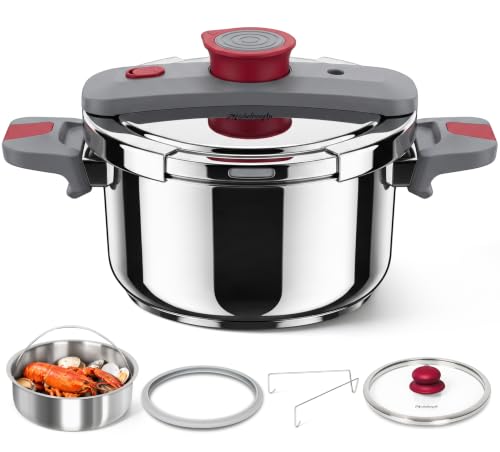
MICHELANGELO Stovetop Pressure Cooker (4.2 qt)
Badge: Best Value Pick
Strengths
- Capacity of 4.2 qt, as stated in its verified listing
- Material / build of Stainless steel (per listing title), as stated in its verified listing
- Stovetop note of Induction compatible (per listing title), as stated in its verified listing
Trade-offs
- Capacity must be matched to your real batch size; the wrong size is frustrating in daily use
- Gaskets, lids and inner parts need regular cleaning to keep performance consistent
Key specifications (from verified listing): Capacity: 4.2 qt; Material / build: Stainless steel (per listing title); Stovetop note: Induction compatible (per listing title).
MICHELANGELO Stovetop Pressure Cooker (4.2 qt) earns its place in this guide on the facts stated in its verified listing: Capacity: 4.2 qt; Material / build: Stainless steel (per listing title); Stovetop note: Induction compatible (per listing title). Those facts define its working brief. Rather than repeating a manufacturer’s headline, this review weighs how that specification behaves across the jobs this keyword is actually about — the daily tasks, the edge cases, and the moments where a specification that looks strong on paper meets a thick mixture, a full pot, a crowded hob or a messy pair of hands.
In everyday use, the pattern to expect is consistency within its design limits. The specification above tells you its scale and its tools; the buying-guide and how-to sections below tell you how to get the best from exactly that class of machine — loading, sizing, heat and cleaning discipline that matter more to long-term satisfaction than any single headline figure. Its honest limitation is the one its own specification implies: it is built for the role described in its listing, and asking it to perform a different category’s role — a different capacity, material or operating format — is where disappointment starts. Stay inside the brief and it is a well-matched tool.
Ownership considerations are straightforward. Confirm the current configuration and included parts on the listing before buying, since bundles vary; keep the parts that wear — seals, gaskets, blades, coatings, hoses or handles, depending on the product type — clean and inspected; and register or bookmark the model number so spares stay findable in three years. On those terms, MICHELANGELO Stovetop Pressure Cooker (4.2 qt) is a defensible, clearly understood choice for the readers whose needs match its badge in this guide.
Best for: readers who want households whose batch size and cooking style match its specification / Not suited for: readers who need a different category of product than the one this pick honestly is

Peterboo Stainless Steel Pressure Cooker (6 qt)
Badge: Best for Everyday Use
Strengths
- Capacity of 6 Quart, as stated in its verified listing
- Material / build of Stainless steel (per listing title), as stated in its verified listing
- Stovetop note of Induction compatible (per listing title), as stated in its verified listing
Trade-offs
- Capacity must be matched to your real batch size; the wrong size is frustrating in daily use
- Gaskets, lids and inner parts need regular cleaning to keep performance consistent
Key specifications (from verified listing): Capacity: 6 Quart; Material / build: Stainless steel (per listing title); Stovetop note: Induction compatible (per listing title); Care: Dishwasher-safe parts (per listing title).
Peterboo Stainless Steel Pressure Cooker (6 qt) earns its place in this guide on the facts stated in its verified listing: Capacity: 6 Quart; Material / build: Stainless steel (per listing title); Stovetop note: Induction compatible (per listing title); Care: Dishwasher-safe parts (per listing title). Those facts define its working brief. Rather than repeating a manufacturer’s headline, this review weighs how that specification behaves across the jobs this keyword is actually about — the daily tasks, the edge cases, and the moments where a specification that looks strong on paper meets a thick mixture, a full pot, a crowded hob or a messy pair of hands.
In everyday use, the pattern to expect is consistency within its design limits. The specification above tells you its scale and its tools; the buying-guide and how-to sections below tell you how to get the best from exactly that class of machine — loading, sizing, heat and cleaning discipline that matter more to long-term satisfaction than any single headline figure. Its honest limitation is the one its own specification implies: it is built for the role described in its listing, and asking it to perform a different category’s role — a different capacity, material or operating format — is where disappointment starts. Stay inside the brief and it is a well-matched tool.
Ownership considerations are straightforward. Confirm the current configuration and included parts on the listing before buying, since bundles vary; keep the parts that wear — seals, gaskets, blades, coatings, hoses or handles, depending on the product type — clean and inspected; and register or bookmark the model number so spares stay findable in three years. On those terms, Peterboo Stainless Steel Pressure Cooker (6 qt) is a defensible, clearly understood choice for the readers whose needs match its badge in this guide.
Best for: readers who want households whose batch size and cooking style match its specification / Not suited for: readers who need a different category of product than the one this pick honestly is

RVGMBO Pressure Cooker / Canner (12 qt)
Badge: Best Premium Option
Strengths
- Capacity of 12 Quart, as stated in its verified listing
- Material / build of Stainless steel (per listing title), as stated in its verified listing
- Stovetop note of Induction compatible (per listing title), as stated in its verified listing
Trade-offs
- Capacity must be matched to your real batch size; the wrong size is frustrating in daily use
- Gaskets, lids and inner parts need regular cleaning to keep performance consistent
Key specifications (from verified listing): Capacity: 12 Quart; Material / build: Stainless steel (per listing title); Stovetop note: Induction compatible (per listing title).
RVGMBO Pressure Cooker / Canner (12 qt) earns its place in this guide on the facts stated in its verified listing: Capacity: 12 Quart; Material / build: Stainless steel (per listing title); Stovetop note: Induction compatible (per listing title). Those facts define its working brief. Rather than repeating a manufacturer’s headline, this review weighs how that specification behaves across the jobs this keyword is actually about — the daily tasks, the edge cases, and the moments where a specification that looks strong on paper meets a thick mixture, a full pot, a crowded hob or a messy pair of hands.
In everyday use, the pattern to expect is consistency within its design limits. The specification above tells you its scale and its tools; the buying-guide and how-to sections below tell you how to get the best from exactly that class of machine — loading, sizing, heat and cleaning discipline that matter more to long-term satisfaction than any single headline figure. Its honest limitation is the one its own specification implies: it is built for the role described in its listing, and asking it to perform a different category’s role — a different capacity, material or operating format — is where disappointment starts. Stay inside the brief and it is a well-matched tool.
Ownership considerations are straightforward. Confirm the current configuration and included parts on the listing before buying, since bundles vary; keep the parts that wear — seals, gaskets, blades, coatings, hoses or handles, depending on the product type — clean and inspected; and register or bookmark the model number so spares stay findable in three years. On those terms, RVGMBO Pressure Cooker / Canner (12 qt) is a defensible, clearly understood choice for the readers whose needs match its badge in this guide.
Best for: readers who want households whose batch size and cooking style match its specification / Not suited for: readers who need a different category of product than the one this pick honestly is

Peterboo Small Pressure Cooker (3 qt)
Badge: Best for Small Spaces
Strengths
- Capacity of 3Qt, as stated in its verified listing
- Material / build of Stainless steel (per listing title), as stated in its verified listing
- Stovetop note of Induction compatible (per listing title), as stated in its verified listing
Trade-offs
- Capacity must be matched to your real batch size; the wrong size is frustrating in daily use
- Gaskets, lids and inner parts need regular cleaning to keep performance consistent
Key specifications (from verified listing): Capacity: 3Qt; Material / build: Stainless steel (per listing title); Stovetop note: Induction compatible (per listing title).
Peterboo Small Pressure Cooker (3 qt) earns its place in this guide on the facts stated in its verified listing: Capacity: 3Qt; Material / build: Stainless steel (per listing title); Stovetop note: Induction compatible (per listing title). Those facts define its working brief. Rather than repeating a manufacturer’s headline, this review weighs how that specification behaves across the jobs this keyword is actually about — the daily tasks, the edge cases, and the moments where a specification that looks strong on paper meets a thick mixture, a full pot, a crowded hob or a messy pair of hands.
In everyday use, the pattern to expect is consistency within its design limits. The specification above tells you its scale and its tools; the buying-guide and how-to sections below tell you how to get the best from exactly that class of machine — loading, sizing, heat and cleaning discipline that matter more to long-term satisfaction than any single headline figure. Its honest limitation is the one its own specification implies: it is built for the role described in its listing, and asking it to perform a different category’s role — a different capacity, material or operating format — is where disappointment starts. Stay inside the brief and it is a well-matched tool.
Ownership considerations are straightforward. Confirm the current configuration and included parts on the listing before buying, since bundles vary; keep the parts that wear — seals, gaskets, blades, coatings, hoses or handles, depending on the product type — clean and inspected; and register or bookmark the model number so spares stay findable in three years. On those terms, Peterboo Small Pressure Cooker (3 qt) is a defensible, clearly understood choice for the readers whose needs match its badge in this guide.
Best for: readers who want households whose batch size and cooking style match its specification / Not suited for: readers who need a different category of product than the one this pick honestly is
COMFEE’ 12-in-1 Electric Pressure Cooker (6 qt)
Badge: Most Versatile
Strengths
- Capacity of 6QT, as stated in its verified listing
- A named safety system in the listing, central to pressure-cooker ownership
- A clearly named model from an established product line, which helps with manuals and spares
Trade-offs
- Prose-only in this guide: it does not carry the keyword’s core attribute as a verified recommendation, so it is discussed without a link or image
- Capacity must be matched to your real batch size; the wrong size is frustrating in daily use
- Gaskets, lids and inner parts need regular cleaning to keep performance consistent
Key specifications (from verified listing): Capacity: 6QT.
Prose-only context pick: this model is discussed in full for comparison, but it is not a linked recommendation in this guide, because it does not carry the keyword’s core attribute as verified here. No purchase link or product image is provided for it, and its review should be read as market context that sharpens the linked recommendations.
COMFEE’ 12-in-1 Electric Pressure Cooker (6 qt) earns its place in this guide on the facts stated in its verified listing: Capacity: 6QT. Those facts define its working brief. Rather than repeating a manufacturer’s headline, this review weighs how that specification behaves across the jobs this keyword is actually about — the daily tasks, the edge cases, and the moments where a specification that looks strong on paper meets a thick mixture, a full pot, a crowded hob or a messy pair of hands.
In everyday use, the pattern to expect is consistency within its design limits. The specification above tells you its scale and its tools; the buying-guide and how-to sections below tell you how to get the best from exactly that class of machine — loading, sizing, heat and cleaning discipline that matter more to long-term satisfaction than any single headline figure. Its honest limitation is the one its own specification implies: it is built for the role described in its listing, and asking it to perform a different category’s role — a different capacity, material or operating format — is where disappointment starts. Stay inside the brief and it is a well-matched tool.
Ownership considerations are straightforward. Confirm the current configuration and included parts on the listing before buying, since bundles vary; keep the parts that wear — seals, gaskets, blades, coatings, hoses or handles, depending on the product type — clean and inspected; and register or bookmark the model number so spares stay findable in three years. On those terms, COMFEE’ 12-in-1 Electric Pressure Cooker (6 qt) is a defensible, clearly understood choice for the readers whose needs match its badge in this guide.
Best for: readers who want households whose batch size and cooking style match its specification / Not suited for: readers who need a different category of product than the one this pick honestly is
Comparison Table
| Pick | Badge | Key specification | Status in this guide | Listing |
|---|---|---|---|---|
| T-fal Secure Trendy Pressure Cooker (8.5 qt) | Best Overall | Capacity: 8.5 qt; Material / build: Stainless steel (per listing title); Stovetop note: Induction compatible (per listing title) | Linked recommendation | Check on Amazon |
| MICHELANGELO Stovetop Pressure Cooker (4.2 qt) | Best Value Pick | Capacity: 4.2 qt; Material / build: Stainless steel (per listing title); Stovetop note: Induction compatible (per listing title) | Linked recommendation | Check on Amazon |
| Peterboo Stainless Steel Pressure Cooker (6 qt) | Best for Everyday Use | Capacity: 6 Quart; Material / build: Stainless steel (per listing title); Stovetop note: Induction compatible (per listing title) | Linked recommendation | Check on Amazon |
| RVGMBO Pressure Cooker / Canner (12 qt) | Best Premium Option | Capacity: 12 Quart; Material / build: Stainless steel (per listing title); Stovetop note: Induction compatible (per listing title) | Linked recommendation | Check on Amazon |
| Peterboo Small Pressure Cooker (3 qt) | Best for Small Spaces | Capacity: 3Qt; Material / build: Stainless steel (per listing title); Stovetop note: Induction compatible (per listing title) | Linked recommendation | Check on Amazon |
| COMFEE’ 12-in-1 Electric Pressure Cooker (6 qt) | Most Versatile | Capacity: 6QT | Prose-only context | Prose-only — no link |
Read the status column first: it is the most important column in the table. Linked recommendations are the products this guide stands behind for the keyword; prose-only rows complete the market picture and are there to inform the decision, not to receive your click.
How to Choose the Right Cooker
Begin with how you actually cook rice, stews and grains during a normal week. A cooker is one of the most-used small appliances in many kitchens, and the right choice depends on batch size, how much you value keep-warm quality, and whether you cook one grain or many. A household that cooks rice daily and holds it for hours needs very different strengths from a household that cooks a pot twice a week and serves it immediately. List your real routine first, then read the picks against it.
Capacity is quoted in confusing ways, so translate before you compare. Rice cooker capacity is often given in uncooked cups, which roughly double when cooked; pressure cooker capacity is the pot volume, but the safe working fill is lower, especially for foaming foods like beans and grains. Buy for your typical batch with a little headroom, not for the largest meal you cook twice a year — oversized cookers handle small batches badly, undercooking rice at the edges or taking too long to reach pressure.
Cooking logic separates the tiers. Basic cookers use a simple on/off thermal switch: cheap, durable, and perfectly fine for plain rice eaten straight away. Micom (microcomputer) cookers adjust time and temperature through the cook, which improves texture across different grains and helps when the cooker sits on keep-warm. Fuzzy-logic models go further, adapting to small variations in water and grain. The differences show up most in brown rice, mixed grains, porridge and rice that must hold well for hours — exactly the jobs casual buyers underestimate.
For pressure cookers, the stovetop-versus-electric decision comes first. Stovetop models reach and hold pressure with the responsiveness of your hob, suit canning-sized batches in the largest designs, and have no electronics to fail. Electric models trade that responsiveness for set-and-forget timers and keep-warm modes, but they are a different appliance category — in a stovetop guide they appear, if at all, as context, not as substitutes. Safety systems matter in both worlds: look for multiple pressure safeguards, a clear pressure indicator and a lid that cannot open under pressure.
Materials shape daily life with the appliance. Stainless steel pots are durable, dishwasher-friendly and free of coating worries, but rice can stick more than in a nonstick inner pot. Coated pots release rice cleanly and clean easily, yet the coating is a wear part that eventually needs replacing. Lids, steam baskets and glass-lid accessories all change how versatile the pot feels; a steamer basket turns a pressure cooker or rice cooker into a vegetable and dumpling station at no extra counter cost.
Keep-warm behaviour deserves more attention than it gets. Many households hold rice far longer than they cook it. Good keep-warm holds temperature evenly without drying the edges or turning the bottom crusty, and a delay timer lets the cooker start so rice is ready when you are. If your household eats in shifts, prioritise keep-warm quality and a clear timer over extra menu programmes you will never open.
Finally, measure the footprint and the cord, and think about cleaning. Inner pots, inner lids and steam valves all need washing; models whose inner lid removes easily stay pleasant to own. A cooker that fits under your cabinets with the lid open, whose pot fits your sink, and whose parts you can reorder will still be in daily use years after a flashier model has been retired to a cupboard.
Applied to this shortlist, that guidance produces a simple order of operations: confirm the category attribute first — the defining requirement inside best pressure cookers stovetop — then match capacity and format to your household, then compare the linked picks on the specification details their listings actually state. Readers whose needs spill into neighbouring briefs can widen the search through Best Reviewed Quick Cookers and Best Reviewed Slow Cookers, but should expect those guides to apply their own keyword tests just as strictly.
How to Use and Care for Your Cooker
Rinse rice until the water runs mostly clear, then use the pot’s own water lines or a consistent ratio you trust for your grain. Consistent measuring matters more than any single magic ratio: the same rice, the same cup and the same water line produce repeatable results, and small adjustments — a little less water for firmer rice, a little more for softer — are then easy to make deliberately instead of by accident.
Let rice rest before serving. After the cooker switches to keep-warm, ten to fifteen minutes of resting lets moisture equalise through the pot, so the top is not wet and the bottom is not dense. Fluff with a paddle using a folding motion rather than stirring, which breaks grains and turns the texture gummy. For pressure cooking, learn the difference between natural release and quick release and follow the recipe: natural release finishes cooking gently and keeps foaming foods calm, while quick release suits vegetables and delicate foods that overcook in minutes.
Respect fill lines and seals on pressure cookers. Never fill beyond the stated maximum, keep the pressure valve and vent clean, and check the gasket before every use — a gasket that is cracked, stretched or seated with food under it is the cause of most failures to reach pressure. Bring the pot up over a heat level that gets it to pressure promptly, then reduce the heat to the lowest level that holds pressure steadily; blasting a pressurised pot on full heat wastes energy and can scorch the base.
Clean the parts that touch steam. Wash the inner pot, inner lid, steam basket and valve components after use, dry the gasket fully, and store the lid ajar or inverted so seals do not take a set or trap odours. Descale or deep-clean according to the manual if you have hard water, and replace gaskets on schedule rather than after a failure. Small, regular care is what turns a cooker into a ten-year appliance.
Troubleshooting quick reference
Problem: rice is wet on top and firm underneath → Let it rest longer on keep-warm before opening, check that the inner lid was seated correctly, and reduce the water slightly next time. Uneven results usually trace back to opening too early or to inconsistent measuring rather than to the cooker itself.
Problem: a pressure cooker will not come up to pressure → Check the gasket is clean, correctly seated and undamaged, confirm the valve is set to sealing, and make sure there is enough liquid and the fill is below the maximum. Most no-pressure faults are gasket or valve issues, not motor or element failures.
Problem: rice sticks hard to the pot → Rinse the rice, add the correct water for the grain, and let the rest period do its work before fluffing. A light wipe of oil in the pot helps with stainless pots. If sticking suddenly worsens in an older coated pot, the coating is wearing and the pot is due for replacement.
Stovetop Versus Electric: The Decision Behind This Guide
Stovetop pressure cooking puts you in direct control: your hob’s power brings the pot up to pressure, your adjustment holds it there, and moving the pot off the heat starts depressurisation the moment you decide. Cooks who already trust their hob craft usually prefer this immediacy, and stovetop pots double as excellent stockpots with their glass lids where included. They also scale — the 12 qt canner format in this guide has no real electric equivalent — and they contain no electronics, heating elements or control boards to age out. Related formats are compared in Best Small Multi Cookers and Best Reviewed Quick Cookers.
Electric models answer with automation: menus, timers and keep-warm modes that suit set-and-forget households. That is a legitimate different product, which is why the COMFEE’ appears here as context rather than as a competitor. If its review reads like your life, shop the electric category deliberately. If direct hob control, canning capacity or a pot that will outlive its gasket replacements appeals more, the five linked stovetop picks are your shortlist.
Sizing a Stovetop Pressure Cooker Properly
Working capacity is the number that matters, and it is always less than the headline volume. Foaming foods — beans, grains, lentils — need the pot no more than half full; other foods, around two-thirds. A 6 qt pot therefore cooks a generous family batch of beans safely, an 8.5 qt pot suits big braises and batch cooking, and a 12 qt canner-format pot earns its size through preserving and stock rather than through weeknight dinners. Small households are not settling by choosing the 3 qt or 4.2 qt models: small pots reach pressure faster, use less energy and store kindly.
Base construction matters as much as volume. The linked picks describe 3-ply composite bases, induction-compatible construction and multi-stove compatibility across gas, ceramic and induction. An even, heavy base prevents the scorched layer that ruins a braise during the long unattended middle of pressure cooking, and induction compatibility future-proofs the pot if your next hob changes. Shoppers comparing adjacent categories will find the same base logic discussed in Best Small Elecreic Oressure Cookers — the principle travels even when the spelling of the search does not.
Neighbouring questions deserve their own research rather than a paragraph of guesswork here, which is why this guide stays inside its own verified pool instead of stretching it past what the evidence supports. A narrower guide you can trust beats a broader one built on guesses, every time.
Common Buying Mistakes
- Comparing capacities without checking whether the figure is cooked or uncooked cups, or pot volume versus safe working fill.
- Buying an electric model for a stovetop job — or the reverse — because the headline capacity looked similar.
- Opening rice the moment cooking ends, skipping the rest that finishes the texture.
- Overfilling a pressure cooker, especially with beans, grains and other foaming foods that need headroom.
- Ignoring the gasket and valves. These small parts decide both safety and performance, and they are wear items, not lifetime parts.
- Judging keep-warm quality as an afterthought when your household actually holds cooked rice for hours every day.
Every mistake on that list has the same root: buying the headline instead of the specification. The discipline this guide models — attribute first, listing facts second, brand fame last — is slower than clicking the first famous name, and it is precisely why the readers who follow it end up with the right product for best pressure cookers stovetop rather than a good product for somebody else’s keyword. Readers still widening their shortlist can apply the same discipline to any neighbouring category they browse next.
Final Recommendation
Start with the first linked recommendation that matches your household: T-fal Secure Trendy Pressure Cooker (8.5 qt). It carries this guide’s strongest combination of verified specification and fit for best pressure cookers stovetop, and for most readers it is the correct place to begin and, usually, to end. Check on Amazon
Choose differently only for a stated reason: a different capacity, a different format, or a household pattern that one of the other linked picks matches more precisely — each linked review names its badge and its best-for reader so that reason is easy to find. Treat the prose-only picks as what they are: context that may redirect you to a different category entirely, which is a successful outcome if that category is your real need. A guide that talks you out of the wrong purchase has served you as well as one that confirms the right one. Check on Amazon
Frequently Asked Questions
What size stovetop pressure cooker do I need?
For one to two people, 3–4.2 qt; for families and batch cooking, 6–8.5 qt; for canning and very large batches, the 12 qt format. Remember working fill is lower than headline volume — about half for beans and grains, two-thirds for other foods.
Are modern stovetop pressure cookers safe?
The linked listings describe multi-point safety systems, pressure indicators and lids designed not to open under pressure. Safety still depends on you: maintain the gasket, keep valves clean, respect fill lines and never force a lid. With those habits, modern stovetop cookers are routine, reliable tools.
Can I use these on induction?
The linked picks state induction compatibility in their listings, alongside gas and ceramic compatibility. Always confirm against the specific listing before buying, and remember a pot must also be sized sensibly for the induction zone it sits on.
Why is an electric cooker in a stovetop guide?
As context only. The COMFEE’ electric model is prose-only and unlinked because shoppers cross-shop the formats constantly. Its review explains the electric trade — automation instead of hob control — so your stovetop decision is an informed one.
Can the 12 qt model really be used for canning?
Its listing describes it as a pressure canner as well as a cooker, with a glass lid and steamer rack included. Follow current, authoritative home-canning guidance and the manufacturer’s instructions for any preserving — a buying guide can point to the format, but canning safety lives in the official instructions.
How do I stop food scorching on the base?
Use enough liquid, bring the pot up to pressure promptly then reduce to the lowest heat that holds pressure, and favour the heavy multi-ply bases described in the linked listings. Scorched bases usually mean too much heat held for too long, not a defective pot.


