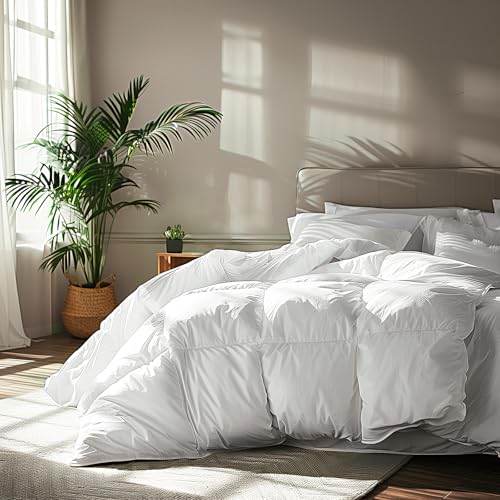
Where to buy: All six comforters in this guide are sold on Amazon, in the queen size (full/queen where the maker sells a combined size) — the size on most guest beds. Prices move constantly, so check the price on Amazon before you order.
Disclosure: topratedkitchenware.com is a reader-supported site. As an Amazon Associate, we earn from qualifying purchases made through links on this page, at no extra cost to you. That is how we keep our guides free. We do not accept payment for placement, and every pick below had to clear the same bar: a verified listing, a queen size that fits the under-$75 brief, and specs we could confirm from the maker’s own listing rather than from roundup sites.
- Best hotel feel: Serta Goose Feather Down Fiber Cotton Comforter
- Best for mixed-temperature guests: puredown Lightweight Down Blanket
- Best wash-between-visits pick: Bedsure Comforter Duvet Insert, Cream
- Best soft-touch welcome: EASELAND Down Alternative Comforter
- Best set-and-forget spare: Linenspa All-Season Down Alternative Comforter
- Best rock-bottom guest bed price: Utopia Bedding Queen Comforter Duvet Insert
A guest room comforter has a stranger job than the one on your own bed. It does not get to be tuned to one sleeper over months of trial and error. It has to feel welcoming to your mother-in-law who sleeps cold, your college friend who sleeps hot, and the cousin who arrives with a toddler — usually with no adjustment beyond an extra blanket folded at the foot of the bed. It has to look crisp and hotel-tidy in the five minutes between “we’re twenty minutes away” and the doorbell. And between visits, it has to survive being washed, aired, and stored without turning into a flattened disappointment by the third guest.
The good news is that $75 is a genuinely workable budget for that job. Under $75 you can have a 100% cotton shell instead of microfiber, real goose feather and down fiber instead of anonymous polyfill, published fill weights, and brands with real warranty desks. The Serta Goose Feather Down Fiber Comforter at the top of this guide — cotton shell, real feather and down fiber — delivers the dense, drapey “nice hotel” feel most hosts are picturing when they dress a guest bed.
But the honesty rules from our main under-$75 guide apply here unchanged, because guest-room shopping attracts the same marketing tricks. You will see “goose down” in headlines for comforters whose own spec sheets admit the fill is 90% feather fiber — short, processed feather pieces, not the fluffy clusters that make true down expensive. You will see deal prices presented as everyday prices. So here is the plain version up front: at $75, a guest room can have an excellent down-alternative comforter that washes between every visit, a genuinely good cotton-shell feather-and-down-fiber comforter for the hotel effect, and — only when a sale cooperates — a lightweight blanket filled with a majority of real down, which happens to be the single best answer to the “my guests all sleep at different temperatures” problem. What $75 cannot buy is a premium down comforter. The cheapest true high-loft down we verified in our research, a 93% goose down, 800-fill-power model, costs several times this budget in full/queen. Your guests do not need it, and this guide will not pretend otherwise.
What follows is a six-comforter shortlist built entirely from verified listings — maker, ASIN, queen dimensions, fill and shell specs, each checked against the under-$75 brief — re-judged through the guest-room lens: hotel feel on night one, one all-season warmth that suits most guests, a care routine that works between visits, a tidy look on a made bed, and flat storage while the room waits empty. Two are cotton-shell natural-fill comforters, one is a real-down lightweight blanket that only fits the budget at its deal price — flagged as such, in the open — and three are the washable down-alternative workhorses that, for a bed laundered after every guest, may honestly be the smartest buys of all.
In this guide
Quick Picks: The 6 Best Comforters for Guest Rooms Under $75
| Pick | Product (Queen) | Best For | Fill | Price | Link |
|---|---|---|---|---|---|
| Best Hotel Feel | Serta Goose Feather Down Fiber Cotton Comforter, Full/Queen 90×90 | The crisp cotton shell and dense drape guests remember | 90% white goose feather fiber, 10% white goose down fiber (listing spec) | Check price on Amazon | Check on Amazon |
| Best for Mixed-Temperature Guests (Deal-Dependent) | puredown Lightweight Down Blanket, Queen 90×90 | One light layer that suits hot and average sleepers alike | Minimum 75% white down (line spec) | Check price on Amazon — deal-dependent | Check on Amazon |
| Best Wash-Between-Visits Pick | Bedsure Comforter Duvet Insert, Queen 88×88, Cream | Machine washable, eight tabs keep a cover squared and tidy | GentleSoft polyester fill | Check price on Amazon | Check on Amazon |
| Best Soft-Touch Welcome | EASELAND Down Alternative Comforter, Queen 88×88, White | Brushed-soft cover guests notice the moment they sit down | 300 GSM whole-piece polyester fill (maker figure) | Check price on Amazon | Check on Amazon |
| Best Set-and-Forget Spare | Linenspa All-Season Down Alternative Comforter, Queen, White | A named brand, published fill weight, 3-year warranty | Microfiber down-alternative fill (maker rates it 300 GSM) | Check price on Amazon | Check on Amazon |
| Best Rock-Bottom Guest Bed Price | Utopia Bedding Queen Comforter Duvet Insert, White 88×88 | Second guest beds, rentals, and one-per-room bulk buys | Polyester down-alternative fill | Check price on Amazon | Check on Amazon |
A note on four comforters you will not find linked above: during research we verified queen listings at Amazon for the Bare Home Duvet Insert, the Hotel Grand Luxury White Goose Feather Down Fiber Comforter, the Martha Stewart Luxury White Goose Feather Down Fiber Comforter, and the Cosybay Feather and Down Fiber Comforter Insert — all within the under-$75 brief, all plausible guest-room picks. What we could not verify was the exact Amazon ASIN for the standard queen listing of each, and a wrong ASIN sends you to the wrong product. We name them here unlinked: search those exact names on Amazon, confirm the queen size and price on the page, and all four are reasonable buys in the same class as our Serta pick. We would rather lose the commission than send you to the wrong listing.
How These Picks Were Chosen
Every comforter in this guide first had to pass the four checks from our main under-$75 research. A verifiable identity: a live Amazon listing whose product-information block names the maker, model, dimensions, and ASIN. A verifiable queen price: the listing had to fit the under-$75 brief when we checked it on Amazon. Confirmable construction: fill composition, shell material, and stitch pattern taken from the maker’s listing or specification sheet — never from a roundup summary, because roundup summaries at this tier routinely garble fill percentages. And a distinct role, so the list is not six versions of the same polyester puff.
Then we applied the guest-room filter, which eliminates some otherwise good comforters. Warmth had to be diplomatic: a guest bed gets one comforter for every kind of sleeper, so heavy winter-weight fills were marked down and honest all-season or lightweight builds were marked up. Care had to fit a host’s routine: a comforter that cannot be washed — or protected by a cover that can — becomes a hygiene question by the fourth guest, so washability and cover-compatibility weigh far more here than they do for your own bed. The made bed had to look finished: drape, shell finish, and whether the insert stays squared inside a duvet cover all count, because a guest room is judged in the first ten seconds at the door. And storage mattered: guest bedding spends most of its life waiting, so each review notes how it stores between visits.
One exclusion from the underlying research is worth repeating because it shows the bar working: the APSMILE Lightweight Goose Feather Comforter, a legitimate cotton-shell queen, sat just over the $75 cap when we checked — so it is out; a budget guide that rounds its own ceiling up is not a budget guide. Warmth ratings, fill weights in GSM, and loft claims in this guide are the makers’ figures, and we say so where they appear — there is no independent lab testing comforters at this price, and construction predicts comfort better than adjectives do.
The Six Picks in Detail
1. Serta Goose Feather Down Fiber Cotton Comforter, Full/Queen — Best Hotel Feel
Who it suits: Hosts whose guest room is a point of pride — the ones who want a visitor to pull back the covers and think “this is nicer than my bed at home” — and who are happy running the comforter inside a duvet cover that gets washed between guests.
The Serta is what this budget is for. The listing’s own specification block (model SE003025, made for Serta by Blue Ridge Home Fashions) states the construction plainly: a 100% cotton shell filled with 90% white goose feather fiber and 10% white goose down fiber, in a full/queen measuring 90 by 90 inches, rated by the maker for medium, all-season warmth. Read that fill line twice, because it is both the appeal and the caveat. Feather fiber is real goose material — the soft, quill-less pieces separated out during feather processing — and it behaves much more like down than whole feathers do: no stiff quills poking through the shell, a flatter and denser hand than polyfill, and warmth that comes from a heavy blanket’s hug rather than a puffy cloud’s loft. Roundups that weighed this comforter put the queen at roughly seven pounds. On a guest bed, that weight reads as luxury: the comforter drapes in clean lines, stays where you fold it back, and gives the bed the settled, substantial look of a good hotel room rather than the puffed-up look of a showroom duvet.
The cotton shell is the second half of the guest-room value. Cotton breathes, feels crisp rather than slippery against a guest’s skin, and — just as important for the host — it looks tidy. A made bed with a cotton-shell comforter holds its edges and photographs the way you arranged it; microfiber shells tend to slide and shine. The listing includes corner loops to anchor a duvet cover, and the brand prints OEKO-TEX certification on this line and a “hypoallergenic” label on the listing; we report those as the maker’s labels, not as medical claims. The warmth profile also suits the guest-room brief well: medium and all-season is the most diplomatic setting there is, warm enough for a cold sleeper with the spare blanket you leave folded nearby, not so heavy that a warm sleeper spends the night kicking it off.
- 100% cotton shell — the crisp, breathable, tidy-looking finish that sells the hotel effect
- Real goose feather fiber and down fiber fill (90/10 per the listing spec) — dense, drapey, quiet warmth with no quill poke-through
- 90×90-inch full/queen drapes properly on a queen guest bed, better than the 88-inch inserts below
- Medium all-season warmth — the single most guest-proof warmth setting in this guide
- The strongest specs-per-dollar in this guide — check the price on Amazon
Honest limitation: Care is the compromise, and in a guest room it is a real one. This is a feather-fiber comforter, not a down comforter — it will never puff like the cloud in a premium down listing’s photos — and this family of natural-fill cotton comforters is not a weekly machine-wash product. The working system is: duvet cover on, cover washed between guests, comforter itself spot-cleaned or professionally cleaned occasionally. If your guest turnover is weekly and you want to launder the whole comforter every time, the polyester picks below will serve you better even though they feel less special on night one. It also arrives vacuum-packed and needs a day or two of airing to reach full body — order it before the guests are imminent, not the week they arrive.
Choose it if: the guest room is a showcase, visits are occasional enough that cover-washing covers the hygiene, and you want the one build at this price that genuinely feels like a hotel. Skip it if: you host constantly and machine-wash everything between guests, your guest room runs hot, or anyone regularly using the bed avoids animal-based fill. The Serta on Amazon is the first buy in this guide — check the live price there before you order.
2. puredown Lightweight Down Blanket, Queen — Best for Mixed-Temperature Guests, Only on Deal
Who it suits: Hosts who never know which kind of sleeper is coming — and warm-climate hosts generally — who want a majority of genuine down in a deliberately light layer, and who are willing to buy it at its deal price.
Every host learns the same lesson: guests’ thermostats are not yours. The comforter you find perfect in January leaves a hot-sleeping guest sweating and a cold-sleeping guest raiding your linen closet at 2 a.m. The experienced host’s answer is not a warmer comforter or a cooler one — it is a light base layer plus a folded spare blanket, so each guest builds their own warmth. That is exactly the product the puredown Lightweight Down Blanket is. puredown’s lightweight line is specified with a minimum of 75% white down fill — actual down clusters, the material whose price is the whole reason “real down under $75” is a constrained question — inside a 100% cotton cover with a satin trim and box stitching, in a queen measuring 90 by 90 inches. Its pricing needs honest flagging: this blanket’s typical price sits above this guide’s $75 cap, and it only belongs here when an Amazon deal brings the queen in light grey under the cap. That is why this pick is flagged as deal-dependent: on deal, it belongs near the top of this guide; at its typical price, it does not belong at all — so check the price on Amazon before you commit.
As a guest layer it has three quiet virtues. First, real down’s warmth-to-weight efficiency means the blanket feels like almost nothing while still taking the chill off an air-conditioned room — the setup most summer guests actually want. Second, the cotton shell keeps it quiet and finished-looking used bare on a made bed, with the satin trim doing the visual work a duvet cover usually does. Third, between guests it stores flatter than any comforter in this guide: a lightweight down blanket folds into a fraction of the shelf space of a puffy insert, which matters in the linen closet every host wishes were bigger. The brand is a down specialist rather than a general bedding label — its premium lines, including the 93% goose down, 800-fill-power comforter we use as this guide’s ceiling evidence for what premium down costs, are built on the same fill supply chain.
- Minimum 75% real white down fill (line specification) — the only majority-down product verified under the cap
- Lightweight warmth profile — the diplomatic base layer under a folded spare blanket
- 100% cotton cover with satin trim; looks finished on a made bed without a duvet cover
- Stores flatter between guests than any other pick here
- Fits this budget only on deal — check the price on Amazon before buying
Honest limitation: Two, and both are disqualifying if they apply. First, the price: its typical price is over this guide’s budget, so this pick exists only while a deal holds — check the price on Amazon before you fall in love, and treat this as the first thing to re-verify at purchase time. Second, the warmth: “lightweight” is not marketing modesty, it is the product. As a guest room’s only layer in an unheated northern house in February, it will leave a cold-sleeping guest cold — it earns its place as part of a layering system, not as a one-blanket solution for deep winter.
Choose it if: your guests run mixed or hot, your guest room is air-conditioned or warm-climate, and the live price is under $75. Skip it if: you need one comforter to handle deep winter alone, or the deal has lapsed. When a deal brings it under the cap, it is the most fill quality this budget can buy.
3. Bedsure Comforter Duvet Insert, Queen, Cream — Best Wash-Between-Visits Pick
Who it suits: Frequent hosts — grandparents with a rotating cast of grandchildren, families whose spare room hosts someone most weekends — who launder the guest bedding after every visit and want a comforter that treats the washing machine as home.
If the Serta is the guest-room pick for night one, the Bedsure is the pick for the morning after: it is the comforter we would hand to hosts who actually run a guest room like a small hotel, with a full bedding change between guests. Bedsure’s GentleSoft line uses a fine polyester fill that owners consistently describe as softer and less “crinkly” than the bargain inserts, held in a box stitch so it does not migrate into one corner by February. The whole thing is machine washable, and that single fact reorganizes the host’s routine — no protecting an insert you are afraid to wash, no cover-only hygiene compromises; the comforter itself goes in the machine with the sheets and comes out ready for the next arrival. The detail that earns it this slot over cheaper washable rivals is the attachment system: eight corner tabs, double the usual four. An insert that stays squared inside its cover is the difference between a bed that looks made and one that looks like a lumpy negotiation.
This listing is almost always on some kind of sale, cycling between its list price and frequent discounts — check the price on Amazon, and if it is sitting at the top of its range, waiting for the next dip is usually rewarded. Bedsure also prints OEKO-TEX certification on this line, reported here as the maker’s certification, as with all such labels. The cream colorway is a small guest-room advantage in itself: it hides the faint wear and wash-fading that stark white shows by the tenth laundering, and it reads warm rather than clinical in a spare room. What you give up against the Serta is the cotton shell and the dense, drapey hand — this is a lighter, puffier, more synthetic-feeling blanket, and it sleeps a touch warmer than its weight suggests because polyester fill and microfiber shells breathe less than cotton. Between guests it stores the way polyester does: compressed in a vacuum bag without complaint, loft returning after a short tumble.
- Machine washable end to end — the only care routine that fully resets a guest bed between visits
- Eight corner tabs — the best duvet-cover attachment in this guide, and the secret of the tidy made bed
- Box-stitched GentleSoft polyester fill with a softer hand than bargain inserts
- Cream colorway hides wash wear better than stark white
- Budget-tier queen pricing from a major bedding brand — check the price on Amazon
Honest limitation: It is still a polyester comforter, with polyester’s two known taxes: it traps more heat than the cotton-shell natural fills — warm-sleeping guests may find it stuffy in summer — and its loft slowly compresses over a couple of years of the frequent washing that is this pick’s whole point. The 88-inch width is also two inches narrower than the Serta and puredown queens, so on a thick modern guest mattress, expect a slightly shorter side drape. None of that stops it being the right answer for high-turnover guest rooms; it just defines the answer it is.
Choose it if: you host often, wash everything between guests, and want the bed to look squared and finished with minimal fuss. Skip it if: your guest room is a low-turnover showcase (the Serta feels better) or your typical guest sleeps very hot. For frequent hosts, the Bedsure is the working host’s center of this entire guide.
4. EASELAND Down Alternative Comforter, Queen, White — Best Soft-Touch Welcome
Who it suits: Hosts who know the first impression of a guest bed is tactile — a visitor sits on the edge, presses a hand into the comforter, and forms an opinion before the suitcase is open — and who catch it at one of its frequent sales.
The construction is a step more deliberate than the rock-bottom tier. The maker specifies a 105 g/m² brushed polyester cover — brushing raises the surface fibers, which is why this shell feels velvety rather than slick when a guest runs a hand across the made bed — over a whole-piece polyester fill the maker rates at 300 GSM, box-stitched with corner tabs for duvet use. Whole-piece fill is a real distinction at this price and a real guest-room one: instead of loose chopped fiber that clumps into lumps and cold spots, a continuous batt keeps the warmth map even, so the bed feels uniformly soft on night one and still looks smooth after a season of between-visit washes.
Its warmth profile is honestly middle-of-the-road: the maker sells it as all-season, and for a guest bed in a normally heated home that is the right diplomatic setting — substantial enough for winter with the spare blanket every good host leaves out, light enough for spring and fall alone. Summer in an un-air-conditioned guest room is where it will feel like too much, as will any 300 GSM polyester comforter. On price, this listing cycles on and off sale often enough that the pattern matters more than any single figure: it is a buy while a sale is running, and worth waiting on at full price — check the price on Amazon before you order. It is machine washable, which keeps it in the host-friendly half of this guide.
- Brushed 105 g/m² polyester shell (maker figure) with a noticeably soft, welcoming hand feel
- Whole-piece 300 GSM polyester fill (maker figure) resists the clumping that makes guest beds look lumpy
- Box stitching and corner tabs; machine washable between visits
- Frequently on sale in the budget tier — check the price on Amazon
Honest limitation: The brushed polyester shell that feels so soft also sleeps warm and can pill over years of washing, and “all-season” is a maker’s label, not a promise — a genuinely hot-sleeping guest in a warm room should get the puredown blanket’s lighter build instead.
Choose it if: the guest bed’s first impression matters and you want a plush, proven, washable insert at a sale price. Skip it if: your guest room runs hot, or you find it at full price with no sale running — at that point the Bedsure above is the better buy.
5. Linenspa All-Season Down Alternative Comforter, Queen, White — Best Set-and-Forget Spare
Who it suits: Hosts outfitting a guest room once and intending not to think about it again — who want a named brand, a published fill weight, duvet loops at all eight points, and a three-year warranty, at a budget-tier price in queen.
The Linenspa (queen, white; model LS70QQMICO) is the guide’s old reliable, and reliability is a guest-room virtue: this is the comforter that behaves identically for the first guest and the fifteenth. Linenspa publishes what the bargain tier usually hides — the maker rates the microfiber down-alternative fill at 300 GSM — the construction is a sewn box stitch, and the insert carries eight duvet loops, the same attachment count as the Bedsure, so it works bare as a clean white comforter or anchored inside a cover that takes the between-visit washing. The detail that lifts it above anonymous bargain-tier inserts is standing behind the product: a three-year warranty from a bedding company with a real customer-service operation. At this price a warranty is mostly a signal, but it signals that the maker expects the stitching to survive your washing machine — which, in a guest room, is the whole game.
Character-wise it sits between the EASELAND and the Utopia: a medium all-season weight that is the safe middle setting for unknown guests, a smooth microfiber shell (less brushed-soft than the EASELAND, less basic than the Utopia), and loft that fluffs back well after the tumble dry that follows each between-visit wash. It is also sold in a wide size and color range, which matters if you are dressing two spare rooms to match. Between guests it compresses into a storage bag without drama and comes back with a shake and a short fluff. Nothing about it is exciting, and that is precisely its market: it is the comforter equivalent of a well-made white t-shirt, and guest rooms run on exactly that kind of dependability.
- Maker-published 300 GSM fill weight — transparency the bargain tier rarely offers
- Eight duvet loops and box stitching; machine washable and dryer friendly
- Three-year manufacturer warranty, unusually concrete support at this price
- Medium all-season weight — the safe setting for guests whose preferences you do not know
- Budget-tier queen pricing — check the price on Amazon
Honest limitation: The microfiber shell is smooth rather than soft, and like all polyester fills it will gradually lose loft across a few years of laundering — the warranty covers defects, not the slow flattening of age. Its all-season weight is a compromise by design: a cold-sleeping guest in a cold house will want the spare blanket over it in January, and a hot sleeper will kick it off in July. It is the middle of the road, well built — which for a guest bed is usually the correct address.
Choose it if: you want maximum predictability per dollar and a guest bed you can reset between visits without thinking. Skip it if: hand-feel is the top priority (the EASELAND’s brushed shell wins) or you want natural fill and the hotel drape (the Serta wins).
6. Utopia Bedding Queen Comforter Duvet Insert, White — Best Rock-Bottom Guest Bed Price
Who it suits: Anyone dressing a guest bed on the smallest possible budget — a second spare room, a rental property, a holiday-let, or several guest beds at once — who wants a legitimate, washable queen comforter for the least money possible, at the lowest price tier in this guide.
The Utopia (white, 88 by 88 inches; model UB0063) is the floor of the respectable market, and it is a higher floor than you might expect. The build is the category standard done without corner-cutting that matters: a microfiber shell, polyester down-alternative fill, box stitching with piped edges to keep the fill from shifting, and corner tabs for duvet covers. It is machine washable — non-negotiable in this guide’s guest-room filter — it has sold in enormous volume for years, and at its rock-bottom tier it costs less than the duvet cover many hosts will put over it.
What you do not get is specification depth. Utopia does not publish a fill weight for this insert, and we flag that rather than papering over it: with no GSM figure, warmth comparisons against the 300 GSM EASELAND and Linenspa are guesswork, and the honest summary from the owner record is “medium-light all-season” — fine for guest beds in heated homes, thin as a cold sleeper’s only layer, which is why the folded spare blanket matters more with this pick than with any other here. The shell is a plain microfiber, soft enough but unremarkable, and the whole product is built to a price in a way you can feel at the edges: adequate piping, adequate stitching, adequate loft. Its storage behavior is its quiet strength — it compresses flat into a vacuum bag, waits in a closet for months, and comes back with a tumble and a shake, which is most of a guest comforter’s actual life. Adequate, at this price, is a compliment.
- The lowest queen price tier in this guide — check the price on Amazon
- Box stitching with piped edges and corner tabs — the full basic feature set
- Machine washable; stores flat between guests and revives with a tumble dry
- 88×88-inch queen from a high-volume bedding brand — buy one per guest bed without flinching
Honest limitation: No published fill weight, a plain microfiber hand, and loft that owners report flattens sooner than the pricier quilts in this guide — sooner still under a holiday-let’s wash-every-turnover routine. This is a comforter you buy by the room, not by the decade, which is exactly the job it is priced for.
Choose it if: the bed is a second guest bed, a rental, or a low-use spare, or you need several queens at once. Skip it if: this is your main guest room and guests are frequent — stepping up to the Linenspa or Bedsure buys noticeably better fill behavior under repeated washing.
Comparison Table
| Product (Queen) | Size | Fill | Shell | Warmth (Maker) | Guest-Room Strength | Care | Price | Link |
|---|---|---|---|---|---|---|---|---|
| Serta Goose Feather Down Fiber | 90×90 in | 90% goose feather fiber / 10% goose down fiber | 100% cotton | Medium / all-season | Hotel drape and feel | Duvet cover advised; professional cleaning | Check price on Amazon | Check on Amazon |
| puredown Lightweight Down Blanket | 90×90 in | Min. 75% white down | 100% cotton | Lightweight | Suits mixed-temperature guests; stores flattest | Follow maker label | Check price on Amazon (deal-dependent) | Check on Amazon |
| Bedsure Duvet Insert, Cream | 88×88 in | GentleSoft polyester | Polyester | All-season | Washes fully between visits; 8 tabs | Machine washable | Check price on Amazon | Check on Amazon |
| EASELAND Down Alternative | 88×88 in | 300 GSM whole-piece polyester (maker) | Brushed polyester | All-season | Softest first-touch welcome | Machine washable | Check price on Amazon | Check on Amazon |
| Linenspa All-Season | 88×88 in | 300 GSM microfiber fill (maker) | Microfiber | All-season | Warranty-backed set-and-forget spare | Machine washable | Check price on Amazon | Check on Amazon |
| Utopia Bedding Insert | 88×88 in | Polyester (weight not published) | Microfiber | All-season | Cheapest per guest bed; stores flat | Machine washable | Check price on Amazon | Check on Amazon |
How to Choose the Right Comforter for a Guest Room Under $75
Start with turnover, not thread counts. How often the bed hosts, and whether you wash the comforter itself or just its cover between guests, decides this purchase more than any spec. Monthly-or-more turnover points to the fully washable polyester picks; a few visits a year lets you choose the Serta’s hotel feel and let the duvet cover do the hygiene work.
Buy the diplomatic warmth. A guest bed gets one setting for every sleeper, so all-season medium — or a lightweight layer plus a spare blanket — beats a heavy winter comforter every time. You can always hand a cold guest another blanket; you cannot hand a hot guest a cooler comforter you do not own.
Leave the layering kit in the room. Whatever you choose, fold a lightweight spare blanket at the foot of the bed or on the closet shelf, and tell guests it is there. Half of guest-room warmth complaints are really “I didn’t know I was allowed to adjust anything” complaints.
Read fill percentages like a lawyer. “Goose down comforter” in a headline can describe a product whose spec block says 90% feather fiber and 10% down fiber — our top pick is exactly that, and it is a good product, but only because we priced it as what it is. The spec block, not the title, is the product. For down-alternative picks, look for a published fill weight (GSM or ounces): a maker who prints 300 GSM is telling you something checkable; a maker who prints nothing is telling you something too.
Size up on drape. Queen mattresses are 60 inches wide and modern ones are thick. An 88×88 insert leaves about 14 inches of drape per side before mattress depth eats into it; a 90×90 like the Serta and puredown drapes noticeably better and looks more finished on a made guest bed. Measure your guest mattress’s depth before ordering, not after.
Decide the duvet-cover question before you buy. If you will use a cover — and for the natural-fill picks you effectively must — attachment points matter: eight tabs or loops genuinely outperform four at keeping the made bed squared. If you will not use a cover, shell fabric matters more, because it is what the guest touches: cotton and brushed polyester feel best bare; plain microfiber is the most clammy.
The Guest-Room Warmth Problem: One Comforter, Every Kind of Guest
Your own bed gets tuned. You learn over a season that you run hot, your partner runs cold, and the compromise gets engineered with a lighter comforter and a throw on one side. A guest bed gets no such tuning period — it gets a stranger, for two nights, who will politely say “slept great!” regardless. The honest design target is therefore not perfection for one sleeper but acceptability for all of them, and that target has a specific shape: a medium, all-season base layer that a typical sleeper in a heated room finds comfortable, plus visible adjustability in both directions — a folded blanket for the cold sleeper, and a base layer light enough, or a room cool enough, for the hot one.
That is why this guide’s warmth ranking looks the way it does. The puredown blanket, a “summer” product in a personal-bed guide, becomes a strategic pick here: paired with a spare blanket, it covers the widest guest range of any single purchase under $75. The Serta and the 300 GSM polyester picks occupy the diplomatic middle. What we deliberately excluded from guest duty are the heavy winter-weight fills that crowd this tier in January sales: a winter comforter on a guest bed optimizes for the coldest imaginable guest and quietly punishes everyone else. Set the room’s temperature sensibly, choose the middle-weight comforter, leave the blanket folded where it can be seen, and you have solved the problem the way hotels solve it — with layers, not with a single heroic blanket.
Between Guests: Washing, Airing, and Storing Flat
A guest comforter’s real life happens between visits, and the care routine is where cheap purchases either pay off or quietly fail. The full-reset routine — the one small hotels run — is: strip the bed, wash sheets and duvet cover, wash or air the comforter itself, remake the bed or store the bedding clean. The picks in this guide split into two honest systems for doing that. The washable system (Bedsure, EASELAND, Linenspa, Utopia) puts the comforter itself in a large-capacity machine on gentle, less often than the sheets if you use a cover, and dries it completely — polyester fill stored damp is a mildew invitation. The cover system (the Serta, and the puredown used under a throw) keeps the comforter out of the machine: the cover takes the weekly washing, and the natural fill gets airing, shaking, and occasional professional attention. Neither system is wrong; the mistake is buying one and running the other.
Storage is the third act. Every comforter here arrives compressed and needs a day of air and shaking to reach full body — natural fills especially can take 24 to 48 hours — so unpack a new one before the guests’ weekend, not during it. Between visits, store clean bedding loosely in a breathable bag where possible; vacuum bags are a legitimate space tool for the polyester picks and the puredown blanket (down tolerates compression well and lofts back with air and a shake), but no fill enjoys being crushed for a year. Finally, the simplest guest-room habit of all: remake the bed the day guests are due, not the day the last guests left. A bed made fresh that morning feels like a hotel; the same bedding made three weeks early feels like a spare room.
The Made Bed: What Guests Actually Notice
Guests form their verdict at the door, in about ten seconds, and the comforter is most of that verdict. Three things do the visual work. Drape: a comforter that falls in clean, even lines to a consistent height on both sides reads as intentional; the 90-inch picks (Serta, puredown) drape a thick queen mattress best, and any insert looks better pulled a few inches toward the foot so the top fold sits below the pillows rather than swallowing them. Surface: cotton shells and brushed shells read as matte and calm; shiny microfiber reads as budget, which is one reason the Utopia earns its keep best under a cover. Squareness: an insert bunched inside its cover ruins the whole effect, and this is where the eight-tab and eight-loop picks (Bedsure, Linenspa) quietly outperform — tie or loop every point, shake the covered insert from the foot corners, and the bed stays made-looking through the whole visit instead of only at check-in.
The finishing moves cost nothing. Fold the top of the comforter back once, in a band roughly the depth of the pillows, so the sheet or cover’s inner face shows — the universal visual shorthand for “this bed was made for you.” Add the folded spare blanket across the foot: it signals the layering permission described above and anchors the composition. And choose white or cream bedding if you possibly can — light bedding shows guests it is clean and washes without color-matching anxiety. A guest room does not need to look like a boutique hotel; it needs to look like someone expected you, and the comforter, draped straight and folded back, is how it says so.
Common Buying Mistakes
Buying your own preferences for a stranger’s bed. The most common guest-room mistake is purchasing the comforter you would want — extra-warm, extra-light, feather-free, feather-only — for a bed whose sleepers you cannot predict. Guest duty rewards the diplomatic middle on every axis.
Believing the headline instead of the spec block. “Goose down” titles sit on top of 90%-feather-fiber spec sheets all over this tier. The fill percentages in the product-information block are the product; the title is advertising.
Skipping the cover on natural fill. A feather-fiber comforter without a duvet cover becomes a dry-cleaning subscription — or, in a guest room, a hygiene worry you think about every time you make the bed. Budget the cover into the Serta’s true cost, or buy a washable polyester pick and skip the pretense.
Paying the non-sale price on a permanently-on-sale product. Half this guide’s picks cycle through deals monthly — the Bedsure cycled through a wide range within a single autumn. If a listing shows a high “typical” price and a deal culture, wait a week or set a price alert rather than paying the ceiling.
Ignoring the two inches. An 88-inch insert on a 14-inch-deep queen mattress leaves the bed looking underdressed and a tall guest’s shoulders negotiating with the sheet. Measure mattress depth, and favor 90-inch queens if yours is thick.
Unpacking the night before guests arrive. Compressed comforters need a day or two to reach full body, and new bedding benefits from a first wash. A comforter bought in a panic the week of a visit will look flat and smell like packaging for exactly the nights it was bought for.
Treating “hypoallergenic” as a medical promise. On bedding labels it is a maker’s marketing label for processed or synthetic fill. It says nothing clinical, and no comforter treats allergies or dust-mite problems — if a guest has real allergies, an allergen-barrier encasement, freshly washed bedding, and a conversation with the guest are the real provisions.
Final Recommendation
Match the pick to the guest room’s real life. For the showcase guest room that hosts a few times a year, the Serta is the answer: a cotton shell, real goose feather and down fiber, true 90-inch drape, and a major brand’s backing — the fullest expression of what this budget can do, with the duvet cover doing the between-visit washing. For the hard-working guest room that turns over monthly or more, take the Bedsure and never think about your comforter again; full washability plus eight tabs is the small-hotel system at a spare-room price. Hosts whose guests run hot or wildly mixed should watch the puredown blanket and buy it when a deal brings it under the cap, pairing it with a folded spare blanket so every guest builds their own warmth. The Linenspa is the set-and-forget spare, and the Utopia, at the bottom of this guide’s price range, is all the comforter a second guest bed needs. What we would not do with $75 is chase the word “down” into an unverifiable listing with no spec block — in a guest room, where the sleeper cannot tell you what went wrong, the verified spec sheet matters even more than it does on your own bed.
Related guides
Frequently Asked Questions
What warmth should a guest room comforter be?
All-season medium is the diplomatic answer for a heated home — it suits the widest range of unknown sleepers. Pair it with a folded spare blanket in the room for cold sleepers, and keep the room’s thermostat sensible for hot ones. Heavy winter-weight comforters are the most common guest-room overbuy: they delight the coldest imaginable guest and punish everyone else.
Can you really buy a down comforter for under $75?
You can buy a lightweight down blanket under $75 when it is on sale — our puredown pick, specified at a minimum of 75% white down, fits this budget only on deal, against a typical price above the cap, and we flag it as deal-dependent for exactly that reason. A full-weight, high-loft down comforter is a different product class: genuine high-fill-power queens sat well above this budget in our research — even the entry point was over the cap, and premium models cost several times this budget. Under $75, “down” in a headline usually means down fiber or feather fiber — real materials with flatter, denser warmth, honestly labeled in their spec blocks, but not the cloud-like loft of true down. For a guest bed, that flatter warmth is often the better tool anyway: it drapes tidier and reads as a hotel blanket.
Should a guest room comforter be machine washable?
It should be washable as a system. Either the comforter itself goes in the machine — the Bedsure, EASELAND, Linenspa, and Utopia all do — or it lives inside a duvet cover that does, which is the working arrangement for the natural-fill Serta. What does not work is a non-washable comforter used bare: by the fourth guest it is a hygiene question with no good answer. High-turnover hosts should buy the fully washable picks; occasional hosts can run the cover system happily.
How do I make a guest bed look like a hotel bed?
Drape, surface, and squareness. Choose a comforter wide enough to fall evenly on both sides (90 inches on a thick queen), a matte shell (cotton or brushed), and — if you use a duvet cover — an insert with eight attachment points so it stays squared. Fold the top back once below the pillows, lay a folded spare blanket across the foot, and make the bed the day guests arrive rather than weeks ahead. The effect is “someone expected you,” and it costs nothing beyond the right comforter.
Which of these is best for hot-sleeping guests?
The puredown lightweight down blanket, and it is not close: the least fill by design, a breathable cotton shell, and real down’s warmth-to-weight efficiency — especially paired with a spare blanket so the guest, not you, decides the total warmth. Among the everyday picks, the cotton-shell Serta breathes better than any polyester option. Avoid thick polyester “winter” fills entirely for a warm guest room.
How long will a guest room comforter under $75 last?
Longer than the same comforter on your own bed, because guest duty is measured in nights hosted, not nights owned — but laundering is the wear engine, and guest bedding gets laundered out of proportion to its use. Plan on three to seven years of good service: polyester fills lose loft gradually with washing, natural feather-fiber fills hold their character longer but ask for gentler care. A duvet cover, complete drying, and loose storage between visits all push toward the top of that range.
Why are some good comforters named in this guide but not linked?
Because we could verify their queen listings at Amazon but not the exact listing ASIN for the standard queen variant, and a wrong link is worse than no link. The Bare Home insert, Hotel Grand feather/down fiber comforter, Martha Stewart feather/down fiber queen, and Cosybay feather/down fiber insert are all worth a direct search on Amazon — confirm size and check the price on the listing page before buying.
Related Guides
- Best Comforter Under $75
- Best Comforter For Apartments Under $75
- Best Comforter For Small Bedrooms Under $75
- Best Duvet Insert Under $75
- Best Bed Sheet Set For Guest Rooms Under $75
- Best Cooling Pillow For Guest Rooms
