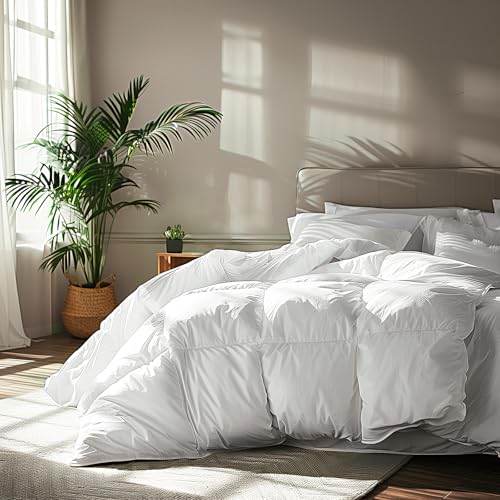
Best Comforter for Small Bedrooms Under $75: 6 Queen Picks for the One-Comforter Room
Where to buy: All six comforters in this guide are sold on Amazon, in the queen size (full/queen where the maker sells a combined size). Prices move constantly, so check the current price on Amazon before you order.
Disclosure: topratedkitchenware.com is a reader-supported site. As an Amazon Associate, we earn from qualifying purchases made through links on this page, at no extra cost to you. That is how we keep our guides free. We do not accept payment for placement, and every pick below had to clear the same bar: a verified listing, a queen size positioned at or under the $75 budget at the time we checked, and specs we could confirm from the maker’s own listing rather than from roundup sites.
A small bedroom changes the comforter question completely. In a big house, a comforter is one of several: there is a linen closet with a winter weight and a summer weight, a spare for the guest bed, and a machine that swallows a queen insert without complaint. In a small bedroom — a 10-by-10, a studio corner, a box room with a closet the width of a door — the comforter on the bed is usually the only comforter. There is nowhere to store a second one, and the off-season layer, if it exists at all, lives in a vacuum bag under the bed. And because the bed takes up most of the room, the comforter is also most of what the room looks like: its drape, its color, and whether it reads as calm or as clutter is effectively your interior design.
So this guide re-judges the six best-verified comforters under $75 through that lens. The shortlist itself comes from our main under-$75 research: the same six listings and the same verified ASINs, and the same honest ceiling — $75 buys cotton shells, real goose feather and down fiber, better down-alternative fills, and, only when it is offered within this budget, a lightweight blanket with a majority of real down. It does not buy premium down; a true high-loft down comforter, such as a 93% goose down, 800-fill-power queen from an established down brand, sits far above this tier. What changes here is the judging. Warmth still matters, but so do storage footprint, washability in a small machine, how a comforter behaves when it can never be rotated away, and how it looks on the bed that dominates the room. Our top pick for most small bedrooms is the Serta Goose Feather Down Fiber Comforter — cotton shell, real feather and down fiber, a true 90-inch queen that drapes like furniture — with the washable down-alternative picks close behind for households whose laundry reality points the other way.
One warning before the picks, because it is the warning this entire tier needs: $75 is where bedding marketing starts borrowing words it has not earned. You will see “goose down” in headlines for comforters whose own spec sheets admit the fill is 90% feather fiber — short, processed, quill-free feather pieces, not the fluffy clusters that make true down expensive. You will see temporary offers presented as everyday prices. Every pick below is described as what its maker’s spec block actually says it is, and the one pick that only fits this budget when it is offered within it is flagged as such, in the open, everywhere it appears.
In this guide
Quick Picks: The 6 Best Comforters for Small Bedrooms Under $75
| Pick | Product (Queen) | Best For | Fill | Price | Link |
|---|---|---|---|---|---|
| Best Overall | Serta Goose Feather Down Fiber Cotton Comforter, Full/Queen 90×90 | The one-comforter room: cotton shell, real feather/down fiber, furniture-grade drape | 90% white goose feather fiber, 10% white goose down fiber (listing spec) | Check price on Amazon | Check on Amazon |
| Best Real Down (Deal-Dependent) | puredown Lightweight Down Blanket, Queen 90×90 | Warm small rooms, and the smallest off-season storage footprint in this guide | Minimum 75% white down (line spec) | Check price on Amazon | Check on Amazon |
| Best Down Alternative | Bedsure Comforter Duvet Insert, Queen 88×88, Cream | One washable comforter that has to survive every season and every spill | GentleSoft polyester fill | Check price on Amazon | Check on Amazon |
| Best Soft-Touch Budget Pick | EASELAND Down Alternative Comforter, Queen 88×88, White | Brushed-soft shell that looks and feels finished without a duvet cover | 300 GSM whole-piece polyester fill (maker figure) | Check price on Amazon | Check on Amazon |
| Best Warranty for the Money | Linenspa All-Season Down Alternative Comforter, Queen, White | A crisp, bright, hotel-clean look with a 3-year warranty behind it | Microfiber down-alternative fill (maker rates it 300 GSM) | Check price on Amazon | Check on Amazon |
| Best Rock-Bottom Price | Utopia Bedding Queen Comforter Duvet Insert, White 88×88 | The least money, leaving budget for the storage and cover a small room needs | Polyester down-alternative fill | Check price on Amazon | Check on Amazon |
A note on four comforters you will not find linked above: during the research behind this guide we found the Bare Home Duvet Insert, the Hotel Grand Luxury White Goose Feather Down Fiber Comforter, the Martha Stewart Luxury White Goose Feather Down Fiber Comforter, and the Cosybay Feather and Down Fiber Comforter Insert positioned within this budget tier at Amazon — all plausible in a small bedroom. What we could not verify was the exact Amazon ASIN for the standard queen listing of each, and a wrong ASIN sends you to the wrong product. Rather than guess, we name them here unlinked: search those exact names on Amazon, confirm queen size and check the current price on the page, and all four are reasonable buys in the same class as our Serta pick.
How These Picks Were Chosen
The verification bar is the one from our main under-$75 guide, unchanged. Every comforter here passed four checks: a verifiable identity (a live Amazon listing whose product-information block names the maker, model, dimensions, and ASIN); a queen size positioned at or under the $75 budget at Amazon at the time we checked; construction confirmed from the maker’s own listing or specification sheet — fill composition, shell material, stitch pattern — never from a roundup summary; and a distinct role, so the list is not six versions of the same polyester puff. Two exclusions show the bar working: the APSMILE Lightweight Goose Feather Comforter, a legitimate cotton-shell queen, sat just over the cap and is out, because a budget guide that rounds its own ceiling up is not a budget guide.
On top of that bar, this guide applies the small-bedroom filter, and it reorders the list. Four questions were asked of every pick. Can it be the only comforter? With no linen closet, there is no seasonal rotation unless storage exists somewhere, so a year-round warmth profile counts for more than a perfect January or a perfect July. What does it cost in space? A comforter that is not on the bed still lives somewhere — its stored volume, and whether it tolerates compression, is a real specification in a small home. Can you actually wash it? A queen comforter is a bulky load; in a small apartment machine or a laundromat it is a logistics problem, and a comforter you dread washing is a comforter that stays dirty. How does it look? In a small room the bed is the largest visible surface you own. Drape, size, and color are not vanity here; they are most of the room.
Warmth ratings, fill weights in GSM, and loft claims below are the makers’ figures, and we say so where they appear. There is no independent lab testing comforters at this price. What can be verified is construction — and construction predicts comfort, washability, and storage behavior better than adjectives do.
The Six Picks in Detail
1. Serta Goose Feather Down Fiber Cotton Comforter, Full/Queen — Best Overall
Who it suits: Small-bedroom owners who will own exactly one comforter, want it to look like a deliberate piece of the room rather than a puff of bedding, and are willing to protect it with a duvet cover — check price on Amazon for the queen size.
The Serta Goose Feather Down Fiber Comforter earns the top slot in a small room for a reason that barely matters in a big one: drape. Its listing specification block (model SE003025, made for Serta by Blue Ridge Home Fashions) states a 100% cotton shell filled with 90% white goose feather fiber and 10% white goose down fiber, in a full/queen measuring a true 90 by 90 inches, rated by the maker for medium, all-season warmth. Feather fiber is real goose material — the soft, quill-less pieces separated out during feather processing — and it behaves like a heavy blanket rather than a cloud: flat, dense, and hanging in clean lines over the edge of the bed. Roundups that weighed this comforter put the queen at roughly seven pounds. On a bed that fills most of a small room, that tailored fall reads as furniture.
The cotton shell reinforces the effect and the comfort. It breathes better than the microfiber shells on every cheaper pick here, feels crisp rather than slick against skin, and takes a duvet cover gracefully — the listing includes corner loops to keep one in place. That cover matters doubly in a small home: it is the washable layer, and it is also the one textile change that alters the entire room. The maker prints OEKO-TEX certification on this line and a “hypoallergenic” label on the listing; we report those as the maker’s labels, not as medical claims. As the room’s single comforter, its medium all-season profile is the right compromise — substantial through a heated winter, and in summer the dense-but-breathable build is easier to live with than an equally warm polyester puff, though hot sleepers in uncooled rooms should read the puredown review below before deciding.
- 100% cotton shell — breathes better than microfiber and looks crisp on the bed that dominates the room
- Real goose feather fiber and down fiber fill (90/10 per the listing spec) — dense, tailored drape instead of puff
- True 90×90-inch full/queen — the best side drape of any pick here on a standard queen
- Corner loops for a duvet cover, which becomes both the wash plan and the room’s color
- Upper part of this budget tier in queen — the strongest specs for the money in this guide; check price on Amazon
Honest limitation: Care and storage are the taxes, and in a small home both bite harder. This is a feather-fiber comforter, not a down comforter — it will never loft like the premium clouds in product photos — and this family of natural-fill cotton comforters is not a weekly machine-wash product: budget for a duvet cover from day one and expect professional cleaning or careful spot cleaning over its life. Nor does it store small: seven pounds of feather fiber does not compress the way down or polyester does, so if it ever comes off the bed it needs real space. The small-bedroom defense is that it should never need to come off — as a true all-season single comforter, it lives on the bed twelve months a year, and the storage problem belongs to comforters you rotate.
Choose it if: you want one comforter that stays on the bed year-round, looks tailored doing it, and you are happy living with a duvet cover. Skip it if: your household washes bedding hot and often in a small machine, anyone in the bed avoids animal-based fill, or your room runs hot and uncooled all summer. When it is offered within this budget, the Serta on Amazon is the first buy in this guide — check the current price on Amazon.
2. puredown Lightweight Down Blanket, Queen — Best Real Down, Only on Deal
Who it suits: Hot sleepers in small, warm-running rooms — and anyone whose only “linen closet” is a single under-bed box — who want a majority of genuine down in a layer that also happens to store smaller than anything else in this guide, and who will only buy it when it is offered within this budget.
The puredown Lightweight Down Blanket is the exception that proves this tier’s ceiling rule. puredown’s lightweight line is specified with a minimum of 75% white down fill — actual down clusters, the material whose cost is the whole reason “under $75” is a constrained question — inside a 100% cotton cover with a satin trim and box stitching, in a queen measuring 90 by 90 inches, in light grey. Its positioning straddles this budget: when it is offered within the $75 cap it belongs in this guide, and when it is not, it is over budget and does not belong at all — check price on Amazon before deciding, and no amount of affection for real down changes that.
For a small bedroom, this blanket solves two problems at once. The first is heat: small rooms hold warmth, small bedrooms with a sleeper or two in them hold more, and a deliberately lightweight down layer is often the only “comforter” a warm small room needs for most of the year. The second is storage, and it is the quiet headline: real down compresses. Where a polyester queen insert fills an entire under-bed box, this blanket packs down to a fraction of that volume, so it is the one pick here that can genuinely be the second layer in a home with almost no storage — the off-season layer that lives in a drawer or a slim vacuum bag. The brand is a down specialist rather than a general bedding label; its premium lines, including the 93% goose down, 800-fill-power comforter we use as this guide’s ceiling evidence for what premium down looks like far above this tier, are built on the same fill supply chain.
- Minimum 75% real white down fill (line specification) — the only majority-down product verified under the cap
- Compresses smaller than any other pick — the only realistic “spare layer” for a no-linen-closet home
- 100% cotton cover with satin trim and box stitching; 90×90-inch true queen
- Lightweight warmth profile matched to small rooms that run warm
- Only fits this guide when offered within the budget — check price on Amazon
Honest limitation: Two, and both are disqualifying if they apply to you. First, its positioning: it often sits above this budget, so this pick exists only when it is offered within the cap — check the current price on Amazon before you fall in love, because this is the first thing to re-verify at purchase time. Second, the warmth: “lightweight” is not marketing modesty, it is the product. As a room’s only layer in a cold climate it will not carry a cold sleeper through February; its small-bedroom role is the warm room’s main layer or the storable second layer, not a cheap route to a winter down comforter, because that route does not exist.
Choose it if: your small room runs warm, you sleep hot, or you need one layer that stores in almost no space — and the current price on Amazon is under $75. Skip it if: it must be your sole winter comforter in an unheated room, or the deal has lapsed. The listing to watch is the puredown blanket on Amazon; when it is offered within this budget, it is the most fill quality — and the least stored volume — this budget can buy.
3. Bedsure Comforter Duvet Insert, Queen, Cream — Best Down Alternative
Who it suits: Small households that need their single comforter to be a machine-washable appliance — one insert that takes every season, every spill, and every pet, and comes back from the wash unharmed — in the middle of this budget tier for the queen — check price on Amazon.
The Bedsure Comforter Duvet Insert in queen (88 by 88 inches, cream) is the down-alternative pick we would hand to most small-bedroom households most of the time, because in a one-comforter home the deciding feature is not night-one softness — it is whether the comforter survives being the only one. Bedsure’s GentleSoft line uses a fine polyester fill that owners consistently describe as softer and less “crinkly” than the bargain inserts, held in a box stitch so it does not migrate into one corner by February. The detail that earns it this slot is the attachment system: eight corner tabs, double the usual four. In a small room that matters: the bed is always on display, and an insert that stays squared inside its cover keeps it looking made.
The small-bedroom case continues with color and care. Cream, rather than stark white, hides the everyday wear of a room where the bed doubles as sofa, desk, and dining table — which, in a small bedroom, it does — and it warms up a small space visually where bright white can read as clinical. And the whole comforter is machine washable, which for a household whose comforter is also its couch throw is not a footnote but the headline. One honest logistics note, developed below: a queen insert is still a bulky load, and “machine washable” assumes a large-capacity drum — in a small apartment top-loader, this comforter is a laundromat trip, albeit an easy one. Bedsure also prints OEKO-TEX certification on this line, reported here as the maker’s certification, as with all such labels.
- Eight corner tabs — the best duvet-cover attachment in this guide, and it shows on a always-visible bed
- Machine washable end to end; the practical pick when one comforter does every job
- Box-stitched GentleSoft polyester fill with a softer hand than bargain inserts
- Cream colorway hides wear and warms a small room better than stark white
- Middle of this budget tier for the queen — check price on Amazon
Honest limitation: It is still a polyester comforter, with polyester’s two known taxes: it traps more heat than cotton-shell natural fills — a real consideration in a small room that already runs warm — and its loft slowly compresses over a couple of years of washing in a way feather fiber does not. The 88-inch width is two inches narrower than the Serta and puredown queens, so on a thick modern mattress expect a slightly shorter side drape. None of that stops it being the right answer for most buyers; it just defines the answer it is.
Choose it if: you want one washable, cover-friendly comforter for everyday use well within this budget, in a room where the bed works overtime. Skip it if: you run hot and want a cotton shell, or you dislike synthetic fill on principle. For its positioning in this tier, the Bedsure insert on Amazon is the value center of this entire guide — check the current price on Amazon.
4. EASELAND Down Alternative Comforter, Queen, White — Best Soft-Touch Budget Pick
Who it suits: Small-bedroom buyers who will skip the duvet cover — no budget for one, no space to store a second cover set — and want the comforter itself to feel soft and look finished bare, in the lower part of this budget tier for the queen — check price on Amazon.
The EASELAND Down Alternative Comforter (queen, white, 88 by 88 inches) has been one of Amazon’s default bedding recommendations for years, and its construction explains why it keeps being recommended. The construction is a step more deliberate than the rock-bottom tier. The maker specifies a 105 g/m² brushed polyester cover — brushing raises the surface fibers, which is why this shell feels velvety rather than slick — over a whole-piece polyester fill the maker rates at 300 GSM, box-stitched with corner tabs for duvet use. Whole-piece fill is a real distinction at this price: a continuous batt keeps the warmth map even instead of clumping into cold spots. In a small bedroom the bare-use case is the point. A duvet cover is one more textile to buy, wash, and store; a comforter whose own shell is soft enough to sleep under directly removes that entire category of clutter, and its brushed white surface looks calm and intentional on the bed that fills the room.
Its warmth profile is honestly middle-of-the-road: the maker sells it as all-season, and in a normally heated home that is fair — substantial enough for winter with a throw layered over it in cold rooms, light enough for spring and fall alone. On positioning, it sits in the lower part of this tier and this listing cycles in and out of offers: it is a buy when it sits in that lower part, and a wait — or a switch to the Bedsure above — when it climbs toward the middle of the budget.
- Brushed 105 g/m² polyester shell (maker figure) — soft enough to use bare, no cover required
- Whole-piece 300 GSM polyester fill (maker figure) resists the clumping of chopped-fill rivals
- Box stitching and corner tabs if you do add a cover later; machine washable
- Lower part of this budget tier for the queen — check price on Amazon
Honest limitation: The brushed polyester shell that feels so soft also sleeps warm and can pill over years of washing, and “all-season” is a maker’s label, not a promise — genuinely hot sleepers in small warm rooms should look at the puredown blanket’s lighter build instead. Its positioning in this tier can shift as offers change, so check the current price on Amazon rather than assuming it still sits in the lower part.
Choose it if: you want the softest-feeling budget insert, used bare, with an unusually deep owner track record. Skip it if: you sleep hot, want a cotton shell, or find it pushed toward the middle of this budget — at that positioning the Bedsure above is the better buy. When it sits in the lower part of the tier, the EASELAND on Amazon is the plushest budget option you can put on a queen bed — check price on Amazon.
5. Linenspa All-Season Down Alternative Comforter, Queen, White — Best Warranty for the Money
Who it suits: Small-bedroom minimalists who want the crisp white-bed look — the one styling trick that reliably makes a small room feel bigger and calmer — from a named brand with a published fill weight and a three-year warranty, in the lower part of this budget tier in queen — check price on Amazon.
The Linenspa All-Season Comforter (queen, white; model LS70QQMICO) is the guide’s old reliable, and its small-bedroom argument is visual as much as thermal. Linenspa publishes what the bargain tier usually hides: the maker rates the microfiber down-alternative fill at 300 GSM, the construction is a sewn box stitch, and the insert carries eight duvet loops — the same attachment count as the Bedsure — so it works anchored inside a cover or bare as a clean white comforter. Bare and white is a legitimate strategy in a small room: a plain white bed is the hotel trick for making a tight space read as serene rather than crowded. The detail that lifts it above anonymous bargain inserts is standing behind the product: a three-year warranty from a bedding company with a real customer-service operation. At this price a warranty is mostly a signal — but it signals that the maker expects the stitching to survive your washing machine, which, for a comforter that will be washed as the room’s only one, matters.
- Maker-published 300 GSM fill weight — transparency the bargain tier rarely offers
- Crisp white finish that brightens and visually enlarges a small room
- Eight duvet loops and box stitching; machine washable and dryer friendly
- Three-year manufacturer warranty, unusually concrete support at this price
- Lower part of this budget tier for the queen — check price on Amazon
Honest limitation: The microfiber shell is smooth rather than soft, and white is the least forgiving color in a room where the bed is also the sofa — it will show the life a small bedroom lives on it, and you will wash it more often for looks alone. Like all polyester fills it gradually loses loft across a few years of laundering; the warranty covers defects, not the slow flattening of age.
Choose it if: you want maximum predictability per dollar, a bright minimal look, and bedding you can wash without thinking. Skip it if: hand-feel is your top priority (the EASELAND’s brushed shell wins) or you want natural fill (the Serta wins). For a small room that needs to look calm, the Linenspa on Amazon is very hard to beat in the lower part of this tier — check the current price on Amazon.
6. Utopia Bedding Queen Comforter Duvet Insert, White — Best Rock-Bottom Price
Who it suits: Small-bedroom buyers on the tightest budget, for whom the smartest move is a legitimate, washable queen comforter at the lowest positioning in this guide — check price on Amazon — leaving room in the budget for the storage bag, duvet cover, or throw the room also needs.
The Utopia Bedding Queen Comforter (white, 88 by 88 inches; model UB0063) is the floor of the respectable market, and it is a higher floor than you might expect. The build is the category standard done without corner-cutting that matters: a microfiber shell, polyester down-alternative fill, box stitching with piped edges to keep the fill from shifting, and corner tabs for duvet covers. It is machine washable, it has sold in enormous volume for years, and it typically costs less than the duvet cover many people will put over it. The small-bedroom logic is budget arithmetic: choosing the lowest-positioned pick instead of a mid-tier one can leave room for a vacuum storage bag and a decent throw, and in a small room those supporting purchases are not extras — they are what makes a one-comforter system work.
What you do not get is specification depth. Utopia does not publish a fill weight for this insert, and we flag that rather than papering over it: with no GSM figure, warmth comparisons against the 300 GSM EASELAND and Linenspa are guesswork, and the honest summary from the owner record is “medium-light all-season” — fine for heated homes, thin for a cold sleeper’s only blanket in a cold room, and in a small bedroom that thinness has one upside: it is the least bulky of the polyester picks to wash and to store. Adequate, at the bottom of this tier, is a compliment.
- The lowest-positioned queen option in this guide — check price on Amazon
- Box stitching with piped edges and corner tabs — the full basic feature set
- Machine washable, and the slimmest polyester pick to launder and store
- 88×88-inch queen from a high-volume bedding brand; savings fund the room’s storage and layers
Honest limitation: No published fill weight, a plain microfiber hand, and loft that owners report flattens sooner than the pricier quilts in this guide. As a small bedroom’s only comforter it is the pick most likely to need a throw layered over it in mid-winter — buy it as part of a system, not as a one-and-done winter solution.
Choose it if: the budget is the budget, and you would rather own a decent comforter plus a storage bag and a throw than a better comforter alone. Skip it if: it is your every-night bed in a cold room and you can stretch to the Bedsure or EASELAND — stepping up within the tier buys noticeably better fill behavior. As the foundation of a small-room bedding system, the Utopia insert on Amazon is the sensible floor.
Comparison Table
| Product (Queen) | Size | Fill | Shell | Warmth (Maker) | Attachment | Care | Price |
|---|---|---|---|---|---|---|---|
| Serta Goose Feather Down Fiber | 90×90 in | 90% goose feather fiber / 10% goose down fiber | 100% cotton | Medium / all-season | Corner loops | Duvet cover advised; professional cleaning | Check price on Amazon |
| puredown Lightweight Down Blanket | 90×90 in | Min. 75% white down | 100% cotton | Lightweight | — (blanket, used bare or layered) | Follow maker label | Check price on Amazon |
| Bedsure Duvet Insert, Cream | 88×88 in | GentleSoft polyester | Polyester | All-season | 8 corner tabs | Machine washable | Check price on Amazon |
| EASELAND Down Alternative | 88×88 in | 300 GSM whole-piece polyester (maker) | Brushed polyester | All-season | Corner tabs | Machine washable | Check price on Amazon |
| Linenspa All-Season | 88×88 in | 300 GSM microfiber fill (maker) | Microfiber | All-season | 8 duvet loops | Machine washable | Check price on Amazon |
| Utopia Bedding Insert | 88×88 in | Polyester (weight not published) | Microfiber | All-season | Corner tabs | Machine washable | Check price on Amazon |
How to Choose the Right Comforter for a Small Bedroom Under $75
Start with the one-comforter test. In a small bedroom, assume the comforter you buy is the comforter you will use in January and July alike, because there is nowhere to keep a second one. That pushes you toward honest all-season builds — the Serta’s dense medium warmth, or a 300 GSM polyester insert — and away from extremes. A winter-weight comforter in a home with no storage is not cozy; it is a six-month storage problem that happens to be warm for the other six.
Count your storage before you count your warmth. Measure the actual space a spare layer could live in: the under-bed clearance, the top shelf of the closet, the one drawer that is not full. Then match the layer to it. Real down (the puredown blanket) compresses to a fraction of its lofted size and is the only fill that genuinely fits a tiny footprint; polyester inserts need a full vacuum bag and a plan; feather fiber barely compresses at all, which is why the Serta is judged as an always-on-the-bed comforter, not a rotating one.
Be honest about your laundry. A queen comforter is a big, heavy-when-wet load. If you have a small apartment top-loader, a “machine washable” queen insert may still mean the laundromat’s large drum — fine if the laundromat is downstairs, miserable if it is across town. If washing access is limited, weight the decision toward the comforter that needs washing least often (a cotton-shell natural fill under a washable duvet cover) or the one that washes and dries fastest (the slimmer polyester picks).
Treat the bed as the room’s largest piece of furniture — because it is. Choose the look deliberately. Drape matters: a 90×90 comforter (Serta, puredown) hangs lower and looks more tailored on a queen than an 88×88, especially on a thick mattress where the smaller inserts can look like they are floating. Color matters: cream and soft tones hide wear and warm a small space; crisp white brightens and enlarges but shows everything.
Read fill percentages like a lawyer. “Goose down comforter” in a headline can legally describe a product whose spec block says 90% feather fiber and 10% down fiber — our top pick is exactly that, and it is a good product, but only because we priced it as what it is. The spec block, not the title, is the product. For down-alternative comforters, look for a published fill weight (GSM or ounces): a maker who prints 300 GSM is telling you something checkable, while a maker who prints nothing is telling you something too.
Budget the system, not just the comforter. Under $75, the winning small-bedroom purchase is often a lower- or mid-tier comforter plus the things that make one comforter enough: a duvet cover (the washable, changeable skin), a throw for the coldest weeks, and a vacuum bag for whatever layer is off-season. Think about the whole system before deciding an upper-tier comforter costs too much or a rock-bottom one saves money — either can be true, depending on what else the room needs.
One Comforter, Every Job: Living Without a Linen Closet
The linen closet is the invisible assumption inside almost all bedding advice. Guides cheerfully tell you to rotate a lightweight comforter for summer and a heavy one for winter, to keep a spare for guests, to store the off-season set “with cedar.” A small bedroom has none of that infrastructure. So the small-bedroom comforter is not a seasonal specialist — it is a year-round employee, and it should be hired like one.
That changes what “best” means in three concrete ways. First, warmth should sit in the honest middle: a medium, all-season build you adjust with what is already in the room — a throw across the foot of the bed in January, a sheet alone under the comforter kicked half-off in July. Layering with a throw is the small room’s substitute for a second comforter, because a throw stores in a drawer, on a hook, or draped as decoration. Second, durability outranks delicacy: a comforter that cannot be rotated away also cannot rest, so stitching, fill stability, and a shell that tolerates frequent cover changes matter more than a luxurious first-night hand. Third, the comforter absorbs jobs beyond sleeping — in a small bedroom the bed is where you fold laundry, read, and work on a laptop, so this guide favors fills and shells that tolerate being lived on, and a washable cover or washable insert is close to non-negotiable.
The Off-Season Problem: Where a Spare Layer Actually Goes
Sooner or later, even a one-comforter household owns a second layer: the blanket for the coldest month, the light layer for the heatwave, the spare for a guest on an air mattress. In a small bedroom, storing it is an engineering problem, and the fills in this guide behave very differently as stored objects.
Real down is the storage champion, and it is not close. Down clusters compress to a small fraction of their lofted volume and recover when released, which is why the puredown blanket can live in a drawer, a slim storage bag, or the corner of an under-bed box alongside other things. Polyester inserts are the opposite: a queen down-alternative comforter, uncompressed, can occupy most of a standard under-bed container by itself, and vacuum-bagging it flat is a genuine solution — with two caveats. Crushed synthetic fill recovers imperfectly, and every deep compression costs a little loft permanently; and a vacuum bag is itself a commitment of the exact under-bed space you were trying to save for shoes, documents, and everything else a small home stores horizontally. Feather fiber, the Serta’s fill, compresses worst of all and resents it most — one more reason this guide treats that comforter as a permanent resident of the bed rather than a rotating piece.
Washing a Queen Comforter in a Small Machine: The Bulk Problem
Small top-loaders with a center agitator are the hardest case: a queen insert often physically fits but cannot circulate, emerging twisted, unevenly washed, and hard on the machine’s balance — makers of washable inserts generally assume a large-capacity drum, and “machine washable” on the label means exactly that, not “washable in any machine.” The realistic options are a laundromat’s double- or triple-load machine (cheap, effective, and a trip), a duvet-cover strategy that keeps the insert itself out of the wash for months at a time, or choosing a slimmer insert that a modest drum can genuinely handle.
This is where the picks separate by household. The natural-fill Serta, worn under a duvet cover, asks the least of your laundry: wash the cover with your sheets, spot-clean the insert, and book professional cleaning rarely — the right rhythm when laundry access is awkward, provided you accept the cover discipline. The washable polyester picks ask more frequent but simpler care, and among them the slimmer Utopia and the 300 GSM Linenspa and EASELAND are meaningfully easier loads than a lofty oversized insert would be. In a small bedroom, “care” is not a footnote on the label. It is a recurring appointment with your actual life, so choose the comforter whose appointment you will keep.
Common Buying Mistakes
Buying a seasonal wardrobe of bedding for a room with no closet. A winter comforter and a summer comforter is a two-storage-problem purchase. In a small bedroom, buy one honest all-season comforter and adjust with a throw and a sheet.
Believing the headline instead of the spec block. “Goose down” titles sit on top of 90%-feather-fiber spec sheets all over this tier. The fill percentages in the product-information block are the product; the title is advertising.
Paying the highest positioning on a product that regularly moves within the tier. Half this guide’s picks move up and down within this budget regularly, and the puredown pick exists only when it is offered within the cap. If a listing currently sits at the top of its usual positioning, wait or check again rather than buying at its ceiling.
Ignoring the two inches. An 88-inch insert on a 14-inch-deep queen mattress leaves the bed looking — and feeling — short-sheeted, and in a small room the bed’s proportions are the room’s proportions. Measure mattress depth; favor 90-inch queens if yours is thick.
Storing a spare comforter “on top of the wardrobe.” Visible, lumpy storage at eye level shrinks a small room daily. If a layer cannot store small, compressed, or in a drawer, the room does not have a spare-layer plan — it has clutter.
Assuming “machine washable” means your machine. A queen insert needs a large-capacity drum to wash and dry properly. Check the drum you actually own or the laundromat you actually use before choosing a bulky insert as your only comforter.
Skipping the cover on natural fill. A feather-fiber comforter without a duvet cover becomes a dry-cleaning subscription — worse in a small home, where the cover is also doing the decorative work. Budget the cover into the purchase, or buy a washable polyester pick and skip the pretense.
Treating “hypoallergenic” as a medical promise. On bedding labels it is a maker’s marketing label for processed or synthetic fill. It says nothing clinical, and no comforter treats allergies or dust-mite problems — if those are your concern, an allergen-barrier encasement and a conversation with your doctor are the real purchases.
Final Recommendation
For most small bedrooms, the answer is the Serta Goose Feather Down Fiber Comforter: it combines a cotton shell, real goose feather and down fiber, true 90-inch queen sizing, and a major brand’s backing in the upper part of this budget tier — check the current price on Amazon — and its dense, tailored drape is the best-looking finish for a bed that fills the room. It lives on the bed all year, which is what a home without a linen closet needs. If your household runs on washability, take the Bedsure in the middle of this tier: eight tabs, a wear-hiding cream colorway, and an insert that survives being the only comforter you own. Hot sleepers in warm small rooms should watch the puredown down blanket and buy it when it is offered within this budget, accepting its light weight as the feature it is — it is also the only spare layer that stores in almost no space. If the budget is the tightest constraint, the Utopia at the bottom of this tier, plus a storage bag and a throw, is a smarter small-room system than a mid-tier comforter alone. What we would not do within the $75 budget is chase the word “down” into an unverifiable listing with no spec block — at this budget, in a room this size, the verified spec sheet is the luxury.
Frequently Asked Questions
Can you really buy a down comforter for under $75?
You can buy a lightweight down blanket under $75 when it is offered within this budget — our puredown pick is specified at a minimum of 75% white down, but it often sits above the cap, so check price on Amazon. A full-weight, high-loft down comforter is a different product class that sits well above this tier. Under $75, “down” in a headline usually means down fiber or feather fiber, which are real materials with flatter, denser warmth — good products, honestly labeled in their spec blocks, but not the cloud-like loft of true down.
What is the best comforter setup for a small bedroom with no linen closet?
One honest all-season comforter, a duvet cover, and a throw. The comforter handles the middle of the year, the throw adds the coldest weeks’ warmth and stores in a drawer or on the bed itself. If you add a second layer, make it one that stores small: real down compresses best, which is why our puredown pick is the only true “spare” we recommend for tight storage.
How do I store a spare comforter in a small bedroom?
In descending order of sanity: compressed in a vacuum bag allocated a fixed slice of under-bed space; folded into a drawer or the top shelf of the closet; or, for down, rolled into a breathable bag in any modest gap, since down compresses to a fraction of its lofted size. Never store any comforter damp, and let vacuum-bagged fills air out and re-loft for a day before use.
Can I wash a queen comforter in a small apartment washing machine?
Usually not well. Most “machine washable” queen inserts assume a large-capacity drum; in a small top-loader the load cannot circulate, washes unevenly, and can unbalance the machine. The practical routes are a laundromat’s large machine, a duvet cover that keeps the insert clean for months between rare washes, or a slimmer insert your drum can genuinely tumble. Whatever the route, dry the comforter completely before storing it — damp fill in a small room mildews fast.
What is the difference between feather fiber and down fiber?
Both are processed natural fills. Down fiber is the small, soft fiber separated from down clusters; feather fiber is the soft, quill-free portion of feathers. Down fiber lofts more and feels closer to down; feather fiber is denser, drapes more, and costs less. A 90/10 feather-fiber/down-fiber blend like the Serta’s sleeps like a heavy hotel blanket — warm and substantial rather than puffy — and drapes in the clean lines that suit a small room’s ever-visible bed.
Is a $75 comforter warm enough for winter in a small room?
For a heated home, yes, with the right pick: the Serta’s dense natural fill and the 300 GSM polyester picks are all rated all-season by their makers and handle typical winter bedrooms, especially layered with a throw. Small rooms also hold heat better than large ones, which works in your favor. For unheated rooms or cold sleepers in genuine northern winters, layer a lightweight pick under a blanket, or raise the budget — a single under-$75 comforter is not a one-layer solution there.
Which of these comforters is best for hot sleepers in small rooms?
The puredown lightweight down blanket, and it is not close: it has the least fill by design, a breathable cotton shell, and real down’s warmth-to-weight efficiency. Among the everyday picks, the cotton-shell Serta breathes better than any polyester option. Avoid thick polyester “winter” fills entirely if you run hot.
How long will a comforter under $75 last?
Plan on three to seven years of good service. Polyester fills lose loft gradually with washing; natural feather-fiber fills hold their character longer but ask for gentler care. In a one-comforter small bedroom the timeline runs at the harder end — the comforter never rests — so a duvet cover and full drying push toward the top of the range.
Are these comforters machine washable?
The four down-alternative picks — Bedsure, EASELAND, Linenspa, and Utopia — are machine washable; follow each label and use a large-capacity machine. The natural-fill picks are cover-and-professional-care products: protect the Serta with a duvet cover from day one, and follow the puredown’s label for its lighter construction.
Why are some good comforters named in this guide but not linked?
Because we could place them within this budget tier at Amazon but could not verify the exact listing ASIN for the standard queen variant, and a wrong link is worse than no link. The Bare Home insert, Hotel Grand feather/down fiber comforter, Martha Stewart feather/down fiber queen, and Cosybay feather/down fiber insert are all worth a direct search on Amazon — confirm size and check the current price on the listing page before buying.
Related Guides
- Best Comforter Under $75
- Best Comforter For Small Bedrooms Under $30
- Best Comforter For Apartments Under $75
- Best Duvet Insert Under $75
- Best Bed Sheet Set For Small Bedrooms
- Best Storage Bed Frame For Small Bedrooms
