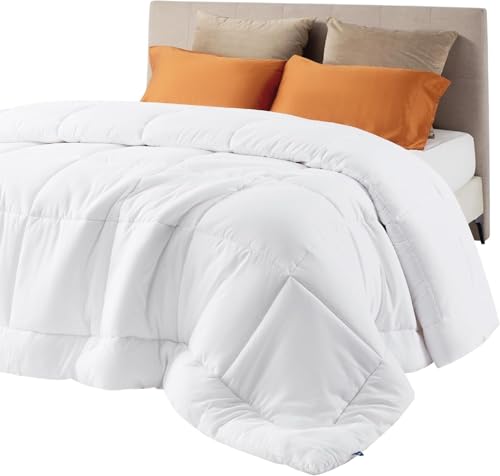
Where to buy
Check the latest price, availability and delivery on Amazon. Orders are placed on Amazon. We may earn a commission from qualifying purchases. Every pick in this guide is for the queen size — full/queen where a brand sells a combined size — because comforter prices change with size, and in a small bedroom the queen is almost always the bed in question.
- Best overall: Boll & Branch Down Duvet Insert, Full/Queen, All Season — Check on Amazon
- puredown Goose Down Comforter, Full/Queen, 800 Fill Power — Check on Amazon
- Continental Bedding Siberian Goose Down Comforter, Queen, 800 Fill Power — Check on Amazon
- Globon Winter White Goose Down Comforter, Queen — Check on Amazon
See 2 more Amazon options
- CUDDLE DREAMS Classic Wool Comforter, Midweight, Queen — Check on Amazon
- APSMILE Down Comforter, Queen, All Season — Check on Amazon
Read the full guide ↓
Disclosure: As an Amazon Associate, topratedkitchenware.com earns from qualifying purchases. Links to Amazon on this page are affiliate links; they cost you nothing extra. Listing details such as price and availability change often, so check the current Amazon listing before you buy.
In a small bedroom, the bed is not one piece of furniture among many — it is most of the room. It takes the majority of the floor, it fills the doorway view, and its top surface is the largest single expanse of color and texture you own. That changes what a premium comforter is. In a big bedroom a flagship duvet is bedding; in a small one it is also your wallpaper, your upholstery and your focal point, the thing you look at every time you enter and the surface you sit on, read on and fold laundry on. So this guide judges the top of Amazon’s comforter market through that lens — and it starts with the honesty the whole premium tier requires: on Amazon, no single queen comforter verifiably sits at the top of this budget on a stable basis. The most expensive queen we could tie to a live Amazon listing sits at the upper end of the premium tier, the genuine high-fill-power down comforters cluster well below the ceiling, and the one listing whose pricing has historically crossed this guide’s ceiling — the Continental Bedding Siberian — is notably volatile, spending time both above and below the $700 line. Check the current price on Amazon for any pick before you decide. A $700 budget for a small bedroom is therefore an allocation, not a purchase: a flagship comforter, an honest answer to the storage problem, and a remainder you should feel no pressure to spend.
The storage problem is the small bedroom’s defining constraint, and it shapes every pick below. The standard premium advice — run a two-comforter rotation, a winter weight and a lighter weight swapped twice a year — assumes a linen closet. Small bedrooms rarely have one. So each review below asks where the other comforter lives: down earns a genuine advantage here, because it compresses to a fraction of its lofted size in a way polyester never does, while wool stays bulky and asks for shelf space a small room may not have. For most small bedrooms we would begin with the Boll & Branch down duvet insert: responsibly sourced down in an organic cotton baffle-box shell — check price on Amazon for the full/queen all-season — warm enough and finished enough to be the room’s one year-round surface. If you want the highest stated fill power with the clearest spec sheet, the puredown below states 93% goose down at a maker-rated 800 fill power — check the current price on Amazon. Below you will find a quick picks table, detailed notes on each of the six, a comparison table, a buying checklist, an honest account of whether premium money makes sense in a small room at all, the mistakes small-bedroom shoppers make most at this price, and answers to the questions that come up again and again.
In this guide
Quick Picks
Short on time, or comparing several options at once? Each row below names a buyer type and the product that suits it, with a link to the listing. All picks are queen size; premium comforter prices move with sales and stock, so check the current price on Amazon before you buy.
| Buyer type | Pick | Why it stands out | Link |
|---|---|---|---|
| Best overall | Boll & Branch Down Duvet Insert, Full/Queen, All Season | Responsibly sourced down, organic cotton baffle-box shell — the one-comforter answer; check price on Amazon | Check on Amazon |
| Best stated specs | puredown Goose Down Comforter, Full/Queen, 800 Fill Power | 93% goose down and a 700-thread-count cotton shell; compresses smallest for storage — check price on Amazon | Check on Amazon |
| Best ceiling pick | Continental Bedding Siberian Goose Down Comforter, Queen | 800 fill power Siberian white goose down; pricing is volatile — check the current price on Amazon and buy only when it sits comfortably within budget | Check on Amazon |
| Best winter value in real down | Globon Winter White Goose Down Comforter, Queen | 800 fill power winter weight, home-washable per the maker, at the accessible end of the premium down tier; check price on Amazon | Check on Amazon |
| Best natural alternative to down | CUDDLE DREAMS Classic Wool Comforter, Midweight, Queen | 240 GSM Australian wool; the flattest, calmest drape here — check price on Amazon | Check on Amazon |
| Best second comforter | APSMILE Down Comforter, Queen, All Season | 46 oz of feather and down fiber in a baffle box — the affordable rotation partner; check price on Amazon | Check on Amazon |
How These Picks Were Chosen
The first filter was the budget, applied to the queen size specifically — and applied honestly in both directions. Every product below is a real Amazon listing whose queen or full/queen version sits within this guide’s $700 budget framework in the United States; because listing prices change, each review directs you to check the current price on Amazon rather than relying on a figure printed here. The Continental Bedding pick is the deliberate edge case: its pricing has moved both below and above the ceiling over time, and the guide tells you to buy it only when its current price sits comfortably within budget. Anything whose queen version we could not link responsibly was left unlinked or left out, however famous the brand — that is why the silk comforter discussed later in this guide is named without a link.
The second filter is the room. A small bedroom asks four questions a big one does not. Does the comforter look finished on its own, because the bed is the room’s main surface? Can it work as the only comforter, or — if it is half of a rotation — does the off-season half store small enough for a room with no linen closet? Does its size suit a bed against a wall, where oversized drape pools on one side? And does its care fit a laundromat routine? We compared fill materials, down percentages, fill weights, shell fabrics, dimensions and care instructions against those questions. Where a maker prints a warmth, loft or fill-power figure, this guide reports it as a maker claim — fill power is a lab measure of one ounce of down; it grades the down, not the comforter.
The spread is deliberate: a certified flagship that can carry a room alone, a spec-led high-fill-power comforter that stores smallest, a volatile ceiling listing to buy opportunistically, a home-washable winter down comforter, a wool comforter with the quietest drape, and a feather-fiber all-season comforter that makes a rotation affordable. A silk-filled comforter is the one premium family we could not link responsibly, and the guide says why.
The 6 Best Comforters for Small Bedrooms Under $700
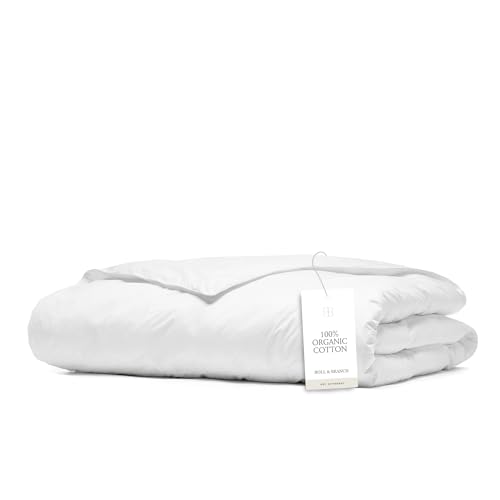
Boll & Branch Down Duvet Insert, Full/Queen, All Season
Who it suits: Small-bedroom buyers spending flagship money who need one comforter to do everything — sleep surface, room decor and year-round weight — and who will use a duvet cover.
This is the pick the premium tier is supposed to look like, and in a small bedroom its virtues compound. The fill is responsibly sourced, triple-washed white down held in baffle boxes — fabric walls between the layers, so the down keeps its loft instead of being pinched flat at every stitch — inside a down-proof shell of certified organic long-staple cotton. The brand is Fair Trade Certified, the down carries International Down Standard sourcing certification, and the finished textile is OEKO-TEX Standard 100 certified, per the brand and review coverage. The insert comes in three weights — lightweight, midweight and ultraweight — and the full/queen all-season version is the configuration this guide focuses on — check price on Amazon, as pricing varies by weight. The lightweight full/queen is listed at about 6.6 lb, which tells you the design priority: loft and drape, not bulk. In a room where the bed fills the view, that drape is the decor — a clean, even surface that looks finished without styling.
The small-bedroom case for this pick is the one-comforter case. An all-season weight, changed by adding or removing a blanket at the foot rather than by swapping the comforter itself, means there is no second comforter to store — the storage problem simply never arises. A duvet cover does the visual work instead: one insert, two or three covers, and the room changes color with the laundry instead of with the seasons. Now the honesty this pick requires, because it is the most instructive in the guide. Boll & Branch does not publish the fill power of its own duvet on its own product page. The 650 fill-power figure attached to this insert comes from review coverage — Sleep Foundation’s testing roundup — not from the maker, and at flagship level that omission is worth naming: fill power is the number buyers are taught to compare, and the flagship brand in this guide declines to state it. Judge the insert on what is verifiable instead — certified sourcing, an organic shell, baffle-box construction, three honest weight options — and it earns its place. The brand’s published warranty, per the same coverage, covers its mattresses and foundations rather than bedding, and its trial on bedding is 30 nights; at this level, read the current terms on the listing before ordering.
- Responsibly sourced, triple-washed down in baffle boxes, per the brand — loft without stitched-flat squares.
- Certified organic long-staple cotton shell; Fair Trade Certified, with IDS and OEKO-TEX marks reported in coverage.
- Full/queen all-season — check price on Amazon; three weight options available in the same line.
Honest limitation: The maker does not publish a fill-power figure for this duvet — the 650 figure in circulation comes from reviewers, not Boll & Branch — and the brand’s warranty coverage of bedding is limited, so the premium buys certified materials and construction rather than a stated spec or a long guarantee.
Choose it if you want one comforter to carry the whole room and the whole year, and traceable sourcing matters more to you than a headline fill-power number. Skip it if you shop by fill power, your bed sits hard against a wall and you need a smaller, neater cut, or you want warranty coverage that matches a flagship purchase.
puredown Goose Down Comforter, Full/Queen, 800 Fill Power, Winter Oversized (98 x 90 Inch)
Who it suits: Cold sleepers in small, hard-to-heat rooms who want the clearest spec sheet in the guide — and the comforter that stores smallest when it comes off the bed.
If the Boll & Branch is the flagship by reputation, the puredown is the flagship by spec sheet. The listing states the fill plainly: 93% white goose down — a genuinely high down share, well above the 75% minimum a fill must meet to be labeled simply “down” in the US — at a maker-rated 800 fill power, with 40 ounces of fill in the full/queen. The shell is 100% cotton at a stated 700 thread count, the construction is a pinch-pleat baffle style, and the down is RDS and OEKO-TEX Standard 100 certified per the maker. Check the current price on Amazon for the full/queen, fulfilled by Amazon — real, high-share down positioned below the flagship in this tier, leaving a substantial part of this guide’s budget unspent. For a small bedroom, add the property no spec sheet headlines: high-fill-power down compresses further than any other fill here. Off the bed, this winter-weight comforter packs down to a fraction of its lofted size — the difference between a spare comforter that fits in an under-bed bag and one that evicts your shoes from the closet.
Two small-room cautions. First, dimensions: at 98 by 90 inches this comforter is honestly oversized. On a bed pushed against a wall — the standard small-bedroom layout — the wall side has nowhere to drape, and the excess bunches and pools toward the open side. It is manageable if you fold the surplus at the wall edge, but the look runs abundant rather than tidy. Second, warmth: 40 ounces of 800-fill-power down is a lot of insulation, and the maker labels this version winter weight and “extra warmth.” Small bedrooms are often the warmest rooms in a home, so it can be too much blanket in a compact, well-heated room for much of the year. As the winter half of a rotation it is exactly right; as a small room’s only comforter, think hard about your room’s actual temperature first.
- 93% white goose down per the listing — a down share most listings in this category never state.
- Maker-rated 800 fill power with 40 oz of fill in the full/queen; RDS and OEKO-TEX certified per the maker.
- Compresses smaller off the bed than any rival here — the storage-friendly winter pick; check price on Amazon.
Honest limitation: It is a winter-weight comforter in an oversized 98 x 90 inch cut: the drape can pool and bunch on a bed pushed against a wall, and 40 oz of high-loft down will overheat a warm, compact bedroom outside the cold months. Like all real down it wants professional-style care rather than weekly machine washing.
Choose it if you sleep cold, your small room is a cold room, and you want the clearest spec sheet in this guide plus the smallest stored footprint. Skip it if your bed sits against a wall and you want a neat drape, or your bedroom runs warm year-round — take the all-season flagship above instead.
Continental Bedding Siberian Goose Down Comforter, Queen, 800 Fill Power
Who it suits: Patient, price-watching buyers who want the highest-ceiling down Amazon sells — and are willing to buy it only when its current price sits comfortably within budget.
This is the listing that defines Amazon’s verifiable comforter ceiling, and it is included with its volatility stated plainly rather than hidden behind a single number. The product is a Siberian white goose down comforter at a maker-rated 800 fill power, model CB-Siberian-800FP-Duvet-Q. Its queen pricing is notably volatile: the same comforter has sat both comfortably inside this guide’s budget and well outside it, sometimes within the same season, so check the current price on Amazon before treating it as an under-$700 pick at all. Continental Bedding’s wider range supports the positioning — its Serenity line of 700 fill-power Hungarian white goose down comforters, minimum 90% down per the brand’s retail listings, sits in the same premium tier at other retailers — but this Siberian queen’s Amazon pricing is the volatile one, and the guide treats it accordingly.
The small-bedroom question is whether ceiling-spec down earns ceiling money in a compact room, and the honest answer is: only when its current price sits comfortably within budget. What the money buys when the price cooperates is the top of the Amazon down market: Siberian down is prized because birds raised in severe cold grow larger clusters, and larger clusters are what 800 fill power is measuring. Like all cluster down it compresses beautifully for storage, which suits a room with no linen closet. But a small bedroom does not multiply the benefit — you sleep under the same square yards of down as a large bedroom does, and the room gives the oversized luxury nowhere extra to show. So the buying rule is the review: this is a tracker purchase, not a cart purchase. Set a price alert, check the current price on Amazon, and buy only when it sits well within the $700 budget — ideally when it undercuts the flagship above — and walk away without regret when it sits above the ceiling, because the Boll & Branch plus the wool below together cover more of the year. What it never buys is price stability, and any single figure for this listing should be treated as temporary.
- Siberian white goose down at a maker-rated 800 fill power — the ceiling specification on Amazon.
- Pricing is notably volatile — check the current price on Amazon before deciding.
- The brand’s Hungarian-down Serenity line sits in the same premium tier at other retailers, corroborating the positioning.
Honest limitation: The price is the limitation. This listing has moved above this guide’s $700 ceiling at times, and nothing about the product changes when it does — buy it only when the current price sits comfortably within budget.
Choose it if you can wait for a dip and want the highest-specification down Amazon lists. Skip it if you need a comforter this week at a predictable price — the puredown gives you a stated 93% down at 800 fill power with more predictable positioning in this tier — check price on Amazon.
Globon Winter White Goose Down Comforter, Queen (90 x 90 Inch)
Who it suits: Winter sleepers in small rooms who want genuine 800-fill-power down without flagship prices — and whose care routine runs through a laundromat or a small home machine.
The Globon is the value shock of this guide: a winter-weight goose down comforter, maker-rated at 800 fill power, in a 420-thread-count shell with corner tabs, sold in this form since 2017 — and positioned at the accessible end of the premium down tier for the queen; check price on Amazon. The fill is a white goose down and feather blend treated with a moisture-repellent process the maker markets for faster drying and better performance in humid bedrooms, the construction uses tall-walled box chambers to keep the fill distributed and the edges full, and the brand states RDS and OEKO-TEX certifications in its materials. Unusually for down at any price, Globon rates this comforter for home washing — and in a small bedroom that may be the most valuable line in its listing. No dry-cleaner trips with a queen comforter in a laundry bag, no professional-cleaning bill quietly attaching itself to your bedding every year; it washes where your sheets wash. At 90 by 90 inches it is also the standard-cut down pick here, draping a queen bed neatly without the puredown’s oversized surplus — the right proportions for a bed against a wall.
Its honesty gap is the mirror of Boll & Branch’s. Where the flagship will not state its fill power, the Globon will not state its down-to-feather ratio: the listing describes the fill as goose down and feather without publishing the split, and under US labeling that means the down share could sit anywhere the label law allows. Reviewers who have weighed it also note it is lighter than its “winter” name suggests — high fill power insulates efficiently, so a warm comforter need not be a heavy one, but shoppers picturing a dense, tuck-you-in blanket should recalibrate toward lofty and light. In a small room that lightness cuts both ways: the bed looks less mountainous, which most small rooms benefit from, and the loft still reads as a proper down comforter from the doorway. At this point in the tier, those are footnotes rather than objections: this is among the most accessible routes in the guide to down that lofts like down, and as the winter half of a small-space rotation it is very hard to argue with.
- Maker-rated 800 fill power winter down for the queen — check price on Amazon; the guide’s price-to-loft outlier at the lower end of the premium tier.
- Moisture-treated fill and a home-washable rating, per the maker — the only premium down here that skips the dry cleaner.
- Standard 90 x 90 inch cut drapes neatly on a wall-side bed; sold since 2017 with RDS and OEKO-TEX certifications stated in brand materials.
Honest limitation: The down-to-feather ratio is not published, so the 800 fill-power figure cannot be converted into an exact warmth prediction; and the loft is light for a “winter” label, which cold sleepers who equate weight with warmth may find surprising.
Choose it if you want real high-loft down on a mid-market budget, a washable winter comforter, or a standard cut for a bed against the wall. Skip it if the unpublished fill ratio bothers you — the puredown prints its 93% — or you want a heavy, dense blanket feel.
CUDDLE DREAMS Classic Wool Comforter, Midweight for All Season, Queen (88 x 88 Inch)
Who it suits: Small-bedroom sleepers who run hot and cold in the same night, couples who disagree about temperature, and anyone who uses the bed as the room’s sofa, desk and reading chair by day.
Every premium guide needs the pick that is not down, because down’s one genuine weakness is moisture: it insulates superbly in dry air and sulks when damp. Wool is the opposite specialist. This comforter carries 240 GSM of Australian wool — the brand’s midweight, all-season fill weight, with lighter 120 GSM summer and heavier winter versions in the same line — inside a soft, noiseless jacquard cotton shell, with eight ties for a duvet cover, double-stitched edges, and an OEKO-TEX Standard 100 certification. A short zipper in the shell lets you inspect the wool itself, a small transparency gesture more brands should copy. Check price on Amazon for the midweight queen — positioned at the lower end of this tier, it is among the most accessible picks in this guide. Its cut is also the smallest here at 88 by 88 inches — and in a small bedroom that is a feature, not a shortfall: it drapes a queen bed to the edges without surplus pooling on the floor side or bunching at the wall.
Wool’s comfort claim is temperature regulation — a comfort claim, not a medical one: wool fibers absorb and release moisture vapor, so it feels less clammy across a night of temperature swings, a real consideration in a small room where two sleepers warm a compact air volume quickly. Wool does not loft: it sleeps flatter and heavier, and a flat, tailored bed is the calmest-looking surface a small room can wear. It also sits better when the bed doubles as seating. Care is the friction: coverage describes dry-clean-only handling, owners report a mild wool scent on opening that fades with airing, and wool stores at full bulk, needing a shelf or wardrobe top rather than a compression bag. As a small room’s only comforter — the role its all-season midweight is built for — none of that is a problem.
- 240 GSM Australian wool fill — the midweight of a three-weight line — in a quiet jacquard cotton shell.
- OEKO-TEX Standard 100 certified, eight duvet ties, and an inspection zipper to verify the fill.
- The guide’s smallest, neatest cut at 88 x 88 inches and its flattest drape; check price on Amazon for the queen.
Honest limitation: Wool does not loft: expect a flatter, heavier drape than any down pick here, plus dry-clean-style care, a faint wool scent at first, and full-bulk storage. Cold sleepers in cold houses will find the midweight a three-season comforter, not a winter one.
Choose it if you sleep hot, share a bed with someone who does not, sit on the bed all day, or want the visually quietest surface in the guide as your room’s one comforter. Skip it if the cloud-like puff of down is the whole point of the purchase, or you need a rotation partner that stores small.
APSMILE Down Comforter, Queen, All Season (90 x 90 Inch)
Who it suits: Small-bedroom buyers building the rotation on a sane budget — an honest, mid-warmth feather-and-down-fiber comforter to pair with a winter flagship, or a first real-fill comforter that leaves much of the $700 budget unspent.
The APSMILE closes the guide because it makes the small-room allocation arithmetic work. The queen measures 90 by 90 inches with 46 ounces of fill — a genuine medium warmth by weight — in a baffle-box construction under a 400-thread-count double-brushed cotton-blend cover, with corner tabs for a duvet cover. The fill is feather and down fiber, and the guide prints that phrase without decoration: like the feather-fiber Serta that anchored our under-$100 guide, this is processed fill made from feathers and down, not the down clusters of the puredown or the Continental. It insulates evenly, drapes well and sits at a fraction of the cluster-down level in this tier — check the current price on Amazon for the queen, fulfilled by Amazon. APSMILE sells the same line in lightweight and winter weights and in oversized sizes, which is useful if the standard queen’s drape is short on a thick mattress.
Judge it as the rotation’s working half and it is exactly right — with one small-room adjustment to the standard advice. Paired with the puredown, the two together cover winter and the rest of the year better than any single comforter at a comparable combined level; paired with the Globon, the whole system stays at the accessible end of the budget. But fiber fill compresses less willingly than cluster down, so in a room without a linen closet the honest pairing is the reverse of the big-bedroom one: let the down flagship be the comforter that stores (it packs smallest), and let the APSMILE be the one that stays on the bed through the milder months, or accept a vacuum storage bag under the bed as the fiber comforter’s home. Its ceiling is the fill itself: fiber fills compress sooner than cluster down over years of use, the cover is a cotton blend rather than pure cotton, and the brand’s “750 fill power” language in its wider marketing refers to its fiber fill’s loft claim — a maker figure that does not compare with the cluster-down fill power of the picks above, and which this guide does not print as one. Bought with those limits understood, it is the pick that turns a $700 budget from one expensive blanket into a bedding system that fits a small room.
- 46 oz of feather and down fiber fill in a baffle box — a true medium warmth by fill weight.
- 400-thread-count cotton-blend cover with corner tabs; lightweight and winter siblings in the same line.
- Check price on Amazon for the queen — the rotation partner that fits the budget at the accessible end of the tier.
Honest limitation: The fill is feather and down fiber, not down clusters: expect less loft per ounce, a shorter peak-loft life than the puredown or Continental, and a larger stored footprint than cluster down. Do not compare the brand’s fiber fill-power language with cluster-down figures.
Choose it if you are building a two-season rotation or want real-fill warmth at a mid price. Skip it if this is a one-comforter purchase meant to be the best blanket you own for a decade — that is the puredown or the Boll & Branch.
Comparison Table
| Product | Type | Best use | Link |
|---|---|---|---|
| Boll & Branch Down Duvet Insert, Full/Queen | Down, organic cotton shell, baffle box | The one-comforter flagship that carries the whole room | Check on Amazon |
| puredown Goose Down Comforter, Full/Queen | 93% goose down, 800 fill power (maker) | Cold small rooms; stores smallest off the bed | Check on Amazon |
| Continental Bedding Siberian Comforter, Queen | Siberian goose down, 800 fill power (maker) | The ceiling pick — buy only when the current price sits comfortably within budget | Check on Amazon |
| Globon Winter Goose Down Comforter, Queen | Goose down/feather, 800 fill power (maker) | Home-washable winter down, standard cut | Check on Amazon |
| CUDDLE DREAMS Classic Wool Comforter, Queen | Australian wool, 240 GSM | Flattest drape; the bed-as-sofa pick | Check on Amazon |
| APSMILE Down Comforter, Queen | Feather and down fiber, 46 oz | The all-season half of a small-space rotation | Check on Amazon |
How to Choose a Comforter for a Small Bedroom Under $700
- Do the allocation first. No single Amazon queen comforter verifiably costs $700, so decide whether you are buying one flagship, one flagship plus a rotation partner, or one honest mid-price comforter and keeping the rest — before you fall for any one listing.
- Measure the bed’s layout, not just the bed. A queen against a wall needs drape on three sides, not four. Oversized cuts like the puredown’s 98 x 90 inches bunch at the wall; standard 90 x 90 and the wool’s 88 x 88 sit neater. Measure your duvet cover too, or the flagship will bunch inside it.
- Decide the storage question before the warmth question. If there is no linen closet, either buy one all-season comforter, or buy a rotation whose off-season half is cluster down — the fill that compresses smallest. A wool or fiber second comforter needs a real shelf, wardrobe top or under-bed bag, measured in advance.
- Read fill power and fill weight together. Fill power grades the down; fill weight decides the warmth. An 800-fill-power comforter with 40 oz of fill (the puredown) is a winter blanket; the same rating on half the fill is a summer one.
- Demand the down percentage. US labeling lets a fill be called “down” at 75% clusters. The puredown states 93%; where a listing will not state its ratio at all, like the Globon, judge it as a blend and weigh it on fill weight.
- Separate clusters from fiber. Down clusters, down fiber and feather fiber are three different products in three different tiers. The APSMILE and the fiber picks are honest value; trouble starts when fiber wears cluster language.
- Interrogate the missing spec. At this price, what a listing omits is information: Boll & Branch publishes certifications but not fill power; the Globon publishes fill power but not its ratio. Buy the product whose omissions you can live with.
- Match the warmth to the room’s real temperature. Small bedrooms hold heat. “Winter” and “all-season” are maker words; use fill ounces — around 46 oz is medium warmth in a queen, 40 oz of high-loft down is seriously warm, 240 GSM of wool is a temperate all-season — and be honest about how warm your small room actually sleeps.
- Price-watch the volatile listings. The Continental Siberian’s pricing moves widely. On listings like that, checking the current price on Amazon and patience are worth more than any coupon.
- Budget the care, not just the comforter. Real down and wool want professional-style cleaning; the Globon’s home-washable rating is a genuine saving when your laundry routine is a laundromat. A duvet cover, washed weekly, is the cheapest care upgrade for all of them — and in a small room it doubles as the decor change.
The Bed Is the Room: The Comforter as Your Largest Decor Surface
Stand in the doorway of a small bedroom and take inventory: the bed blocks most of the walls and covers most of the floor. What fills your view is a rectangle of bedding, and whatever covers it is functionally the room’s color scheme, texture and style statement in one washable surface. Money spent on shell quality — the organic long-staple cotton on the Boll & Branch, the 700-thread-count cotton on the puredown — is not hidden spending. You are never more than a few feet from the bed, and fabric is read at close range: shell smoothness, evenness of loft, and drape at the foot. A cheap, lumpy comforter does not recede in a small room; it dominates it.
The duvet cover therefore becomes the hardest-working decor item you own: one insert underneath, two or three covers above it, and the room’s palette changes with a laundry cycle rather than a redecoration. Loft is also a decor decision. High-loft down looks generous and soft, but a mountainous bed visually shrinks the floor around it. Wool’s flat, tailored drape is calmer and neater, the bed reading as a made surface rather than a nest. Neither is better — but in a small bedroom you are choosing the room’s whole mood when you choose between them.
One Comforter, No Linen Closet: The Rotation, Reframed
The standard premium advice is a two-comforter rotation: a winter weight and a lighter weight, swapped twice a year. In a small bedroom that advice has a cost measured in cubic feet: where does the off-season comforter live? There are three honest answers. The first is to decline the rotation entirely: one true all-season comforter — the Boll & Branch, or the wool at a much lower point in the tier — adjusted with a blanket at the foot. Storage cost is zero, and for small rooms that run warm it is usually the right answer.
The second answer exploits the fact that makes down the small-room premium fill: cluster down compresses. An 800-fill-power comforter like the puredown packs into a storage bag a fraction of its lofted size. Store down in a large, breathable cotton bag rather than a vacuum-sealed one, keep it dry, and shake and air it when it comes back out; long months of hard compression are how loft dies. An under-bed bag is the small room’s linen closet. The third answer is the budget rotation with eyes open about bulk: the APSMILE or the wool as the second comforter, stored flat on a wardrobe top or in an under-bed bag, accepting that fiber and wool keep their size. In plan terms: the flagship plan is the Boll & Branch alone — check price on Amazon — with budget left for covers; the spec rotation pairs the puredown with the APSMILE; the value rotation pairs the Globon with the wool. Every plan leaves a remainder for storage bags, a second cover, or nothing at all. Unspent is a legitimate outcome.
Is Premium Money Honest in a Small Bedroom?
The small-bedroom case cuts in both directions. The case against is real: a comforter covers the same body in a nine-by-ten room as in a twenty-by-twenty one; square footage adds no warmth. The premium tier’s showpiece virtues — oversized drape, cloud-scale loft — are precisely what a small room displays worst: drape pools against walls, and loft eats visual space. And opportunity cost is sharpest in small rooms, where the $700 budget is also a blackout curtain, a mattress topper and a lamp. A shopper who buys the APSMILE and spends the remainder on the rest of the room has not made a mistake this guide can identify.
The case for rests on exposure. In a small bedroom the bed is lived on — sat on, read on, worked on — and seen at every passing. Premium money verifiably buys what constant contact exposes: fill that keeps its loft in year three, a shell that stays smooth, certified materials, and — in down’s case — a warmth-to-bulk ratio that stores like nothing else. It should never buy scale for its own sake: a king upgrade, an oversized cut bought as luxury, or a volatile ceiling listing bought at its peak. Spend on the material if your contact justifies it. Both honest answers — the flagship and the wool — are in this guide, because for different small bedrooms each is the right one.
Common Buying Mistakes
- Assuming a $700 budget means a $700 comforter exists, then stretching to a king size or a boutique listing to “use” money that the queen market never asked for.
- Buying the oversized cut for a bed pushed against a wall, then fighting pooled, bunched drape on the open side every morning.
- Building a two-comforter rotation with no answer to where the off-season comforter will live — and discovering the answer is “on the only chair.”
- Storing down vacuum-sealed for months to save space, and unpacking it to find the loft — the thing you paid for — permanently flattened. Use a large breathable bag.
- Comparing a king price in one listing with a queen price in another; premium listings default to their most dramatic size, and the headline figure follows it.
- Buying fill power without fill weight — an 800 rating on a thin fill sleeps colder than a 650 on a heavy one.
- Paying cluster-down prices for feather fiber because the headline said “down” and the percentages went unread.
- Treating a volatile listing’s headline figure as stable: the Continental’s pricing moves widely, so check the current price on Amazon before buying.
- Buying winter weight for a small, well-heated bedroom and blaming the comforter for hot nights a medium fill would have prevented.
- Skipping the duvet cover on a premium insert, then washing the insert itself into early retirement — in a small room, the cover is also your cheapest redecoration.
- Judging loft in the first hour out of the vacuum pack, before the down has had its day or two to expand.
Final Recommendation
- Most small bedrooms: Boll & Branch Down Duvet Insert, Full/Queen, All Season.
- Cold sleepers and spec shoppers: puredown Goose Down Comforter, Full/Queen, 800 Fill Power.
- Patient price-watchers: Continental Bedding Siberian Goose Down Comforter, Queen — only when its current price sits comfortably within budget.
- Winter warmth on a budget: Globon Winter White Goose Down Comforter, Queen.
- Hot-and-cold sleepers and bed-as-sofa rooms: CUDDLE DREAMS Classic Wool Comforter, Midweight, Queen.
- Building the rotation: APSMILE Down Comforter, Queen, All Season.
Our top two are the Boll & Branch and the puredown, because they represent the premium tier’s two honest philosophies, and both happen to suit small rooms for opposite reasons. The Boll & Branch sells verifiable sourcing, an organic shell and construction you can inspect — check price on Amazon — as the one-comforter answer, needing no storage, no rotation and no second purchase, and it declines to state its fill power, which this guide has printed rather than forgiven. The puredown prints everything — 93% down, a maker-rated 800 fill power, 40 ounces, a 700-thread-count shell — check the current price on Amazon — and compresses smaller than anything else here when its season ends. Either anchors a small bedroom completely; the wool remains the guide’s quiet recommendation for rooms that run warm or beds that work as sofas by day. Read the percentages, multiply the fill power by the ounces, measure your wall clearance before you choose a cut, check the live price on the listing, and leave whatever the market does not honestly charge you unspent.
Frequently Asked Questions
Can you really buy a $700 comforter on Amazon?
Not on a stable, verifiable basis, in queen size. The most expensive queen comforter we could tie to an Amazon listing sits at the upper end of the premium tier — the Boll & Branch; check price on Amazon. The Continental Bedding Siberian’s pricing has crossed the $700 line at times, but it has also sat well below it. Treat any single-figure quote for a “700-dollar comforter” on Amazon with suspicion, and treat this budget as an allocation: a flagship, an honest storage plan, and a remainder.
What size comforter suits a queen bed in a small bedroom?
It depends on the layout more than the mattress. Queens in this guide run from 88 x 88 inches (the wool) through the standard 90 x 90 (Globon, APSMILE) to an oversized 98 x 90 (the puredown). If the bed sits against a wall, the standard and smaller cuts drape neater — the oversized surplus has nowhere to fall on the wall side and pools toward the open side. If the bed is centered with walkway on both sides, the oversized drape is a genuine luxury. Measure your duvet cover against whichever cut you choose.
Where do I store a second comforter when there is no linen closet?
Prefer the fill that stores small: cluster down compresses to a fraction of its lofted size and fits a large, breathable storage bag under the bed — that is the small room’s linen closet. Keep it breathable rather than vacuum-sealed, and dry before storing. Wool and feather-fiber comforters keep most of their bulk, so they need a wardrobe top, a shelf or a flat under-bed bag planned in advance. And the zero-storage answer is always available: one all-season comforter, adjusted with a blanket at the foot.
Is a premium comforter worth it in a small bedroom?
Sometimes — and the honest test is contact, not square footage. In a small room the bed is the main surface: seen constantly, sat on daily, slept in nightly. Premium money buys loft that survives years, a shell that stays smooth, and certified materials, and those are the qualities constant contact rewards. It does not buy extra warmth for a smaller room, and it should never buy scale — oversized cuts and king upgrades are the premium tier’s worst small-room purchases. If your budget is tight, the wool pick or the APSMILE — both at the lower end of this tier; check price on Amazon — plus the remainder spent elsewhere in the room is a completely respectable outcome.
Is 800 fill power worth paying for?
It is worth paying for when it arrives with fill weight and a stated down percentage, as on the puredown — 93% down, 800 fill power, 40 ounces is a verifiably warm specification. Fill power alone, without ounces or percentages, is half an equation: it grades the down, not the blanket. In small rooms it carries one extra dividend: higher fill power compresses smaller, so the warmest picks here are also the easiest to store. Treat every fill-power figure as a maker claim; there is no shelf-edge test you can run at home.
Down, wool or silk: which premium fill should a small bedroom choose?
Down for maximum warmth per ounce, loft, and the smallest stored footprint — that is the puredown and the Continental. Wool for temperature swings, warm compact rooms and beds that double as seating, where its flat drape is also the calmest-looking surface — that is the CUDDLE DREAMS, at a far lower price. Silk for light, draping, gentle insulation in warm rooms — a genuine luxury, but the one family this guide could not link with a verified Amazon queen price, so verify the live listing carefully before buying it anywhere.
How do I care for a premium comforter without a laundry room?
Use a duvet cover and wash the cover weekly; that single habit does most of the work and fits any laundromat routine. Air the comforter itself seasonally, fluff down regularly to restore loft, and expect professional-style cleaning for down and wool rather than home washing — the Globon, rated by its maker for home washing, is the exception in this guide and a real consideration if the dry-cleaner run is genuinely impractical. Make sure any comforter is completely dry before it goes back on the bed or into storage.
What if the Continental Siberian is over $700 when I check?
Then it is, for that day, outside this guide — its pricing has a history of moving again, in both directions. Buy the puredown, whose positioning in this tier is more stable — check the current price on Amazon — or set an alert and wait for the Siberian to return to within budget. A comforter you will own for a decade is worth a fortnight of patience, and overpaying a volatile listing at its peak is the one mistake this budget makes easy.
- Best Comforter Under $100
- Best Comforter Under $400
- Best Comforter For Small Bedrooms Under $200
- Best Comforter For Small Bedrooms Under $400
- Best Down Comforter Under $400
- Best Duvet Cover Set Under $100