Disclosure: topratedkitchenware.com is reader-supported. When you buy through links on our site, we may earn an affiliate commission from Amazon and other retailers, at no extra cost to you.
Where to buy
Short on time? These are the six shortlisted best chairs for acoustic players picks, each linked to its Amazon listing so you can check the latest price on Amazon and confirm the current configuration before you buy. The full reviews, sizing guidance and care notes follow below. Read the full guide ↓
- Amazon Basics Solid Wood Saddle-Seat Counter Stools, Walnut, Set of 2 — Best Overall for Players. Check on Amazon for the current listing details.
- GRUSIGN Bar Stools Set of 2, Swivel Adjustable, Brown — Best Adjustable Pick. Check on Amazon for the current listing details.
- VASAGLE Wooden Bar Stools Set of 2, Cappuccino Beige — Best Upholstered Comfort. Check on Amazon for the current listing details.
- VASAGLE Bar Stools Set of 2, 26-Inch, Caramel Brown — Best Tall Perch. Check on Amazon for the current listing details.
- DUMOS 24 Inch Counter Height Bar Stools Set of 4 — Best for Group Sessions. Check on Amazon for the current listing details.
- DUMOS Counter Height Bar Stools Set of 4, 26 Inch, Brown — Best Backed Set for Ensembles. Check on Amazon for the current listing details.
The best chairs for acoustic players are defined by what they do not have: no arms. Every guitarist learns this the hard way, usually within a minute of sitting in a dining chair with the guitar — the armrest meets the instrument’s lower bout, the strumming elbow loses its swing, and the guitar ends up held at a compromise angle that punishes both hands. A player’s chair is an armless chair, with a footrest for the raised-foot posture and a seat height that lets the guitar rest naturally. Everything in this guide starts from that simple, strict brief.
The six picks are all stools, because stools are what players actually use. There is a solid wood saddle stool that is close to the platonic ideal of a practice seat, an adjustable swivel pair for players who share a studio or teach, an upholstered wooden pair for long living-room sessions, a tall 26-inch perch for standing-style practice, and two sets of four — backless and backed — that outfit a whole picking circle, classroom or ensemble rehearsal.
Each pick is reviewed as playing equipment below: clearance, posture, session comfort and honest limits. Then the guide covers how to choose a height for your body and your style, how to set up a practice corner, and the mistakes that leave guitarists fighting furniture instead of learning songs.
Readers who arrived here from a neighbouring search may also want our guide to Best Chairs For Adhd Adults, which covers that seating problem in the same detail.
Key Takeaways
- Armless is non-negotiable: chair arms collide with the guitar body and the strumming elbow alike.
- A footrest or rung matters — the raised-foot posture is foundational for classical and fingerstyle playing.
- Seat height sets the guitar’s angle: 24 inches suits most players, 26 suits taller players and standing-style practice.
- Backless stools are the traditional player’s seat; a low backrest helps during breaks and theory, not mid-song.
- Sets of four outfit a picking circle or teaching studio with identical, obstacle-free seats.
In this guide
Quick Picks
| Pick | Badge | Standout trait | Listing |
|---|---|---|---|
| Amazon Basics Solid Wood Saddle-Seat Counter Stools, Walnut, Set of 2 | Best Overall for Players | Backless and armless, so nothing touches the guitar body or your strumming arm | Check on Amazon |
| GRUSIGN Bar Stools Set of 2, Swivel Adjustable, Brown | Best Adjustable Pick | Height adjustment dials the seat to your guitar and your leg length | Check on Amazon |
| VASAGLE Wooden Bar Stools Set of 2, Cappuccino Beige | Best Upholstered Comfort | Padded fabric seat softens multi-hour practice and jam sessions | Check on Amazon |
| VASAGLE Bar Stools Set of 2, 26-Inch, Caramel Brown | Best Tall Perch | Taller 26-inch seat suits the semi-standing posture many performers practise in | Check on Amazon |
| DUMOS 24 Inch Counter Height Bar Stools Set of 4 | Best for Group Sessions | Four backless stools seat a whole picking circle with zero guitar interference | Check on Amazon |
| DUMOS Counter Height Bar Stools Set of 4, 26 Inch, Brown | Best Backed Set for Ensembles | Backrests for the whole ensemble without a single armrest in the way | Check on Amazon |
How These Picks Were Chosen
Picks were selected from Creators-API-verified stool listings with one hard filter applied first: no arms. Any stool whose design put an armrest where a guitar body or a strumming arm needs to be was excluded regardless of its other virtues. The second filter was the footrest — a bar, ring or rung at a usable height — because raised-foot posture is not an accessory for acoustic players; it is technique.
Within those filters, the set was balanced for real playing lives: solo practice, teaching, ensemble rehearsal and performance-style perching, across fixed and adjustable heights and wooden, metal and upholstered builds. Every dimension and material quoted comes from the listing itself. The guidance is research-led — product specifications and the long-settled consensus of players about what a seat must never do to an instrument.
The 6 best chairs for acoustic players, reviewed in detail
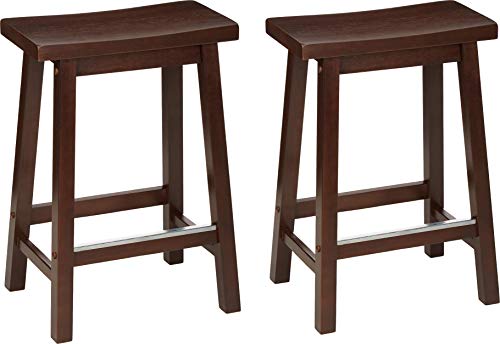
Amazon Basics Solid Wood Saddle-Seat Counter Stools, Walnut, Set of 2
Badge: Best Overall for Players
Ask guitarists what ruins a chair and the answer is always the same: arms and a high back crowding the instrument. This Amazon Basics saddle stool removes both problems. The solid wood saddle seat, the footrest for the classical-style raised foot, and the completely open sides let an acoustic guitar sit exactly where it should — against you, not against the furniture.
For a player, a chair is equipment. The wrong armrest bruises a strumming arm’s rhythm, the wrong back crowds the guitar’s body, the wrong height bends the neck angle out of shape. Amazon Basics Solid Wood Saddle-Seat Counter Stools, Walnut, Set of 2 was judged as equipment — on clearance, posture and the footrest geometry that classical and fingerstyle players depend on.
Strengths
- Backless and armless, so nothing touches the guitar body or your strumming arm
- Solid wood saddle seat stays comfortable through long practice sessions
- Footrest gives the raised-foot playing posture a proper ledge
Trade-offs
- Fixed 24-inch height only — taller players may want more
- No back support during breaks between songs
- Wood seat is firm; some players will add a thin pad
At a glance
- Seat height: 24-inch height
- Pack: set of 2
- Material: solid wood
- Form: saddle seat with footrest
- Colour: walnut
One honest limitation: It is a stool, not a chair: players who lean back between songs will miss a backrest.
Living with the Amazon Basics Solid Wood Saddle-Seat Counter Stools, Walnut, Set of 2 day to day is mostly a story of small conveniences adding up. Its defining specification — seat height: 24-inch height — shapes every use, and the quality noted in the strengths list, that it solid wood saddle seat stays comfortable through long practice sessions, turns out to be the one owners mention most once the novelty wears off. In the context of acoustic playing, that consistency matters: a chair that behaves the same way on the fiftieth use as on the first is a chair that stops being thought about, which is the highest compliment furniture in daily service can earn.
Set against the rest of the shortlist, the Amazon Basics Solid Wood Saddle-Seat Counter Stools, Walnut, Set of 2 is the pick for buyers who read its badge — Best Overall for Players — and nod. If your priorities lean the other way, the neighbouring picks frame the choice: the GRUSIGN Bar Stools Set of 2, Swivel Adjustable, Brown answers with its own strength (height adjustment dials the seat to your guitar and your leg length), while the DUMOS Counter Height Bar Stools Set of 4, 26 Inch, Brown counters with backrests for the whole ensemble without a single armrest in the way. None of the six is the best chair in the abstract; each is the best answer to a differently weighted version of the same question, and this one weights best overall for players above all.
Across a long session — the unit of time acoustic playing is really measured in — the Amazon Basics Solid Wood Saddle-Seat Counter Stools, Walnut, Set of 2 holds its character. The seat and support do not change their minds halfway through, the structure stays quiet and settled, and the small ergonomic facts established in the first ten minutes are still true in the third hour. That steadiness is easy to underrate in a listing and impossible to overrate in ownership, because long sessions are where chairs are actually judged.
Best for: readers whose priority is best overall for players in the context of acoustic playing / Not suited for: buyers whose needs run against that strength — read the trade-offs above before deciding.

GRUSIGN Bar Stools Set of 2, Swivel Adjustable, Brown
Badge: Best Adjustable Pick
Players come in different heights and so do guitars, which is why the adjustable GRUSIGN stools earn their place: raise or lower the seat until the guitar’s body clears your thigh and the neck angle feels natural, then swivel gently toward whoever is leading the song. The backrest waits behind you for the pauses.
Playing posture is personal — flatpickers, fingerstylists and classical players all sit differently — but every style agrees on clearance: nothing may touch the instrument that is not the player. GRUSIGN Bar Stools Set of 2, Swivel Adjustable, Brown is reviewed against that universal rule first, and comfort second.
Strengths
- Height adjustment dials the seat to your guitar and your leg length
- Swivel helps when turning toward a music stand, amp or bandmate
- Armless backrest gives support without crowding the guitar
Trade-offs
- Swivel can feel loose for players who plant both feet firmly
- Faux leather seat gets warm in long summer sessions
- Backrest height may meet the guitar’s upper bout for some postures — test your angle
At a glance
- Pack: set of 2
- Form: swivel adjustable bar chairs with backrest
- Material: faux leather upholstery
- Colour: brown
One honest limitation: The moving base is a preference thing; traditionalists often prefer the planted feel of the wooden saddle stool.
What ownership of the GRUSIGN Bar Stools Set of 2, Swivel Adjustable, Brown feels like across a season is worth spelling out, because the listing photographs cannot. The detail that defines it in practice is this: colour: brown. Around that, the everyday experience is shaped by how it swivel helps when turning toward a music stand, amp or bandmate — a quality that sounds minor in a specification list and becomes the reason the chair is reached for first. For acoustic playing, reliability of that kind is worth more than any single headline feature.
The comparison that matters for the GRUSIGN Bar Stools Set of 2, Swivel Adjustable, Brown is not against a rival brand but against the other five answers in this guide. Choose it over the VASAGLE Wooden Bar Stools Set of 2, Cappuccino Beige when armless backrest gives support without crowding the guitar matters more to you than raw versatility; choose it over the Amazon Basics Solid Wood Saddle-Seat Counter Stools, Walnut, Set of 2 when its particular trade-off — swivel can feel loose for players who plant both feet firmly — is one you can accept happily. Framed that way, the decision is honest: you are not buying the most features, you are buying the features arranged in the order your own days will use them.
Session length is where this class of chair separates into the honest and the optimistic, and the GRUSIGN Bar Stools Set of 2, Swivel Adjustable, Brown is on the honest side of that line. Nothing about its comfort depends on a first impression: the support is mechanical, the surfaces are what they appear to be, and the experience at the end of a long stretch of acoustic playing matches the experience at the start closely enough that you stop budgeting your comfort — which is, in the end, the entire point of buying well in this category.
Best for: readers whose priority is best adjustable pick in the context of acoustic playing / Not suited for: buyers whose needs run against that strength — read the trade-offs above before deciding.

VASAGLE Wooden Bar Stools Set of 2, Cappuccino Beige
Badge: Best Upholstered Comfort
Long acoustic sessions — a folk club rehearsal, an evening of fingerstyle practice — reward a padded seat, and the VASAGLE pair’s linen-look upholstery and solid wood legs deliver comfort without a single armrest in the guitar’s way. The cappuccino beige finish also suits living-room playing corners better than workshop-style stools.
Hours decide. A stool that serves a twenty-minute strum may fail a three-hour rehearsal, so VASAGLE Wooden Bar Stools Set of 2, Cappuccino Beige is assessed for the long session: seat padding, foot placement, and how the body feels when the case finally closes.
Strengths
- Padded fabric seat softens multi-hour practice and jam sessions
- Solid wood legs feel stable and quiet on hard floors
- Armless sides keep the guitar completely unobstructed
Trade-offs
- Fixed height — measure against your playing posture first
- Fabric seat needs care around drinks and rosin-dusted hands
- Backrest is shaped for sitting back, so sit forward when playing
At a glance
- Pack: set of 2
- Material: linen-look fabric, solid wood legs
- Form: ergonomic backrest
- Colour: cappuccino beige
- Collection: MAZIO Collection
One honest limitation: Fixed-height stools always fit some players better than others; very tall players should consider the adjustable GRUSIGN.
Day to day, the VASAGLE Wooden Bar Stools Set of 2, Cappuccino Beige settles into a routine quickly, and routine is the real test of any pick in this guide. Its set of 2 gives it a clear identity among the six, and in practice the trait that earns its keep is that it solid wood legs feel stable and quiet on hard floors. Owners of chairs in this class tend to judge them at the three-month mark, not the three-day mark, and this is a design whose virtues — steady, repeatable, uncomplaining — are precisely the three-month kind.
It also helps to place the VASAGLE Wooden Bar Stools Set of 2, Cappuccino Beige on the shortlist’s map of compromises. Every pick here trades something: this one trades on the fact that fabric seat needs care around drinks and rosin-dusted hands, and in exchange delivers armless sides keep the guitar completely unobstructed. Buyers who find that exchange attractive will be satisfied for years; buyers who bristle at it should walk one pick up or down this list, where the same budget of compromises is spent differently — toward the VASAGLE Bar Stools Set of 2, 26-Inch, Caramel Brown on one side or the GRUSIGN Bar Stools Set of 2, Swivel Adjustable, Brown on the other.
One more practical observation about the VASAGLE Wooden Bar Stools Set of 2, Cappuccino Beige in extended use: it forgives interruption. Sessions in real homes and real studios are broken by doors, phones, kettles and colleagues, and a chair that is easy to leave and easy to return to — no readjustment ritual, no lost position — protects the thread of the work or the evening. Across weeks of such interrupted days, that forgiveness compounds into the feeling owners describe as the chair simply suiting their life.
Best for: readers whose priority is best upholstered comfort in the context of acoustic playing / Not suited for: buyers whose needs run against that strength — read the trade-offs above before deciding.

VASAGLE Bar Stools Set of 2, 26-Inch, Caramel Brown
Badge: Best Tall Perch
Many acoustic players practise the way they perform — perched high, one foot on a rung, guitar held at stage angle. The 26-inch VASAGLE stool is built for that posture, with wipeable PU leather for working-musician life and clean mid-century styling that suits studios and teaching rooms.
For a player, a chair is equipment. The wrong armrest bruises a strumming arm’s rhythm, the wrong back crowds the guitar’s body, the wrong height bends the neck angle out of shape. VASAGLE Bar Stools Set of 2, 26-Inch, Caramel Brown was judged as equipment — on clearance, posture and the footrest geometry that classical and fingerstyle players depend on.
Strengths
- Taller 26-inch seat suits the semi-standing posture many performers practise in
- PU leather wipes clean after gigs, lessons and studio dust
- Armless profile keeps strumming and fretting arms free
Trade-offs
- Fixed tall height can leave shorter players’ feet searching for the rung
- Upholstery and guitar hardware should be kept apart when standing up
- Low-profile back is for pauses, not for leaning while playing
At a glance
- Seat height: 26-inch counter height
- Pack: set of 2
- Material: PU leather upholstery
- Style: mid-century modern, stitched, EKHO Collection
One honest limitation: At this height, players under average height may find the footrest geometry less natural; the 24-inch saddle stool is the safer perch.
Living with the VASAGLE Bar Stools Set of 2, 26-Inch, Caramel Brown day to day is mostly a story of small conveniences adding up. Its defining specification — seat height: 26-inch counter height — shapes every use, and the quality noted in the strengths list, that it pU leather wipes clean after gigs, lessons and studio dust, turns out to be the one owners mention most once the novelty wears off. In the context of acoustic playing, that consistency matters: a chair that behaves the same way on the fiftieth use as on the first is a chair that stops being thought about, which is the highest compliment furniture in daily service can earn.
Set against the rest of the shortlist, the VASAGLE Bar Stools Set of 2, 26-Inch, Caramel Brown is the pick for buyers who read its badge — Best Tall Perch — and nod. If your priorities lean the other way, the neighbouring picks frame the choice: the DUMOS 24 Inch Counter Height Bar Stools Set of 4 answers with its own strength (four backless stools seat a whole picking circle with zero guitar interference), while the VASAGLE Wooden Bar Stools Set of 2, Cappuccino Beige counters with padded fabric seat softens multi-hour practice and jam sessions. None of the six is the best chair in the abstract; each is the best answer to a differently weighted version of the same question, and this one weights best tall perch above all.
Across a long session — the unit of time acoustic playing is really measured in — the VASAGLE Bar Stools Set of 2, 26-Inch, Caramel Brown holds its character. The seat and support do not change their minds halfway through, the structure stays quiet and settled, and the small ergonomic facts established in the first ten minutes are still true in the third hour. That steadiness is easy to underrate in a listing and impossible to overrate in ownership, because long sessions are where chairs are actually judged.
Best for: readers whose priority is best tall perch in the context of acoustic playing / Not suited for: buyers whose needs run against that strength — read the trade-offs above before deciding.
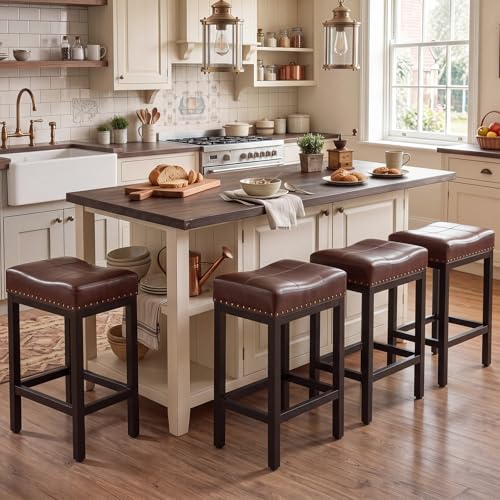
DUMOS 24 Inch Counter Height Bar Stools Set of 4
Badge: Best for Group Sessions
A picking circle, a group lesson or a family jam needs four identical, obstacle-free seats, and this DUMOS set is the economical way to get them. Backless saddle stools are the traditional musician’s seat for a reason: nothing touches the instrument, the footrest is where your foot wants to be, and everyone can stand up mid-song without untangling themselves from a chair.
Playing posture is personal — flatpickers, fingerstylists and classical players all sit differently — but every style agrees on clearance: nothing may touch the instrument that is not the player. DUMOS 24 Inch Counter Height Bar Stools Set of 4 is reviewed against that universal rule first, and comfort second.
Strengths
- Four backless stools seat a whole picking circle with zero guitar interference
- Saddle seat and footrest support the classic one-foot-up playing posture
- Metal base shrugs off being moved around constantly
Trade-offs
- Backless design means breaks are taken standing or elsewhere
- Saddle shape divides opinion on very long sits
- 24-inch height is a single fixed size for every player
At a glance
- Seat height: 24 inch counter height
- Pack: set of 4
- Form: backless saddle seat
- Material: PU leather seat, metal base with footrest
One honest limitation: Solo players who want back support for practice marathons will be better served by the backed picks.
What ownership of the DUMOS 24 Inch Counter Height Bar Stools Set of 4 feels like across a season is worth spelling out, because the listing photographs cannot. The detail that defines it in practice is this: material: pu leather seat, metal base with footrest. Around that, the everyday experience is shaped by how it saddle seat and footrest support the classic one-foot-up playing posture — a quality that sounds minor in a specification list and becomes the reason the chair is reached for first. For acoustic playing, reliability of that kind is worth more than any single headline feature.
The comparison that matters for the DUMOS 24 Inch Counter Height Bar Stools Set of 4 is not against a rival brand but against the other five answers in this guide. Choose it over the DUMOS Counter Height Bar Stools Set of 4, 26 Inch, Brown when metal base shrugs off being moved around constantly matters more to you than raw versatility; choose it over the VASAGLE Bar Stools Set of 2, 26-Inch, Caramel Brown when its particular trade-off — backless design means breaks are taken standing or elsewhere — is one you can accept happily. Framed that way, the decision is honest: you are not buying the most features, you are buying the features arranged in the order your own days will use them.
Session length is where this class of chair separates into the honest and the optimistic, and the DUMOS 24 Inch Counter Height Bar Stools Set of 4 is on the honest side of that line. Nothing about its comfort depends on a first impression: the support is mechanical, the surfaces are what they appear to be, and the experience at the end of a long stretch of acoustic playing matches the experience at the start closely enough that you stop budgeting your comfort — which is, in the end, the entire point of buying well in this category.
Best for: readers whose priority is best for group sessions in the context of acoustic playing / Not suited for: buyers whose needs run against that strength — read the trade-offs above before deciding.
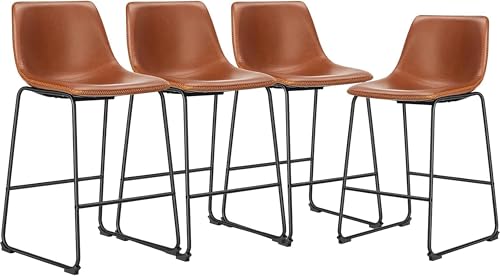
DUMOS Counter Height Bar Stools Set of 4, 26 Inch, Brown
Badge: Best Backed Set for Ensembles
Teaching studios and ensemble rehearsal rooms need backed seats that still respect the instrument, and this DUMOS set of four threads that needle: armless sides, a backrest for the theory parts of the lesson, and a 26-inch perch that keeps the guitar at a natural playing angle.
Hours decide. A stool that serves a twenty-minute strum may fail a three-hour rehearsal, so DUMOS Counter Height Bar Stools Set of 4, 26 Inch, Brown is assessed for the long session: seat padding, foot placement, and how the body feels when the case finally closes.
Strengths
- Backrests for the whole ensemble without a single armrest in the way
- 26-inch height suits taller players and standing-style rehearsal
- Faux leather wipes clean between students or sets
Trade-offs
- Taller fixed height will not fit every player in a mixed group
- Backrest can meet the guitar body if you sit too far back — sit toward the edge
- Four stools need storage space between sessions
At a glance
- Seat height: 26 inch
- Pack: set of 4
- Material: faux leather upholstery, metal frame
- Form: armless stools with back
One honest limitation: Mixed-height groups may find one fixed height a compromise; that is the adjustable pick’s home ground.
Day to day, the DUMOS Counter Height Bar Stools Set of 4, 26 Inch, Brown settles into a routine quickly, and routine is the real test of any pick in this guide. Its 26 inch gives it a clear identity among the six, and in practice the trait that earns its keep is that it 26-inch height suits taller players and standing-style rehearsal. Owners of chairs in this class tend to judge them at the three-month mark, not the three-day mark, and this is a design whose virtues — steady, repeatable, uncomplaining — are precisely the three-month kind.
It also helps to place the DUMOS Counter Height Bar Stools Set of 4, 26 Inch, Brown on the shortlist’s map of compromises. Every pick here trades something: this one trades on the fact that backrest can meet the guitar body if you sit too far back — sit toward the edge, and in exchange delivers faux leather wipes clean between students or sets. Buyers who find that exchange attractive will be satisfied for years; buyers who bristle at it should walk one pick up or down this list, where the same budget of compromises is spent differently — toward the Amazon Basics Solid Wood Saddle-Seat Counter Stools, Walnut, Set of 2 on one side or the DUMOS 24 Inch Counter Height Bar Stools Set of 4 on the other.
One more practical observation about the DUMOS Counter Height Bar Stools Set of 4, 26 Inch, Brown in extended use: it forgives interruption. Sessions in real homes and real studios are broken by doors, phones, kettles and colleagues, and a chair that is easy to leave and easy to return to — no readjustment ritual, no lost position — protects the thread of the work or the evening. Across weeks of such interrupted days, that forgiveness compounds into the feeling owners describe as the chair simply suiting their life.
Best for: readers whose priority is best backed set for ensembles in the context of acoustic playing / Not suited for: buyers whose needs run against that strength — read the trade-offs above before deciding.
Comparison Table
| Pick | Badge | Key specification from the listing | Best for | Listing |
|---|---|---|---|---|
| Amazon Basics Solid Wood Saddle-Seat Counter Stools, Walnut, Set of 2 | Best Overall for Players | Seat height: 24-inch height | Best Overall for Players | Check on Amazon |
| GRUSIGN Bar Stools Set of 2, Swivel Adjustable, Brown | Best Adjustable Pick | Pack: set of 2 | Best Adjustable Pick | Check on Amazon |
| VASAGLE Wooden Bar Stools Set of 2, Cappuccino Beige | Best Upholstered Comfort | Pack: set of 2 | Best Upholstered Comfort | Check on Amazon |
| VASAGLE Bar Stools Set of 2, 26-Inch, Caramel Brown | Best Tall Perch | Seat height: 26-inch counter height | Best Tall Perch | Check on Amazon |
| DUMOS 24 Inch Counter Height Bar Stools Set of 4 | Best for Group Sessions | Seat height: 24 inch counter height | Best for Group Sessions | Check on Amazon |
| DUMOS Counter Height Bar Stools Set of 4, 26 Inch, Brown | Best Backed Set for Ensembles | Seat height: 26 inch | Best Backed Set for Ensembles | Check on Amazon |
How to Choose a Chair for Acoustic Playing
Height comes first, because height sets the guitar’s geometry. Sit with the guitar in playing position: your fretting hand should reach the neck without your shoulder hiking, and the guitar’s body should rest against your leg at an angle that keeps the soundhole open to the room. For most players on most chairs, a 24-inch seat achieves this; taller players, and those who practise in a semi-standing performance posture, often prefer 26 inches. Adjustable stools exist for the players in between — and for teachers whose students come in all sizes.
Footrest geometry is the second decision, and classical and fingerstyle players should treat it as the first. The raised foot — traditionally the left — lifts the guitar’s neck into its playing angle, and the stool’s rung or bar must sit where that foot naturally lands, neither stretching the ankle nor cramping the knee. Test with your actual playing posture, ideally with a footstool player’s habits in mind: if you already use a separate footrest or a support cushion, a lower rung matters less; if the stool’s rung is your footrest, it matters most of all.
Back or no back is a question about what happens between songs. Backless stools keep the playing position pure and are the traditional choice for practice and performance; nothing touches the guitar, ever. A low backrest earns its keep in teaching, rehearsal and long social sessions, where half the time is talking, listening and demonstrating — provided you sit toward the seat’s edge while actually playing, so the guitar clears it. Be honest about your ratio of playing to pausing.
Seat material closes the decision. Solid wood saddle seats are firm, honest and traditional, shaping posture across long practice; padded upholstery forgives three-hour rehearsals and living-room sessions. Either way, check the practicalities: the stool should be quiet (a creaking stool on a recording is a special misery), stable under the small shifts playing involves, and finished so that belt buckles, buttons and guitar hardware are the only things that ever mark it — never the other way round.
If your shortlist started with a related question, see Best Chairs For Adjustable Height Desk for the companion rundown.
Setting Up a Practice Seat and Looking After It
Set the stool up where you actually play, then tune the triangle: stool, music stand, light. Sit in playing position and check that the stand sits at reading distance without leaning, that light falls on the page rather than the guitar’s glossy top, and that your foot lands on the rung without searching. For adjustable stools, find your height with the guitar in hand — not by eye — and mark it if the stool is shared, so your setup returns in seconds.
Build a pre-practice check into the ritual: fasteners snug, rung firm, seat clean. A thirty-second circuit at the start of a session prevents the mid-session wobble that breaks concentration and, worse, trust — a player who does not trust the stool sits defensively, and defensive posture is bad technique. Keep a soft cloth with the stool for wiping down upholstery or wood after long sessions; sweat and rosin dust are unkind to finishes left uncleaned.
Care follows the material. Wooden stools want an occasional wipe and protection from radiators and damp corners; upholstered stools want a brush vacuum and prompt attention to spills; metal frames want their bolts checked quarterly. Store the stool in the playing corner rather than the garage — instruments and their furniture both prefer the room they work in, and a stool that lives at the practice spot gets practised on.
A close cousin of this search is covered in Best Chairs For Adults And Kids, where the same shortlist method is applied to that brief.
Troubleshooting
Problem: the guitar body knocks the chair → you are sitting too far back or the backrest is meeting the upper bout; sit toward the front half of the seat while playing, and let the backrest serve the pauses.
Problem: fretting shoulder aches after twenty minutes → the seat is likely too low, dropping the guitar’s neck; raise the seat, raise the foot, or add height with an adjustable stool until the neck angle lifts the hand into a neutral reach.
Problem: the stool creaks on recordings → tighten every fastener, check the rung joints, and place the stool on a rug; a thin rug under a practice stool is standard studio practice for exactly this reason.
Practice, Teaching and the Picking Circle: Three Seating Problems
Solo practice wants one perfect stool, tuned to one body and one guitar. Teaching wants adjustability, because the stool must fit a ten-year-old at four o’clock and an adult at five, and it must swivel between demonstrating and observing. The picking circle wants uniformity: four identical backless stools, so every player’s guitar clears, every foot finds the same rung, and nobody’s seat becomes the circle’s weak chair.
Most players need the first and grow into the others. Buy your practice stool for yourself without apology; when the teaching or the circle arrives, the sets of four in this guide exist so the expansion is a purchase, not a redesign.
For the adjacent angle on this topic, Best Chairs For Alignment And Posture works through its own set of picks and trade-offs.
Posture for Players: What the Seat Can and Cannot Do
A good stool supports good posture; it cannot create it. What it can do is remove the obstacles: the armrest that twists your torso, the height that drops the guitar into your lap, the missing rung that leaves a foot dangling and a pelvis tilted. With those removed, the familiar playing posture — feet grounded or one raised, back tall but not rigid, guitar held by the body rather than gripped — becomes the path of least resistance.
Treat this as comfort and craft guidance, not medical advice: if playing hurts persistently, the answer is a teacher’s eye on your technique and, where needed, a clinician — not a different stool. The stool’s job is narrower and entirely achievable: to never be the reason a session ends early.
You may also find Best Chairs For Aminators useful if your seating problem turns out to be that one instead.
What to Check When Your Chairs Arrive
The first ten minutes with a new chair decide whether small problems get solved free or lived with forever, so give every arrival a proper inspection before the packaging leaves the house. Work through it in order: all parts present against the listing, every fastener tightened in sequence, and the finished chair set down on a hard, level floor and loaded with your own weight in your normal position for acoustic playing. Rock gently, shift, stand, sit again. Anything that creaks, wobbles or feels uneven at this stage is information — most of it is a fastener asking for a quarter-turn, and all of it is easier to address on day one than in month three.
Check the fit against the measurements you made when choosing, while returning is still simple. Seat height against the surface it serves, width against the space it must share, arms or edges against whatever they must clear. Photograph the chair in place; the photograph is both a sanity check for proportion — rooms reveal in pictures what eyes forgive in person — and a record if anything needs discussing with the seller. Keep the packaging until the first full week of use has passed, because the honest verdict on any chair in this category is a week of real days, not an afternoon of deliberate sitting.
Finally, register the details future-you will want: the assembly sequence that worked, which key fits the fasteners, and where the spare pads or glides live. A note in a phone is enough. Chairs in daily service loosen, settle and drift on a schedule measured in months, and the owners who stay happy with them are the ones whose first-week diligence turned later maintenance into a five-minute ritual rather than an archaeological expedition.
The First Month: How a Good Chair Becomes Your Chair
There is a settling-in month for every chair in this guide, and it runs in both directions: the chair settles — fasteners seat, cushions take their working shape, mechanisms smooth — and you settle, learning the chair’s positions and habits until using it well is unconscious. Expect to re-tighten once in the first fortnight and to revisit any adjustable settings at least twice; a setting chosen on day one was chosen by a stranger, and the month-one version, chosen by an experienced owner, is the one the chair will keep for years.
Use the month to test the chair against your real range of days, not your best day: the longest session, the busiest gathering, the messiest task, the tired evening. A pick that serves the whole range has earned its place permanently; a pick that only serves the showcase day is telling you something worth hearing while change is still possible. This is also the month to establish the care rhythm from the how-to section above — small, weekly, unremarkable — because rhythms established in month one are the ones still running in year three.
By the end of the month, a well-chosen chair disappears. That disappearance is the true product being bought in this entire category: not a specification list, not a badge, but the absence of a daily friction. If your chair has achieved it, the work of this guide is done and the chair’s work — years of unnoticed, reliable service in acoustic playing — has begun.
Common Buying Mistakes
- Buying a chair with arms and discovering the problem at the first chord.
- Choosing height by the room’s other furniture instead of by the guitar’s playing angle.
- Forgetting the footrest, then balancing a foot on a rung-less frame or a stack of books.
- Sitting deep into a backed stool so the guitar body meets the backrest on every strum.
- Ignoring creaks and wobble until they are on a recording or in the middle of a performance.
- Leaving the good stool in another room — practice happens where the seat already is.
And if the project widens, Best Chairs For Apartment is the natural next read in this series.
Final Recommendation
For most players, the Amazon Basics solid wood saddle stool is the answer to keep coming back to: armless, footrest-equipped, honestly built, and shaped by decades of players sitting exactly this way. Taller players and performance-style practicers should take the 26-inch VASAGLE perch, and anyone whose sessions run long in a living room will appreciate the upholstered VASAGLE pair.
Teachers should go straight to the adjustable GRUSIGN, and circles, classes and ensembles to the DUMOS sets — backless for purity, backed for rehearsal comfort. Whichever you choose, sit in your real playing posture when you judge it; the guitar will tell you the truth in one chord.
Quick links to the three lead picks: Amazon Basics Solid Wood Saddle-Seat Counter Stools, Walnut, Set of 2, GRUSIGN Bar Stools Set of 2, Swivel Adjustable, Brown, VASAGLE Wooden Bar Stools Set of 2, Cappuccino Beige, each linking to its Amazon listing to check the latest price on Amazon.
Frequently Asked Questions
Why do guitarists avoid chairs with arms?
Because arms collide with both the guitar and the player: the instrument’s lower bout meets the armrest, and the strumming elbow loses its natural swing. Armless stools remove both collisions, which is why every pick in this guide is armless.
What seat height is best for playing acoustic guitar?
Most players settle at a 24-inch seat; taller players and standing-style performers often prefer 26 inches. The test is the guitar’s angle: neck comfortably raised, fretting shoulder relaxed, foot resting naturally on the rung.
Do I need a footrest on the stool?
Classical and fingerstyle players, almost certainly — the raised foot sets the guitar’s angle. Flatpickers who play with both feet grounded can manage with a low rung. A stool with a proper bar or ring covers both habits.
Is a backless stool uncomfortable for long sessions?
For pure playing, most players find backless natural — the posture is active, not slumped. For sessions mixed with talking, listening and teaching, a low backrest for the pauses is a genuine comfort, provided you sit forward to play.
Can one stool serve guitar and other instruments?
Armless stools are the shared seat of most string players — mandolin, banjo and fiddle players face the same clearance rules. Bowed instruments with wide bow arms are the exception and need even more open space.
How many stools does a teaching studio need?
One adjustable stool for the student seat is the highest-value purchase, plus a matched stool for the teacher. Group classes justify the sets of four, which keep every student’s setup identical.