Disclosure: As an Amazon Associate, topratedkitchenware.com earns from qualifying purchases. Links on this page are affiliate links; they cost you nothing extra. Prices and availability change often, so check the current Amazon listing before you buy.
Weighing up electric tea kettle pros and cons means weighing a genuinely useful specialisation against its costs, because an electric tea kettle asks you to pay more than a basic kettle and give it more counter space and more cleaning attention. In return it offers the one thing tea actually demands and a basic kettle cannot give: water at the temperature your leaf wants, and often a built-in infuser to brew in the same vessel. The honest summary is that the pros are decisive for households that drink several kinds of tea, and almost irrelevant for households that drink one kind from a bag. This page takes each side seriously — the advantages with the evidence behind them, the disadvantages without softening — and then translates the balance for different drinkers, because a trade-off that matters enormously to a green-tea drinker may not matter at all to you. For the shortlist itself, start with electric tea kettle buying guide; this page is about whether the category deserves your money at all.
Quick verdict: an electric tea kettle suits drinkers who rotate tea types, brew loose leaf, or drink several cups across a morning. It does not suit single-tea bag drinkers, very small kitchens where a basic kettle already struggles for space, or anyone who will not descale — a neglected temperature-control kettle slowly becomes an inaccurate one.
Key Takeaways
- The biggest pro is flavour: correct water temperature stops green and white teas tasting bitter and harsh.
- The biggest con is upkeep: infusers clog, glass shows scale, and temperature sensors drift when scale coats them.
- Convenience pros — presets, keep-warm, cordless pouring — compound daily; the cons are mostly occasional.
- Cost only makes sense spread over daily use; a weekly drinker pays premium prices for rare benefits.
The Pros
Water at the Temperature Your Tea Actually Wants
This is the founding advantage, and it is not marketing. Tea leaves are not interchangeable: delicate white and green leaves release bitter, harsh compounds quickly in boiling water, while black tea and herbal blends need full heat to extract properly. A basic kettle gives you one temperature — boiling — plus guesswork. An electric tea kettle gives you the range, labelled by tea type, at a button press. Drinkers who switch from boiling-and-waiting to a green-tea preset routinely describe the same leaf tasting like a different, better tea. No other advantage on this list matters if this one does not apply to your shelf, and if it does apply, it nearly settles the question by itself.
Water temperature is the whole reason this category exists, so it deserves plain numbers. These are the widely used brewing ranges taught by tea sellers and used by the preset buttons on the kettles above; treat them as starting points and adjust a few degrees at a time to your own leaf.
- Delicate and white teas: the coolest water of the main families, roughly the range a kettle labels for delicate or white tea. Water near boiling flattens their gentle flavour and can bring out a cooked taste.
- Green teas: hot but well short of boiling. Japanese greens usually want the cooler end of the green range, Chinese greens tolerate a little more heat. Boiling water on green leaf is the single most common cause of a harsh, bitter cup.
- Oolong teas: the middle ground, and the widest range, because oolongs themselves range from green-like to nearly black. Start mid-range for a lightly oxidised ball oolong and hotter for a dark, roasted one.
- Black teas and herbal infusions: full, freshly boiled water. These leaves and botanicals need the heat to extract properly, and holding back only produces a thin cup.
- French press coffee and pour over: just off the boil is the usual advice, which is why so many tea kettles include a coffee preset alongside the tea buttons.
If you only remember one rule, make it this one: the paler and more delicate the leaf, the cooler the water. A kettle with presets simply turns that rule into a button press, and a kettle without them turns it into a waiting game of boiling, resting and guessing.
Loose Leaf Without a Second Vessel
A built-in infuser collapses the brewing kit to one appliance. Leaf goes in the basket, water heats around it, and you pour from the same vessel — no separate pot warming on the counter, no transfer drips, one thing to wash. For daily loose-leaf drinkers this simplification is the difference between brewing properly on a busy morning and reaching for a bag instead. It also encourages experimenting with leaf, because the effort barrier drops. The electric tea makers take this further with automation, but even a simple basket in a glass kettle changes the daily routine in a way owners consistently praise.
Presets Remove the Thinking From Busy Mornings
Convenience is often dismissed as laziness; here it is consistency. A preset remembers what you would otherwise have to remember at seven in the morning: which button for the sencha, which for the breakfast blend, how long to let boiled water rest for the oolong. Press, pour, done. Households with several drinkers benefit most, because the kettle carries the knowledge instead of one nominated tea expert. Guests can make their own cup correctly, which anyone who has watched a visitor pour boiling water over delicate green tea will appreciate.
Keep-Warm Turns One Boil Into a Morning of Tea
A keep-warm hold keeps water — or in automatic models, brewed tea — at temperature for a second and third cup without reboiling. Reboiling the same water repeatedly is both wasteful and, many drinkers find, flattening to the taste; holding temperature avoids the cycle. For slow mornings, desk workers and households where cups happen one at a time across an hour, this single feature can justify the category on its own. It is less magical than it sounds — it is a thermostat and patience — but its effect on the rhythm of a morning is real.
Faster and Tidier Than the Stovetop Kettle
Against the stovetop alternative, the electric kettle wins on speed, on automatic shut-off, and on pouring: a cordless jug lifted from a swivel base is simply easier to handle than a hot pan-shaped kettle from a hob. There is no flame or hot ring left on, no whistle to startle the house, and no carrying a kettle across the kitchen from stove to pot. The comparison with the tea kettles for stovetops is closer than partisans admit — stovetop kettles are beautifully simple and last decades — but for daily electric convenience, the plug-in wins most households.
One Appliance Covers Tea, Press Coffee and Kitchen Hot Water
A temperature-control kettle quietly serves the rest of the kitchen: water just off the boil for French press, cooler water for delicate drinks, a fast boil for cooking tasks. This versatility softens the counter-space argument, because the tea kettle often replaces a basic kettle entirely rather than joining it. Households that consolidate to one good kettle usually report the counter feels emptier, not fuller.
In this guide
The Cons
It Costs More Than the Kettle It Replaces
Temperature control, infusers and automation all add cost over a basic boil-only kettle, and the premium tiers add a great deal. The honest defence is cost per use across years of daily brewing; the honest criticism is that a household drinking one bagged tea gains almost nothing for the extra spend. This is the category’s sharpest trade-off and the reason is an electric tea kettle worth it exists as a separate, profile-by-profile judgement.
Infusers Need Real Cleaning, and Clog Quietly
The basket that makes loose leaf easy also collects tea oils and fine leaf in its mesh, and scale seals the problem in. A neglected infuser slows the brew, holds yesterday’s flavours, and eventually makes good tea taste muddy. The cleaning itself is not hard — soak, brush gently, descale — but it is recurring, and it is the first thing busy owners skip. If you know you will not maintain a mesh basket, choose a heat-only kettle and a separate, easily washed infuser or pot instead of pretending otherwise.
Scale Attacks Accuracy, Not Just Looks
Every kettle scales in hard water, but a temperature-control kettle has more to lose: mineral coating insulates the sensor and the element, so the temperature you select drifts from the temperature you get, and the boil grows slower and noisier. Glass models at least show the problem early; steel hides it until the tea tastes wrong. Descaling restores both, which makes the maintenance bargain explicit in this category — the precision you paid for is rented, and the rent is a monthly soak.
More Features Mean More to Fail
A basic kettle has a switch and an element. A tea kettle adds control boards, sensors, keep-warm circuits, and in automatic models a motorised basket. Each addition is a potential failure that a simpler kettle cannot have, and repairs are rarely economical; a failed board usually means a replaced kettle. Longevity-minded buyers should weigh this seriously and favour established brands with straightforward designs over feature-stuffed unknowns.
Capacity and Minimum Fill Cut Both Ways
Family-size kettles carry minimum fills that waste water and time for a solo cup, while compact design kettles strand you when guests arrive. There is no size that serves a single desk drinker and a six-person breakfast equally well, so every buyer accepts one compromise or the other. Infusers shrink usable capacity further, since a basket of leaves needs room and headspace.
Glass Is Fragile and Steel Hides Its State
The two body materials each carry a con the other avoids. Glass can crack or shatter with a knock or thermal shock, and it demands a calmer counter. Steel is tough but conceals its water level and its scale behind a gauge and a lid you must open to check. Neither flaw is fatal; both are daily, physical realities that photographs do not convey.
What the Trade-Offs Mean for You
If You Drink Several Tea Types
The pros dominate. Temperature presets and an infuser address your actual daily problem, and the cleaning cost is small against several better cups a day. Buy mid-range or better and maintain it.
If You Drink One Tea, From Bags
The cons dominate. You are paying for range you will never select and a basket you will never fill. A basic kettle, or the entry tier of this category, plus better tea is the rational spend.
If Your Water Is Hard
Every pro survives, but the maintenance con doubles in weight. Choose glass if you want the scale visible as a reminder, choose steel if you will descale on a calendar schedule regardless, and budget the few minutes monthly as part of the purchase.
If Counter Space Is Your Scarcest Resource
Measure before you buy, favour compact models, and count the automatic tea makers out unless the automation truly serves a daily habit. A kettle that must be stored in a cupboard will be used like one: reluctantly.
How the Category Compares With the Alternatives
| Option | Temperature control | Brews in vessel | Upkeep | Best for |
|---|---|---|---|---|
| Electric tea kettle | Presets by tea type | Often, via infuser | Descale plus infuser care | Mixed tea households |
| Basic electric kettle + teapot | Boil only | In the pot | Descale only | Black tea and bag drinkers |
| Gooseneck coffee kettle | Often precise | No | Descale only | Pour over coffee first, tea second |
| Stovetop kettle + teapot | None | In the pot | Minimal | Simplicity and longevity |
The table makes the category’s position plain: it is the only option that combines presets with in-vessel brewing, and it charges upkeep for the combination. The gooseneck kettles for pour over coffee remain the right tool when coffee leads and tea follows.
How to Buy Smart
Buy the temperature system before the styling: presets labelled by tea, a steady hold, and an honest keep-warm. Inspect the infuser’s mesh and removability in photographs as carefully as the kettle’s silhouette. Match capacity to your daily round and check the minimum fill. Prefer brands with a track record in kettles over novelty names, read the listing’s exact configuration — infusers and finishes vary within a model name — and treat the descale schedule as part of the price. The detailed shortlist and tier guidance live in electric tea kettle buying guide, and how to choose an electric tea kettle turns the same checks into a step-by-step walk.
Setup and Care That Reduce the Cons
Most cons on this page shrink with three habits. Rinse and boil-discard before first use, then empty leftover water instead of reboiling it. Keep the infuser honest with a weekly soak-and-brush, and descale the whole system on your water’s schedule rather than your tea’s complaints.
Scale is the white or grey mineral crust that hard water leaves on the element, the floor of the kettle and the mesh of the infuser. It slows the boil, flakes into cups, and makes temperature control less accurate, because the sensor is reading through an insulating layer of mineral. The fix is simple and cheap. Fill the kettle partway with equal parts water and plain white vinegar, or water with a spoonful of citric acid, bring it to a gentle heat, switch off and leave it to stand until the fizzing stops and the crust loosens. Pour the solution away, wipe any residue with a soft cloth, then boil a full kettle of fresh water and discard it — twice if the vinegar smell lingers. The infuser needs its own attention: steep it in the same warm descaling solution, then scrub the mesh gently with an old soft toothbrush, because clogged mesh slows the brew and holds the flavour of the last strong tea. How often depends on your water: monthly in a hard-water area, a few times a year where the water is soft. The fuller routine, including glass care and lid seals, is covered step by step in how to clean an electric tea kettle and the general method in how to descale an electric kettle.
An electric tea kettle is a litre or more of near-boiling water on a powered base, and it deserves the same respect as a pan on the stove. Fill between the minimum and maximum marks: below the minimum you risk boiling dry and stressing the element, above the maximum the water can surge out of the spout as it boils. Keep the kettle on its base on a stable, dry surface, route the cord so it cannot be caught by a passing sleeve, and pour slowly with the lid closed — most scalds from kettles happen during an impatient pour, not during the boil. Let the kettle cool before refilling it for a descale or a deep clean, never immerse the base or the kettle body in water, and keep the whole appliance out of the reach of small children, who see a shiny kettle at exactly their height on many counters. If a kettle ever boils dry, smells of hot plastic, or trips your electrics, unplug it and retire it rather than coaxing it along.
Bottom Line
The pros of an electric tea kettle are about flavour and daily rhythm; the cons are about money, space and upkeep. Drinkers who rotate teas or brew loose leaf will find the pros waiting for them every morning and the cons reduced to a monthly soak. Drinkers with one tea and a bag will find the reverse. Neither verdict is a flaw in the category — it is a specialised tool, and specialised tools reward the households they were specialised for. Read the model-level evidence in electric tea kettle reviews before choosing where on the spectrum your kettle should sit.
Electric Tea Kettle Pros And Cons in One View
Before the deeper sections below, the whole argument fits in one honest paragraph. On the pro side: correct water for each tea family, one-vessel loose-leaf brewing, presets that carry the knowledge for the whole household, keep-warm that turns one boil into a morning, and speed with automatic shut-off that a stovetop cannot match. On the con side: a premium over a basic kettle, a permanent counter footprint, an infuser that clogs if neglected, scale that taxes the accuracy you bought, and electronics that can fail where a switch would not. Every section that follows is an expansion of one clause of that paragraph, because the balance between the two sides is decided by details — your teas, your water, your counter, your habits — and not by the category in the abstract.
More Pros Worth Weighing
Precise Water Helps Everything Else You Make
The temperature panel earns its keep beyond tea more often than buyers expect. Water just off the boil for French press coffee, gentler water for delicate instant drinks and for warming a pot before brewing, a fast controlled heat for kitchen tasks that begin with hot water — the kettle becomes the house’s water instrument rather than a single-drink appliance. Households consistently report that a temperature-control kettle absorbs jobs from both the basic kettle and the microwave, which reframes the counter-space con: the footprint often replaces a footprint rather than adding one.
Safety Features a Stovetop Cannot Offer
Automatic shut-off at temperature, boil-dry protection that cuts power when a kettle is switched on empty, a cool-return base and a jug that lifts free of its cord — these are unglamorous advantages that matter in real kitchens with children, elderly drinkers, and mornings that begin before their owners are fully awake. A stovetop kettle left on a ring is a hazard with a whistle; an electric tea kettle that has done its job simply waits, warm and inert. For some households this section, not the flavour section, is the deciding pro.
Consistency That Teaches You Your Own Tea
An underrated pro: repeatable water makes your tea experiments legible. When temperature is held constant by the kettle, changing the leaf, the amount or the steep time produces differences you can actually attribute, and drinkers learn their own preferences faster. The guessing routine of boil-and-wait scrambles every variable at once. Tea drinkers who enjoy improving their cup — which is most loose-leaf drinkers, eventually — find the kettle quietly educational.
More Cons Worth Weighing
Counter Clutter, Cords and Kitchen Politics
The footprint is not just area; it is a permanent claim in the kitchen’s most contested territory, with a cord that must reach a socket without crossing a hob or a sink. In shared and small kitchens, that claim is renegotiated by every other appliance with ambitions. Buyers should measure the actual space, including the vertical room to lift a full kettle clear of its base under wall cupboards, because a kettle that must be pulled forward to use is a kettle slowly migrating toward storage and disuse.
Filters, Seals and the Small Parts Economy
Spout filters clog and eventually want replacing. Lid seals age. Infuser baskets get dropped, dented and, in the worst case, discontinued. None of this is unique to tea kettles, but the category has more small parts than a basic kettle, and a brand’s willingness to sell those parts separately is a fair proxy for how long it expects the appliance to serve. Obscure brands with no parts trail are a con that only becomes visible in year two.
Button Clutter and the Guest Test
Feature-rich bases can fail the simplest usability test: can a guest make tea in your kitchen without instructions? Panels dense with modes, holds and toggles impose a small tax on every new user and a real one on elderly relatives. The category’s best designs pass the guest test with labelled presets; its worst hide basic boiling behind a menu. Count this con if your kitchen serves many hands.
Not Every Tea Ritual Wants a Machine at the Centre
Some tea practices — small-pot gongfu brewing with many short infusions, for instance — revolve around a small kettle of water kept at temperature and a great deal of pouring by hand. An electric tea kettle can serve as the water engine for such a ritual, and many do, but the infuser and automation go unused and the appliance’s centre of gravity feels wrong for the practice. The con is not quality; it is fit. A specialised tool can be excellent and still be specialised away from your ritual.
The Seasonal View: A Year With the Trade-Offs
Live with the balance across a year and its rhythm becomes clear. In the first month, the pros are loudest: the green tea tastes right, the morning is shorter, the basket feels like a discovery. By the third month the cons file their first reports — a slower boil announces scale, the infuser wants its brush, the counter negotiation with a new appliance peaks. Households that adopt the small maintenance routine here settle into the long middle of ownership, where the kettle disappears into the routine and simply makes tea properly, which is the highest praise a kitchen appliance earns. Households that do not, watch the pros erode one by one until the kettle is a basic boiler with a premium past. The category does not change across that year; the owner’s habits decide which side of the ledger compounds.
The Trade-Offs, Model by Model
Category arguments land differently on different hardware, so here are three representative kettles with their own balance sheets, presented prose-first. The full six-model treatment is in electric tea kettle reviews.
Cuisinart PerfecTemp Tea Kettle
The Cuisinart PerfecTemp is the reference point for this category, the kettle most other tea kettles get compared against, because it built its name on the one feature tea drinkers actually need: labelled temperature presets for different teas instead of a single rolling boil. One-touch buttons for delicate, green, white, oolong, coffee and black or herbal teas take the guesswork out of water that is too hot for the leaf in your cup. A keep-warm function holds the chosen temperature while you finish a first cup, and a removable infuser basket on many configurations lets the kettle brew as well as heat. The stainless body feels substantial, the controls are legible without a manual, and the whole machine behaves like an appliance designed by people who drink several kinds of tea in one household.
Best for: households that want the category’s pros with the fewest cons attached
Not suited for: drinkers whose main con is wanting automation
Strengths
- Presets deliver the headline pro in full
- Steel body dodges the fragility con
- Keep-warm without mechanism complexity
Trade-offs
- Premium tier is its money con
- Steep timing remains your job
- Scale still taxes accuracy if neglected
Tier: premium. Check price on Amazon.

COSORI Electric Tea Kettle with Infuser
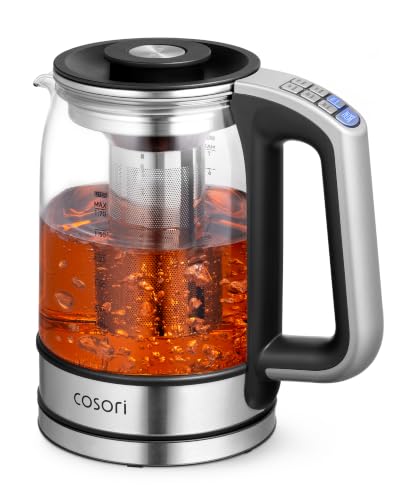
The COSORI tea kettle with infuser is the glass option most buyers land on, and the glass is the point: you can watch the water approach the boil, watch the leaf open, and see at a glance how much water remains. The borosilicate body pairs with a stainless infuser that drops into the pot for loose leaf brewing, and the base carries straightforward temperature control rather than a bare on-off switch. Glass asks for gentler handling than steel and shows scale sooner, which is either a flaw or a useful reminder to descale, depending on your temperament. For tea drinkers who brew visually and drink several types, it is the balanced middle of this category.
Best for: visual brewers who accept the glass con knowingly
Not suited for: busy counters where fragility is a daily risk
Strengths
- Infuser pro in its most watchable form
- Mid-range tier softens the money con
- Scale visibility turns a con into a reminder
Trade-offs
- Fragility is a standing condition
- Shows every trace of hard water
- Basket limits the largest rounds
Tier: mid-range. Check price on Amazon.

Breville Smart Tea Infuser
The Breville Smart Tea Infuser is the automation play in this category. Rather than simply heating water and leaving the steeping to you, it manages the brew cycle itself: the basket lowers into the water at the set temperature and lifts when the steep time ends, so a forgotten pot does not turn bitter on the counter. Presets cover the main tea families, strength settings adjust the cycle, and a keep-warm hold keeps the finished tea ready for a second cup. It is the largest commitment of counter space and budget in this group, and it earns that footprint only in households that brew loose leaf daily and genuinely want the machine to watch the clock for them.
Best for: forgetful brewers for whom automation erases the biggest practical con of manual steeping
Not suited for: anyone whose con list starts with size, parts or price
Strengths
- Removes the over-steeping failure entirely
- Strength control deepens the flavour pro
- Keep-warm holds finished tea, not just water
Trade-offs
- Largest size and parts cons in the category
- Premium tier at its steepest
- Most cleaning surface per brew
Tier: premium. Check price on Amazon.
Noise, Speed and the Senses: The Underrated Ledger
Reviewers weigh buttons; owners live with sounds and waits. On the pro side, an electric tea kettle is faster than its stovetop rival and frees the cook from attendance, and insulated models muffle the boil to a background murmur. On the con side, a glass kettle at full boil is an audible event, ready beeps can be unwelcome in a sleeping house, and a kettle that takes the scenic route to temperature because of scale taxes patience daily. These sensory items rarely decide a purchase alone, but they colour every day of ownership, and households with babies, shift workers or open-plan living should promote them from footnotes to criteria. The category’s honest summary is that its best models are quiet, quick and polite, and its worst are merely loud versions of the same competence.
The Environmental Ledger, Kept Qualitatively
Without inventing figures, the environmental balance of the category can still be reasoned about. On the pro side, heating only the water you need, in an appliance that switches itself off and holds temperature without reboiling, is a disciplined way to make hot water, and a durable kettle kept for years displaces several cheaper ones. On the con side, electronics shorten the plausible lifespan compared with a stovetop kettle that can serve for decades, and a failed control board usually retires an otherwise sound vessel. The mindful owner’s response is behavioural: buy the simplest model that meets the need, maintain it so it lasts, fill it honestly, and let longevity do the environmental work. A mid-range kettle descaled monthly and used daily for years is a defensible object; a feature-stacked one replaced in two years is not, whatever its efficiency claims.
Gifting, Second Kettles and Second Lives
A small, practical pro deserves recording: this category gifts well and cascades well. A new premium kettle sends a sound mid-range one to an office, a student flat or a spare room, where its presets continue to earn. Tea kettles are also among the most gifted small appliances for new households, because they are useful on day one and personal without being intimate. The corresponding con is that a gifted kettle imposes its maintenance culture on the recipient; gift the simple tiers to households you do not also plan to descale for. None of this decides a purchase, but it softens the money con for upgraders, whose old kettle rarely goes to waste.
The Pro and Con of Habit Formation
There is a behavioural entry that belongs on both sides of this ledger. On the pro side, a good tea kettle builds the tea habit it serves: because brewing properly becomes easy, households brew properly more often, drink better tea, and gradually stock better leaf — a virtuous circle that owners describe as the appliance improving their taste rather than merely their water. The kettle becomes the fixed point around which a small daily ritual organises itself, and rituals of that kind are disproportionately valuable in a household’s day. On the con side, the same mechanism runs in reverse when the purchase precedes the habit: an expensive, specialised appliance waiting for a routine that never forms becomes a standing reminder of an intention not kept, which is a genuinely unpleasant object to share a kitchen with. This is why the pros-and-cons balance cannot be struck from the appliance alone. The identical kettle is an asset in a house whose habit exists and a liability in a house whose habit was hypothetical, and the buyer’s self-knowledge is the only instrument that can weigh this entry before the purchase rather than after it.
Comparing the Balance Across Price Tiers
The ledger also shifts as money moves. At the entry tier, the cons shrink to near nothing — a modest premium over a basic kettle, a modest footprint — but so do the pros, because the temperature range that justifies the category may be absent or rudimentary; the entry kettle is a pro-and-con truce. At the mid-range, both sides reach their full size: the pros arrive complete — presets, infuser, keep-warm — while the cons remain the manageable set of upkeep, space and a moderate premium, which is why this page and every other in the cluster keep identifying the mid-range as the balance point of the category. At the premium tier, the pros become specific rather than larger — automation, design, construction — while the cons grow teeth: the highest cost of failure, the most parts, the largest footprint. A buyer who understands that the ledger does not simply improve with price, but changes shape, will choose a tier by the shape of their own household rather than by altitude, and that is the most useful sentence on this page.
A Note on Households With Children and Elderly Drinkers
Two household compositions bend the balance in opposite directions and deserve explicit treatment. With small children, the safety pros — automatic shut-off, boil-dry protection, a jug that lifts free of its cord, double-wall exteriors that stay calmer — gain real weight, while the glass con and the counter-clutter con gain weight with them; the ledger tilts toward steel, insulation and simplicity. With elderly drinkers, the balance tilts toward legibility and lightness: labelled presets that remove memory work are a genuine pro, a heavy double-wall kettle at full load is a genuine con, and a keep-warm that prevents repeated lifting and boiling may be the single most valuable feature in the house. Neither composition changes the category’s fundamentals, but both change which model embodies them, and a pros-and-cons page that ignored them would be balancing the books for a household that does not exist.
The Ledger for Renters and Shared Kitchens
Two living situations bend the balance in ways owners of settled kitchens rarely consider, and they close this page’s survey of the trade-offs. Renters gain a particular pro: an electric tea kettle is a complete, portable upgrade that asks nothing of the landlord — no installation, no plumbing, no permission — and leaves with its owner at the end of the lease, taking its improved mornings with it. Against that, renters in small or shared spaces feel the counter con at double strength, and a kettle that must negotiate for its footprint with three housemates’ appliances lives a harder life than the same kettle in a family kitchen. Shared kitchens add a social entry to both columns: a legible preset panel is a pro because anyone can use it without training or territorial dispute, while a precious glass or design-finish kettle is a con because its owner will spend the year quietly anxious about other people’s handling. The category survives both situations well at its simple, durable end and poorly at its fragile, complicated end, which is the same conclusion the rest of this page reached by other roads — the trade-offs of an electric tea kettle are, in the end, the trade-offs of the household that hosts it.
The Balance in a Single Morning, Timed by Feel
Reduce the whole ledger to one morning and its texture. The pros arrive as absences: no waiting for water to cool, no guessing, no second boil, no strainer balanced over the sink. The cons arrive as presences, but later and elsewhere: a brush by the sink on Saturday, a descale date on the calendar, a footprint negotiated once and then forgotten. That asymmetry — pros distributed daily and invisibly, cons concentrated occasionally and visibly — explains why owners’ verdicts and reviewers’ ledgers so often differ in tone while agreeing in content. The reviewer counts items; the owner lives in the distribution. A household deciding from this page should therefore weight not only how many entries each column holds, but when each entry is paid. Most households, offered the same trade in any other appliance — small scheduled chores in exchange for a daily friction removed — take it without hesitating, and the tea kettle’s ledger, read by the calendar rather than by the column, is exactly that trade.
What Tips the Balance: A Closing Weighing
Every pros-and-cons page owes its reader a final act of weighing rather than a shrug, so here is this page’s, stated as plainly as the evidence allows. The pros of an electric tea kettle are structural: they arise from the physics of tea and the shape of mornings, and they renew themselves daily without asking anything but electricity. The cons are managerial: they arise from owning a more complex object, and they can be scheduled, budgeted and habituated until they shrink to the size of a calendar entry. Structural advantages against manageable costs is, in most categories of household goods, the signature of a sound purchase — for the households the advantages address. The exception that proves the rule is the household those advantages do not address at all, for whom the same managerial costs purchase nothing, and whose correct verdict this page has defended as vigorously as the opposite one. Balance, in the end, is not a property of the kettle. It is a property of the fit between the kettle and a kitchen, and the fit is knowable in advance — which is the most encouraging sentence a pros-and-cons page can end on.
Electric Tea Kettle: Weighing the Trade-Offs in Daily Use
Start with how the strengths and frustrations of a {p} balance out in a real kitchen. Most coverage of a electric tea kettle concentrates on the first week of ownership, yet the decisions that matter most tend to surface later, once the electric tea kettle has to earn its place in an ordinary weekday routine rather than a carefully staged first attempt. Write down the three jobs you expect it to do most often, in the order you actually do them, and judge every claim you read against that short personal list instead of against a generic ideal.
Work through a realistic scenario, not a best case. Picture the busiest version of the job: more people to serve, less time than planned, ingredients or materials that are slightly out of the ordinary, and a clean-up waiting at the end. Ask how the electric tea kettle behaves at that upper edge, because a model that only shines on a small, simple load will disappoint precisely when you need it most. If the honest answer is that you would split the job into batches or fall back on an older method, factor that into the decision now rather than discovering it later.
Troubleshooting is easier when you expect the usual failure points. With any electric tea kettle, the recurring problems tend to cluster in the same places: uneven results from overloading or poor arrangement, wear showing first on the parts handled most often, and small annoyances with lids, seals, handles, controls or fittings that only appear after repeated use. Before buying, look for whether those wear parts can be cleaned properly, replaced or worked around, and whether the instructions address them directly rather than pretending they never happen.
Edge cases deserve a deliberate pass. Think about the odd shapes, the thicker or thinner than usual loads, the leftovers, the second helping and the guest with different preferences. A well-chosen electric tea kettle handles the exceptions gracefully, or at least predictably, while a poor match turns every exception into a workaround. List your two or three most common exceptions in advance and check, from the manual or the listing details, that nothing about them is ruled out by size, shape, material or care requirements.
Finally, plan the first fortnight deliberately. Use the electric tea kettle for one familiar job first, so you have a baseline you trust, then introduce the harder cases one at a time and note what changes. Small adjustments to arrangement, timing, quantity or preparation usually close most of the gap between disappointing first results and the performance the design is capable of. That short learning period is also the fairest test of the trade-offs that only show up after weeks of use: if the routine has not settled by the end of it, the mismatch is real, and it is better to know while returning or exchanging is still straightforward.
Maintenance decides how long the good results last. Set a simple rhythm: a quick wipe or rinse after each use, a deeper clean on a fixed day, and a periodic check of the parts that move, seal or bear weight. A electric tea kettle that needs fiddly disassembly for basic care will be cleaned less often, and performance drifts long before anything actually breaks. Prefer designs where the parts that get dirtiest are the parts that are easiest to reach, and be honest with yourself about which cleaning steps you will genuinely keep up.
Measure before you commit. Note the footprint, the clearance above and behind the spot where the electric tea kettle will live, and the route you will carry it by when it is hot, full or awkward. A electric tea kettle that technically fits but blocks a cupboard door, crowds a neighbouring appliance or has to be dragged across a worktop every time will quietly fall out of use, whatever its merits on paper. In the Coffee & Tea category especially, a few centimetres of clearance and a sensible storage plan separate a daily tool from a bulky regret.
Frequently Asked Questions
Are electric tea kettles worth the extra cost over a basic kettle?
For households that drink several types of tea or brew loose leaf daily, yes: the temperature presets prevent the bitterness that boiling water causes in green and white teas, and that flavour difference arrives with every cup. For a household drinking one bagged black tea, the extra features go unused and a basic kettle plus better tea is the smarter purchase. The category rewards frequency and variety, and punishes neither — it simply has nothing to offer a routine that never varies.
What is the biggest disadvantage of an electric tea kettle?
Upkeep. The infuser mesh clogs gradually with leaf and oil, and scale coats the element and sensor, quietly degrading the temperature accuracy you paid for. Both yield to a simple routine — a weekly brush of the basket and a monthly descale in hard-water areas — but owners who skip maintenance end up with a kettle that performs like a basic one at a premium price.
Does an electric tea kettle use more electricity than a basic kettle?
Boiling the same amount of water takes roughly the same energy in any kettle. The differences come from behaviour: heating only the water you need saves more than any model choice, while a keep-warm hold uses a small ongoing draw to maintain temperature. Owners who fill to the cup rather than the maximum line will see no meaningful penalty from choosing a tea kettle.
Can I brew tea bags in an electric tea kettle?
You can heat the water in it and brew the bag in your mug, which is what most bag drinkers do. Putting bags directly into a kettle with an infuser is possible on some models but risks torn paper, fibres in the mesh and flavours lingering in the basket. The kettle’s strengths are aimed at loose leaf; for bags, treat it as a very good water heater with helpful presets.
How long should an electric tea kettle last?
A well-kept kettle from an established brand should serve for years of daily use. Lifespan is governed less by the element than by scale, seals and electronics, which is why descaling and drying the kettle between uses matter. Feature-heavy and automatic models carry more that can fail; simpler temperature-control kettles are usually the longevity sweet spot in this category.
Is a glass electric tea kettle a good idea with hard water?
It is a defensible one. Glass shows scale immediately, which prompts timely descaling and keeps temperature control honest, and many owners prefer that visibility. The costs are fragility and the sight of the scale itself between cleans. Steel hides the scale, which looks calmer but lets accuracy drift unnoticed. With hard water, choose based on whether you want a reminder or a routine.
Related Reading
- electric tea kettle buying guide
- electric tea kettle review
- electric tea kettle reviews
- is an electric tea kettle worth it
- best electric kettles for tea
- glass tea kettles
- tea kettles for stovetops