Disclosure: As an Amazon Associate, topratedkitchenware.com earns from qualifying purchases. Links on this page are affiliate links; they cost you nothing extra. Prices and availability change often, so check the current Amazon listing before you buy.
This electric tea kettle review examines the electric tea kettle as a class of appliance rather than as a single box: what the design is trying to do, where the best examples succeed, and where even good models compromise. The ranked, model-by-model treatment lives in electric tea kettle reviews; this page is the deep read that explains what separates the tiers before you compare names. An electric tea kettle is defined against its neighbours. A general electric kettle boils water and stops. A gooseneck coffee kettle shapes a slow, precise pour for coffee grounds. The tea kettle’s defining tools are temperature presets matched to tea types and, on most models that earn the name, a built-in infuser that brews in the vessel. Everything in this review follows from those two tools: how well the class controls temperature, how honestly it handles loose leaf, and what the conveniences cost in upkeep and complexity.
The verdict up front: the class succeeds at its central promise. Water at the right temperature, delivered without fuss, makes measurably better tea from the same leaf, and the best models deliver that promise with a consistency a stovetop-and-guesswork routine cannot match. The class suits households that drink more than one family of tea, loose-leaf drinkers who value a one-vessel routine, and anyone whose second cup matters. It does not suit the single-tea bag drinker, for whom the presets are decoration, or the buyer who will not descale, because this class rents its precision in exchange for maintenance.
Key Takeaways
- Judge the class by temperature steadiness first: a kettle that holds its set temperature beats one with more buttons that overshoots.
- The infuser divides the class: built-in baskets simplify loose-leaf mornings and add the main cleaning burden.
- Premium money buys automation and build, not better water — mid-range kettles heat just as honestly.
- Glass and steel are equally valid; the choice is about your water, your counter and your habits.
- Longevity favours simple designs from established brands over feature-stacked novelty models.
What an Electric Tea Kettle Is and Where It Fits
The electric tea kettle sits between two better-known appliances and borrows from both. From the general electric kettle it takes the powered base, the cordless jug and the fast boil. From the tea maker it takes the idea that brewing, not just heating, can happen in the vessel. Its own contribution is the preset panel: buttons labelled for delicate, green, white, oolong and black teas, each standing for a temperature range the leaf prefers. In a market full of appliances that add features nobody requested, this class is unusually honest — its headline feature answers the single most common technical error in home tea making, which is water too hot for the leaf. Where it fits in a kitchen depends on what it replaces. For most buyers it replaces a basic kettle outright and absorbs the teapot’s job on weekdays. For serious collectors of teaware it becomes the water engine behind the pots they already love, and judged purely as a water engine, the best of the class is excellent.
In this guide
Design, Build and Setup
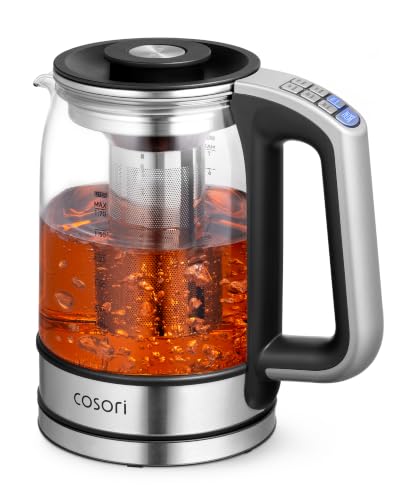
Across the class, design divides into three bodies. Glass kettles, represented here by the COSORI pattern, put the process on display: you see the water climb toward temperature, the leaf unfurl in the basket, the level fall across a morning. The cost is fragility and an honest view of your water’s mineral content. Single-wall stainless kettles are the durable middle: lighter, tougher, quieter about their interior state. Double-wall stainless, the Secura pattern, adds insulation that keeps the exterior calmer and the contents hot between boils, at the price of weight and of judging the level by a gauge. Bases across the class are variations on a theme — a swivel base, controls that range from a single dial to a labelled preset panel, and in the automatic tier, the Breville pattern, a mechanism that moves the basket for you. Setup everywhere is mercifully identical: rinse, boil a full load of plain water, discard it, and the kettle is ready. The models that complicate that ritual with apps or pairing routines are solving problems tea drinkers do not have.
Build quality shows in the details a spec sheet skips. A lid that opens wide enough for a hand and a cloth. A spout that pours in a stream you can aim, without the surge-and-glug of a badly shaped lip. A handle that stays comfortable when the body is full and hot. An infuser basket whose mesh is fine enough for small leaf, wide enough for oolongs to open, and removable without dripping across the counter. The class’s best models get all five right; its disappointments usually fail on two of them while advertising a sixth feature nobody asked for.
Performance in Real Use
Temperature Accuracy and Steadiness
The class’s core test is whether the water in the cup matches the button you pressed. In practice, good models across all tiers do this well when they are clean: the preset delivers water in the intended range and, crucially, does not overshoot to a rolling boil first and coast down, which would scorch delicate leaf in the first pour. Steadiness separates tiers more than the number of settings. A keep-warm hold that maintains temperature gently is worth more than degree-by-degree adjustment that hunts up and down. The enemy of all of it is scale: a coated sensor reads through mineral insulation and drifts, which is why this class’s real-world accuracy is partly a cleaning story, told in full in how to clean an electric tea kettle.
Water temperature is the whole reason this category exists, so it deserves plain numbers. These are the widely used brewing ranges taught by tea sellers and used by the preset buttons on the kettles above; treat them as starting points and adjust a few degrees at a time to your own leaf.
- Delicate and white teas: the coolest water of the main families, roughly the range a kettle labels for delicate or white tea. Water near boiling flattens their gentle flavour and can bring out a cooked taste.
- Green teas: hot but well short of boiling. Japanese greens usually want the cooler end of the green range, Chinese greens tolerate a little more heat. Boiling water on green leaf is the single most common cause of a harsh, bitter cup.
- Oolong teas: the middle ground, and the widest range, because oolongs themselves range from green-like to nearly black. Start mid-range for a lightly oxidised ball oolong and hotter for a dark, roasted one.
- Black teas and herbal infusions: full, freshly boiled water. These leaves and botanicals need the heat to extract properly, and holding back only produces a thin cup.
- French press coffee and pour over: just off the boil is the usual advice, which is why so many tea kettles include a coffee preset alongside the tea buttons.
If you only remember one rule, make it this one: the paler and more delicate the leaf, the cooler the water. A kettle with presets simply turns that rule into a button press, and a kettle without them turns it into a waiting game of boiling, resting and guessing.
Brewing Loose Leaf in the Basket
In-vessel brewing works best within its limits. A basket handles one or two drinkers’ worth of leaf beautifully, giving the leaves room if you resist overfilling, and keeping the pour clear when the mesh is fine and clean. It struggles at the extremes: a full family pot with a heaped basket restricts flow and under-extracts the centre, and very fine teas shed sediment through all but the finest mesh. The automatic tier removes the other variable — time — by lifting the basket when the steep ends, which matters most for the teas that punish over-steeping. Manual baskets ask you to be the timer, which most drinkers manage happily and forgetful drinkers genuinely do not.
Speed, Noise and the Morning Routine
Every model in the class boils faster than a stovetop kettle and frees you from watching it, thanks to automatic shut-off. Noise varies more than speed: glass kettles advertise the boil audibly, insulated steel muffles it, and households with sleeping babies or thin walls learn to care. The morning routine is where the class earns its counter space — presets remove decisions, keep-warm removes reboiling, and the cordless jug removes the trek between base and table. Judged as a routine rather than a gadget, a good tea kettle is one of the few small appliances that makes a daily ritual easier every single day instead of merely faster once.
Pouring and Handling
A kettle is a vessel of near-boiling water that you tilt over cups, and its handling deserves the same scrutiny as its electronics. Balanced weight when full, a handle clear of the hot body, a lid that stays shut during the pour and a spout that starts and stops cleanly — these are safety features wearing the clothes of convenience. The compact design tier, the Buydeem pattern, often pours beautifully at small volumes; the large family kettles demand two-handed respect at full load. None of this appears in feature lists, and all of it appears in daily satisfaction.
Strengths and Trade-Offs of the Class
Strengths
- Correct water temperature for each tea family, delivered by a labelled button rather than memory and guesswork.
- One-vessel loose-leaf brewing on infuser models, with one thing to wash instead of a pot, a strainer and a kettle.
- A calmer morning routine: presets, keep-warm and cordless pouring remove friction from a daily ritual.
Trade-offs
- Recurring upkeep: infusers clog and scale degrades the very accuracy the class sells.
- Complexity costs money now and longevity later; boards, sensors and motors are failures a basic kettle cannot have.
- Every capacity choice compromises somewhere: minimum fills waste water for solo cups, compact kettles strand you with guests.
How It Compares
| Rival | Where it wins | Where the tea kettle wins |
|---|---|---|
| Basic electric kettle | Price, simplicity, longevity | Temperature range, infuser, keep-warm |
| Gooseneck coffee kettle | Pour control for coffee | Capacity, infuser, tea presets |
| Stovetop kettle and teapot | Decades-long simplicity | Speed, shut-off, temperature control |
| Automatic tea maker | Hands-off steep timing | Price, size, simplicity within its own class |
The comparisons clarify the purchase: the tea kettle is the choice when tea, in variety, is the point. The electric kettles with temperature control overlap the class heavily on heating, and the smart kettles with temperature control add connected features most tea drinkers can skip without loss.
Who Should Buy It and Who Should Skip It
Buy into the class if your tea shelf holds more than one family of tea, if loose leaf is a habit rather than an occasion, or if two or more cups across a morning is your normal pattern. Buy with confidence at mid-range; go premium for automation or design, knowingly. Skip the class if one bagged tea is your whole tea life, if your counter cannot spare the footprint, or if maintenance honesty compels you to admit the descaler will stay unopened. The pre-purchase checklist is short: your teas, your volumes, your water hardness, your cleaning temperament. how to choose an electric tea kettle walks those four in order.
Setup, Care and Maintenance Essentials
Set up once, properly: rinse, boil and discard a full load, learn the minimum and maximum marks, and place the base where its cord stays out of walkways. Then maintain the two systems that define the class — the water path and the basket.
Scale is the white or grey mineral crust that hard water leaves on the element, the floor of the kettle and the mesh of the infuser. It slows the boil, flakes into cups, and makes temperature control less accurate, because the sensor is reading through an insulating layer of mineral. The fix is simple and cheap. Fill the kettle partway with equal parts water and plain white vinegar, or water with a spoonful of citric acid, bring it to a gentle heat, switch off and leave it to stand until the fizzing stops and the crust loosens. Pour the solution away, wipe any residue with a soft cloth, then boil a full kettle of fresh water and discard it — twice if the vinegar smell lingers. The infuser needs its own attention: steep it in the same warm descaling solution, then scrub the mesh gently with an old soft toothbrush, because clogged mesh slows the brew and holds the flavour of the last strong tea. How often depends on your water: monthly in a hard-water area, a few times a year where the water is soft. The fuller routine, including glass care and lid seals, is covered step by step in how to clean an electric tea kettle and the general method in how to descale an electric kettle.
An electric tea kettle is a litre or more of near-boiling water on a powered base, and it deserves the same respect as a pan on the stove. Fill between the minimum and maximum marks: below the minimum you risk boiling dry and stressing the element, above the maximum the water can surge out of the spout as it boils. Keep the kettle on its base on a stable, dry surface, route the cord so it cannot be caught by a passing sleeve, and pour slowly with the lid closed — most scalds from kettles happen during an impatient pour, not during the boil. Let the kettle cool before refilling it for a descale or a deep clean, never immerse the base or the kettle body in water, and keep the whole appliance out of the reach of small children, who see a shiny kettle at exactly their height on many counters. If a kettle ever boils dry, smells of hot plastic, or trips your electrics, unplug it and retire it rather than coaxing it along.
Final Verdict
The electric tea kettle is a specialised appliance that does its specialisation justice. Its presets fix the commonest error in home tea, its infusers simplify the commonest routine, and its compromises — cost, upkeep, complexity — are visible and manageable rather than hidden. For the households it suits, it is among the most satisfying small appliances in the kitchen. For the households it does not suit, the honest alternatives are a basic kettle and better leaves. The models, ranked and compared, are in electric tea kettle reviews, and the full buying walk-through is in electric tea kettle buying guide.
Electric Tea Kettle Review: How This Class Earned Its Place
The electric tea kettle is a young category with an old problem. For as long as tea has been brewed at home, the water has been the uncontrolled variable: boiled by default, rested by guesswork, poured by hope. Delicate teas suffered quietly and their drinkers blamed the leaf. The category emerged when two mature technologies — the fast electric kettle and the thermostat — became cheap enough to combine with a panel of labelled presets, and when loose-leaf tea’s popularity created households that drank three families of tea in a day. Its subsequent evolution has been refinement rather than reinvention: better baskets, double walls, an automatic tier that manages the steep itself. Reviewing the class today means reviewing a settled design at its maturity, which is a pleasant assignment: the compromises that remain are honest ones, visible in advance, and the best models have largely stopped making beginners’ mistakes.
Controls and Interfaces, Examined Closely
The interface is where a tea kettle’s philosophy shows. The preset panel, exemplified by the Cuisinart pattern, argues that tea knowledge should live in the appliance: buttons named for teas, pressed without thought, understood by guests. The variable dial argues for the expert user who thinks in temperatures and wants one fluid control. The automatic interface, the Breville pattern, argues that the machine should manage time as well as heat, and adds strength settings to prove it. Each philosophy serves its drinker, and each fails the others’ drinkers in predictable ways — panels feel limiting to tuners, dials feel cryptic to households, automation feels excessive to the twice-weekly brewer. A class-level review can only insist on the virtues all three should share: legibility at arm’s length, a control that cannot be knocked into the wrong mode by a passing hand, a ready signal you can hear from the next room but silence at midnight, and a display of current temperature where the design claims precision. Models that treat the interface as decoration age badly; models that treat it as the product age well.
The Keep-Warm Question
Keep-warm divides reviewers because it divides mornings. Technically it is simple: a thermostat holds the set temperature, reheating in small pulses rather than reboiling. Its defenders describe a transformed routine — water ready across a long morning, second cups without a second wait, tea-party hosting without kettle relays. Its critics note that water held hot for hours is water changing slowly, that the feature draws a small continuous power, and that many owners simply never engage it. Both are right, about different households. The review position is that keep-warm should be judged as a subscription to a pattern: valuable exactly in proportion to the staggered cups in your real morning, and inert otherwise. It should never headline a purchase for a boil-brew-finish drinker, and it should never be dismissed by anyone whose household drinks in relays.
Materials in Depth
Borosilicate glass, the COSORI pattern’s material, is chosen for thermal shock resistance and neutrality: it contributes nothing to the water and hides nothing from the drinker. Its weakness is mechanical, not chemical — it fears the knock, not the boil. Stainless steel trades visibility for toughness, and its grades and finishes decide how it ages: brushed exteriors forgive a busy kitchen, polished ones record it. The interior question matters more than the exterior one, and it is the Secura pattern’s whole argument: the fewer non-steel surfaces the water touches, the simpler the flavour and the cleaning story. Plastic appears in lids, handles, gauges and basket frames across the class, including in premium models; the honest review standard is not purity but placement — plastic out of the water path is unobjectionable, plastic in it is a question the listing should answer. Double-wall construction, finally, is insulation with two dividends, a calmer exterior and slower cooling, paid for in weight and in the loss of the water level at a glance.
The Small-Batch and Gongfu Corner
A class review owes a paragraph to the drinkers at its edge. Gongfu brewing — many short infusions from a small pot — asks a kettle for steadiness above all: water held near a chosen temperature across an hour of small pours. Preset kettles with a genuine hold serve this practice well as water engines, and their infusers and automation simply sit the session out. Matcha drinkers need controlled hot water in small amounts and judge kettles by minimum fill and pour control. Iced-tea households brew double-strength batches and judge by capacity and boil speed. The class serves all three minorities credibly, which speaks well of its core design: precise hot water, held politely, is a general-purpose good.
Durability: What Wears Out First
Longevity in this class is a story of small parts. Elements rarely die; they scale, slow, and are retired by owners who mistake the symptom for the disease. Sensors drift under the same mineral insulation. Lid hinges and seals accumulate the mechanical wear of a thousand mornings. Infuser mesh tears at the rim where it is handled. Control boards fail singly and finally. The pattern across all of it is that maintenance and design simplicity are the two longevity levers, and both are visible at purchase: a kettle that can be descaled easily will be, and a kettle with fewer mechanisms has fewer funerals to schedule. The class’s best-regarded models are not its most featured; they are the ones whose owners, years in, report the radical outcome that nothing has happened yet.
The Models That Define the Class
A class review should name its reference points. These four patterns define the current electric tea kettle landscape; the complete six-model roundup, with verdicts per household, is in electric tea kettle reviews.
Cuisinart PerfecTemp Tea Kettle
The Cuisinart PerfecTemp is the reference point for this category, the kettle most other tea kettles get compared against, because it built its name on the one feature tea drinkers actually need: labelled temperature presets for different teas instead of a single rolling boil. One-touch buttons for delicate, green, white, oolong, coffee and black or herbal teas take the guesswork out of water that is too hot for the leaf in your cup. A keep-warm function holds the chosen temperature while you finish a first cup, and a removable infuser basket on many configurations lets the kettle brew as well as heat. The stainless body feels substantial, the controls are legible without a manual, and the whole machine behaves like an appliance designed by people who drink several kinds of tea in one household.
Best for: readers who want the class’s reference design for mixed tea households
Not suited for: readers seeking automation or fine manual tuning
Strengths
- The preset panel as the class’s defining interface
- Steady keep-warm behaviour
- Durable steel execution
Trade-offs
- Fixed ranges define its ceiling
- No steep automation
- Premium tier
Tier: premium. Check price on Amazon.

Breville Smart Tea Infuser
The Breville Smart Tea Infuser is the automation play in this category. Rather than simply heating water and leaving the steeping to you, it manages the brew cycle itself: the basket lowers into the water at the set temperature and lifts when the steep time ends, so a forgotten pot does not turn bitter on the counter. Presets cover the main tea families, strength settings adjust the cycle, and a keep-warm hold keeps the finished tea ready for a second cup. It is the largest commitment of counter space and budget in this group, and it earns that footprint only in households that brew loose leaf daily and genuinely want the machine to watch the clock for them.
Best for: readers who want the class’s automation frontier
Not suited for: readers who prize simplicity and small footprints
Strengths
- Basket automation unique in this roundup
- Strength control over the finished brew
- The most complete tea appliance here
Trade-offs
- Size and parts count lead the class
- Premium tier leads the class too
- Demands the most cleaning discipline
Tier: premium. Check price on Amazon.

COSORI Electric Tea Kettle with Infuser
The COSORI tea kettle with infuser is the glass option most buyers land on, and the glass is the point: you can watch the water approach the boil, watch the leaf open, and see at a glance how much water remains. The borosilicate body pairs with a stainless infuser that drops into the pot for loose leaf brewing, and the base carries straightforward temperature control rather than a bare on-off switch. Glass asks for gentler handling than steel and shows scale sooner, which is either a flaw or a useful reminder to descale, depending on your temperament. For tea drinkers who brew visually and drink several types, it is the balanced middle of this category.
Best for: readers who want the glass expression of the class
Not suited for: readers whose counters punish fragile vessels
Strengths
- Visual brewing as a genuine feature
- Honest mid-range execution
- Infuser included and well judged
Trade-offs
- Fragility is inherent to the material
- Hard water writes on it visibly
- Basket caps the largest pots
Tier: mid-range. Check price on Amazon.
Secura Electric Tea Kettle
The Secura electric tea kettle built its following on construction: a stainless interior with no plastic touching the water, a double-wall body that stays calmer to the touch and holds heat longer between boils, and a cool-touch exterior that matters in busy kitchens. Tea drinkers who are particular about what their water contacts tend to shortlist it quickly. Temperature control and infuser arrangements vary across the Secura range, so the listing deserves a careful read, but the core promise is consistent: steel where the water lives, insulation where your hands live, and a kettle that feels engineered rather than decorated.
Best for: readers who judge the class by its water path
Not suited for: readers who brew by eye and by gauge-free instinct
Strengths
- All-steel interior as a design thesis
- Double-wall calm in use
- Heat retention between rounds
Trade-offs
- Hidden level and scale
- Weight at full load
- Range variation demands listing care
Tier: mid-range. Check price on Amazon.
Where Reviewers Disagree About This Class
Honest reviewing includes the disagreements. Reviewers split on degree-by-degree control: one camp calls it the mark of a serious kettle, the other notes that labelled presets cover every tea most households own and that fine adjustment mostly serves the pleasure of adjusting. They split on glass: beauty and honesty to one camp, a fragility tax to the other. They split hardest on automation, which one camp experiences as the category’s future and the other as a solution touring for a problem. This review’s position is that all three disputes are really one dispute about who the drinker is, and that the class is healthiest for containing all three answers at once. What reviewers do not dispute is the centre: temperature steadiness, a clean pour, an honest basket and a descale you will actually perform. Judge any individual review — including this one — by whether it keeps that centre in view.
The Class, Judged Tea by Tea
Black tea asks nothing of the class and receives competence. Herbal infusions ask for a full, honest boil and receive it. Green tea is the class’s proving ground, and the verdict is that presets have genuinely solved a problem that defeated generations of home brewers armed with kettles and patience. White tea extends the same verdict with less margin. Oolong, the widest family, rewards the kettles with the widest honest range and the roomiest baskets, and exposes token infusers without mercy. Matcha and small-pot practices use the class as a water engine and judge it on hold and minimum fill, where it acquits itself well. A category that serves its hardest customers — the delicate teas — while remaining harmless to its easiest has earned its place on the counter, which is this review’s conclusion as much as its premise.
Testing the Class Against Its Own Promises
A class review should end by auditing the category against the three promises its marketing makes most often. The first promise is better tea through temperature, and the class keeps it: the mechanism is real, the effect is repeatable, and the drinkers who benefit are exactly the drinkers the promise names. The second promise is effortlessness, and the class keeps it with an asterisk — the effort is not abolished but relocated, from the daily guesswork of water to the periodic discipline of descaling and basket care, which most households experience as a good trade and inattentive ones experience as a slow betrayal. The third promise is that one appliance can serve a household’s whole hot-water life, and the class keeps it for tea-led households while remaining, honourably, the second-best tool in coffee-led ones. Two promises kept and one kept with an asterisk is a strong audit for any appliance category, and it is why this review’s criticisms throughout have been about fit and upkeep rather than about the concept. The concept is sound. The execution, in the models that define the class, is mature. What remains for the buyer is the oldest task in reviewing’s audience: matching a good tool to the right hands.
Notes on Noise, Heat and the Physical Details
The physical life of the class deserves a final, consolidated note, because these are the properties that specifications omit and ownership reveals. Boil noise scales with scale: a clean kettle of any material is a civilised sound, a coated one is a kettle clearing its throat across the whole house, and reviewers who test only new appliances systematically underreport the noise of old ones. Exterior heat divides by construction exactly as the materials section described, with double-wall models earning their weight in busy kitchens every single day. Steam management is the sleeper detail: a kettle that vents steam away from its handle and from the hand that lifts the lid is a kettle designed by someone who has been mildly scalded and learned, and the class’s best models all show that education. Condensation under cupboards ruins more kitchen paint than any other small appliance, and the class’s answer is placement rather than engineering — a point a review can make once and owners ignore at their paintwork’s peril. None of these details will headline a listing. Together they are the difference between a kettle rated highly in its first week and one rated highly in its third year, and a class-level review exists precisely to keep the third year’s evidence in the room.
How This Review Scores the Class
Scored as a class rather than as products, the electric tea kettle earns its strongest marks for purpose: it identified a real, daily error in home tea making and engineered it away at a fair spread of prices. It earns strong marks for maturity: the reference designs are settled, the failure modes are known, and the maintenance bargain is stated plainly by the better makers. It earns its weakest marks for discipline-dependence, because its central virtue — accuracy — decays exactly as fast as its owner’s care does, and no design in the current class fully escapes that dependence. It earns a final, distinctive mark for honesty as a category: unlike many small appliances, it does not promise transformation. It promises that the water will be right, the basket will be ready and the second cup will be warm. In an appliance aisle fluent in exaggeration, a class that promises three things and delivers them deserves the reviewer’s respect and, for the households it fits, the buyer’s money.
The Class in the Wider Kitchen
No appliance is reviewed in a vacuum, and the tea kettle’s final context is the modern counter it shares. It competes for space and sockets with coffee machines that have grown larger and more theatrical every year, and its quiet claim — a modest footprint, a single job done precisely, a silhouette that does not shout — reads increasingly like a design philosophy rather than a limitation. It also sits at an interesting angle to the kitchen’s general drift toward connected everything: the class has largely declined to add applications, accounts and firmware to the act of boiling water, and this review counts that restraint among its virtues, while noting the smart kettles with temperature control exist for households that want them. A category that knows what it is, in an aisle of appliances auditioning to be platforms, has a coherence worth recording. The electric tea kettle heats water to the temperature your tea wants, brews it if you ask, holds it warm while the morning unfolds, and otherwise stays out of the way. Reviewed as a class, that restraint is not the absence of ambition. It is the ambition, correctly sized.
A Reviewer’s Confession: The Limits of Class Reviews
Class reviews, this one included, trade in patterns, and patterns flatten the individual quirks that decide real satisfaction: the exact resistance of one model’s button, the particular note of one kettle’s ready chime, the way one lid’s hinge feels in its second year. A reader should therefore treat this review as the map and the model-level roundup as the territory’s survey, and should treat both as subordinate to the evidence of their own kitchen — the shelf, the water, the counter, the household’s hands. What a class review can legitimately claim is narrower and more useful than omniscience: that the category’s centre is sound, that its compromises are known and priced in, and that its best current expressions share a recognisable set of virtues. On that narrower claim this review rests its verdict without reservation. The electric tea kettle is a mature, honest appliance class that makes a specific, daily difference to a specific, identifiable set of households — and in a market built on vague promises to everyone, specificity of that kind is the highest grade a reviewer honestly gives.
Final Notes From the Review Desk
Two small observations survive every section of this review and deserve the last word. The first is that the class’s best feature is invisible in its own marketing: not the presets, not the baskets, but the removal of a daily decision from households that make hundreds of them before breakfast. Appliances that subtract decisions age into indispensability in a way that appliances adding features rarely do, and the tea kettle’s quiet indispensability in the right kitchens is the deepest finding of this review. The second observation is about the drinkers rather than the devices. Tea has always rewarded attention disproportionately — small care, visibly better cups — and the electric tea kettle is best understood as attention, mechanised: the watching of temperature, the timing of the steep, the readiness of the second cup, all delegated to an appliance so the drinker’s attention can go where it belongs, which is the leaf and the moment. A class review can ask for no better summary of its subject than that, and this one does not try.
One Sentence for the Reader in a Hurry
If this entire review had to survive as a single sentence, it would be this: the electric tea kettle takes the one variable home brewers could never control — the temperature of the water at the moment it meets the leaf — and makes it the easiest part of making tea, and everything else in this long examination, from baskets to bases to the politics of descaling, is the story of what that one achievement costs and whom it serves.
Electric Tea Kettle: What Long-Term Use Reveals That a First Test Misses
Start with how a {p} holds up once the novelty wears off and routines settle in. Most coverage of a electric tea kettle concentrates on the first week of ownership, yet the decisions that matter most tend to surface later, once the electric tea kettle has to earn its place in an ordinary weekday routine rather than a carefully staged first attempt. Write down the three jobs you expect it to do most often, in the order you actually do them, and judge every claim you read against that short personal list instead of against a generic ideal.
Work through a realistic scenario, not a best case. Picture the busiest version of the job: more people to serve, less time than planned, ingredients or materials that are slightly out of the ordinary, and a clean-up waiting at the end. Ask how the electric tea kettle behaves at that upper edge, because a model that only shines on a small, simple load will disappoint precisely when you need it most. If the honest answer is that you would split the job into batches or fall back on an older method, factor that into the decision now rather than discovering it later.
Finally, plan the first fortnight deliberately. Use the electric tea kettle for one familiar job first, so you have a baseline you trust, then introduce the harder cases one at a time and note what changes. Small adjustments to arrangement, timing, quantity or preparation usually close most of the gap between disappointing first results and the performance the design is capable of. That short learning period is also the fairest test of long-term ownership: if the routine has not settled by the end of it, the mismatch is real, and it is better to know while returning or exchanging is still straightforward.
Measure before you commit. Note the footprint, the clearance above and behind the spot where the electric tea kettle will live, and the route you will carry it by when it is hot, full or awkward. A electric tea kettle that technically fits but blocks a cupboard door, crowds a neighbouring appliance or has to be dragged across a worktop every time will quietly fall out of use, whatever its merits on paper. In the Coffee & Tea category especially, a few centimetres of clearance and a sensible storage plan separate a daily tool from a bulky regret.
When you check listings such as Cuisinart PerfecTemp Tea Kettle, Breville Smart Tea Infuser and COSORI Electric Tea Kettle with Infuser, use them as worked examples: run through the same checks below on each one in turn, so the comparison stays honest and like for like rather than based on whichever listing happens to shout loudest.
Use a short decision checklist to finish. One, does it fit the space and the storage you really have. Two, does it handle your three most common jobs without a workaround. Three, do the edge cases you listed stay manageable. Four, can every wear part be cleaned or replaced without drama. Five, would you still choose it if a friend described the same drawbacks in their own kitchen. A electric tea kettle that passes all five is a sound buy; one that fails two or more is a compromise you are choosing with open eyes, which is a very different thing from being surprised later.
Maintenance decides how long the good results last. Set a simple rhythm: a quick wipe or rinse after each use, a deeper clean on a fixed day, and a periodic check of the parts that move, seal or bear weight. A electric tea kettle that needs fiddly disassembly for basic care will be cleaned less often, and performance drifts long before anything actually breaks. Prefer designs where the parts that get dirtiest are the parts that are easiest to reach, and be honest with yourself about which cleaning steps you will genuinely keep up.
Edge cases deserve a deliberate pass. Think about the odd shapes, the thicker or thinner than usual loads, the leftovers, the second helping and the guest with different preferences. A well-chosen electric tea kettle handles the exceptions gracefully, or at least predictably, while a poor match turns every exception into a workaround. List your two or three most common exceptions in advance and check, from the manual or the listing details, that nothing about them is ruled out by size, shape, material or care requirements.
Frequently Asked Questions
Is an electric tea kettle better than a regular kettle for tea?
For varied tea drinking, yes, and the reason is temperature. Green and white teas taste bitter and harsh in boiling water, and a regular kettle offers nothing between boiling and guesswork. A tea kettle’s presets deliver the right range at a button press, and infuser models also brew in the vessel. For black tea alone, a regular kettle loses nothing, which is why the honest answer depends entirely on your shelf.
What temperature should I use for green tea?
Hot but well short of boiling — the range your kettle’s green tea preset is built around. Japanese greens prefer the cooler end, Chinese greens tolerate slightly hotter water, and all of them punish a full boil with bitterness. If your kettle has no presets, boil, then let the water stand with the lid open for several minutes before pouring, and adjust by taste over a few sessions.
Do electric tea kettles with infusers make good tea?
Yes, within sensible limits. A clean, fine-mesh basket with room for the leaves to open brews one or two cups’ worth of loose leaf very well. The limits are scale: a heaped basket in a full pot under-extracts, and very fine teas shed some sediment. Keep the mesh clean and the basket un-crowded, and in-vessel brewing is a genuine convenience rather than a compromise.
How long do electric tea kettles last?
Years of daily use is a fair expectation from an established brand, provided scale is managed. The element rarely fails first; sensors, seals and control boards do, and hard water accelerates all of it. Simpler temperature-control models generally outlast automatic and feature-heavy ones, and descaling on schedule is the single most effective longevity habit an owner can keep.
Can I use an electric tea kettle for pour over coffee?
You can heat the water, and its temperature control suits coffee well, but the pour itself is the problem: a tea kettle’s spout is built for filling cups, not for the slow, thin stream pour over demands. Coffee-first households should look at the gooseneck kettles for pour over coffee; tea-first households who make the occasional press pot will find a tea kettle entirely sufficient.
Why does my tea kettle’s temperature seem inaccurate?
The usual cause is scale. Mineral coating insulates the temperature sensor and the element, so the kettle heats past or short of its setting and boils more slowly and noisily. A full descale — vinegar or citric acid soak, a gentle wipe, and fresh-water boils to rinse — normally restores both speed and accuracy. If a clean kettle still misses its settings badly, the sensor itself is failing and the kettle is nearing replacement.