Disclosure: As an Amazon Associate, topratedkitchenware.com earns from qualifying purchases. Links on this page are affiliate links; they cost you nothing extra. Prices and availability change often, so check the current Amazon listing before you buy.
These electric tea kettle reviews take the six models that define the current category and judge each on the work a tea kettle actually does: holding the right temperature for the leaf in front of it, brewing loose leaf without fuss where an infuser is fitted, pouring safely, and staying accurate after months of mornings. The single deep-dive on the category’s design sits in electric tea kettle review; this page is the comparative roundup, organised so that a household can find its own pattern — the multi-tea family, the solo loose-leaf drinker, the bagged-tea pragmatist — and read the verdict written for them. Every pick below is presented prose-first with its tier stated in words; check the current Amazon listing for the exact configuration before buying, because these kettles are sold in variants that share a name, and the infuser, finish and capacity in the box are what you will live with.
The short answer, before the detail: the Cuisinart PerfecTemp is the safest all-round recommendation for mixed tea households, the Breville Smart Tea Infuser is the one to buy when steep timing is your problem, and the COSORI is the glass kettle most visual brewers should start from. The Secura owns the all-steel argument, the Buydeem owns small counters and good taste, and the Hamilton Beach owns the honest budget. None of the six is the wrong kettle for its intended drinker, and each is the wrong kettle for someone — the verdicts below say who.
Key Takeaways
- Best overall for most households: the preset-led Cuisinart pattern — labelled temperatures, keep-warm, durable steel.
- Best for loose leaf without attention: the Breville’s automatic basket, which ends the steep for you.
- Best glass: the COSORI, for drinkers who brew by eye and accept the descaling visibility that comes with glass.
- Best budget: the Hamilton Beach, which does the fundamentals honestly for bag drinkers and starters.
- Every verdict below assumes descaling happens; an unmaintained kettle from any tier performs like a basic one.
How These Electric Tea Kettle Reviews Were Judged
Each kettle was assessed against the same five tests. Temperature behaviour: does it reach and hold the range its presets promise, without overshooting through delicate settings? Brewing: where an infuser is fitted, does the basket give leaves room, keep the pour clear, and remove without a drip trail? Handling: balance at full load, handle comfort, lid behaviour, spout control. Routine: how the kettle fits a real morning — minimum fill, keep-warm usefulness, noise. And ownership: cleaning burden, scale behaviour, and the simplicity or complexity of what might fail in year three. Tier labels are qualitative — entry, mid-range, premium — because what matters is the company a kettle keeps, not a number that changes with the season. The category framework behind these tests is set out in electric tea kettle buying guide.
In this guide
The Six Kettles, Reviewed
Cuisinart PerfecTemp Tea Kettle
The Cuisinart PerfecTemp is the reference point for this category, the kettle most other tea kettles get compared against, because it built its name on the one feature tea drinkers actually need: labelled temperature presets for different teas instead of a single rolling boil. One-touch buttons for delicate, green, white, oolong, coffee and black or herbal teas take the guesswork out of water that is too hot for the leaf in your cup. A keep-warm function holds the chosen temperature while you finish a first cup, and a removable infuser basket on many configurations lets the kettle brew as well as heat. The stainless body feels substantial, the controls are legible without a manual, and the whole machine behaves like an appliance designed by people who drink several kinds of tea in one household.
Best for: mixed households that want presets to simply work, cup after cup
Not suited for: degree-by-degree tuners and solo drinkers who need one button
Strengths
- Labelled presets map cleanly onto real tea families
- Keep-warm hold behaves steadily
- Substantial build that feels like a long-term appliance
Trade-offs
- No automation of the steep itself
- Premium tier without a design statement
- Fixed preset ranges rather than fine adjustment
Tier: premium. Check price on Amazon.

Breville Smart Tea Infuser
The Breville Smart Tea Infuser is the automation play in this category. Rather than simply heating water and leaving the steeping to you, it manages the brew cycle itself: the basket lowers into the water at the set temperature and lifts when the steep time ends, so a forgotten pot does not turn bitter on the counter. Presets cover the main tea families, strength settings adjust the cycle, and a keep-warm hold keeps the finished tea ready for a second cup. It is the largest commitment of counter space and budget in this group, and it earns that footprint only in households that brew loose leaf daily and genuinely want the machine to watch the clock for them.
Best for: loose-leaf households that brew daily and walk away mid-steep
Not suited for: small kitchens, occasional brewers, and anyone counting parts to clean
Strengths
- Automatic basket ends the steep on schedule
- Strength settings give real control over the cup
- Keep-warm holds finished tea ready
Trade-offs
- The largest footprint and the most cleaning
- Premium tier, full stop
- Mechanism is one more thing to maintain
Tier: premium. Check price on Amazon.

COSORI Electric Tea Kettle with Infuser
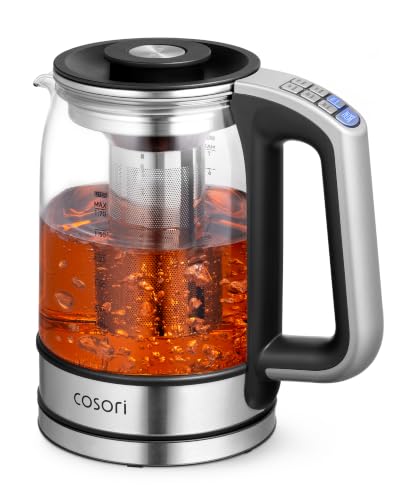
The COSORI tea kettle with infuser is the glass option most buyers land on, and the glass is the point: you can watch the water approach the boil, watch the leaf open, and see at a glance how much water remains. The borosilicate body pairs with a stainless infuser that drops into the pot for loose leaf brewing, and the base carries straightforward temperature control rather than a bare on-off switch. Glass asks for gentler handling than steel and shows scale sooner, which is either a flaw or a useful reminder to descale, depending on your temperament. For tea drinkers who brew visually and drink several types, it is the balanced middle of this category.
Best for: visual brewers and mixed drinkers who want glass with an infuser included
Not suited for: busy family counters where glass will be tested daily
Strengths
- Brewing you can watch, from boil to leaf
- Stainless infuser handles loose leaf well
- Mid-range tier with honest controls
Trade-offs
- Scale announces itself in hard water
- Glass demands gentle handling
- Basket space limits very large pots
Tier: mid-range. Check price on Amazon.

Hamilton Beach Electric Tea Kettle
The Hamilton Beach tea kettle is the honest entry point: an affordable electric kettle from a brand that has made countertop basics for decades, aimed at drinkers who want hot water fast and a simple steep without paying for automation. Expect the fundamentals done competently — quick boiling, an auto shut-off when the water is ready or the kettle runs dry, a cordless pour from a swivel base — with temperature finesse varying by configuration. It suits the tea-bag drinker, the office kitchen, and the first apartment far better than the loose-leaf perfectionist, and it is honest about that trade. As a second kettle or a starter, it makes a great deal of sense.
Best for: starter kitchens, offices and bag drinkers who want speed and simplicity
Not suited for: green-tea drinkers who need trustworthy cool presets daily
Strengths
- Fast, competent boiling with auto shut-off
- Cordless pour from a swivel base
- Entry tier that respects a budget
Trade-offs
- Temperature finesse varies by configuration
- Not designed around loose leaf
- Basic materials and finish
Tier: entry. Check price on Amazon.
Secura Electric Tea Kettle
The Secura electric tea kettle built its following on construction: a stainless interior with no plastic touching the water, a double-wall body that stays calmer to the touch and holds heat longer between boils, and a cool-touch exterior that matters in busy kitchens. Tea drinkers who are particular about what their water contacts tend to shortlist it quickly. Temperature control and infuser arrangements vary across the Secura range, so the listing deserves a careful read, but the core promise is consistent: steel where the water lives, insulation where your hands live, and a kettle that feels engineered rather than decorated.
Best for: drinkers who want steel inside and out and a calmer kettle to handle
Not suited for: brewers who judge water and level by eye
Strengths
- Stainless interior, nothing plastic in the water path
- Double wall holds heat between boils
- Exterior stays calmer in a busy kitchen
Trade-offs
- Level and scale hide behind the gauge
- Heavier at full load
- Range varies — verify the listing’s features
Tier: mid-range. Check price on Amazon.

Buydeem Electric Kettle
The Buydeem electric kettle is the design-led option, a kettle bought as much for how it looks on the counter as for how it brews. The retro styling, colour finishes and compact footprint target smaller kitchens and desks, while the feature set underneath — temperature settings suited to tea, an infuser on tea-focused configurations, and a keep-warm hold — keeps it a working tea appliance rather than a ornament. It will not out-capacity the big family kettles, and it does not try to. For a single drinker or a couple who brew a pot in the morning and another in the evening, it is the kettle most likely to be left out on display instead of hidden in a cupboard.
Best for: one or two drinkers with a small counter and an eye for design
Not suited for: families and hosts brewing pot after pot
Strengths
- Compact, handsome and happy left on display
- Tea settings and infuser on tea configurations
- Keep-warm suits a two-pot day
Trade-offs
- Capacity is the standing compromise
- Premium tier for its size
- Style finishes reward gentle cleaning
Tier: premium. Check price on Amazon.
Head to Head: What Actually Separates Them
Strip away styling and the six divide along two axes. The first is who manages the steep: you, with a manual basket or a separate pot — Cuisinart, COSORI, Secura, Buydeem and Hamilton Beach all leave the timing to you, in descending order of temperature help — or the machine, which is the Breville alone. The second axis is what you watch: glass drinkers monitor water and leaf directly, steel drinkers trust presets and gauges. Neither axis has a wrong side. The mistakes happen when a household buys across its own pattern: automation for a twice-weekly brewer, a compact design kettle for a family of five, a basic boiler for a daily sencha drinker. The electric tea kettle pros and cons page weighs those category-level costs and benefits in full.
Which One Fits Your Routine?
You Drink a Little of Everything
Start with the Cuisinart pattern and stop shopping. Labelled presets, a keep-warm hold and a durable body cover a rotating shelf without automation you may not need. Add the COSORI instead if your household brews by eye and wants the glass.
You Brew Loose Leaf and Lose Track of Time
The Breville is the only kettle here that solves your actual problem. Its premium buys back every over-steeped pot you currently pour away, and its size is the price of the mechanism. No manual basket substitutes for it.
You Want the Water Pure and the Kettle Calm
The Secura’s all-steel water path and double wall answer a specific, reasonable preference. Accept the hidden water level as the trade, and descale on schedule since you cannot see the scale arrive.
You Are Setting Up a First Kitchen
The Hamilton Beach now, better leaves with the savings, and an upgrade in a few years when you know which teas you actually drink. That sequence beats buying a premium kettle for a habit that has not formed yet.
Care Notes That Apply to All Six
Every kettle in this roundup shares the same two maintenance facts. Scale degrades temperature accuracy and boil speed, and infuser mesh clogs with leaf and oil until the brew slows and flavours blur. The routine that prevents both is short and identical across brands.
Scale is the white or grey mineral crust that hard water leaves on the element, the floor of the kettle and the mesh of the infuser. It slows the boil, flakes into cups, and makes temperature control less accurate, because the sensor is reading through an insulating layer of mineral. The fix is simple and cheap. Fill the kettle partway with equal parts water and plain white vinegar, or water with a spoonful of citric acid, bring it to a gentle heat, switch off and leave it to stand until the fizzing stops and the crust loosens. Pour the solution away, wipe any residue with a soft cloth, then boil a full kettle of fresh water and discard it — twice if the vinegar smell lingers. The infuser needs its own attention: steep it in the same warm descaling solution, then scrub the mesh gently with an old soft toothbrush, because clogged mesh slows the brew and holds the flavour of the last strong tea. How often depends on your water: monthly in a hard-water area, a few times a year where the water is soft. The fuller routine, including glass care and lid seals, is covered step by step in how to clean an electric tea kettle and the general method in how to descale an electric kettle.
An electric tea kettle is a litre or more of near-boiling water on a powered base, and it deserves the same respect as a pan on the stove. Fill between the minimum and maximum marks: below the minimum you risk boiling dry and stressing the element, above the maximum the water can surge out of the spout as it boils. Keep the kettle on its base on a stable, dry surface, route the cord so it cannot be caught by a passing sleeve, and pour slowly with the lid closed — most scalds from kettles happen during an impatient pour, not during the boil. Let the kettle cool before refilling it for a descale or a deep clean, never immerse the base or the kettle body in water, and keep the whole appliance out of the reach of small children, who see a shiny kettle at exactly their height on many counters. If a kettle ever boils dry, smells of hot plastic, or trips your electrics, unplug it and retire it rather than coaxing it along.
The Bottom Line of These Reviews
There is no single winner here because there is no single tea drinker. There is a best kettle for the mixed household, for the forgetful loose-leaf brewer, for the glass lover, for the steel purist, for the small counter and for the first kitchen — and the six above map to those six drinkers cleanly. Choose by your routine, maintain what you buy, and any of them will make better tea than the boiling-and-guessing they replace. For the value question argued profile by profile, see is an electric tea kettle worth it.
Living With Each Kettle: The Second Read
First impressions rank kettles by their buttons; second impressions rank them by their Tuesdays. This section revisits each of the six with the questions owners ask after the novelty fades: what does it do to a routine, what does it ask in return, and which small behaviour grows either fonder or more irritating with repetition.
Cuisinart PerfecTemp in Daily Life
The PerfecTemp’s daily gift is the absence of thought. The preset panel becomes muscle memory within a week, and the kettle’s substantial feel makes it the appliance nobody in the house treats carelessly. Its keep-warm quietly reorganises staggered mornings. What grows irritating, for some, is exactly its virtue: the presets are the presets, and the drinker who falls for one unusual leaf that wants an in-between temperature will work around the panel with a thermometer or a compromise. Owners who descale on schedule report the steadiest long-term accuracy in this roundup’s steel contingent; owners who do not, discover the drift this category is famous for and blame the buttons.
Breville Smart Tea Infuser in Daily Life
The Breville reorganises the drinker’s role from brewer to supervisor, and the adjustment is emotional as much as practical: some drinkers love handing over the steep, others miss the ritual and start standing over a machine that does not need them. Its basket cycle is the roundup’s best answer to the interrupted morning. The costs are rhythm costs — more parts through the sink, a footprint that anchors a counter corner, a presence that small kitchens feel daily. In the right household it is the most loved kettle here; in the wrong one it is the most resented, and the difference is entirely how often the automation is used.
COSORI Tea Kettle With Infuser in Daily Life
The COSORI teaches its owner their own water. The glass makes scale a visible diary entry rather than a surprise, and most owners settle into a descale rhythm without resentment because the kettle asked politely and early. Watching the leaf open becomes part of the pleasure for visual brewers, and the clear pour rewards a clean basket. The daily cautions are physical: this is the kettle that gets moved gently, filled carefully and given the calm corner of the counter. Households that grant it those terms report a kettle that feels more like glassware they love than an appliance they tolerate.
Hamilton Beach Tea Kettle in Daily Life
The Hamilton Beach disappears into service, which is the entry tier’s entire ambition. It boils, it pours, it asks for a descale now and then, and it never once demands to be understood. Its daily limitation appears only when the household’s tea life outgrows it — the first green tea phase, the first loose-leaf gift — at which point it retires gracefully to office, spare-room or student duty. As a measure of value, a kettle that serves years at the basics and then serves years more elsewhere has little to apologise for.
Secura Electric Tea Kettle in Daily Life
The Secura’s daily character is calm: a body that does not shout its heat, water that stays hot between rounds, an interior its owner never has to think about. The gauge replaces the glance, and owners adapt within days. Its weight at full load is the recurring note — a kettle to fill at the sink with intention rather than to wave under the tap. For drinkers whose priority list begins with what touches the water, no other kettle in this roundup settles the question as completely.
Buydeem Electric Kettle in Daily Life
The Buydeem is the kettle most likely to be complimented by visitors and the one whose owner most often uses the word ‘mine’ about an appliance. Its small scale suits the two-pot day perfectly and its looks earn its counter place in small kitchens where everything visible must justify itself aesthetically as well as functionally. The capacity ceiling is a known, accepted term rather than a discovered flaw — this is a kettle bought by drinkers who counted their servings first. Its finishes reward the gentle cloth and punish the scourer, which owners of design objects already know in their hands.
Value Across the Tiers, Stated Plainly
Spread across years of daily use, the difference between tiers shrinks to the cost of a few bags of good tea, which cuts both ways: premium buyers should not agonise, and entry buyers should not feel they have bought a lesser morning. The honest value map of this roundup is that the mid-range captures most of the category’s functional worth, the premium tiers sell specific capabilities — automation, design, all-steel construction — rather than general betterness, and the entry tier sells freedom from deliberation. Choose the capability, not the altitude.
Extended Head-to-Heads
Cuisinart PerfecTemp vs Breville Smart Tea Infuser
This is the roundup’s central contest, because both kettles court the serious household and part on one question: who manages the steep? The Cuisinart hands you perfect water and trusts you with the leaves; the Breville takes the leaves too, and charges size, money and cleaning for the custody. Choose the Cuisinart if your household stays within earshot of its tea and drinks widely across the preset panel. Choose the Breville if your household’s recurring failure is the forgotten pot. Neither answer shames the other kettle; they are the same seriousness pointed at different weaknesses — knowledge in one case, attention in the other.
COSORI vs Secura: Glass Honesty or Steel Calm
The mid-range contest is material philosophy. The COSORI shows you everything — water, leaf, scale — and asks for gentle hands in exchange for total information. The Secura hides everything behind steel and insulation and asks for calendar discipline in exchange for calm. Hard water argues for the COSORI’s early warnings or the Secura’s unruffled surface, depending on whether you are a person who responds to reminders or to routines. Busy family counters argue for the Secura; contemplative solo brewing argues for the COSORI. The teas themselves are indifferent, which is exactly why the choice belongs to the kitchen rather than the cupboard.
Buydeem vs Hamilton Beach: The Small-Budget Fork
These two never compete on features, and that is the point. The Hamilton Beach spends everything on function and nothing on ceremony; the Buydeem spends on design and compactness and keeps the tea features that matter for one or two drinkers. A first flat on a strict budget should take the Hamilton Beach and better leaves. A small flat that is also a settled home, where the kettle will be seen and used daily for years, can justify the Buydeem as the rare appliance that pays rent in pleasure as well as tea. The fork is not about money alone; it is about whether the kettle is equipment or furniture in your household’s mind.
Ownership Costs Across the Six
Beyond their tiers, the six divide by what they charge in upkeep. The Breville charges most: the largest cleaning surface, the mechanism to keep dry and honest, the basket whose schedule matters most. The glass COSORI charges in vigilance — gentle handling, visible scale, prompt descaling. The steel kettles charge in faith: descale on schedule without visual evidence, and check by taste and speed. The Hamilton Beach charges least of all, asking only the basic descale every kettle on earth requires. None of these charges is hidden, and this review’s consistent advice is to read them as part of the price, because a kettle whose upkeep you resent becomes, within a year, the roundup’s worst performer regardless of its badge.
If We Could Only Keep Two
Forced to reduce the roundup to a pair that covers the widest range of real households, the keepers are the Cuisinart PerfecTemp and the COSORI. Between them they cover the preset-led steel pattern and the glass infuser pattern, the family round and the visual brew, at tiers that stop short of the steepest premium. The Breville leaves with genuine regret — it is the only kettle here that does something no other can — and households recognised in its profile should overrule this exercise and keep it instead. The exercise’s real lesson is that two patterns cover most of the tea-drinking world, and the other four exist for the households at its edges, who know exactly who they are.
How Each Kettle Handles the Hard Cases
Roundups are usually written at the average; ownership happens at the extremes. This section runs all six kettles through the four hardest cases in a tea kettle’s life and records who copes and who complains.
The Delicate Tea Test
A prized white tea, brewed on a quiet morning, is the strictest audit of temperature steadiness. The preset-led Cuisinart and the automatic Breville pass with the least drinker effort, the Breville adding the insurance of a managed steep. The COSORI passes in the hands of a drinker who watches the glass and lifts the basket on time. The Secura passes on its presets where fitted and asks the drinker to trust rather than verify. The Buydeem passes at its scale, for a cup or two. The Hamilton Beach, in its basic configurations, is the honest failure of this test — it was not built for it, and this review declines to pretend otherwise.
The Full-House Test
Six people, one breakfast, no patience. Capacity and boil speed take the marks, keep-warm becomes the difference between service and relay races, and compact kettles are excused from a test they never entered. The family-scale steel kettles carry this case; the Breville carries it at the price of its full cycle; the Buydeem and the smaller glass configurations serve the table in two rounds and should be forgiven for it, because their households bought them for the other three hundred mornings of the year.
The Hard-Water Month
Thirty days of hard water without a descale is the ownership stress test. The COSORI reports its condition honestly and earliest, which this review counts as a virtue disguised as an eyesore. The steel kettles keep their counsel and their slowing boils, and their owners learn to read speed and noise as instruments. The Breville’s mechanism is the most exposed to neglect and the most rewarding of diligence. The lesson the month teaches is the roundup’s refrain: in hard water, the best kettle is the one whose maintenance you will actually perform, and every verdict in this article silently assumes its reader has chosen accordingly.
The Forgotten Pot Test
One test has a single winner by design. Start a pot, answer the door, take a phone call, return in twenty minutes. Five of these kettles present you with the consequences of your absence, mitigated only by how gracefully their teas over-steep. The Breville presents you with tea. This review has distributed its praise widely and deliberately, but it will not blur this point: for the household whose life reliably interrupts its brewing, the automatic kettle is not a luxury variant of the others. It is a different answer to a different problem, and it should be bought or rejected on that basis alone.
Reviewing the Review: What Would Change These Verdicts
Verdicts should state their conditions. These six would reorder if a household’s water were soft enough to make descaling a rumour, because the glass kettle’s main tax would fall away. They would reorder if steep timing ceased to matter — a household that drinks only robust teas gains nothing from automation and should demote the Breville accordingly. They would reorder in a studio flat, where the Buydeem’s footprint outranks every capacity argument, and in a six-person house, where the same kettle exits the list. The verdicts are stable for the households they name and openly conditional beyond them, which is the most any roundup can honestly offer: not a league table for the world, but a set of well-lit paths from a routine to a kettle.
What a Second Year Does to These Verdicts
Reviews are written in the first season of ownership, and this roundup closes by projecting its six kettles into their second year, when novelty has burned off and only behaviour remains. The Cuisinart’s verdict strengthens with time, because its virtues are the daily kind and its vices are the kind that stay politely in the specification sheet. The Breville’s verdict polarises: households that use the automation weekly love it more each season, households that drifted back to manual habits feel its size more each season, and no middle verdict survives contact with year two. The COSORI’s verdict depends on a single physical fact — whether the glass survives the household — and on the owner’s settled peace with visible scale. The Hamilton Beach’s verdict quietly improves, because an entry kettle still boiling honestly in year two has outperformed its tier’s expectations. The Secura’s verdict tracks its owner’s descaling faithfulness with unusual fidelity. The Buydeem’s verdict tracks something rarer in appliance reviewing: whether its owner still enjoys looking at it, which, in the households that chose it well, they report they do. A roundup that cannot imagine its products old is only half a review; these six, imagined old, keep the order this article gave them — for the households each was matched to, which was always the condition.
The Roundup’s One-Paragraph Answer
For the reader who arrived for a name: buy the Cuisinart PerfecTemp if your household drinks widely and wants presets to simply work; buy the Breville Smart Tea Infuser if your pots keep dying of neglect; buy the COSORI if you brew by eye and want glass with its infuser included; buy the Secura if what touches your water matters most; buy the Buydeem if two cups and a beautiful small counter are your whole brief; buy the Hamilton Beach if your tea comes in bags and your budget has better places to go. Maintain whichever you choose as if its accuracy depended on it, because it does. That paragraph, plus the descaling schedule, is the entire practical content of this roundup — the preceding pages exist to show the working, and to make sure the name you pick from the paragraph is the one your household would have picked from the evidence.
The Six, Scored by the Mornings They Create
Close the roundup with the only scoring that survives a year of ownership: the character of the morning each kettle creates. The Cuisinart morning is competent and unremarkable, which is praise — tea appears correctly, repeatedly, without the appliance entering consciousness. The Breville morning is delegated; the drinker wakes to a machine already mid-task and feels, depending on temperament, either served or supervised. The COSORI morning is visual and unhurried, a small ceremony of watching water and leaf do their work in the open. The Hamilton Beach morning is fast and forgettable, tea as fuel, honestly delivered. The Secura morning is calm, the kettle’s exterior cool to a passing hand, the water inside holding its heat like a kept secret. The Buydeem morning is the most aesthetic of the six, tea made inside an object the household chose to look at. None of these mornings is the best morning; each is the best morning for somebody, and the roundup’s six verdicts, pursued through tiers and tests and hard cases, resolve in the end to that single sentence. Choose the morning you want to have, maintain the kettle that makes it, and the rest of the article becomes what it was always meant to be: the evidence, kept on file, for a decision your routine had already made.
After the Roundup: How to Argue With These Verdicts
A good roundup should teach its readers how to overrule it, so here is the method. Take the verdict you doubt and find the assumption underneath it: every judgement in this article rests on a stated household pattern, a stated water type, or a stated habit. Change the assumption to your own facts and the verdict is yours to rebuild — demote the Breville if your pots are never forgotten, promote the COSORI if your water is soft and your counter calm, promote the Buydeem if your household is one person and a window ledge, demote the Cuisinart if your shelf is a single beloved oolong that wants one exact temperature daily. What you may not honestly do is keep a verdict while discarding its assumption, because that is how roundups mislead: not by erring, but by being read as universal when they were written as conditional. These six kettles, judged conditionally and maintained properly, will each make one household’s tea better every single day. The roundup’s work was to say which household. The reader’s work — the pleasant work — is to recognise their own.
A Note on Finishes, Variants and Reading the Box
The roundup’s last practical word concerns the gap between a model’s name and the object in the box. Every kettle in this article is sold in variants — finishes that photograph alike, capacities that share a silhouette, regional versions whose panels differ in the small print — and a verdict earned by one configuration does not automatically transfer to its cousins. The infuser is the variant that matters most: included in one listing, absent in another, different in mesh in a third. Before any purchase from this roundup, perform the thirty-second audit the buying guide teaches: confirm the infuser, confirm the temperature system, confirm the capacity and minimum fill, in the maker’s own description of the exact item in the cart. Reviewers review patterns; households live with objects. That audit is the bridge between the two, and it is the cheapest insurance in the entire category.
The Roundup’s Debts: What It Could Not Test
Honesty about method closes this roundup. A comparative review can judge design, behaviour and the logic of each kettle’s compromises, but it cannot live six parallel lives for three years, and the verdicts that matter most in year three — the seal that perished, the board that failed, the basket that tore — arrive on a schedule no review can accelerate. What this article has done instead is weight the predictors: simplicity where longevity hides, maintenance where accuracy lives, and the maker’s reputation for standing behind small parts. Readers should hold the verdicts with the confidence those predictors deserve — high on pattern, provisional on any individual unit — and should treat the first-week test described in the choosing guide as the final, personal round of this roundup, run in the only laboratory whose results are guaranteed to apply: their own kitchen.
The Reviewer’s Own Shortlist, If Forced to One
Every roundup reader eventually asks the reviewer to stop distributing praise and commit. Committed, then, with the conditions stated one final time: for a household that drinks across the tea shelf and wants one kettle to serve a decade of mornings, the Cuisinart PerfecTemp is the single name this article would defend in an argument — not because it wins every test, but because it loses none of them badly, and kettles, like the mornings they serve, are won on the absence of bad days rather than the presence of brilliant ones.
Electric Tea Kettle: What Long-Term Use Reveals That a First Test Misses
Start with how a {p} holds up once the novelty wears off and routines settle in. Most coverage of a electric tea kettle concentrates on the first week of ownership, yet the decisions that matter most tend to surface later, once the electric tea kettle has to earn its place in an ordinary weekday routine rather than a carefully staged first attempt. Write down the three jobs you expect it to do most often, in the order you actually do them, and judge every claim you read against that short personal list instead of against a generic ideal.
Measure before you commit. Note the footprint, the clearance above and behind the spot where the electric tea kettle will live, and the route you will carry it by when it is hot, full or awkward. A electric tea kettle that technically fits but blocks a cupboard door, crowds a neighbouring appliance or has to be dragged across a worktop every time will quietly fall out of use, whatever its merits on paper. In the Coffee & Tea category especially, a few centimetres of clearance and a sensible storage plan separate a daily tool from a bulky regret.
Troubleshooting is easier when you expect the usual failure points. With any electric tea kettle, the recurring problems tend to cluster in the same places: uneven results from overloading or poor arrangement, wear showing first on the parts handled most often, and small annoyances with lids, seals, handles, controls or fittings that only appear after repeated use. Before buying, look for whether those wear parts can be cleaned properly, replaced or worked around, and whether the instructions address them directly rather than pretending they never happen.
Edge cases deserve a deliberate pass. Think about the odd shapes, the thicker or thinner than usual loads, the leftovers, the second helping and the guest with different preferences. A well-chosen electric tea kettle handles the exceptions gracefully, or at least predictably, while a poor match turns every exception into a workaround. List your two or three most common exceptions in advance and check, from the manual or the listing details, that nothing about them is ruled out by size, shape, material or care requirements.
When you check listings such as Cuisinart PerfecTemp Tea Kettle, Breville Smart Tea Infuser and COSORI Electric Tea Kettle with Infuser, use them as worked examples: run through the same checks below on each one in turn, so the comparison stays honest and like for like rather than based on whichever listing happens to shout loudest.
Maintenance decides how long the good results last. Set a simple rhythm: a quick wipe or rinse after each use, a deeper clean on a fixed day, and a periodic check of the parts that move, seal or bear weight. A electric tea kettle that needs fiddly disassembly for basic care will be cleaned less often, and performance drifts long before anything actually breaks. Prefer designs where the parts that get dirtiest are the parts that are easiest to reach, and be honest with yourself about which cleaning steps you will genuinely keep up.
Use a short decision checklist to finish. One, does it fit the space and the storage you really have. Two, does it handle your three most common jobs without a workaround. Three, do the edge cases you listed stay manageable. Four, can every wear part be cleaned or replaced without drama. Five, would you still choose it if a friend described the same drawbacks in their own kitchen. A electric tea kettle that passes all five is a sound buy; one that fails two or more is a compromise you are choosing with open eyes, which is a very different thing from being surprised later.
Work through a realistic scenario, not a best case. Picture the busiest version of the job: more people to serve, less time than planned, ingredients or materials that are slightly out of the ordinary, and a clean-up waiting at the end. Ask how the electric tea kettle behaves at that upper edge, because a model that only shines on a small, simple load will disappoint precisely when you need it most. If the honest answer is that you would split the job into batches or fall back on an older method, factor that into the decision now rather than discovering it later.
Frequently Asked Questions
Which electric tea kettle is best for most people?
The preset-led stainless pattern represented here by the Cuisinart PerfecTemp suits the widest range of households: labelled temperatures for the main tea families, a keep-warm hold, and a durable build, without automation to maintain. Households that brew loose leaf and walk away should step up to the automatic Breville pattern instead, and glass lovers should start with the COSORI.
Are expensive electric tea kettles actually better?
They are better at specific things: automation of the steep, finer temperature adjustment, heavier build and design. They do not heat water more honestly than a good mid-range kettle, and a premium badge cannot rescue stale leaf or hard, un-descaled water. Spend premium money only on the specific capability — usually the automatic basket — that your routine will use daily.
Which electric tea kettle is best for green tea?
Any model whose presets include a trustworthy green tea setting and whose temperature holds steady without overshooting. The preset-led and glass models in this roundup both serve green tea drinkers well. The pattern to avoid is a boil-only kettle, which forces you to boil, wait and guess — the routine that produces most of the bitter green tea made at home.
Glass or stainless: which do reviewers recommend?
Reviewers recommend by household, not by material. Glass suits drinkers who brew visually and want scale visible early; it asks for a calmer counter. Stainless suits busy households, hides scale, and in double-wall form keeps the outside calmer and the water hotter. Both make excellent tea when maintained; the wrong choice is the one that fights your kitchen’s daily reality.
Do I need an automatic tea maker, or is a kettle with an infuser enough?
A kettle with an infuser is enough for drinkers who stay near their tea while it steeps, which is most drinkers most of the time. Automation earns its premium for one profile: the brewer who regularly starts a pot and gets pulled away, returning to over-steeped tea. If that is your weekly experience, the automatic basket pays for itself in rescued pots; if not, it is size and complexity without a job.
How do these kettles handle hard water?
All of them scale; they differ in how visibly. Glass shows the crust early, prompting timely descaling. Steel hides it, so accuracy drifts quietly until the tea tastes off. Whichever you choose, a monthly vinegar or citric acid descale in a hard-water area — including a soak and brush for the infuser — keeps any of these six performing as reviewed.