Disclosure: As an Amazon Associate, topratedkitchenware.com earns from qualifying purchases. Links on this page are affiliate links; they cost you nothing extra. Prices and availability change often, so check the current Amazon listing before you buy.
Learning how to choose an electric tea kettle starts with a liberating fact: the decision is smaller than the marketing suggests. Strip away finishes and feature lists and an electric tea kettle asks you five real questions — what teas you drink, whether you brew in the kettle or a pot, how much water your routine actually needs, what your water does to appliances, and how much machinery you want to maintain. Answer those five honestly and the shortlist shrinks to two or three models, at which point the electric tea kettle buying guide can finish the job. This guide walks the questions as steps, in the order that eliminates the most kettles earliest, and ends with three worked examples of buyers whose right answers are completely different kettles.
Key Takeaways
- Your tea shelf chooses the temperature system: varied teas need presets, one black tea needs almost none.
- The infuser decision is really a washing-up decision: brew in the kettle and clean a basket, or brew in a pot and clean a pot.
- Size to your daily round and check the minimum fill; both numbers matter more than the headline capacity.
- Hard water argues for visible scale (glass) or disciplined descaling (steel) — pick the reminder system you will obey.
- Automation is worth its size and cost only for drinkers who regularly lose track of a steep.
What You Need to Know Before Comparing
Three pieces of background make every later step easier. First, why temperature matters at all: tea families genuinely want different water, and the gap between a scorched green tea and a properly heated one is the whole reason this category exists.
Water temperature is the whole reason this category exists, so it deserves plain numbers. These are the widely used brewing ranges taught by tea sellers and used by the preset buttons on the kettles above; treat them as starting points and adjust a few degrees at a time to your own leaf.
- Delicate and white teas: the coolest water of the main families, roughly the range a kettle labels for delicate or white tea. Water near boiling flattens their gentle flavour and can bring out a cooked taste.
- Green teas: hot but well short of boiling. Japanese greens usually want the cooler end of the green range, Chinese greens tolerate a little more heat. Boiling water on green leaf is the single most common cause of a harsh, bitter cup.
- Oolong teas: the middle ground, and the widest range, because oolongs themselves range from green-like to nearly black. Start mid-range for a lightly oxidised ball oolong and hotter for a dark, roasted one.
- Black teas and herbal infusions: full, freshly boiled water. These leaves and botanicals need the heat to extract properly, and holding back only produces a thin cup.
- French press coffee and pour over: just off the boil is the usual advice, which is why so many tea kettles include a coffee preset alongside the tea buttons.
If you only remember one rule, make it this one: the paler and more delicate the leaf, the cooler the water. A kettle with presets simply turns that rule into a button press, and a kettle without them turns it into a waiting game of boiling, resting and guessing.
Second, how this category differs from its neighbours, because choosing the wrong category is the costliest mistake available. A general electric kettle boils only; it is the right tool for a black-tea household and the wrong one for a green-tea shelf. A gooseneck coffee kettle controls a pour for coffee and makes an awkward, small tea kettle. An automatic tea maker is this category’s premium tier, not a separate species. Third, the vocabulary of listings: presets are labelled temperature ranges, keep-warm holds a temperature after heating, an infuser is the removable brewing basket, and double-wall means an insulated body. With those terms settled, the steps below are judgement calls, not research projects. The how to choose a tea kettle guide covers the stovetop side of the same decision if you are still weighing whether to go electric at all.
In this guide
How To Choose An Electric Tea Kettle in 7 Steps
Step 1: Audit Your Tea Shelf Before Any Kettle
Write down what you actually drank last month, by family: black, green, white, oolong, herbal. If the list is one entry long and it is black tea or a herbal blend, your temperature needs are a full boil and nothing else — buy at the entry tier or buy a good basic kettle, and spend the difference on leaf. If the list holds two or more families, and especially if green or white appear, presets move from luxury to the point of the purchase. This single step eliminates half the catalogue in both directions, which is why it comes first. Be honest about the shelf you have, not the shelf a prettier kettle might inspire; habits change slowly, and the kettle should serve the drinker you are.
Step 2: Decide Where the Tea Will Brew
Choose between three brewing arrangements. Brewing in the kettle, via a built-in infuser, suits daily loose-leaf drinkers making one or two cups: one vessel, one wash. Brewing in a separate pot suits households with a beloved teapot, larger rounds, and teas that want room to open; the kettle then only heats, and should be judged as a water engine. Brewing automatically suits the drinker who walks away mid-steep. Each arrangement discards a third of the market. Inspect your current routine rather than your aspirations: the pot you reach for now is strong evidence about the arrangement you will actually use.
Step 3: Match the Temperature System to Step 1
With the shelf audited, pick the control grade that serves it. Boil-only is a legitimate choice for single-family shelves. Labelled presets — delicate, green, white, oolong, black — are the sweet spot for varied shelves, because they turn brewing knowledge into a button a guest can press. Degree-by-degree adjustment serves the dedicated drinker who brews one prized leaf repeatedly and fine-tunes it. Whatever the grade, value steadiness over count: a kettle that holds its setting without overshooting protects delicate leaf better than a panel full of settings that hunt. Add keep-warm only if a second cup within the hour is your genuine pattern.
Step 4: Size the Kettle to Your Daily Round
Count servings in your largest regular round — not guests, not holidays — and size for that, then check the minimum fill against your smallest regular round, which is usually one morning mug. A family kettle with a high minimum wastes water, time and energy on every solo cup for years; a compact kettle fails every family breakfast the day it arrives. If your rounds vary wildly, the mid-size kettle plus a small stovetop pot for crowds is often the honest compromise. Remember that an infuser basket consumes space: a kettle’s brewing capacity is meaningfully less than its water capacity.
Step 5: Choose the Body for Your Water and Your Counter
Glass, single-wall steel and double-wall steel are three different ownership experiences. Glass suits visual brewers and hard-water homes that want scale visible early; it needs a calmer counter and gentler hands. Single-wall steel is the durable, lighter default. Double-wall steel keeps the exterior calmer — a real consideration with children or crowded counters — and holds heat between boils, at the cost of weight and a hidden water level. Decide by walking your actual kitchen in your mind at its busiest moment, not by the calmest photograph on the listing.
Step 6: Interrogate the Infuser, If You Chose One
Not all baskets are equal, and the differences are daily. Mesh fineness decides whether small-leaf teas pour clear or cloudy. Basket width decides whether ball oolongs can open or stay half-closed and under-brewed. Removal decides whether you drip across the counter every morning. Lid design decides whether the basket lifts out with the lid or needs a separate fiddle with wet fingers. Photographs and listings reveal most of this; weight it heavily, because in an infuser kettle the basket is the appliance you interact with most, more than the buttons.
Step 7: Set the Maintenance Terms You Will Actually Keep
Every kettle in this category trades precision for upkeep, so finish by choosing terms you can honour. Commit to descaling on your water’s schedule and a weekly brush for the basket, and the full category is open to you. Know that you will not, and the honest shortlist narrows to simple, heat-only designs whose accuracy matters less and whose cleaning is a single chamber. This is not a character judgement; it is how a kettle stays the kettle you bought. The full ownership picture is weighed in electric tea kettle pros and cons.
Gear for This Guide
Four patterns cover nearly every outcome of the steps above. They are presented prose-first by tier; verify the exact configuration on the current listing before buying.
Cuisinart PerfecTemp Tea Kettle
The Cuisinart PerfecTemp is the reference point for this category, the kettle most other tea kettles get compared against, because it built its name on the one feature tea drinkers actually need: labelled temperature presets for different teas instead of a single rolling boil. One-touch buttons for delicate, green, white, oolong, coffee and black or herbal teas take the guesswork out of water that is too hot for the leaf in your cup. A keep-warm function holds the chosen temperature while you finish a first cup, and a removable infuser basket on many configurations lets the kettle brew as well as heat. The stainless body feels substantial, the controls are legible without a manual, and the whole machine behaves like an appliance designed by people who drink several kinds of tea in one household.
Best for: the varied-shelf household that followed the steps to presets and steel
Not suited for: buyers whose steps ended at automation or at a basic boil
Strengths
- Presets answer Step 3 for most shelves
- Capacity suits a family round
- Keep-warm matches a multi-cup morning
Trade-offs
- Fixed ranges, not fine tuning
- Manual steep timing
- Premium tier
Tier: premium. Check price on Amazon.

COSORI Electric Tea Kettle with Infuser
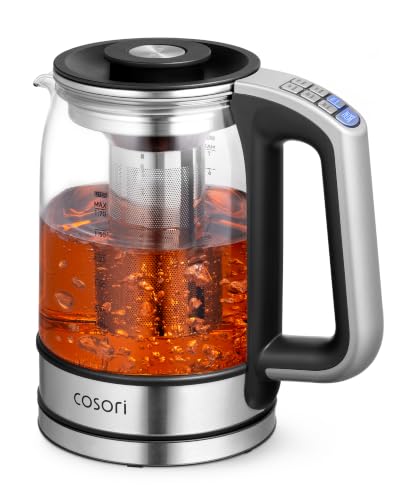
The COSORI tea kettle with infuser is the glass option most buyers land on, and the glass is the point: you can watch the water approach the boil, watch the leaf open, and see at a glance how much water remains. The borosilicate body pairs with a stainless infuser that drops into the pot for loose leaf brewing, and the base carries straightforward temperature control rather than a bare on-off switch. Glass asks for gentler handling than steel and shows scale sooner, which is either a flaw or a useful reminder to descale, depending on your temperament. For tea drinkers who brew visually and drink several types, it is the balanced middle of this category.
Best for: the visual brewer whose Step 5 chose glass and Step 2 chose the basket
Not suited for: hard-knocking family counters
Strengths
- Glass makes Steps 4 and 5 easy to live with
- Infuser included for in-kettle brewing
- Mid-range tier
Trade-offs
- Shows scale in hard water
- Fragile by material
- Basket limits the largest pots
Tier: mid-range. Check price on Amazon.
Secura Electric Tea Kettle
The Secura electric tea kettle built its following on construction: a stainless interior with no plastic touching the water, a double-wall body that stays calmer to the touch and holds heat longer between boils, and a cool-touch exterior that matters in busy kitchens. Tea drinkers who are particular about what their water contacts tend to shortlist it quickly. Temperature control and infuser arrangements vary across the Secura range, so the listing deserves a careful read, but the core promise is consistent: steel where the water lives, insulation where your hands live, and a kettle that feels engineered rather than decorated.
Best for: the buyer whose Step 5 prioritised a steel water path and a calm exterior
Not suited for: visual brewers who judge by eye
Strengths
- Stainless interior throughout
- Double wall for busy counters
- Holds heat between rounds
Trade-offs
- Hidden level and scale
- Heavier in hand
- Check the listing’s exact features
Tier: mid-range. Check price on Amazon.

Buydeem Electric Kettle
The Buydeem electric kettle is the design-led option, a kettle bought as much for how it looks on the counter as for how it brews. The retro styling, colour finishes and compact footprint target smaller kitchens and desks, while the feature set underneath — temperature settings suited to tea, an infuser on tea-focused configurations, and a keep-warm hold — keeps it a working tea appliance rather than a ornament. It will not out-capacity the big family kettles, and it does not try to. For a single drinker or a couple who brew a pot in the morning and another in the evening, it is the kettle most likely to be left out on display instead of hidden in a cupboard.
Best for: the solo or couple household whose Step 4 landed on compact
Not suited for: families and frequent hosts
Strengths
- Small footprint, low fills
- Design worth displaying
- Tea settings with keep-warm
Trade-offs
- Capacity ceiling
- Premium tier for the size
- Gentle cleaning for the finish
Tier: premium. Check price on Amazon.
Common Mistakes
The recurring mistakes in this category are consistent enough to list as warnings. Buying for the tea shelf you wish you had. Paying for automation used twice a week. Ignoring the minimum fill and heating three cups to drink one, for years. Choosing glass for a counter shared with toddlers and cast iron. Choosing steel and then never opening the lid to notice scale until the tea tastes of it. Treating the infuser as a photograph rather than the part you will scrub weekly. And buying the kettle before the tea, leaving nothing for the leaves that the kettle exists to serve. Each mistake is a skipped step above, which is the kindest thing that can be said about a checklist: it works when it is followed.
Pro Tips
Buy the kettle your second year of tea drinking needs, not your second week’s enthusiasm — but do not over-buy for a connoisseurship that may never arrive; the mid-range of this category is genuinely good. Keep the box and paperwork until the kettle has survived a month of mornings. Fill from a jug if your tap and kettle lid quarrel. And when two kettles tie on every step, choose the one whose controls a guest can understand without you, because a kettle the household can use is a kettle that gets used. The model-level comparisons that finish the decision are in electric tea kettle reviews.
Worked Examples
The Household With Four Teas and Two Children
Step 1 shows black, green, oolong and herbal across the week — presets are the point. Step 2 keeps a family pot for weekends but brews in-kettle on weekdays. Step 4 wants a full family round with a moderate minimum. Step 5, with small children, chooses double-wall or single-wall steel over glass. The steps converge on a preset-led steel kettle, the Cuisinart or Secura pattern, and the household stops shopping with confidence.
The Solo Drinker With a Shelf of Greens
Step 1 is almost entirely green and white tea, so Step 3 demands trustworthy cool presets above all else. Step 4 is one mug, twice a day: minimum fill dominates, capacity barely matters. Step 2 is loose leaf in the kettle. Step 5 is a calm one-person counter where glass is safe and loved. The steps converge on a compact glass infuser kettle, the COSORI pattern in a smaller footprint or the Buydeem pattern where design matters.
The Bagged-Tea Pragmatist in a First Flat
Step 1 shows one breakfast blend in bags. That answer ends the expensive part of the guide: boil-only or entry tier, judged on speed, pour and price. Step 4 is two mugs. The remaining steps are formalities, and the money saved goes to a better blend and a decent mug — the correct outcome, and the reason Step 1 comes first. The fuller argument for this profile is in is an electric tea kettle worth it.
Matching the Kettle to Tea Styles You May Grow Into
Shelves evolve, and a good choice leaves room for the drinker you are becoming without betting the budget on a connoisseur you may never be. If your current shelf is black tea but loose leaf has begun to appear as gifts and experiments, favour a mid-range preset kettle with an infuser: it serves today’s bags’ water perfectly and is ready for the leaf phase without a second purchase. If you are deepening into green and white teas, weight trustworthy cool presets and steadiness above capacity and styling, because those teas will audit your kettle daily. If oolong is your growing passion, basket width matters more than almost anything — ball oolongs need room to open — and a glass body lets you watch the leaves and learn. If your household is heading toward hosting, capacity and keep-warm climb the list. The pattern is constant: identify the direction of travel, buy one step ahead of the present, and resist buying five steps ahead, because tastes that leap usually land somewhere nobody predicted.
Questions to Ask of Any Listing Before You Commit
Turn the steps into interrogation. Is the infuser included in this configuration, and what does its mesh look like in the open-lid photograph? Are the temperatures labelled by tea, set by dial, or adjusted degree by degree — and does the description anywhere promise steadiness or a hold, or only a number of settings? What are the minimum and maximum fills, in the maker’s own figures? What is the body actually made of, inside and out, and what touches the water? How does the maker instruct descaling, and does the brand sell the spout filter and basket as spares? Can the beeps be silenced? A listing or a brand that answers these plainly has designed for owners; one that answers with adjectives has designed for browsers. The five minutes of reading this takes will be repaid every morning the kettle serves.
A Decision Tree, in Words
If your shelf is one tea in bags, stop at the entry tier and spend the savings on the tea. If your shelf holds several teas, take presets as settled and ask the brewing question: in the kettle, or in a pot? In the kettle, for one or two drinkers, leads to the infuser models; then let your water and counter choose glass or steel, and let your forgetfulness decide whether automation joins the basket. In a pot, or for a family round, leads to the heat-only preset kettles; then let capacity and minimum fill arbitrate, and let double-wall construction win if small hands share the kitchen. At every branch, the maintenance question stands as a final gate: if the descale will not happen, step down one level of complexity and buy the simpler kettle with a clear conscience. That is the whole guide in one paragraph, and it will choose as well as the seven steps for most households.
Two More Worked Examples
The Tea-Curious Couple in a Small Flat
Their shelf holds a breakfast blend and a growing row of sample tins. Counter space is measured in centimetres and the kettle will be visible from the sofa. The steps point to compact capacity, presets for the samples they are exploring, an infuser for the loose leaf they now own, and a body they enjoy looking at. The Buydeem pattern fits the paragraph exactly, and the couple’s remaining budget goes where it should: into the next samples.
The Host Who Brews for Six on Sundays
Weekday drinking is modest, but Sunday fills a table. Step 4 dominates: capacity for a full round, a keep-warm that survives a long lunch, and a body that can travel to the table without drama. Step 2 keeps the big ceremonial pot and asks the kettle to be its engine. The steps converge on a full-size preset kettle in steel, the Cuisinart pattern, with the beloved pot retained for the ceremony and the kettle doing the thermal work.
Step Zero: Start From the Kettle You Already Own
Before the seven steps, take inventory. The kettle currently on your counter, and the pot beside it, encode your real habits more honestly than any intention you bring to a listing. If the current kettle is a basic boiler and your complaint is only speed, this category may be an expensive answer to a small question. If your complaint is bitter greens, skipped loose leaf or second cups gone cold, the inventory has already made the case and the steps merely assign the model. Note also what your current setup does well — a beloved pot, a stovetop ritual a partner loves — because a good choice preserves those things and replaces only the failing part. The commonest choosing error is not picking the wrong kettle; it is replacing a whole working routine to fix one broken variable.
Reading Temperature Claims With a Reviewer’s Eye
Listings speak about temperature in three dialects, and Step 3 requires translating them. ‘Temperature control’ alone may mean anything from a boil-stop thermostat to a full preset panel. ‘Variable temperature’ usually means a dial or buttons across a range, which is genuinely useful and less guest-friendly than labels. Named presets — delicate, green, white, oolong, black — are the dialect of a kettle designed for tea rather than adapted to it. Keep-warm claims deserve the same translation: a hold measured in a long, stated period behaves differently from a brief keep-warm that exists to be printed on the box. None of this requires cynicism; it requires reading the maker’s own specifications rather than the marketing paragraph, and preferring the kettle whose claims are stated in checkable form.
The Infuser, Examined Like an Engineer
Step 6 deserves its own expansion, because the basket is where infuser kettles diverge most and photograph worst. Mesh fineness is a trade in itself: finer mesh pours clearer tea and clogs sooner, coarser mesh flows freely and lets fine teas through. Basket geometry matters as much as mesh — a wide, shallow basket lets leaves spread and water circulate, while a narrow, deep one stacks leaves into a plug that brews at the edges and stews in the middle. The seal between basket and kettle decides whether leaves escape into the pot during the pour. The handle or tab that lifts the basket decides whether removal is a one-handed pleasure or a two-handed negotiation with wet steel. And the basket’s own cleaning access — whether its base opens or its mesh can be brushed from both sides — decides its condition in month six. Judge these five in photographs and descriptions with the seriousness you gave the temperature panel; you will touch the basket more often than the buttons.
After You Choose: The First Week Test
A choice is not finished at the checkout. Give the kettle a deliberate first week: one delicate tea to audit the cool presets, one full family round to audit capacity, one second cup under keep-warm, one descale-free inspection of the basket after several brews, and one guest invited to make their own cup unaided. A kettle that passes your week is chosen in fact as well as in law. A kettle that fails it has told you so while returns are still easy, which is the kindest failure available in appliance buying. Keep the packaging until the week is done, and let the checklist in this guide serve as the week’s scorecard.
Choosing When Two Drinkers Disagree
Households rarely contain one tea drinker with one opinion, and the choosing steps bend when two people weight them differently. The commonest dispute is glass versus steel, and it resolves best by asking which partner brews more often and which partner cleans more often: the brewer’s preference should lead on material, the cleaner’s on complexity, because those are the hands that live with each property daily. The second dispute is size, and it resolves by the minimum-fill test — the partner who drinks alone most often holds the veto on oversized kettles, because they pay the waste daily while the other pays the capacity shortage weekly. The third dispute is automation, and it resolves by evidence: count the household’s ruined pots in a month, together, before pricing the machine that prevents them. Choosing a kettle is a small exercise in household fairness, and the steps in this guide work best when both drinkers walk them and initial their own answers.
What to Do With the Kettle You Replace
A complete choosing guide ends after the purchase, with the displaced appliance. A sound basic kettle has honourable second posts: the office kitchen, the guest room tray, the student flat, the garden room, the caravan. A kettle that still boils honestly should be passed on rather than shelved, because a shelved appliance is pure waste while a cascaded one keeps serving the drinks it was always good at. If the old kettle is scaled, slow or damaged, retire it without sentiment and let the new kettle’s first descale date be set by the calendar rather than inherited from its predecessor’s neglect. Either way, the household ends the choosing process with exactly the hot-water fleet it planned — which, as this guide has argued from its first step, was the real decision all along.
A Final Pass Over the Seven Steps
Reread your answers once, in order, before committing. The shelf audit decides the temperature system; if it was optimistic, every later step inherits the error. The brewing arrangement decides the category’s half; if it was aspirational, the infuser will testify against it within a month. The sizing decides the daily economics; the body decides the daily physics; the basket decides the daily cleaning; and the maintenance terms decide whether the kettle in year three resembles the kettle in the reviews. A choice that survives that rereading is as sound as choosing gets, and the remaining risk — that your tea life itself changes — is the one risk no guide can retire. Buy the kettle your evidence describes, keep the first-week test honest, and let the matter rest: a well-chosen kettle should free attention for the tea, which was the point of every step.
Choosing for Tea Styles: A Style-by-Style Crib Sheet
Close the guide by running the steps once more at the speed of a shelf, style by style, so a reader can find their dominant tea and read their answer directly. For a shelf of Japanese greens, the choosing collapses to one question — whose cool presets are steadiest — and the answer is a preset-led kettle with a genuine hold, in whichever body the counter prefers. For Chinese greens and whites, the same answer holds with capacity slightly promoted, because these drinkers brew in rounds. For oolong devotees, basket geometry outranks everything: width, flow and a glass view of the leaves opening, in a kettle whose middle ranges are honest. For black-tea and herbal households, the crib sheet is shortest of all — boil, capacity, pour, price, in that order — and the guide’s blessing to stop early. For mixed shelves, which is most real shelves, the preset panel is the answer and the remaining steps are the ones this guide spent its length on. A choosing method that can be compressed this far without breaking was probably sound; one that cannot be compressed at all was probably a fog. Keep the crib sheet, lend the guide.
When the Steps Point Two Ways
Sometimes the audit produces a genuine tie — the shelf says presets, the counter says compact, the budget says entry, and no kettle satisfies the whole parliament. Resolve ties by the frequency principle: the property exercised daily outranks the property exercised weekly, which outranks the property exercised at Christmas. In practice that means minimum fill beats maximum capacity, presets beat styling, and the descale you will perform beats the feature you will admire. If a tie survives even that, choose the kettle from the maker whose listings answered your questions most plainly, because a household will live with that maker’s honesty — in manuals, in spare parts, in support — long after it has forgotten the feature that caused the tie. Choosing well is partly choosing who to be a customer of, and the steps end, fittingly, with a judgement about people as much as about kettles.
The Steps, Applied to the Kettle as a Gift
The seven steps were written for a buyer choosing their own kettle, and they bend, instructively, when the kettle is a gift. Step 1 must be performed on the recipient’s shelf, from memory and observation, which usually argues for humility: when the recipient’s teas are unknown, presets are the safer bet than specialisation, because range forgives ignorance. Step 4 argues for the middle sizes, since the extremes — the tiny design kettle, the family vessel — are the most personal choices a drinker makes. Step 5 argues for steel unless the recipient is a known glass lover, because a gift should not impose a fragility regime on a household that did not choose it. And Step 7 argues for including the means of maintenance with the gift, because handing someone a precision appliance without its descaler is handing them the first chapter of a disappointment. A gift chosen by the steps, on someone else’s evidence, is a small masterpiece of attention — and the recipient, pressing a labelled preset that matches their morning tea exactly, will feel chosen-for rather than merely bought-for, which is the entire point of the exercise.
The Guide in the Shop: A Pocket Summary
Distilled for the moment of actual decision — in a shop aisle or on a listing page, with a kettle in hand or in cart — the whole guide fits into the following breath. Name your teas; if there is more than one family, presets are settled. Decide where brewing happens; the basket question answers itself from your current mornings. Read the minimum fill before the maximum, and size to the round you actually pour. Let your water choose between glass that shows scale and steel that hides it, and let your household’s hands confirm the choice. Interrogate the basket like the appliance it is. Write the descale date in your calendar before the kettle’s first boil, as a promise the purchase makes to itself. And if two kettles survive all of that, buy the one a guest could operate. Everything else in this guide — the steps, the examples, the crib sheet — is commentary on those sentences, written for the reader at leisure. The reader in the aisle needs only the sentences, and may consider the guide’s work done the moment they can recite them.
The Chooser’s Postscript: Confidence and Its Limits
End the guide with an honest account of what choosing well can and cannot promise. It can promise that the kettle matches the evidence: the shelf, the routine, the water, the counter, the hands. It cannot promise that the evidence will hold — shelves evolve, households move, a new tea arrives and reorganises a decade of habit in a month. The correct response to that limit is not paralysis and not overbuying for hypothetical futures; it is choosing cleanly for the present with the mid-range’s forgiving breadth, and trusting that a kettle matched to a real routine will serve long enough to justify itself even if the routine later changes. Most well-chosen kettles do exactly that, and the minority that are outgrown are outgrown upward, by drinkers whose tea life the kettle itself helped to grow. There are worse fates for an appliance, and worse outcomes for a guide, than to be succeeded by the enthusiasm it created.
The Last Question: How Long Should Choosing Take?
A choosing guide should finally ration its own reader’s time, because deliberation has a cost and kettles are not houses. The seven steps, honestly answered from a real shelf and a real kitchen, take an evening — most of it spent looking at your own counter, your own water’s effect on the old kettle, and your own last month of tea, rather than at listings. A second evening of comparing the two or three survivors is reasonable. Beyond that, additional research mostly manufactures distinctions the mornings will never reveal, and the chooser should hear the guide’s permission to stop: pick the kettle the evidence favours, run the first-week test, and return the saved attention to the tea. Choosing is a means. The guide’s final step, unnumbered because it belongs to every step, is knowing when the choosing is done.
Choosing, One Year Later
The guide’s last service is to tell the reader what a good choice feels like at a distance, so they can recognise success when it arrives quietly. A year after a well-chosen kettle, the household no longer discusses it. The presets are pressed without looking, the descale date is a calendar triviality, the basket is brushed by whoever brews the strong tea, and the tea shelf has become the interesting frontier again — new leaves, not new appliances. That disappearance into the routine is the true signature of a correct choice, and it cannot be photographed for a listing. If, a year on, the kettle is still being discussed — its quirks managed, its size resented, its basket avoided — the choice missed, and the steps in this guide, reread with a year’s evidence, will show exactly where. Either way, the kettle will have taught the household what it actually drinks, and that knowledge outlasts any single appliance.
Electric Tea Kettle: Troubleshooting the Steps That Commonly Go Wrong
Start with where people most often get stuck with a {p} and how to recover quickly. Most coverage of a electric tea kettle concentrates on the first week of ownership, yet the decisions that matter most tend to surface later, once the electric tea kettle has to earn its place in an ordinary weekday routine rather than a carefully staged first attempt. Write down the three jobs you expect it to do most often, in the order you actually do them, and judge every claim you read against that short personal list instead of against a generic ideal.
Finally, plan the first fortnight deliberately. Use the electric tea kettle for one familiar job first, so you have a baseline you trust, then introduce the harder cases one at a time and note what changes. Small adjustments to arrangement, timing, quantity or preparation usually close most of the gap between disappointing first results and the performance the design is capable of. That short learning period is also the fairest test of the failure points and fixes: if the routine has not settled by the end of it, the mismatch is real, and it is better to know while returning or exchanging is still straightforward.
When you check listings such as Cuisinart PerfecTemp Tea Kettle, COSORI Electric Tea Kettle with Infuser and Secura Electric Tea Kettle, use them as worked examples: run through the same checks below on each one in turn, so the comparison stays honest and like for like rather than based on whichever listing happens to shout loudest.
Troubleshooting is easier when you expect the usual failure points. With any electric tea kettle, the recurring problems tend to cluster in the same places: uneven results from overloading or poor arrangement, wear showing first on the parts handled most often, and small annoyances with lids, seals, handles, controls or fittings that only appear after repeated use. Before buying, look for whether those wear parts can be cleaned properly, replaced or worked around, and whether the instructions address them directly rather than pretending they never happen.
Maintenance decides how long the good results last. Set a simple rhythm: a quick wipe or rinse after each use, a deeper clean on a fixed day, and a periodic check of the parts that move, seal or bear weight. A electric tea kettle that needs fiddly disassembly for basic care will be cleaned less often, and performance drifts long before anything actually breaks. Prefer designs where the parts that get dirtiest are the parts that are easiest to reach, and be honest with yourself about which cleaning steps you will genuinely keep up.
Work through a realistic scenario, not a best case. Picture the busiest version of the job: more people to serve, less time than planned, ingredients or materials that are slightly out of the ordinary, and a clean-up waiting at the end. Ask how the electric tea kettle behaves at that upper edge, because a model that only shines on a small, simple load will disappoint precisely when you need it most. If the honest answer is that you would split the job into batches or fall back on an older method, factor that into the decision now rather than discovering it later.
Measure before you commit. Note the footprint, the clearance above and behind the spot where the electric tea kettle will live, and the route you will carry it by when it is hot, full or awkward. A electric tea kettle that technically fits but blocks a cupboard door, crowds a neighbouring appliance or has to be dragged across a worktop every time will quietly fall out of use, whatever its merits on paper. In the Coffee & Tea category especially, a few centimetres of clearance and a sensible storage plan separate a daily tool from a bulky regret.
Edge cases deserve a deliberate pass. Think about the odd shapes, the thicker or thinner than usual loads, the leftovers, the second helping and the guest with different preferences. A well-chosen electric tea kettle handles the exceptions gracefully, or at least predictably, while a poor match turns every exception into a workaround. List your two or three most common exceptions in advance and check, from the manual or the listing details, that nothing about them is ruled out by size, shape, material or care requirements.
Use a short decision checklist to finish. One, does it fit the space and the storage you really have. Two, does it handle your three most common jobs without a workaround. Three, do the edge cases you listed stay manageable. Four, can every wear part be cleaned or replaced without drama. Five, would you still choose it if a friend described the same drawbacks in their own kitchen. A electric tea kettle that passes all five is a sound buy; one that fails two or more is a compromise you are choosing with open eyes, which is a very different thing from being surprised later.
Frequently Asked Questions
What is the most important feature in an electric tea kettle?
Temperature control matched to your teas. If you drink several families of tea, labelled presets are the feature the category exists for, and steadiness — holding the set temperature without overshooting — matters more than the number of settings. If you drink only black tea, the most important features collapse to boil speed, a clean pour and honest build, and you should not pay for range you will never select.
Should I choose a kettle with a built-in infuser?
Choose it if you brew loose leaf most days for one or two people and want one vessel to wash. Skip it if you brew in a favourite pot, make large pots, or drink mostly bags. Judge any basket on mesh fineness, width for leaves to open, and whether it removes without dripping — the basket is the part of the kettle you will handle and clean most often.
What size electric tea kettle do I need?
Size to your largest regular round of drinks, then check the minimum fill against your smallest. One or two drinkers need a compact kettle with a low minimum; a family drinking together needs a full-size pot. Remember an infuser basket reduces brewing capacity below the water capacity, and that oversizing costs you water, time and energy on every small round for the kettle’s whole life.
Is glass or stainless steel easier to live with?
Stainless is easier on a busy counter: durable, lighter or insulated, and forgiving of knocks. Glass is easier for a visual brewer and for hard-water homes, because you can see the level, the leaf and the scale. The trade is fragility and visible mineral crust against hidden levels and hidden scale. Neither is wrong; match the material to your household’s hands and your water.
Do I need keep-warm on a tea kettle?
Only if your pattern includes a second cup within the hour. Slow mornings, desk work and staggered household cups make keep-warm genuinely useful, because it avoids reboiling the same water repeatedly. If you boil, brew and finish in one sitting, keep-warm is a feature you will pay for and rarely touch, and its absence should not disqualify an otherwise right kettle.
When is an automatic tea maker the right choice?
When over-steeping is your recurring problem: you start pots and get pulled away, and return to bitter tea often enough to resent it. The automatic basket lowers and lifts on schedule, which no manual kettle can do for you. If you stay near your tea while it steeps, the automation buys nothing, and a simpler kettle with an infuser gives you the same cup with less to clean and less to fail.