Disclosure: As an Amazon Associate, topratedkitchenware.com earns from qualifying purchases. Links on this page are affiliate links; they cost you nothing extra. Prices and availability change often, so check the current Amazon listing before you buy.
Knowing how to clean enameled dutch oven cookware properly is the difference between a pot that looks and cooks beautifully for decades and one that dulls, stains and crazes within a few years. The good news is that enamel asks for gentleness, not effort: warm water, a soft sponge, brief soaking and thorough drying handle almost everything, while the damage nearly always comes from the opposite instincts — metal scourers, fierce detergents, cold water on a hot pot, and long overnight soaks. This guide gives the full routine step by step, covers burnt-on food and stubborn stains honestly, and explains the few warning signs that mean a pot needs assessment rather than another wash.
How to Clean Enameled Dutch Oven Cookware: Key Takeaways
- Cool first, always: never put water into a hot pot or a hot pot into water.
- Warm water, ordinary washing-up liquid and a soft sponge or cloth are the whole everyday kit.
- Soak briefly in warm water to release food — minutes while you eat, not hours overnight.
- Burnt-on food yields to a gentle simmer of water and a wooden spoon, not to force.
- Bicarbonate of soda paste handles most staining; metal scourers and harsh abrasives are banned for life.
- Dry thoroughly, especially the exposed iron rim, and store the pot fully dry.
In this guide
What You Need
Required: a soft sponge or washing-up cloth, ordinary washing-up liquid, warm water, a wooden spoon or soft scraper for loosened residue, and a clean dry towel. Helpful but optional: bicarbonate of soda for a gentle cleaning paste, a soft nylon brush for textured exterior details, and a trivet or thick board so the pot can cool safely out of the way. Explicitly not needed — and not allowed near the enamel — are steel wool, metal scouring pads, oven cleaners, bleach-heavy sprays and abrasive powders. If a product promises to strip, scour or restore by aggression, it belongs on a different material. Enamel is glass-like and smooth; everything that cleans it works by softening and lifting, never by scratching, and the short shopping list above reflects that.
Safety and Before You Start
Thermal shock is the one enemy enamel cannot argue with. The coating is a glass-like layer bonded to iron, and the two materials react to sudden temperature change at different rates, which is how crazing and cracks begin. The habits that protect it are simple and absolute. Warm the pot gradually rather than blasting it on a fierce heat from cold, and never leave it heating empty for a long stretch, because an empty pot climbs in temperature far faster than a full one and stresses the enamel. Add oil or liquid before serious heat, let a pot from the fridge come closer to room temperature before it meets a hot oven, and at the end of cooking let it cool on the hob or a board before any water touches it. Above all, never pour cold water into a hot pot and never plunge a hot pot into a sink of water — that single impatient moment is responsible for more ruined enamel than years of ordinary cooking.
Weight deserves its own honest paragraph in any discussion of this pot, because it shapes every single use. An enameled Dutch oven is heavy empty and very heavy full of stew, and pretending otherwise helps nobody. The safe technique never changes: clear the route from hob to counter or table before you lift, put on proper oven gloves even for a short move, take a handle in each hand, keep the pot level and close to your body, and set it down on a trivet or board rather than a cold or wet surface. Never try to carry a full pot one-handed, never let a helper grab one handle while you take the other without agreeing the move first, and never leave a child to wrestle a lid that weighs more than they expect. If your wrists, shoulders or grip make that routine sound difficult, believe that feeling now rather than after the purchase — a smaller pot you lift confidently will cook far more meals than a large one you dread moving.
The Cleaning Routine, Step by Step
Step One: Let the Pot Cool Properly
When cooking ends, move the pot — two gloved hands — to a trivet or board and let it stand until it is warm rather than hot. This pause protects the enamel from thermal shock and protects you, because a pot that looks calm can still be fiercely hot. Use the time to serve, eat, or clear the table. Rushing this step is the single most common cause of crazing, and it is entirely self-inflicted, which makes it the easiest damage in the kitchen to prevent.
Step Two: Empty, Then Soak Briefly in Warm Water
Transfer leftovers once the pot has cooled enough to handle safely, scrape out loose food with a wooden spoon or soft spatula, then fill the pot with warm water and a little washing-up liquid and leave it while you eat or for a short while afterwards. Warm water softens the starches and sugars that glue food to enamel, and most residue will simply float free. Keep the soak brief and purposeful: prolonged soaking, especially overnight, does nothing extra for the enamel and is unkind to the exposed iron rim, which can discolour or rust at the edge.
Step Three: Wash Gently, Inside and Out
Everyday cleaning of enamel is deliberately unexciting, and that is the point. Let the pot cool until it is warm rather than hot, then wash it in warm water with a soft sponge or cloth and ordinary washing-up liquid. Food releases far more easily after a short soak in warm water — a soak measured in minutes while you eat, not hours left overnight, because prolonged soaking is unkind to the exposed iron rim and pointless for the enamel itself. For stuck patches, simmer a little water in the cooled-then-rewarmed pot and loosen the residue with a wooden spoon or a soft scraper, and for stubborn staining a gentle paste of bicarbonate of soda and water, applied with a soft cloth, does most of what you need. Never reach for metal scourers, steel wool or aggressive abrasive pads: they scratch and dull the enamel, and scratched enamel stains faster and cleans harder forever after. Dry the pot thoroughly, pay attention to the bare rim, and store it fully dry.
Step Four: Lift Stuck Food With Heat, Not Force
For patches that survive the soak — the caramelised edges of a braise, the footprint of a loaf — put a little water in the pot, warm it gently on the hob until it simmers softly, and work the residue with a wooden spoon as the heat loosens it. Let the pot cool again before washing as usual. This simmer-release method succeeds precisely because it reverses how the food stuck in the first place, and it does so without a single scratch. Repeat it rather than escalating to tools: a second gentle simmer always beats one moment of metal.
Step Five: Treat Stains With Bicarbonate Paste
Staining is the cosmetic tax enamel charges for its convenience, and it helps to separate stains from damage. A light interior will gradually take on shadows from turmeric, tomato, red wine and years of fond, and those marks are a record of cooking rather than a failure of care. They do not affect how the pot cooks, they do not harbour flavours from one meal to the next in any way a normal palate detects, and chasing a showroom finish after every stew leads people to exactly the harsh scrubbing that does cause real harm. Gentle methods — warm soaks, bicarbonate paste, patience — lift most of what matters. A dark interior hides the same history almost completely, which is a genuine practical argument for choosing one if you know visible staining will bother you. What should concern you is different: chips that expose iron, cracks, or a network of fine crazing lines, because those are structural, and a pot showing them deserves assessment rather than another round of cleaning.
Step Six: Dry Thoroughly and Store Dry
Drying is a step, not an afterthought. Towel the pot inside and out, then give the rim — the ring of exposed iron where lid meets pot on many models — particular attention, because that is where moisture lingers and rust can start. Some owners warm the empty, washed pot briefly on a low hob to drive off the last moisture; if you do, keep it brief, never leave it heating empty for long, and let it cool gradually. Store the pot fully dry, with a cloth protecting the rim if the lid sits on it, and never put it away damp in a closed cupboard.
Storage sounds trivial until a heavy pot meets a crowded cupboard. Keep the pot somewhere you can lift it from safely with two hands — a low, sturdy shelf beats a high one, and the hob itself is where many owners happily leave it, since a handsome enameled pot earns its place on display and stays within easy reach. Protect the enamel in storage: do not nest other pans inside it without a cloth or felt between them, keep the lid seated or store it with a cloth protecting the rim, and never drag the pot across a glass hob or a stone counter. If you stack cookware, the Dutch oven goes at the bottom as the foundation, never balanced on top of lighter pans. A pot stored where it is easy to reach gets used; a pot buried behind rarely used equipment quietly becomes the expensive object this guide is trying to help you avoid buying.
Troubleshooting and Common Mistakes
The recurring mistakes in this category are predictable, which means they are avoidable. Buyers choose size by ambition rather than by household, then discover the full weight at the worst moment. They use metal utensils out of habit and score the enamel in the first month. They heat the pot empty on high to save time, rinse it hot under a cold tap, or leave it soaking overnight, and then blame the coating when crazing appears. They store it wet, nest pans inside it unprotected, or slide it across a glass hob. And they skip the unglamorous checks — oven fit, burner fit, sink fit, lid fit — that decide daily satisfaction far more than colour does. Every one of these errors is a habit rather than a catastrophe, and the cooks who keep enamel beautiful for years are not more talented, just more consistent about the small protections.
Three specific troubles deserve direct answers. A white, chalky film after washing is usually mineral deposit from hard water or detergent residue; a warm-water rinse and thorough drying, sometimes with a gentle bicarbonate paste, clears it. Rainbow-like discolouration on a light interior after tomato or wine is ordinary staining, cosmetic only. Fine web-like lines, chips down to dark iron, or a crack you can feel with a fingernail are different — that is crazing or damage rather than dirt, and no cleaning method reverses it; cook gently with such a pot, avoid thermal stress entirely, and consider the maker’s guidance on whether it should stay in service.
Gear That Helps
Cleaning is mostly technique, but the pot itself sets the workload: light interiors show you exactly what needs attention, while the smoothest enamels release food most willingly. Both examples below clean by the routine above — neither needs, or tolerates, anything harsher.
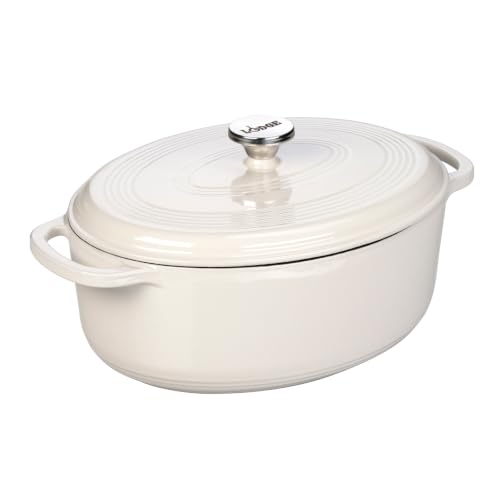
Lodge Enameled Cast Iron Dutch Oven
Entry tier positioning. the practical starting point in this category. It covers the core jobs — braising, simmering, baking and roasting — in a straightforward design that puts function ahead of decoration, with wide loop handles that are easier to grip with thick oven gloves than smaller handles tend to be. The enamel interior is light in tone on many versions, which helps you watch fond develop while you sear, and the overall feel is sturdy rather than refined. It suits a first-time buyer who wants the enameled experience without a premium commitment, and a busy household that will use the pot hard every week. It is less suited to a cook chasing the smoothest enamel finish or the most polished detailing, and like every pot here it is very heavy when full, so two-handed lifts with gloves are the rule from the first day.
Best for: cooks whose habits match the strengths above. Not suited for: anyone whose priorities point the other way. Check price on Amazon for linked listings when they appear at publication; in this prose-first draft the pick is presented without a link so nothing is claimed that has not been verified.
Le Creuset Signature Enameled Cast Iron Dutch Oven
Premium tier positioning. the refined benchmark many shoppers measure the category against. The enamel finish is notably smooth, the light interior makes browning easy to judge, and the larger handles and considered lid fit give it a composed feel in daily use. It suits a cook who plans to keep one pot for a very long time, cooks acidic sauces often, and values finish and long-term support as part of the purchase. Bread bakers like the even heat and the way the sealed lid traps steam around a loaf. It is less suited to a buyer who will resent paying a premium for refinement they may not notice, or to anyone who wants a pot they can treat roughly without thinking about the enamel. Treat it gently — no metal scouring, no thermal shock — and it rewards that care for years.
Best for: cooks whose habits match the strengths above. Not suited for: anyone whose priorities point the other way. Check price on Amazon for linked listings when they appear at publication; in this prose-first draft the pick is presented without a link so nothing is claimed that has not been verified.
Maintenance and Keeping It Working
Between washes, small habits keep the pot young. Use wood, silicone or nylon tools so the surface never meets metal in anger. Warm and cool the pot gradually as doctrine. Wipe the exterior after cooking rather than letting spills bake on across several meals. Check the rim when you dry, and touch it with the tiniest trace of cooking oil on a cloth only if your maker’s guidance suggests it for exposed iron edges. Once in a while, look at the enamel in good light: early awareness of a chip or craze lets you adjust how the pot is used long before a small flaw becomes a finished pot.
The lid is not an accessory; it is half the cooking system. A heavy, well-seated lid holds moisture in a slow braise so the liquid you start with is close to the liquid you finish with, it traps the steam that gives a loaf of bread its crackling crust, and it keeps a soup at a bare simmer without constant topping up. When you compare pots, lift the lid and set it back down. It should sit evenly with no rocking, feel reassuringly heavy without being awkward, and have a knob you can grip securely with a gloved hand or a folded cloth. Remember that the knob and the lid handle are as hot as the pot itself after oven cooking — treat every part of the lid as hot, every time, and lift it tilting away from you so the escaping steam passes clear of your face and hands. A lid that fits well and is handled with respect is the difference between a braise that concentrates and one that quietly dries out.
Practical Notes From Everyday Cooking
Leftovers behave differently in iron. A braise cooled and refrigerated in its pot, then gently rewarmed in the same vessel the next day, often tastes better than it did fresh, because the flavours have had a night to settle and the reheating is even and unhurried. Respect the temperature rules on that journey — cool before chilling, warm gradually when reheating, and never take the pot straight from fridge to fierce heat. Decanting into storage containers is kinder to the pot’s rim over the long term if the food will sit for days, but for the classic next-day stew, the pot itself is part of the recipe.
Seasonal cooking flatters this pot in every quarter. Winter is its obvious season — stews, beans, braises and bread — but spring soups, summer tomato sauces cooked low and slow, and autumn roasts all sit naturally in it. The oven work warms the kitchen, which is a pleasure in January and a consideration in August; summer cooks tend to keep the pot on the hob for sauces and beans instead. A buyer weighing the purchase should picture their cooking across the whole year rather than in the mood of the month they happen to shop in, because the pot’s value is the sum of all four seasons.
Practical Notes From Everyday Cooking
One pot also changes how a small kitchen works. When a single vessel sears, braises, bakes, simmers and serves, several other pans stop earning their cupboard space, and the cook who owns less but uses all of it tends to cook more, not less. That consolidation is a real argument for spending properly on the one pot: the budget of two or three mediocre pans gathered into a single good Dutch oven usually produces the better kitchen. The counter-argument is equally real — a household that rarely braises or bakes gains nothing by consolidating around a pot it will not use.
Guests reveal the truth about cookware. Nobody comments on a stockpot, but a handsome enameled pot arriving at the table starts conversations, and the cook who braises in it tends to cook for people more often. That social dimension is not frivolous: tools that make hosting easier get used, and tools that get used justify themselves. If your cooking life includes feeding friends from one big pot, the enameled Dutch oven is close to purpose-built for it. If your cooking is mostly quick solo meals on weeknights, be honest that the pot’s greatest strengths — slow, generous, shared food — point away from your routine rather than towards it.
Table service is an underrated part of the case for enamel. The pot that cooked the meal carries it to the table looking like it belongs there, keeps second helpings warm without a return to the hob, and turns an ordinary stew into something that feels hosted. That is also why colour and finish matter more in this category than in most cookware: the pot lives in public. Choose a colour you will still enjoy when it is no longer new, remember that pale interiors show the evening’s work while dark ones hide it, and accept that a pot used at the table will gather the small marks of gatherings. Most owners come to read those marks fondly.
Practical Notes From Everyday Cooking
Seasonal cooking flatters this pot in every quarter. Winter is its obvious season — stews, beans, braises and bread — but spring soups, summer tomato sauces cooked low and slow, and autumn roasts all sit naturally in it. The oven work warms the kitchen, which is a pleasure in January and a consideration in August; summer cooks tend to keep the pot on the hob for sauces and beans instead. A buyer weighing the purchase should picture their cooking across the whole year rather than in the mood of the month they happen to shop in, because the pot’s value is the sum of all four seasons.
There is a rhythm to cooking in heavy iron that lighter pans never teach. You learn to start earlier and rush less: the pot comes up to heat gradually, the sear is given its time, the braise is left alone for long stretches, and the finished dish rests in the vessel while you set the table. Cooks who enjoy that rhythm find the pot almost meditative; cooks who want instant response from a pan often find it ponderous, and neither reaction is wrong. Knowing which cook you are is worth more than any single feature comparison, because the pot will ask for that patience every time you use it, and reward it every time you give it.
Leftovers behave differently in iron. A braise cooled and refrigerated in its pot, then gently rewarmed in the same vessel the next day, often tastes better than it did fresh, because the flavours have had a night to settle and the reheating is even and unhurried. Respect the temperature rules on that journey — cool before chilling, warm gradually when reheating, and never take the pot straight from fridge to fierce heat. Decanting into storage containers is kinder to the pot’s rim over the long term if the food will sit for days, but for the classic next-day stew, the pot itself is part of the recipe.
Practical Notes From Everyday Cooking
Guests reveal the truth about cookware. Nobody comments on a stockpot, but a handsome enameled pot arriving at the table starts conversations, and the cook who braises in it tends to cook for people more often. That social dimension is not frivolous: tools that make hosting easier get used, and tools that get used justify themselves. If your cooking life includes feeding friends from one big pot, the enameled Dutch oven is close to purpose-built for it. If your cooking is mostly quick solo meals on weeknights, be honest that the pot’s greatest strengths — slow, generous, shared food — point away from your routine rather than towards it.
Table service is an underrated part of the case for enamel. The pot that cooked the meal carries it to the table looking like it belongs there, keeps second helpings warm without a return to the hob, and turns an ordinary stew into something that feels hosted. That is also why colour and finish matter more in this category than in most cookware: the pot lives in public. Choose a colour you will still enjoy when it is no longer new, remember that pale interiors show the evening’s work while dark ones hide it, and accept that a pot used at the table will gather the small marks of gatherings. Most owners come to read those marks fondly.
One pot also changes how a small kitchen works. When a single vessel sears, braises, bakes, simmers and serves, several other pans stop earning their cupboard space, and the cook who owns less but uses all of it tends to cook more, not less. That consolidation is a real argument for spending properly on the one pot: the budget of two or three mediocre pans gathered into a single good Dutch oven usually produces the better kitchen. The counter-argument is equally real — a household that rarely braises or bakes gains nothing by consolidating around a pot it will not use.
Practical Notes From Everyday Cooking
There is a rhythm to cooking in heavy iron that lighter pans never teach. You learn to start earlier and rush less: the pot comes up to heat gradually, the sear is given its time, the braise is left alone for long stretches, and the finished dish rests in the vessel while you set the table. Cooks who enjoy that rhythm find the pot almost meditative; cooks who want instant response from a pan often find it ponderous, and neither reaction is wrong. Knowing which cook you are is worth more than any single feature comparison, because the pot will ask for that patience every time you use it, and reward it every time you give it.
Leftovers behave differently in iron. A braise cooled and refrigerated in its pot, then gently rewarmed in the same vessel the next day, often tastes better than it did fresh, because the flavours have had a night to settle and the reheating is even and unhurried. Respect the temperature rules on that journey — cool before chilling, warm gradually when reheating, and never take the pot straight from fridge to fierce heat. Decanting into storage containers is kinder to the pot’s rim over the long term if the food will sit for days, but for the classic next-day stew, the pot itself is part of the recipe.
Seasonal cooking flatters this pot in every quarter. Winter is its obvious season — stews, beans, braises and bread — but spring soups, summer tomato sauces cooked low and slow, and autumn roasts all sit naturally in it. The oven work warms the kitchen, which is a pleasure in January and a consideration in August; summer cooks tend to keep the pot on the hob for sauces and beans instead. A buyer weighing the purchase should picture their cooking across the whole year rather than in the mood of the month they happen to shop in, because the pot’s value is the sum of all four seasons.
Practical Notes From Everyday Cooking
Table service is an underrated part of the case for enamel. The pot that cooked the meal carries it to the table looking like it belongs there, keeps second helpings warm without a return to the hob, and turns an ordinary stew into something that feels hosted. That is also why colour and finish matter more in this category than in most cookware: the pot lives in public. Choose a colour you will still enjoy when it is no longer new, remember that pale interiors show the evening’s work while dark ones hide it, and accept that a pot used at the table will gather the small marks of gatherings. Most owners come to read those marks fondly.
One pot also changes how a small kitchen works. When a single vessel sears, braises, bakes, simmers and serves, several other pans stop earning their cupboard space, and the cook who owns less but uses all of it tends to cook more, not less. That consolidation is a real argument for spending properly on the one pot: the budget of two or three mediocre pans gathered into a single good Dutch oven usually produces the better kitchen. The counter-argument is equally real — a household that rarely braises or bakes gains nothing by consolidating around a pot it will not use.
Guests reveal the truth about cookware. Nobody comments on a stockpot, but a handsome enameled pot arriving at the table starts conversations, and the cook who braises in it tends to cook for people more often. That social dimension is not frivolous: tools that make hosting easier get used, and tools that get used justify themselves. If your cooking life includes feeding friends from one big pot, the enameled Dutch oven is close to purpose-built for it. If your cooking is mostly quick solo meals on weeknights, be honest that the pot’s greatest strengths — slow, generous, shared food — point away from your routine rather than towards it.
Practical Notes From Everyday Cooking
Leftovers behave differently in iron. A braise cooled and refrigerated in its pot, then gently rewarmed in the same vessel the next day, often tastes better than it did fresh, because the flavours have had a night to settle and the reheating is even and unhurried. Respect the temperature rules on that journey — cool before chilling, warm gradually when reheating, and never take the pot straight from fridge to fierce heat. Decanting into storage containers is kinder to the pot’s rim over the long term if the food will sit for days, but for the classic next-day stew, the pot itself is part of the recipe.
Seasonal cooking flatters this pot in every quarter. Winter is its obvious season — stews, beans, braises and bread — but spring soups, summer tomato sauces cooked low and slow, and autumn roasts all sit naturally in it. The oven work warms the kitchen, which is a pleasure in January and a consideration in August; summer cooks tend to keep the pot on the hob for sauces and beans instead. A buyer weighing the purchase should picture their cooking across the whole year rather than in the mood of the month they happen to shop in, because the pot’s value is the sum of all four seasons.
There is a rhythm to cooking in heavy iron that lighter pans never teach. You learn to start earlier and rush less: the pot comes up to heat gradually, the sear is given its time, the braise is left alone for long stretches, and the finished dish rests in the vessel while you set the table. Cooks who enjoy that rhythm find the pot almost meditative; cooks who want instant response from a pan often find it ponderous, and neither reaction is wrong. Knowing which cook you are is worth more than any single feature comparison, because the pot will ask for that patience every time you use it, and reward it every time you give it.
Practical Notes From Everyday Cooking
One pot also changes how a small kitchen works. When a single vessel sears, braises, bakes, simmers and serves, several other pans stop earning their cupboard space, and the cook who owns less but uses all of it tends to cook more, not less. That consolidation is a real argument for spending properly on the one pot: the budget of two or three mediocre pans gathered into a single good Dutch oven usually produces the better kitchen. The counter-argument is equally real — a household that rarely braises or bakes gains nothing by consolidating around a pot it will not use.
Guests reveal the truth about cookware. Nobody comments on a stockpot, but a handsome enameled pot arriving at the table starts conversations, and the cook who braises in it tends to cook for people more often. That social dimension is not frivolous: tools that make hosting easier get used, and tools that get used justify themselves. If your cooking life includes feeding friends from one big pot, the enameled Dutch oven is close to purpose-built for it. If your cooking is mostly quick solo meals on weeknights, be honest that the pot’s greatest strengths — slow, generous, shared food — point away from your routine rather than towards it.
Table service is an underrated part of the case for enamel. The pot that cooked the meal carries it to the table looking like it belongs there, keeps second helpings warm without a return to the hob, and turns an ordinary stew into something that feels hosted. That is also why colour and finish matter more in this category than in most cookware: the pot lives in public. Choose a colour you will still enjoy when it is no longer new, remember that pale interiors show the evening’s work while dark ones hide it, and accept that a pot used at the table will gather the small marks of gatherings. Most owners come to read those marks fondly.
Practical Notes From Everyday Cooking
Seasonal cooking flatters this pot in every quarter. Winter is its obvious season — stews, beans, braises and bread — but spring soups, summer tomato sauces cooked low and slow, and autumn roasts all sit naturally in it. The oven work warms the kitchen, which is a pleasure in January and a consideration in August; summer cooks tend to keep the pot on the hob for sauces and beans instead. A buyer weighing the purchase should picture their cooking across the whole year rather than in the mood of the month they happen to shop in, because the pot’s value is the sum of all four seasons.
There is a rhythm to cooking in heavy iron that lighter pans never teach. You learn to start earlier and rush less: the pot comes up to heat gradually, the sear is given its time, the braise is left alone for long stretches, and the finished dish rests in the vessel while you set the table. Cooks who enjoy that rhythm find the pot almost meditative; cooks who want instant response from a pan often find it ponderous, and neither reaction is wrong. Knowing which cook you are is worth more than any single feature comparison, because the pot will ask for that patience every time you use it, and reward it every time you give it.
Leftovers behave differently in iron. A braise cooled and refrigerated in its pot, then gently rewarmed in the same vessel the next day, often tastes better than it did fresh, because the flavours have had a night to settle and the reheating is even and unhurried. Respect the temperature rules on that journey — cool before chilling, warm gradually when reheating, and never take the pot straight from fridge to fierce heat. Decanting into storage containers is kinder to the pot’s rim over the long term if the food will sit for days, but for the classic next-day stew, the pot itself is part of the recipe.
Practical Notes From Everyday Cooking
Guests reveal the truth about cookware. Nobody comments on a stockpot, but a handsome enameled pot arriving at the table starts conversations, and the cook who braises in it tends to cook for people more often. That social dimension is not frivolous: tools that make hosting easier get used, and tools that get used justify themselves. If your cooking life includes feeding friends from one big pot, the enameled Dutch oven is close to purpose-built for it. If your cooking is mostly quick solo meals on weeknights, be honest that the pot’s greatest strengths — slow, generous, shared food — point away from your routine rather than towards it.
Table service is an underrated part of the case for enamel. The pot that cooked the meal carries it to the table looking like it belongs there, keeps second helpings warm without a return to the hob, and turns an ordinary stew into something that feels hosted. That is also why colour and finish matter more in this category than in most cookware: the pot lives in public. Choose a colour you will still enjoy when it is no longer new, remember that pale interiors show the evening’s work while dark ones hide it, and accept that a pot used at the table will gather the small marks of gatherings. Most owners come to read those marks fondly.
One pot also changes how a small kitchen works. When a single vessel sears, braises, bakes, simmers and serves, several other pans stop earning their cupboard space, and the cook who owns less but uses all of it tends to cook more, not less. That consolidation is a real argument for spending properly on the one pot: the budget of two or three mediocre pans gathered into a single good Dutch oven usually produces the better kitchen. The counter-argument is equally real — a household that rarely braises or bakes gains nothing by consolidating around a pot it will not use.
Keep a Cleaning Log: Patterns, Fixes, and Fewer Repeats
Keep a simple problem log for the enameled dutch oven across the next few cleaning sessions, noting the soil, the method you used, and the result, because patterns in that log solve problems that single attempts cannot. Write down which soils actually occur in your house rather than cleaning for imaginary ones, since most routines fail by fighting the wrong residue with the wrong patience. Note the water you are working with, because hard water leaves its own film that can masquerade as a dirty surface long after the real soil is gone. Record how long each soak, rest, or drying stage genuinely took, since the honest timings turn a vague routine into one you can plan around on busy days.
When a mark survives cleaning, log what it survived: the agent, the tool, and the duration, so the next attempt escalates intelligently instead of repeating the same effort louder. Track which tools you reach for and which stay in the cupboard, and retire the unused ones from the kit so the routine stays small enough to actually happen. Where a shortlist names specific examples, such as Lodge Enameled Cast Iron Dutch Oven, run these same checks against that listing line by line rather than assuming the general verdict transfers unchanged. Apply the identical test to Le Creuset Signature Enameled Cast Iron Dutch Oven as well, on the same day and under the same conditions, because a fair comparison needs one ruler rather than two moods.
- Log soil, method, and result each session
- Record the honest soak and dry timings
- Photograph stubborn marks in the same light
- Note where odour or film returns first
- Delete one unsupported step each month
- Keep the two-minute busy-night version on a card
Note the first place odour returns, if it does, because that location is usually a seam, a seal, or a stored-damp problem rather than a general cleanliness failure. Log the mistakes separately from the results: the rushed dry, the wrong cloth, the forgotten rinse, since most recurring problems are one repeated shortcut wearing different costumes. Write down what the manufacturer actually instructs for your model, in your own words, and keep it near the sink, because memory edits instructions generously over time. Record how the enameled dutch oven looks and performs the day after cleaning, not only immediately after, since some residues and moisture problems announce themselves overnight.
Note any change in surface feel, sound, or fit after cleaning, because those small signals are the early warnings that a routine is helping or quietly harming. Keep track of the consumables you actually finish, and how long each lasts, so restocking becomes a calendar habit instead of an emergency discovered mid-clean. If someone else cleans the enameled dutch oven differently, log their method and its result without prejudice, because households often discover the better routine by accident. Review the log monthly and delete one step that the evidence does not support, since routines grow by addition and only stay usable by subtraction.
Escalate to the maker’s support only with the log in hand, because dates, methods, and results turn a vague complaint into a question they can actually answer. Photograph stubborn marks before and after each new method, in the same light, so progress that feels invisible becomes measurable instead of a matter of mood. Note the storage conditions between uses with the same care as the wash itself, since a clean enameled dutch oven stored damp can undo an hour of good work in a day. Write the two-minute version of your proven routine on a card for the busiest evenings, derived from the log rather than from hope, and keep it where the work happens.
Frequently Asked Questions
Can I put an enameled Dutch oven in the dishwasher?
It is best avoided. The pot is heavy enough to damage racks and other items, detergents are harsher than enamel needs, and the exposed iron rim can suffer in a long damp cycle. Hand washing takes only a few minutes with warm water and a soft sponge, and it keeps both the enamel and the rim in far better condition.
How do I remove burnt-on food without scratching?
Let the pot cool, soak it briefly in warm water, then add a little fresh water and bring it to a gentle simmer so the heat loosens the residue. Work it free with a wooden spoon, cool the pot again, and wash as usual. Repeat the gentle simmer if needed — patience replaces the scouring that would scratch the enamel permanently.
Is it safe to soak an enameled Dutch oven overnight?
Brief warm soaking is helpful; overnight soaking is not recommended. It adds nothing for the enamel and leaves the exposed iron rim sitting in water for hours, which invites discolouration and rust at the edge. Soak while you eat, wash, dry thoroughly, and put the pot away dry — that rhythm protects both surfaces.
What removes stains from a light enamel interior?
Warm soaking and a gentle paste of bicarbonate of soda and water, applied with a soft cloth and a little patience, lift most staining. Accept that some shadowing from tomato, wine and spices is permanent and purely cosmetic. Never escalate to metal scourers or abrasive powders — the scratches they leave stain faster than the original surface did.
Why did fine lines appear in my enamel?
A network of fine lines is crazing, usually caused by thermal shock — heating the pot empty on high heat, or exposing a hot pot to cold water. Crazing cannot be washed away. Prevent it by warming and cooling gradually, never heating the pot empty for long, and never adding cold water to a hot pot.
How do I stop the rim from rusting?
Dry it deliberately. After washing, towel the whole pot and then dry the exposed iron rim last and most carefully, even warming the pot briefly on low heat to drive off moisture if your kitchen is damp. Store the pot fully dry, and the rim will stay clean instead of developing rust at the edge.
Related Guides and Next Steps
Continue with the companion guides in this series and the closest live guides on the same shelf: Enameled Dutch oven pros and cons Enameled Dutch oven review Enameled Dutch oven buying guide How to choose an enameled Dutch oven Best enameled cast iron Dutch ovens Best Dutch ovens for bread baking Best stockpots, for lighter big-batch cooking Best Dutch oven for bread and soups Best cast iron Dutch oven, the bare-iron alternative
Read the companion pieces before you buy if you are still torn — each one approaches the same pot from a different angle, and the overlap is deliberate: the decision improves every time you test it against a new question.


