Disclosure: As an Amazon Associate, topratedkitchenware.com earns from qualifying purchases. Links on this page are affiliate links; they cost you nothing extra. Prices and availability change often, so check the current Amazon listing before you buy.
Learning how to choose an ergonomic pillow is mostly learning to ignore the loud parts of the product page. The dramatic shapes, the material stories, and the feature lists all matter less than a short sequence of fit decisions that you can work through in order: your position, your build, your mattress, your temperature, and only then the products. This guide walks those decisions as numbered steps, adds the mistakes that undo them, and finishes with worked examples so you can watch the method operate on real buyer profiles before applying it to your own bed.
One honest note before the steps. Choosing well improves comfort and sleep quality; it does not turn a pillow into a medical intervention, and nothing in this process diagnoses or treats anything. If persistent pain is part of your nights, involve a healthcare professional in the decision. For the purely practical question of fit, though, method beats luck every time, and the method is shorter than the marketing suggests. Readers who want the category overview first will find it in the full ergonomic pillow buying guide.
Key Takeaways
- The deciding criteria, in order: sleep position, the gap your build creates, your mattress, temperature, then shape family and material.
- Your current pillow improvisations are free fitting data; folding and stacking mean you need more height or support.
- Adjustable designs forgive uncertain guesses; fixed contours reward confident ones.
- A fair trial lasts at least a week of full nights, with one change at a time and brief notes.
- Foam cores are never machine washed; that single care rule protects your whole purchase.
In this guide
What You Need to Know Before Comparing
Comparisons are useless until the comparison criteria exist. This background builds them.
An ergonomic pillow is simply a pillow designed around the shape and resting position of your head, neck, and shoulders rather than around a rectangle of fluff. The word ergonomic gets used loosely in marketing, but the underlying idea is practical: when you lie down, your head should rest at a height and angle that feels natural for the position you sleep in, with the gap between your neck and the mattress comfortably filled rather than left hanging or propped at a sharp angle. A well-matched pillow makes that position easy to find and easy to keep, which is why the right one can make sleep feel noticeably more settled.
None of this is medical treatment, and it is important to keep the framing honest. An ergonomic pillow is a comfort product. It can support a comfortable resting position and help you stop fighting your pillow at three in the morning, but it does not diagnose, treat, or cure anything. If you have ongoing pain, numbness, or a diagnosed condition, a pillow is not a substitute for professional advice, and you should talk to a qualified healthcare professional about what is going on. Within those limits, choosing a pillow that fits your body and your habits is one of the simplest comfort upgrades in the bedroom.
How to Choose an Ergonomic Pillow in 7 Steps
Step 1: Name Your Real Sleep Position
Start with the position you actually sleep in, judged by where you wake up rather than where you fall asleep. Back, side, stomach, or a genuine combination: this single answer eliminates half the catalogue immediately. Back sleepers shop medium profiles and gentle-to-moderate contours. Side sleepers shop height. Combination sleepers shop forgiveness. Stomach sleepers should mostly shop elsewhere, in low and soft conventional pillows, and an honest guide says so at step one rather than step seven.
Step 2: Measure the Gap You Need to Fill
Lie in your position on your current bed and assess the space between your head and the mattress. Side sleepers can have a partner check whether the head rests level or tips. Note your current improvisations, because folding, stacking, and the arm-under-head manoeuvre are your body’s measurements, recorded nightly. Broader shoulders mean a bigger gap for side sleepers; a smaller build means a smaller one. This step converts a vague hope for support into a rough height target.
Step 3: Factor In Your Mattress
The same pillow behaves differently on different beds. A soft mattress lets your shoulder sink, shrinking the gap and reducing the height you need; a firm mattress holds you up and increases it. If you have recently changed mattresses, distrust your old pillow conclusions entirely, because the system changed underneath them. Shoppers between two pillow heights should usually take the lower option on a soft bed and the higher option on a firm one.
Step 4: Choose the Shape Family
Now, and only now, pick a type. Confident single-position sleepers who know their size can take a fixed contour and enjoy its consistency. Uncertain buyers, combination sleepers, and anyone between sizes should take an adjustable and tune it at home. Pronounced hollow-centre shapes are a deliberate second-stage choice for back sleepers who already know they like defined geometry. Let your certainty, not the product photography, assign you to a family.
Step 5: Choose the Material for Your Temperature and Taste
With shape settled, material decides the nightly feel. Solid memory foam is dense, still, and shape-true but warmer. Shredded fills breathe and mould. Latex is springy and cooler with an instant response. Hot sleepers should weight this step heavily, because a perfectly shaped pillow that sleeps hot will lose to temperature every warm night. Check the wider material landscape in best memory foam pillows if you want the foam family’s full range.
Step 6: Check Size, Case Fit and Care Rules
Confirm the pillow’s size against your cases and your bed, use any sizing guide the maker provides, and read the care rules before money moves: foam cores are spot-clean only and never machine washed, covers and protectors carry the laundry. Budget for a protector if you do not own one. These unglamorous checks prevent the specific disappointments that have nothing to do with how the pillow sleeps and everything to do with how it lives in your house.
Step 7: Protect the Purchase and Run a Fair Trial
Read the trial and return terms, keep the packaging, and commit to a genuine trial: full nights, at least a week and ideally two, one change at a time, brief notes on nights and mornings. Decide on the pattern, not on a single night. A fair trial is the final step of choosing, not an optional extra, because in this category the choosing is not finished until your own bed has voted.
Gear for This Guide: Picks by Buyer Type
With the method established, here are the designs the steps most often lead to, organised by the buyer each one serves. Use the steps to find your row first, then read that row’s pick closely and the others briefly. Every design here is a comfort product at a stated tier; check the current listing when you are ready to act on the method.

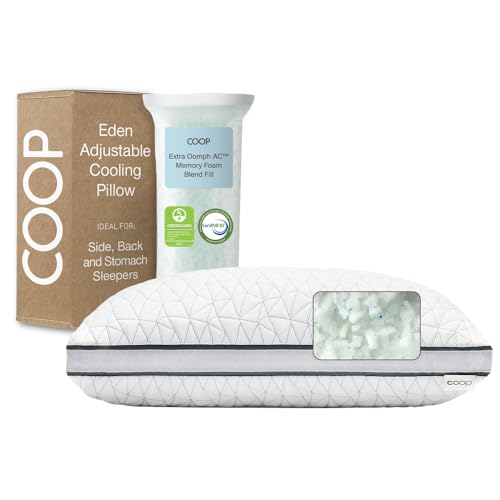
Coop Home Goods Eden Adjustable Pillow
The Coop Home Goods Eden takes the opposite approach to a fixed contour: instead of moulding the foam into one set shape, it fills a zippered inner case with a blend of shredded memory foam and soft microfibre-style fill that you can add or remove by the handful. That adjustability is the whole point. If most pillows feel a touch too high or a touch too flat, being able to tune the loft in small steps at home is a genuinely practical advantage, and it makes this design one of the most forgiving starting points for someone switching to an ergonomic pillow for the first time.
In use, the feel is plush and mouldable rather than firm and sculpted. You can punch it into shape, bunch it for reading, or flatten the centre for back sleeping, which suits restless sleepers who change position through the night. The trade-off for that freedom is upkeep: shredded fill shifts and benefits from a quick fluff to redistribute it, and the surface is less uniformly supportive than a solid contour. The removable cover can be washed following the label, while the fill itself should be kept dry and aired rather than washed, which keeps care simple as long as you use a protector.
In this line-up the Eden plays the role of insurance policy. Because the height can be changed after purchase, it is the pick that punishes a wrong guess the least, and for many households it ends up as the pillow that finally stops the cycle of buying, disliking, and donating pillows. Treat the first week as calibration rather than verdict, keep the removed fill in its bag, and you will likely land on a setting that a fixed pillow would have had to guess perfectly to match.
Best for: sleepers who have never found a fixed pillow height that feels right, and anyone who likes to reshape their pillow during the night.
Not suited for: sleepers who want a firm, sculpted contour that holds exactly the same shape every night with zero adjustment.
Strengths
- Loft you can fine-tune at home by adding or removing fill
- Mouldable feel suits position changers and pillow punchers
- Forgiving first step away from a flat, unsupportive pillow
Trade-offs
- Fill shifts over time and needs regular fluffing
- Less structured support than a solid contour shape
- Tuning takes a few nights of small experiments
This is a mid-to-premium tier option; check the current listing for the latest details before you buy.

Tempur-Pedic TEMPUR-Neck Pillow
The Tempur-Pedic TEMPUR-Neck Pillow is the classic fixed-contour design: a solid piece of dense TEMPUR material shaped with a higher edge and a dipped centre, offered in more than one size so you can match the profile to your build and sleep position. Where adjustable pillows ask you to find your own setting, this one makes the decision for you, and the dense foam holds that shape consistently night after night without fluffing, shaking, or rearranging.
The feel is firm, slow to respond, and very deliberate. You settle into it rather than sinking through it, and the contour encourages you to stay in the position the shape was designed around, which back sleepers and dedicated side sleepers often appreciate once they are used to it. That same firmness is the main hurdle: the adjustment period is real, the pillow can feel unyielding for the first several nights, and stomach sleepers generally find a raised contour edge uncomfortable. The foam core should never be washed; spot clean only, air it out, and wash the removable cover instead.
The premium tier buys consistency here more than luxury. The dense material feels much the same in year three as in week three, which matters for a product whose entire value is a shape. Owners who match the sizing to their build tend to become quietly loyal to it. Owners who guess the size tend to blame the concept. If you are between sizes, the maker’s own sizing guidance based on build and sleep position is worth more than any general advice, including ours.
Best for: back and side sleepers who want a set-and-forget contour and prefer a firm, supportive feel.
Not suited for: stomach sleepers, and anyone who wants to adjust the height after buying.
Strengths
- Consistent, sculpted contour that never needs fluffing
- Dense foam holds its shape and feel for a long time
- More than one size helps match the profile to your build
Trade-offs
- Firm feel has a noticeable adjustment period
- Fixed shape cannot be tuned if the height feels wrong
- Generally a poor match for stomach sleeping
This is a premium tier option; check the current listing for the latest details before you buy.
Epabo Contour Memory Foam Pillow
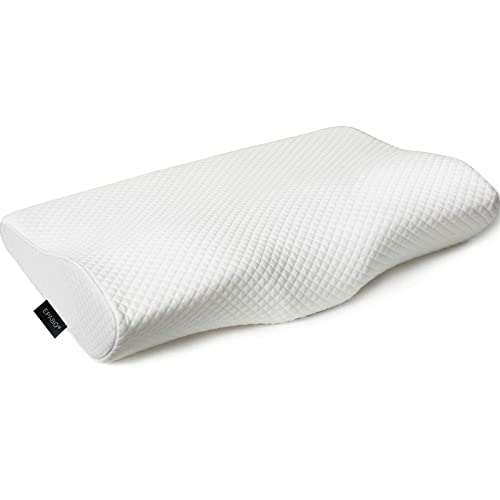
The Epabo Contour Memory Foam Pillow is a widely sold example of the classic butterfly-style contour: raised edges, a lower middle, and a shape intended to cradle the head while the edge supports a comfortable neck position through the night. It is the kind of design many people picture when they first search for an ergonomic pillow, and its accessible tier makes it a common first experiment with contoured sleep.
The memory foam has that familiar slow-response feel, softening slightly with body warmth as you settle in. A removable element in the design lets you fine-tune the height a little, which softens the all-or-nothing risk that fixed contours usually carry. As with most contoured foam, the first several nights can feel strange if you are coming from a soft hotel-style pillow, and the foam can sleep warmer than airy fibre fills. Care follows the memory foam rule: never machine wash the foam core, spot clean it, keep it dry, and wash the removable cover on its own.
Care and patience decide the Epabo experience. Keep the core dry, wash the cover, and resist judging it during the first strange nights. Owners who treat it as a two-week trial with notes tend to report a fair verdict either way. Owners who expect hotel-pillow familiarity on night one tend to return it and conclude that contours are not for them, which is a conclusion about the adjustment period rather than about the pillow.
Best for: first-time contour buyers who want to test the concept without stepping up to a premium tier.
Not suited for: very hot sleepers, and anyone who wants wide adjustability rather than small tweaks.
Strengths
- Classic contour shape at an accessible tier
- Some height fine-tuning built into the design
- Slow-response foam feels cushioning once you settle
Trade-offs
- Contour feel takes several nights to get used to
- Memory foam can sleep warm for hot sleepers
- One fixed basic shape will not suit every build
This is an entry-to-mid tier option; check the current listing for the latest details before you buy.
Milemont Memory Foam Pillow
The Milemont Memory Foam Pillow sits in the middle of the ergonomic market: a contoured memory foam design with a gently sculpted profile rather than an extreme one. That moderation is its appeal. The dip and raised edges are present, but the transitions are softer, so the pillow feels less like a piece of equipment and more like a supportive everyday pillow with better manners than a flat slab of foam.
For combination sleepers, that gentler geometry can be easier to live with, because rolling from back to side does not land you on a dramatically different height. The foam responds slowly, holds its shape well, and asks for no adjustment beyond choosing your size and giving it a fair trial across the adjustment period. Warm sleepers should note that solid memory foam generally breathes less than shredded or latex fills, and the core must be spot cleaned only, never machine washed, with the removable cover handling the regular laundry.
The Milemont is the diplomat of this line-up: enough contour to matter, not so much that it argues with you. For combination sleepers it may be the most liveable fixed design here, because the transition between its zones is gentle enough that rolling over does not feel like changing pillows mid-night. If your sleep data, or your partner, says you move a lot, weight that heavily; the best pillow for a mover is the one whose shape never punishes movement.
Best for: combination sleepers who want contour benefits in a milder, easier-going form.
Not suited for: sleepers who want to dial the height precisely, or who strongly prefer a cool, airy fill.
Strengths
- Gentle contour is easier to adapt to than aggressive shapes
- Holds its shape with no fluffing or tuning
- Balanced feel works across back and side positions
Trade-offs
- Solid foam can feel warm to hot sleepers
- No meaningful height adjustment after purchase
- Moderate contour may feel underwhelming to committed contour fans
This is a mid tier option; check the current listing for the latest details before you buy.

Qutool Cervical Pillow
The Qutool Cervical Pillow uses a pronounced hollow-centre contour: the middle dips to cradle the head while the surrounding edges are shaped to support a comfortable resting position for the neck and shoulders. Despite the clinical-sounding name, treat it as what it is, a comfort product with a distinctive shape, not a medical device. Its fans tend to be back sleepers who like the feeling of being settled into one defined spot rather than roaming across a flat pillow.
The pronounced geometry is both the draw and the risk. If the shape matches you, the pillow feels purposeful and stable; if it does not, there is little middle ground, and the adjustment period matters more here than with gentler designs. Arm-rest style contours on some versions give side sleepers a place to tuck a hand, which some people love and others ignore entirely. Memory foam care rules apply in full: keep the core dry, spot clean only, never machine wash the foam, and rely on the removable washable cover plus a protector for hygiene.
One practical note decides many Qutool experiences: the adjustment period is not a formality here. The shape is different enough from a conventional pillow that your first impression is nearly worthless, in either direction. Commit to the trial, keep notes, and judge at the end of it. Also mind the basics that surround any strongly shaped pillow: a case that fits, a protector for hygiene, and a strict no-washing rule for the foam core, which should only ever be spot cleaned and aired.
Best for: back sleepers who like a defined, cradled resting spot and want to try a stronger contour shape.
Not suited for: stomach sleepers, and anyone who prefers a soft, shapeless, hug-the-pillow feel.
Strengths
- Defined hollow-centre shape feels stable for back sleeping
- Distinct zones for different resting positions
- Accessible tier for experimenting with stronger contours
Trade-offs
- Pronounced shape is love-it-or-leave-it
- Longer adjustment period than gentle contours
- Limited use for stomach sleepers
This is an entry-to-mid tier option; check the current listing for the latest details before you buy.

DONAMA Cervical Pillow
The DONAMA Cervical Pillow is another hollow-centre contour design, shaped with a dip for the head, supportive edges, and extended zones intended to keep the pillow feeling stable as you settle. Like the other strongly shaped options in this guide, it is best understood as a comfort and sleep-quality product with a distinctive geometry, and it earns its place here because that geometry is exactly what a certain group of back and side sleepers goes looking for.
Living with it is a tale of the first fortnight. The shape can feel unfamiliar, even odd, for the first few nights, and the honest advice is to judge it after the adjustment period rather than after one sleep. Side sleepers often use the higher edges, back sleepers the centre dip, and the foam holds those zones without daily maintenance. Warmth is typical of solid memory foam, and care is the standard routine: the foam core is spot-clean only and must never go in a washing machine, while the removable cover can be laundered as the label directs.
Where the DONAMA can quietly shine is as a second, purpose-specific pillow: the one a back sleeper reaches for on the main bed while a softer, mouldable pillow handles reading and lounging. Not every pillow has to do every job. A household with a reading pillow, a sleeping pillow, and a guest pillow has not over-bought; it has simply stopped asking one rectangle of fill to be good at three different tasks, which is a reasonable definition of an ergonomic household.
Best for: back and side sleepers curious about hollow-centre contours who will give a new shape a fair trial.
Not suited for: stomach sleepers and anyone who wants a plush, mouldable pillow instead of a defined shape.
Strengths
- Stable multi-zone shape for back and side positions
- No daily fluffing or adjustment needed
- Accessible tier for a strongly contoured design
Trade-offs
- Unfamiliar feel during the first nights
- Fixed zones cannot be reshaped to taste
- Solid foam warmth may bother hot sleepers
This is an entry-to-mid tier option; check the current listing for the latest details before you buy.
Common Mistakes
Each step above has a characteristic way of being skipped, and the skips are so consistent they deserve their own section.
The most common buying mistake is choosing by keyword rather than by fit: picking the pillow with the most dramatic shape, the longest feature list, or the most persuasive story, without ever asking what height and firmness your own sleeping position needs. The second mistake is judging too fast, returning a contour after two strange nights when the adjustment period had barely begun. The third is ignoring the mattress: a pillow that was perfect on a firm bed can feel entirely wrong on a soft one, and people often blame the pillow for a change the mattress caused.
A fourth mistake is treating one pillow as a universal answer for two people. Partners with different builds and positions usually need different pillows, and compromising on one shared model often means both people get a mediocre fit. Finally, there is the hygiene mistake: assuming a foam pillow can be washed like a fibre one. It cannot. Buy the protector, wash the cover, spot clean the core, and the pillow will stay fresh for its whole working life instead of becoming a problem you replace early.
Pro Tips From the Fitting Process
A few habits separate buyers who nail the fit first time from buyers who return twice. Test your current setup before shopping, keep removed adjustable fill in its bag until the trial ends, photograph your resting position if you sleep alone, and refit from scratch whenever the mattress changes. Small disciplines, applied once, pay out nightly.
Because fit is so personal, the buying terms matter almost as much as the pillow. Before you order, read the seller’s trial and return conditions with your eyes open: how long you have to decide, whether a used pillow can be returned, and who pays for return shipping. A generous trial turns a risky experiment into a reasonable one, especially for fixed contours that cannot be adjusted if the height turns out wrong for your build. Keep the packaging until you are sure, and keep your receipt and order details somewhere you can find them.
Use the trial properly. Sleeping on a pillow for two nights and sending it back tells you almost nothing, because the adjustment period has barely started. Sleeping on it for two or three weeks, through the strange phase and into the settled phase, tells you nearly everything. Take brief notes if your memory is unreliable: how the first hour felt, how the morning felt, whether you woke up to rearrange things. Patterns in those notes are far more trustworthy than a single night’s impression, and they make the keep-or-return decision an evidence decision instead of a mood decision.
Worked Examples
Watch the seven steps run on three typical buyers, and notice how early steps do most of the deciding.
Consider three buyers. The first is a back sleeper on a medium mattress who wakes up to punch a flat fibre pillow back into shape. A gentle fixed contour or a mid-height adjustable gives this sleeper a stable resting spot and ends the nightly reshaping, with the adjustable option safer if their build is unusual. The second is a side sleeper with broad shoulders on a firm mattress, currently using two stacked pillows that slide apart. This sleeper needs genuine height in a single stable pillow: a higher contour profile or an adjustable filled generously, plus a case that keeps everything in place.
The third buyer is a combination sleeper who starts on their side and finishes on their back, sharing a bed with a partner who sleeps completely differently. For this buyer, extremes are the enemy: a gentle contour or an adjustable set to a middle height handles both positions without punishing either, and the partner should be fitted separately rather than handed a matching pillow for the sake of symmetry. Notice what all three examples share: the decision started from position, build, and mattress, and only then moved to products. That order, needs first and models second, is the whole method of this guide in miniature.
The Short Version
Position, gap, mattress, temperature, shape, material, trial. Run those seven considerations in that order and the catalogue shrinks from overwhelming to obvious, usually to one or two designs that genuinely fit your life. That is the entire skill this guide teaches, and it transfers to every pillow you will ever buy after this one. For the balanced evidence on what these pillows do well and badly once fitted, continue to ergonomic pillow pros and cons in full.
A Closer Look at Temperature
Step five deserves reinforcement, because temperature is the criterion choosers most often underweight and most often regret.
Temperature is the quiet deal-breaker in this category. Solid memory foam moulds by responding to warmth, and that same density can hold heat against your head and neck, which bothers light sleepers and anyone who runs hot. Makers respond with gel infusions, ventilated foam, and breathable covers, and these features help at the margins, but they do not turn a dense foam pillow into an airy one. If you are a genuinely hot sleeper, shredded fills that let air move, springy latex, or a cooling-focused design will usually serve you better than a solid contour with a cooling label.
Your bedding choices amplify or soften the effect. A breathable pillowcase fabric, a protector that is not plastic-feeling, and a bedroom that is not overheated all help any pillow sleep cooler. Judge temperature over several nights rather than one, because room conditions vary. And be honest about your priorities: a hot sleeper who buys a dense contour for its shape and then sleeps badly from warmth has optimised the wrong variable. Comfort is a system, and temperature is one of its load-bearing parts.
Sizing Details That Decide the Fit
Between the steps sits a layer of fine print that decides whether a well-chosen pillow actually fits your bed and cases.
Pillow size sounds trivial until a new pillow does not fit your cases or crowds a smaller bed. Most ergonomic pillows come in standard, queen, and sometimes king lengths, with contours also varying in height profile between sizes. Match the pillow to the cases you own or budget for new ones, and remember that a contoured pillow inside a case that is far too large will shift and bunch, which quietly undermines the shape you paid for. A case that fits reasonably closely keeps the contour where it belongs.
Height profiles deserve the same attention as length. Some contour designs offer more than one height, and the taller option is not the upgraded option; it is simply the option for a different build and sleep position. Bigger is not better in pillow geometry. The right size is the one that fills your personal gap between mattress and head without lifting you into an angle, and for many average builds that is the middle option, not the maximum. When a listing offers a size guide based on shoulder width or sleep position, use it; it exists because returns taught the maker where people guess wrong.
Surviving the Adjustment Period
The trial in step seven only works if you understand what the first fortnight will feel like and why it misleads.
Almost every ergonomic pillow, and especially every contour, comes with an adjustment period, and planning for it will save you from returning a good pillow too early. Your muscles, habits, and expectations have been shaped by your old pillow, sometimes for years. A new shape changes where your head rests and how your neck is supported, and the first few nights can feel strange, stiff, or simply unfamiliar even when the pillow is objectively a better match. Strange is not the same as wrong. Give a new contour at least a week, and ideally closer to two, before you judge it, unless something feels clearly and persistently wrong.
Work with the adjustment period instead of enduring it blindly. Start with the new pillow for the whole night rather than swapping back at two in the morning, because the swap resets your adaptation. Keep everything else in the bed the same so the pillow is the only variable. If the design allows height tweaks, make one small change at a time and sleep several nights between changes. And keep perspective: if discomfort is sharp, worsening, or still present after a fair trial, stop forcing it. Persistent pain is a reason to talk to a healthcare professional, not a reason to push through with a different pillow shape.
Care Rules That Protect the Choice
A well-chosen pillow can still be ruined by one wash, so the care rules belong inside the choosing process, not after it.
Memory foam care is simple but non-negotiable: the foam core itself must never go in a washing machine and should never be soaked. Machine washing breaks down the foam’s structure, and a soaked core dries so slowly that it can develop odours long before it dries out. If the core needs attention, spot clean small marks with a barely damp cloth and a little mild detergent, press moisture out with a dry towel, and let the pillow air in a ventilated spot away from direct heat until it is completely dry before the cover goes back on.
The removable cover is your hygiene workhorse, so wash it regularly following its label, and add a pillow protector underneath it for another washable barrier against sweat and spills. Air the whole pillow out when you change the bedding; foam benefits from fresh air and a chance to release the warmth and moisture of the week. New foam can carry a factory smell at first, which normally fades after a day or two of airing in a ventilated room before first use. None of this is demanding, but it is different from the wash-everything routine that works for fibre pillows, and it is worth knowing before you buy rather than after the first spill.
Special Cases: Partners, Guests and Travel
Three common situations bend the standard method, and each has a simple adjustment.
Two situations deserve a word of their own. Guest rooms are the first: a guest pillow should be the most forgiving pillow you own, not your most specialised one, because you cannot fit a pillow to a stranger’s build and position. An adjustable or a medium, gentle design adapts across visitors in a way a pronounced contour never will. The second situation is the shared bed at home. Fitting each partner separately feels unromantic and is completely correct; sleep is individual even when the bed is shared, and two different pillows on one bed is a sign the fitting was done properly.
There is also the travel question. A full-size ergonomic pillow is a bulky travel companion, and most people reasonably leave it at home and accept a few nights of hotel pillows. If you travel constantly and your sleep suffers for it, smaller travel versions of contour shapes exist and are worth a look; if you travel twice a year, your money is better spent on the pillow you use for the other fifty weeks. Prioritise the nights that dominate your life, and let the exceptions be exceptions.
Test Before You Shop
The method improves further if you gather your fitting data before opening a single product page.
You can learn a surprising amount before buying anything by testing your current setup honestly. Lie in your usual sleep position on your current pillow and pay attention to where the gaps and pressure points are. A partner or a phone camera on a timer can show you whether your head is tipped up, dropped back, or resting level. Note whether you fold your pillow, stack pillows, or sleep with an arm under your head; each habit is your body improvising the support the pillow is not providing, and each one points at a specific fix.
Improvisation is useful data. Folding suggests you need more loft or firmer support. An arm under the head suggests the same. Pushing the pillow away entirely suggests it is too high or too firm for your position. Waking with the pillow on the floor suggests it never felt right at any point in the night. Bring those observations to your shopping and the product descriptions start to sort themselves: you are no longer browsing shapes, you are matching a shape to a documented need, which is a much shorter and more successful search.
What the Tiers Buy a Chooser
Budget is a choosing variable too, and it helps to know exactly what each step up purchases.
Ergonomic pillows span entry, mid, and premium tiers, and it helps to know what the steps between tiers actually buy. Entry tier contours offer the basic shapes in standard foams and are a sensible way to test whether a contour suits you at all. Mid tier options add better foams, more considered covers, size choices, and the adjustability features that reduce fitting risk. Premium tier designs buy material quality, consistency, and longevity: dense foams that hold their shape for years, well-finished covers, and sizing systems that take some of the guesswork out of matching a pillow to a build.
What extra money does not buy is a guarantee of personal fit. A premium pillow in the wrong height is still the wrong height, and an entry pillow in the right shape can outperform it for a particular sleeper. Spend first on getting the geometry right, ideally with adjustability or a fair trial as insurance, and spend second on material quality once you know the shape works. That ordering keeps the budget pointed at the variable that decides your sleep, rather than the variable that decides the product page photography.
Ergonomic Pillow: Troubleshooting the Steps That Commonly Go Wrong
Start with where people most often get stuck with a {p} and how to recover quickly. Most coverage of a ergonomic pillow concentrates on the first week of ownership, yet the decisions that matter most tend to surface later, once the ergonomic pillow has to earn its place in an ordinary weekday routine rather than a carefully staged first attempt. Write down the three jobs you expect it to do most often, in the order you actually do them, and judge every claim you read against that short personal list instead of against a generic ideal.
Maintenance decides how long the good results last. Set a simple rhythm: a quick wipe or rinse after each use, a deeper clean on a fixed day, and a periodic check of the parts that move, seal or bear weight. A ergonomic pillow that needs fiddly disassembly for basic care will be cleaned less often, and performance drifts long before anything actually breaks. Prefer designs where the parts that get dirtiest are the parts that are easiest to reach, and be honest with yourself about which cleaning steps you will genuinely keep up.
Use a short decision checklist to finish. One, does it fit the space and the storage you really have. Two, does it handle your three most common jobs without a workaround. Three, do the edge cases you listed stay manageable. Four, can every wear part be cleaned or replaced without drama. Five, would you still choose it if a friend described the same drawbacks in their own kitchen. A ergonomic pillow that passes all five is a sound buy; one that fails two or more is a compromise you are choosing with open eyes, which is a very different thing from being surprised later.
When you check listings such as Coop Home Goods Eden Adjustable Pillow, Tempur-Pedic TEMPUR-Neck Pillow and Epabo Contour Memory Foam Pillow, use them as worked examples: run through the same checks below on each one in turn, so the comparison stays honest and like for like rather than based on whichever listing happens to shout loudest.
Measure before you commit. Note the footprint, the clearance above and behind the spot where the ergonomic pillow will live, and the route you will carry it by when it is hot, full or awkward. A ergonomic pillow that technically fits but blocks a cupboard door, crowds a neighbouring appliance or has to be dragged across a worktop every time will quietly fall out of use, whatever its merits on paper. In the Health & Wellness Devices category especially, a few centimetres of clearance and a sensible storage plan separate a daily tool from a bulky regret.
Edge cases deserve a deliberate pass. Think about the odd shapes, the thicker or thinner than usual loads, the leftovers, the second helping and the guest with different preferences. A well-chosen ergonomic pillow handles the exceptions gracefully, or at least predictably, while a poor match turns every exception into a workaround. List your two or three most common exceptions in advance and check, from the manual or the listing details, that nothing about them is ruled out by size, shape, material or care requirements.
Finally, plan the first fortnight deliberately. Use the ergonomic pillow for one familiar job first, so you have a baseline you trust, then introduce the harder cases one at a time and note what changes. Small adjustments to arrangement, timing, quantity or preparation usually close most of the gap between disappointing first results and the performance the design is capable of. That short learning period is also the fairest test of the failure points and fixes: if the routine has not settled by the end of it, the mismatch is real, and it is better to know while returning or exchanging is still straightforward.
Frequently Asked Questions
What is the most important factor when choosing an ergonomic pillow?
The match between the pillow’s height and shape and your own sleep position, build, and mattress. That match decides whether the pillow supports a comfortable resting position or fights you all night. Material, brand, and features all rank below it. A modest pillow with the right geometry will serve you better than a premium pillow with the wrong one, which is why this guide spends its steps on measuring your needs before it ever mentions specific products.
How do I know if I need a high or low pillow?
Work from your position. Side sleepers generally need the most height because the shoulder widens the gap the pillow must fill, and broader shoulders need more again. Back sleepers usually need a medium height. Stomach sleepers need the least and often do best outside the contour category. Then adjust for your mattress: softer beds let you sink and reduce the height required, firmer beds keep you higher and increase it. Your current improvisations, folding, stacking, or an arm under the head, are clues that you need more height or support.
Is memory foam or latex better for an ergonomic pillow?
Neither is better in general; they feel different and suit different sleepers. Memory foam moulds slowly, holds sculpted shapes, and feels dense and still, but tends to sleep warmer and must never be machine washed. Latex responds instantly, feels springier, and breathes better, but its bounce is not to everyone’s taste and it rarely offers the pronounced contours foam can hold. Hot sleepers and movement-lovers lean latex or shredded fills; still sleepers who want a defined shape lean foam. Your temperature and your tolerance for bounce decide it.
Should a first-time buyer choose adjustable or fixed?
Adjustable is the safer first purchase for most people, because it forgives an uncertain guess: you can change the height at home as you learn what you need. Fixed contours suit buyers who already know their size, sleep in one position, and value a consistent sculpted shape with zero maintenance. There is no wrong answer, only a risk decision. If your budget allows one experiment, spend it on the option that lets you correct mistakes rather than the one that punishes them.
How long should I test a new pillow before judging it?
At least a week of full nights, and ideally closer to two, particularly for contoured shapes. The first nights measure your old habits more than the new pillow. Keep everything else in the bed unchanged, make any adjustments one at a time, and take brief notes on how nights and mornings felt. Judge on the pattern at the end of the trial. Persistent or worsening discomfort is the exception: stop, reassess, and talk to a healthcare professional if pain is involved.
What if no ergonomic pillow feels right?
First, check the system rather than the pillow alone: a mattress that has softened or a change in your usual position can make every pillow feel wrong. Second, revisit height before brand, because most failed fits are height failures. Third, consider that a conventional quality pillow may simply suit you better; ergonomic shapes are tools, not obligations. And if pain or numbness is part of the picture, step out of the shopping frame entirely and get professional advice, because that is a health question, not a bedding question.
Related Reading
Keep exploring this topic with the companion pieces in this series and the wider pillow guides on this site: