Disclosure: As an Amazon Associate, topratedkitchenware.com earns from qualifying purchases. Links on this page are affiliate links; they cost you nothing extra. Prices and availability change often, so check the current Amazon listing before you buy.
Countertop oven reviews usually fail in one of two ways: they crown a single winner and ignore that households differ, or they list every model on the market and judge none of them. These countertop oven reviews take the middle path. Six models that between them define the modern category — a premium benchmark, two strong mid-tier all-rounders, a family-size speed specialist, a value workhorse and the classic entry-level toaster oven — are compared on the things that actually separate them in a working kitchen: evenness of cooking, capacity in real pans, controls you will enjoy or endure, air frying credibility, cleaning effort, and the heat and space each one brings to your counter. Every model here is treated in prose, positioned by tier rather than by any fixed price, because listings change; check the current Amazon listing for the configuration on offer when you buy. By the end, the aim is not to tell you which countertop oven is best in the abstract, but which of these six is best for the way your household actually cooks.
Countertop Oven Reviews: The Short Version
If you read nothing else: the Breville Smart Oven Air Fryer Pro is the class benchmark for cooking evenness and build, and the pick for keen cooks with the counter and the budget tier to match. The Ninja Foodi XL Prestige is the family-throughput choice — wide, fast and preset-friendly. The Cuisinart TOA-65 is the balanced mid-tier default that most households will be happy with, and the Instant Omni Plus is its closest rival, friendlier to preset-guided cooks. The Hamilton Beach countertop oven is the honest value pick for basics done well, and the BLACK+DECKER toaster oven remains the right answer when the brief is simply toast, reheats and small portions in a small space. None of the six is a bad appliance; they are answers to different questions, and the rest of these reviews exist to help you ask yours precisely.
One pattern runs through every comparison that follows, and it is worth naming before the detail begins: in this category, money buys evenness, refinement and capacity — in that order — and it does not buy different food. A value-tier oven roasts the same chicken thighs as a premium one; it asks a little more attention, browns a little less uniformly, and cleans a little less easily. That is why these reviews keep returning to frequency of use as the deciding variable. A household cooking in its countertop oven daily will feel every refinement it paid for, every day. A household cooking in it twice a week will feel the counter space it surrendered far more than the evenness it gained. Judge the tiers against your own calendar, and the rankings below will fall into place almost by themselves.
Key Takeaways
- Evenness is the premium feature: it, not function count, is what higher tiers really sell.
- Mid-tier models are the sweet spot for most households — full versatility without the premium tier’s size or cost.
- Judge capacity by your own pans and meals, never by headline claims.
- Air fry performance is strong across the class; the differences are in tray capacity and turning, not basic crisping.
- Every model needs manufacturer-specified ventilation clearance and crumb discipline — ownership terms are identical even when prices are not.
- Controls are a daily relationship: choose dials or display by temperament, not by fashion.
In this guide
How These Countertop Oven Reviews Were Judged
Each model was assessed against the same six criteria, weighted the way owners actually experience them. Cooking evenness comes first, because it shows in every meal: toast that browns uniformly, vegetables that colour rather than steam, bakes that rise and set evenly. Real capacity comes second — not the marketing number, but the pans, trays and meals the chamber genuinely accepts with air space to spare. Controls and usability third: how quickly a new user becomes fluent, how repeatable results are, whether mid-cook adjustments are graceful. Air frying fourth, judged on crisping, capacity per batch and the effort of turning food. Cleaning and living-with-it fifth: crumb management, interior finish, exterior heat, fan noise, and the clearance the manual demands. Value last, and value by tier — what the model delivers relative to its own class position, described in words, because a fair review compares a value model against value expectations and a premium model against premium ones.
Two ground rules apply across all six. First, no model was penalised for lacking a function its tier never promised; the entry-level toaster oven is judged as a toaster oven, not as a failed smart oven. Second, safety and placement requirements are treated as facts of the category, not differentiators: every one of these ovens needs a heat-resistant surface, clear ventilation space on the sides, back and above as its manual specifies, distance from anything flammable, and a crumb tray that gets emptied. Where models differ — in how hot the shell runs, how loud the fan is, how easy the interior is to wipe — that is noted, because those differences shape daily life.
A third ground rule deserves stating, because readers of countertop oven reviews are right to be suspicious of them: these reviews contain no prices, no scores and no countdown of best-to-worst, because none of those survive contact with a real kitchen. Prices move between listings and seasons, so each model is placed by tier — entry, value, mid, upper mid, premium — which is the comparison that stays true. Scores pretend that evenness, capacity, controls and cleaning collapse into one number, when every household weights them differently; the criteria sections exist so you can apply your own weights. And a single ranked list would hide the finding that matters most in this category, which is that the right model is a matching exercise, not a championship. What these reviews offer instead is judgement with its reasoning visible, so you can disagree productively and still end up with the right oven.
The Six Models at a Glance
The table below summarises positioning, not specifications — tiers and strengths in words, so it stays true as listings change.
| Model | Tier | Best at | Watch out for |
|---|---|---|---|
| Breville Smart Oven Air Fryer Pro | Premium | Evenness, baking, build quality | Size and premium-tier cost |
| Ninja Foodi XL Prestige Countertop Oven | Upper mid | Family tray meals, speed | Wide footprint |
| Cuisinart TOA-65 | Mid | All-round balance, digital control | Interior cleaning discipline |
| Instant Omni Plus | Mid | Presets, air frying, family portions | Function-menu complexity |
| Hamilton Beach Countertop Oven | Value | Basics done honestly | Temperature learning curve |
| BLACK+DECKER Toaster Oven | Entry | Toast, reheats, small spaces | Capacity and evenness ceiling |
Read the table as a map, then read the model reviews for the terrain. The category background — what these machines are and how the format evolved — is covered in the companion countertop oven review, while sizing and criteria get the full treatment in the countertop oven buying guide.
The Models, Reviewed One by One
Breville Smart Oven Air Fryer Pro
Breville’s flagship earns its benchmark status in the least glamorous way possible: it cooks the most evenly. The oven’s element management — shifting power between elements as the cooking demands — produces toast with uniform colour, roast vegetables with real caramelisation across the tray rather than in patches, and bakes that set and rise the way a good full oven’s do. For bakers, this is the model in the class that asks the fewest apologies. The function range is the broadest here, the chamber takes family-size trays and dishes, the interior finish wipes down more easily than most, and the controls — a dial-led interface with a clear display — manage to feel both precise and unfussy. The trade-offs are presence and price tier: it is a large machine that needs its full clearance, and it sits firmly in premium territory. Owners who cook daily and bake often tend to consider both worth it; households that mostly reheat should look down the list. Best for: serious home cooks, bakers, households replacing most full-oven use. Not suited for: small counters, minimal needs, value-first budgets.
Living with the Breville day to day reinforces the verdict. The interior light and clear countdown display make mid-cook checks effortless, the rack glides rather than scrapes, and the non-stick interior coating is the easiest in this group to return to clean after a fatty roast — a difference that sounds minor in a review and feels major in month three. Toast, the daily staple, is where its evenness is most visible: consecutive batches come out matching, which is rarer in this category than it should be. Its air fry mode is strong rather than class-leading, trading a little ultimate crunch for tray capacity, and the dehydrate and proofing functions are genuinely usable rather than decorative. If your cooking spans baking, roasting and reheating in roughly equal measure, this is the model whose compromises you will notice least.

Ninja Foodi XL Prestige Countertop Oven
Ninja built this oven around a specific insight: on weeknights, families cook tray meals, and they want them fast. The wide chamber takes a full family tray of protein and vegetables in a single layer, the preheat is quick, and the convection is powerful enough that roasting and air frying — the two jobs this audience cares about — are genuine strengths rather than listed features. Presets are tuned to real food rather than marketing categories, and the whole experience feels designed by people who watched families cook. The width that enables the tray capacity is also the caveat: this oven claims a long run of counter, and kitchens with short runs or corner placements should measure with the clearance included before falling for it. It is less a baker’s instrument than the Breville and more a family engine. Best for: families, tray-meal cooks, air fry and roast priorities. Not suited for: narrow counters, precision baking, dial traditionalists. Households comparing it against the wider field of oven-style fryers will also want the best air fryer toaster oven combos.
Ownership of the Ninja is defined by rhythm: it is the oven you reach for when dinner needs to happen now and feed everyone at once. The wide tray means proteins and vegetables cook together in a single layer with proper browning, rather than steaming in a crowded pile, and the presets remove the small daily friction of translating recipes into settings. Its air fry output — wings, chips, breaded cutlets — is among the most convincing in this group, and reheating is fast enough to compete with the microwave for impatient households while beating it on texture every time. The compromises are the footprint already noted, a fan that makes its presence heard, and baking that is good rather than distinguished. Families will forgive all three; a solo cook in a small kitchen should not buy this much oven.

Cuisinart TOA-65 Digital AirFryer Toaster Oven
The TOA-65 is the model these reviews would hand to a household that said only: we want one good countertop oven, please. Its digital controls give repeatable temperatures and times that dial models cannot match for consistency, its fan delivers convincing air frying and even roasting, and its capacity sits in the class’s sweet spot — family casseroles and trays fit, the counter is not consumed. Nothing about it leads the class in any single criterion, and that is precisely its appeal: it is second or third best at almost everything, which in a real kitchen adds up to the most usable whole. The ownership notes are the class’s standard ones, with emphasis on interior cleaning: the chamber rewards a wipe-down habit and punishes neglect with baked-on splatter that gets harder to shift. For most buyers, most of the time, this is the sensible centre of the market. Best for: couples and small families wanting one versatile oven. Not suited for: the largest families, or buyers wanting the coolest-running, quietest shell.
What owners consistently praise in the TOA-65 is repeatability: the digital timer and temperature control mean Tuesday’s result can be reproduced on Friday, which dial models approximate and this one simply does. Toast shade holds its setting, the air fry basket format keeps small items contained, and the footprint-to-capacity ratio is among the best here — it asks for mid-size counter space and returns family-size usefulness. The honest criticisms are that the interior, like most of the class, collects splatter in corners that need a deliberate wipe rather than a casual one, and that the shell and fan are mid-tier in refinement: audible, warm to the touch at full work, unremarkable. Neither flaw is unusual; both are the price of the tier, and the tier is priced fairly for what it cooks.

Instant Omni Plus
The Omni Plus is what happens when the Instant Pot philosophy — guided functions, confident presets, family portions — is applied to a countertop oven, and for the brand’s large audience it will feel instantly familiar. Air frying is a strength, as you would expect from this stable; roasting and baking are handled competently; the display communicates stage and time clearly; and the chamber is sized for real family food rather than snacks. Compared directly with the Cuisinart, the choice is temperament: the Omni Plus guides more, the TOA-65 leaves more to you, and both cook well. Finish and materials are honest mid-tier, the accessory set covers the standard jobs, and the function menu will delight preset fans while slightly wearying minimalists. Best for: Instant households, preset-guided cooks, families. Not suited for: two-dial traditionalists, the smallest kitchens. The connected, app-led end of this market is surveyed separately in our best smart ovens guide.
The Omni Plus’s character shows most in households that cook by program rather than by instinct: select the function, let the machine propose its defaults, adjust the time if the portion is large, and dinner proceeds with very little standing over it. That guidance extends its appeal to less confident cooks, who get good roasting and air frying results without learning an oven’s moods first. Experienced cooks sometimes find the same guidance a half-step slower than direct controls, which is the model’s defining trade-off in miniature. Capacity, cleaning and heat behaviour are all class-standard mid-tier: family portions fit, the interior wants its regular wipe, the shell wants its clearance. It is a model with no serious weakness and a clear personality, which is more than most of the market manages.
Hamilton Beach Countertop Oven
Hamilton Beach occupies the value tier the way it should be occupied: by doing the basics properly and skipping the theatre. The convection models in this line roast and bake creditably, the dials are learnable in a day, and the easy-reach door design offered on some versions — rolling up and over rather than swinging down — is a genuinely thoughtful answer to tight counters and short reaches, as well as a safety plus when hands are full. What you do not get is refinement: temperature settings need a little calibration by experience, browning is less even than the tiers above, and the finish shows its tier under close inspection. Judged against value-tier expectations, though, it delivers exactly what it promises, and its type has been doing so in kitchens, offices and rentals for years. Best for: value-first buyers, second ovens, straightforward cooking. Not suited for: precision bakers, air fry maximalists. Shoppers cross-shopping the classic format should also see the best toaster ovens roundup.
In daily use the Hamilton Beach asks for one thing the digital models do not: a short apprenticeship. Its dial settings are approximate in the way of all dial ovens, so the first few cooks are calibration — noting where your preferred toast shade actually lives, learning whether your unit runs a touch hot for baking, adjusting by habit thereafter. Owners who serve that apprenticeship report a perfectly satisfactory oven; owners who expect display precision from a dial are the ones who leave disappointed, which is a mismatch of expectations rather than a failure of the machine. Everything else is straightforward: trays and racks are simple, the interior cleans with ordinary effort, and the whole appliance feels built to be used hard and understood completely. For a rental, an office kitchen or a first home, that is a persuasive combination.
BLACK+DECKER Toaster Oven
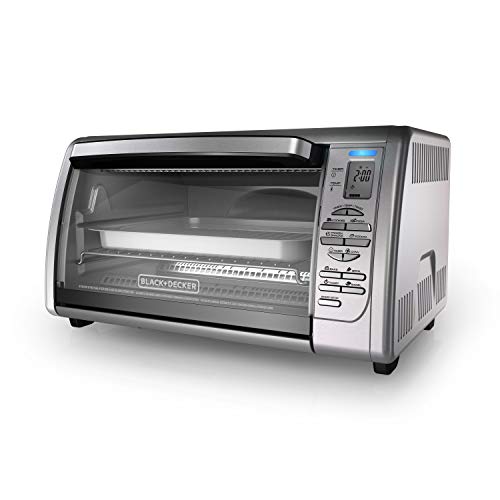
The simplest appliance in these reviews, and in the right kitchen still the correct one. A compact BLACK+DECKER toaster oven toasts breakfast, reheats portions, melts, crisps and bakes small things for one or two people, with controls a guest can operate without instruction and a footprint that fits kitchens the bigger ovens in this list cannot enter. The larger models in the range add convection and air fry functions and stretch capacity somewhat, but the honest centre of the line is the basic machine, and its limitations are the honest ones of its class: modest capacity, simpler browning, fewer functions. It is not a failed countertop oven; it is a successful toaster oven, and households whose oven jobs are genuinely small will be happier with it than with a large machine idling on the counter. Best for: singles, couples with simple needs, dorms, offices, tiny kitchens. Not suited for: family cooking, keen bakers, tray-meal households. If your needs sit between this and a full countertop oven, the best air fryers that toast covers the crossover machines.
The BLACK+DECKER’s daily virtue is invisibility: it sits in a small footprint, asks nothing, and performs its short list of jobs — toast in the morning, a reheated portion at lunch, a baked potato or a tray of garlic bread at dinner — without menus, updates or decisions. Guests and teenagers operate it correctly the first time. Its toast can stripe slightly under the elements and its chamber will not take a family casserole, and owners who bought it knowing that are among the most content in this entire category; owners who bought it hoping to roast Sunday dinners are the disappointed ones, and the disappointment was in the brief, not the box. Buy it for what it is and it is, within these reviews, the easiest recommendation of all to stand behind.
Head to Head: Where the Real Differences Live
Evenness and Baking
The Breville leads, clearly, with the Cuisinart and Instant a step behind and close to each other, the Ninja strong on roasting trays but less distinguished in delicate baking, and the value and entry models requiring the owner’s learned adjustments — rack position, rotation, a foil shield — to reach results the top of the class reaches unaided. If you bake weekly, this ranking should weigh heavily; if you never bake, ignore it entirely and rank by the criteria below.
Capacity in Real Meals
The Ninja’s wide tray format wins for family sheet-pan cooking; the Breville’s chamber is the most generally capable, taking the widest range of dishes; the Cuisinart and Instant cover the family mainstream; the Hamilton Beach serves couples and small families honestly; the BLACK+DECKER serves one or two. Remember that usable capacity is your pans plus air space, and that every model’s true footprint includes its ventilation clearance — a point the sizing guide at how to choose a countertop oven turns into a measuring exercise worth doing before any purchase.
Air Frying
All four function-led models air fry well enough to satisfy most households, with the Instant and Ninja feeling most at home in the mode and the Breville and Cuisinart close behind. The practical differences are batch geometry — wide trays versus deeper baskets — and how much turning the food wants. The Hamilton Beach and BLACK+DECKER models with air fry functions handle modest batches creditably. Anyone whose cooking is mostly air frying in small batches should honestly consider a dedicated fryer instead; our best air fryers guide covers that field.
Cleaning, Heat and Noise
Premium construction shows here: the Breville’s interior finish and the general fit of the top models make wipe-downs easier and shells run better insulated. Mid-tier models are perfectly manageable with a routine. All six need the same non-negotiables — crumb tray emptied often, interior wiped when cool, nothing flammable near the vents, clearance kept clear — and the full routine is set out in how to clean a countertop oven. Fan noise follows power and price loosely: present on all, least intrusive at the top of the market.
Functions Across the Six: What Each Mode Is Really For
Because function lists drive so much marketing in this category, these reviews close the comparison with a mode-by-mode reality check that applies to all six models. Toast is the daily referendum, and the ranking mirrors the evenness ranking: Breville most uniform, the digital mid-tier pair consistent, Ninja good, the dial models dependent on learned settings. Bake separates bakers’ models from reheating models more than any other mode — temperature steadiness and top-element manners decide cakes and batters — and again the premium and digital models hold the advantage. Roast is the great leveller: every fan-equipped model here roasts vegetables and chicken pieces well, because the physics of a small fan chamber flatter the task, and this is the mode where value-tier buyers lose least. Broil rewards the models with strong top elements and punishes inattention equally across all six; rack position matters more than brand. Air fry, as the head-to-head section noted, is a strength of the function-led four and a pleasant extra on the value models that offer it. Reheat and keep-warm are unglamorous and universally competent — no model in this group reheats badly, which is worth saying plainly because it is the mode many households will use most.
The speciality modes deserve the scepticism this review promised. Dehydrate appears on the Breville and some rivals and works — slowly, competently, in small batches — for households that preserve herbs, fruit or jerky; for everyone else it is a line on a box. Proofing is the sleeper feature: bread bakers in cool kitchens rate it among their favourite functions, and it appears on more mid-tier models than it used to. Rotisserie and probe cooking are genuine capabilities where fitted, aimed at enthusiasts who will use them monthly; bought for a fantasy, they are counter clutter with a motor. The verdict across all six reviews is the same: the core six or seven modes decide satisfaction, the speciality modes decide nothing unless they match a hobby you already have. Buy the core executed at your tier, and treat anything beyond it as a gift.
A Note on Sizes, Pans and the Meals in Between
One comparison these reviews return to deliberately is size, because it is where buyers most often misjudge. The six models span three practical bands. The BLACK+DECKER band is the personal oven: toast, portions, small bakes for one or two. The mainstream band — Cuisinart, Instant, Hamilton Beach — is the family oven in its everyday sense: casseroles, trays of chicken, frozen pizzas, batches of cookies, all with room to breathe. The large band — Breville, and the wide-format Ninja — is the entertaining and big-batch band, and it asks the most counter in exchange. The trap is assuming bigger is safer. An oversized chamber used for small jobs preheats slower, browns less eagerly and dominates a counter for capacity that gets used twice a year; an undersized chamber used for family jobs forces batches that erase the category’s convenience. The correct size is the one that fits your three most common meals with air space around the pan — no more, no less — and every model in these reviews is the right size for somebody. Measure your pans, measure your counter with clearance, and let those two tape measures overrule every headline number in the category.
Six Kitchens, Six Answers
Abstract criteria land better as kitchens, so here are the six profiles these reviews were really written for. The baker’s kitchen — sourdough on weekends, cakes for birthdays, a standing interest in even browning — belongs to the Breville, and no other model in this group will satisfy it as completely; its proofing, its steadiness and its finish are aimed exactly there. The family engine room — school nights, tray dinners, wings for a crowd of cousins — belongs to the Ninja, whose width and speed turn the five-o’clock problem into a routine. The mainstream flat or family home that wants one appliance to handle everything without specialising belongs to the Cuisinart, or to the Instant if the household already cooks by program and likes its dinner guided. The rental, the office kitchenette and the holiday home belong to the Hamilton Beach: honest cooking, nothing to break your heart or your deposit over, and controls any guest can run. The studio, the dorm and the one-person household belong to the BLACK+DECKER, which will toast, reheat and bake small things for years while occupying the counter space the others merely dream of. And the second-oven kitchen — the one that already owns a good range and wants a deputy for sides, reheats and summer cooking — should buy by the job it is deputising: the Cuisinart or Instant for general duty, the Ninja if the deputy must handle family trays alone.
Two profiles should not buy from this list at all, and reviews serve readers better by saying so. The household that cooks almost entirely on the stovetop and reheats in the microwave, toasting twice a week, does not need a countertop oven of any size — a simple toaster covers its life, and the counter space is worth more than the appliance. And the household that regularly cooks for eight or more should treat every model here as a supplement rather than a solution; its money belongs in the full-size oven’s capacity, with perhaps the value-tier Hamilton Beach as a reheating deputy. Knowing which list you are on — the six kitchens above, or these two — is the single most valuable judgement in this entire comparison.
Ownership After the First Month
Reviews are written at the start of ownership; satisfaction is decided later, so it is worth projecting each model forward. The pattern across the category is consistent: the first month is about learning — where the toast shade lives, which rack position suits your trays, how your machine’s temperature personality compares with the dial. The models differ in how long that apprenticeship lasts. The digital Cuisinart and the guided Instant shorten it with repeatable settings and sensible defaults; the Breville shortens it with evenness, which forgives imprecision; the dial-driven Hamilton Beach and BLACK+DECKER ask the most of the owner and repay it with simplicity ever after; the Ninja’s learning curve is mostly about its size — arranging the counter life around a wide, hot, frequently used machine.
By the second month, the differentiator becomes cleaning tolerance. Every oven in this group cooks fatty food in a small chamber, and every interior tells the story. Owners who wipe the cool interior weekly and empty the crumb tray on rhythm find all six models age gracefully. Owners who do not will find the mid and value tiers show it first — corners, door frames and the area around elements collect baked-on residue that eventually smokes — while the Breville’s finish buys a little more forgiveness, not immunity. Heat and clearance discipline matter the same way: the kitchens that keep the ventilation space clear and store nothing on top are the kitchens where these ovens run for years without incident. None of the six asks for anything exotic; all six ask for the same small, regular attentions, and the model you should buy is partly the one whose attentions you will actually enjoy performing.
Longevity expectations follow the tiers without drama. Premium construction — door action, element control, interior finish — is built for a long daily service life. Mid-tier models are the market’s workhorses and commonly serve households for years. Value and entry models are simpler machines with simpler failure modes, and their low tier makes replacement a shrug rather than a crisis. In every case, the care routine in how to clean a countertop oven is the cheapest longevity insurance available, and the ventilation and flammables discipline covered there and in the placement section below is the safety foundation the whole category stands on.
Which One Should You Buy?
Match the household, not the hype. Keen cooks and bakers with counter space: the Breville, and no real contest. Families cooking tray meals against the clock: the Ninja. The versatile mainstream — most couples and small families, most cooking styles: the Cuisinart TOA-65, with the Instant Omni Plus as the alternative if your household already thinks in Instant presets. Value-first, basics-first, or a second oven for a specific job: the Hamilton Beach. One or two people, simple jobs, small kitchen: the BLACK+DECKER, bought without a flicker of compromise, because it is the right tool. And if reading these reviews has left you unsure whether the category itself earns its counter space in your home, that prior question is examined honestly in is a countertop oven worth it, and the ownership balance is weighed in countertop oven pros and cons.
Before Any of Them Arrives: Placement and Safety
Whichever model you choose, its first day follows the same script. Place it on a flat, heat-resistant surface with the ventilation clearance its manual specifies at the sides, back and above — and treat that clearance as permanent, because the slow drift of kitchen clutter into the hot zone is how accidents happen. Keep paper, towels, curtains, wooden utensils and packaging away from the shell and vents; store nothing on top, ever. Run the empty first cycle the manual recommends to clear manufacturing residues. Learn where your model’s hot zones are — usually the top and door — and plan the counter around them if children or guests will be near. Empty the crumb tray on a rhythm from week one, because the habit is the appliance’s main fire prevention. None of this is specific to a brand; it is the standing contract of the category, and every model in these reviews assumes you will keep it.
Placement deserves one more paragraph because under-cabinet counters tempt every buyer. A countertop oven under a wall cabinet can work, but only when the gap between the oven’s top and the cabinet’s underside meets the manufacturer’s specified clearance with room to spare — heat and steam rise straight into that underside, and finishes, adhesives and stored contents above all suffer when the gap is tight. If the measurement is marginal, the honest options are a smaller model, a different stretch of counter, or an open shelf position, not optimism. Similarly, keep the oven’s cord routed away from the hot shell, plug it directly into a wall socket rather than a lightweight extension strip, and give it the counter’s breathing room on the sides even when the kitchen is small. Every one of these points appears in every manual in this group, and the reviewers’ unanimous advice is to read yours before the first cook rather than after the first scorch mark.
Final Word
Six models, six honest answers. The countertop oven category is unusually well served at every tier, which is why these reviews refuse a single crown: the best countertop oven is the one whose strengths match your cooking and whose footprint matches your counter. Use the criteria, measure your space, pick your tier — and whichever of the six lands in your kitchen, keep its clearance clear and its crumb tray empty, and it will repay you daily. One last piece of advice from everyone who has lived with these machines: in the first week, cook your three most familiar dishes and nothing new. Familiar food exposes an oven’s character instantly — you know exactly how it should look and taste — and by the end of that week the rack positions, settings and timings will be yours. After that, the appliance stops being a purchase and becomes part of the kitchen, which is the only verdict that ever really mattered.
Countertop Oven: What Long-Term Use Reveals That a First Test Misses
Start with how a {p} holds up once the novelty wears off and routines settle in. Most coverage of a countertop oven concentrates on the first week of ownership, yet the decisions that matter most tend to surface later, once the countertop oven has to earn its place in an ordinary weekday routine rather than a carefully staged first attempt. Write down the three jobs you expect it to do most often, in the order you actually do them, and judge every claim you read against that short personal list instead of against a generic ideal.
Edge cases deserve a deliberate pass. Think about the odd shapes, the thicker or thinner than usual loads, the leftovers, the second helping and the guest with different preferences. A well-chosen countertop oven handles the exceptions gracefully, or at least predictably, while a poor match turns every exception into a workaround. List your two or three most common exceptions in advance and check, from the manual or the listing details, that nothing about them is ruled out by size, shape, material or care requirements.
Use a short decision checklist to finish. One, does it fit the space and the storage you really have. Two, does it handle your three most common jobs without a workaround. Three, do the edge cases you listed stay manageable. Four, can every wear part be cleaned or replaced without drama. Five, would you still choose it if a friend described the same drawbacks in their own kitchen. A countertop oven that passes all five is a sound buy; one that fails two or more is a compromise you are choosing with open eyes, which is a very different thing from being surprised later.
When you check listings such as Breville Smart Oven Air Fryer Pro, Ninja Foodi XL Prestige Countertop Oven and Cuisinart TOA-65 Digital AirFryer Toaster Oven, use them as worked examples: run through the same checks below on each one in turn, so the comparison stays honest and like for like rather than based on whichever listing happens to shout loudest.
Measure before you commit. Note the footprint, the clearance above and behind the spot where the countertop oven will live, and the route you will carry it by when it is hot, full or awkward. A countertop oven that technically fits but blocks a cupboard door, crowds a neighbouring appliance or has to be dragged across a worktop every time will quietly fall out of use, whatever its merits on paper. In the Kitchen Appliances category especially, a few centimetres of clearance and a sensible storage plan separate a daily tool from a bulky regret.
Maintenance decides how long the good results last. Set a simple rhythm: a quick wipe or rinse after each use, a deeper clean on a fixed day, and a periodic check of the parts that move, seal or bear weight. A countertop oven that needs fiddly disassembly for basic care will be cleaned less often, and performance drifts long before anything actually breaks. Prefer designs where the parts that get dirtiest are the parts that are easiest to reach, and be honest with yourself about which cleaning steps you will genuinely keep up.
Work through a realistic scenario, not a best case. Picture the busiest version of the job: more people to serve, less time than planned, ingredients or materials that are slightly out of the ordinary, and a clean-up waiting at the end. Ask how the countertop oven behaves at that upper edge, because a model that only shines on a small, simple load will disappoint precisely when you need it most. If the honest answer is that you would split the job into batches or fall back on an older method, factor that into the decision now rather than discovering it later.
Troubleshooting is easier when you expect the usual failure points. With any countertop oven, the recurring problems tend to cluster in the same places: uneven results from overloading or poor arrangement, wear showing first on the parts handled most often, and small annoyances with lids, seals, handles, controls or fittings that only appear after repeated use. Before buying, look for whether those wear parts can be cleaned properly, replaced or worked around, and whether the instructions address them directly rather than pretending they never happen.
Finally, plan the first fortnight deliberately. Use the countertop oven for one familiar job first, so you have a baseline you trust, then introduce the harder cases one at a time and note what changes. Small adjustments to arrangement, timing, quantity or preparation usually close most of the gap between disappointing first results and the performance the design is capable of. That short learning period is also the fairest test of long-term ownership: if the routine has not settled by the end of it, the mismatch is real, and it is better to know while returning or exchanging is still straightforward.
Frequently Asked Questions
Which countertop oven is best overall?
For cooking performance alone, the Breville Smart Oven Air Fryer Pro is the benchmark in these reviews — the most even cooking, the broadest capability, the best build. But best overall for a specific household depends on the household: families may get more from the Ninja’s tray capacity, mainstream buyers from the Cuisinart’s balance, and small households from a simple BLACK+DECKER they will actually use daily. The right way to use a best-overall verdict is as a starting point, then check it against your counter space, your pans and your three most common cooking jobs.
Is it worth paying for a premium countertop oven?
It is worth it if you will use what the premium tier actually sells: more even cooking, better baking, easier cleaning, a quieter and better-insulated shell, and controls that make results repeatable. Daily cooks and bakers feel those differences constantly. If your use is reheating, toast and the occasional tray, the mid tier delivers the same meals with less refinement, and the value tier covers the basics honestly. Premium pricing buys quality of execution, not extra categories of food — no tier unlocks dishes the others cannot cook at all.
Cuisinart TOA-65 or Instant Omni Plus?
The closest call in these reviews. Both are capable mid-tier all-rounders with family-suitable capacity and convincing air frying. The Cuisinart suits cooks who like direct control — set a temperature and time and own the result — and has the longer track record in the format. The Instant suits households that like guided functions and presets, and will feel familiar to anyone who cooks with an Instant Pot. Build and cleaning demands are comparable. Choose by control temperament and by which interface your household will enjoy; the cooking outcomes are close enough that neither choice is a mistake.
How do I know which size to buy?
Start from meals and pans, not marketing. List the three oven jobs you do most, note the pans they use, and measure those pans; then measure your counter including the ventilation clearance each manual requires. Compact models serve one or two people and simple jobs; mid-size models cover most families; large models earn their footprint only if you regularly cook at their volume. A too-large oven wastes counter and heats slowly for small jobs; a too-small one forces batches and frustration. The full measuring method is in how to choose a countertop oven.
Do countertop ovens use less energy than a full oven?
For the quantities they are designed for, yes — they heat a much smaller chamber, reach temperature faster, and waste less heat into the room, which also makes summer cooking more bearable. The saving is largest on small-to-medium jobs: a single tray, a casserole, a pizza, portions reheated. For a very large load that forces multiple batches, the full oven’s single run can be the more sensible tool. As with most efficiency questions, the match between appliance size and meal size is what decides it, and the countertop oven’s whole design is that match.
What should I check before buying any of these models?
Five things. The chamber against your largest everyday pan, with air space to spare. The counter against the oven plus its specified clearance, on a heat-resistant surface, with nothing flammable nearby. The controls against your temperament — dials for simplicity, a display for repeatability. The function list against your real cooking, ignoring features you will never touch. And the cleaning routine against your honesty about yourself, because every model here needs its crumb tray emptied and its interior wiped. Check those five and any of the six will serve you well; skip them and even the best model can disappoint. Finally, check the listing itself on the day you buy: configurations, included accessories and bundled extras vary between sellers and over time, and the model name alone does not guarantee the same box. Two minutes reading the current listing is the cheapest insurance in the whole purchase.
Related Guides
Start with the countertop oven buying guide and the single-category countertop oven review, then browse the live roundups: the best toaster ovens, the best convection ovens and the best air fryers.