A convection microwave is really two appliances sharing one cavity. In microwave mode it excites the water, fat, and sugar inside food and cooks from within; in convection mode a heating element and fan turn the same box into a small, fast oven that browns, roasts, and bakes. That double identity is exactly what makes cookware selection for these machines trickier than for either appliance alone. A dish that sails through microwave mode can soften and slump when convection air hits it, and a pan that bakes beautifully in convection mode can throw sparks the moment the microwave emitter joins in. So this guide does not rank six pieces on one ladder. It sorts them by the mode or modes their materials can honestly serve, using the temperature ceilings and use limits the manufacturers themselves publish, and it says plainly which picks belong in microwave mode only.
One disclosure before the picks. This page may earn an affiliate commission when readers buy through links, and that commission funds the work behind it. The comparisons below are built from manufacturer specifications, product documentation, and published buying research — materials, stated temperature limits, dimensions, and care rules as the brands document them — reasoned through carefully rather than gathered from cooking in a test kitchen. Where a number comes from a brand’s own literature, the text attributes it, so you can weigh it accordingly. Prices change constantly, so none are printed here; each pick closes with a prompt to check the current price on Amazon. If you are still choosing the oven itself, the companion roundup of the machines is the place to start best oven cleaner for convection ovens before matching cookware to a cavity.
The short version of everything that follows is a single sentence: match the vessel to the mode, not to the meal. Glass and ceramic cross between modes with the fewest conditions. Platinum silicone crosses only as far as its published ceiling, which for the pick below is 220 degrees Celsius. The plastics in this guide — and they are useful, well-designed plastics — are microwave-mode tools, and the guide labels them that way rather than pretending a microwave-safe stamp certifies oven use. Read the mode split first, then the picks, and the right shortlist for your cooking pattern usually becomes obvious.
Two modes, two rulebooks for materials
Microwave mode cooks by passing energy through the vessel into the food, so the vessel itself must stay out of the way. Glass, ceramic, heat-rated silicone, and plastics formulated for microwave use let the energy pass and absorb little of it, which is why they stay comparatively cool apart from the heat the food conducts back into them. Metal does the opposite: it reflects microwaves, concentrates charge at edges and points, and can arc — the crackling spark display that pits cavity walls and can damage the oven. That ban covers more than pans. Foil rims, metallic glazes on ceramic, twist ties, and lids with unshielded metal trim all belong to the same category, and combination cooking modes that blend microwave energy with convection heat inherit the ban in full, because the strictest rule in the cavity governs.
Convection mode reverses the logic completely. With the microwave emitter off, the cavity is simply a compact oven: an element heats the air and a fan circulates it, and the vessel’s job is to survive sustained hot air and transfer it evenly. Metal pans are not merely allowed here, they are often ideal, conducting heat into batters and browning bases the way they do in a full-size oven — the same logic that governs ordinary stovetop and oven cookware best pots and pans for ceramic glass cooktops applies once the microwave side is silent. The limiting factor in this mode is temperature. Sustained convection air runs far hotter than anything microwave mode produces in a vessel wall, and plastics engineered for microwave reheating can soften, warp, or stain permanently at those temperatures even though they performed flawlessly under microwave energy.
Between those poles sits the honest middle ground this guide keeps returning to. Borosilicate glass and stoneware ceramics tolerate both modes, subject to thermal-shock discipline described below. Platinum silicone tolerates both modes only up to the ceiling printed in its documentation — a real number, not a vibe — and many convection microwaves offer settings above that ceiling for roasting, where silicone must sit out. Microwave-rated polypropylene, the material behind three of the six picks, is genuinely excellent inside its one mode: light, cheap, vented, and shaped for the job. The failure this guide exists to prevent is not buying plastic; it is asking plastic to do convection work its documentation never promised.
In this guide
Combination mode: where the strictest rule wins
Many convection microwaves offer combination programmes that run microwave energy and convection heat together to speed cooking — a roast that browns while its centre cooks through, a casserole that finishes in two-thirds of the oven-only time. These programmes are where cookware mistakes concentrate, because the vessel must satisfy both rulebooks at the same moment. The microwave side excludes metal entirely, including metal racks, metal-trimmed lids, and foil. The convection side simultaneously pushes air temperatures into the range where undocumented plastics soften. Run the two filters together and the surviving materials are few: glass, ceramic, and silicone within its published ceiling are the practical answers, which is one more reason the glass picks anchor this guide.
Combination mode also changes how a cook should sequence a meal across vessels. A dish that starts in a plastic steamer in microwave mode cannot simply continue into a combination finish; the food must transfer to glass or ceramic first, and that transfer is worth planning rather than improvising with hot food in hand. The reverse discipline matters too: a casserole baked in a glass dish under convection can return to the same dish for a microwave reheat the next day without any transfer at all. Households that use combination programmes often should weigh that continuity heavily — it is the strongest practical argument for building the cupboard around the two-mode materials and treating the single-mode lines as microwave specialists alongside them.
What to look for in cookware for a convection microwave
Start with the material, then read its published ceiling
Every vessel in this category should be interrogated in the same order. First, what is it made of? Second, what does the manufacturer publish as its temperature ceiling and its approved modes? A ceiling stated in the brand’s own documentation — a number in degrees, tied to the specific product — is the only kind worth trusting. Generic claims such as heat resistant or oven friendly without a figure are marketing weather, not data. When a brand publishes no convection ceiling for a piece, the correct conclusion is that the piece is not documented for convection use, and this guide treats it accordingly. That single habit, reading the ceiling before the styling, eliminates most bad purchases in this category before they happen.
Glass is not one material: borosilicate versus soda-lime
The two glasses in this guide behave differently enough to deserve separate handling rules. Borosilicate glass, the material of the Anyday dishes below and of European-made Pyrex, resists thermal shock well: it tolerates moving between freezer, microwave, and a hot cavity with comparatively little stress, because it expands very little as it heats. Soda-lime glass, used in the United States Pyrex sets including the Smart Essentials line, expands more and asks for discipline in exchange for its lower price: preheat the oven before the dish goes in, never expose it to a broiler or a sudden temperature swing, and never set a hot dish on a wet or cold surface. Neither glass is fragile in normal service, but they are not interchangeable in their rules, and a listing that says only glass is withholding the detail that matters most.
Where ceramic and stoneware fit
Ceramic is the quiet third material of this category: no pick below is built from it, because the strongest ceramic lines for these ovens are sold as individual bakers rather than convection-microwave systems, but it deserves a clear rule since most kitchens already own some. Glazed stoneware and porcelain pass microwave energy like glass does and tolerate convection heat like a baking dish, so a plain ceramic baker is usually a legitimate two-mode vessel. The exceptions live in the decoration and the base: metallic glazes and gold or silver banding are metal for microwave purposes and exclude the piece from that mode entirely, and unglazed bases absorb water that can steam and stress the piece under rapid heating. Check the maker’s own markings on the base — reputable ceramic is stamped with its approved uses, and an unstamped decorative piece should be treated as serving ware, not cookware.
Fit inside a compact cavity
Convection microwaves are smaller inside than their countertop footprints suggest, and the cavity imposes hard geometry. A dish must sit on the turntable and rotate freely in microwave mode, because rotation is what evens the energy pattern; a dish wide enough to stall against the cavity wall cooks in stripes. In convection mode the same dish needs air space around it, since the fan’s circulation is the entire point of the mode, and tall dishes must clear the upper element when the rack is in place. Measure the turntable diameter and the height from turntable to the top of the cavity before shopping, and treat those two numbers as a filter applied before any material preference. Several picks below earn their place partly through compact footprints designed around exactly these constraints.
Lids: venting, splatter control, and the metal question
A lid in microwave mode does three jobs: it traps steam so food cooks evenly, it keeps splatter off the cavity walls, and it must vent, because a sealed lid over steaming food builds pressure that pops lids and scalds hands. The better designs in this guide vent deliberately — a silicone seal with a steam valve, a raised vent tab, or a knob that lifts to open a port. In convection mode the lid question changes character: most plastic storage lids are excluded by temperature outright, and even glass lids carry their own lower ceilings and seal materials to check. The subtlest case is lids with metal components. Anyday’s lids, discussed in its pick, combine glass with a silicone seal and a metal rim around the vent; the brand rates that complete assembly for microwave use as designed, which is a specific documented exception rather than a general licence — the safe habit remains that unlisted metal trim stays out of microwave mode, and any lid’s convection use follows its own published limit rather than the dish’s.
Shape, walls, and airflow
Shape steers results in both modes. In microwave mode, wide and shallow beats narrow and deep: energy penetrates a limited depth, so a broad dish with a thin layer of food cooks through without a raw centre, and rounded corners avoid the overcooked edges that square corners concentrate. In convection mode, the same broad footprint exposes more surface to moving air, while high straight walls shield lower layers from circulation and delay browning. Low rims help in both modes, which is why purpose-designed microwave cookware tends to look like shallow casseroles rather than small stockpots. Handles deserve a thought too: at convection temperatures you will move these dishes with mitts, and stubby glass lugs or silicone grips that stay attached beat smooth rims that slide inside a mitt’s grasp.
Capacity: match the vessel to the portion, not the ambition
Small cavities punish oversized cookware twice — once in fit, once in physics. A vessel filled to the brim in microwave mode cooks unevenly because energy reaches only a limited depth, so the centre of a deep, dense load lags while the edges race. The same load in convection mode insulates its own middle from the circulating air. Right-sizing is the corrective: cook in vessels where food sits in a layer the mode can actually reach, and split large quantities across two medium dishes rather than forcing one deep one. When reading a set’s capacity figures, remember they describe brim volume, not working volume; a bowl’s useful cooking capacity is closer to two-thirds of the printed number once splatter headroom and stirring room are respected.
Rims, feet, and steam paths in microwave mode
Small construction details decide how a vessel behaves under microwave energy. A foot ring or raised base lifts the dish slightly and lets energy and steam circulate beneath it, evening out the cold spot that flat-based dishes develop at the centre. Rolled rims give mitts and fingers a purchase that smooth straight walls deny, which matters when a dish of soup is heavier than it looks. Steam paths matter most of all: lids that vent at a controlled point — a knob, a tab, a silicone valve — release pressure gradually, while improvised covers such as plates or film either seal unpredictably or vent everywhere at once. None of these details appears in a headline specification, so they reward a close read of the product documentation and the listing photographs at selection time.
Cleaning, storage, and the second life of every piece
Cookware for a small oven tends to accumulate, because each piece is bought for one mode or one dish shape. Sets that nest, stack, or share lids protect cupboard space, and freezer-to-oven versatility reduces the transfer step where food gets decanted between a storage box and a cooking vessel. Dishwasher tolerance matters more here than in general cookware, because microwave cooking soils lids and rims with fine splatter that hand-washing misses in seal grooves; check whether seals and vent parts are documented as dishwasher safe or need hand care. Finally, weigh replacement logic: a broken piece from an open-stock line can be replaced singly, while a discontinued set cannot, which argues for established lines like the ones below over novelty bundles.
The six picks, sorted by the modes they can serve
The order below is deliberate. It begins with the two picks whose materials cross between modes under documented conditions — borosilicate glass first, platinum silicone second — then moves through the soda-lime glass workhorse, and finishes with the three microwave-mode specialists. Every pick states its mode boundary in its own section, so a reader who cooks mainly in one mode can shop only the relevant part of the list.
1. Anyday Microwave Cookware Set — the borosilicate all-rounder
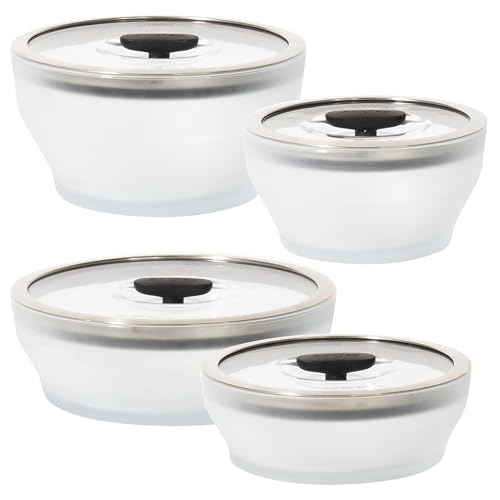
Anyday built its line specifically for microwave cooking and then gave the dishes a second life most microwave brands never attempt: the bowls are borosilicate glass, the material with the strongest thermal-shock resistance in this guide, and the brand publishes oven limits for the glass dishes that reach 500 degrees Fahrenheit, with the lids documented to a lower ceiling of their own. The shapes explain the microwave-first design. The dishes are wide and comparatively shallow, with rounded profiles that suit the limited penetration depth of microwave energy, so grains, vegetables, and proteins cook through without the cold centres that deep narrow bowls produce. Sizes run from small single-portion bowls up to a large deep dish, and the sets combine them with lids across the range.
The lids are the interesting engineering. Each is glass with a silicone seal and a metal rim around a venting knob that lifts to let steam escape during cooking and presses down to seal for storage. Anyday documents the complete lid assembly as designed for microwave use, which makes it a considered exception to the usual rule against metal in microwave mode — the rim is part of a tested product design, not a stray foil edge. The same lid deserves more caution at convection temperatures: its ceiling is published separately from the dish and sits lower, so the disciplined pattern is to bake with the glass dish uncovered or covered as the brand directs for the specific set, and to confirm the exact figures for the set in hand rather than assuming the whole system shares the dish’s 500-degree figure.
In daily terms, this is the pick that collapses the most steps. Food can be mixed, cooked, served, and stored in one vessel, moved from freezer to microwave without the thermal-shock anxiety that soda-lime glass demands, and taken into convection mode for finishing when a recipe wants a baked top. The trade-offs are price position — this is the premium tier of the guide, described in words rather than figures — and the glass weight that comes with real borosilicate, plus lids that ask for a moment’s attention to their vent position before the door closes.
Strengths:
- Borosilicate glass with the strongest thermal-shock tolerance in this guide, documented for freezer, microwave, and oven use
- Brand publishes a 500-degree Fahrenheit oven ceiling for the glass dish itself
- Vented glass lids with silicone seals manage steam and splatter, then seal for storage
- Wide, shallow profiles match how microwave energy actually penetrates food
Trade-offs:
- Premium price tier within this category, especially in the larger sets
- Lids carry a lower published ceiling than the dishes and need their own check before convection use
- Glass weight is noticeable in the biggest dish when it is full
Who it suits: households that cook in both modes within the same meal — microwave the grain, finish the gratin under convection heat — and want one glass system to follow the food through all of it. If most of your cooking moves between the two modes in a single meal, this is the set to build around, so check price on Amazon.

2. Lékué Steam Case — platinum silicone with a printed ceiling
Lékué’s steam case is the silicone representative in this guide, and it earns the slot by being specific. The case is platinum silicone — the higher-purity grade of silicone used for food contact — and Lékué publishes its temperature range openly: the case is documented for use from deep-freeze cold up to 220 degrees Celsius, which is 428 degrees Fahrenheit. That single published figure does a great deal of work. It tells you the case is a legitimate convection-mode vessel for the many convection microwave programmes that run at or below that line — gentle bakes, reheats with browning, vegetable roasting at moderate settings — and equally that it must sit out the high roasting settings above it, where a glass or metal vessel takes over.
The design itself is a shallow, lidded tray that closes around food with a small amount of added liquid, so in microwave mode the food steams in its own vapour. Fish fillets, vegetables, and grains are the documented heartland: the enclosed steam environment cooks them evenly and keeps moisture in, and the flexible walls release food and rinse clean without the scrubbing that steam baskets demand. A version with a removable inner tray lifts food out of its juices where that matters. Because the case is soft, it stores in a drawer or hangs flat in a way no rigid dish in this guide can match, which counts for more than it sounds in kitchens organised around a countertop oven.
The honest limits are about texture and temperature. Silicone insulates rather than conducts, so nothing crisps or browns against its walls the way it does against glass or metal; in convection mode it produces baked and steamed results, not seared ones. The ceiling is a hard boundary rather than a suggestion, and cooks who routinely run convection settings at the top of the range will find the case excluded from exactly those sessions. Within its documented envelope, though, it is the most forgiving piece in the guide: no thermal shock, no chipping, no weight.
Strengths:
- Platinum silicone with a clearly published ceiling of 220 degrees Celsius (428 degrees Fahrenheit)
- Enclosed steam design cooks fish, vegetables, and grains evenly in microwave mode
- Flexible, light, and flat-storing — the easiest piece here to keep in a small kitchen
- No thermal-shock rules; moves between freezer, microwave, and moderate convection heat freely
Trade-offs:
- Convection use stops at the published ceiling, below the top roasting settings of many ovens
- Silicone walls insulate, so browning and crisping are limited compared with glass or metal
- Soft structure needs two hands and support when carried full of hot liquid
Who it suits: steam-centred cooks whose convection work stays at moderate temperatures, and anyone short on storage who wants one flexible piece to cover weekday vegetables, fish, and grains. Steam cooks who want vegetables and fish handled gently in microwave mode will get the most from this case when they check price on Amazon.

3. Sistema Microwave Collection — the microwave-mode specialist, labelled as such
This pick comes with the guide’s clearest boundary, stated at the top of its section rather than buried: the Sistema Microwave Collection is polypropylene plastic, documented by its maker for microwave cooking and reheating, and it is a microwave-mode line only. Nothing in the brand’s documentation rates these pieces for convection temperatures, so they do not go into a hot-air cavity, full stop. That restriction costs the line nothing within its actual job, because as microwave tools these are among the most thoughtfully shaped pieces in the guide — and a convection microwave still spends much of its working life in microwave mode, which is precisely where these earn their cupboard space.
The collection is a family rather than a single dish: steamers with vented lids, soup mugs with sip lids, egg cookers, rice cookers, and rectangular containers with the brand’s clip closures. The recurring design idea is steam management — lids carry a vent that opens for cooking and closes for transport, so reheated food stays moist instead of drying at the edges, and splatter stays inside the container rather than on the cavity walls. The plastic is documented as BPA-free polypropylene, freezer and dishwasher tolerant, and light enough that a full soup mug is a one-handed carry. For packed lunches reheated in a break-room machine or a dorm convection microwave used only in microwave mode, the fit is exact.
What the line asks in return is mode discipline, and the household has to supply it: the same container that reheated lunch perfectly must be swapped for glass when the recipe switches to a convection finish. Plastic also keeps a memory of strong foods — tomato and turmeric stain it, and repeated high-fat reheating can pit the surface over time, which is cosmetic rather than dangerous but shortens the piece’s tidy life. Treat the collection as consumable-grade equipment with a long but finite life, and its value logic holds together well.
Strengths:
- Purpose-built shapes for microwave work: steamers, rice cookers, soup mugs, and egg cookers with vented lids
- Steam-release vents keep reheated food moist and the cavity clean
- Featherweight, freezer tolerant, and dishwasher tolerant per the brand’s documentation
- Budget tier of this guide, so replacing a stained piece is painless
Trade-offs:
- Microwave mode only — not documented for convection temperatures, and no such use should be assumed
- Polypropylene stains with tomato and spice-heavy foods and can pit with repeated fatty reheats
- Clip lids seal well for transport but are not a cooking lid for anything beyond microwave use
Who it suits: reheat-driven households — packed lunches, soup portions, steamed vegetables, and rice — whose convection microwave works mostly in microwave mode and who want lids engineered for that single job. Reheat-heavy households that live in microwave mode and want lids that behave should check price on Amazon.
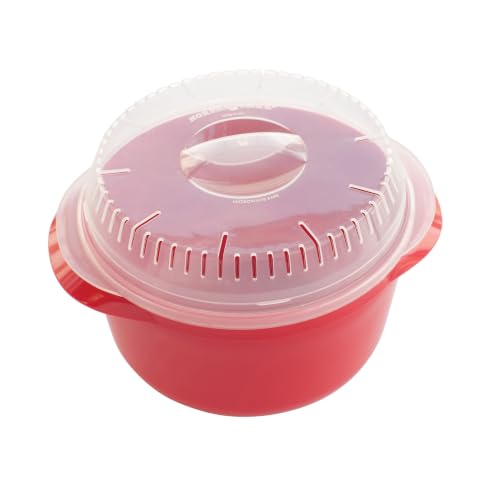
4. Nordic Ware Microwave Cookware — single-task tools for microwave mode
Nordic Ware is famous for metal bakeware, which makes this pick the one most likely to be misunderstood, so the boundary comes first again: the pieces discussed here are the brand’s plastic microwave line, documented for microwave cooking, and they are microwave-mode tools only. The metal pans that share the brand name belong to a different shelf of the kitchen and a different conversation. Within the microwave line, the design philosophy is the opposite of the sets elsewhere in this guide — instead of one vessel doing many jobs, each piece does exactly one job with a shape fitted to it, and the cumulative effect is a small toolkit that covers the microwave-mode tasks households actually repeat daily.
The best-known piece is the microwave popcorn popper, a lidded bowl sized so kernels pop without oil or paper bags and the lid contains the expansion. Around it sit egg cookers shaped to set whites evenly, a microwave-safe cookware range of plates and bowls designed to stay cooler to the touch than ceramic under microwave energy, and splatter covers that keep the cavity clean during reheats. The plastics are documented as BPA-free and melamine-free for the microwave line, with high-heat formulations for the cooking pieces; the brand publishes care guidance that keeps them in microwave service and out of oven heat, which this guide follows exactly.
The appeal is precision at small scale. An egg cooker that produces the same result every morning, a popper that replaces bagged popcorn entirely, a cover that ends the daily cavity wipe-down — these are modest gains that compound across hundreds of uses. The cost is cupboard arithmetic: single-task pieces multiply, and a household that cooks varied meals in microwave mode will find a set like Anyday or Sistema covers more ground per shelf centimetre. The line also shares the plastic family’s limits on staining and on fatty, high-sugar loads, which heat unevenly in any plastic vessel.
Strengths:
- Single-task shapes — popcorn popper, egg cookers, splatter covers — fitted precisely to daily microwave jobs
- Documented BPA-free, melamine-free plastics for the microwave line
- Pieces stay comparatively cool to handle under microwave energy
- Budget-friendly individual pieces that can be bought one task at a time
Trade-offs:
- Microwave mode only, like every plastic line here — no convection use is documented
- Single-task design multiplies piece count in a small cupboard
- Brand confusion is real: the metal bakeware under the same name follows entirely different rules
Who it suits: routine-driven cooks whose microwave mode workload is a short repeating list — morning eggs, evening popcorn, daily reheats — and who prefer a fitted tool per task over one generalist vessel. Anyone whose microwave mode workload is eggs, popcorn, and quick single servings can cover it neatly — check price on Amazon.


5. Pyrex Smart Essentials — the soda-lime glass workhorse
The Smart Essentials line is the value anchor of the glass side of this guide: a nesting set of soda-lime glass bowls in graduated sizes, sold with plastic lids, built for mixing, storing, microwaving, and baking. The glass itself is documented for preheated-oven use, which makes the bowls genuine two-mode pieces — they can carry a casserole into convection mode and a leftover portion into microwave mode the next day. The set’s graduated sizing is its quiet strength: a bowl exists for nearly every quantity a small oven handles, the bowls nest for storage, and the whole line is open stock in spirit, with replacement pieces widely available when one inevitably chips.
The handling rules are stricter than borosilicate’s, and the brand’s own safety documentation is the reason this guide states them firmly. United States Pyrex is soda-lime glass, which expands more as it heats, so the documented discipline is: preheat before the dish goes into a hot cavity, never use it under a broiler or on a stovetop, avoid sudden temperature swings, and set hot glass on a dry cloth or trivet rather than a cold or wet counter. European Pyrex, made from borosilicate under licence, carries more forgiving published limits — the two products share a name and little else, so a listing’s origin matters when comparing documentation. The plastic lids, meanwhile, are storage and splatter tools: they are not oven pieces, and in convection mode they stay in the drawer.
Judged as a system, Smart Essentials asks for a cook’s attention and repays it with the lowest cost per covered task in the guide. The bowls mix, marinate, store, reheat, and bake in sequence without decanting, which is the daily rhythm of a small kitchen. What they will not do is forgive carelessness: the thermal-shock rules are the price of admission, and households that know they will not observe them are better served by the borosilicate pick above, at its higher tier.
Strengths:
- Graduated nesting bowls cover mixing, storing, microwaving, and convection baking in one set
- Glass documented for preheated-oven use, making these true two-mode pieces
- Budget-to-mid-range tier with easy single-piece replacement
- Clear glass makes microwave cooking progress and convection browning easy to monitor
Trade-offs:
- Soda-lime glass demands thermal-shock discipline: preheat first, no broiler, no sudden temperature swings
- Plastic lids are storage and splatter covers only — never convection pieces
- United States and European Pyrex are different glasses under one name; documentation differs by origin
Who it suits: bakers and batch cooks who want one affordable glass set to mix in, store in, reheat in, and bake in, and who are willing to observe the preheat and handling rules that soda-lime glass requires. Bakers who need one glass set to mix, microwave, and bake in convection mode can start here and check price on Amazon.

6. Joseph Joseph M-Cuisine — the stacking microwave-mode system
The M-Cuisine range closes the guide with the most design-led of the microwave-mode lines, and its boundary matches the other plastics: the pieces are polypropylene, documented for microwave cooking, and are not documented for convection use, so they serve microwave mode exclusively. What distinguishes the range is systems thinking. The flagship set stacks a cooking pot, a steamer insert, a grater and prep elements, and a lid into one nested column, so a complete small meal — grain below, vegetables steaming above — cooks in a single microwave session in a footprint smaller than most mixing bowls.
That stacking logic speaks directly to convection microwave owners, whose cavities are compact and whose kitchens often are too. The components are sized to fit small turntables, the lids double as bases during serving, and the whole set stores as one object rather than a scattered family of containers. Individual pieces extend the idea: popcorn makers, egg cookers, and rice cookers in the same visual and functional language, all documented for microwave use with the brand’s care guidance. The plastics are finished to a higher standard than the budget lines — thicker walls, better-fitting lids — which is where the mid-range positioning goes.
The limits are the family’s usual ones, plus one specific to stacking: a multi-component session cooks its layers at one power setting, so foods with very different densities compromise somewhere, and the cook steers by sequencing components rather than by separate controls. Staining and surface wear follow the polypropylene pattern. None of that undermines the central proposition, which is that in a small kitchen, the cookware that gets used is the cookware that stores well — and no microwave-mode line here stores better.
Strengths:
- Stacking system cooks a layered meal in one microwave session inside a compact footprint
- Components nest into a single stored column — the tidiest storage in this guide
- Thicker walls and better-fitting lids than budget plastic lines
- Sized deliberately for small turntables and compact cavities
Trade-offs:
- Microwave mode only, with no documented convection use
- Stacked layers share one power setting, so mixed-density meals need sequencing judgement
- Mid-range pricing for plastic, justified by design rather than material
Who it suits: small kitchens and compact-cavity owners who cook complete small meals in microwave mode and are tired of container clutter colonising the cupboard. Small kitchens short on cupboard room get the tidiest microwave-mode stack from this set, so check price on Amazon.
Side-by-side: materials, modes, and ceilings
The table compresses the guide’s argument into one screen. Read the convection column as the discriminator: two picks cross into convection service under documented conditions, one glass pick crosses with handling rules attached, and three picks are microwave-mode specialists that this guide recommends warmly inside that boundary and not one degree beyond it.
| Pick | Material | Microwave mode | Convection mode | Published ceiling | Best role |
|---|---|---|---|---|---|
| Anyday set | Borosilicate glass | Yes, lids included as designed | Yes for the dish; lids have their own lower limit | 500 degrees Fahrenheit for the dish, per the brand | One system for both modes |
| Lékué Steam Case | Platinum silicone | Yes | Yes, up to its ceiling | 220 degrees Celsius (428 degrees Fahrenheit) | Steaming and gentle bakes |
| Sistema Collection | Polypropylene | Yes | No — not documented | Microwave service only | Reheating and packed lunches |
| Nordic Ware line | Microwave-line plastic | Yes | No — not documented | Microwave service only | Single-task daily tools |
| Pyrex Smart Essentials | Soda-lime glass | Yes | Yes, preheated oven only, with handling rules | Preheated-oven guidance per the brand; no broiler | Mixing, storing, baking value |
| Joseph Joseph M-Cuisine | Polypropylene | Yes | No — not documented | Microwave service only | Stacked small meals, tidy storage |
Read the ceiling figures with one conversion in mind: many convection microwaves sold in the United States top out between 400 and 450 degrees Fahrenheit, which is roughly 200 to 230 degrees Celsius. Set that range against the table and the practical picture sharpens — the Lékué case, documented to 220 degrees Celsius, covers most but not all of a typical oven’s convection span, while the Anyday dish’s published 500-degree figure clears the entire span with room to spare. A ceiling is only meaningful relative to the oven you own, so the useful comparison is never silicone versus glass in the abstract; it is each material’s documented limit against your machine’s documented maximum.
Measure the cavity before you measure the cookware
More cookware disappointments in this category are geometry failures than material failures, so take three measurements before buying anything. First, the turntable’s diameter: in microwave mode a dish wider than the turntable either stalls against the cavity wall or overhangs and rotates unevenly, and both outcomes cook food in stripes. Second, the vertical clearance from turntable to the top of the cavity, with the convection rack in place if you use one: tall bowls that fit on the turntable alone may foul the upper element on the rack. Third, the door opening itself, because a dish that enters at an angle with mitts on both hands needs more clearance than its footprint suggests.
While the tape is out, check the roller ring and the dish’s base together. A vessel whose foot ring is wider than the turntable’s track can rock as it rotates, and a heavy glass dish on a worn roller ring rotates in jerks that slosh liquids and shift lids. Neither fault belongs to the cookware or the oven alone; it belongs to the pairing, which is why a thirty-second cold test spin with the empty dish tells you more than any specification sheet about how the two will behave together on a wet Tuesday.
Then apply the airflow rule for convection mode: leave a margin of open space around the dish on all sides, because the fan’s circulation is the mechanism of the mode and a dish that fills the cavity wall-to-wall blocks it. A practical consequence follows for set buying — in a compact cavity, two medium dishes used in rotation usually outperform one very large dish that technically fits. The picks above were chosen with compact cavities in mind, but the largest Anyday dish and the biggest Pyrex bowls still deserve a tape measure against your specific oven before they join the cupboard.
One more fit variable hides in the rack. Many convection microwaves ship with a low metal or ceramic rack that lifts food toward the upper element for convection browning and, in the manufacturers’ designs, improves air circulation underneath. A dish that fits the turntable may still fail on the rack if its base is narrower than the rack’s grid or its walls too tall once elevated, so test the combination you actually intend to cook with, using the cold oven, before the dish is full and hot. And keep the rack’s own mode rule in view: it belongs to convection service, and the manuals for most models direct it out of the cavity for microwave mode.
Mistakes that damage cookware, and occasionally the oven
The classic error is metal in microwave mode, and it usually arrives disguised: a ceramic dish with a metallic glaze band, a storage container with foil sealed under its lid, a takeaway tray that looked like plain card. Arcing can pit the cavity and damage the oven, so any piece whose material you cannot identify stays out until identified. The second error is the mirror image — trusting a microwave-safe stamp in convection mode. That stamp certifies behaviour under microwave energy; it says nothing about surviving sustained hot air, and warped, softened plastic is the standard tuition paid for confusing the two.
A related error is assuming a brand’s reputation transfers across its own catalogue. A manufacturer famous for oven bakeware also sells microwave-only plastic, and a brand built on microwave design sells lids with lower ceilings than its dishes; the name on the box certifies nothing, and each piece carries only its own documentation. Sealed lids form the third pattern: a lid clipped or pressed fully shut over steaming food builds pressure until it pops, spills, or scalds. Vent before cooking, every time, using the vent the maker built in. Fourth is thermal shock with glass — cold dish into a ripping-hot cavity, hot dish onto a wet counter or a cold stone surface. Soda-lime glass is the least forgiving, but the habit of letting glass change temperature gradually protects every glass in this guide. Fifth is the stalled turntable: a dish too wide to rotate cooks unevenly in microwave mode and blocks circulation in convection mode, a geometry mistake masquerading as a recipe failure. Last, the metal rack supplied with many convection microwaves is a convection-mode accessory in the manufacturers’ manuals — the default is to remove it for microwave mode unless your oven’s manual states otherwise for a specific programme.
Matching the picks to how you actually cook
Consider four common patterns. The reheat household uses the oven ten times a day and bakes in it twice a month: its work is lunches, leftovers, vegetables, and drinks-adjacent tasks, almost all in microwave mode. For that pattern the plastic specialists carry the load — Sistema for containers and steamers, Nordic Ware for the daily single tasks, Joseph Joseph where cupboard space is tight — and a single glass set is enough insurance for the occasional convection finish. Spending the budget the other way round, on premium glass while reheating from stained takeaway tubs, misallocates everything.
The baker pattern runs the relationship in reverse. This cook bought the convection microwave as a second oven: gratins, small roasts, traybakes, and reheated pastry that must crisp rather than steam. Here the glass picks lead — Anyday for the cook who also microwaves grains and vegetables in the same dishes, Pyrex Smart Essentials for the cook who accepts soda-lime discipline in exchange for a full graduated set at a friendlier tier — and the Lékué case supports with steamed vegetables and gentle bakes under its ceiling. Plastic in this kitchen is a lunchbox decision, not a cookware one.
The meal-prep cook adds a fifth pattern: weekend batches of grains, soups, and roasted vegetables portioned into containers for the week. This pattern values lidded vessels that travel from cooking to fridge without decanting, which pushes the Anyday set and the Pyrex bowls forward again, and values multiples — two medium dishes rotating through the oven beat one large dish waiting its turn. It also punishes fragile storage lids and odd shapes that stack badly in a crowded fridge, details the picks above were judged on as carefully as their cooking behaviour.
The combination cook uses the blended programmes the oven offers and needs vessels that never force a mid-recipe transfer: glass and ceramic only, with silicone in support below its ceiling. The small-space cook — dorm, studio, caravan, office kitchenette — optimises for storage and turntable fit above all, which elevates the stacking M-Cuisine system and the flat-storing Lékué case out of proportion to their materials. Most real households blend two of these patterns, and the honest way to shop the guide is to name your dominant one, buy its leads first, and let the second pattern’s picks follow only when the cupboard proves it has room.
Frequently asked questions
Can a metal pan ever go inside a convection microwave?
Yes — in convection mode, with the microwave function fully off, metal pans follow ordinary oven rules and are often the best choice for browning. The prohibition applies to microwave mode and to combination programmes that include microwave energy, where metal reflects energy and can arc. The oven’s own manual is the final authority for its programmes, and where a manual and a general rule disagree, the manual wins for that machine.
Is silicone genuinely safe at convection temperatures?
Silicone is safe up to the ceiling its manufacturer publishes, and not by one degree beyond it. Lékué documents its steam case to 220 degrees Celsius, which covers the moderate convection settings many owners use most, but excludes high roasting temperatures. Silicone also behaves differently from metal and glass at any temperature: it insulates, flexes, and does not crisp food against its surface, so it suits steaming and gentle baking rather than roasting.
Why did a microwave-safe container warp during convection cooking?
Because microwave-safe describes how a material behaves under microwave energy — absorbing little of it and staying comparatively cool — rather than how it withstands hot air. Convection mode bathes the vessel in sustained heat far beyond what microwave mode ever delivers to a container wall, and polypropylene softens across that range. The container did exactly what its documentation promised; the mode asked for something the documentation never offered.
What is the practical difference between borosilicate and soda-lime glass?
Thermal-shock tolerance. Borosilicate expands very little as it heats, so it tolerates freezer-to-oven moves and rapid temperature changes that stress soda-lime glass, which expands more and asks for preheated ovens, no broiler exposure, and no sudden cold surfaces. Both are legitimate oven glasses with long service lives; they simply run under different handling rules, and a listing that does not say which glass it is selling has omitted the detail that decides how you may treat it.
Does the lid stay on during convection cooking?
Only if that specific lid is documented for the temperature involved. Plastic storage lids never qualify, glass lids carry their own ceilings below their dishes’ limits, and silicone seals have their own limits too. Most convection cooking in these ovens is done uncovered or with the dish covered only as the vessel’s own documentation directs — when in doubt, cook uncovered and add a splatter guard in microwave mode instead.
The bottom line
A convection microwave rewards cooks who think in modes. Buy glass for the freedom to cross between them — borosilicate if you want the fewest rules, soda-lime if you accept its discipline at a friendlier tier. Buy platinum silicone for steam and gentle bakes, respecting its printed ceiling as a boundary rather than a guideline. Buy the plastic lines for what they genuinely are, the best-shaped tools in this guide for microwave mode, and let them be excellent at that instead of adequate at everything. The right cookware for a two-mode oven is simply the piece whose material rules you never have to think about twice.