Disclosure: As an Amazon Associate, topratedkitchenware.com earns from qualifying purchases. Links on this page are affiliate links; they cost you nothing extra. Prices and availability change often, so check the current Amazon listing before you buy.
This bakeware set review looks at the modern bakeware set as a product in its own right: what it is, how the current generation of sets is built, and how the best-known lines perform across the bakes home cooks actually make. Rather than crowning a single winner, it uses six representative product lines as reference points, so you can judge design, performance and durability against your own habits and finish knowing exactly what a good set will and will not do in your kitchen.
Bakeware Set Review: Verdict and Key Takeaways
The verdict, up front: the bakeware set category is mature and genuinely useful, and the differences between good sets live in flatness, gauge, finish and piece selection rather than in marketing features. Uncoated aluminum sets remain the longevity champions. Modern coated steel sets release better than ever and suit most households. Buy a set if you bake across several shapes most weeks. Skip the big-box set if you only ever use one or two pans, and buy those pans individually instead.
Key Takeaways
- Design: rolled rims, straight sides and honest weight separate serious sets from decorative ones.
- Performance: evenness across a sheet pan is the single most revealing test of any set.
- Release: modern coatings are excellent when new; uncoated pans with parchment match them and outlast them.
- Durability: warping and coating wear, in that order, are how sets die.
- Best for: households baking weekly across cookies, cakes, loaves and traybakes. Not suited for: single-shape specialists.
In this guide
What a Bakeware Set Is and Where It Fits
A bakeware set is a coordinated collection of oven pans, usually built around a sheet pan, cake pans, a loaf pan, a muffin pan and a rectangular pan, sharing one material, finish and design language. It sits between two alternatives: the professional’s open-stock wall of individual pans, and the improvised cupboard of inherited pieces. The set’s promise is coherence. Every piece behaves the same way in the oven, stacks together in the cupboard, and follows one care routine, which lowers the mental cost of baking in a way individual reviews rarely capture.
The category segments into three philosophies. Uncoated metal sets serve bakers who line pans and value decades of service. Coated sets serve bakers who prize release and easy washing and accept a finite coating life. Mixed and novelty sets chase gift appeal with colours and grips. This review weighs the first two philosophies most heavily, because they are where long-term satisfaction lives, while treating styled family sets fairly for the households they genuinely suit.
What Bakeware Materials Actually Do to Your Baking
Material is the single decision that shapes everything else about a bakeware set, because material decides how heat moves. A pan is not a passive container. It absorbs heat from the oven air, stores some of it, and passes it into the batter or dough touching its surface. Fast, responsive materials give you quick browning and quick cooling. Slow, heavy materials give you gentle, buffered heat and longer carryover cooking after the pan leaves the oven. Neither is universally better. The right choice depends on whether you bake delicate sponges, crusty breads, sticky traybakes, or weeknight roasted vegetables in the same pans.
Aluminum and Aluminized Steel
Plain aluminum is the baker’s classic for good reason. It conducts heat quickly and evenly, it is light enough to move confidently when full, and it does not rust. Its weakness is reactivity: acidic batters can pick up a metallic taste and grey discolouration during long contact, which is why experienced bakers line aluminum pans for tomato-based or citrus-heavy recipes. Aluminized steel takes a steel core and coats it with an aluminum-silicone alloy, combining steel’s strength and warp resistance with a surface that resists rust. Most serious mid-range and professional-style sets use one of these two metals as their foundation.
Carbon Steel and Nonstick Coatings
Carbon steel is strong, relatively thin, and an excellent conductor, which is why so much nonstick bakeware is built on it. The coating does the releasing while the steel does the heating. The partnership works well until the coating ages, because every nonstick surface is ultimately a consumable layer with a lifespan measured in years of careful use rather than decades. Heat discipline matters here: moderate oven temperatures, no empty preheating under a broiler, no aerosol spray oils whose additives bake into a sticky film, and no metal spatulas carving portions out of the pan.
Silicone, Glass and Ceramic
Silicone bakeware releases beautifully and stores in tiny spaces, but it flexes, which makes moving a full muffin tray a two-handed balancing act, and it browns far less than metal. Glass conducts slowly and then holds heat for a long time, so it suits casseroles and pies that benefit from gentle, sustained heat, while demanding a temperature adjustment and care with sudden temperature changes. Stoneware and ceramic sit in the same family: beautiful from oven to table, excellent for gratins and fruit crisps, slower to brown cookie bottoms. Most complete kitchens end up mixing families rather than marrying one, using metal for sheets and cakes and glass or ceramic for baked dishes that go straight to the table.
Design, Build and Setup
Pick up the sheet pan first; it tells the truth about the whole box. A serious sheet pan lies flat, has a rolled rim that stiffens it, and feels reassuring rather than tinny when you flex it gently. Cake pans should have straight sides and clean seams so layers stack without gaps. Loaf pans should have crisp corners that bake defined edges. Muffin cups should be formed smoothly, without sharp folds that trap batter and defeat washing. Handles and grips help, but rim design matters more, because rims are what your mitts actually hold.
Setup, such as it is, consists of washing, drying, and a calibration bake. New coatings benefit from a gentle first wash and a light oiling before their first sticky bake, while uncoated pans need nothing but a wash. Run one familiar recipe through each core piece in the first week and note timing differences; every set in this review baked slightly differently from the cupboards it replaced, and the bakers who noted the differences were the ones who rated their sets highly a month later.
Simple Home Tests That Reveal a Pan’s Character
You do not need a laboratory to evaluate bakeware. Four kitchen tests, done once with any new set, tell you most of what matters. First, the water test for flatness: pour a thin layer of water across a cold sheet pan and tilt it gently. Water that rushes to one corner reveals a slope that will also collect oil and batter. Second, the sugar-cookie test: bake a single batch of pale, plain cookies across the whole sheet and compare colour from corner to corner. Even colour means even heat; a dark quadrant points to either the pan or your oven, and rotating the pan halfway through the next batch tells you which.
Third, the release test: bake muffins or a simple sponge with only the lightest greasing and see what the pan does honestly, because a coating that needs heavy greasing on day one will not improve with age. Fourth, the warp check: after a genuinely hot roast, listen for the sudden bang that signals a pan flexing, and check the pan on a flat counter once cooled. A pan that rocks has twisted, and twisted pans bake unevenly forever after.
Write down what you learn. Note the temperature adjustment each pan seems to want, which pieces release cleanly, and which need parchment insurance. Tape the notes inside a cupboard door if you have to. This small calibration ritual, which takes one baking session, is the difference between bakers who love their sets and bakers who keep shopping for a better one, when the sets themselves are often identical.
Performance in Real Use
Cookies and Sheet-Pan Baking
Cookies expose evenness mercilessly. Across the lines profiled below, the heavy uncoated and aluminized sheets produced the most uniform colour from corner to corner, while lighter coated sheets browned faster and needed earlier checking. For roasted vegetables and sheet-pan dinners, capacity and rim height mattered more than finish: juices stayed contained, and flat pans crisped rather than steamed. Any set whose sheet pan warps under high heat fails this category outright, whatever its other virtues.
Cakes, Muffins and Release
Release is where coated sets earn their keep. Layer cakes turned out cleanly, muffins lifted without tearing, and cleanup shrank to a quick wash. Uncoated pans matched the results only with disciplined greasing or liners, which experienced bakers do automatically and beginners forget exactly once, memorably. For delicate sponges and sticky glazes, the coated lines in this review were simply kinder, and kindness at the turning-out stage decides whether baking feels relaxing or risky.
Loaves, Casseroles and Everyday Roasting
Loaf pans separated the sets on crust: metal pans gave defined, crisp sides, while deeper pans needed extra minutes for centres to set. Rectangular pans handled casseroles and traybakes competently across all lines, with the heavier pans showing less flex when carried full. Everyday roasting punished coatings used carelessly, a reminder that a set’s cake pans and its roasting pans may deserve different treatment even when they share a box.
Strengths and Trade-Offs of the Category
Strengths
- Coherent behaviour across every piece shortens the learning curve for new bakers.
- Bundle pricing makes equipping a kitchen markedly cheaper than open-stock buying.
- Standard sizing makes published recipes behave as written.
Trade-Offs
- Piece lists reflect the maker’s priorities, not yours, so some shapes will idle.
- Coated sets share a coating lifespan across the box.
- Averaged construction means secondary pieces can be thinner than the flagship pan.
How the Main Lines Compare
The six profiles below are the heart of this bakeware set review. Read them as philosophies rather than rankings: the right choice is the one whose strengths align with your weekly baking and whose trade-offs you can live with for years.
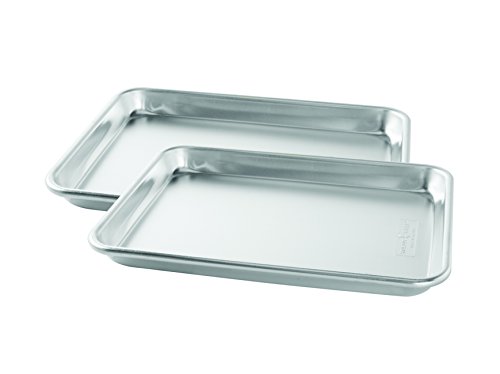
Nordic Ware Naturals
The Naturals line is built around plain, uncoated aluminum with rolled rims, and it behaves like the sheet pans used in working bakeries: light in the hand, quick to heat, quick to cool, and completely indifferent to metal utensils. There is no coating to protect, so the pans darken and pick up marks over the years without losing performance. Bakers who grew up with this style tend to trust it because what you see is exactly what you get, season after season.
Strengths
- Uncoated surface cannot peel, blister or wear through, so the pans age gracefully for many years
- Aluminum heats evenly and cools fast, which helps stop carryover browning on cookies
- Rolled rims resist warping and give you a secure grip with oven mitts
Trade-offs
- Bare aluminum can react with acidic foods and discolour with tomato or citrus batters
- Shiny surface browns more gently, which some bakers find slow for crisp edges
- Needs parchment or greasing for sticky bakes because nothing is nonstick by design
Best for: Bakers who bake weekly, prefer parchment, and want pans that outlast coatings. Not suited for: Anyone who wants effortless release for sticky cakes without liners. This is a mid-tier option; check price on Amazon when you are ready to compare current listings.

USA Pan Bakeware
USA Pan builds its bakeware from aluminized steel with a corrugated surface texture and a silicone-based nonstick coating. The ridges are not decoration: they increase surface area, encourage air flow under food, and help baked goods release with very little greasing. The pans feel noticeably substantial, with a heft that signals thick material and careful finishing, and the fluted texture gives cookies and roasted vegetables an unusually even bottom colour.
Strengths
- Corrugated surface promotes even browning and remarkably easy release
- Heavy aluminized steel resists warping through repeated high-heat cycles
- Coating is applied without the older chemistries many buyers now avoid
Trade-offs
- The textured surface needs a soft brush to clean crumbs out of the ridges
- Premium positioning means replacing a single pan costs more than basic lines
- Coating still has a lifespan, so metal utensils and harsh scouring shorten it
Best for: Regular bakers who want nonstick convenience with a more durable, professional feel. Not suited for: Bakers who prefer completely uncoated pans they can scrub without thinking. This is a premium-leaning mid-tier option; check price on Amazon when you are ready to compare current listings.

Wilton Perfect Results Premium
Wilton is the name most home bakers meet first, and the Perfect Results Premium line is designed as an accessible, complete starting point: steel pans with a nonstick coating, sold in combinations that cover cakes, muffins, loaves and sheets in one purchase. The pans are lighter than premium lines, the coating is serviceable rather than exceptional, and the whole proposition is about getting a new kitchen baking quickly without a large commitment.
Strengths
- Complete, coordinated sets make it easy to equip a first baking kitchen in one step
- Lightweight pans are easy to handle, store and wash
- Widely available, so adding a matching piece later is simple
Trade-offs
- Thinner steel can flex or warp sooner than heavier pans under high heat
- Nonstick coating is the first thing to age, especially with spray oils and dishwashers
- Lighter build gives less even browning on demanding bakes like shortbread
Best for: New bakers, occasional bakers, and anyone equipping a first or second kitchen. Not suited for: High-volume bakers who will put pans through daily, high-heat use. This is a entry-tier option; check price on Amazon when you are ready to compare current listings.

Calphalon Nonstick Bakeware
Calphalon approaches bakeware the way it approaches cookware: heavier-gauge steel cores with layered nonstick surfaces and a slightly more engineered feel than entry-level lines. The pans have rolled edges, a reassuring weight, and coatings designed to release cakes cleanly and survive years of regular use when they are treated properly. It sits in the middle of the market on purpose, aimed at bakers who found basic sets flimsy but do not need professional equipment.
Strengths
- Heavier steel core browns evenly and resists the warping that plagues thin pans
- Layered nonstick releases cakes and muffins cleanly with minimal greasing
- Rolled edges and solid finishing make the pans comfortable to handle hot
Trade-offs
- Weight that helps browning makes full pans heavier to lift from a low oven
- Coating care rules still apply: no metal edges, no harsh pads, gentle washing
- Sets are curated, so the piece mix may not match every baker’s habits
Best for: Committed home bakers who bake most weeks and want a step up in durability. Not suited for: Anyone shopping purely on the lowest possible outlay for a rarely used set. This is a mid-tier option; check price on Amazon when you are ready to compare current listings.
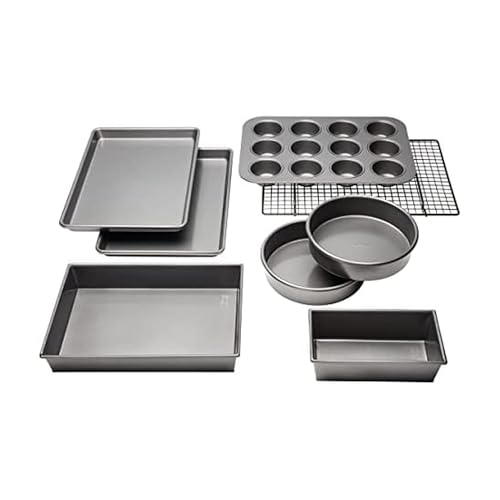
Chicago Metallic Professional
Chicago Metallic has supplied commercial bakeries for generations, and its Professional line brings that plain, workmanlike approach home: aluminized steel, sensible shapes, and both uncoated and nonstick options depending on the piece. Nothing about these pans is decorative. They are built to be stacked, scrubbed, and used hard, and the range includes the awkward specialty shapes that lifestyle brands skip, from pullman loaf pans to serious jelly roll pans.
Strengths
- Commercial heritage shows in flat, warp-resistant construction and clean corners
- Both coated and uncoated options let you match the finish to the food
- Unusual and specialty shapes are easier to find in this range than most
Trade-offs
- Utilitarian looks will not match a display-kitchen aesthetic
- Some pieces are sold individually, so building a set takes more decisions
- Nonstick versions need the same gentle handling as any coated pan
Best for: Serious home bakers who value function, flat pans and specialty shapes over looks. Not suited for: Buyers who want one decorative, gift-style boxed set to cover everything. This is a mid-tier option; check price on Amazon when you are ready to compare current listings.

Rachael Ray Yum-o! Bakeware
The Yum-o! line pairs nonstick steel pans with bright silicone grip handles, aiming squarely at everyday family baking rather than pastry precision. The grips genuinely help when you are pulling a full sheet of nachos or a tray of meatballs out of a hot oven with bulky mitts, and the colours make the set easy to spot in a crowded cupboard. Under the friendly styling the pans are conventional nonstick steel, best suited to moderate temperatures and regular, unfussy use.
Strengths
- Silicone grips make hot pans easier and safer to move with oven mitts
- Friendly sizing and shapes suit family meals as much as sweet baking
- Nonstick surface handles everyday roasting and baking with easy cleanup
Trade-offs
- Grip inserts and coatings prefer moderate heat over broiler-style punishment
- Colourful styling will not appeal to bakers who want a neutral, classic look
- Like most coated entry lines, longevity depends on gentle washing and storage
Best for: Family cooks who bake and roast in the same pans and value easy handling. Not suited for: Bakers chasing the flattest, heaviest professional sheet pans. This is a entry-to-mid-tier option; check price on Amazon when you are ready to compare current listings.
How a Set Performs Across a Real Week of Cooking
Specifications tell you very little about living with bakeware. A week of real cooking tells you almost everything. Monday might be a sheet pan of vegetables roasted alongside sausages, where the pan needs to tolerate high heat, hold juices without spilling, and wash clean without soaking overnight. Tuesday could be muffins for lunchboxes, where release matters most and a pan that needs aggressive greasing will quietly fall out of use. Wednesday is often a casserole or traybake in the rectangular pan, taken straight to the table, where appearance and heat retention suddenly matter as much as browning.
By the weekend the set faces its real examination. Cookies test evenness across the whole sheet, because any hot spot announces itself as one dark row. A layer cake tests release and corner definition. Banana bread in the loaf pan tests whether the centre cooks before the crust over-browns. A good set is not the one that wins one of these tests dramatically. It is the one that passes all of them without drama, special handling, or a growing list of exceptions you have to remember.
This is also where set coherence shows its value. When every pan in the cupboard shares a material and finish, your instincts transfer: you know how long things take, how much greasing is enough, and when to check for doneness. A mixed cupboard assembled piece by piece can bake beautifully, but each pan has its own personality and the learning never quite finishes. Neither approach is wrong, yet the coherence of a set is a genuine, practical benefit that individual pan reviews rarely mention.
Who Should Buy a Bakeware Set, and Who Should Skip It
Buy a set if you are equipping a kitchen, replacing a chaotic cupboard, or baking across at least three shapes most weeks. Buy the uncoated philosophy if you already line pans by habit and want maximum lifespan; buy coated if release and washing ease decide whether you bake at all. Skip the set format if your baking is gloriously narrow: the sourdough devotee needs one superb loaf pan, not a box, and the cookie-only household needs two great sheets. A pre-purchase checklist: measure the oven, list your five most common bakes, decide coated or uncoated honestly, and judge every candidate by its sheet pan.
Care, Cleaning and Storage That Double a Set’s Life
Most bakeware does not die in the oven. It dies at the sink and in the cupboard. Coatings are scratched by stacked pans grinding against each other, by metal utensils, by scouring pads, and by the slow chemical assault of dishwasher detergent. Uncoated pans survive more abuse but stain, and bakers who attack stains aggressively with harsh pads trade appearance for a rougher surface that food clings to. A gentle routine protects both families.
Wash pans warm rather than cold, because a hot pan plunged into cold water is the classic warping scenario, especially for thinner steel. Soak stuck-on food instead of chiselling it. Use soft sponges and brushes, and keep a paste of baking soda for the browned polymerised oil that builds up on sheet pans; that patina is harmless and even mildly nonstick, so there is no need to restore a pan to showroom brightness. Dry pans fully before stacking, and place a cloth, a paper towel or a pan protector between coated surfaces. Stored this way, a mid-range set routinely outlasts the same set treated carelessly by many years.
Oven habits matter too. Never cut food in the pan. Never use a coated pan under a broiler unless the maker explicitly allows it. Avoid aerosol sprays on nonstick surfaces, because their propellant additives bake into a varnish that makes the coating seem to fail when the pan is actually just glazed. Grease with butter, oil on a paper towel, or a liner instead. Finally, rotate your sheet pans if you own two, because the pan that does every roast and every cookie batch will age twice as fast as its twin for no benefit.
Final Verdict
As a category, the bakeware set deserves its place in most kitchens. The best modern sets brown evenly, release kindly, wash easily and stack into one calm shelf, and they do it for years when cared for with a simple routine. Choose the philosophy first, the piece list second and the brand third, and the set you buy will quietly improve every bake you make. That is the conclusion of this bakeware set review, and it holds across every line profiled above.
Score It Yourself: A First-Week Test Plan for the Bakeware set
Use this scorecard during the first week, while changing your mind is still easy, and run the same ordinary jobs you bought the bakeware set for rather than showcase tasks chosen to flatter it. Score setup first: how long the box-to-ready journey took, whether the instructions answered the question you actually had, and whether anything needed a tool the box did not mention. Score the core job on a normal weekday portion, with your usual ingredients and timing, and write the result down before you try any advanced mode or accessory. Score consistency by repeating that same job on another day and comparing the two outcomes side by side, since repeatability is the quality that separates a good example from a lucky one.
Score the controls under real conditions, with damp hands, low light, or a timer running elsewhere, because that is the environment the bakeware set will actually be judged in. Score cleaning honestly by timing it once, including the drying and reassembly, and by noting any corner, seam, or crevice that needed a second attempt. Where a shortlist names specific examples, such as Nordic Ware Naturals, run these same checks against that listing line by line rather than assuming the general verdict transfers unchanged. Apply the identical test to USA Pan Bakeware as well, on the same day and under the same conditions, because a fair comparison needs one ruler rather than two moods.
- Time the box-to-ready setup
- Repeat the core job on two separate days
- Time the full clean including drying
- Watch a second user try without coaching
- Deliberately make the common mistake once
- File the scorecard with the receipt
If Wilton Perfect Results Premium is also in contention, give it the same worksheet and let the three sets of answers sit side by side before anyone reaches for a checkout button. Score the storage reality: whether the bakeware set and its parts return to their spot without a rearrangement ritual, and whether anything migrates to a counter because it has no home. Score the noise, heat, steam, or vibration against the room it lives in, at the hour you most often use it, and note whether anyone in the household comments unprompted. Score the small parts: lids, seals, trays, attachments, and fasteners, because in long ownership the small parts are where satisfaction quietly leaks away.
Score the documentation by looking up one real question mid-task and timing how long the answer takes to find, in the booklet or on the maker’s support pages. Score the fit against the measurements you took before ordering, and note any surprise, generous or otherwise, while the details are still fresh enough to help another buyer. Score the second user experience by watching someone else in the household use the bakeware set without coaching, and noting exactly where they hesitate or guess. Score the worst job, not the best: the largest load, the trickiest ingredient, or the latest tired evening, because that score predicts your feelings in month six.
Score the recovery: deliberately make the common mistake, such as overfilling, mis-seating a part, or choosing the wrong setting, and judge how obvious and forgiving the fix is. Add the scores without weighting them, then read the lowest two again, because those are the entries that decide whether this example stays in your house. If a low score surprises you, repeat that single test once before concluding anything, since first attempts often measure the operator rather than the product. Keep the finished scorecard with the receipt and warranty details, so a future claim, resale, or replacement decision starts from evidence rather than from a fading impression.
Frequently Asked Questions
What should I look for first in a bakeware set?
Look at the sheet pan. It should lie flat, feel substantial, and have a rolled rim that resists flexing, because the sheet pan reveals the construction quality of the whole set. Then check that the piece list matches your weekly baking, that the pans fit your oven and cupboards, and that the material philosophy, coated or uncoated, matches how you actually bake and wash up.
Do expensive bakeware sets bake better?
Up to a point, yes, because money buys thicker material, flatter pans and better coatings, which show up as even browning and reliable release. Beyond the solid mid-range, extra spending buys styling, grips and brand rather than better bakes. The worst value sits at the very bottom, where thin pans warp and coatings fade quickly, and at the novelty top, where you pay for looks.
How can I tell if a bakeware set will warp?
Weight and rims are the clues. Heavier-gauge pans with rolled or reinforced rims resist the thermal stress that twists thin pans, and aluminized steel is notably warp-resistant. You cannot test warping before buying, but you can favour substantial pans, avoid extreme temperature shocks in use, and never plunge a hot pan into cold water, which warps even good pans.
Is nonstick or uncoated bakeware better in a review sense?
Reviewers separate them by job. Nonstick wins on release and cleanup for cakes, muffins and sticky bakes, and modern coatings perform beautifully while they last. Uncoated wins on longevity, high-heat tolerance and carefree scrubbing, and matches release with parchment or greasing. The better choice is the one aligned with your habits, not the one with the higher abstract score.
How many pans in a set will I actually use?
Most households regularly use the sheet pan, rectangular pan, loaf pan, muffin pan and one or two cake pans, which is why a focused set often outperforms a sprawling one in daily satisfaction. Audit your last month of baking before buying. Pieces outside your real rotation are not bonuses; they are storage costs wearing a gift bow.
Can a bakeware set go in the dishwasher?
Many sets are labelled dishwasher safe, but hand washing is still the kinder choice. Dishwasher detergent and heat dull coatings faster, and uncoated aluminum can emerge discoloured. A warm soak and a soft sponge take only minutes and preserve release and appearance for years. If dishwasher use is non-negotiable for you, favour uncoated pans, which tolerate it best.
Related Guides
bakeware set buying guide bakeware set pros and cons bakeware set reviews how to choose a bakeware set is a bakeware set worth it
Related reading: the best bakeware sets we have tested, Nordic Ware bakeware in detail, USA Pan bakeware in detail, bakeware sets for baking enthusiasts.
Parchment paper deserves a place in any discussion of bakeware, because it changes what a pan needs to do. With a liner, release becomes the paper’s job and the pan only has to deliver even heat, which is why many professionals happily use plain uncoated pans for everything. Silicone mats do similar work for cookies and roasted items, though they slightly soften bottom browning. Choosing to bake with liners is not cheating; it is a system decision that lets simpler, longer-lasting pans perform like premium ones.
Oven thermometers expose an uncomfortable truth: many home ovens run hotter or cooler than their dials claim, and they cycle around the target rather than holding it. Before blaming a new set for pale or dark results, confirm what temperature your oven actually delivers. A pan cannot compensate for an oven that is significantly off, and recalibrating your expectations, or the oven itself, often transforms results more than any purchase could.
Greasing technique matters more than greasing quantity. A thin, complete film of butter or oil, worked into corners with a brush or paper towel, releases better than a thick, uneven layer that pools and fries into patches. Flouring a greased cake pan adds insurance for delicate sponges, while cocoa powder does the same job for chocolate cakes without leaving pale marks. These small habits make mid-range pans perform like expensive ones.
Cooling is a stage of baking, not an afterthought. Cakes need a short rest in the pan so their structure firms enough to turn out without tearing, but a long rest traps steam and sogs the crust. Cookies firm up on the hot sheet for a few minutes before they can move without breaking, then finish cooling on a rack where air reaches their bottoms. A set that includes a rack, or a cupboard that has one, completes the system.
Rotation is the simplest uneven-baking fix ever devised. Home ovens have hot spots, usually toward the back and near the elements, and turning a pan halfway through baking averages them out. Two pans swapped between shelves benefit even more. If your bakes brown unevenly, rotate faithfully for a month before shopping for new pans; the problem is as often the oven’s personality as the pan’s quality.
Batch size changes pan choice. A recipe doubled into a deeper pan does not simply take a little longer; the centre may still be liquid when the edges are overdone, because heat travels slowly through batter. Two shallower pans almost always beat one deep one for even results. This is a quiet argument for sets with duplicate core pieces, and for owning two sheet pans rather than one heroic oversized tray.
Frozen and chilled doughs are a useful stress test for any pan. Cookie dough baked from frozen spends longer in the oven, which exaggerates differences in browning between dark and light finishes. If your household freezes dough for fresh-baked cookies on demand, favour lighter finishes and heavier gauges, and note the adjusted timing on the recipe after the first successful batch.
Acidic foods and bare metal need a truce. Tomato sauces, rhubarb, citrus curds and vinegar-based glazes can react with uncoated aluminum during long contact, picking up flavour and colour you did not invite. Line the pan, choose a coated or enamelled surface, or move the food promptly after baking. Short bakes rarely cause trouble; it is the slow casserole and the overnight marinade that need planning.
The sound of a pan tells you things. A sharp bang a few minutes into roasting is a pan flexing as it heats, which usually means thin material expanding unevenly. Occasional flexing in a light pan is common and not dangerous, but it spills juices and signals a pan that will eventually take a permanent twist. Heavy pans heat silently, which is one of those small quality signals you only appreciate after living with both kinds.
Lids are the most misunderstood part of set value. A lid that fits a rectangular pan turns it into a transport container and a marinating dish, and helps keep casseroles moist. Yet lids are also how modest sets inflate their piece counts. Judge a set by its pans first and treat lids as a genuine bonus only when they fit pieces you will actually use weekly.
Handedness and height sound trivial until you lift a full, hot rectangular pan from a low oven while wearing mitts. Wide rims give your thumbs a landing place. Silicone grips help if your mitts are thin. Low, flimsy rims force a fingertip grip that nobody trusts with a bubbling casserole. When comparing sets in person or in photographs, look at the rims first; they are where daily confidence is built.
Second-hand bakeware can be excellent value, with one caution: coatings. Uncoated aluminum and steel pans from quality makers survive decades and can be scrubbed back to honest working condition. Coated pans with scratches, bubbles or flaking should be passed over, because their best years are behind them and damaged coatings only deteriorate faster. Buy the uncoated classics used; buy coatings new.
A note on colour: dark pans are not a defect and light pans are not old-fashioned. They are different tools. Dark finishes suit foods that want aggressive bottom browning, like pizza-style flatbreads and roasted potatoes. Light finishes protect pale cakes, shortbread and meringue-based bakes. A thoughtful set, or a thoughtful baker mixing pieces, uses each where it shines instead of declaring one universally superior.
Stacking order protects coatings better than any spray or treatment. Heaviest pans at the bottom, coated pans separated by cloth or protectors, and nothing with sharp feet or rough bases resting inside a nonstick surface. Cupboards undo more coatings than ovens do, simply because pans are stored three hundred days a year and baked on perhaps fifty.
If you bake for people with different needs, pans quietly help. A muffin pan portions batter evenly for lunchboxes. A loaf pan turns a standard recipe into neat, freezable slices. Sheet pans let you roast vegetables on one side and proteins on the other for households cooking two versions of dinner at once. The right shapes reduce friction in ways that have nothing to do with browning curves.
Cleaning roasted pans is easier warm. Once a sheet pan has cooled enough to handle but still holds warmth, a soak in hot soapy water loosens most residue without a fight. Leave it overnight and the same residue sets like varnish. Bakers who wash promptly can use gentler tools, which keeps surfaces smoother, which makes the next wash easier still. Good pans and good habits compound together.
Recipe language assumes standard pans. When a recipe says a batter fits a particular pan, it assumes typical depth and dimensions, and substituting a much deeper or shallower piece changes the bake even if the volume matches. A coherent set, whose pieces follow standard sizing, makes recipes behave as written. That predictability is worth real money to bakers who follow published recipes closely.
Finally, remember that pans are among the longest-lived objects in a kitchen. Appliances are replaced, knives are replaced, but a well-chosen sheet pan can serve for decades. That longevity argues for buying the best-constructed set your actual baking habits justify, choosing classic shapes over fashionable ones, and favouring makers whose individual pieces remain available when you eventually want a duplicate.
Seasonal baking changes what a set must do. Autumn brings pies and gratins that sit heavily in dishes and travel to other houses. Winter brings cookie batches in rotation, where a second sheet pan doubles your output and a reliable rack becomes essential furniture. Spring brings lighter cakes that expose release problems, and summer brings fruit crisps that bubble over and test how easily a pan washes. A set that survives all four seasons without a weak chapter is a set chosen well.
Travelling bakes deserve a thought when choosing pans. A rectangular pan with a secure lid becomes a carrier for school events and potlucks, while loose cakes on plates are an anxiety with a crust. If your baking regularly leaves the house, favour sets whose core pans have lids available or whose rims accept foil tightly, and practise the journey once with something forgiving before trusting it with a showpiece.
Children change bakeware priorities in ways catalogues never mention. Pans need to be light enough for supervised young helpers, cool quickly enough to reduce lingering danger on counters, and wash easily enough that baking together does not end with an adult scrubbing alone. Silicone grips and moderate sizes earn their place in family kitchens for reasons that have nothing to do with browning curves and everything to do with Tuesday evenings.
Small ovens and countertop ovens impose their own geometry. A set designed for a full-size range may include a sheet that simply cannot enter a compact oven, leaving the owner with a flagship pan that lives elsewhere. Measure before buying, and if your oven is compact, build around smaller sheets and standard cake and loaf sizes, which fit almost everywhere and still cover the great majority of recipes.
Altitude and humidity quietly alter baking, and pans interact with both. At altitude, batters rise faster and set slower, so pan depth and fill level matter more, and dark pans can over-brown before centres set. In humid climates, crispness fades quickly, making racks and prompt cooling more important. None of this changes which set to buy, but it changes which pieces you will lean on hardest.
There is a particular pleasure in a pan that has history. Uncoated pans develop a patina that records years of roasts and bakes, and many bakers find that seasoned surface releases better with age. Coated pans move in the opposite direction, starting perfect and declining gently. Knowing which direction your set travels helps you interpret its performance honestly instead of mistaking seasoning for damage or wear for failure.
Recipe scaling is where standard sets quietly shine. Doubling a brownie recipe into the next standard pan size is a known manoeuvre with predictable timing, while eccentric pans demand guesswork. Bakers who cook for crowds, bake sales or freezer stocking benefit from that predictability every time they scale, and it is a genuine argument for boring, standard sizing over novelty shapes.
Noise is an unglamorous quality signal. A cupboard where pans nest silently is a cupboard where coatings are not grinding together at every retrieval. If your storage forces pans to clash, add protectors or hang the most-used sheet where it can be reached without excavating a stack. The cheapest coating preservation programme ever devised is a few squares of cloth and a moment of care.
Gift buying follows different rules from self buying. A set given to a new household should favour forgiveness: coated surfaces, standard sizes, easy washing and nothing that demands specialist knowledge. A set given to an experienced baker should favour construction, because they will judge the sheet pan in the first ten seconds and the coating in the second year. When in doubt, gift the set you would want to inherit.
Freezer use expands a set’s job description. Muffin pans freeze portions of stock, sauces and baby food into tidy pucks. Loaf pans shape terrines and ice-cream cakes. Sheet pans freeze berries and dumplings in a single layer before bagging. Metal sets handle this double duty without complaint, though lining helps release and protects finishes from freezer moisture during long storage.
Finally, trust your own calibration notes over generic advice, including this guide’s. Your oven, your recipes and your hands form a system no reviewer can replicate. A set that suits your system, at a construction level your budget supports, chosen for the shapes you truly use, will outperform a theoretically superior set bought for someone else’s kitchen. That is the principle underneath every section here.
Consider how a set behaves with your favourite recipes specifically, not baking in the abstract. If your signature bake is a sticky caramel traybake, release and washing dominate your life and coatings earn their keep daily. If it is a crusty loaf, pan depth and material dominate. Bring one signature recipe mentally through every candidate set and ask where it would struggle; that small exercise predicts satisfaction better than any feature comparison.
Oven gloves and mitts are part of the bakeware system too. Bulky mitts need generous rims to grip; slim gloves can manage sleeker pans. If you have ever nearly tipped a full casserole because the rim offered nothing to hold, you already know this matters. When choosing between otherwise equal sets, pick the rim design your hands and mitts handle with confidence at a hot oven door.
There is a quiet economics to duplicates. A second sheet pan costs little compared with the set, yet it transforms batch baking, letting one tray cool while another bakes and doubling cookie output without doubling time. If a set tempts you mainly because it includes two sheets, that instinct is sound. Duplicates of your hardest-working shape are rarely wasted money, unlike duplicates of shapes you use twice a year.
Washing technology has changed what care means. Modern detergents are effective at lower temperatures, which is kinder to coatings, and long soaking is safer than aggressive scrubbing for almost every finish. The bakers whose pans look best after five years are rarely the ones who scrub hardest; they are the ones who soak patiently, wash gently and dry completely, every time, as a rhythm rather than a project.


