Disclosure: As an Amazon Associate, topratedkitchenware.com earns from qualifying purchases. Links on this page are affiliate links; they cost you nothing extra. Prices and availability change often, so check the current Amazon listing before you buy.
Good bakeware set reviews should do more than repeat box copy; they should tell you how sets behave after months of cookies, casseroles and birthday cakes. This roundup-style review examines the bakeware set category through six widely available product lines, comparing how each handles browning, release, durability and daily washing, so you can see which philosophy earns a place in a real kitchen and which suits only occasional use.
Bakeware Set Reviews: Verdict and Key Takeaways
The pattern across these bakeware set reviews is consistent: construction quality predicts satisfaction better than piece count, brand fame or styling. Heavy, flat pans from any reputable line made bakers happy; thin pans disappointed regardless of coating claims. Uncoated sets were rated highest for longevity, coated sets highest for release and easy evenings. The best set for you is the one whose profile matches your most common bakes, so read the profiles as job descriptions rather than league positions.
Key Takeaways
- Even browning on the sheet pan is the most reliable predictor of a good set.
- Coatings decide convenience; gauge and rims decide lifespan.
- Sets with available individual pieces are easier to live with long term.
- Family-styled sets trade precision for handling ease, fairly, when that is what a household needs.
- Every set reviewed here bakes well when matched to the right baker; mismatches cause most complaints.
In this guide
The Core Pieces, and What Each One Earns Its Space Doing
A bakeware set is really a bundle of promises, and the value of the bundle depends on how many of those promises match your actual cooking. Before comparing brands, audit the piece list against your last month of baking. Most home bakers live on four shapes and merely store the rest, so a smaller set built around the right four shapes beats a sprawling set built around impressive counts.
The Sheet Pan
The sheet pan is the hardest-working piece in any set: cookies, roasted vegetables, sheet-pan dinners, reheating pizza, toasting nuts, and catching drips under pies all happen here. Look for a flat surface that stays flat, a rim high enough to contain oil and juices, and rolled edges that stiffen the pan and give mitts something to grip. A warped sheet pan is worse than no sheet pan, because food slides into the low corner and burns there while the high corner steams.
Round Cake Pans, Square and Rectangular Pans
Two round cake pans are the minimum for layer cakes, and their corners and seams decide whether layers release cleanly and stack evenly. Square pans handle brownies, blondies and cornbread, where corner pieces are a matter of household politics. The larger rectangular pan is the casserole and traybake workhorse: lasagne, enchiladas, slab cakes and breakfast bakes. In each case, straight sides and clean corners matter more than decoration, because they decide how portions cut and how evenly edges cook compared with centres.
Muffin, Loaf and Specialty Pieces
A muffin pan earns its space beyond muffins: mini quiches, baked eggs, portioned meatloaf and freezer-friendly breakfast cups all use the same cups. A loaf pan covers sandwich bread, banana bread, pound cake and terrines, and its material strongly affects crust, with metal giving crisper sides and glass or ceramic giving softer ones. Cooling racks, often treated as filler, are genuinely essential, because cookies and cakes left to cool in their pans steam their own bottoms soggy. Treat racks, and any piece you know you will never use, as a reason to choose a different set rather than as a bonus.
How These Reviews Were Assessed
Each line was judged on the same everyday work: a batch of pale cookies spread across the full sheet to expose hot spots, a layer cake that must release and stack, muffins that test cup release, a loaf that tests centre cooking against crust colour, and a rectangular traybake that tests carrying strength and washing. Durability judgements weigh material, gauge, rim construction and coating type, because no honest review can compress years of use into a week; construction is the evidence available, and it is good evidence when read carefully.
How Pans Change Heat, Browning and Timing
Two bakers can follow the same recipe in the same oven and get different results purely because their pans differ, and understanding why saves a great deal of frustration. Dark surfaces absorb more radiant heat and brown faster, sometimes dramatically faster on bottoms and edges. Shiny surfaces reflect heat and brown gently, which protects delicate cakes but can leave cookie bottoms pale. Heavy pans smooth out the temperature swings of a cycling oven element. Thin pans follow those swings, which can mean uneven colour across a single tray of cookies.
Practical consequences follow. If you move a trusted recipe from a shiny aluminum pan to a dark nonstick one, expect faster browning and consider reducing the temperature slightly and checking early. If you move from metal to glass, expect slower initial heating but stronger carryover, so remove bakes promptly and do not leave a pie sitting in its hot glass dish while you admire it. None of this makes one pan right and another wrong. It means the first bake in any new set is a calibration bake: watch the food, note the timing difference, and write it on the recipe so the knowledge survives.
Colour is only half the story. Pan depth changes how batters set, because deep pans insulate the centre while edges cook, which is why the same batter can dome, sink or crack differently across pans. Fill levels matter for the same reason: an overfilled loaf pan has a raw centre long after its top looks done. A set with consistent sizing across pieces helps here, because your recipes behave predictably when every pan in the cupboard follows the same logic.
The Sets, Reviewed One by One
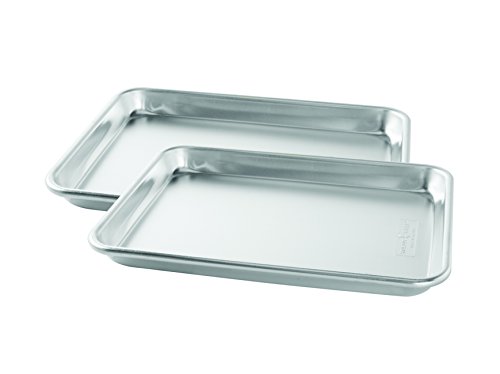
Nordic Ware Naturals
The Naturals line is built around plain, uncoated aluminum with rolled rims, and it behaves like the sheet pans used in working bakeries: light in the hand, quick to heat, quick to cool, and completely indifferent to metal utensils. There is no coating to protect, so the pans darken and pick up marks over the years without losing performance. Bakers who grew up with this style tend to trust it because what you see is exactly what you get, season after season.
Strengths
- Uncoated surface cannot peel, blister or wear through, so the pans age gracefully for many years
- Aluminum heats evenly and cools fast, which helps stop carryover browning on cookies
- Rolled rims resist warping and give you a secure grip with oven mitts
Trade-offs
- Bare aluminum can react with acidic foods and discolour with tomato or citrus batters
- Shiny surface browns more gently, which some bakers find slow for crisp edges
- Needs parchment or greasing for sticky bakes because nothing is nonstick by design
Best for: Bakers who bake weekly, prefer parchment, and want pans that outlast coatings. Not suited for: Anyone who wants effortless release for sticky cakes without liners. This is a mid-tier option; check price on Amazon when you are ready to compare current listings.

USA Pan Bakeware
USA Pan builds its bakeware from aluminized steel with a corrugated surface texture and a silicone-based nonstick coating. The ridges are not decoration: they increase surface area, encourage air flow under food, and help baked goods release with very little greasing. The pans feel noticeably substantial, with a heft that signals thick material and careful finishing, and the fluted texture gives cookies and roasted vegetables an unusually even bottom colour.
Strengths
- Corrugated surface promotes even browning and remarkably easy release
- Heavy aluminized steel resists warping through repeated high-heat cycles
- Coating is applied without the older chemistries many buyers now avoid
Trade-offs
- The textured surface needs a soft brush to clean crumbs out of the ridges
- Premium positioning means replacing a single pan costs more than basic lines
- Coating still has a lifespan, so metal utensils and harsh scouring shorten it
Best for: Regular bakers who want nonstick convenience with a more durable, professional feel. Not suited for: Bakers who prefer completely uncoated pans they can scrub without thinking. This is a premium-leaning mid-tier option; check price on Amazon when you are ready to compare current listings.

Wilton Perfect Results Premium
Wilton is the name most home bakers meet first, and the Perfect Results Premium line is designed as an accessible, complete starting point: steel pans with a nonstick coating, sold in combinations that cover cakes, muffins, loaves and sheets in one purchase. The pans are lighter than premium lines, the coating is serviceable rather than exceptional, and the whole proposition is about getting a new kitchen baking quickly without a large commitment.
Strengths
- Complete, coordinated sets make it easy to equip a first baking kitchen in one step
- Lightweight pans are easy to handle, store and wash
- Widely available, so adding a matching piece later is simple
Trade-offs
- Thinner steel can flex or warp sooner than heavier pans under high heat
- Nonstick coating is the first thing to age, especially with spray oils and dishwashers
- Lighter build gives less even browning on demanding bakes like shortbread
Best for: New bakers, occasional bakers, and anyone equipping a first or second kitchen. Not suited for: High-volume bakers who will put pans through daily, high-heat use. This is a entry-tier option; check price on Amazon when you are ready to compare current listings.

Calphalon Nonstick Bakeware
Calphalon approaches bakeware the way it approaches cookware: heavier-gauge steel cores with layered nonstick surfaces and a slightly more engineered feel than entry-level lines. The pans have rolled edges, a reassuring weight, and coatings designed to release cakes cleanly and survive years of regular use when they are treated properly. It sits in the middle of the market on purpose, aimed at bakers who found basic sets flimsy but do not need professional equipment.
Strengths
- Heavier steel core browns evenly and resists the warping that plagues thin pans
- Layered nonstick releases cakes and muffins cleanly with minimal greasing
- Rolled edges and solid finishing make the pans comfortable to handle hot
Trade-offs
- Weight that helps browning makes full pans heavier to lift from a low oven
- Coating care rules still apply: no metal edges, no harsh pads, gentle washing
- Sets are curated, so the piece mix may not match every baker’s habits
Best for: Committed home bakers who bake most weeks and want a step up in durability. Not suited for: Anyone shopping purely on the lowest possible outlay for a rarely used set. This is a mid-tier option; check price on Amazon when you are ready to compare current listings.
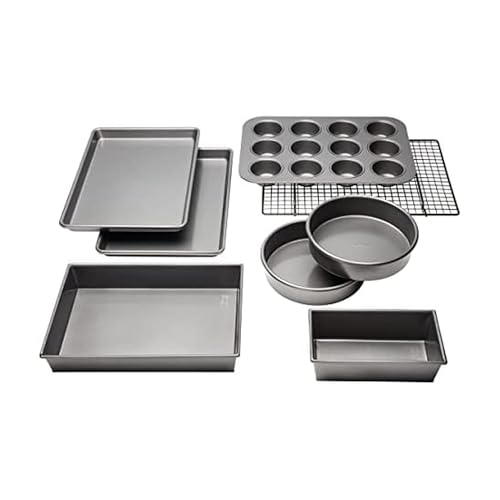
Chicago Metallic Professional
Chicago Metallic has supplied commercial bakeries for generations, and its Professional line brings that plain, workmanlike approach home: aluminized steel, sensible shapes, and both uncoated and nonstick options depending on the piece. Nothing about these pans is decorative. They are built to be stacked, scrubbed, and used hard, and the range includes the awkward specialty shapes that lifestyle brands skip, from pullman loaf pans to serious jelly roll pans.
Strengths
- Commercial heritage shows in flat, warp-resistant construction and clean corners
- Both coated and uncoated options let you match the finish to the food
- Unusual and specialty shapes are easier to find in this range than most
Trade-offs
- Utilitarian looks will not match a display-kitchen aesthetic
- Some pieces are sold individually, so building a set takes more decisions
- Nonstick versions need the same gentle handling as any coated pan
Best for: Serious home bakers who value function, flat pans and specialty shapes over looks. Not suited for: Buyers who want one decorative, gift-style boxed set to cover everything. This is a mid-tier option; check price on Amazon when you are ready to compare current listings.

Rachael Ray Yum-o! Bakeware
The Yum-o! line pairs nonstick steel pans with bright silicone grip handles, aiming squarely at everyday family baking rather than pastry precision. The grips genuinely help when you are pulling a full sheet of nachos or a tray of meatballs out of a hot oven with bulky mitts, and the colours make the set easy to spot in a crowded cupboard. Under the friendly styling the pans are conventional nonstick steel, best suited to moderate temperatures and regular, unfussy use.
Strengths
- Silicone grips make hot pans easier and safer to move with oven mitts
- Friendly sizing and shapes suit family meals as much as sweet baking
- Nonstick surface handles everyday roasting and baking with easy cleanup
Trade-offs
- Grip inserts and coatings prefer moderate heat over broiler-style punishment
- Colourful styling will not appeal to bakers who want a neutral, classic look
- Like most coated entry lines, longevity depends on gentle washing and storage
Best for: Family cooks who bake and roast in the same pans and value easy handling. Not suited for: Bakers chasing the flattest, heaviest professional sheet pans. This is a entry-to-mid-tier option; check price on Amazon when you are ready to compare current listings.
Simple Home Tests That Reveal a Pan’s Character
You do not need a laboratory to evaluate bakeware. Four kitchen tests, done once with any new set, tell you most of what matters. First, the water test for flatness: pour a thin layer of water across a cold sheet pan and tilt it gently. Water that rushes to one corner reveals a slope that will also collect oil and batter. Second, the sugar-cookie test: bake a single batch of pale, plain cookies across the whole sheet and compare colour from corner to corner. Even colour means even heat; a dark quadrant points to either the pan or your oven, and rotating the pan halfway through the next batch tells you which.
Third, the release test: bake muffins or a simple sponge with only the lightest greasing and see what the pan does honestly, because a coating that needs heavy greasing on day one will not improve with age. Fourth, the warp check: after a genuinely hot roast, listen for the sudden bang that signals a pan flexing, and check the pan on a flat counter once cooled. A pan that rocks has twisted, and twisted pans bake unevenly forever after.
Write down what you learn. Note the temperature adjustment each pan seems to want, which pieces release cleanly, and which need parchment insurance. Tape the notes inside a cupboard door if you have to. This small calibration ritual, which takes one baking session, is the difference between bakers who love their sets and bakers who keep shopping for a better one, when the sets themselves are often identical.
How a Set Performs Across a Real Week of Cooking
Specifications tell you very little about living with bakeware. A week of real cooking tells you almost everything. Monday might be a sheet pan of vegetables roasted alongside sausages, where the pan needs to tolerate high heat, hold juices without spilling, and wash clean without soaking overnight. Tuesday could be muffins for lunchboxes, where release matters most and a pan that needs aggressive greasing will quietly fall out of use. Wednesday is often a casserole or traybake in the rectangular pan, taken straight to the table, where appearance and heat retention suddenly matter as much as browning.
By the weekend the set faces its real examination. Cookies test evenness across the whole sheet, because any hot spot announces itself as one dark row. A layer cake tests release and corner definition. Banana bread in the loaf pan tests whether the centre cooks before the crust over-browns. A good set is not the one that wins one of these tests dramatically. It is the one that passes all of them without drama, special handling, or a growing list of exceptions you have to remember.
This is also where set coherence shows its value. When every pan in the cupboard shares a material and finish, your instincts transfer: you know how long things take, how much greasing is enough, and when to check for doneness. A mixed cupboard assembled piece by piece can bake beautifully, but each pan has its own personality and the learning never quite finishes. Neither approach is wrong, yet the coherence of a set is a genuine, practical benefit that individual pan reviews rarely mention.
Strengths and Trade-Offs Across the Roundup
Strengths
- Modern sets at every tier brown more evenly than the thin pans they typically replace.
- Coated lines have made cake and muffin release nearly foolproof for beginners.
- Uncoated professional-style lines offer genuine decade-scale value.
Trade-Offs
- Entry lines save money by thinning material, and the sheet pan shows it first.
- Styled family sets sacrifice the flatness and heat tolerance specialists want.
- Every coated set carries an expiry date that care can postpone but not cancel.
Who Each Style of Set Suits
Choose the uncoated professional style if you bake weekly, line pans without resentment, and measure purchases in decades. Choose a quality coated style if cakes and muffins dominate and easy washing keeps you baking. Choose an entry set without embarrassment if you bake monthly, are equipping a temporary kitchen, or are discovering whether baking is your hobby at all. Choose the handled family style if hot pans must move safely around a busy kitchen. The reviews above reward honesty about habits far more than ambition about them.
Care, Cleaning and Storage That Double a Set’s Life
Most bakeware does not die in the oven. It dies at the sink and in the cupboard. Coatings are scratched by stacked pans grinding against each other, by metal utensils, by scouring pads, and by the slow chemical assault of dishwasher detergent. Uncoated pans survive more abuse but stain, and bakers who attack stains aggressively with harsh pads trade appearance for a rougher surface that food clings to. A gentle routine protects both families.
Wash pans warm rather than cold, because a hot pan plunged into cold water is the classic warping scenario, especially for thinner steel. Soak stuck-on food instead of chiselling it. Use soft sponges and brushes, and keep a paste of baking soda for the browned polymerised oil that builds up on sheet pans; that patina is harmless and even mildly nonstick, so there is no need to restore a pan to showroom brightness. Dry pans fully before stacking, and place a cloth, a paper towel or a pan protector between coated surfaces. Stored this way, a mid-range set routinely outlasts the same set treated carelessly by many years.
Oven habits matter too. Never cut food in the pan. Never use a coated pan under a broiler unless the maker explicitly allows it. Avoid aerosol sprays on nonstick surfaces, because their propellant additives bake into a varnish that makes the coating seem to fail when the pan is actually just glazed. Grease with butter, oil on a paper towel, or a liner instead. Finally, rotate your sheet pans if you own two, because the pan that does every roast and every cookie batch will age twice as fast as its twin for no benefit.
Final Verdict
Read together, these bakeware set reviews point to a reassuring conclusion: the market’s centre is strong. A baker who picks any well-constructed set matched to their habits, calibrates it over a few bakes, and washes it kindly will be well served for years. Spend your attention on flatness, weight and piece lists, not on counts and colours, and let the profiles above steer you to the philosophy that fits your kitchen.
The First-Week Scorecard: Testing This Bakeware set at Home
Apply the identical test to USA Pan Bakeware as well, on the same day and under the same conditions, because a fair comparison needs one ruler rather than two moods. If Wilton Perfect Results Premium is also in contention, give it the same worksheet and let the three sets of answers sit side by side before anyone reaches for a checkout button. Score the storage reality: whether the bakeware set and its parts return to their spot without a rearrangement ritual, and whether anything migrates to a counter because it has no home. Score the noise, heat, steam, or vibration against the room it lives in, at the hour you most often use it, and note whether anyone in the household comments unprompted.
Score the small parts: lids, seals, trays, attachments, and fasteners, because in long ownership the small parts are where satisfaction quietly leaks away. Score the documentation by looking up one real question mid-task and timing how long the answer takes to find, in the booklet or on the maker’s support pages. Score the fit against the measurements you took before ordering, and note any surprise, generous or otherwise, while the details are still fresh enough to help another buyer. Score the second user experience by watching someone else in the household use the bakeware set without coaching, and noting exactly where they hesitate or guess.
- Time the box-to-ready setup
- Repeat the core job on two separate days
- Time the full clean including drying
- Watch a second user try without coaching
- Deliberately make the common mistake once
- File the scorecard with the receipt
Score the worst job, not the best: the largest load, the trickiest ingredient, or the latest tired evening, because that score predicts your feelings in month six. Score the recovery: deliberately make the common mistake, such as overfilling, mis-seating a part, or choosing the wrong setting, and judge how obvious and forgiving the fix is. Add the scores without weighting them, then read the lowest two again, because those are the entries that decide whether this example stays in your house. If a low score surprises you, repeat that single test once before concluding anything, since first attempts often measure the operator rather than the product.
Keep the finished scorecard with the receipt and warranty details, so a future claim, resale, or replacement decision starts from evidence rather than from a fading impression. Revisit the card after a month and change only the scores that genuinely moved, because the difference between week one and month one is the learning curve made visible. Note which score you would check first if you were buying a second bakeware set as a gift, since that priority usually reveals what the product is really about. Finish by writing one sentence describing who should not buy this example, because a clear exclusion is the most useful line in any honest assessment.
Whatever the category, photograph your intended spot with the neighbouring items in place, because a picture exposes crowding that measurements alone politely ignore. Keep every measurement, tally, and note from these checks in one place, ideally with the receipt, so the next decision in this category starts from your evidence rather than from scratch. Involve the household early where the product is shared, since a decision everyone helped measure is a decision nobody relitigates at the first inconvenience. Prefer the option that fits your existing routine with the fewest new habits, because each new habit is a small tax collected every single day.
Be wary of solving a storage problem by creating a carrying problem, since distance between storage and use is where good equipment goes to be forgotten. Check the return conditions before the trial period begins, and calendar the last safe decision day, so the deadline works for you instead of surprising you. Judge the packaging and unboxing only once, briefly, and then ignore them, because they are the one part of ownership guaranteed never to repeat. Let the second week arbitrate disputes from the first, since novelty inflates both delight and irritation beyond their durable values.
When two options remain tied after honest testing, choose the one whose weaknesses fall on your rarest jobs rather than your commonest ones. Remember that the best outcome of a careful check is sometimes a confident no, which costs an afternoon and saves a cupboard, a counter, and a slow resentment. Write your verdict where you will see it before any future upgrade, because the most expensive purchases are the ones that re-buy a lesson already learned. Treat measurements taken in your own rooms as senior to any general guidance, including this guide, whenever the two disagree about fit.
Frequently Asked Questions
Which bakeware set gets the best reviews overall?
Well-constructed mid-range sets in both philosophies review best over time: uncoated aluminum and aluminized steel lines for longevity and even baking, and heavier coated lines for release and convenience. Entry sets review well as starter equipment when expectations match their thinner construction. The consistent lesson across reviews is that matching the set to your baking habits matters more than any single ranking.
What do reviewers test first in a bakeware set?
The sheet pan, with a batch of pale cookies spread across its whole surface. Uneven colour exposes hot spots, warping and thin material in a single bake. Reviewers then test cake release, muffin release, loaf centres and how the pans wash, because those five experiences predict daily satisfaction better than any specification list or piece count printed on the box.
Why do some bakeware sets get bad reviews after a year?
Usually because coatings were washed harshly, cut in, sprayed with aerosol oils or stored in a grinding stack, or because thin pans warped under high heat and cold water. Construction sets the ceiling, but habits decide how close a set gets to it. Reviews that follow sets over time consistently praise the same models that disappointed other owners, with care as the dividing line.
Are professional-style bakeware sets too much for home bakers?
No. Professional style simply means plain, heavy, uncoated construction, which home bakers who bake weekly often love for its evenness and lifespan. The only adjustment is greasing or lining for release, which quickly becomes habit. Occasional bakers may find coated sets kinder, but there is nothing intimidating about professional pans beyond their honest, undecorated looks.
How do I compare bakeware set reviews fairly?
Compare reviews that test the same jobs you do. A set praised for cookies may be untested for layer cakes, and a family set praised for handling may never have faced a serious loaf. Weight reviews that discuss construction, flatness and care over time more heavily than first impressions, and be suspicious of any review that ranks purely by piece count or appearance.
When should I replace a bakeware set?
Replace coated pans when release fails despite gentle cleaning, or when coating is damaged or flaking. Replace any pan that has warped enough to rock on a flat surface, because it will bake unevenly forever. Uncoated pans rarely need replacing at all; staining and darkening are cosmetic. Many bakers replace pieces individually rather than whole sets, which is easier when the line sells open stock.
Related Guides
bakeware set buying guide bakeware set pros and cons bakeware set review how to choose a bakeware set is a bakeware set worth it
Related reading: the best bakeware sets we have tested, our guide to nonstick bakeware sets, ceramic bakeware sets compared, bakeware sets for baking enthusiasts.
Parchment paper deserves a place in any discussion of bakeware, because it changes what a pan needs to do. With a liner, release becomes the paper’s job and the pan only has to deliver even heat, which is why many professionals happily use plain uncoated pans for everything. Silicone mats do similar work for cookies and roasted items, though they slightly soften bottom browning. Choosing to bake with liners is not cheating; it is a system decision that lets simpler, longer-lasting pans perform like premium ones.
Oven thermometers expose an uncomfortable truth: many home ovens run hotter or cooler than their dials claim, and they cycle around the target rather than holding it. Before blaming a new set for pale or dark results, confirm what temperature your oven actually delivers. A pan cannot compensate for an oven that is significantly off, and recalibrating your expectations, or the oven itself, often transforms results more than any purchase could.
Greasing technique matters more than greasing quantity. A thin, complete film of butter or oil, worked into corners with a brush or paper towel, releases better than a thick, uneven layer that pools and fries into patches. Flouring a greased cake pan adds insurance for delicate sponges, while cocoa powder does the same job for chocolate cakes without leaving pale marks. These small habits make mid-range pans perform like expensive ones.
Cooling is a stage of baking, not an afterthought. Cakes need a short rest in the pan so their structure firms enough to turn out without tearing, but a long rest traps steam and sogs the crust. Cookies firm up on the hot sheet for a few minutes before they can move without breaking, then finish cooling on a rack where air reaches their bottoms. A set that includes a rack, or a cupboard that has one, completes the system.
Rotation is the simplest uneven-baking fix ever devised. Home ovens have hot spots, usually toward the back and near the elements, and turning a pan halfway through baking averages them out. Two pans swapped between shelves benefit even more. If your bakes brown unevenly, rotate faithfully for a month before shopping for new pans; the problem is as often the oven’s personality as the pan’s quality.
Batch size changes pan choice. A recipe doubled into a deeper pan does not simply take a little longer; the centre may still be liquid when the edges are overdone, because heat travels slowly through batter. Two shallower pans almost always beat one deep one for even results. This is a quiet argument for sets with duplicate core pieces, and for owning two sheet pans rather than one heroic oversized tray.
Frozen and chilled doughs are a useful stress test for any pan. Cookie dough baked from frozen spends longer in the oven, which exaggerates differences in browning between dark and light finishes. If your household freezes dough for fresh-baked cookies on demand, favour lighter finishes and heavier gauges, and note the adjusted timing on the recipe after the first successful batch.
Acidic foods and bare metal need a truce. Tomato sauces, rhubarb, citrus curds and vinegar-based glazes can react with uncoated aluminum during long contact, picking up flavour and colour you did not invite. Line the pan, choose a coated or enamelled surface, or move the food promptly after baking. Short bakes rarely cause trouble; it is the slow casserole and the overnight marinade that need planning.
The sound of a pan tells you things. A sharp bang a few minutes into roasting is a pan flexing as it heats, which usually means thin material expanding unevenly. Occasional flexing in a light pan is common and not dangerous, but it spills juices and signals a pan that will eventually take a permanent twist. Heavy pans heat silently, which is one of those small quality signals you only appreciate after living with both kinds.
Lids are the most misunderstood part of set value. A lid that fits a rectangular pan turns it into a transport container and a marinating dish, and helps keep casseroles moist. Yet lids are also how modest sets inflate their piece counts. Judge a set by its pans first and treat lids as a genuine bonus only when they fit pieces you will actually use weekly.
Handedness and height sound trivial until you lift a full, hot rectangular pan from a low oven while wearing mitts. Wide rims give your thumbs a landing place. Silicone grips help if your mitts are thin. Low, flimsy rims force a fingertip grip that nobody trusts with a bubbling casserole. When comparing sets in person or in photographs, look at the rims first; they are where daily confidence is built.
Second-hand bakeware can be excellent value, with one caution: coatings. Uncoated aluminum and steel pans from quality makers survive decades and can be scrubbed back to honest working condition. Coated pans with scratches, bubbles or flaking should be passed over, because their best years are behind them and damaged coatings only deteriorate faster. Buy the uncoated classics used; buy coatings new.
A note on colour: dark pans are not a defect and light pans are not old-fashioned. They are different tools. Dark finishes suit foods that want aggressive bottom browning, like pizza-style flatbreads and roasted potatoes. Light finishes protect pale cakes, shortbread and meringue-based bakes. A thoughtful set, or a thoughtful baker mixing pieces, uses each where it shines instead of declaring one universally superior.
Stacking order protects coatings better than any spray or treatment. Heaviest pans at the bottom, coated pans separated by cloth or protectors, and nothing with sharp feet or rough bases resting inside a nonstick surface. Cupboards undo more coatings than ovens do, simply because pans are stored three hundred days a year and baked on perhaps fifty.
If you bake for people with different needs, pans quietly help. A muffin pan portions batter evenly for lunchboxes. A loaf pan turns a standard recipe into neat, freezable slices. Sheet pans let you roast vegetables on one side and proteins on the other for households cooking two versions of dinner at once. The right shapes reduce friction in ways that have nothing to do with browning curves.
Cleaning roasted pans is easier warm. Once a sheet pan has cooled enough to handle but still holds warmth, a soak in hot soapy water loosens most residue without a fight. Leave it overnight and the same residue sets like varnish. Bakers who wash promptly can use gentler tools, which keeps surfaces smoother, which makes the next wash easier still. Good pans and good habits compound together.
Recipe language assumes standard pans. When a recipe says a batter fits a particular pan, it assumes typical depth and dimensions, and substituting a much deeper or shallower piece changes the bake even if the volume matches. A coherent set, whose pieces follow standard sizing, makes recipes behave as written. That predictability is worth real money to bakers who follow published recipes closely.
Finally, remember that pans are among the longest-lived objects in a kitchen. Appliances are replaced, knives are replaced, but a well-chosen sheet pan can serve for decades. That longevity argues for buying the best-constructed set your actual baking habits justify, choosing classic shapes over fashionable ones, and favouring makers whose individual pieces remain available when you eventually want a duplicate.
Seasonal baking changes what a set must do. Autumn brings pies and gratins that sit heavily in dishes and travel to other houses. Winter brings cookie batches in rotation, where a second sheet pan doubles your output and a reliable rack becomes essential furniture. Spring brings lighter cakes that expose release problems, and summer brings fruit crisps that bubble over and test how easily a pan washes. A set that survives all four seasons without a weak chapter is a set chosen well.
Travelling bakes deserve a thought when choosing pans. A rectangular pan with a secure lid becomes a carrier for school events and potlucks, while loose cakes on plates are an anxiety with a crust. If your baking regularly leaves the house, favour sets whose core pans have lids available or whose rims accept foil tightly, and practise the journey once with something forgiving before trusting it with a showpiece.
Children change bakeware priorities in ways catalogues never mention. Pans need to be light enough for supervised young helpers, cool quickly enough to reduce lingering danger on counters, and wash easily enough that baking together does not end with an adult scrubbing alone. Silicone grips and moderate sizes earn their place in family kitchens for reasons that have nothing to do with browning curves and everything to do with Tuesday evenings.
Small ovens and countertop ovens impose their own geometry. A set designed for a full-size range may include a sheet that simply cannot enter a compact oven, leaving the owner with a flagship pan that lives elsewhere. Measure before buying, and if your oven is compact, build around smaller sheets and standard cake and loaf sizes, which fit almost everywhere and still cover the great majority of recipes.
Altitude and humidity quietly alter baking, and pans interact with both. At altitude, batters rise faster and set slower, so pan depth and fill level matter more, and dark pans can over-brown before centres set. In humid climates, crispness fades quickly, making racks and prompt cooling more important. None of this changes which set to buy, but it changes which pieces you will lean on hardest.
There is a particular pleasure in a pan that has history. Uncoated pans develop a patina that records years of roasts and bakes, and many bakers find that seasoned surface releases better with age. Coated pans move in the opposite direction, starting perfect and declining gently. Knowing which direction your set travels helps you interpret its performance honestly instead of mistaking seasoning for damage or wear for failure.
Recipe scaling is where standard sets quietly shine. Doubling a brownie recipe into the next standard pan size is a known manoeuvre with predictable timing, while eccentric pans demand guesswork. Bakers who cook for crowds, bake sales or freezer stocking benefit from that predictability every time they scale, and it is a genuine argument for boring, standard sizing over novelty shapes.
Noise is an unglamorous quality signal. A cupboard where pans nest silently is a cupboard where coatings are not grinding together at every retrieval. If your storage forces pans to clash, add protectors or hang the most-used sheet where it can be reached without excavating a stack. The cheapest coating preservation programme ever devised is a few squares of cloth and a moment of care.
Gift buying follows different rules from self buying. A set given to a new household should favour forgiveness: coated surfaces, standard sizes, easy washing and nothing that demands specialist knowledge. A set given to an experienced baker should favour construction, because they will judge the sheet pan in the first ten seconds and the coating in the second year. When in doubt, gift the set you would want to inherit.
Freezer use expands a set’s job description. Muffin pans freeze portions of stock, sauces and baby food into tidy pucks. Loaf pans shape terrines and ice-cream cakes. Sheet pans freeze berries and dumplings in a single layer before bagging. Metal sets handle this double duty without complaint, though lining helps release and protects finishes from freezer moisture during long storage.
Finally, trust your own calibration notes over generic advice, including this guide’s. Your oven, your recipes and your hands form a system no reviewer can replicate. A set that suits your system, at a construction level your budget supports, chosen for the shapes you truly use, will outperform a theoretically superior set bought for someone else’s kitchen. That is the principle underneath every section here.
Consider how a set behaves with your favourite recipes specifically, not baking in the abstract. If your signature bake is a sticky caramel traybake, release and washing dominate your life and coatings earn their keep daily. If it is a crusty loaf, pan depth and material dominate. Bring one signature recipe mentally through every candidate set and ask where it would struggle; that small exercise predicts satisfaction better than any feature comparison.
Oven gloves and mitts are part of the bakeware system too. Bulky mitts need generous rims to grip; slim gloves can manage sleeker pans. If you have ever nearly tipped a full casserole because the rim offered nothing to hold, you already know this matters. When choosing between otherwise equal sets, pick the rim design your hands and mitts handle with confidence at a hot oven door.
There is a quiet economics to duplicates. A second sheet pan costs little compared with the set, yet it transforms batch baking, letting one tray cool while another bakes and doubling cookie output without doubling time. If a set tempts you mainly because it includes two sheets, that instinct is sound. Duplicates of your hardest-working shape are rarely wasted money, unlike duplicates of shapes you use twice a year.
Washing technology has changed what care means. Modern detergents are effective at lower temperatures, which is kinder to coatings, and long soaking is safer than aggressive scrubbing for almost every finish. The bakers whose pans look best after five years are rarely the ones who scrub hardest; they are the ones who soak patiently, wash gently and dry completely, every time, as a rhythm rather than a project.
Think about who else uses your kitchen. A set shared with housemates, teenagers or enthusiastic beginners will face metal utensils and dishwashers whatever the house rules say. In shared kitchens, uncoated pans are not just a preference but a peace treaty, because they forgive the treatment they will inevitably receive. Buying for the kitchen you share beats buying for the kitchen you wish you had.
Presentation pans occupy a small but real niche. A beautiful ceramic dish that carries a crumble from oven to table saves a transfer, holds heat through a meal and earns compliments a steel pan never will. Most metal sets will not cover this job, which is why so many set owners add one presentable dish later. Planning that addition from the start prevents the false feeling that the set failed at a job it never claimed.
Weight cuts both ways and deserves honest thought. Heavy pans bake evenly and resist warping, but a heavy rectangular pan full of lasagne is a serious lift from a low oven, especially for bakers with limited wrist or shoulder strength. If lifting is a concern, moderate weight with good rims and grips is the wiser specification, and there is no prize for owning the heaviest pan in the neighbourhood.
Lastly, give any new set a fair season before judging it. The first bakes in unfamiliar pans include calibration errors that belong to the baker, not the bakeware. By the tenth bake, timings are instinctive, greasing is calibrated and the pans have either become invisible equipment, which is the highest praise kitchen tools earn, or revealed a genuine flaw you can name precisely. Both outcomes are useful knowledge.


