Disclosure: topratedkitchenware.com is reader-supported. When you buy through links on our site, we may earn an affiliate commission from Amazon and other retailers, at no extra cost to you.
Where to buy
Four batteries in this roundup are native 24 volt lithium batteries and are the linked picks in this guide to the best 24 volt lithium batteries, spanning the category from a compact 5Ah project pack to an 8038.4Wh storage battery. The remaining two are well-regarded 12 volt LiFePO4 batteries that appear in 24 volt searches because owners wire them in series pairs; they are reviewed in full as prose-only components, with no link, because a component is not a 24 volt battery until a second unit and a disciplined owner complete it.
- Xeanerol 24V 5Ah Lithium Battery with 2A Fast Charger — check the latest price on Amazon
- yeagulch 24V 100Ah LiFePO4 Lithium Battery — check the latest price on Amazon
- Dyness 24V 100Ah LiFePO4 Lithium Battery — check the latest price on Amazon
- yeagulch 24V 314Ah LiFePO4 Lithium Battery — check the latest price on Amazon
- SUPER EMPOWER 12V 100Ah LiFePO4, Group 24 — series-pair component, covered prose-only below
- VEMDIA 12V 100Ah LiFePO4, Group 31 — series-pair component, covered prose-only below
Read the full guide ↓
The search for the best 24 volt lithium batteries covers more honest variety than most battery categories, because 24 volts is where small project power and serious energy storage overlap. At one end of this guide sits a 5Ah lithium-ion pack that runs RC cars, LED strips, and cameras and arrives with its own little charger. At the other end sits a 314Ah lithium iron phosphate battery holding 8038.4Wh, enough to carry an off-grid cabin through the night behind a 200A management system. Between them stand two 100Ah LiFePO4 batteries that represent the category’s center of gravity: trolling motors, RV house systems, marine banks, and solar storage. This guide treats that whole span seriously, because the keyword does, while drawing two firm lines that protect buyers. The first line is voltage honesty: only native 24 volt batteries are linked, and the two 12 volt units are labeled as the series components they are. The second line is scale honesty: a battery is recommended for the work its capacity and discharge design can actually do, and the small pack is praised for projects rather than inflated into a storage battery. Readers focused on the phosphate chemistry specifically can go deeper in Best 24 Volt Lithium Batteries Deep Cycle; this page maps the full lithium landscape at 24 volts.
Why does the native-versus-series distinction deserve so much emphasis? Because the ownership experiences diverge completely after purchase day. A native battery has one management system, one charge profile, one monitor reading, and one unit to blame or thank. A series pair has two of everything electrical that matters, plus a balancing discipline that, if skipped, quietly converts a good bank into a confusing one. Neither architecture is a scam; the paired route built most of the 24 volt world for decades. But they are different products wearing similar search results, and a guide that blurs them sends buyers home with the wrong charger, the wrong expectations, and occasionally a single 12 volt battery facing a 24 volt motor. The reviews below keep the categories separate so that every reader can choose deliberately.
Key Takeaways
- Four linked picks are native 24 volt lithium batteries: one compact lithium-ion project pack and three LiFePO4 batteries from 100Ah to 314Ah.
- The two 100Ah LiFePO4 batteries each store 2560Wh; they differ mainly in intent, one trolling-first and one built around a stated expansion architecture up to 20.48kWh.
- The 314Ah battery stores 8038.4Wh behind a 200A BMS and belongs to cabins, large RVs, and backup systems rather than portable duty.
- The 5Ah pack is a genuine 24 volt lithium battery for RC, LED, CCTV, and DIY work; it is linked for those roles and recommended for nothing larger.
- The two prose-only 12 volt batteries are quality deep-cycle units that only become 24 volt power as a matched, maintained series pair.
- Across every class, the same rules apply: size in watt-hours, respect the BMS current ceiling, charge on a true lithium profile, and protect lithium cells from charging in freezing temperatures.
- Reading any listing in a fixed order, native voltage, full chemistry name, watt-hours, BMS watts, protection set, then cycle class, dissolves most of the confusion this category is known for.
- Switching from lead-acid habits brings three surprises: far less weight and bulk, a flat discharge curve that makes voltage gauges useless, and a relaxed charging temperament that forgives partial charges.
In this guide
Quick Picks
- Xeanerol 24V 5Ah Lithium Battery — Badge: Best for Small Projects. A compact 24 volt lithium-ion pack with a 2A fast charger and cable connector, listed for DIY projects, RC cars, LED strips, and CCTV cameras. Check on Amazon
- yeagulch 24V 100Ah LiFePO4 — Badge: Best for Trolling and General Duty. Native 24 volt, 2560Wh, built-in 100A BMS, low-temperature cutoff, and a listing that names trolling motors first. Check on Amazon
- Dyness 24V 100Ah LiFePO4 — Badge: Best for Expandable Systems. Native 24 volt, 2560Wh, smart 100A BMS, and stated 4P2S connection support up to 20.48kWh. Check on Amazon
- yeagulch 24V 314Ah LiFePO4 — Badge: Best Maximum Capacity. Native 24 volt storage at infrastructure scale: 8038.4Wh, a 200A BMS, and low-temperature protection. Check on Amazon
- SUPER EMPOWER 12V 100Ah LiFePO4 (Group 24) — Badge: Best Series Component, Group 24. A 1280Wh deep-cycle battery with a 100A BMS and low-temperature cutoff. Prose-only: a 12 volt unit, documented as half of a possible series pair.
- VEMDIA 12V 100Ah LiFePO4 (Group 31) — Badge: Best Series Component, Group 31. A deep-cycle battery with a built-in 100A BMS, listed for solar systems, home energy, RVs, and marine use. Prose-only: a 12 volt unit, documented as half of a possible series pair.
How These Picks Were Chosen
All six products come from a verified pool checked against Amazon’s catalog data on 2026-11-20. Every specification in this guide, from capacities and energy figures to BMS ratings, cycle classes, charger details, and protection features, is drawn only from the verified listing title of the exact product under review. Where that data does not state a specification, the guide does not invent one; dimensions, weights, and terminal details are absent for that reason, and their absence is a feature of honest research rather than an oversight. A guide that admits the edge of its verified knowledge is more useful than one that papers over it, especially in a category where a wrong assumption is measured in hundreds of watts, an installation that does not fit, or a long walk back to the dock, the road, or the cabin door.
The linking rule follows the keyword’s own terms. This keyword asks for 24 volt lithium batteries, without narrowing the chemistry, so eligibility required native 24 volt output and lithium chemistry of any branch. Four picks pass: the Xeanerol’s lithium-ion project pack and the three LiFePO4 batteries. The two remaining picks are lithium iron phosphate deep-cycle batteries of real quality, but they are 12 volt units; under this guide’s standing voltage rule they are prose-only components, reviewed in full because the series-pair route is a legitimate way owners build 24 volt banks and because readers deserve the pairing requirements in writing rather than discovered later. Within the linked four, recommendations are scaled honestly: the project pack is recommended for projects, and no sentence in this guide suggests it can store solar energy or run a motor.
No hands-on testing is claimed. The comparisons are research-led, built from the verified specifications and from established lithium battery practice covering discharge ceilings, charging profiles, low-temperature behavior, and bank architecture. Readers whose interest is specifically deep-cycle service will find the companion analysis in Best 24 Volt Lithium Batteries Deep Cycle, and those building toward solar should read Best 24 Volt Lithium Batteries For Solar alongside this page.
The 6 Best 24 Volt Lithium Batteries Across Every Scale
The order below follows the research rotation, which conveniently walks the category from its smallest honest member to its largest components. Read each review’s status line first: linked or prose-only, and the class of work the battery is actually for.

Xeanerol 24V 5Ah Lithium Battery with 2A Fast Charger
Badge: Best for Small Projects
Strengths
- Genuine native 24 volt output in a compact pack, with a matched 2A fast charger and cable connector included.
- Complete, self-contained kit: nothing else to source for the project roles it names.
- Verified listing is precise about its world: 24 volt DIY projects, RC cars, LED light strips, CCTV cameras.
Trade-offs
- At 5Ah it stores roughly a twentieth of the energy of the 100Ah batteries in this guide.
- Lithium-ion project construction, with no deep-cycle design or cycle class claimed in its verified data.
- Bare project format offers none of the casing, terminals, or protection architecture of a storage battery.
Spec box (from verified listing data): Nominal voltage 24V; capacity 5Ah; chemistry lithium-ion; charger 2A fast charger included; connection cable connector; named uses 24 volt DIY projects, RC cars, LED light strips, CCTV cameras.
It would be easy to treat the Xeanerol as a footnote beside batteries sixty times its capacity, and that would be a mistake, because for its actual jobs it is the most convenient product in this guide. An RC builder, a lighting installer, or a hobbyist powering a camera rig needs exactly this: true 24 volt output, a charger designed for the pack, a connector ready to wire, and no surplus size or weight. The discipline this guide applies is not to diminish the pack but to fence its recommendation honestly. Five amp-hours is a project’s worth of energy, not a system’s. The moment a load involves propulsion, appliances, or overnight storage, the correct product is one of the LiFePO4 batteries below, and the price of confusing the two categories is a protection shutdown or a ruined pack. Within its fence, buy it with confidence; it is a tidy, complete answer to a real set of questions.
Best for: RC cars, LED installations, CCTV power, and 24 volt DIY projects / Not suited for: deep-cycle duty, energy storage, trolling, or inverter loads
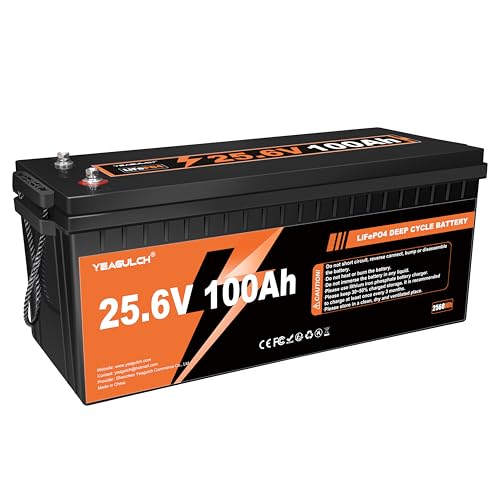
yeagulch 24V 100Ah LiFePO4 Lithium Battery
Badge: Best for Trolling and General Duty
Strengths
- Native 24 volt LiFePO4 with the full 2560Wh, a built-in 100A BMS, and a stated 15000+ deep-cycle class.
- Verified listing names trolling motors first, followed by off-grid, solar, RV, and marine use.
- Low-temperature cutoff protection, with UN38.3 and UL1973 certifications named in the listing data.
Trade-offs
- No ingress rating is stated in its verified data, so installation dryness is the owner’s responsibility.
- No structured expansion ceiling is published in its data, unlike the Dyness.
- The 100A BMS ceiling, roughly 2400 watts at 24 volts, still bounds the largest inverter and motor combinations.
Spec box (from verified listing data): Nominal voltage 24V; capacity 100Ah; energy 2560Wh; chemistry LiFePO4; BMS built-in 100A; stated cycle class 15000+ deep cycles; protection low-temperature cutoff; certifications named UN38.3, UL1973; named uses trolling motors, off-grid, solar, RV, marine.
This is the category’s center of gravity: the battery most 24 volt shoppers actually need. Its specification covers the canonical jobs without excess or apology. On a trolling motor it delivers a full day-class energy supply through one protection system, with cold-morning charge protection for the seasons when fishing is best. In an RV or a small solar bank it offers the same 2560Wh with the partial-charge tolerance that makes LiFePO4 so forgiving of real-world charging habits. The absence of a stated waterproof rating is its one clear gap against the wider pool, and it is an installation question rather than a performance one: mount it somewhere sheltered, as most house batteries are, and the gap closes. Buyers whose first mission is propulsion can compare the motor-specific reasoning in Best 24 Volt Lithium Trolling Motor Battery.
Best for: trolling motors, RV house power, marine banks, and small solar storage in sheltered installs / Not suited for: installations that require a stated waterproof rating from the battery itself

Dyness 24V 100Ah LiFePO4 Lithium Battery
Badge: Best for Expandable Systems
Strengths
- Native 24 volt, 2560Wh, with a smart 100A BMS.
- Stated 4P2S connection support up to 20.48kWh, the clearest published growth path in this guide.
- Verified listing states a 10-year lifetime design intent for marine, RV, and solar service.
Trade-offs
- Its stated cycle class of 4000+ deep cycles sits below the 15000-class figures claimed by the yeagulch units.
- No low-temperature cutoff or ingress rating is stated in its verified title data.
- Reaching the stated expansion ceiling requires system-level design, matched units, and re-sized charging.
Spec box (from verified listing data): Nominal voltage 24V; capacity 100Ah; energy 2560Wh; chemistry LiFePO4; BMS smart 100A; stated cycle class 4000+ deep cycles; stated lifetime 10-year; stated connection support 4P2S, up to 20.48kWh; named uses marine, RV, solar.
The Dyness argues for itself on architecture. Most batteries in this class can be paralleled in practice; this one publishes the scheme, 4P2S up to 20.48kWh, in its own listing data, which tells a system builder that growth was a design input rather than an afterthought. For a solar installation that will add panels, a cabin that will add loads, or an RV owner whose ambitions grow by the season, that published path converts an eventual redesign into a planned addition. The counterweights are stated just as plainly in this review: a lower cycle class than its rivals here, and no cold or ingress protection named in its verified title. A buyer cycling daily for a decade may weight the cycle class first; a buyer building a growing system will weight the architecture first. Both are rational, and the guide’s job is to make the trade visible, which the verified numbers do.
Best for: solar, RV, and marine systems designed to expand in planned steps / Not suited for: buyers who prioritize the highest stated cycle class above growth architecture

yeagulch 24V 314Ah LiFePO4 Lithium Battery
Badge: Best Maximum Capacity
Strengths
- 8038.4Wh of native 24 volt storage in a single unit, more than three 100Ah batteries combined.
- A 200A BMS doubles the discharge ceiling of the 100Ah class, supporting roughly 4800 watts.
- Stated 15000+ deep-cycle class with low-temperature protection and UL 1973 and UN38.3 certifications named.
Trade-offs
- Stationary-class scale; small boats and portable projects should stay with the smaller picks.
- A single very large unit concentrates the bank’s risk in one enclosure.
- Refilling 8kWh demands a substantial charger or solar array and patience.
Spec box (from verified listing data): Nominal voltage 24V; capacity 314Ah; energy 8038.4Wh; chemistry LiFePO4; BMS 200A; stated cycle class 15000+ deep cycles; protection low-temperature protection; certifications named UL 1973, UN38.3; named uses trolling motors, RV, marine, solar, backup power, off-grid.
Every category has a pick that reframes the buyer’s sense of scale, and this is it. Eight kilowatt-hours is not a bigger accessory battery; it is a small utility. Behind its 200A management system, this unit can carry a cabin’s overnight loads, an RV’s multi-day boondocking, or a backup system’s essential circuits with the kind of reserve that turns outages into inconveniences. Its listing still names trolling motors, and a large vessel with the space could use it, but its natural habitat is the battery room, the garage wall’s floor space, and the big RV bay. Ownership at this scale deserves infrastructure habits: heavy cable, a charger sized to the asset, a shunt-based monitor, and a dry, temperate home. Buyers who plan that way get the most capable 24 volt lithium battery in this guide; buyers who need portability should take the hint from its dimensions of purpose and choose the 100Ah class instead.
Best for: off-grid cabins, large RVs, backup power, and solar systems needing days of autonomy / Not suited for: portable use, small boats, or loads that fit comfortably in the 100Ah class
SUPER EMPOWER 12V 100Ah LiFePO4 Battery, Group 24
Badge: Best Series Component, Group 24
Strengths
- A full 1280Wh of deep-cycle capacity with a 100A BMS and low-temperature cutoff.
- Stated support for 4P4S expansion up to 20.48kWh shows a design that expects bank building.
- Group 24 format suits compact battery boxes where a pair must fit a defined space.
Trade-offs
- It is a 12 volt battery; it cannot power a 24 volt load alone, which is why it carries no link in a 24 volt guide.
- As half of a series pair it brings a second BMS, an interconnect, and balance maintenance into the owner’s life.
- Its expansion story is written for 12 volt architecture and should not be confused with native 24 volt growth.
Spec box (from verified listing data): Nominal voltage 12V; capacity 100Ah; energy 1280Wh; chemistry LiFePO4; BMS 100A; format Group 24; low-temperature cutoff; stated expansion support 4P4S, up to 20.48kWh; named uses RV, trolling motor, marine, solar.
Nothing in this review should be read as a criticism of the battery, which is a mainstream, well-specified 12 volt deep-cycle unit of exactly the kind that powers a large share of the RV and marine world. It is here because owners building 24 volt banks from pairs will meet it, and because a buyer who already owns one has a legitimate decision to make: complete the matched pair, with the balance discipline that requires, or sell the concept and go native. What this guide will not do is hand it a 24 volt recommendation it has not earned; the voltage in its own title is 12, and titles are where honesty starts. Readers set on the paired route should buy the twin at the same time, from the same model line, and read the installation section below before ordering cable.
Best for: owners completing a matched series pair, and 12 volt systems in its own right / Not suited for: any single-battery 24 volt installation
VEMDIA 12V 100Ah LiFePO4 Battery, Group 31
Badge: Best Series Component, Group 31
Strengths
- Deep-cycle LiFePO4 capacity with a built-in 100A BMS and a stated 15000-cycle class.
- Verified listing aims it at solar systems, home energy, RVs, and marine use, a realistic spread.
- Group 31 format matches a wide installed base of trays and boxes.
Trade-offs
- A 12 volt unit, prose-only here for the same reason as the SUPER EMPOWER above.
- Paired use doubles the connection count and adds balance checks to the maintenance calendar.
- No low-temperature feature is stated in its verified title data, where its pair-mate rival names one.
Spec box (from verified listing data): Nominal voltage 12V; capacity 100Ah; chemistry LiFePO4 (lithium iron phosphate in the listing title); BMS built-in 100A; format Group 31; stated cycle class 15000 deep cycles; named uses solar system, home energy, RVs, marine.
The VEMDIA mirrors the SUPER EMPOWER’s role one format size up: a credible 12 volt half for a deliberately built series pair, and a perfectly good 12 volt battery in its own right. The pairing rules bear repeating because they are where paired banks succeed or fail. Same model, same purchase, same initial charge, equal cables, periodic individual voltage checks. A pair built that way delivers the same 2560Wh the native 100Ah picks offer, at the cost of the maintenance the natives were invented to eliminate. A pair built casually delivers arguments. Choose the architecture with your habits in mind, not just your budget, and either of these components will do its half of the work honorably.
Best for: matched-pair builders in the Group 31 format and 12 volt solar or RV systems / Not suited for: single-battery 24 volt installs or mixed-model series pairs
Comparison Table
| Pick | Voltage | Chemistry | Capacity | Energy | Class | Status | Link |
|---|---|---|---|---|---|---|---|
| Xeanerol 24V 5Ah | 24V native | Lithium-ion | 5Ah | Small pack class | Projects | Linked | Check on Amazon |
| yeagulch 24V 100Ah | 24V native | LiFePO4 | 100Ah | 2560Wh | Deep-cycle | Linked | Check on Amazon |
| Dyness 24V 100Ah | 24V native | LiFePO4 | 100Ah | 2560Wh | Deep-cycle, expandable | Linked | Check on Amazon |
| yeagulch 24V 314Ah | 24V native | LiFePO4 | 314Ah | 8038.4Wh | Storage | Linked | Check on Amazon |
| SUPER EMPOWER 12V 100Ah | 12V | LiFePO4 | 100Ah | 1280Wh | Deep-cycle component | Prose-only — 12V | — |
| VEMDIA 12V 100Ah | 12V | LiFePO4 | 100Ah | 1280Wh class | Deep-cycle component | Prose-only — 12V | — |
How to Choose Among 24 Volt Lithium Batteries
Choose by class first and brand second. The classes in this guide are projects, deep-cycle service, expandable systems, and bulk storage, and they barely overlap. A project load measured in watts and minutes belongs to the Xeanerol’s world. A motor, an RV, or a modest solar bank belongs to the 100Ah LiFePO4 world. A system with a growth plan belongs to the Dyness’s published architecture. A cabin or backup system with an autonomy requirement belongs to the 314Ah unit. Most buying regret in this category comes from shopping across classes on a single metric, usually capacity or a headline cycle figure, and discovering that the battery’s design center was somewhere else entirely.
Within a class, run the same three checks every time. Energy: convert to watt-hours and compare against an honest estimate of the load’s daily appetite, with reserve. Current: confirm the BMS ceiling, 100A on the 100Ah class and 200A on the big unit, covers the largest simultaneous load with headroom, remembering that at 24 volts each amp of BMS rating is worth roughly 24 watts of permission. Protection and environment: low-temperature cutoff for cold installations, ingress protection where water is a fact of life, and certifications named in the product’s own data. Then check the unglamorous companions: a charger with a true 24 volt lithium profile, cable and fusing sized to the ceiling, and a shunt-based monitor, because lithium’s flat discharge curve makes voltage-only gauges decorative.
Chemistry deserves its own sentence in any lithium guide. LiFePO4 dominates the service classes in this roundup because its cycle life, stability, and tolerance of partial charging suit daily deep-cycle work; the project pack’s lithium-ion design suits compact, light, intermittent duty. Neither is a defect. The defect is only ever a mismatch between the chemistry’s strengths and the job’s demands, and it is entirely avoidable by reading the chemistry line before the capacity line. Buyers who want the chemistry comparison developed further will find it in Best 24 Volt Lithium Ion Battery, and marine-focused buyers in Best 24 Volt Marine Battery.
How to Install, Charge, and Maintain a 24 Volt Lithium Bank
Mount the battery so it cannot move, in the driest suitable space available, with terminals covered and cable runs short, properly crimped, and protected by a fuse near the positive terminal sized for the cable. For a series pair, add the discipline the architecture demands: identical units bought together, each charged fully on its own before connection, an interconnect as short and heavy as the main leads, and main cables taken from opposite ends of the pair. For paralleled native units, charge all units to the same state before joining them and follow the manufacturer’s stated connection scheme where one is published.
Charging is a settings decision before it is a hardware one. Set the charger or solar controller to a 24 volt lithium profile matched to the battery’s chemistry, and verify the setting rather than assuming the label. Recharge promptly after use, store the bank partially charged for long layoffs, and never defeat low-temperature protection to force a winter charge; warm the battery’s space and let the protection release on its own. Project packs are simpler: use the charger supplied with the pack, and only that charger, since its voltage is matched to the pack’s design.
Maintenance across all classes is a short list performed on a seasonal rhythm: terminal tightness, cable inspection, a glance at monitor readings against expectations, and for pairs, an individual voltage check on each unit. Three problems cover most field experience. Problem: runtime shrinks noticeably across a season → suspect chronic undercharging from a wrong charger profile first, and pair imbalance second; both mimic battery aging and both are correctable. Problem: the system disconnects under a heavy load → the BMS has tripped on current or a connection is heating; reduce the load, inspect every lug, and re-plan if the load has outgrown the ceiling. Problem: charging will not start on a cold morning → low-temperature protection is doing its job; warm the space, wait, and charge when the battery allows it.
Reading a Lithium Battery Listing Like an Engineer
Listings in this category reward a particular reading order, and it is worth teaching explicitly because it transfers to every battery a reader will ever buy. Read the voltage first and insist that it be native, in the title, not implied by a pairing suggestion in the description. Read the chemistry second, in full: lithium iron phosphate is a specification; lithium alone is a family reunion. Read capacity third and convert it immediately to watt-hours with the native voltage, because that single multiplication dissolves most cross-voltage confusion. Read the BMS rating fourth and translate it into watts of permission at your system voltage. Read the protection set fifth, looking for the low-temperature cutoff by name and for certifications you can recognize. Read the cycle class last and comparatively, as a statement about the maker’s design intent rather than a countdown printed on the case. A listing that survives that order of reading with its claims intact, as the linked four here do within their verified data, is a listing that can be bought from. A listing that depends on the reader never performing step one or step three is telling you, in its own way, everything you need to know.
The Series Question, Answered Once and Clearly
Because two of this guide’s six products exist to raise it, the series question deserves a direct summary. Wiring two identical 12 volt batteries in series produces a genuine 24 volt bank with the pair’s combined energy, and it remains a legitimate build when the units are matched, bought together, charged in balance, and checked periodically. What it never produces is a 24 volt battery in a single product, which is why the components here are prose-only: the recommendation a buyer acts on should describe the thing they will actually install, maintain, and troubleshoot. Owners who love the paired architecture’s staged cost and replaceable halves should build it proudly and maintain it properly. Owners who want the problem to disappear should buy native. The only wrong answer is the accidental one, a single 12 volt battery ordered against a 24 volt load because a search result grouped them together, and preventing that one order is worth every paragraph this guide has spent on the distinction. Deliberate builders, whether they choose native simplicity or the paired tradition, almost never regret the purchase; accidental buyers almost always do, eventually and expensively.
Matching the Battery to the Four Jobs People Actually Buy For
Abstract classes become concrete when they are attached to shopping lists. The first common list is a fishing boat being converted from a legacy lead-acid pair to lithium: a 24 volt trolling motor, a damp locker, a garage charger, and an owner tired of replacing batteries every few seasons. That list resolves to the yeagulch 100Ah or a waterproof rival from the wider pool, plus a lithium-profile charger and a shunt monitor, and its total ownership story is dominated by what disappears: the second battery, the interconnect, the balance checks, and the early replacements. The second list is a solar shed or small cabin that will grow: panels this year, more load next year. That list resolves to the Dyness and its published expansion path, because the cheapest battery in a growing system is the one that does not have to be replaced when the system doubles. The third list is a serious off-grid or backup installation, where the battery is infrastructure and the autonomy requirement is written in days. That list resolves to the 314Ah unit and the unglamorous companions it deserves: heavy cable, a substantial charger, and monitoring good enough to manage an 8kWh asset. The fourth list is a workbench: an RC fleet, a lighting project, a camera that needs power where no outlet lives. That list resolves to the Xeanerol, bought in an afternoon and working by the weekend.
Notice what none of these lists contains: a battery chosen because its headline number was the largest in a search result, or because a smaller product was on a tempting promotion. Every durable purchase in this category starts from the load and the environment and walks toward the battery, never the reverse. The two prose-only components belong to a fifth list, the deliberate pair build, which is a fine list when it is written on purpose and a poor one when it happens by accident. If this section has a single lesson, it is that the written list is the product: get the class, the energy, the current ceiling, and the protection set right on paper, and the specific battery almost chooses itself from the linked four.
What Changes After Switching to Lithium
Owners arriving from lead-acid habits consistently report the same three surprises, and new lithium buyers should hear them in advance. The first is weight and space: lithium stores its working energy in a fraction of the lead-acid footprint, so lockers and battery bays suddenly have room and boats sit differently on their trailers. The second is voltage behavior: a lithium bank holds its voltage nearly flat through most of its discharge, so motors and electronics run at full character deep into the day instead of fading by degrees, and the old habit of reading state of charge from a voltmeter becomes useless, which is why this guide keeps prescribing a shunt-based monitor. The third is charging temperament: lithium accepts charge quickly and forgives partial charging, so the anxious ritual of keeping a bank brim-full at all times can be retired; prompt recharge after use and partial-charge storage are the new, lighter habits. None of these surprises is a complaint. Together they explain why conversions in this category so rarely reverse, and why the discipline that matters shifts from nursing the battery to simply specifying it correctly at the start. The battery stops being a chore with a voltage and becomes what it should have been all along: a quiet utility that is noticed mainly on the rare occasions when it is absent, which is the highest compliment stored energy can earn in any boat, vehicle, cabin, or workshop it serves.
Common Buying Mistakes
- Comparing amp-hours across voltages. Convert everything to watt-hours before comparing any two batteries.
- Buying a single 12 volt battery for a 24 volt load. Native voltage is the first line of the specification to verify.
- Asking a project pack to do storage or propulsion work. Class mismatches fail fast and sometimes permanently.
- Ignoring the BMS current ceiling while planning inverter loads. Runtime is capacity; permission is current.
- Charging a lithium bank on a lead-acid profile, then blaming the battery for short runtime.
- Mixing models, brands, or ages inside a series pair or a paralleled bank. Matched units are the price of predictable behavior.
Final Recommendation
Most buyers should start with the yeagulch 24V 100Ah, the category’s center of gravity for trolling, RV, marine, and small solar duty. Choose the Dyness 24V 100Ah when the system is designed to grow along its published expansion path, and the yeagulch 24V 314Ah when the installation is a cabin, a large RV, or a backup system whose autonomy is measured in days. For the bench and the project shelf, the Xeanerol 24V 5Ah is the right small answer. The two 12 volt components remain honorable halves for owners deliberately building a pair. Match the class to the job, charge on the right profile, and any of the linked four will do exactly what its listing promised. One closing habit is worth adopting whatever you buy: record the bank’s voltage, capacity, BMS ceiling, and charger profile on a label inside the installation, and keep the verified listing details with the system’s paperwork. Batteries outlast memories, installations change hands and change chargers, and the four facts on that label are the difference between a five-minute answer and a weekend of guesswork for whoever maintains the system next, including a future version of yourself.
Frequently Asked Questions
Are all 24 volt lithium batteries the same chemistry?
No. Lithium is a family name. This guide alone contains lithium iron phosphate batteries, the deep-cycle and storage class, and a lithium-ion project pack built for compact intermittent duty. The chemistries differ in cycle life, stability, and intended work, which is why the chemistry line deserves reading before the capacity line on any listing.
How many watt-hours do I need?
Add up the load in watts multiplied by the hours it runs each day, then add reserve for inefficiency, weather, and the days that go long. A 100Ah battery at 24 volts holds 2560Wh, which covers modest daily loads comfortably. Systems whose honest daily appetite or autonomy target runs to several days belong in the 314Ah class or in a planned multi-unit bank.
Can two 12 volt lithium batteries replace a native 24 volt battery?
Electrically, a matched series pair delivers the same voltage and total energy. Operationally, it adds a second BMS, an interconnect, and a balancing routine the native battery does not need. It is a legitimate architecture when built and maintained deliberately, which is why this guide reviews the two 12 volt components in full while linking only the native units.
What does the BMS rating mean for my loads?
It is the maximum continuous current the battery will deliver before its protection disconnects. At 24 volts, a 100A BMS supports roughly 2400 watts of load and a 200A BMS roughly 4800 watts. Motors and inverters surge above their cruising draw, so plan headroom rather than arithmetic equality.
What charger works with a 24 volt lithium battery?
A charger or solar controller with a true 24 volt lithium profile matched to the battery’s chemistry. Lead-acid profiles undercharge lithium banks, and 12 volt chargers cannot correctly charge a 24 volt bank in any wiring arrangement. Small project packs should use only the charger supplied with them, since it is matched to the pack.
Can I leave a 24 volt lithium battery in the cold?
Storage and discharge in cold conditions are generally workable within stated limits, with reduced available capacity. Charging below freezing is the hazard, which is why the larger picks here carry low-temperature protection that blocks charging until the battery warms. Store the bank partially charged, cool and dry, with parasitic loads disconnected.
Is a bigger battery always the safer purchase?
Not always. Oversizing a bank for a small, fixed load adds cost, charging time, and installation bulk without adding useful service, and a project load served by the 5Ah pack gains nothing from a storage battery. Oversizing earns its keep when loads will grow, when autonomy through bad weather matters, or when the current ceiling of a smaller unit is the binding constraint. Size to the honest load plus a deliberate reserve, not to anxiety.
What is the difference between the two 100Ah LiFePO4 picks?
Intent and published details. The yeagulch 100Ah leads with trolling motors in its listing and states low-temperature cutoff protection and a 15000+ cycle class. The Dyness publishes a structured 4P2S expansion path up to 20.48kWh and a 10-year lifetime statement, with a stated cycle class of 4000+. Both are native 24 volt, 2560Wh batteries with a 100A-class BMS; choose by whether cold protection and cycle class or expansion architecture matters more to your installation.
How long will a 24 volt lithium battery last?
The verified data in this guide states cycle classes from 4000+ cycles on the Dyness to 15000+ on the yeagulch units, under each maker’s own test conditions. Real life depends on depth of discharge, temperature, charging discipline, and load stress. Treat the class comparatively when choosing, and treat installation and charging habits as the longevity you personally control.
