A carbon steel wok heats quickly, is lighter than cast iron and can be used for stir-frying, searing and shallow frying. Traditional woks have a round base meant for a wok ring, while flat-bottom versions sit directly on a gas, electric or induction cooktop. The base shape matters more than most buyers expect.
The six woks below were picked with flat-base home cooktops in mind. Diameters, weights, heat limits and cooktop notes come from each product’s listing page, and we call out places where a listing contradicts itself. We have not used these woks ourselves. Seasoning and non-stick wording is the makers’ own.
As an Amazon Associate we earn from qualifying purchases. Links below are affiliate links, and they do not change the product information we give.
What to Look For
| Feature | Why it matters |
|---|---|
| Base shape | A flat base suits most home cooktops; round needs a ring |
| Cooking surface | Total diameter and the flat area can be very different |
| Cooktop fit | Check gas, electric and induction in the listing |
| Seasoning | Pre-seasoned, seasoned or nitrided finishes need different care |
In this guide
Specs at a Glance
| Wok | Size and weight | Cooktops listed | Heat limit and notes |
|---|---|---|---|
| YOSUKATA 13.5 in | 13.5 in; 1.6 kg | Gas, electric coil, induction | 600 F; beech handle; shape field conflicts with title |
| Babish 14 in | 14 in; 5 lb; 6 in flat base | Gas, electric coil, induction | 500 F; wood handle plus helper handle |
| Joyce Chen Classic 14 in | 14 in; 3.3 lb; 1.5 mm gauge | Gas only in the specs | 500 F; removable beech handle |
| Made In 13 in | 13.5 in total; 5.5 in cooking surface; 5 lb | Gas, induction, smooth top | 1200 F; stainless handle; made in Sweden |
| Anolon EverLast N2 | 14 in; 4.9 lb | Gas, electric coil, induction | 1000 F; nitrided; broiler safe |
| Amazon Basics | 12.6 in; 1.13 kg | All stovetops | No heat figure listed; acacia handle |
The 6 Best Carbon Steel Woks

Top pickBest for outdoor and indoor cooking
1. YOSUKATA 13.5 in Pre-Seasoned Flat Bottom Wok
A 13.5 inch black carbon steel wok that weighs 1.6 kilograms, with a New Zealand beech handle and a pre-seasoned surface the maker says was finished above 600 F. It is listed for gas, electric coil, induction, open fire and grill use. The title says flat bottom but the shape field says rounded bottom with sloped sides, so check the base before you buy.
Suits: outdoor and indoor cooking. Strengths: a light weight and wide cooktop list. Weaknesses: an unclear base shape and a 30 day warranty. Skip it if you need a confirmed flat base.

View YOSUKATA 13.5 in Pre-Seasoned Flat Bottom Carbon Steel Wok on Amazon
Best for a large flat-base wok
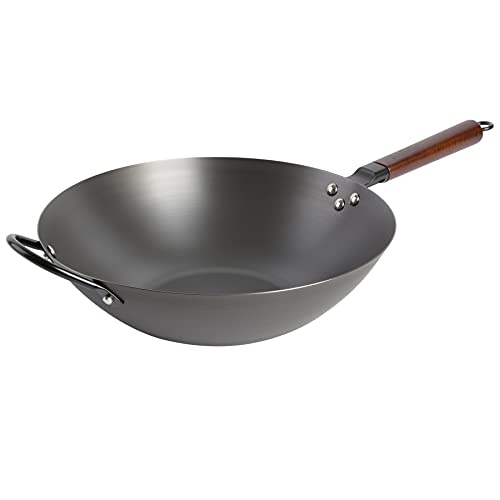
2. Babish 14 in Carbon Steel Wok
A 14 inch wok with a stated 6 inch flat base, a riveted wooden handle and a helper handle, weighing 5 pounds. The maker says it builds a natural non-stick surface with oil and lists use on gas, electric, glass and induction cooktops with a 500 F limit.
Suits: a large flat-base wok. Strengths: a stated base size and a helper handle. Weaknesses: the heaviest of the six along with Made In. Skip it if you want a light wok.

Best for a gas range
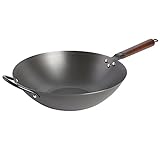
3. Joyce Chen Classic 14 in Preseasoned Wok
A 14 inch wok made from 1.5 mm gauge carbon steel with a removable beech wood handle and a hang hole, weighing 3.3 pounds. The surface is preseasoned and can be built upon. The specs list gas as the only compatible cooktop, which is narrower than the other five.
Suits: a gas range. Strengths: a removable handle and a modest weight. Weaknesses: gas only in the specs. Skip it if you cook on induction.

View Joyce Chen Classic Series 14 in Preseasoned Carbon Steel Wok on Amazon
Best for high-heat searing
4. Made In 13 in Seasoned Carbon Steel Wok
A conical wok that is 13.5 inches across but has a 5.5 inch cooking surface, a stainless steel handle and a stated limit of 1200 F, made in Sweden. The capacity field reads 13.5 cubic inches, which looks like the diameter entered in error. It is listed for gas, induction and smooth top ranges.
Suits: high-heat searing. Strengths: a clear size breakdown and a high heat limit. Weaknesses: a small flat area and a mislabeled capacity. Skip it if you want a wide flat floor.
View Made In 13 in Seasoned Carbon Steel Wok on Amazon
Best for a low-maintenance routine
5. Anolon EverLast N2 14 in Nitrided Wok
A 14 inch wok of nitrided carbon steel with stay-cool stainless handles, 4.9 pounds and a 6.5 liter capacity. The maker says no seasoning is needed, though it advises cooking with oil, and lists metal utensil use, broiler use and a 1000 F limit. The bullets call it a flat bottom wok.
Suits: a low-maintenance routine. Strengths: a nitrided finish and a broiler-safe build. Weaknesses: hand wash only. Skip it if you like building your own patina.
View Anolon EverLast N2 14 in Nitrided Carbon Steel Wok on Amazon

Best for a first carbon steel wok
6. Amazon Basics 12.6 in Pre-Seasoned Wok
A 12.6 inch, 6 liter bowl-shaped wok weighing 1.13 kilograms, with an acacia wood handle, listed for all stovetops including induction and not for microwaves or conventional ovens. Care is hand wash, with oil seasoning before first use and after each session.
Suits: a first carbon steel wok. Strengths: the smallest and lightest of the six. Weaknesses: no heat limit listed. Skip it if you need a high-heat figure.

View Amazon Basics 12.6 in Pre-Seasoned Carbon Steel Wok on Amazon
Care and Setup
- Hand wash, dry at once and wipe a thin film of oil on the surface.
- Heat the wok before adding oil and food.
- Use wooden, silicone or other tools the maker approves.
- Keep wooden handles away from open flame.
Mistakes to Avoid
- Buying a round-bottom wok for an induction cooktop.
- Comparing total diameter with cooking surface.
- Leaving the wok wet after washing.
- Ignoring a gas-only note in the specs.
Seasoning a Carbon Steel Wok From Scratch
Seasoning is a thin layer of polymerized oil bonded to the steel. It protects the metal from rust and gradually builds a slick, darker surface that food releases from more easily. Even a wok sold as pre-seasoned benefits from a few rounds of home seasoning, because the factory layer is usually light. Some woks arrive coated in a protective film that must be scrubbed off first, so read the instructions before you start.
A common method is to wash the wok, dry it completely on a burner, then heat it until it changes color and the surface looks dry. Add a very thin layer of a high smoke point oil, wipe nearly all of it off with a paper towel, and heat until the oil stops smoking. Repeat several times. The key is thin layers: thick oil turns sticky and flakes. Ventilate the kitchen well, since the process makes smoke.
After the initial seasoning, cooking builds the patina. Frying foods with fat, such as vegetables in oil or fried rice, helps the surface develop. Expect a mottled look, with blues, browns and black. That is normal and not a defect. Acidic foods like tomato or wine sauces, long simmers and soaking can thin the layer, so use the wok for stir-frying and short cooking at first. If food sticks, don’t panic: clean, dry and add another thin coat of oil. If the maker describes the finish as nitrided or otherwise treated, follow their care instructions, which may differ from traditional seasoning.
Flat Base, Round Base and Cooktop Fit
The base shape determines where a wok can be used. A round-bottom wok is traditional and works best on a gas burner with a wok ring or a purpose-built wok burner, where the flame wraps around the curve. On an electric coil or radiant cooktop, a round base touches only a small spot and heats poorly. A flat base sits on the surface and can work on gas, electric and glass tops.
Induction adds another condition. Induction heats the cookware by magnetic field, so the base must be magnetic, and it must make contact with the surface. A flat base is typically needed, since a round wok does not sit on the glass. Carbon steel is magnetic, so most carbon steel woks work if they have a flat base, but check the listing for explicit mention of induction, and check the cooktop manual for the minimum pan diameter the zone detects. Some induction cooktops come with a concave wok hob designed for round-bottom woks.
Also compare the cooking surface with the flat area. A wide wok with a small flat base heats only that spot well, while the sides stay cooler. That is normal for woks, which are used to move food between hot and cooler zones. If you want to sear a large amount of food at once, a wider flat area is useful, though it comes at the price of the classic wok shape. Read the dimensions carefully: total diameter, depth and base diameter tell you more than the headline size.
Handles, Weight and Cooking Technique
Handle style changes how you cook. A long single handle allows tossing and flipping food with a flick of the wrist, but the wok needs to be light enough for that. A pair of side handles, sometimes called ears, makes it easier to lift and carry a heavy wok, and many woks combine a long handle with a small helper handle. Wooden handles are comfortable and stay cooler but can burn or loosen near open flame or in an oven. Metal handles can get hot, so use a mitt or choose a stay-cool design.
Weight is a real trade-off. Lighter woks respond faster to heat changes and are easier to toss, while heavier ones hold heat better and are steadier on a flat cooktop. Gauge, which is the thickness of the steel, affects both. A thinner steel heats quickly and can warp if abused; thicker steel is more stable.
Technique matters more than the wok in many cases. Preheat the wok until it is very hot before adding oil, add food in small batches so it sears instead of steams, and keep ingredients prepared and ready because cooking is fast. Use a spatula or ladle that suits the surface, wood, silicone or metal depending on the maker’s guidance. Keep food moving, push it up the sides to cool, and avoid overcrowding. A wok on a home burner won’t match restaurant heat, so cooking in batches is a good habit.
Cleaning, Drying and Rust Prevention
The routine after cooking is short but important. While the wok is still warm, rinse it with hot water and use a soft brush, sponge or bamboo wok brush to remove food. A small amount of mild soap is usually fine on a well-seasoned wok, though many cooks avoid harsh scrubbing and abrasive pads that strip seasoning. Never leave the wok to soak or sit wet, since carbon steel rusts quickly.
Dry it immediately and thoroughly. Placing it on a hot burner for a minute evaporates remaining moisture. Then wipe on a very thin film of oil with a cloth or paper towel. This protects the surface until the next use. Store it in a dry place and avoid stacking other cookware inside without a cloth or paper towel layer.
If rust appears, scrub it off with steel wool or a scouring pad, rinse, dry and re-season. Light rust is common and fixable. Sticky spots are usually too-thick oil layers, which you can scrub off before seasoning again. Dishwashers are a poor choice, since they strip the seasoning and leave water on the metal. Flaking can occur if the seasoning is thick or uneven, and it is not harmful but looks unpleasant; scrub it off and rebuild thin layers. A wok that warps, has a cracked weld on the handle or has deep pitting that cannot be removed is ready to be replaced.
Choosing Size for Your Household
Wok diameter is often the first spec buyers see, but it should match the number of people you cook for, the size of your burner and the space in your cabinet. A smaller wok of around a dozen inches suits one or two people and sits comfortably on a standard burner. A larger wok of fourteen inches or more handles family meals and big batches but can overhang a small burner and weigh more.
Depth and wall angle affect how much food stays in the pan during tossing. Deeper woks with steep sides hold more and contain splatter, while shallower pans give more surface for searing. Check whether the listing gives capacity in liters or quarts, which is a better guide than diameter alone.
Consider storage: a wok with a removable handle stores more easily, and a hanging hole helps if you have a rack. Think about the lid too. Many woks are sold without one, and a lid that fits is useful for steaming and braising. Check the listing to see if one is included, and measure to buy one that fits if not. A dome lid suits a round wok, and a flat lid suits a flat-bottom one. Finally, decide how much upkeep you accept. Traditional seasoned carbon steel rewards care, while treated surfaces may ask for less maintenance but still reward gentle handling.
Flat Bottom, Round Bottom and Induction Compatibility
The shape of a wok base decides which stove it works on. A traditional round bottom sits well on a gas burner with a wok ring, where flames lick up the sides. A flat bottom sits steadily on electric and induction cooktops, and is the usual choice for modern kitchens. Induction requires a magnetic pan, and carbon steel qualifies, but only a flat contact area ensures good heat transfer. Check the base diameter and the maker notes about your stove type.
| Stove type | Wok base that helps |
|---|---|
| Gas with a wok ring | Round or flat bottom |
| Standard gas without a ring | Flat bottom |
| Electric coil or smooth top | Flat bottom with a wide base |
| Induction | Flat bottom that sits flush on the surface |
Seasoning a New Carbon Steel Wok
Most carbon steel woks arrive with a protective coating that needs to be removed, and they require seasoning before cooking. Follow the maker instructions exactly. The general idea is to wash the pan, heat it, apply a thin layer of high smoke point oil and heat until the surface darkens, building a natural non-stick layer. Ventilate the kitchen well, since the process creates smoke. Repeat thin coats until the surface is even.
- Wash away the factory coating as the maker directs.
- Dry the wok completely on the stove.
- Apply a very thin layer of suitable oil.
- Heat gently until the oil stops smoking and the metal changes color.
- Cool, wipe and repeat if the maker suggests.
Everyday Care and Rust Prevention
Carbon steel can rust if left wet. After cooking, rinse with hot water and a soft brush, then dry the wok on the burner. Wipe a thin film of oil over the inside before storing. Avoid soaking, dishwashers and harsh soap unless the maker allows it. If rust appears, scrub it off, re-season and continue. Store in a dry place with a paper towel between the wok and any lid.
Handles, Size and Cooking Space
Check the handle design. A long handle helps toss food, and a helper handle assists lifting. Wooden handles stay cooler but must be kept away from flame. Choose a diameter that fits your burner and the number of people you cook for. A wok that is too large for a small burner heats unevenly.
Stir-Fry Habits That Suit Carbon Steel
Carbon steel responds quickly to heat, so prepare everything before you light the burner. Cut food into similar sizes, and keep sauces measured and close by. Heat the wok until a drop of water skitters, add a thin film of oil, and cook in small batches so the temperature stays high. Move food constantly, and push finished items up the sides while the next batch cooks. Avoid long simmering of acidic sauces, which can strip seasoning.
- Dry ingredients well before they hit the oil.
- Do not overcrowd the wok.
- Use a metal or wooden spatula made for woks.
Stir-Frying in Depth: Preparation Is the Cooking
A stir-fry is decided before the wok gets hot. The cooking itself takes minutes at high heat, with no pauses to chop an onion or find the soy sauce, so everything must be cut, measured and arranged within reach before the burner is lit. Cooks call this being ready; in wok cooking it is not a virtue but a requirement. Cut ingredients to similar sizes so they finish together, keep the aromatics — garlic, ginger, chilli — in their own small pile because they go in first and burn fastest, and mix any sauce in a cup beforehand so it can be added in one motion.
Order is the second discipline. Dense vegetables and meat need the most time; delicate leaves and herbs need seconds. A typical sequence sears the protein first and removes it, stir-fries the hard vegetables, returns the protein with the aromatics, then adds sauce and the delicate ingredients at the end. Cooking in stages like this is how a home wok, whose heat is modest compared with a restaurant’s, still produces food that tastes wok-cooked rather than stewed: each ingredient meets the hot metal in its turn instead of everything steaming together in a pile.
Batch size is the third discipline, and the one home cooks resist hardest. A wok piled full drops in temperature the moment the food lands, and from that moment you are boiling dinner in its own juices. Cook in batches small enough that the ingredients sizzle audibly and keep moving, and combine them only at the end. In the 13 to 14 inch woks that fill this guide, that usually means cooking for two or three people per batch at most — which is still faster than one large, soggy batch, and tastes incomparably better.
Dry ingredients cook better than wet ones. Pat meat dry before it meets the wok, drain vegetables that have been washed, and let a marinade drip off rather than pouring it in, because surface water is the enemy of searing. These small acts of drying, repeated across every ingredient, are the difference between the glossy, lightly charred result the wok exists to produce and the pale imitation that makes people think their burner is at fault when their preparation was.
Heat Management on a Home Burner
Home burners are weaker than restaurant burners, and the carbon steel wok is the pan best designed to forgive that. Its thin walls respond instantly to the flame you have, heating fast where the burner touches and cooling the moment food or a toss draws the heat away. Work with that responsiveness: preheat the wok until it is properly hot before the oil goes in, and give it a few seconds to recover its heat between batches rather than piling the next batch onto a tired pan.
The classic sequence — hot wok, then oil — exists for a reason. Oil added to a cold wok soaks into the surface as it heats and can leave food prone to sticking; oil swirled into an already hot wok forms a thin, immediate cooking surface. You will see the oil shimmer and move like water when the moment is right. Beginners should also know that a wisp of smoke from the empty preheating wok is normal in this style of cooking, which is why the extractor fan goes on before the wok does, not after the kitchen fills.
Learn your own burner’s geography. Most home hobs have one strong burner and several modest ones, and the wok belongs on the strong one even if it is awkwardly placed. On an electric or induction hob, a flat-bottomed wok — the style most of this guide’s six represent — keeps full contact with the surface and heats evenly, while a round-bottomed wok needs its ring and patience. Whichever hob you have, the wok that matches it, as the cooktop sections of this guide explain, will outperform a theoretically finer wok that fights your heat source.
Heat is also adjusted by movement, not only by the dial. Lifting the wok slightly, tilting it to spread the food across a cooler wall, or pulling it half off the flame for a few seconds are all ways of thinking like the pan. Carbon steel’s light weight — compared with cast iron — is what makes this style of control possible, and it is a large part of why the material has kept its place for centuries: the cook and the pan adjust to each other continuously, and the food can tell.
Beyond Stir-Fry: The Wok’s Other Lives
A wok that only stir-fries is underemployed. Its shape makes it the safest deep-frying vessel in most kitchens: the wide top lets oil expand and food be lifted clear, the sloping walls return splashes to the oil, and the volume of oil needed is less than a straight-sided pot of similar capacity because the base is narrow. Tempura, fried chicken pieces, spring rolls and crisped tofu all fry beautifully in a wok, and the oil, once cooled and strained, can be stored for its next use as cooks have always done.
With a lid and a simple rack or a bamboo steamer basket, the wok becomes a steamer of real capacity. Water in the base, the food above it, and the wok’s volume gives the steam room to circulate so dumplings, fish and vegetables cook evenly without crowding. The same shape makes it a fine vessel for blanching vegetables, for boiling noodles with room to move, and for the quick soups of weeknight cooking, where ingredients can be stir-fried in the base and the stock added to the same pan — one vessel, two techniques, very little washing up.
The wok even smokes food, in the traditional stovetop method: a lining of foil in the base, a small mixture of tea, rice and sugar heated until it smoulders, a rack above it and the lid on, with the extractor earning its keep. Smoked fish, chicken and tofu made this way carry a flavour no other home pan produces. It is an occasional technique rather than a weekly one, but it illustrates the wok’s real nature: it is not a stir-fry accessory but a complete cooking system that happens to stir-fry best of all.
Breakfast deserves a mention, because a seasoned carbon steel wok is a superb egg pan — fried eggs slide on its surface, omelettes roll in its curves — and its size swallows a family quantity of fried rice made from last night’s leftovers, which many owners privately consider the wok’s finest hour. A pan that handles dinner’s most demanding technique and the morning after with equal ease earns its permanent place on the hob, and permanence on the hob is the true measure of any pan.
Seasoning as a Living Surface
The seasoning sections earlier in this guide cover the initial process; what matters over the years is understanding that seasoning is not a coating you apply once but a surface that cooking maintains. Every time you cook with oil at heat, the surface is renewed a little; every acidic, watery, long-simmered dish takes a little away. A wok in regular stir-fry service effectively maintains itself, which is why the woks in busy kitchens look better than the woks in cupboards. Use is the care regime, and the best thing you can do for a new wok’s surface is cook dinner in it tonight, and tomorrow, and the day after.
New owners should expect the surface to look uneven for its first weeks — darker where the burner touches, patchy where dishes varied — and to perform better than it looks. Appearance evens out over months of cooking. What you are watching for is behaviour, not beauty: food releasing more easily, a sheen developing, water beading rather than soaking in. Judge the seasoning by the eggs, not by the mirror, and you will not be tempted into needless re-seasoning rituals that reset a surface that was quietly improving.
Certain dishes are seasoning’s friends and others its tax. Dry, oily, high-heat cooking — stir-fries, fried rice, seared meats — builds the surface. Long simmering in liquid, steaming, and acidic tomato or vinegar-heavy dishes cooked for a long time wear it back. Neither list is a prohibition; a wok is for cooking, and a steamed fish is worth a little surface wear that the next stir-fry will repair. Simply follow an acidic or watery dish with a light wipe of oil on the warm, dry pan, and the balance restores itself.
When a wok has been neglected — stored damp, rusted, or scrubbed back to patchy metal by an overzealous helper — the recovery is the same initial seasoning process, done calmly, and the pan forgives completely. That forgiveness is carbon steel’s deepest advantage over coated pans: there is no surface to ruin permanently, because the surface is one you create and can always create again. A wok is never finished, in either sense, and a cook who understands that owns a pan for life.
Carbon Steel Against the Other Pan Materials
It helps to place carbon steel among its rivals honestly. Against cast iron, it offers the same seasoning-based cooking surface at a fraction of the weight, with faster heat response in both directions — it heats quicker and cools quicker, which is why it can be tossed and why it suits fast cooking. Cast iron holds heat more stubbornly, which suits searing a thick steak; the wok’s responsiveness suits everything that moves. Many good kitchens own both and reach for each without ideology.
Against stainless steel, carbon steel trades shine for release. Stainless is handsome, dishwasher-tolerant and excellent for acidic sauces and deglazing, but food sticks to it more readily and it asks for more oil and more management at the pan. Against non-stick, carbon steel trades out-of-the-box ease for permanence: a non-stick surface is at its best on the day it arrives and declines from there, while a carbon steel surface starts at its plainest and improves for years, with no coating to baby, no temperature ceiling to respect and no replacement date written into its future.
The nitrided design in this guide, the Anolon EverLast N2, sits interestingly in this landscape: nitriding hardens and protects the steel’s surface against rust, giving some of carbon steel’s character with less of its fussiness, while still seasoning and cooking like the traditional material. It is a legitimate answer for the cook who loves the wok shape and the high-heat technique but knows their drying-and-oiling discipline will lapse. Honesty about your own habits is a specification, and this guide includes an option for almost every level of it.
What no rival offers is the wok’s combination: one pan that sears at high heat, tosses without straining a wrist, deep-fries, steams, smokes, and improves with age, at a weight a cook can lift one-handed while it is full. That is why the material question and the shape question arrive together in this guide — carbon steel is not merely a good wok material, it is the material the shape was perfected in, and the six here are best judged as that partnership.
The Workflow Around the Wok: Boards, Knives and Bowls
Wok cooking rewards a prepared station as much as a prepared recipe. Arrange the board, the knife, a bowl for each ingredient group, a small bowl for scraps, and the sauce cup in a fixed order beside the hob, and the cooking becomes a calm procession rather than a scramble. Because stir-frying allows no pauses, the station is built before the heat and dismantled after the eating; experienced wok cooks set it up the same way every time, so that on a tired evening the hands know the geography without the mind’s help.
Knife work is the wok’s quiet foundation. Ingredients cut to even, bite-sized pieces cook at the same speed, present their largest surface to the heat, and can be eaten with chopsticks or a fork without further cutting. Cutting meat across its grain, and partially freezing it briefly if your kitchen routine allows, makes thin, even slices achievable with an ordinary knife. Vegetables cut on a diagonal expose more surface and look like you meant it. None of this requires new equipment — it requires deciding that the ten minutes at the board are part of the cooking, not a preliminary to it.
Utensils should suit the pan. A wok spatula with a curved edge that matches the pan’s slope, or a pair of long cooking chopsticks, moves food the way the shape intends; metal tools are traditional on carbon steel and the seasoned surface tolerates them, as the FAQ in this guide notes, though a beginner may find wood or silicone kinder while the surface is young. Tongs earn a place for frying and for turning pieces precisely. What the wok does not want is a small, flat spoon fighting its curves — match the tool to the bowl of the pan and the cooking feels twice as skilled.
Serving completes the workflow. A stir-fry waits for no one, losing its gloss and crispness by the minute, so plates or a serving bowl should be ready and the table warned before the last ingredient goes in. Cook rice first and let it rest; it is patient. The wok dish is not. Households that internalise that single ordering — rice waits, stir-fry does not — find their weeknight wok cooking transforms from a mild stress into the fastest good dinner they own.
Troubleshooting: Sticking, Rust, Warps and Smoke
Sticking is the beginner’s main complaint and it is almost always a sequence problem rather than a pan problem. The usual causes, in order: the wok was not hot enough when the food went in; the food was wet; the pan was overcrowded; or the food was moved too soon, before it had released itself. Protein in particular grips the hot metal at first and lets go as its surface sears — the cook’s job is to wait for that moment rather than scraping at it. Correct the sequence, in that order, and the same wok that stuck on Monday releases on Friday.
Rust appears when a wok is put away damp or left soaking, and it looks worse than it is. Light rust scrubs away with a scouring pad and effort, the pan is dried thoroughly on the heat, oiled lightly, and cooking resumes; the seasoning in the rusted patch rebuilds over the following meals. The prevention is the thirty-second ritual from the care sections: wash, dry on the burner until truly dry, wipe with the thinnest film of oil while warm. A wok stored in a humid cupboard near a steamy dishwasher may still bloom occasionally — treat it as maintenance, not failure.
A wok that rocks on a flat hob has usually been warped by thermal shock — cold water into a very hot pan is the classic cause — or it was always destined to sit imperfectly and the ring or a different burner is the practical answer. Gentle warping matters little on gas, where the flame does not care, and more on flat electric surfaces, where contact is everything. Prevention is the same patience that governs all carbon steel: let the pan cool a little before washing, and never use the sink as a way to cool a wok in a hurry.
Excessive smoke during ordinary cooking usually means old oil residue burning on the pan’s outside or a buildup around the burner, rather than a fault in the wok. Keep the exterior as clean as the interior, wipe spills before they carbonise, and remember that this style of cooking does produce some smoke at the searing stage — the extractor is part of the equipment. If smoke arrives with a bitter smell from an idle, heating pan, the seasoning itself may have built up rancid layers, and a thorough scrub and fresh, light re-seasoning resets the pan completely.
Choosing Size and Shape by the Dishes You Cook
Size in this guide spans from the 12.6 inch Amazon Basics to the 14 inch designs, and the right choice is written in your household’s dishes rather than its headcount alone. A 14 inch wok, like the Babish, the Joyce Chen or the Anolon, gives ingredients room to sear in a single batch for two or three people and tosses without shedding food across the hob. A smaller wok heats faster on a modest burner, suits one or two diners perfectly, and is the easier pan to store and to lift — virtues that decide daily use more than capacity does.
Shape interacts with your hob, as the earlier sections explain, but it also interacts with your cooking. Flat-bottomed designs sit securely and suit modern hobs; they also give a small flat floor where oil pools and ingredients can sear in a layer, which beginners find manageable. The sloping walls still provide the cool zone where cooked ingredients rest while the next batch sears — the wok’s built-in staging area — and learning to park food up the wall is the small technique that makes a home wok feel twice its size.
Handle arrangements shape the cooking too. A long single handle suits tossing and one-handed control; a helper handle opposite makes lifting a full wok safer and storage more demanding. Judge them with your own strength and your own cupboards in mind, and if you plan to serve from the wok at the table, remember the handle travels with it. The pre-seasoned models in this guide — the YOSUKATA, Joyce Chen and Amazon Basics among them — shorten the road to first cooking, while a pan you season yourself teaches you the surface from the beginning; both are honourable starts.
The Made In, at the guide’s more crafted end, and the Joyce Chen, a classic of long standing, illustrate that the final choice is often about the object as much as the cooking: weight in the hand, the finish of the handle, the feeling that this pan will be yours for decades. Those judgements are legitimate. A wok is handled daily and kept for a generation, and the one that feels right will be cooked in more, seasoned better and loved longer — which, by the logic of the living surface, literally makes it the better pan.
The Final Decision, Made Simply
Decide by hob first: flat bottom for flat hobs, and let the cooktop sections of this guide confirm the match. Decide by household second: the size that cooks your ordinary dinner in one batch without crowding, which for most homes is the 13 to 14 inch heart of this guide. Decide by temperament third: a pre-seasoned or nitrided surface for the cook who wants the shortest road and the least ritual, a traditional surface for the cook who will enjoy seasoning as part of the craft.
Then cook the wok in, properly and patiently: dry ingredients, hot pan, small batches, the drying ritual after every wash. The first fortnight teaches the pan and the cook together, and by the end of it the surface will be darkening, the food releasing, and the technique settling into your hands. Every wok in this guide rewards that fortnight with years of fast, vivid cooking — the kind that makes a weeknight feel like an occasion and a pile of plain vegetables like a plan.
Carbon Steel Wok FAQ
Flat or round bottom?
Flat bases sit steadily on most home cooktops. Round bases are meant for a wok ring on gas.
Does a nitrided wok still need oil?
Anolon says no seasoning is required but still advises cooking with oil.
Why is my wok sticking?
Sticking usually means the seasoning is thin or the pan was not hot enough before food went in. Preheat properly, use enough oil and build up the seasoning with thin coats and regular use.
What oil should I use for seasoning?
Oils with a high smoke point, such as grapeseed, canola or peanut oil, are commonly used. Apply a very thin layer and heat until the smoking stops. Follow the maker's advice if one is given.
Is it safe to cook acidic food in a carbon steel wok?
A brief cook is generally fine, but long simmers of tomato, wine or vinegar can strip seasoning and give a metallic taste. Keep acidic dishes short, and re-oil the wok afterward.
Can I use metal utensils?
It depends on the maker. Many cooks use metal spatulas on well-seasoned carbon steel, but wood or silicone is gentler on the seasoning. Check the care sheet for your wok.
Can a carbon steel wok go in the oven?
Sometimes, if the handle is oven-safe. Wooden handles may not be, so check the listing for temperature limits and which parts are rated.
Do I need a wok ring?
A wok ring is used with round-bottom woks on gas burners to keep them steady. A flat-bottom wok doesn't need one, and a ring can interfere with a flat base on some cooktops.
Is it normal for the wok to discolor?
Yes. Blue, brown and black marks are normal as the steel is heated and seasoned. They do not mean the wok is ruined.
The Short Version
For a light wok with many cooktop options, the YOSUKATA. For a flat base and helper handle, the Babish. For gas and a removable handle, the Joyce Chen. For high heat, the Made In. For less upkeep, the Anolon. For a simple first wok, the Amazon Basics.
Related Guides
- 6 Best Carbon Steel Pans: Diameter vs Cooking Surface (2026)
- 6 Best Cookware for Induction Cooktops: Pans That Work (2026)
- Induction Cookware Fit: Check the Base and the Hob Manual
- 6 Best Small Stainless Steel Cookware Sets: 5 to 8 Pieces (2026)