Disclosure: topratedkitchenware.com is reader-supported. When you buy through links on our site, we may earn an affiliate commission from Amazon and other retailers, at no extra cost to you.
Where to buy
All six openers in this guide earned their links the same way: each one’s verified listing describes automatic, one-touch, or hands-free electric operation — the features that decide whether a person with limited hand strength, mobility, or dexterity can open a can independently. They are linked below in the order we recommend them for accessibility-first buyers. If you are shopping for yourself, start with the first pick that matches your kitchen’s format; if you are shopping for a parent, relative, or client, read the full guide first, because the right choice depends on which specific motions are difficult.
- KORSKR Electric Can Opener — Check on Amazon
- Cuisinart Deluxe Electric Can Opener CCO-50BKN — Check on Amazon
- Famawo Electric Can Opener — Check on Amazon
- bella Electric Can Opener
- Cuisinart CCO-55 Deluxe Electric Can Opener
- Amazon Basics 3-In-1 Electric Can Opener
Read the full guide ↓
The best disabled persons can openers are not a separate species of product — they are ordinary electric can openers judged by a stricter and more honest standard: can this be used, start to finish, by someone whose hands cannot grip, squeeze, twist, or pinch with force? A manual can opener fails that standard at every step. It demands a hard pinch to pierce the lid, a sustained squeeze to hold the handles together, a twisting torque to walk the wheel around the rim, and a careful grip to deal with a sharp lid at the end. For a person with arthritis, a stroke-affected hand, Parkinson’s, carpal tunnel, or a limb difference, that sequence is not an inconvenience; it is a locked door between them and a meal they can prepare alone. The six electric openers in this guide were chosen to remove that sequence piece by piece.
What replaces it, in the best designs, is a short and gentle list: place the can or the tool, touch one control, let the machine travel and cut, and lift a smooth-edged lid that a magnet or the tool itself is holding. Every pick below is automatic or one-touch in its verified listing; several add the details that matter at the margins of independence, like hands-free travel, smooth edges that forgive unsteady handling, magnetic lid holding, and — in one case — explicit suitability for left-handed users. This guide also speaks plainly about what an opener cannot fix: reaching a high shelf, carrying a heavy can, opening jars. The goal is a kitchen that asks less of the body at every step, and the can opener is one very fixable step.
Key Takeaways
- All six picks are electric and automatic or one-touch in their verified listings — no squeezing, twisting, or sustained grip is required from any of them.
- The KORSKR handheld is the most independence-focused pick: battery powered, hands free, smooth-edged, sized for any can, and explicitly suitable for left-handed users.
- Countertop picks (both Cuisinart models and the Amazon Basics) let the machine hold the can as well as cut it — the better format when one hand is weak or unavailable.
- Smooth-edge cuts and magnetic lid holders are safety features, not luxuries, for users with reduced sensation or unsteady hands.
- Match the pick to the person: the motions that are difficult — gripping, pressing, lifting, reaching — decide which design removes the most barriers.
In this guide
Quick Picks
Six picks, six different accessibility profiles. The badges are used again in the detailed reviews. Readers comparing the wider ease-of-use field will also find our roundup of the Best Easiest To Use Electric Counter Top Can Openers useful, since it ranks countertop machines by the same low-effort standard.
| Pick | Badge | Format | Accessibility standout | Link |
|---|---|---|---|---|
| KORSKR Electric Can Opener | Best for Hands-Free Independence | Handheld, battery | Hands free; left-handed friendly | Check on Amazon |
| Cuisinart Deluxe CCO-50BKN | Best Countertop for Seniors | Countertop, corded | Single-touch; removable lever | Check on Amazon |
| Famawo Electric Can Opener | Best Rechargeable | Handheld, USB-C | One-touch; magnetic lid hold | Check on Amazon |
| bella Electric Can Opener | Best One-Touch Simplicity | Countertop, corded | Automatic one-touch | Check on Amazon |
| Cuisinart CCO-55 Deluxe | Best Premium Countertop | Countertop, corded | Press and release; removable lever | Check on Amazon |
| Amazon Basics 3-In-1 | Best Multi-Tool Station | Countertop, corded | Magnetic lid holder; 3-in-1 tools | Check on Amazon |
Read the format column as the first decision. Handheld picks ask the user to place a light tool on the rim and then do nothing — ideal when both hands can position but neither can work hard. Countertop picks ask even less of positioning strength, because the machine holds the can; they suit one-handed use and the weakest grips, at the cost of counter space and an outlet. Neither family is “more accessible” in the abstract — the match to the person is everything.
How These Picks Were Chosen
Every product here was verified against Amazon’s catalog data through the Creators API before inclusion, and each mini spec box states only what that verified listing states. The inclusion rule was accessibility in the listing’s own words: a pick had to describe automatic, one-touch, single-touch, or hands-free electric operation. That rule is stricter than it sounds. It excludes every manual opener, every lever design that must be held down with force, and every product whose accessibility is a reviewer’s hopeful inference rather than a stated design feature. Where a listing adds a relevant detail — suitability for seniors, for arthritis, for left-handed users — the review quotes that positioning; where it does not, the review does not invent it.
Beyond the control, we compared the picks on the rest of the independence sequence: whether the machine or the tool holds the can during the cut, whether the lid is held afterward (by magnet or by the tool) or must be fished out, whether the resulting edges are smooth, how the tool is powered and what happens when the power runs low, and how the cutting parts are cleaned — because an opener that a person cannot clean independently is an opener that quietly depends on someone else. We also weighed format honestly: handhelds free the counter and travel between rooms and homes; countertop machines anchor the whole task to one accessible station.
This is a research-led guide. It does not claim laboratory testing or clinical evaluation, and an opener is not a medical device — for individual advice about hand function and kitchen adaptation, an occupational therapist is the right professional. What this guide can do is verify claims, refuse to print prices or ratings that would rot in place, and organize the real differences between six genuinely low-effort machines so that the person buying — for themselves or for someone they love — can match a tool to a body with confidence.
The 6 Best Disabled Persons Can Openers, Reviewed for Independence
The order below ranks the picks by how completely they remove effort and risk from the whole task — control, holding, cutting, lid, and cleanup — not by brand or by format loyalty.

KORSKR Electric Can Opener
Badge: Best for Hands-Free Independence
Strengths
- Battery powered, automatic, and hands free: after placement and a start press, the tool does the entire circuit alone.
- Smooth-edge cut removes the sharp-lid hazard that unsteady hands are most at risk from.
- Explicitly suitable for left-handed people, and sized for any can — two inclusion details most listings never mention.
Trade-offs
- The user must still place the tool squarely on the rim; positioning is the one step that remains manual.
- Battery powered, so a household routine for spare batteries matters.
- As a handheld it rides the rim, so very tall, heavy cans are less steady than on a countertop machine.
Mini spec box
- Type: handheld electric
- Power: battery powered
- Operation: automatic, hands free
- Cut: smooth edge
- Color: black
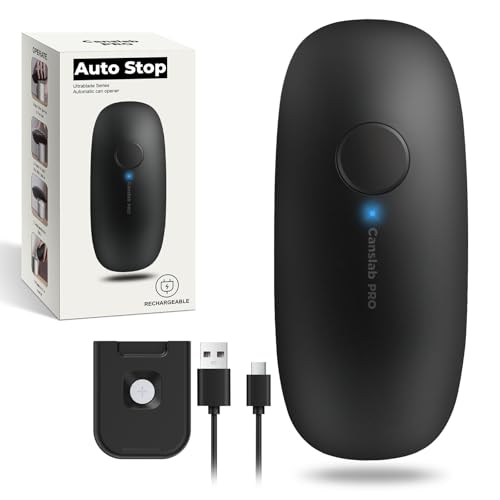
The KORSKR takes the top badge because its verified listing reads like it was written by someone who understood the assignment: an automatic, battery powered, hands-free opener with a smooth edge, suitable for any size cans, positioned for seniors and described as an ideal kitchen gadget for women and left-handed people. Unpack that. Hands free means the sustained-effort problem — the squeeze, the hold, the twist — is simply gone; the tool travels the can under its own power while the user’s hands rest. Smooth edge means the output of the task is safe for hands with reduced sensation, which cannot rely on feeling a sharp rim in time. Any size means no compatibility arithmetic. And the left-handed note matters more than it might appear: most kitchen tools silently assume a right-handed user, and for a left-handed person whose right hand is the affected one, that assumption is the barrier.
The battery power suits the independence use case in a specific way: the tool works wherever the person is — their own kitchen, a child’s house, a holiday rental — with no outlet hunt and no counter installation, and fresh cells restore it instantly. Its honest limits are the handheld format’s: it must be seated on the rim to start, and it balances there, so the heaviest tall cans are a countertop machine’s job. For the everyday cans of an ordinary pantry, though, this is the most complete removal of effort in the guide, and a thoughtful gift for exactly the person who insists they do not need help — because with this, mostly, they do not.
Best for: users who want hands-free automatic opening anywhere, including left-handed users and anyone with reduced hand sensation / Not suited for: very tall heavy cans as a daily diet, or households that will not keep spare batteries.

Cuisinart Deluxe Electric Can Opener CCO-50BKN
Badge: Best Countertop for Seniors
Strengths
- Single-touch automatic operation on a standing machine that holds the can for you.
- Positioned by its own listing for seniors, with a magnetic lid holder for a safe lid ending.
- Removable activation lever, so the cutting assembly can be washed without wrestling the whole appliance.
Trade-offs
- Needs permanent counter space and an outlet — an installation, not a drawer tool.
- Top-cut style: the lid edge deserves the usual care even with the magnet’s help.
- Black finish shows splashes; a wipe-down routine helps.
Mini spec box
- Type: countertop electric, corded
- Operation: single-touch automatic
- Feature: magnetic lid holder
- Cleaning: removable activation lever
- Color: black
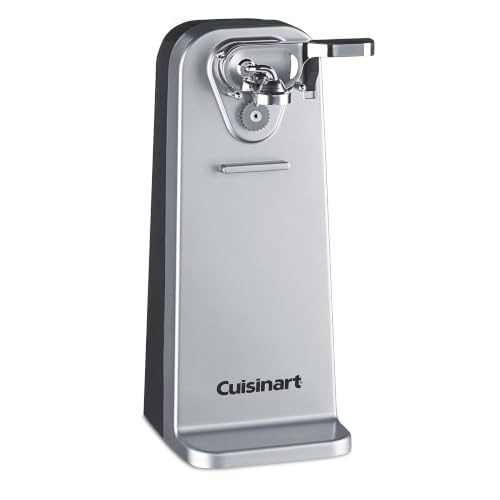
Where the KORSKR removes effort by going hands-free, the Cuisinart CCO-50BKN removes it by holding everything. Its verified listing describes single-touch automatic operation with a magnetic lid holder and a removable activation lever, positioned for seniors — and for a user whose hands are weak, unreliable, or reduced to one, a standing machine changes the physics of the task. The can is placed once, the machine grips it, one touch starts the cut, the magnet receives the lid. At no point must the user simultaneously hold, squeeze, and turn, which is the combination that defeats arthritic hands on a manual opener.
The removable lever is the independence detail hiding in plain sight. Cleaning is part of using a tool independently, and a fixed cutting head on a heavy countertop body is genuinely hard for a weak-handed user to clean well. A lever assembly that lifts away and goes to the sink keeps the whole cycle — open, cook, clean — within one person’s abilities. This is also the pick we would install in a parent’s kitchen during a weekend visit: permanent, plugged in, always ready, with nothing to charge, nothing to store, and nothing to remember. Readers setting up a whole low-effort counter will find its natural companions among the Best Easy To Use Electric Can Openers, where single-touch controls are the ranking criterion.
Best for: seniors and one-handed users who want a permanent, single-touch countertop station / Not suited for: small counters without a spare outlet, or anyone who needs the opener to travel.

Famawo Electric Can Opener
Badge: Best Rechargeable
Strengths
- One-touch operation with a magnetic lid hold — a lid-safety feature handhelds often omit.
- USB-C rechargeable, so there are no disposable batteries to buy, store, or change with sore fingers.
- Smooth-edge cut, and a listing aimed at seniors and easy use.
Trade-offs
- Fits most can sizes, per its listing — a slightly narrower promise than “all sizes.”
- A charging routine replaces the battery routine; a forgotten charge is a dead tool.
- Handheld rim-riding: less anchored than a countertop machine on tall cans.
Mini spec box
- Type: handheld electric
- Power: USB-C rechargeable
- Operation: one-touch
- Feature: magnetic lid hold
- Cut: smooth edge
The Famawo’s contribution to this guide is the combination of one-touch operation with a magnetic lid hold in a rechargeable handheld. Its verified listing describes a USB-C rechargeable automatic opener with a smooth edge, one-touch operation, and magnetic lid hold, easy for seniors and fitting most can sizes. The lid hold deserves the spotlight: the most dangerous moment of can opening for a person with limited dexterity is not the cut but the aftermath — a loose, sharp lid. A handheld that keeps the lid held after the cut removes that moment, and among the handhelds in this guide that feature is rarer than it should be.
USB-C charging is the second accessibility decision, and it cuts both ways honestly. Changing small batteries is itself a dexterity task — prying a compartment, orienting cells, forcing a cover — that sore or stiff fingers may hate; plugging in a common cable is gentler, and the same cable likely already lives in the house for a phone. The cost is the routine: the tool must be charged before it is empty, which suits a regular cook and argues against the Famawo for chaotic, infrequent use. Position it on the rim, touch once, and let it work — for the user who can manage placement but not force, that is independence in a drawer-sized package, and it pairs naturally with the wider category surveyed under Best Electric Can Openers Arthriti.
Best for: users who want one-touch opening and a held lid without battery changes / Not suited for: anyone who would never maintain a charging routine, or cans beyond the “most sizes” it claims.

bella Electric Can Opener
Badge: Best One-Touch Simplicity
Strengths
- Automatic one-touch operation on a countertop machine that holds the can.
- No batteries, no charging — mains power is always ready.
- A soft oatmilk finish that is gentle on the eye in a calm, accessible kitchen.
Trade-offs
- Its verified listing is brief: no magnetic lid holder or removable lever is stated, so plan for tongs at lid time.
- Countertop footprint and outlet required.
- Pale finish shows splashes readily.
Mini spec box
- Type: countertop electric, corded
- Operation: automatic one-touch
- Finish: oatmilk
The bella is the countertop pick for buyers who want the format’s holding power with the least possible interface. Its verified listing promises an electric can opener with automatic one-touch operation in oatmilk — a short promise, kept cleanly: the machine holds the can, one touch runs the cut, and mains power means the tool is ready at every hour without a battery or a cable routine. For a user whose difficulty is force rather than positioning, that is the essential transaction, delivered without extra features to learn or modes to select.
The review must be equally clear about what the listing does not say. No magnetic lid holder is claimed, and no removable lever is claimed, so a buyer for whom lid handling is the critical risk should weigh the Cuisinart models, whose listings state their lid and cleaning features outright. Simplicity is a genuine accessibility virtue — fewer controls, fewer decisions — and the bella embodies it; but simplicity chosen knowingly, with the lid plan made in advance, is the version of this purchase we recommend.
Best for: users who want a permanent one-touch countertop machine with the simplest possible operation / Not suited for: buyers who need a stated magnetic lid holder, or kitchens without counter space.

Cuisinart CCO-55 Deluxe Electric Can Opener
Badge: Best Premium Countertop
Strengths
- One-touch press and release — a momentary touch, with no sustained holding against spring pressure.
- Magnetic lid holder and removable lever: the safest lid ending and the easiest cleaning in the countertop group.
- Chrome countertop build suited to a permanent, set-up-once station.
Trade-offs
- Chrome shows fingerprints and asks for wiping.
- Permanent counter resident; needs its outlet.
- No extra-tall can claim appears in its verified listing.
Mini spec box
- Type: countertop electric, corded
- Operation: one-touch press and release
- Feature: magnetic lid holder
- Cleaning: removable lever
- Finish: chrome
The CCO-55 is the refinement pick among the countertop machines: its verified listing describes one-touch press and release operation with a magnetic lid holder and a removable lever, in chrome. Press and release is the control language that matters most for painful hands — the touch is momentary, and the machine owns the duration of the cut — and it is the same reason this model anchors discussions of the Best Elecgtric Can Openers category whenever ease of use leads the criteria, however the search was spelled.
Against its sibling, the CCO-50BKN above, the CCO-55 trades the explicit “for seniors” positioning for the press-and-release control and the chrome presentation; in substance the two machines are close cousins, and the choice between them can honestly come down to which is available and which finish the kitchen prefers. Both hold the can, both hold the lid, both let their levers come off for washing. For a buyer building a long-term accessible station, either Cuisinart is a defensible anchor; the CCO-55 is the one we would choose when the lightest possible touch is the deciding factor.
Best for: users who need the lightest momentary-touch control in a permanent countertop machine / Not suited for: tall-can specialists, or counters with no room for a standing appliance.
Amazon Basics 3-In-1 Electric Can Opener
Badge: Best Multi-Tool Station
Strengths
- Electric opening with a magnetic lid holder, described by its listing as safe and easy to use.
- Built-in bottle opener and knife sharpener consolidate three grip-demanding tasks into one station.
- A 50W corded motor: always ready, never fading mid-can.
Trade-offs
- The listing does not describe one-touch or automatic operation in the terms the other picks use, so expect a more conventional lever interaction.
- Countertop footprint, cord, and a multi-tool body with more surfaces to clean.
- The knife sharpener’s value depends on the household actually sharpening knives.
Mini spec box
- Type: countertop electric, corded
- Power: 50W
- Functions: can opener, bottle opener, knife sharpener
- Blade: stainless steel
- Feature: magnetic lid holder
- Color: black
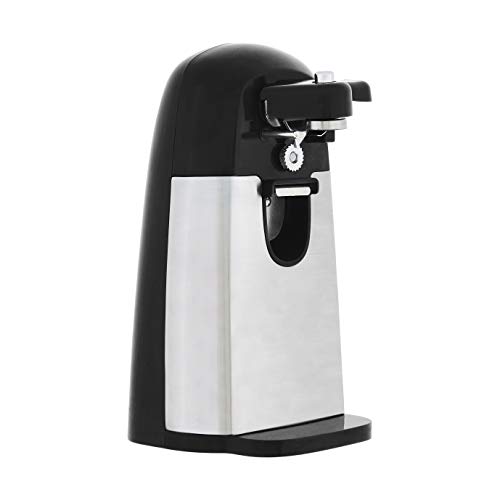
The Amazon Basics 3-In-1 earns its place in an accessibility guide for a reason beyond its can opener: it consolidates. Its verified listing describes a 3-in-1 electric can opener, bottle opener, and knife sharpener with a stainless steel blade, a magnetic lid holder, and a safe, easy-to-use design at 50W. Bottle caps and dull knives are, like cans, small daily tests of grip and force; a single plugged-in station that removes all three tests from the day has a logic that a single-purpose tool cannot match, particularly in a small accessible kitchen where every appliance must justify its footprint twice.
The honest caveat is about the control. Unlike the picks above, this listing does not use the words one-touch or automatic, and this guide will not upgrade its language on the manufacturer’s behalf. Expect a conventional countertop interaction — easier than any manual opener by a wide margin, with the machine holding the can and a magnet holding the lid — but if the buyer’s hands need the guaranteed lightest touch, the Cuisinarts state that promise in writing and this one does not. Buy the Amazon Basics for the consolidated station; buy a Cuisinart for the control.
Best for: households that want one countertop station covering cans, bottles, and knife sharpening / Not suited for: buyers who need a stated one-touch or automatic control above all else.
Comparison Table
All six picks against the steps of the task. Read across a row to see how much of the sequence — start, hold, cut, lid, power — each design takes off the user’s hands.
| Product | Format | Control | Lid handling | Power | Link |
|---|---|---|---|---|---|
| KORSKR Electric Can Opener | Handheld | Automatic, hands free | Smooth-edge lid | Battery | Check on Amazon |
| Cuisinart CCO-50BKN | Countertop | Single-touch automatic | Magnetic lid holder | Corded | Check on Amazon |
| Famawo Electric Can Opener | Handheld | One-touch | Magnetic lid hold | USB-C rechargeable | Check on Amazon |
| bella Electric Can Opener | Countertop | Automatic one-touch | Not stated in listing | Corded | Check on Amazon |
| Cuisinart CCO-55 | Countertop | One-touch press and release | Magnetic lid holder | Corded | Check on Amazon |
| Amazon Basics 3-In-1 | Countertop | Electric, easy-to-use design | Magnetic lid holder | Corded, 50W | Check on Amazon |
How to Choose a Can Opener for a Disabled Person
Start from the hands, not the products. List the specific motions that are difficult. Is it gripping? Sustained pressure? Twisting? Pinching a small tab? Feeling where an edge is? Each difficulty maps to a design answer in this guide: gripping and twisting point to any automatic pick; sustained pressure points to one-touch press and release or hands-free travel; pinching points away from pull-tab cans entirely; reduced sensation points to smooth-edge cuts and magnetic lid holding, because an edge you cannot feel is an edge that must not be sharp. A purchase matched to the actual difficulty list will outperform a purchase matched to a generic “easy to use” label every time.
Decide who holds the can. This is the format question in accessibility terms. If the user has one functional hand, or hands that cannot steady a can while a tool works, a countertop machine that holds the can itself — either Cuisinart, the bella, or the Amazon Basics — removes a whole subtask. If the user can place a light tool with both hands but cannot apply force, the handhelds (KORSKR, Famawo) ask for placement only and then take over. Watch the person open a can today and note where the second hand gets recruited; that recruitment is what your purchase must make unnecessary.
Plan the lid. The cut is only half the task. A magnetic holder (both Cuisinarts, the Famawo, the Amazon Basics) parks the lid safely; a smooth-edge cut (KORSKR, Famawo) makes the lid safe to touch; the bella’s listing states neither, so its lid plan is tongs and care. For users with reduced sensation or vision, treat lid handling as a first-order criterion, not a footnote.
Plan the power and the cleaning, too. Independence includes maintenance. Batteries mean spares within reach and a compartment the user can open; USB-C charging means a cable habit; corded means neither, at the price of a fixed station. Cleaning means a removable lever where possible, or a wipe-down the user can manage. A tool that only works when someone else maintains it is a partial solution, and it is better to know that before buying than after. Readers comparing how review organizations weigh these trade-offs may find the discussions gathered under Best Electric Can Openers By Consumer Reports a useful second opinion alongside this guide’s listing-based approach.
How to Use, Clean, and Troubleshoot an Automatic Can Opener
Set the station up once, properly, and daily use becomes a short, calm sequence. Keep the opener where cans are stored or beside the prep area, at a height the user can reach without stretching, with frequently opened cans on the lowest shelf. For a countertop machine: stand the can flat, engage the rim, touch the control, and let the machine work; lift the lid from its magnet straight into the bin. For a handheld: wipe the can’s top, seat the tool level on the rim, press start, and support nothing — the tool travels alone; lift it away at the end with the lid held or smooth-edged, and bin the lid without touching its rim. Practice twice with the user present before declaring the setup finished; the second can is where confidence forms.
Cleaning should be designed, not improvised. Choose the cleaning method the user can actually perform: a removable lever washed at the sink (both Cuisinarts), a handheld wiped with a damp cloth (KORSKR, Famawo), a countertop body wiped in place. Never immerse a corded or battery unit. If dried residue builds around a cutter, a cloth and warm water in the moment beats any later excavation — build the wipe into the same motion as putting the tool away.
Troubleshooting, in accessible terms, is about removing frustration fast. Problem: the tool starts but stops partway → power is low; recharge, replace batteries, or check the plug, and confirm the rim is clean and undented. Problem: the can will not engage or the tool sits crooked → reseat it flat and square; a tilted start defeats every design in this guide. Problem: the lid falls into the food → the cut was stopped before the magnet took the lid, or the model has no holder; run cuts to completion, and keep tongs at the station for holder-less models so the recovery is planned rather than improvised.
Setting Up the Rest of the Can Workflow
An accessible opener solves the middle of the task; the ends deserve the same thought. Before the cut: store cans at waist height where possible, in shallow rows the user can reach without climbing or deep reaching, and consider a can dispenser or a simple shelf riser so the wanted can is the reachable can. Carrying matters too — a light tray or a rolling cart between pantry and counter removes the two-handed heavy-can carry that defeats many otherwise independent cooks. After the cut: keep a small bin or recycling caddy at the station so lids and empties travel inches, not rooms; keep tongs clipped beside the opener for holder-less lids and for retrieving anything dropped; and keep a manual opener in the drawer as the outage-and-dead-battery backup, chosen with the largest, softest handles available, because a backup that cannot be used is not a backup. None of this requires renovation — it requires looking at the whole thirty seconds, and the thirty steps around it, through the user’s hands.
Buying for Someone Else: A Short Etiquette and Method
Many of these openers will be bought by adult children, partners, and carers, and the method matters as much as the model. First, ask and observe rather than assume: watch the person open a can, and let them name what hurts or fails — the buyer who guesses often solves the wrong motion. Second, preserve dignity in the framing: this is a better tool, not a concession, and the hands-free and one-touch designs in this guide are genuinely the best current technology for everyone, which happens to be true. Third, install and practice together, then leave the manual opener in the drawer without ceremony; independence that survives the gift-giver’s departure is the point. Finally, check back in a fortnight. The seating trick on a handheld, the battery routine, the lid habit — small frictions surface in week two, and nearly all of them have small fixes. The roundups collected under Best Electric Can Openers Consumer Reports can help a family compare notes, but the user’s own report after two weeks of breakfasts is the review that counts.
Understanding the Motions: What “Difficult” Actually Means
Advice in this category often fails because it treats “disabled” as a single condition. It is not, and the differences decide purchases. Arthritis primarily attacks force and endurance in the small joints: the pinch that pierces a lid and the sustained squeeze that follows are the pain points, which is why momentary-touch controls and hands-free travel rank so highly here. A stroke or hemiparesis typically leaves one hand strong and one unreliable, which shifts the brief toward machines that hold the can — the countertop family — because the working hand cannot simultaneously steady and operate. Parkinson’s adds tremor, which punishes precision tasks like seating a small tool or guiding a sharp lid, and rewards designs with forgiving placement and magnet-held lids. Reduced sensation, common in diabetes and after nerve injury, changes the risk calculus rather than the effort calculus: the cut may be easy while the sharp edge is dangerous, so smooth-edge results move from preference to requirement. Low vision shifts attention to controls that can be found and confirmed by touch, and to stations where everything lives in one predictable place.
None of this is medical advice, and an occupational therapist who can watch the actual person in the actual kitchen will out-diagnose any guide. But it explains why this page refuses to crown a single winner for everyone. The KORSKR’s hands-free travel answers force problems; the Cuisinarts’ can-holding answers one-handed problems; the Famawo’s held, smooth-edged lid answers sensation problems. The right question at the start of this purchase is never “which opener is best for disabled people” in the abstract — it is “which motions does this person need the machine to take over,” and the six reviews above are organized so that question can be answered pick by pick.
Left-Handed Users and Other Forgotten Ergonomics
Most kitchen tools are designed for a right-handed, two-handed, full-strength user, and everyone else is expected to adapt quietly. Can openers are a concentrated example: a manual opener’s handles, wheel, and turning crank all assume the right hand supplies the torque while the left supplies the grip, so a left-handed person — or a right-handed person whose right side is the affected one — is fighting the tool’s geometry before the can even opens. This is why the KORSKR’s explicit mention of left-handed users in its verified listing earned it real credit in this guide rather than a passing nod. Automatic designs dissolve most handedness problems structurally: when the machine travels the can, the user’s dominant hand only places and starts, and placement is far less handed than torque. The same structural logic helps other forgotten users — the person cooking seated, for whom a low drawer-stored handheld beats a high countertop station; the person with limited reach, for whom a tool that comes to the can beats a station the can must be carried to; and the person whose grip is fine but whose wrists are not, for whom the elimination of twisting matters more than the elimination of squeezing. When a listing bothers to name the users it suits, believe that it was designed with them in the room — and when your household includes one of those users, weight that sentence heavily.
Common Buying Mistakes
Buying the label instead of the motion. “Easy to use” is a slogan; one-touch, single-touch, hands-free, and press-and-release are specifications. Shop the specifications. Forgetting the lid. The cut gets the attention and the sharp lid does the damage; plan its journey before buying. Ignoring maintenance. Batteries, charging, and cleaning are part of independence — if the user cannot perform them, the tool is only half chosen. Assuming one hand can hold while the other works. For many users it cannot; countertop machines that hold the can exist precisely for this. Skipping the practice cans. Every design here has a one-can learning curve; judge the tool on the third can, with the user, not on the first can alone.
Final Recommendation
For the fullest removal of effort, buy the KORSKR first: hands-free automatic travel, a smooth edge, any-size coverage, and an explicit welcome to left-handed users make it the independence pick of this guide. For a permanent kitchen station — the parent’s counter, the one-handed cook — buy the Cuisinart CCO-50BKN for its single-touch operation and senior-focused design, or the CCO-55 if the lightest press-and-release touch is the deciding factor. Choose the Famawo when battery changes are themselves a dexterity problem and a magnetic lid hold matters; choose the bella for the simplest one-touch countertop interface; choose the Amazon Basics 3-In-1 when one station should also retire the bottle opener and the knife sharpener. Every pick here was verified, every claim traced to its listing — match the design to the hands, and the can stops being a barrier.
And keep the standard this guide used in front of you after the purchase, because it generalizes to the whole kitchen: a tool earns its place when the person can start it, use it, finish with it, clean it, and put it away without recruiting help at any step. Judged by that standard, the humble can opener is often the first domino — the jar opener, the kettle, the pan handle, and the shelf heights fall into the same honest audit. Fix the can first, with one of the machines above; then walk the rest of the kitchen with the same eyes, and a room that quietly excluded someone becomes a room that quietly includes them again.
Frequently Asked Questions
What type of can opener is best for someone with arthritis?
An automatic electric one whose control needs no sustained force: one-touch press and release (Cuisinart CCO-55), single-touch (CCO-50BKN), or hands-free travel (KORSKR). The motions arthritis punishes — grip, squeeze, twist — are exactly what these designs delete. Our arthritis-focused category coverage, linked earlier in this guide, compares more models on the same criterion.
Can a person with one functional hand use these openers?
The countertop picks are the natural fit, because the machine holds the can: place the can with the working hand, touch the control, and lift the magnet-held lid. Handhelds need the tool placed and steadied at the start, which some one-handed users manage well and others do not — a practice can or two will answer the question honestly for a specific person.
Are smooth-edge openers safer for people with reduced sensation?
Yes, materially. Reduced sensation removes the warning system that tells a hand it has met a sharp edge, so an opener that leaves blunt edges — the KORSKR and Famawo state smooth-edge cuts — removes a hazard rather than asking the user to be careful around it. Magnetic lid holding adds a second layer of the same protection.
Which is better for a disabled user, handheld or countertop?
It depends on the difficulty list. Countertop machines hold the can and need an outlet and counter space; handhelds need placement but then work hands-free and travel anywhere. Weak or single-handed holding points countertop; weak force with adequate placement points handheld. This guide’s buying section maps specific difficulties to each design.
What if the user cannot change batteries or manage charging?
Choose a corded countertop pick. Mains power removes the entire maintenance question — the machine is ready whenever it is touched. Among the corded picks, the Cuisinarts add removable levers, which also keeps cleaning within the user’s abilities.
Should the opener live on the counter or in a drawer?
Wherever it removes the most steps. A countertop machine in a fixed station suits a user who cooks in one place and benefits from a predictable setup — everything in reach, nothing to fetch, nothing to put away. A drawer-stored handheld suits a user who cooks seated, moves between kitchens, or shares the space with others who rearrange counters. The deciding factor is not tidiness; it is which arrangement the user can operate entirely alone, including putting the tool away afterward.
Is an electric can opener a good gift for an elderly parent?
It is one of the most practical kitchen gifts there is, provided it is matched to their hands and installed with a short practice session. Single-touch countertop models like the CCO-50BKN, positioned by its own listing for seniors, are the safest default; handhelds like the KORSKR suit parents who resist counter appliances. Buy the motions they struggle with, not the model you would want. And buy it before it is urgently needed, if you can: a tool learned calmly, on an ordinary Tuesday, is a tool that will actually be used on the difficult days, rather than one more unfamiliar object introduced in a crisis.