Disclosure: topratedkitchenware.com is reader-supported. When you buy through links on our site, we may earn an affiliate commission from Amazon and other retailers, at no extra cost to you.
Where to buy
These are the six verified picks for this guide to best electric can openers for arthritis. Linked names take you to the Amazon listing, where you can check the latest price on Amazon, confirm the current configuration, and read recent owner feedback. Built for the arthritis use case first: stated arthritis designs lead the list, supported by one-touch countertop machines for kitchens that prefer a fixed station.
- Hamilton Beach Smooth Touch Electric Can Opener (76606AG)
- Canslab Ultrablade PRO Electric Can Opener
- Kitchen Mama Auto Electric Can Opener (Red)
- KITCHENMUH One Touch Electric Can Opener (Black+Grey)
- KORSKR Automatic Electric Can Opener (Black)
- Cuisinart CCO-55 Deluxe Electric Can Opener (Chrome)
Read the full guide ↓ for how each pick was chosen, who it suits, and the honest limitation that might rule it out for you.
The best electric can openers for arthritis are not simply the best electric openers with a sympathetic label. Arthritis reshapes the whole task: grip strength fluctuates by the day and by the hour, pinch force is expensive, sustained effort accumulates, and a sharp lid punishes exactly the fingers least able to dodge it. A machine serves this audience only when its design spends the motor’s effort where the user’s effort is scarcest. This guide compares six verified openers on precisely that basis.
The field divides by philosophy. The Canslab and KITCHENMUH listings address arthritis by name, engineering the hand out of the cut with handsfree travel, smooth edges and, for the Canslab, automatic stopping. The Kitchen Mama and KORSKR take the same hands-free handheld route with their own stated strengths. The Hamilton Beach and Cuisinart CCO-55 represent the countertop philosophy: fix the machine, steady the can with the machine’s weight, and reduce the human contribution to one push or press. Both philosophies can be right; your kitchen and your hands decide which. If you are comparing neighbouring questions at the same time, our guide to Best Electric Can Openers For Elderly covers the closest variation of this search.
Key Takeaways
- Arthritis suitability must be mechanical, not rhetorical: look for stated one-touch, hands-free or arthritis design.
- Fluctuating grip means the machine must work on your worst hand day, not your average one.
- Smooth edges protect unreliable fingers at the exact moment attention relaxes: the end of the cut.
- Handhelds remove lifting and aiming; countertops remove holding and guiding. Choose your load.
- Auto-stop is an accessibility feature, not a luxury, when judging a cut’s end by feel is unreliable.
- Power logistics are accessibility too: a flat battery is a barrier, so store charge with the tool.
In this guide
Quick Picks
| Pick | Badge | Why it earns its place | Listing |
|---|---|---|---|
| Hamilton Beach Smooth Touch Electric Can Opener (76606AG) | Best Overall | Easy push down lever; opens standard, extra-tall and pop-top cans. | Check on Amazon |
| Canslab Ultrablade PRO Electric Can Opener | Best for Arthritis-Aware Design | USB rechargeable; smart auto stop. | Check on Amazon |
| Kitchen Mama Auto Electric Can Opener (Red) | Best Hands-Free Handheld | Battery operated; automatic hands free operation. | Check on Amazon |
| KITCHENMUH One Touch Electric Can Opener (Black+Grey) | Best One-Touch Simplicity | One touch operation; fits all can sizes. | Check on Amazon |
| KORSKR Automatic Electric Can Opener (Black) | Best for Left-Handed Cooks | Automatic operation; suitable for any size cans. | Check on Amazon |
| Cuisinart CCO-55 Deluxe Electric Can Opener (Chrome) | Best Chrome Countertop Finish | One-touch press and release operation; magnetic lid holder. | Check on Amazon |
The table is a shortcut, not the whole story. Badges summarise the single job each pick does best, and the detailed reviews below explain the trade-offs behind every badge, because the best electric can openers for arthritis question is really a question about which compromises fit your hands, your cans and your counter.
How These Picks Were Chosen
Candidates were screened against the arthritis task profile before any other virtue was considered. A pick needed a stated load-removing feature in its verified listing — arthritis or senior suitability, one-touch or hands-free operation, smooth-edge cutting, automatic stopping, or a palm-push countertop lever — and the six that follow each bring at least one, with the leaders bringing several. Brand fame alone earned nothing here.
Every pick in this guide was cross-checked against its verified Amazon listing data before it was included: the product name, brand, power format and headline features in each review come from that listing information, checked on 2026-11-20, not from memory or from other roundups. Where a listing states a feature, we say so; where it does not, we do not invent it, which is why some spec boxes are shorter than others. That honesty matters more than a tidy table. You will also notice that this guide prints no fixed prices and no fixed scores. Prices move, and scores printed in an article go stale while the product stays the same, so we point you to the listing to check the latest price on Amazon and to read current owner feedback alongside the trade-offs described here. Readers weighing a more evidence-led angle often look at Best Electric Can Openers For Seniors alongside this guide.
This is research-led guidance, not a claim of laboratory testing. We compared the verified feature sets against the jobs this keyword describes, weighted removal of pinch, grip and turn loads; lid safety; and whether the design still works on a low-grip day, and demoted designs that solved the wrong problem, however impressive their listings sounded. Six picks survived. Each one is the right answer for somebody in this guide’s audience, and the reviews say plainly who that somebody is and who should look elsewhere.
The 6 Best Picks for Best electric can openers for arthritis

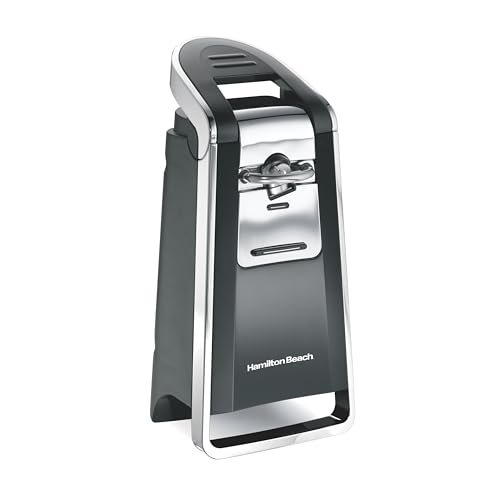
Hamilton Beach Smooth Touch Electric Can Opener (76606AG)
Badge: Best Overall
Strengths
- Push down lever spreads the starting effort across the palm instead of concentrating it in fingertips
- Handles extra-tall cans that tip or jam smaller openers, plus pop-top cans when the tab has snapped
- Smooth Touch action is designed to leave an edge that is kinder to fingers than a raw cut
Trade-offs
- Lever must be pushed to start, so it asks slightly more of the hand than a true one-touch button
- Larger countertop body is the price of extra-tall can clearance
- Chrome trim shows fingerprints and needs a wipe to stay smart
At a glance
- Format: countertop corded
- Power: Corded countertop design
- Easy push down lever
- Opens standard, extra-tall and pop-top cans
- Smooth Touch cutting action
- Black and chrome finish
- Model 76606AG
The Hamilton Beach Smooth Touch is built for the cans other openers struggle with. Its listing is explicit that it opens all standard sizes, extra-tall cans and pop-top cans, and that breadth is its reason to exist. Tall cans of tomatoes or stock are where lighter openers tip, stall or need a second hand to steady everything; a countertop unit with the clearance and weight to handle them removes that small daily friction. Starting the cut uses an easy push down lever, which spreads force through the heel of the hand rather than asking fingertips to pinch and hold. The Smooth Touch name refers to its cutting approach, aimed at an edge that is less threatening than the razor rim a basic top-cut can leave. The honest limitation is that the lever still asks for a deliberate push, so someone seeking the absolute minimum of hand involvement may prefer a one-touch handheld. For mixed pantries with tall cans in regular rotation, though, this is the most capable countertop option in the group. The arthritis test for the Hamilton Beach Smooth Touch Electric Can Opener is simple: could you complete its whole cycle, including the lid and the clean-up, on a low-grip morning? Its review answers honestly.
Best for: households opening extra-tall cans and snapped pop-top cans regularly / Not suited for: anyone seeking the absolute minimum hand involvement of a one-touch handheld

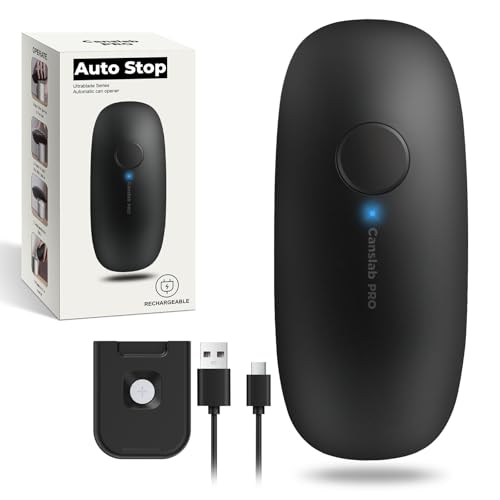
Canslab Ultrablade PRO Electric Can Opener
Badge: Best for Arthritis-Aware Design
Strengths
- Smart Auto Stop ends the cycle when the cut is done, so there is no guessing or over-running the rim
- Side cut with smooth edge separates the lid at the side, leaving an edge designed to be safe to touch
- Wall mountable storage keeps it off the counter and out of the drawer tangle
Trade-offs
- Cordless convenience depends on keeping the USB charge topped up
- Side-cut style can feel unfamiliar the first few times if you grew up with top-cut openers
- Handheld format still needs the can on a flat, stable surface to walk around cleanly
At a glance
- Format: handheld rechargeable
- Power: USB rechargeable, cordless
- USB rechargeable
- Smart Auto Stop
- Handsfree side cut with smooth edge
- Made for seniors with arthritis
- Cordless and wall mountable
- Black finish
The Canslab Ultrablade PRO is the most explicitly arthritis-aware design in this pool: its listing names seniors with arthritis directly, and the feature set backs that up. The cut is handsfree and happens at the side of the lid, leaving a smooth edge, which removes both the gripping effort and the sharp-rim worry in one move. Smart Auto Stop is the detail that quietly matters. Judging when a cut is complete, and stopping a machine at the right moment, is a small cognitive and physical load; automating the stop removes it. Being USB rechargeable and cordless means it works wherever the can is, and the wall mountable design gives it a home that is neither counter nor drawer. The limitation is the side-cut learning curve: the first can feels odd if you expect the lid to lift from the top, and the rechargeable battery rewards a regular top-up habit. For hands that hurt, this combination of handsfree cutting, smooth edges and automatic stopping is the strongest specialist package here. The arthritis test for the Canslab Ultrablade PRO Electric Can Opener is simple: could you complete its whole cycle, including the lid and the clean-up, on a low-grip morning? Its review answers honestly.
Best for: seniors with arthritis who want handsfree side cutting, a smooth edge and automatic stopping / Not suited for: cooks who dislike the unfamiliar feel of a side-cut lid

Kitchen Mama Auto Electric Can Opener (Red)
Badge: Best Hands-Free Handheld
Strengths
- Truly hands free: set it on the can, start it, and it walks the rim by itself
- Smooth edge cut addresses the sharp-lid problem that makes people avoid cans
- Battery operation means no cord, no outlet hunt and no counter commitment
Trade-offs
- Batteries are an ongoing consumable and a flat set stops play until replaced
- Handheld units can struggle to start on dented rims where a countertop machine would power through
- Red finish is a love-it or leave-it choice in a neutral kitchen
At a glance
- Format: handheld battery
- Power: Battery operated, cordless
- Battery operated
- Automatic hands free operation
- Smooth edge cut
- Food-safe design
- Red finish
Kitchen Mama built its reputation on a simple promise: put the opener on the can, press the button, and take your hand away. The listing describes it as automatic, hands free and food-safe, with a smooth edge cut, and that combination explains its following among cooks whose hands no longer cooperate with manual openers. There is no lever to hold, no handle to squeeze and no cord to manage, because it runs on batteries and travels around the rim under its own power. The smooth edge matters beyond comfort: a lid that is not razor sharp is safer to lift away and safer in the bin. The honest limitation is power management. Batteries fade gradually, so cuts get slower before they stop, and keeping a spare set in the drawer becomes part of ownership. Dented rims can also challenge a small handheld where a heavy countertop machine would simply force its way through. If your cans are standard and your priority is the least physical involvement possible, this is a compelling, proven pattern. The arthritis test for the Kitchen Mama Auto Electric Can Opener is simple: could you complete its whole cycle, including the lid and the clean-up, on a low-grip morning? Its review answers honestly.
Best for: anyone who wants the proven set-it-on-the-can, hands-free pattern with no cord at all / Not suited for: cooks who hate managing batteries or who open many dented cans

KITCHENMUH One Touch Electric Can Opener (Black+Grey)
Badge: Best One-Touch Simplicity
Strengths
- One touch start is the simplest control scheme in this entire group
- Listing states it fits all can sizes, the broadest sizing claim of any handheld here
- Smooth edge, food safe cut keeps the blade path and the rim on the safer side
Trade-offs
- Battery operated, so running costs and readiness depend on your spare battery habit
- Less established brand than the countertop names, so long-term parts support is less certain
- Handheld format gives less leverage on damaged or dented rims than a fixed countertop unit
At a glance
- Format: handheld battery
- Power: Battery operated, cordless
- One touch operation
- Fits all can sizes
- Made for seniors with arthritis
- Battery operated
- Smooth edge, food safe cut
- Black and grey finish
The KITCHENMUH is aimed squarely at the arthritis use case, and its listing says so directly: it is a one touch, battery operated opener for seniors with arthritis that fits all can sizes and leaves a smooth, food safe edge. One touch is not a marketing flourish here; it is the whole point. Every control beyond a single press is a small tax on sore hands, and this design tries to charge that tax only once. The fits-all-sizes claim is the broadest of any handheld in this guide, which matters if your pantry mixes small tomato paste cans with family-size bean cans. Battery operation keeps it cordless and drawer-friendly. The trade-offs are the standing handheld ones: batteries to keep in reserve, and less brute leverage on a dented rim than a countertop machine bolted to its own weight. The brand is also less established than Cuisinart or Hamilton Beach, which some buyers weigh heavily. On pure ease-of-use specification for arthritic hands, though, few listings state their case as directly as this one does. The arthritis test for the KITCHENMUH One Touch Electric Can Opener is simple: could you complete its whole cycle, including the lid and the clean-up, on a low-grip morning? Its review answers honestly.
Best for: seniors with arthritis who want one touch, all can sizes and a smooth food safe edge / Not suited for: buyers who only trust long-established appliance brands

KORSKR Automatic Electric Can Opener (Black)
Badge: Best for Left-Handed Cooks
Strengths
- Explicitly listed as suitable for left handed people, a group most opener designs quietly ignore
- Hands free automatic travel around the rim after a single start
- Any-size-can claim covers the mixed sizes most pantries actually hold
Trade-offs
- Battery powered, so readiness depends on charge discipline and spares
- Left handed suitability depends on your technique; the listing claim is a starting point, not a guarantee for every user
- Newer brand name with a shorter track record than the legacy countertop makers
At a glance
- Format: handheld battery
- Power: Battery powered, cordless
- Automatic operation
- Suitable for any size cans
- Battery powered, hands free
- Smooth edge cut
- Listed for seniors, women and left handed people
- Black finish
The KORSKR earns its place with one claim nobody else in this pool makes: its listing names left handed people explicitly, alongside seniors and women, as the users it suits. Anyone left handed knows how many kitchen tools assume a right-handed world, from the orientation of a manual opener handle to where a lever sits. An automatic handheld that sits on top of the can and travels by itself sidesteps much of that handedness entirely, because the machine does the turning. It is battery powered and hands free, leaves a smooth edge, and is listed as suitable for any size of can. The limitations mirror its handheld peers: batteries to manage, and a brand history shorter than the household names. If you are left handed, or buying for someone who is, this is the pick whose listing actually speaks to you rather than assuming you will adapt. That kind of direct fit is worth more than a longer feature list aimed at somebody else. The arthritis test for the KORSKR Automatic Electric Can Opener is simple: could you complete its whole cycle, including the lid and the clean-up, on a low-grip morning? Its review answers honestly.
Best for: left handed cooks and seniors who want hands free automatic opening for any size can / Not suited for: cooks who prefer a corded countertop station that is always ready

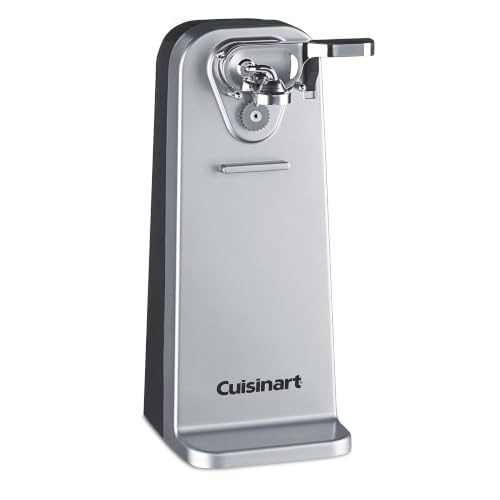
Cuisinart CCO-55 Deluxe Electric Can Opener (Chrome)
Badge: Best Chrome Countertop Finish
Strengths
- Press and release one-touch control: press to start, and the machine handles the rest of the cycle
- Removable lever washes properly, tackling the hygiene spot where openers age worst
- Magnetic lid holder keeps the lid from dropping into food at the end of the cut
Trade-offs
- Chrome finish is the most fingerprint-hungry surface in this group
- Countertop corded format needs a permanent home and an outlet
- No smooth-edge claim in the listing, so expect a conventional cut
At a glance
- Format: countertop corded
- Power: Corded countertop design
- One-touch press and release operation
- Magnetic lid holder
- Removable lever
- Chrome finish
The CCO-55 is Cuisinart’s chrome-finished take on the same low-effort idea as its black CCO-50 sibling: one-touch press and release operation, a magnetic lid holder, and a lever that removes for washing. Press and release deserves emphasis, because it describes the whole interaction. There is no holding, squeezing or guiding; you press, release, and collect a lid that the magnet is holding for you. The removable lever remains one of the most practical features any countertop opener can offer, because the cutting head is where food residue builds up and where a fixed design slowly becomes unpleasant. The honest limitations are cosmetic and spatial. Chrome looks superb on day one and shows every fingerprint by day three, and any countertop unit trades counter space for readiness. The listing makes no smooth-edge claim, so treat the cut as conventional. If you want a countertop opener that looks like a deliberate appliance rather than a gadget, and cleans up properly, this is the polished option. The arthritis test for the Cuisinart CCO-55 Deluxe Electric Can Opener is simple: could you complete its whole cycle, including the lid and the clean-up, on a low-grip morning? Its review answers honestly.
Best for: cooks who want press-and-release ease, a washable lever and a polished chrome appliance / Not suited for: kitchens where fingerprints on chrome would be a daily irritation
Comparison Table
| Pick | Format | Power | Standout feature from its listing | Listing |
|---|---|---|---|---|
| Hamilton Beach Smooth Touch Electric Can Opener (76606AG) | countertop corded | Corded countertop design | Easy push down lever | Check on Amazon |
| Canslab Ultrablade PRO Electric Can Opener | handheld rechargeable | USB rechargeable, cordless | USB rechargeable | Check on Amazon |
| Kitchen Mama Auto Electric Can Opener (Red) | handheld battery | Battery operated, cordless | Battery operated | Check on Amazon |
| KITCHENMUH One Touch Electric Can Opener (Black+Grey) | handheld battery | Battery operated, cordless | One touch operation | Check on Amazon |
| KORSKR Automatic Electric Can Opener (Black) | handheld battery | Battery powered, cordless | Automatic operation | Check on Amazon |
| Cuisinart CCO-55 Deluxe Electric Can Opener (Chrome) | countertop corded | Corded countertop design | One-touch press and release operation | Check on Amazon |
Read the format column first. It decides where the opener lives and how much of the work your hands still do, and it explains most of the real difference between these six. Power comes second: corded countertop models are always ready, battery and rechargeable handhelds are ready only if you keep them fed. The standout feature column is a tiebreaker, not a starting point. Shoppers comparing the smooth-edge question specifically will find Best Electric Can Openers For Small Cans a useful companion read.
How to Choose the Right Electric Can Opener for Best electric can openers for arthritis
Start with the control, because the control is where ease is won or lost. A true one-touch design asks you to press once and then supervises itself; a press-and-hold lever asks your hand to stay involved for the whole cut. Neither is automatically better. One-touch suits hands that tire or ache, because involvement ends the moment the cut begins. A lever suits cooks who like to feel the machine engage and who open cans in quick batches, because starting the next can is instant. Be honest about which description sounds like your hands on an ordinary tired evening, not on your best morning.
Next, decide where the opener lives. Countertop corded models trade counter space for permanent readiness: no batteries, no charging, no drawer. Handheld cordless models trade that readiness for freedom: they work at any counter, any table, and store in a drawer or on a wall mount. The right trade depends on your kitchen’s scarcest resource. If counter space is precious and outlets are few, cordless wins. If your household forgets to charge things, corded wins, and it is not close.
Then consider the cut itself. Smooth-edge and side-cut designs separate the lid so the remaining rim is far less sharp, which changes both safety and feel: lids lift away cleanly and bins are safer to press down. Conventional top cuts are familiar and work on the widest range of rims, but the removed lid is a sharp disc that deserves tongs or a magnet, never fingertips. If children help in the kitchen, or if a sharp lid is the part of can opening you genuinely dread, weight the smooth-edge picks heavily.
Build fluctuation into the decision. Rate each finalist twice: once for a good day and once for a bad one, and buy for the bad-day score, because the good-day score takes care of itself. A design that needs a firm two-handed steady on a tall can may be fine in May and impossible during a winter flare. The bad-day test also settles the format question for most people: if bad days make lifting the can the worst step, go handheld; if bad days make aiming and holding the worst step, go countertop.
Finally, match the opener to your actual cans for a week before you buy. Count how many are standard, how many are tall, how many are small paste cans, and whether pop-top tabs regularly snap on you. That one-week audit, written on the back of a shopping list, predicts satisfaction better than any feature list, because best electric can openers for arthritis is ultimately a question about your pantry, not about motors in the abstract. Readers whose week turns out to be dominated by small cans often end up reading Best Electric Small Smooth Edge Can Openers before deciding.
How to Use, Clean and Look After an Electric Can Opener
Using any electric opener well starts before the motor does. Wipe the top of the can, because dust and dried drips from storage end up exactly where the cutter travels. Set the can on a flat, dry surface; a can rocking on crumbs defeats even a good machine. Engage the cutter squarely on the rim, start the cut, and then let the machine work at its own pace. Forcing a handheld around faster than its motor wants to go, or dragging a countertop can sideways, is how ragged cuts and stalls happen. When the cut completes, lift the lid away with the magnet, a utensil or the smooth-edge rim itself, and drop it straight into the bin.
Cleaning is a two-minute habit, not a project. After messy cans such as tomatoes, tuna or beans, wipe the cutting area with a damp cloth while residue is fresh. Weekly, if you open cans most days, wash any removable lever or head in warm soapy water, dry it fully, and check the cutting wheel for a trapped sliver of metal, which is the hidden cause of many sudden failures. Never immerse a motor body in water. A dry machine stored in a dry place will reward you with years of unremarkable, reliable service, which is exactly what you want from a tool like this.
Troubleshooting. Problem: the opener stalls halfway round the rim → check for a dent at the stall point, reseat the cutter just past it, and support the can so the machine is not dragging its weight. Problem: the lid drops into the food → the magnet was not engaged or was coated in residue; clean the magnet face, and on the next can hold the lid tab area for the last moment of the cut until you trust the hold. Problem: a rechargeable or battery model sounds slower week by week → that is the power source fading, not the motor failing; recharge or replace the batteries before judging the machine. Problem: cuts get ragged on a countertop model → wash the removable lever or cutting head first, because dried residue on the wheel is the most common cause.
Grip, Pinch and Turn: The Three Costs Arthritis Counts
Manual opening bills your hands three times. The pierce is a pinch: thumb and forefinger drive the cutter through metal. The turn is a sustained grip under rotation, the exact demand that arthritic joints tolerate worst because it combines force with duration. The lid is a fine-motor bill: a thin, sharp disc to be pinched, lifted and carried. Electric designs pay these bills differently. Motors pay the pierce and the turn in every pick here. The lid bill is paid only by magnetic holders, smooth-edge cuts and whole-lid side cuts, which is why those features recur throughout this guide’s recommendations.
When you read any listing, translate its features into bills paid. Hands-free means the turn bill is gone entirely. One-touch means the pierce bill is a single low-force press. Smooth edge means the lid bill shrinks to a lift you can do with a utensil or a whole-hand scoop. A feature that pays no bill — a colour, a styling line — may still please you, but it should never outvote one that does. That translation habit will serve you for every adaptive kitchen purchase, not just this one.
Pacing, Warmth and the Rest of the Adaptive Kitchen
The opener is one purchase inside a wider strategy, and the strategy multiplies its value. Warm hands grip better, so sequence can opening after a warm-water task. Sit for the task if standing fatigues you; a handheld opener works perfectly well with the can on a table at seated height. Keep the week’s cans in one waist-high zone so the routine never begins with cupboard gymnastics. And let the machine finish: the urge to help a slow cut along with a guiding squeeze reintroduces exactly the load you paid to remove.
Finally, be honest with the people you cook with. If someone else in the household opens cans faster by hand, the electric machine is still yours for the days they are out and the days your hands say no. Adaptive tools are not admissions; they are how a kitchen stays fully yours for decades. The picks in this guide were chosen to disappear into that independence, doing a small job completely so your hands can spend themselves on the parts of cooking you actually enjoy.
For a wider view of the manual alternative and when it still makes sense, see Best Hand Can Openers.
Grip is only one part of hand comfort. Vision matters too: you need to see that the cutter has seated on the rim, see whether the cut is progressing, and see the lid at the end. High-contrast finishes, clear on and off behaviour, and a machine that stops decisively all reduce the squinting and second-guessing that make a simple task feel tiring. Sound is another quiet signal. A steady motor note that changes pitch when the cut completes tells you the job is done without watching every second. The easiest openers in this guide tend to give you several of these signals at once, which is why two machines with similar motors can feel completely different in daily use.
Consider keeping a simple manual opener as a backup even after you choose an electric model. Power cuts, flat batteries and the one oddly shaped can that defeats every machine are rare, but they happen, and a basic manual opener in the drawer costs almost nothing and takes almost no space. The electric opener then handles the ninety-nine percent of cans that make up real life, and the manual one covers the exceptions without drama. This is not a failure of the electric approach; it is the same belt-and-braces logic that keeps a torch in a house with electric lights. Your daily experience improves, and the edge cases stop being emergencies.
Think about the full journey of a single can in your kitchen, because ease of use is decided at every step of it, not just the cutting step. The can comes out of a cupboard or pantry, it needs a stable surface, the opener has to engage the rim without a fight, the cut has to complete without stalls, the lid has to go somewhere safe, and the opener has to be cleaned and put away. A design that is effortless at the cutting step but fiddly to engage, messy to clean or awkward to store will slowly stop being used, and an opener that stops being used is worse than a simpler one that stays in daily rotation. When you compare the picks in this guide, walk each one through that whole journey in your imagination and notice where your own hands, eyes or patience would be taxed.
If you cook for someone else whose hands are struggling, watch them open a can before you buy. Notice whether the hard moment is the initial squeeze to pierce the lid, the sustained turning, the lifting of a heavy can, or the disposal of the sharp lid. Different electric designs solve different moments: one-touch handhelds remove squeezing and turning, countertop machines remove holding and aiming, and smooth-edge cutters remove the dangerous lid. Matching the machine to the actual hard moment is the difference between a thoughtful purchase and an expensive drawer ornament. The best gift in this category is the one that disappears into the routine within a week.
Where the opener lives changes how easy it feels. A countertop model that sits two steps from where you prep is easier in practice than a technically superior handheld buried at the back of a crowded drawer. If you choose a handheld, give it a fixed home: the front of the utensil drawer, a wall mount if the design allows it, or a small tray near the cans. If you choose a countertop model, place it where cans are opened, not where it looks best, and keep the cord route tidy so moving it for cleaning is a ten-second job. Friction is mostly geography, and geography is entirely within your control.
Common Buying Mistakes
For arthritis, the deepest mistake is buying for the average day, because arthritis is not average; it is a distribution with bad tails, and the machine must cover the tails. The second is accepting the word easy in a listing as evidence, without checking which loads the design actually removes. The third is neglecting power readiness, so the adaptive tool is flat on the very day it was bought for, and the manual opener — the painful one — comes back out of the drawer.
Three further mistakes show up repeatedly. The first is buying for the cans you wish you opened instead of the cans in your cupboard today. The second is ignoring cleaning until the cutter is coated and the machine seems weak, when a wash would have restored it. The third is treating the cheapest moment as the decision: within this category, the difference between a frustrating opener and a satisfying one is usually design fit, not a small gap in cost, so use the listing to check the latest price on Amazon only after you have decided which design fits your hands.
Final Recommendation
The Canslab Ultrablade PRO leads this guide because its listing builds the whole cycle around arthritis: handsfree side cutting, smooth edge, automatic stop. The KITCHENMUH follows closely with stated arthritis design and one-touch, all-sizes coverage. The Kitchen Mama is the proven hands-free battery option, and the KORSKR adds explicit left handed suitability to the same pattern. For a fixed station, the Hamilton Beach’s palm-push lever and tall-can coverage and the Cuisinart CCO-55’s press-and-release control with a washable lever are the countertop answers, differing mainly in cut style and finish.
Start your shortlist here: Hamilton Beach Smooth Touch Electric Can Opener, Canslab Ultrablade PRO Electric Can Opener, Kitchen Mama Auto Electric Can Opener. Those three cover the main shapes of this category between them, and the detailed reviews above will tell you quickly which shape matches your kitchen. Whichever you choose, check the latest price on Amazon on the day you buy, confirm the format and power type one last time, and give the new routine a full week of ordinary cooking before you judge it; new habits around an everyday tool always feel stranger on day one than they do on day seven.
One last cross-check for readers still torn between two neighbouring searches: Best Hand Can Openers That Dont Quit frames the same decision from the adjacent angle, and reading both final sections side by side usually settles it.
Frequently Asked Questions
Are electric can openers really easier than manual ones?
For most people, yes, and the difference is where the effort goes. A manual opener asks for a hard squeeze to pierce the lid and a sustained turning grip for the whole cut. An electric design replaces both with a motor: you position the can and start the cycle. The effort that remains is placement and, on lever models, a single push. People whose grip is strong may notice little difference; people whose hands tire, ache or cramp usually notice it on the very first can.
What is the difference between a top cut and a smooth-edge side cut?
A top cut slices through the top of the lid just inside the rim, leaving a sharp edge on the removed lid. A side cut or smooth-edge design separates the lid at the side seam, so the lid lifts off with a much smoother rim and the can edge is less sharp too. Side cuts can feel strange at first because the lid comes away as a complete disc, and they can struggle on unusual rims, but for safety-focused households they are usually the preferred style once the habit forms.
Do electric can openers work on pop-top cans?
They can, and sometimes they should. Pop-top tabs snap off, bend, or demand a fingertip pull that is genuinely hard for sore hands. A countertop model whose listing says it opens pop-top cans, such as the Hamilton Beach pick in this guide, handles them by cutting the lid the conventional way. Handhelds vary more, so if snapped tabs are a recurring frustration in your house, treat that listing claim as a deciding feature rather than a bonus.
How long do batteries or charges last in handheld models?
Listings in this guide do not promise a fixed number of cans, and you should be suspicious of any source that states one as a fact, because can size, rim condition and battery age all change the answer. The practical approach is rhythm rather than counting: recharge USB models after a run of heavy use, keep spare batteries for battery models in the same drawer, and treat a slowing motor as a power reminder, not a product failure.
Can an electric opener handle very tall or large cans?
Countertop models with explicit extra-tall clearance, like the Hamilton Beach in this guide, are the safest bet for tall stock and tomato cans. Handhelds sit on top of the can, so height matters less to them, but a very heavy can still needs a stable surface and sometimes a steadying hand nearby. Very wide catering cans are the hardest case for every design here; if you open those weekly, say so in your shortlist criteria and favour the countertop machine with the most clearance.
What makes an electric opener genuinely arthritis-friendly?
Three mechanical facts. The start must need no pinch or sustained hold — a single touch or a palm push. The cut must proceed without your grip — hands-free travel or a fixed machine doing the holding. And the lid must be safe for stiff fingers — a smooth edge, a side-cut whole lid, or a magnet doing the holding. Stated arthritis or senior design in a listing, as the Canslab and KITCHENMUH provide here, is a good sign precisely because those brands have engineered for all three facts.
How do I know when to replace an electric can opener?
Replace it when cleaning no longer restores a clean cut, when the motor labours on ordinary cans with fresh power, or when the cutter starts leaving metal slivers. A gradual decline is usually residue or a fading battery, both fixable. A sudden change after a drop can mean a bent cutter, which is not worth forcing. Because these are relatively simple machines, a well-kept pick should give years of service; treat replacement as a response to behaviour, not to age alone.