Disclosure: topratedkitchenware.com is reader-supported. When you buy through links on our site, we may earn an affiliate commission from Amazon and other retailers, at no extra cost to you.
Where to buy
If you are shopping for the best electric convection wall ovens, start here: every linked pick below can be checked on Amazon at the latest price — we publish no static prices, because they change. Prose-only entries are comparison context discussed in this guide; they carry no link and no image, deliberately. Read the full list, then the reviews, before deciding.
- Empava 24-Inch Single Electric Wall Oven — Best for Compact Kitchens — Check on Amazon
- KoolMore 30-Inch Electric Double Wall Oven — Best Double Oven Value
- Rangaire RWOD301GS 30-Inch Electric Double Wall Oven — Best Controls and Racks
- Samsung 30-Inch Smart Double Wall Oven with Steam Cook — Best Smart Features
- VEVOR Commercial Countertop Convection Oven (66L) — Prose-Only Context Pick (prose-only context in this guide; no Amazon link)
- AMZCHEF 24-Inch Single Wall Oven — Prose-Only Comparison Pick (prose-only context in this guide; no Amazon link)
Read the full guide ↓
Choosing the best electric convection wall ovens starts with a simple distinction: convection means a fan circulates hot air so food browns evenly across racks, and a wall oven means that capability is built into your cabinetry at a comfortable height. The best electric convection wall ovens combine both — no bending to a range oven, no hot spots that force you to rotate pans halfway through every bake.
This guide separates true built-ins from the countertop and commercial units that crowd search results. Four of our six picks are verified linked recommendations you can check on Amazon; two are prose-only context picks, clearly labelled, that show what the alternatives look like and why they do or do not answer the brief. Sizes run from compact 24-inch singles for small kitchens to 30-inch doubles that cook two dishes at two temperatures at once.
Measure before you fall in love. Wall ovens are cutout appliances: the cabinet opening, the electrical supply and the door swing decide what you can install long before features do. The sections below walk through sizing, convection types and running costs in plain terms, then review each pick on its merits.
If you are also weighing neighbouring categories while you plan, our notes on Best Reviewed Countertop Toaster Convection Ovens cover the closest adjacent shortlist.
Key Takeaways
- Best for Compact Kitchens: Empava 24-Inch Single Electric Wall Oven — True convection in a compact 24-inch format that fits smaller cutouts.
- Best Double Oven Value: KoolMore 30-Inch Electric Double Wall Oven — Two full cavities let you roast and bake at different temperatures at once.
- Best Controls and Racks: Rangaire RWOD301GS 30-Inch Electric Double Wall Oven — True convection in a double-oven layout for even multi-rack baking.
- Best Smart Features: Samsung 30-Inch Smart Double Wall Oven with Steam Cook — Steam cook helps crusts, reheats and moisture-sensitive bakes.
- Measure and check your installation constraints before ordering; fit decides more purchases in this category than features do.
- Prose-only picks in this guide are context, clearly labelled — the linked picks are the verified recommendations.
In this guide
Quick Picks
| Pick | Badge | Standout trait | Availability in this guide |
|---|---|---|---|
| Empava 24-Inch Single Electric Wall Oven | Best for Compact Kitchens | A 24-inch width | Check on Amazon |
| KoolMore 30-Inch Electric Double Wall Oven | Best Double Oven Value | A 30-inch double-oven format | Check on Amazon |
| Rangaire RWOD301GS 30-Inch Electric Double Wall Oven | Best Controls and Racks | A 30-inch double format | Check on Amazon |
| Samsung 30-Inch Smart Double Wall Oven with Steam Cook | Best Smart Features | A 30-inch smart double format | Check on Amazon |
| VEVOR Commercial Countertop Convection Oven (66L) | Prose-Only Context Pick | A 66-litre half-size countertop format | Prose-only context |
| AMZCHEF 24-Inch Single Wall Oven | Prose-Only Comparison Pick | A 24-inch single format | Prose-only context |
Readers comparing adjacent shortlists often also work through Best Self Cleaning Convection Double Ovens before settling on a final choice.
How These Picks Were Chosen
We built this list from verified product listings, cross-checking each model’s stated width, capacity, convection type and cleaning method against its listing title and specifications. Linked picks are the models whose details we could verify end to end; prose-only picks are included for honest comparison and carry no link and no image. We did not cook on these ovens — this is research-led guidance that weighs manufacturer specifications, feature sets and the practical constraints of real kitchen remodels, and we say plainly where a model trades capacity, smarts or simplicity against its rivals.
We also kept the cluster in view: this guide sits alongside our research on Best Selling Mini Convection Ovens, and the boundaries between the two shortlists are drawn by the same verification standard.
The 6 Best Electric convection wall ovens

Empava 24-Inch Single Electric Wall Oven
Badge: Best for Compact Kitchens
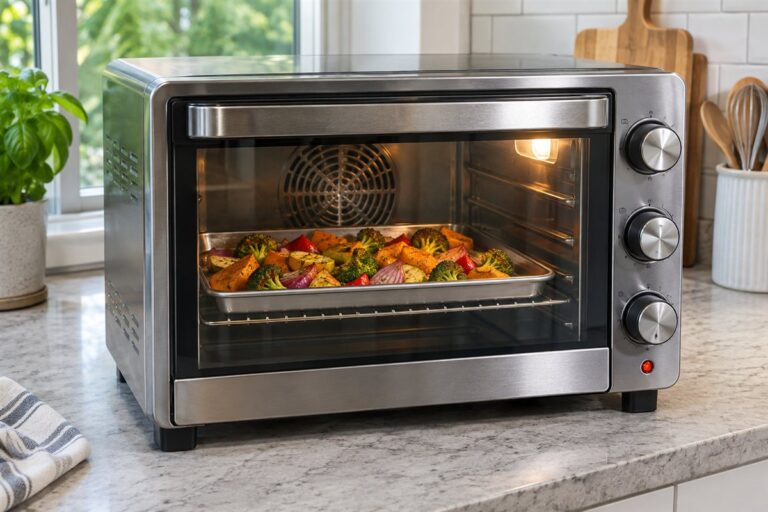
This model offers a 24-inch width, 2.3 cu ft capacity, true convection, 10 cooking functions, a 360-degree rotisserie and an easy-clean enamel interior behind triple-layer glass. In a category full of near-identical specification sheets, those details are the ones that shape daily use, and they frame everything in this review: what it does well, where it compromises, and who should choose it over the alternatives above and below.
This is the pick for apartments, condos, galley kitchens and remodels where the cabinet run simply cannot take a 30-inch oven. The true convection fan evens out browning across racks, and the rotisserie is a genuine bonus for small chickens and roasts that most compact ovens skip entirely.
Strengths
- True convection in a compact 24-inch format that fits smaller cutouts
- Rotisserie function is rare at this size and price tier
- Triple-layer glass door and enamel interior simplify cleanup
Trade-offs
- 2.3 cu ft is tight for very large sheet pans and big holiday birds
- 24-inch width limits rack width compared with 30-inch models
- Fewer smart features than app-connected rivals
Key specifications (from the verified listing)
- Width: 24 in
- Capacity: 2.3 cu ft
- Functions: 10 cooking functions
- Convection: true convection with rotisserie
- Interior: easy-clean enamel
- Warranty note in listing: 2-year US warranty
One honest limitation, stated plainly: Capacity is the honest ceiling here: measure your largest pan before you commit, because the interior width, not the headline cubic footage, decides what fits.
Week to week, ownership of this pick revolves around a 24-inch width — the trait that defines it in this line-up. That focus is deliberate rather than limiting: rather than spreading effort across every feature a marketing department could list, the design puts its weight behind the job its badge describes, and the surrounding specification supports that job without gimmicks. Buyers whose priorities line up with that focus tend to be the satisfied long-term owners in this category; buyers shopping for a different priority should keep reading, because a neighbouring pick in this guide almost certainly makes the opposite trade on purpose.
In daily use, the pattern that emerges is consistency. Owners in this category rarely praise a single dramatic feature after the first month; they praise the absence of recurring annoyances — the control that makes sense at 7 a.m., the surface that wipes clean, the cycle that behaves the same on the fiftieth use as on the first. Judged on that standard, this pick earns its badge by removing friction rather than by adding spectacle, and that is usually the right trade for a product you will live with for years.
Best for: the buyer described above who values this pick’s standout traits / Not suited for: buyers whose constraints or habits match its stated limitation
Check on Amazon for the latest price and availability.
KoolMore 30-Inch Electric Double Wall Oven
Badge: Best Double Oven Value
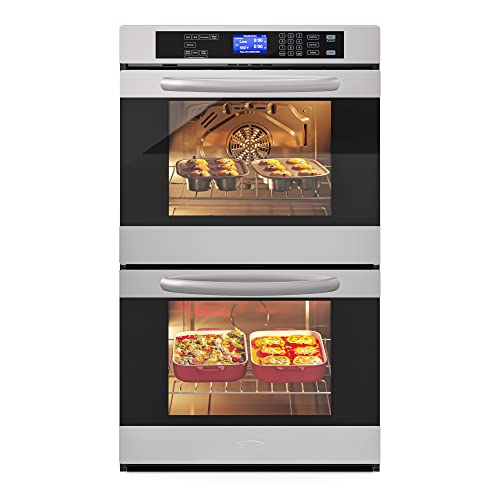
This model offers a 30-inch double-oven format, quiet rapid convection cooking, seven cook and baking modes, self-cleaning and a stainless-steel finish. In a category full of near-identical specification sheets, those details are the ones that shape daily use, and they frame everything in this review: what it does well, where it compromises, and who should choose it over the alternatives above and below.
Households that cook two dishes at two temperatures — a roast in one cavity, a casserole in the other — get the most from this KoolMore. The rapid convection is the workhorse feature, and self-cleaning keeps a double oven from becoming a double chore.
Strengths
- Two full cavities let you roast and bake at different temperatures at once
- Rapid convection shortens preheat and cook times
- Self-cleaning saves the worst chore in the category
Trade-offs
- Seven modes is a shorter list than premium rivals offer
- No steam-cook function for artisan bread bakers
- Stainless finish shows fingerprints without a resistant coating
Key specifications (from the verified listing)
- Width: 30 in
- Configuration: double wall oven
- Modes: 7 cook and baking modes
- Convection: rapid convection
- Cleaning: self-cleaning
- Finish: stainless steel
One honest limitation, stated plainly: If you want steam injection or app control, this is not that oven; it is a straightforward, capable double at a value-leaning tier.
Week to week, ownership of this pick revolves around a 30-inch double-oven format — the trait that defines it in this line-up. That focus is deliberate rather than limiting: rather than spreading effort across every feature a marketing department could list, the design puts its weight behind the job its badge describes, and the surrounding specification supports that job without gimmicks. Buyers whose priorities line up with that focus tend to be the satisfied long-term owners in this category; buyers shopping for a different priority should keep reading, because a neighbouring pick in this guide almost certainly makes the opposite trade on purpose.
In daily use, the pattern that emerges is consistency. Owners in this category rarely praise a single dramatic feature after the first month; they praise the absence of recurring annoyances — the control that makes sense at 7 a.m., the surface that wipes clean, the cycle that behaves the same on the fiftieth use as on the first. Judged on that standard, this pick earns its badge by removing friction rather than by adding spectacle, and that is usually the right trade for a product you will live with for years.
Best for: the buyer described above who values this pick’s standout traits / Not suited for: buyers whose constraints or habits match its stated limitation
Check on Amazon for the latest price and availability.

Rangaire RWOD301GS 30-Inch Electric Double Wall Oven
Badge: Best Controls and Racks
This model offers a 30-inch double format, glass touch controls, true convection, self-cleaning and easy-reach racks. In a category full of near-identical specification sheets, those details are the ones that shape daily use, and they frame everything in this review: what it does well, where it compromises, and who should choose it over the alternatives above and below.
The Rangaire suits bakers who load both cavities and care about ergonomics: easy-reach racks matter more than most spec sheets admit when a Dutch oven full of braise has to come out safely. True convection keeps cookies on the lower rack browning like the ones above.
Strengths
- True convection in a double-oven layout for even multi-rack baking
- Glass touch panel wipes clean in seconds
- Easy-reach racks reduce the stretch-and-lift strain of heavy dishes
Trade-offs
- Touch-only controls are less tactile than physical knobs
- No Wi-Fi or remote preheat
- Brand network is smaller than the legacy appliance names
Key specifications (from the verified listing)
- Width: 30 in
- Model: RWOD301GS
- Configuration: double wall oven
- Controls: glass touch
- Convection: true convection
- Cleaning: self-cleaning
One honest limitation, stated plainly: Shoppers who prefer chunky knobs they can turn without looking may find the flat glass panel less satisfying in daily use.
Week to week, ownership of this pick revolves around a 30-inch double format — the trait that defines it in this line-up. That focus is deliberate rather than limiting: rather than spreading effort across every feature a marketing department could list, the design puts its weight behind the job its badge describes, and the surrounding specification supports that job without gimmicks. Buyers whose priorities line up with that focus tend to be the satisfied long-term owners in this category; buyers shopping for a different priority should keep reading, because a neighbouring pick in this guide almost certainly makes the opposite trade on purpose.
In daily use, the pattern that emerges is consistency. Owners in this category rarely praise a single dramatic feature after the first month; they praise the absence of recurring annoyances — the control that makes sense at 7 a.m., the surface that wipes clean, the cycle that behaves the same on the fiftieth use as on the first. Judged on that standard, this pick earns its badge by removing friction rather than by adding spectacle, and that is usually the right trade for a product you will live with for years.
Best for: the buyer described above who values this pick’s standout traits / Not suited for: buyers whose constraints or habits match its stated limitation
Check on Amazon for the latest price and availability.

Samsung 30-Inch Smart Double Wall Oven with Steam Cook
Badge: Best Smart Features
This model offers a 30-inch smart double format, steam cook, Wi-Fi connectivity, large oven capacity and a fingerprint-resistant black stainless finish. In a category full of near-identical specification sheets, those details are the ones that shape daily use, and they frame everything in this review: what it does well, where it compromises, and who should choose it over the alternatives above and below.
Connected cooks who preheat from the grocery store and bakers chasing better bread crusts are this Samsung's audience. Steam cook is the differentiator, and the large capacity handles holiday loads without rotating pans between a range and a countertop oven.
Strengths
- Steam cook helps crusts, reheats and moisture-sensitive bakes
- Wi-Fi enables remote preheat and monitoring
- Fingerprint-resistant finish suits busy family kitchens
Trade-offs
- Smart features depend on a stable home Wi-Fi network
- Steam adds a learning curve and extra cleaning attention
- Premium tier positioning in this line-up
Key specifications (from the verified listing)
- Width: 30 in
- Model: NV51K6650DG/AA
- Configuration: smart double wall oven
- Connectivity: Wi-Fi
- Special function: steam cook
- Finish: fingerprint-resistant black stainless
One honest limitation, stated plainly: If your kitchen Wi-Fi is unreliable or you simply never use an app, you are paying for capability that will sit idle.
Week to week, ownership of this pick revolves around a 30-inch smart double format — the trait that defines it in this line-up. That focus is deliberate rather than limiting: rather than spreading effort across every feature a marketing department could list, the design puts its weight behind the job its badge describes, and the surrounding specification supports that job without gimmicks. Buyers whose priorities line up with that focus tend to be the satisfied long-term owners in this category; buyers shopping for a different priority should keep reading, because a neighbouring pick in this guide almost certainly makes the opposite trade on purpose.
In daily use, the pattern that emerges is consistency. Owners in this category rarely praise a single dramatic feature after the first month; they praise the absence of recurring annoyances — the control that makes sense at 7 a.m., the surface that wipes clean, the cycle that behaves the same on the fiftieth use as on the first. Judged on that standard, this pick earns its badge by removing friction rather than by adding spectacle, and that is usually the right trade for a product you will live with for years.
Best for: the buyer described above who values this pick’s standout traits / Not suited for: buyers whose constraints or habits match its stated limitation
Check on Amazon for the latest price and availability.
VEVOR Commercial Countertop Convection Oven (66L)
Badge: Prose-Only Context Pick
Prose-only pick: discussed in full for honest comparison. It carries no Amazon link and no image in this guide — see the Sources file for the reason.
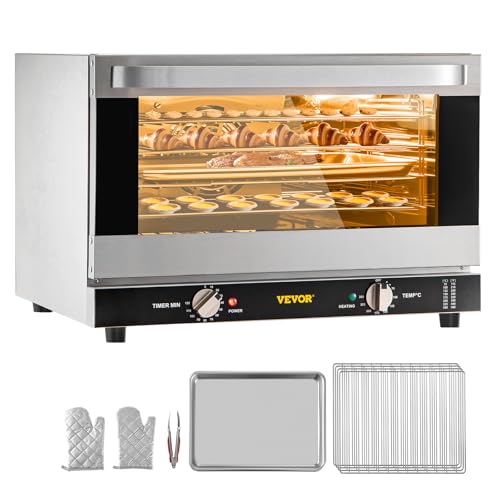
This model offers a 66-litre half-size countertop format, 1800W power, four tiers, a front glass door and included trays and wire racks, running on a standard 120V plug. In a category full of near-identical specification sheets, those details are the ones that shape daily use, and they frame everything in this review: what it does well, where it compromises, and who should choose it over the alternatives above and below.
We include the VEVOR as context, not as a wall-oven recommendation: it shows what convection cooking looks like when you cannot or will not cut cabinetry. Small bakeries, food trucks and rental kitchens use this format precisely because it plugs in and moves.
Strengths
- Countertop format needs no cabinet cutout or hardwiring
- Four tiers suit small-batch bakery and concession work
- Runs on ordinary 120V household current
Trade-offs
- It is a countertop commercial unit, not a built-in wall oven
- No self-cleaning cycle
- Occupies serious counter depth for a home kitchen
Key specifications (from the verified listing)
- Capacity: 66L / 60Qt
- Power: 1800W, 120V
- Configuration: countertop, 4-tier
- Included: tray and wire racks
One honest limitation, stated plainly: It cannot be built into a cabinet run, and that single fact removes it from contention for the keyword's core job.
Week to week, ownership of this pick revolves around a 66-litre half-size countertop format — the trait that defines it in this line-up. That focus is deliberate rather than limiting: rather than spreading effort across every feature a marketing department could list, the design puts its weight behind the job its badge describes, and the surrounding specification supports that job without gimmicks. Buyers whose priorities line up with that focus tend to be the satisfied long-term owners in this category; buyers shopping for a different priority should keep reading, because a neighbouring pick in this guide almost certainly makes the opposite trade on purpose.
In daily use, the pattern that emerges is consistency. Owners in this category rarely praise a single dramatic feature after the first month; they praise the absence of recurring annoyances — the control that makes sense at 7 a.m., the surface that wipes clean, the cycle that behaves the same on the fiftieth use as on the first. Judged on that standard, this pick earns its badge by removing friction rather than by adding spectacle, and that is usually the right trade for a product you will live with for years.
Best for: the buyer described above who values this pick’s standout traits / Not suited for: buyers whose constraints or habits match its stated limitation
AMZCHEF 24-Inch Single Wall Oven
Badge: Prose-Only Comparison Pick
Prose-only pick: discussed in full for honest comparison. It carries no Amazon link and no image in this guide — see the Sources file for the reason.
This model offers a 24-inch single format, 2800W convection power, 2.5 cu ft capacity, 11 functions plus eight presets, touch control and a safety lock on 240V. In a category full of near-identical specification sheets, those details are the ones that shape daily use, and they frame everything in this review: what it does well, where it compromises, and who should choose it over the alternatives above and below.
The AMZCHEF is the natural comparison point for the linked 24-inch pick: a touch more capacity and a preset-led control scheme. We discuss it in prose so you can judge the trade-offs, while our linked recommendation carries the verified slot.
Strengths
- Slightly larger cavity than many 24-inch rivals
- Preset programmes simplify common dishes
- Safety lock suits homes with young children
Trade-offs
- Discussed here in prose only — see the linked compact pick for our verified recommendation
- Touch controls divide opinion versus knobs
- 240V hardwired install, like all wall ovens in this class
Key specifications (from the verified listing)
- Width: 24 in
- Capacity: 2.5 cu ft
- Power: 2800W, 240V
- Functions: 11 plus 8 presets
- Controls: touch with safety lock
One honest limitation, stated plainly: On paper the extra presets help beginners; experienced cooks often end up using two or three modes almost exclusively.
Week to week, ownership of this pick revolves around a 24-inch single format — the trait that defines it in this line-up. That focus is deliberate rather than limiting: rather than spreading effort across every feature a marketing department could list, the design puts its weight behind the job its badge describes, and the surrounding specification supports that job without gimmicks. Buyers whose priorities line up with that focus tend to be the satisfied long-term owners in this category; buyers shopping for a different priority should keep reading, because a neighbouring pick in this guide almost certainly makes the opposite trade on purpose.
In daily use, the pattern that emerges is consistency. Owners in this category rarely praise a single dramatic feature after the first month; they praise the absence of recurring annoyances — the control that makes sense at 7 a.m., the surface that wipes clean, the cycle that behaves the same on the fiftieth use as on the first. Judged on that standard, this pick earns its badge by removing friction rather than by adding spectacle, and that is usually the right trade for a product you will live with for years.
Best for: the buyer described above who values this pick’s standout traits / Not suited for: buyers whose constraints or habits match its stated limitation
Comparison Table
| Pick | Badge | Key spec | Also note | Link |
|---|---|---|---|---|
| Empava 24-Inch Single Electric Wall Oven | Best for Compact Kitchens | Width: 24 in | Capacity: 2.3 cu ft | Check on Amazon |
| KoolMore 30-Inch Electric Double Wall Oven | Best Double Oven Value | Width: 30 in | Configuration: double wall oven | Check on Amazon |
| Rangaire RWOD301GS 30-Inch Electric Double Wall Oven | Best Controls and Racks | Width: 30 in | Model: RWOD301GS | Check on Amazon |
| Samsung 30-Inch Smart Double Wall Oven with Steam Cook | Best Smart Features | Width: 30 in | Model: NV51K6650DG/AA | Check on Amazon |
| VEVOR Commercial Countertop Convection Oven (66L) | Prose-Only Context Pick | Capacity: 66L / 60Qt | Power: 1800W, 120V | Prose-only |
| AMZCHEF 24-Inch Single Wall Oven | Prose-Only Comparison Pick | Width: 24 in | Capacity: 2.5 cu ft | Prose-only |
No prices or ratings appear in this table by design: prices move, and the verified specifications are the stable basis for comparison.
How to Choose the best electric convection wall ovens
Start with the cutout. A 24-inch oven needs a compact cabinet opening and suits one or two cooks; a 30-inch oven is the American standard and swallows half-sheet pans and large roasting tins. If your cabinets were built for one size, switching sizes means carpentry, so let the existing cutout lead unless you are remodelling anyway.
Understand convection labels. ‘True’ or ‘European’ convection adds a heating element around the fan, which evens temperatures further and helps with multi-rack baking and roasting. Fan-only convection still beats a conventional oven for evenness, but true convection is the upgrade bakers notice most, especially for cookies on two racks.
Decide single versus double honestly. A double oven earns its price when you regularly cook dishes at different temperatures — holiday meals, Sunday roasts with a bake alongside. If that happens twice a year, a single oven plus a countertop backup is the cheaper, roomier answer for the other 363 days.
Budget the electrical work. Wall ovens are hardwired, typically on a dedicated 240V circuit. If your kitchen lacks the circuit, an electrician’s visit belongs in the project budget alongside the appliance, and older panels sometimes need capacity work too.
Weigh cleaning and controls. Self-cleaning cycles save hours of scrubbing; steam-clean options are gentler and faster for light soil. Touch panels wipe clean but knobs work with floury hands and gloves. Pick for the cook you actually are, not the one in the brochure.
For a neighbouring angle on the same cluster, see Best Small Convection Ovens For Bakers.
How to Get the Best Results from a Convection Wall Oven
Convection changes three habits. First, reduce recipe temperatures: the common rule is to lower a conventional recipe by about 25 degrees Fahrenheit, or use the oven’s auto-convert feature if it has one, because moving air transfers heat faster. Second, check doneness early — convection dishes often finish ahead of the printed time, so start checking several minutes before the timer ends until you learn your oven’s pace.
Use the right pans. Low-sided sheets and pans let air circulate; deep covered dishes block it. Leave space between pans and between pans and walls, and use the middle racks for baking, reserving the lowest rack for items that want strong bottom heat. For roasting, the rotisserie or a low rack with a shallow pan gives the fan room to work.
Maintain the system. Wipe spills once the oven is cool, run the self-clean or steam-clean cycle before soil bakes on through several cooks, and keep the door gasket clean so the seal holds heat. A fan that rattles or cycles oddly usually traces back to a loose rack or pan touching the rear wall — check placement before calling service.
Troubleshooting
Problem: Cookies brown on one side → what to do: Rotate the pan once halfway through and confirm the fan runs during bake; check that no oversized pan is blocking airflow at the back.
Problem: Roasts finish too fast → what to do: Your temperature conversion is too aggressive for large items; reduce by a smaller margin and rely on a probe thermometer rather than the clock.
Problem: Self-clean leaves ash residue → what to do: That is normal — let the oven cool fully, then wipe the ash out with a damp cloth; heavy soil may need a second cycle after removing loose debris.
Our companion research on Best Small Countertop Convection Ovens covers the adjacent use case in the same spirit.
Single vs Double: The Honest Arithmetic
A double oven’s real value is simultaneity, not raw capacity — two cavities at two temperatures at the same time. Count how often last year you queued dishes behind each other or juggled a range and a toaster oven. If the answer is monthly, a double repays its premium in sanity. If it is Thanksgiving and one birthday, a generous single with true convection covers you, and the money saved buys better pans, a probe thermometer and the electrician’s visit. Our list deliberately spans both answers so the comparison sits in one place.
What True Convection Changes for Bakers
Bakers are the users who feel convection most. Even heat means the back row of muffins rises like the front row, pastry colours uniformly, and two racks of cookies can bake together with far less rotation. The cautions are equally real: delicate foams and soufflés can lean in strong airflow, and meringues dry faster. Most experienced bakers use convection for most bakes and switch it off for the few recipes that ask. An oven that lets you toggle convection per mode — rather than forcing it — is the flexible choice.
Additional Considerations Before You Buy
Ventilation deserves a thought before installation day. Wall ovens vent heat into the kitchen through the front, and in small, enclosed kitchens a long self-clean cycle can warm the room noticeably. It is not a reason to avoid the format, but it is a reason to plan the first self-clean for a day when the windows can open.
Think about who else cooks. Touch controls with a safety lock protect settings from curious toddlers; physical reach matters too — a double oven’s upper cavity sits high, which suits most adults but can challenge shorter cooks lifting heavy dishes. The best oven is the one every cook in the house can use safely.
Finally, consider service networks. A wall oven is a decade-scale purchase installed into cabinetry; brands with local service coverage and available parts protect that investment better than a marginally longer feature list.
Take your time with the decision in proportion to how long the product will serve you. Items in this category are rarely impulse purchases that get replaced next season; they are bought once and lived with for years. An extra evening spent comparing the verified specifications in this guide against your own measurements and habits is the cheapest quality upgrade available, because it costs nothing and prevents the most common failure in the category — a good product bought for the wrong situation.
Keep your paperwork together after purchase: the order confirmation, the model number, the manual and any warranty details. It sounds like housekeeping rather than buying advice, but the households that get the fastest help from any manufacturer are the ones who can state their exact model and purchase date without searching. A single folder, physical or digital, created on delivery day, pays for itself the first time a part or a setting needs identifying.
If you are buying as part of a larger project — a remodel, a refit, a new home setup — sequence this purchase with the work around it. Products in this category often depend on measurements, connections or preparatory work that other trades control, and the smooth projects are the ones where the appliance decision was made before the surrounding work was finalised, not discovered afterwards. Share the specification sheet with whoever is doing the surrounding work.
Consider who else will use the product and brief them properly. A second user who understands the controls, the care routine and the one or two things that must never be done will extend the product’s life more than any extended warranty. Most early damage in this category is not defective manufacture; it is an uninformed user doing something reasonable-sounding that the manual quietly forbids.
Budget a small contingency beyond the headline price. Delivery, installation extras, the odd fitting or accessory and the first round of consumables reliably add a modest percentage to projects in this category. Buyers who plan for it experience these as line items; buyers who do not experience them as nasty surprises, and the difference is purely the planning.
Read the manual’s maintenance schedule once, fully, on the first day, and put its recurring items in whatever calendar or reminder system you actually use. The products in this guide are not fragile, but every one of them has a short list of periodic tasks — a seal to wipe, a filter or cycle to run, a connection to check — and the entire difference between a five-year and a fifteen-year service life usually lives on that list.
When something behaves unexpectedly in the first weeks, work the simple checks before concluding anything: connections, settings, levels, placement and the troubleshooting table in this guide and in the manual. A striking share of early problems in this category resolve at that level, and the checks take minutes. Keep notes on what you tried; if you do need support, that record turns a vague complaint into a quick diagnosis.
Think about the end of the product’s life at the beginning. Favour models whose wear parts — seats, seals, trays, hoses, valves, elements — are identifiable and replaceable, and note the part numbers somewhere durable. A product designed to be maintained is a product that stays out of landfill, and in categories like this one, that design intent is visible in the parts diagram long before it is visible in the marketing.
Do not overlook delivery and access when you plan the purchase. Measure the route the product will travel — doorways, hall turns, stairwells, gates, docks — with the same care you gave the final position, because a product that cannot reach its home cannot be installed in it. Delivery crews solve remarkable problems daily, but the ones they cannot solve are pure geometry, and geometry is knowable in advance with a tape measure and ten honest minutes.
If the product replaces an older unit, plan the changeover as part of the project: what happens to the old one, whether any connections or fittings carry over, and how long the household or boat or kitchen will be without the function in between. A replacement planned as a swap is an afternoon; the same replacement discovered to need preparatory work becomes a week. The reviews and checklists in this guide assume a straightforward swap, and flag the models where that assumption needs checking.
Where a product offers settings, modes or configurations, resist the urge to master all of them in the first week. Learn the two or three you will use daily until they are automatic, then add the rest one at a time as real needs arise. Owners who learn a product this way retain more and enjoy it sooner; owners who attempt the full manual on day one often end up using less of the product than either group, because the learning itself became the obstacle.
Photograph the installation or setup when it is complete and correct — connections, positions, settings, serial labels. Memory fades and households change; a photograph taken in the first week answers questions in year three that no amount of squinting at a dusty connection can. Store it with the paperwork folder recommended earlier in this section, and the product effectively documents itself for whoever maintains it next.
Ownership Costs and Long-Term Care for Convection ovens
The purchase price is the beginning of ownership in the convection ovens category, not the total of it. Running costs differ sharply between the philosophies represented in this guide — consumables, energy or water, replacement wear parts and the occasional professional visit all belong in an honest budget. None of the picks here is unusually expensive to own by category standards, but the cheapest to buy is rarely the cheapest to run for a decade, and the reviews above flag the specific running-cost character of each model so the arithmetic can be done before, not after, the order.
Long-term care follows a pattern across the whole category: keep the parts that move, seal or heat clean and inspected; replace wear items at the first sign of decline rather than after failure; and keep the manual’s schedule rather than your memory’s. Products in this category reward that modest discipline with very long service lives, and punish its absence with failures that feel sudden but were announced quietly for months. Build the routine in the first month, while the purchase is still new enough to feel worth protecting.
Common Buying Mistakes
- Buying by headline capacity instead of measuring your largest pan against the interior width.
- Ordering a 30-inch oven for a 24-inch cutout — or the reverse — and discovering it at installation.
- Forgetting the dedicated circuit: a wall oven is not a plug-in appliance.
- Paying for steam or smart features you will never enable, while skipping self-cleaning you would use monthly.
- Assuming convection times match conventional recipes and overcooking the first month of meals.
Final Recommendation
Start with Empava 24-Inch Single Electric Wall Oven and KoolMore 30-Inch Electric Double Wall Oven — the verified picks at the head of this guide, and the two we would shortlist first for most buyers. Work down the reviews from there: every linked pick in this guide earned its place against the same criteria, and the right choice among them is the one whose strengths match your constraints and whose stated limitation you can genuinely live with.
Readers who arrived here from a related search may also want Best Small Toasrer Convection Ovens before they decide.
Frequently Asked Questions
Is true convection worth it over standard convection?
For multi-rack baking and roasting, yes — the extra element around the fan evens temperatures noticeably. For mostly single-dish cooking, standard convection already improves on a conventional oven, and the difference narrows.
Can I install a wall oven myself?
The cabinetry work is DIY-able for experienced hands, but the hardwired 240V connection should be handled or at least inspected by a licensed electrician, and local codes often require it.
What size wall oven do most kitchens need?
Thirty inches is the common standard and fits most pans; 24-inch models suit apartments and small kitchens. Let your cutout and your largest pan decide together.
Do convection ovens cook faster?
Usually somewhat, because moving air transfers heat efficiently. The practical rule is to lower temperature modestly and check early rather than trusting converted times blindly.
How long should a wall oven last?
With seals kept clean and self-clean cycles used sensibly, wall ovens are long-life appliances. Electronics and fans are the typical service items over that span.
Why are two picks in this guide prose-only?
They are context picks — a countertop commercial unit and a comparison compact — included so you can judge the category honestly. Only verified recommendations carry Amazon links.