Disclosure: topratedkitchenware.com is reader-supported. When you buy through links on our site, we may earn an affiliate commission from Amazon and other retailers, at no extra cost to you.
Where to buy
The picks below are the verified models for this guide to best small countertop convection ovens. Linked names lead to their Amazon listings, where you can check the latest price on Amazon, confirm the exact configuration, and read current owner feedback. Start with the first pick if you want the shortest route: Check on Amazon for the Emeril Lagasse 26QT French Door Air Fryer Toaster Oven.
- Emeril Lagasse 26QT French Door Air Fryer Toaster Oven — Best Overall
- Breville Smart Oven Air Fryer Pro (BOV900BSS) — Best Premium Pick
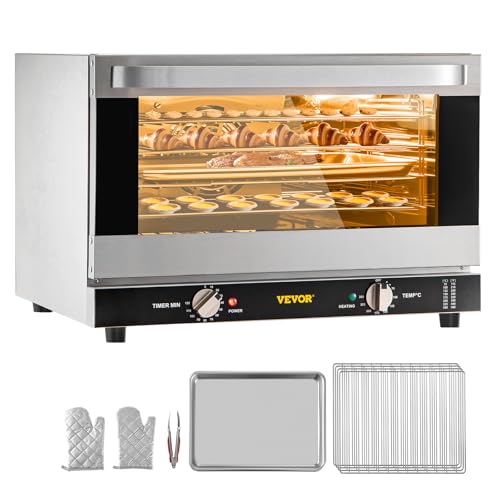
- KoolMore 23 in. Commercial Countertop Convection Oven (KM-CTCO-15) — Best for Batch Cooking
- Cuisinart Air Fryer Toaster Oven Combo (TOA-55) — Best All-Rounder
- BLACK+DECKER 8-Slice Extra Wide Convection Toaster Oven (TO3250XSBD) — Best for Families
- KoolMore 30-Inch Electric Double Wall Oven (KM-WO30D-SS) — Prose-Only — Built-In, Off-Brief
Read the full guide ↓ for the detailed reviews, the honest trade-offs behind every badge, and the checks that matter more than any headline claim.
Finding the best small countertop convection ovens is really a fit problem wearing a cooking problem’s clothes. The cooking is the easy part to compare — fans, wattage, temperature ranges — while the failures happen at home: an oven too deep for the counter, a door that swings into the walkway, a cavity that refuses your favourite pan. This guide compares six verified models on both halves of that equation.
Five of the six are genuine countertop machines, from a 0.6 cubic foot all-rounder to a commercial half-size-pan oven. The sixth is a built-in double wall oven that arrived in the verified pool; it is reviewed honestly and covered prose-only, because no amount of specification makes a wall oven a countertop appliance. Prices are not printed — they change too often to be useful — so linked picks lead to the live listing to check the latest price on Amazon.
One boundary before the reviews: this guide is research-led. It is built from verified product data, maker specifications and accumulated owner experience reported for these models — not from invented hands-on claims. Where a model has a real limitation, the review says so plainly. If you are comparing neighbouring searches while you decide, the discussion in Best Small Convection Ovens For Bakers covers closely related ground, and Best Small Microwave Convection Ovens is worth reading alongside this guide.
Key Takeaways
- Fit decides first: measure counter depth, door swing and your largest pan before falling for any specification.
- The Cuisinart TOA-55’s 0.6 cu. ft. cavity and 12-inch pizza fit make it the balanced default for most small kitchens.
- The Breville is the premium depth pick; the KoolMore commercial oven is the batch-throughput pick.
- One pool model is a built-in wall oven and is covered prose-only — it cannot sit on a counter.
- Convection rewards spacing and rotation: technique closes most of the gap between good and great results.
In this guide
Quick Picks
These are the six picks for best small countertop convection ovens at a glance. The badge each model carries here is the same badge used in its detailed review below, so you can jump straight to the full review of any model that catches your eye.
| Pick | Badge | Best for |
|---|---|---|
| Emeril Lagasse 26QT French Door Air Fryer Toaster Oven | Best Overall | Most small kitchens wanting one capable countertop oven |
| Breville Smart Oven Air Fryer Pro (BOV900BSS) | Best Premium Pick | Cooks who want the deepest function set on the counter |
| KoolMore 23 in. Commercial Countertop Convection Oven (KM-CTCO-15) | Best for Batch Cooking | Meal-preppers and small bakeries working in half-size pans |
| Cuisinart Air Fryer Toaster Oven Combo (TOA-55) | Best All-Rounder | Households wanting the balanced mid-size default |
| BLACK+DECKER 8-Slice Extra Wide Convection Toaster Oven (TO3250XSBD) | Best for Families | Families whose toast and pizza runs are wide |
| KoolMore 30-Inch Electric Double Wall Oven (KM-WO30D-SS) | Prose-Only — Built-In, Off-Brief | Renovators researching a built-in double oven |
Badges are judgements, not decorations: each one is defended in the detailed review, including the trade-offs that come with it. If two picks share your shortlist, the comparison table further down lines their formats and key specifications up side by side.
How These Picks Were Chosen
Every model in this guide comes from a verified pick pool checked against Amazon’s catalogue data, so the names, configurations and images you see here correspond to real, current listings. That verification step matters more than it sounds: oven line-ups change constantly, model names repeat across years and formats, and a guide is only useful if the machine it describes is the machine you can actually buy.
The ranking weighs countertop fit first — footprint against real counters, cavity against real pans — then convection performance, control style and cleaning burden, alongside the everyday fundamentals: cavity size against the pans and meals a household actually cooks, temperature range and control style, how much cleaning the machine asks for, and whether its extra modes map onto food people make weekly. Features that sound impressive but rarely get used were given little weight. Badges were assigned after the ranking, to describe each model’s genuine centre of gravity.
For a small countertop brief, the review question is double: does the oven cook well, and does it live well in a small kitchen. A model can ace the first and fail the second, so footprint, door behaviour and storage reality are scored alongside the cooking, and the one built-in wall oven in the pool is covered prose-only rather than dressed up as a countertop option.
One pick format note, stated once for the whole guide: where a verified model does not match the core brief of this keyword, it is covered prose-only — reviewed in full, with no Amazon link and no image — and the reason is given in its review and in the sources file that accompanies this article. That policy keeps every link in this guide an honest one.
Best small countertop convection ovens
Six verified models, reviewed in ranking order. Each review covers what the machine is, where it shines, where it honestly falls short, and who should buy it — with the specifications the verified listing itself states, and nothing invented beyond them.
Emeril Lagasse 26QT French Door Air Fryer Toaster Oven
Badge: Best Overall
Strengths
- French doors open with one hand and keep the hot door out of your way
- 24 presets cover the everyday countertop repertoire without menu digging
- Six included accessories mean it cooks on day one
Trade-offs
- 26 quarts is the large end of countertop — measure depth and door swing
- Preset-led controls reward readers of the manual more than dial-and-go cooks
- Air fryer and toaster oven in one body means one cavity doing two jobs sequentially
Key specifications (from the verified listing)
- Capacity: 26 quarts (from listing title)
- 24 one-touch preset options
- French door design
- Six cooking accessories included
- Extra-large interior
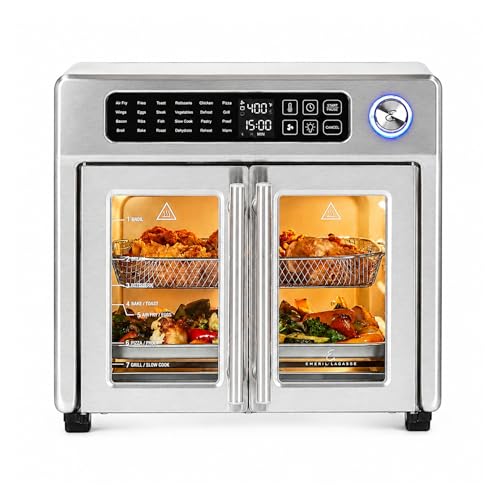
The Emeril Lagasse 26QT is built around its French doors: both open together from a single pull, so a tray slides in without the juggling act a drop-down door demands, and nothing hot swings toward your wrist. Inside, the 26-quart cavity and 24 one-touch presets aim it squarely at family-size countertop work — sheet-pan dinners, frozen favourites and reheats that a small toaster oven would queue through in batches. The six included accessories underline that ambition. Its honest cost is footprint and ceremony: this is a large appliance that asks to be learned, and in a genuinely small kitchen it will dominate the counter it sits on. Judged as a countertop convection oven rather than a compact one, it is a coherent, generous machine.
Best for: Most small kitchens wanting one capable countertop oven / Not suited for: Counters with very limited depth
Check on Amazon to see the current listing for the Emeril Lagasse 26QT French Door Air Fryer Toaster Oven, confirm the configuration, and check the latest price on Amazon.
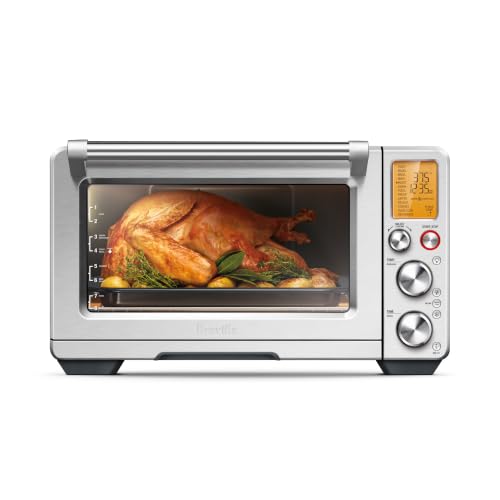
Breville Smart Oven Air Fryer Pro (BOV900BSS)
Badge: Best Premium Pick
Strengths
- 13 functions make it the most versatile countertop pick in this pool
- Convection and air fry modes cover both gentle baking and crisping
- Breville’s oven line is the reference point rivals are measured against
Trade-offs
- Premium-tier positioning within the countertop class
- Feature depth means a learning curve before it feels automatic
- Large countertop footprint for its class
Key specifications (from the verified listing)
- 13 cooking functions (from listing title)
- Convection setting stated to reduce cook time by up to 30%
- Functions include roast, bake and dehydrate
- Finish: brushed stainless steel
- Model: BOV900BSS
The Breville Smart Oven Air Fryer Pro is the overachiever of the countertop class: 13 functions spanning roast, bake, dehydrate and air fry, with a convection setting the listing credits with cutting cook time by up to 30 percent. That breadth is not padding — dehydrate and slow, gentle modes are exactly what separates a true second oven from a toast box. The brushed stainless build suits kitchens where the oven stays out permanently, which it will, because its size argues against cupboard storage. The trade-offs are price-tier positioning and complexity: owners who only toast will pay for depth they never open. For cooks who genuinely use a countertop oven as an oven, it is the benchmark in this guide.
Best for: Cooks who want the deepest function set on the counter / Not suited for: Toast-only households that will never open the extra modes
Check on Amazon to see the current listing for the Breville Smart Oven Air Fryer Pro (BOV900BSS), confirm the configuration, and check the latest price on Amazon.

KoolMore 23 in. Commercial Countertop Convection Oven (KM-CTCO-15)
Badge: Best for Batch Cooking
Strengths
- Half-size pan compatibility plugs straight into bakery and cafe workflows
- Four racks multiply batch capacity in one cavity
- ETL listing and stainless build suit commercial duty
Trade-offs
- Commercial priorities: utility first, home-kitchen styling second
- 1600W and a 23-inch body need a serious stretch of counter
- No home-style preset or air fry programme is stated
Key specifications (from the verified listing)
- Size: 23 in. commercial countertop format (from listing title)
- Takes half-size pans
- 4 racks
- Power: 1600W
- Stainless steel; ETL listed for safety and sanitation
- Model: KM-CTCO-15
The KoolMore KM-CTCO-15 is a working oven, not a lifestyle one: a 23-inch stainless commercial countertop convection oven built around half-size pans, four racks and 1600 watts, ETL listed for safety and sanitation. In a bakery, cafe or serious home-production kitchen, that specification is the whole argument — standard pans, stacked batches, a cavity that wipes down and goes again. At home it reads differently: the same capacity that thrills a meal-prepper overwhelms a toast-and-reheat household, and the listing promises no domestic comforts like air fry presets. Buy it for throughput and pan standardisation, and it is the most purposeful machine in this guide. Buy it for ordinary family dinners and it is more oven than the job wants.
Best for: Meal-preppers and small bakeries working in half-size pans / Not suited for: Casual home cooks wanting presets and air fry programmes
Check on Amazon to see the current listing for the KoolMore 23 in. Commercial Countertop Convection Oven (KM-CTCO-15), confirm the configuration, and check the latest price on Amazon.

Cuisinart Air Fryer Toaster Oven Combo (TOA-55)
Badge: Best All-Rounder
Strengths
- 0.6 cu. ft. cavity fits a 12-inch pizza — the size test most households actually run
- 1800W and 450°F ceiling give it real searing headroom
- Removable crumb tray makes the daily clean a ten-second job
Trade-offs
- Air fryer baskets and trays need hand-washing attention to stay non-stick friendly
- 0.6 cu. ft. is mid-size: big for toast, small for a full sheet pan
- Dial-style class controls trade precision for simplicity
Key specifications (from the verified listing)
- Capacity: 0.6 cu. ft. (from listing title)
- 7-in-1 functions
- Power: 1800W
- Maximum temperature 450°F
- Fits a 12-inch pizza
- Removable crumb tray
- Model: TOA-55
The Cuisinart TOA-55 lands in the countertop sweet spot: 0.6 cubic feet that swallows a 12-inch pizza, 1800 watts, a 450°F ceiling and seven functions with air frying at the centre. That combination covers the real weekly repertoire — pizza night, roasted vegetables, reheated leftovers that come back crisp instead of sad — without the footprint drama of the extra-large models. The removable crumb tray is a small feature with daily consequences: crumbs leave the oven instead of carbonising in it. Its limits are the class limits — one cavity, one dish at a time, and accessories that want gentle washing. As a single countertop oven for a small-to-mid household, its balance of size, power and simplicity is the easiest to defend in this guide.
Best for: Households wanting the balanced mid-size default / Not suited for: Competition bakers needing a full sheet pan
Check on Amazon to see the current listing for the Cuisinart Air Fryer Toaster Oven Combo (TOA-55), confirm the configuration, and check the latest price on Amazon.

BLACK+DECKER 8-Slice Extra Wide Convection Toaster Oven (TO3250XSBD)
Badge: Best for Families
Strengths
- Extra-wide cavity takes family-size toast runs and wide dishes
- Included bake pan, broil rack and toasting rack cover the core jobs
- Straightforward controls suit shared and multi-generational kitchens
Trade-offs
- Wide body claims a long run of counter
- Feature set is deliberately basic next to the preset-led rivals
- Toaster-oven class temperature finesse, not precision-oven control
Key specifications (from the verified listing)
- Capacity: 8 slices (from listing title)
- Extra-wide interior
- Convection cooking
- Includes bake pan, broil rack and toasting rack
- Finish: stainless steel and black
- Model: TO3250XSBD
The BLACK+DECKER TO3250XSBD is the width pick: an extra-wide 8-slice convection toaster oven that treats countertop cooking as a family-logistics problem. Eight slices at once ends the toast queue; the wide cavity takes the casserole and pizza shapes narrower ovens refuse; and the included bake pan, broil rack and toasting rack mean the three core jobs work out of the box. Convection keeps the wide cavity honest, moving air so the edges do not lag the centre. What it does not offer is finesse — no preset library, no air fry branding, no precision theatre. Households that cook family quantities of simple food will find that trade exactly right, and its controls are the ones guests and teenagers operate without instruction.
Best for: Families whose toast and pizza runs are wide / Not suited for: Precision bakers wanting tight temperature theatre
Check on Amazon to see the current listing for the BLACK+DECKER 8-Slice Extra Wide Convection Toaster Oven (TO3250XSBD), confirm the configuration, and check the latest price on Amazon.
KoolMore 30-Inch Electric Double Wall Oven (KM-WO30D-SS)
Badge: Prose-Only — Built-In, Off-Brief
Coverage note: This pick is covered prose-only because its verified listing describes a 30-inch built-in double wall oven that must be installed into cabinetry — it is not a countertop appliance and cannot honestly be linked in a guide whose brief is small countertop convection ovens. It is reviewed in full so wall-oven shoppers can judge it, with no Amazon link and no image.
Strengths
- Two full cavities cook dinner and dessert at different temperatures simultaneously
- Self-cleaning removes the worst oven chore
- Built-in format frees the entire counter
Trade-offs
- It is a built-in wall oven: it needs a cabinet cut-out, hardwired installation and a renovation-scale decision
- Nothing about it is countertop, portable or small-kitchen friendly
- Double capacity is wasted on households that rarely cook two dishes at once
Key specifications (from the verified listing)
- Size: 30-inch built-in double wall oven (from listing title)
- 7 cook and baking modes
- Dual large-capacity ovens
- Convection cooking in both cavities
- Self-cleaning
- Model: KM-WO30D-SS
The KoolMore KM-WO30D-SS is a 30-inch built-in double wall oven: two large cavities, seven cook and baking modes, convection in the spec and a self-cleaning cycle, in stainless steel. As a wall oven proposition it is straightforward and capable — holiday cooking, two-temperature dinners and a permanently clear counter are its natural territory. But its format is the opposite of a countertop appliance: it is installed into cabinetry, hardwired, and chosen during a kitchen project rather than carried home for tonight’s dinner. It is reviewed here in full because the verified pool contains it, and covered prose-only in countertop and toaster-oven guides because linking it as a countertop pick would misdescribe both the product and the brief.
Best for: Renovators researching a built-in double oven / Not suited for: Anyone shopping for a countertop appliance
Comparison Table
The six picks side by side, in the formats their verified listings state. Use this table to shortlist, then read the full reviews of your finalists — the trade-offs that decide ownership rarely fit in a table cell.
| Pick | Format | Badge |
|---|---|---|
| Emeril Lagasse 26QT French Door Air Fryer Toaster Oven | 26-quart countertop convection air fryer toaster oven with French doors | Best Overall |
| Breville Smart Oven Air Fryer Pro (BOV900BSS) | countertop smart oven with 13 functions and convection | Best Premium Pick |
| KoolMore 23 in. Commercial Countertop Convection Oven (KM-CTCO-15) | 23-inch commercial countertop convection oven for half-size pans | Best for Batch Cooking |
| Cuisinart Air Fryer Toaster Oven Combo (TOA-55) | 0.6 cu. ft. countertop air fryer toaster oven, 7-in-1 | Best All-Rounder |
| BLACK+DECKER 8-Slice Extra Wide Convection Toaster Oven (TO3250XSBD) | 8-slice extra-wide countertop convection toaster oven | Best for Families |
| KoolMore 30-Inch Electric Double Wall Oven (KM-WO30D-SS) | 30-inch built-in electric double wall oven with convection | Prose-Only — Built-In, Off-Brief |
How to Choose the Right Convection Oven
Start with the tape measure, not the feature list. Record your counter’s depth, the clearance under upper cabinets, and where the oven’s door will swing or its French doors will open. Then measure your two most-used pans. Those four numbers eliminate more wrong ovens than any review can, and they are the numbers manufacturers’ quart and cubic-foot figures only approximate.
Next, match the cavity to your week. A household reheating, toasting and cooking for two lives happily in a mid-size cavity that preheats quickly. A batch cook or home baker should look at the wide and commercial patterns in this guide and accept their footprints knowingly. Capacity you use weekly is a feature; capacity you use twice a year is a counter tax.
Finally, choose controls for your tired self. Preset libraries help cooks who use them; dials help everyone else. Decide after fit and capacity, and let it break ties rather than lead the search.
Within this guide’s linked picks, the shortlist logic is simple: the Cuisinart for balance, the Breville for depth, the BLACK+DECKER for width, the Emeril for door ergonomics and family volume, and the KoolMore commercial oven only when half-size pans and batches are genuinely your routine. Readers working through adjacent briefs will also find the comparison in Best Small Toasrer Convection Ovens useful, and Best Small Toaster Convection Ovens covers the neighbouring case in the same spirit.
How to Set Up and Run a Countertop Convection Oven Well
A countertop convection oven rewards a deliberate first week. This setup routine gets any of the countertop picks in this guide cooking at their best.
- Place the oven with the manual’s clearances on every side, on a level, heat-stable surface, away from the sink’s splash zone.
- Run one empty heat cycle as the manual directs to clear manufacturing residues before the first food goes in.
- Calibrate with a familiar dish — roast vegetables or a frozen pizza — and note the time and temperature adjustment your cavity needs versus your old oven.
- Stock the right pans: a rimmed sheet that fits with airflow space, and the included racks and trays washed and ready.
- Build the habits early: single layers for crisping, tray rotation for long bakes, and a warm wipe-down after fatty cooking.
- Keep the crumb tray on a weekly rhythm so yesterday’s debris never becomes this week’s smoke.
Troubleshooting.
Problem: Food browns on top but stays pale underneath → the tray is likely too high or the pan is insulating the base. Move down a rack, preheat the tray for sturdy items, and give the fan a few minutes after loading before judging colour.
Problem: One side of the tray cooks faster than the other → rotate the tray halfway through. Even good convection has gentle gradients, and rotation is the four-second habit that erases them.
Problem: The oven smokes during high-heat cooking → fat from a previous session is usually the fuel. Let the oven cool, wipe the interior and tray, and use a rimmed pan for fatty items so drips stay contained.
What ‘Small’ Should Mean in a Countertop Oven
‘Small’ in this category is a relationship, not a number. An oven is small when it leaves the counter usable — when the kettle, the board and the cookbooks keep their places and the oven earns its footprint daily. A 26-quart oven can be small in a generous kitchen and enormous in a galley, which is why this guide scores footprint against your counter rather than against an abstract scale.
The second half of ‘small’ is cavity honesty. Exterior compactness paired with a cavity that refuses standard pans is the worst trade in the category. The picks above were judged on the pans they accept — a 12-inch pizza, an 8-slice toast run, a half-size sheet — because those are the units real kitchens think in.
If your kitchen is genuinely tight, prioritise door design as well as dimensions. French doors and short drop-down doors behave very differently in a narrow galley, and the door is the part of the oven you negotiate with every single day.
Countertop Oven or Full-Size Oven: Dividing the Week
Households that add a countertop convection oven rarely stop using the main oven — they reassign it. The countertop takes the daily work: reheats, toast, weeknight trays, small bakes. The range keeps the holiday bird, the double batch and the oversized Dutch oven. That division is where the countertop oven repays its counter space, in preheat minutes saved every single day.
The division fails when the countertop oven is asked to be the main oven in disguise. If your week regularly involves two large dishes at once or pans beyond its cavity, the honest answer is a bigger primary oven, not a heroic countertop one — which is the context in which the prose-only wall oven in this guide belongs.
A useful test before buying: list last week’s oven jobs and mark which the countertop candidates could have handled. If the mark covers most of the week, the purchase will feel obvious within a month. If it covers a third, keep your counter clear and your money.
Living With a Convection Oven, Day to Day
Convection cooking is, at heart, air management. A fan moves hot air across food so surfaces dry and brown evenly instead of sitting in the still, stratified air of a conventional cavity. That is why convection ovens reward spacing: trays crowded edge to edge block the very airflow the fan exists to create, and the centre items steam while the edges crisp. Leave a finger’s width around pans and the technology does what it promises.
Temperature adjustment is the first skill convection asks of you. Recipes written for conventional ovens generally translate with a modest reduction in temperature or time, because moving air transfers heat more efficiently. Rather than memorising conversions, run your three most-cooked dishes once with a notebook nearby: the adjustments your oven actually needs will be smaller and more specific than any chart, and they will be yours.
Rack position still matters in a fan oven. The fan evens the cavity far better than a conventional oven manages, but the element positions and the door zone still create gentle gradients. Middle racks remain the default for baking; rotating a tray halfway through a long bake is cheap insurance that costs four seconds and saves the occasional lopsided batch.
Preheating discipline separates good convection results from erratic ones. A fan can circulate lukewarm air very evenly, which is not the same as cooking. Wait for the oven to signal readiness, especially for pastry and anything whose rise depends on an early burst of heat, and resist loading early because the first five minutes looked close enough.
The crumb tray and interior walls tell you how an oven will age. Grease that is wiped while the cavity is merely warm lifts easily; grease baked through fifty cycles becomes part of the finish. A two-minute wipe after roasting, once the oven is safe to touch, is the entire maintenance secret of owners whose five-year-old ovens still look new.
Glass doors are a cooking tool, not a styling choice. Every door opening dumps the hot air the fan has organised, and the cavity spends minutes rebuilding it. Watching through glass — checking colour, rise and bubbling without opening — protects exactly the consistency convection was bought for, and it is why a clear, well-lit window matters more than another preset.
Sheet-pan sizing is the quiet specification of countertop ovens. Manufacturers quote quarts and cubic feet, but your life is lived in pans: the quarter sheet, the 9-by-13, the pizza. Measure the pans you actually own and compare them with the cavity before buying, because an oven that fits your pans will be used daily and one that almost fits them will be resented weekly.
Air fry modes in oven form are convection with intent: higher fan speeds and top heat aimed at crisping. They excel at frozen foods, wings and vegetables, and they do it in batches a basket fryer would queue through. The technique that matters is a single layer with space around each piece — the same airflow rule as all convection, enforced more strictly because crisping is the entire point.
Related reading while you narrow the shortlist: Best Self Cleaning Convection Double Ovens takes the neighbouring question in depth, and Best Selling Mini Convection Ovens is the companion comparison for this cluster.
Broiling in a small cavity is a proximity skill. The element is close, the food is closer, and the distance between golden and burnt is measured in moments. Use the rack position the maker recommends, keep the door behaviour the manual specifies, and never walk away: broiling rewards attention and punishes optimism in roughly equal measure.
A temperature probe changes roasting from estimation to knowledge. Thick proteins carry over as they rest, and a probe lets you pull them at the temperature that accounts for that rise instead of discovering doneness at the carving board. If a pick in this guide offers a probe, it is the feature most likely to change your results rather than merely your routine.
Cleaning a convection oven well is mostly about the fan’s neighbourhood. Baked-on splatter near the fan cover eventually perfumes everything the oven cooks. Follow the maker’s guidance for your model, keep harsh methods away from coatings and sensors, and treat a self-cleaning cycle — where fitted — as the heavy tool it is: ventilate, remove racks as directed, and let it finish.
Energy thinking favours the right-sized cavity. Heating a large oven for two slices of toast wastes little in absolute terms but does it daily; heating a countertop oven for a full family dinner it cannot fit wastes the whole meal’s timing. The efficient kitchen is not the one with the smallest oven — it is the one whose oven sizes match its actual meals, which is why this guide keeps returning to fit.
Two-cavity cooking, where a double oven is in play, is a scheduling skill. The art is pairing dishes whose temperatures can compromise in one cavity while the other runs exact — the roast resting while the gratin finishes, the dessert baking gently below the main event. Households that master that pairing find a double oven transformative; households that never cook two things at once find it an expensive cupboard.
True convection deserves its name to be understood. In a standard convection oven the fan circulates air heated by the usual elements; in a true convection design a third element around the fan heats the air as it moves, tightening temperature consistency across racks. Multi-rack bakers feel the difference in edge-to-centre evenness; single-tray cooks may never notice it. Buy the specification your baking actually exercises.
Steam, where an oven offers it, is moisture as an ingredient. A humid cavity keeps bread crusts supple long enough to expand before they set, reheats leftovers without desiccating them, and roasts gently in a way dry heat cannot imitate. It also adds a routine — water to fill, a reservoir to empty and dry — and the honest question is whether your cooking uses moisture weekly or merely admires it in the brochure.
Controls shape ownership more than specifications do. A dial you can set with wet hands, a display you can read across the room, a timer that announces itself clearly — these decide whether an oven is a pleasure on a tired Tuesday. When two picks in this guide match on cooking merit, choose the controls your household will operate half-asleep, because that is when they will mostly be operated.
Placement is a safety specification. Countertop ovens radiate heat from their tops and sides and vent steam toward whatever is above them. The clearances in the manual are not legal padding; they protect cabinets, walls and the oven’s own electronics. Measure the alcove, respect the gaps, and never let a tea towel live on top of a working oven.
The first week with a new oven should be a calibration week. Cook the familiar dishes — the roast vegetables, the frozen pizza, the tray of cookies whose behaviour you know — and note what the new cavity does differently. Every oven has a personality measured in small offsets; learning yours deliberately in week one prevents a year of vaguely disappointing versions of dishes you used to nail.
Accessories deserve the same scrutiny as the oven. The included racks, trays and baskets define what the machine does on day one, and proprietary sizes can make replacements a hunt. Check what is in the box, whether standard pans fit alongside, and how each piece is meant to be washed. An oven is a system, and the tray you hate cleaning will quietly decide which functions you stop using.
Noise is a real, if minor, specification. Convection means a fan, and fans are audible — more in a quiet open-plan home at dawn than in a busy family kitchen at six. No oven in this guide is silent, and none is a jet engine; the practical step is placing any countertop model on a stable, level surface, because a rattling tray amplifies a modest fan into a household complaint.
Finally, buy the oven for the meals on your actual calendar. Count a fortnight honestly: how many roasts, bakes, reheats, frozen shortcuts and two-dish dinners really happened. The right oven is the one whose size, modes and controls match that fortnight — not the aspirational one, and not the minimal one. Every review in this guide was written against real routines for exactly that reason.
Frozen food is convection’s home turf. Moving air strips the cold boundary layer off frozen items continuously, so fries, nuggets, pastries and pizzas cook evenly without the soggy underside that still air produces. The technique is unchanged — single layer, space around each piece, a preheated tray for anything that wants a crisp base — but frozen food is where new owners notice the fan’s value first.
Reheating is the second revelation. Yesterday’s roast chicken, rice dishes in shallow layers, and baked pasta all return to the table in better condition from a convection oven than from a microwave, because dry heat re-crisps surfaces while it warms. The cost is minutes; the gain is that leftovers taste cooked rather than revived, which quietly changes how much food a household wastes.
Baking pastry in moving air asks for one adjustment: vigilance at the edges. Laminated doughs and pale biscuits colour faster at exposed corners, and a pale foil shield or a small temperature reduction for the final minutes protects them. Once that habit forms, pastry from a good convection cavity — flaky, evenly risen, uniformly golden — is the result owners show off.
Dehydrating, where a low temperature range allows it, is the slow art of the category. Herbs, fruit leathers, chillies and jerky all reward the fan’s patience: moving air at gentle heat removes moisture evenly without cooking. Ovens whose range reaches genuinely low temperatures open this whole second pantry; ovens that start too hot simply cannot play, which is why the bottom of the temperature range deserves as much attention as the top.
Proofing dough is the gentlest use of a warm cavity. A low, stable warmth — or simply the residual heat after a short preheat, switched off — gives dough the sheltered rise a draughty kitchen denies it. Bakers who discover their oven proofs as well as it bakes tend to bake more often, because the two slowest steps of bread both move indoors.
Keeping food warm is a host’s quiet superpower, and convection ovens do it without continuing to cook aggressively. The lowest settings hold a finished dish at serving temperature while the rest of the meal catches up — the exact scheduling gap that makes home entertaining stressful. Used this way, the oven is not cooking at all; it is buying you twenty calm minutes.
Roasting vegetables teaches convection faster than any other dish. Cubes of root vegetable in a single layer, oiled and salted, emerge with caramelised edges and tender centres in a way still air rarely matches, because the fan keeps surfaces dry enough to brown. Crowd the tray and the same vegetables steam — the single most instructive mistake in the category, and the cheapest to fix.
Whole proteins reward a rest as much as a roast. Convection’s efficient heat means carryover cooking is real: a chicken or joint pulled at temperature will climb several degrees as it rests under foil. Owners who plan the rest into the timing serve juicier meat than owners who cook to the number and carve immediately, whatever oven they own.
Toasting nuts and seeds is a two-minute job that convection does beautifully and dangerously: beautifully because the moving air toasts evenly, dangerously because the distance from golden to burnt is under a minute. Stay in the room, use the window, and pull the tray early — residual heat on the hot tray finishes the job on the counter.
A second tray changes the maths of weeknight cooking. Where the cavity and the system allow two levels — and true convection most of all — protein above and vegetables below finish together, and the oven stops being a queue. Even in single-tray ovens, choosing dishes that share a temperature is the same skill in miniature: plan the oven’s load the way you plan the hob’s burners.
Glass and ceramic dishes behave differently from metal in moving air. Metal heats fast and browns bases; glass and ceramic heat gently and hold heat at the table. Neither is wrong — but a casserole that scorched in metal may be perfect in ceramic, and a pie that stayed pale in glass may want metal. Matching the vessel to the dish is the advanced class of oven cooking, and it costs nothing to learn.
Oven thermometers tell the truth dials approximate. Even good ovens run a few degrees from their displays, and the offset often differs between the top and bottom of the range. A single calibration check with a familiar dish — or a thermometer if you own one — converts guesswork into a note in your notebook: this oven, this setting, this result. Every pick in this guide rewards that one experiment.
The door seal is the unsung specification. A worn or dirty seal leaks the hot air the fan works to organise, lengthening cooks and unevening results. Wipe seals gently, keep them free of baked-on debris, and close doors with intention rather than momentum. It is unglamorous maintenance with a direct line to everything the oven is for.
Seasonal cooking changes what an oven is for. Winter wants long roasts and baked roots; summer wants the countertop oven precisely because it does not heat the whole kitchen the way a full-size cavity does. Households in warm climates often find the small oven becomes the default nine months a year — one more reason fit and daily-job matching outrank occasional capacity in every recommendation this guide makes.
Common Buying Mistakes
Countertop oven disappointment is almost always a fit mistake made before the cooking ever started.
- Buying on quarts or cubic feet alone, without checking whether your own pans physically fit the cavity.
- Treating every preset and mode as value, when your real week uses three of them.
- Ignoring door swing, venting and clearance, then discovering the oven cannot live where you planned.
- Assuming a bigger cavity is automatically better, when a right-sized oven preheats faster and suits daily meals.
- Skipping the manual’s convection conversion guidance and judging the oven by one under-adjusted first bake.
Final Recommendation
For most readers, start with the Emeril Lagasse 26QT French Door Air Fryer Toaster Oven: it carries its badge because its format, controls and specification suit the widest range of readers chasing best small countertop convection ovens. You can Check on Amazon for its current listing. If your routine leans toward the strengths of another pick instead, the Breville Smart Oven Air Fryer Pro (BOV900BSS) is the alternative we would buy in that situation — Check on Amazon for that listing too. Compare your finalists against your pan sizes and your weekly meals, and choose the one whose trade-offs you mind least. That comparison, honestly made, is the whole decision.
If your counter is truly small, let the tape measure veto before the heart decides: the balanced Cuisinart pattern is the default for a reason, and every larger pick in this guide should have to argue its way onto a tight counter with batches you genuinely cook.
Frequently Asked Questions
What size countertop convection oven suits a small kitchen?
The one that fits your counter with the manual’s clearances and accepts your most-used pans. In this guide, the 0.6 cu. ft. Cuisinart pattern is the balanced reference; measure pans, not just quarts.
Why is one pick in this guide not linked?
The KoolMore KM-WO30D-SS is a built-in double wall oven, not a countertop appliance, so it is covered prose-only: reviewed accurately, with no link and no image.
Do countertop convection ovens cook faster than regular ovens?
Moving air transfers heat more efficiently, so many dishes finish sooner or at a slightly lower temperature. Your first week should be a calibration week with familiar dishes.
Can a countertop oven replace my main oven?
For daily reheats, toast and small-to-mid meals, often yes. For large birds, double batches and oversized pans, the main oven keeps its job — the two divide the week rather than compete.
What pan should I check first before buying?
Your most-used one. A 12-inch pizza fit and an 8-slice toast capacity are the reference tests in this guide; your own sheet pan is the third.
How do I stop one side cooking faster than the other?
Rotate the tray halfway through longer cooks, keep single layers for crisping, and leave airflow space around pans so the fan can do its work.