Disclosure: topratedkitchenware.com is reader-supported. When you buy through links on our site, we may earn an affiliate commission from Amazon and other retailers, at no extra cost to you.
Where to buy
The picks below are the verified models for this guide to best small toaster convection ovens. Linked names lead to their Amazon listings, where you can check the latest price on Amazon, confirm the exact configuration, and read current owner feedback. Start with the first pick if you want the shortest route: Check on Amazon for the VEVOR Commercial Convection Oven 66L (Half-Size).
- VEVOR Commercial Convection Oven 66L (Half-Size) — Best for Batch Cooking
- Emeril Lagasse 26QT French Door Air Fryer Toaster Oven — Best Overall
- Cuisinart Air Fryer Toaster Oven Combo (TOA-55) — Best All-Rounder
- BLACK+DECKER 8-Slice Extra Wide Convection Toaster Oven (TO3250XSBD) — Best for Families
- Nuwave Bravo XL Pro Air Fryer Toaster Oven — Most Presets
- KoolMore 30-Inch Electric Double Wall Oven (KM-WO30D-SS) — Prose-Only — Built-In, Off-Brief
Read the full guide ↓ for the detailed reviews, the honest trade-offs behind every badge, and the checks that matter more than any headline claim.
The best small toaster convection ovens earn the word small twice: small on the counter, and small in the demands they make on a routine. This guide compares six verified models against that double test — five countertop machines that toast, bake and roast in compact cavities, and one built-in double wall oven from the pool that is reviewed honestly and covered prose-only, because it is neither small nor a toaster oven.
The countertop five span the useful range of the category: a 66-litre commercial tiered oven for batch cooks, French-door family volume, a balanced 0.6 cubic foot all-rounder, an extra-wide 8-slice family machine, and a 30-quart preset-and-probe flagship. Prices are not printed — they move too often — so linked picks lead to the live listing to check the latest price on Amazon.
One boundary before the reviews: this guide is research-led. It is built from verified product data, maker specifications and accumulated owner experience reported for these models — not from invented hands-on claims. Where a model has a real limitation, the review says so plainly. If you are comparing neighbouring searches while you decide, the discussion in Best Small Convection Ovens For Bakers covers closely related ground, and Best Small Countertop Convection Ovens is worth reading alongside this guide.
Key Takeaways
- Five picks are genuine small countertop toaster convection ovens; the built-in double wall oven is prose-only.
- The Cuisinart TOA-55 is the size-balanced default; the BLACK+DECKER is the width pick for family toast runs.
- The VEVOR 66L breaks the ‘small’ rule productively — it is the batch and micro-bakery outlier, bought knowingly.
- Door design is a small-kitchen feature: French doors and compact swings matter in galleys.
- Judge small ovens by the pans and pizzas they fit, not by quart figures alone.
In this guide
Quick Picks
These are the six picks for best small toaster convection ovens at a glance. The badge each model carries here is the same badge used in its detailed review below, so you can jump straight to the full review of any model that catches your eye.
| Pick | Badge | Best for |
|---|---|---|
| VEVOR Commercial Convection Oven 66L (Half-Size) | Best for Batch Cooking | Small bakeries and batch cooks working in tiers |
| Emeril Lagasse 26QT French Door Air Fryer Toaster Oven | Best Overall | Family kitchens wanting French-door ease and volume |
| Cuisinart Air Fryer Toaster Oven Combo (TOA-55) | Best All-Rounder | Households wanting the balanced mid-size default |
| BLACK+DECKER 8-Slice Extra Wide Convection Toaster Oven (TO3250XSBD) | Best for Families | Families whose toast and pizza runs are wide |
| Nuwave Bravo XL Pro Air Fryer Toaster Oven | Most Presets | Cooks who want probe cooking and a huge preset library |
| KoolMore 30-Inch Electric Double Wall Oven (KM-WO30D-SS) | Prose-Only — Built-In, Off-Brief | Renovators researching a built-in double oven |
Badges are judgements, not decorations: each one is defended in the detailed review, including the trade-offs that come with it. If two picks share your shortlist, the comparison table further down lines their formats and key specifications up side by side.
How These Picks Were Chosen
Every model in this guide comes from a verified pick pool checked against Amazon’s catalogue data, so the names, configurations and images you see here correspond to real, current listings. That verification step matters more than it sounds: oven line-ups change constantly, model names repeat across years and formats, and a guide is only useful if the machine it describes is the machine you can actually buy.
The ranking weighs small-format fit first — footprint, cavity against household pans, toast capacity — then convection performance and cleaning burden, alongside the everyday fundamentals: cavity size against the pans and meals a household actually cooks, temperature range and control style, how much cleaning the machine asks for, and whether its extra modes map onto food people make weekly. Features that sound impressive but rarely get used were given little weight. Badges were assigned after the ranking, to describe each model’s genuine centre of gravity.
For a small toaster convection brief, size discipline is the scoring rule: models are judged on how completely they serve a small kitchen’s daily jobs, and the pool’s one built-in double wall oven — the opposite of small and of countertop — is covered prose-only rather than allowed to blur the category.
One pick format note, stated once for the whole guide: where a verified model does not match the core brief of this keyword, it is covered prose-only — reviewed in full, with no Amazon link and no image — and the reason is given in its review and in the sources file that accompanies this article. That policy keeps every link in this guide an honest one.
Best small toaster convection ovens
Six verified models, reviewed in ranking order. Each review covers what the machine is, where it shines, where it honestly falls short, and who should buy it — with the specifications the verified listing itself states, and nothing invented beyond them.

VEVOR Commercial Convection Oven 66L (Half-Size)
Badge: Best for Batch Cooking
Strengths
- 66 litres and four tiers give the largest batch capacity in this pool
- Glass door keeps progress visible without heat loss
- Runs on a standard 120V outlet despite its commercial size
Trade-offs
- Far beyond domestic scale — this is production equipment
- Commercial styling and footprint dominate any home counter
- No home-oriented presets or air fry programme stated
Key specifications (from the verified listing)
- Capacity: 66L / 60Qt (from listing title)
- Power: 1800W
- 4-tier interior
- Front glass door
- Tray and wire racks included
- 120V, 5-15P plug
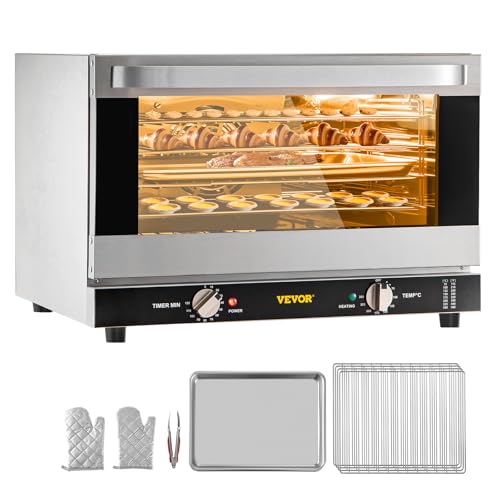
The VEVOR 66L is commercial equipment that happens to sit on a counter: 60-plus quarts across four tiers, 1800 watts, a front glass door, and trays and wire racks in the box, running from an ordinary 120V outlet. For a bakery case, a market stall or a household running genuine production batches, that tiered capacity is transformative — four levels of product moving through one cavity. In a home kitchen it is simply enormous, and its listing makes no concession to domestic routines. It earns its place in these guides as the capacity ceiling of the category: the machine that shows what countertop convection becomes when throughput is the only brief. Most households should admire it and buy smaller.
Best for: Small bakeries and batch cooks working in tiers / Not suited for: Home cooks wanting domestic presets and styling
Check on Amazon to see the current listing for the VEVOR Commercial Convection Oven 66L (Half-Size), confirm the configuration, and check the latest price on Amazon.
Emeril Lagasse 26QT French Door Air Fryer Toaster Oven
Badge: Best Overall
Strengths
- French doors open with one hand and keep the hot door out of your way
- 24 presets cover the everyday countertop repertoire without menu digging
- Six included accessories mean it cooks on day one
Trade-offs
- 26 quarts is the large end of countertop — measure depth and door swing
- Preset-led controls reward readers of the manual more than dial-and-go cooks
- Air fryer and toaster oven in one body means one cavity doing two jobs sequentially
Key specifications (from the verified listing)
- Capacity: 26 quarts (from listing title)
- 24 one-touch preset options
- French door design
- Six cooking accessories included
- Extra-large interior
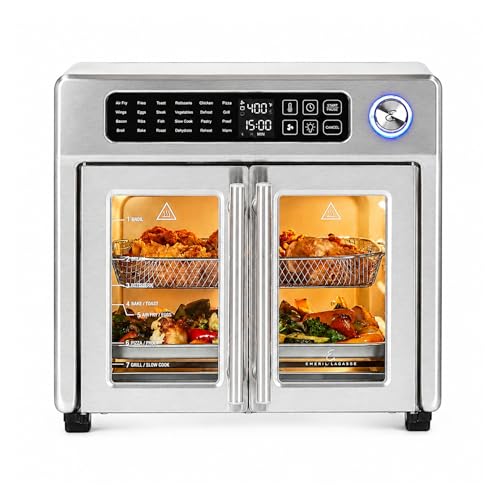
The Emeril Lagasse 26QT is built around its French doors: both open together from a single pull, so a tray slides in without the juggling act a drop-down door demands, and nothing hot swings toward your wrist. Inside, the 26-quart cavity and 24 one-touch presets aim it squarely at family-size countertop work — sheet-pan dinners, frozen favourites and reheats that a small toaster oven would queue through in batches. The six included accessories underline that ambition. Its honest cost is footprint and ceremony: this is a large appliance that asks to be learned, and in a genuinely small kitchen it will dominate the counter it sits on. Judged as a countertop convection oven rather than a compact one, it is a coherent, generous machine.
Best for: Family kitchens wanting French-door ease and volume / Not suited for: Counters with very limited depth
Check on Amazon to see the current listing for the Emeril Lagasse 26QT French Door Air Fryer Toaster Oven, confirm the configuration, and check the latest price on Amazon.

Cuisinart Air Fryer Toaster Oven Combo (TOA-55)
Badge: Best All-Rounder
Strengths
- 0.6 cu. ft. cavity fits a 12-inch pizza — the size test most households actually run
- 1800W and 450°F ceiling give it real searing headroom
- Removable crumb tray makes the daily clean a ten-second job
Trade-offs
- Air fryer baskets and trays need hand-washing attention to stay non-stick friendly
- 0.6 cu. ft. is mid-size: big for toast, small for a full sheet pan
- Dial-style class controls trade precision for simplicity
Key specifications (from the verified listing)
- Capacity: 0.6 cu. ft. (from listing title)
- 7-in-1 functions
- Power: 1800W
- Maximum temperature 450°F
- Fits a 12-inch pizza
- Removable crumb tray
- Model: TOA-55
The Cuisinart TOA-55 lands in the countertop sweet spot: 0.6 cubic feet that swallows a 12-inch pizza, 1800 watts, a 450°F ceiling and seven functions with air frying at the centre. That combination covers the real weekly repertoire — pizza night, roasted vegetables, reheated leftovers that come back crisp instead of sad — without the footprint drama of the extra-large models. The removable crumb tray is a small feature with daily consequences: crumbs leave the oven instead of carbonising in it. Its limits are the class limits — one cavity, one dish at a time, and accessories that want gentle washing. As a single countertop oven for a small-to-mid household, its balance of size, power and simplicity is the easiest to defend in this guide.
Best for: Households wanting the balanced mid-size default / Not suited for: Competition bakers needing a full sheet pan
Check on Amazon to see the current listing for the Cuisinart Air Fryer Toaster Oven Combo (TOA-55), confirm the configuration, and check the latest price on Amazon.

BLACK+DECKER 8-Slice Extra Wide Convection Toaster Oven (TO3250XSBD)
Badge: Best for Families
Strengths
- Extra-wide cavity takes family-size toast runs and wide dishes
- Included bake pan, broil rack and toasting rack cover the core jobs
- Straightforward controls suit shared and multi-generational kitchens
Trade-offs
- Wide body claims a long run of counter
- Feature set is deliberately basic next to the preset-led rivals
- Toaster-oven class temperature finesse, not precision-oven control
Key specifications (from the verified listing)
- Capacity: 8 slices (from listing title)
- Extra-wide interior
- Convection cooking
- Includes bake pan, broil rack and toasting rack
- Finish: stainless steel and black
- Model: TO3250XSBD
The BLACK+DECKER TO3250XSBD is the width pick: an extra-wide 8-slice convection toaster oven that treats countertop cooking as a family-logistics problem. Eight slices at once ends the toast queue; the wide cavity takes the casserole and pizza shapes narrower ovens refuse; and the included bake pan, broil rack and toasting rack mean the three core jobs work out of the box. Convection keeps the wide cavity honest, moving air so the edges do not lag the centre. What it does not offer is finesse — no preset library, no air fry branding, no precision theatre. Households that cook family quantities of simple food will find that trade exactly right, and its controls are the ones guests and teenagers operate without instruction.
Best for: Families whose toast and pizza runs are wide / Not suited for: Precision bakers wanting tight temperature theatre
Check on Amazon to see the current listing for the BLACK+DECKER 8-Slice Extra Wide Convection Toaster Oven (TO3250XSBD), confirm the configuration, and check the latest price on Amazon.

Nuwave Bravo XL Pro Air Fryer Toaster Oven
Badge: Most Presets
Strengths
- 142 presets plus a temperature probe give it the deepest control set here
- 50–500°F range spans dehydrating warmth to genuine searing heat
- Probe cooking removes the guesswork from roasts and thick cuts
Trade-offs
- 30 quarts is a very large countertop commitment
- Preset abundance can overwhelm cooks who want three buttons
- Probe and programme features reward owners who read the manual
Key specifications (from the verified listing)
- Capacity: 30 quarts (from listing title)
- 142 presets
- Temperature range 50–500°F
- Integrated temperature probe (smarter probe)
- PFAS-free cooking surfaces stated
- Stainless steel
The Nuwave Bravo XL Pro is the control enthusiast’s countertop oven: 30 quarts, 142 presets, a 50–500°F range and an integrated temperature probe, with PFAS-free surfaces stated in the listing. The probe is the feature that changes cooking rather than decorating it — roasts and thick proteins finish on internal temperature instead of timers and hope. The preset library and the wide temperature span make it as comfortable dehydrating at the bottom of the range as searing at the top. The costs are scale and complexity: it is among the largest machines here, and its depth is wasted on toast-only households. For cooks who treat the countertop oven as their main oven, it makes the strongest technical case in this pool.
Best for: Cooks who want probe cooking and a huge preset library / Not suited for: Minimalists who want three buttons and no manual
Check on Amazon to see the current listing for the Nuwave Bravo XL Pro Air Fryer Toaster Oven, confirm the configuration, and check the latest price on Amazon.
KoolMore 30-Inch Electric Double Wall Oven (KM-WO30D-SS)
Badge: Prose-Only — Built-In, Off-Brief
Coverage note: This pick is covered prose-only because its verified listing describes a 30-inch built-in double wall oven that must be installed into cabinetry — it is not a small appliance, not a toaster oven and not countertop. It is reviewed in full so wall-oven shoppers can judge it, with no Amazon link and no image.
Strengths
- Two full cavities cook dinner and dessert at different temperatures simultaneously
- Self-cleaning removes the worst oven chore
- Built-in format frees the entire counter
Trade-offs
- It is a built-in wall oven: it needs a cabinet cut-out, hardwired installation and a renovation-scale decision
- Nothing about it is countertop, portable or small-kitchen friendly
- Double capacity is wasted on households that rarely cook two dishes at once
Key specifications (from the verified listing)
- Size: 30-inch built-in double wall oven (from listing title)
- 7 cook and baking modes
- Dual large-capacity ovens
- Convection cooking in both cavities
- Self-cleaning
- Model: KM-WO30D-SS
The KoolMore KM-WO30D-SS is a 30-inch built-in double wall oven: two large cavities, seven cook and baking modes, convection in the spec and a self-cleaning cycle, in stainless steel. As a wall oven proposition it is straightforward and capable — holiday cooking, two-temperature dinners and a permanently clear counter are its natural territory. But its format is the opposite of a countertop appliance: it is installed into cabinetry, hardwired, and chosen during a kitchen project rather than carried home for tonight’s dinner. It is reviewed here in full because the verified pool contains it, and covered prose-only in countertop and toaster-oven guides because linking it as a countertop pick would misdescribe both the product and the brief.
Best for: Renovators researching a built-in double oven / Not suited for: Anyone shopping for a small toaster oven
Comparison Table
The six picks side by side, in the formats their verified listings state. Use this table to shortlist, then read the full reviews of your finalists — the trade-offs that decide ownership rarely fit in a table cell.
| Pick | Format | Badge |
|---|---|---|
| VEVOR Commercial Convection Oven 66L (Half-Size) | 66-litre commercial countertop convection oven, 4-tier | Best for Batch Cooking |
| Emeril Lagasse 26QT French Door Air Fryer Toaster Oven | 26-quart countertop convection air fryer toaster oven with French doors | Best Overall |
| Cuisinart Air Fryer Toaster Oven Combo (TOA-55) | 0.6 cu. ft. countertop air fryer toaster oven, 7-in-1 | Best All-Rounder |
| BLACK+DECKER 8-Slice Extra Wide Convection Toaster Oven (TO3250XSBD) | 8-slice extra-wide countertop convection toaster oven | Best for Families |
| Nuwave Bravo XL Pro Air Fryer Toaster Oven | 30-quart countertop air fryer toaster oven with grill combo and probe | Most Presets |
| KoolMore 30-Inch Electric Double Wall Oven (KM-WO30D-SS) | 30-inch built-in electric double wall oven with convection | Prose-Only — Built-In, Off-Brief |
How to Choose the Right Convection Oven
Define small by your kitchen, then hold the line. Measure the counter run the oven will occupy, the cabinet clearance above it, and the walkway its door will open into. In a small kitchen those measurements are the specification; a model that violates them will be moved, resented and eventually replaced, however well it cooks.
Match the cavity to the household’s arithmetic. Toast slices per morning, pizzas per week, and the largest tray you bake monthly are the three numbers that size a toaster oven honestly. The picks in this guide state their anchors — 8 slices, a 12-inch pizza, 0.6 cubic feet, four tiers — and the reviews translate them into household terms.
Then weigh the extras by use, not by count. A probe you will use on Sunday roasts is worth more than twenty presets you will not. Small kitchens punish dead features twice: once in money, once in the counter space the larger control panel and cavity consume.
Shortlist logic for small kitchens: the Cuisinart for balance, the BLACK+DECKER when width is the constraint, the Emeril when door ergonomics and family volume matter, the Nuwave when control depth is genuinely wanted, and the VEVOR only when batch production — not smallness — is the real brief. Readers working through adjacent briefs will also find the comparison in Best Small Microwave Convection Ovens useful, and Best Small Toasrer Convection Ovens covers the neighbouring case in the same spirit.
How to Run a Small Toaster Convection Oven Like a Pro
Small cavities cook fast and forgive little. These habits are tuned to compact toaster convection ovens specifically.
- Preheat fully — small cavities heat quickly but also cool quickly when loaded, so a settled preheat protects the first minutes of baking.
- Use the middle rack as home base and learn your oven’s one deliberate exception for broiling.
- Cook in single layers with airflow gaps; in a small cavity, crowding steams food faster than in a large one.
- Set a timer five minutes shorter than the recipe’s first check — compact ovens run ahead of big-oven timings.
- Rotate trays halfway through bakes longer than twenty minutes to erase the cavity’s gentle gradients.
- Wipe and crumb-tray weekly: small interiors concentrate splatter, and small ovens smoke sooner when neglected.
Troubleshooting.
Problem: Food browns on top but stays pale underneath → the tray is likely too high or the pan is insulating the base. Move down a rack, preheat the tray for sturdy items, and give the fan a few minutes after loading before judging colour.
Problem: One side of the tray cooks faster than the other → rotate the tray halfway through. Even good convection has gentle gradients, and rotation is the four-second habit that erases them.
Problem: The oven smokes during high-heat cooking → fat from a previous session is usually the fuel. Let the oven cool, wipe the interior and tray, and use a rimmed pan for fatty items so drips stay contained.
When a ‘Small’ Oven Is Not Small: Reading This Pool Honestly
This guide’s pool contains the category’s whole size argument in miniature. At one end sits a 0.6 cubic foot oven designed around a 12-inch pizza; at the other, a 66-litre four-tier commercial machine and a built-in double wall oven. All three are ‘convection ovens’ in a catalogue. Only the first is small in any sense a kitchen would recognise.
That spread is why the reviews score size explicitly instead of assuming the keyword did it. The VEVOR is included as a linked pick because it is at least a countertop toaster-format machine, and its review states plainly that it serves batch production rather than small kitchens. The wall oven crosses the format line entirely — built-in, double, installed — and is therefore prose-only.
The lesson generalises beyond this guide: in oven listings, format words (countertop, built-in, commercial) carry more truth than size adjectives. Read the format first, the dimensions second, and the marketing third, and the category becomes much easier to shop.
Small Oven, Full Menu: What Compact Convection Cooks Best
Compact convection ovens are at their best with foods that love moving air and modest volumes: roasted vegetables, chicken pieces, small casseroles, reheated anything, frozen favourites and single-tray dinners for one to four people. These are also, not coincidentally, the centre of most households’ actual week.
They are at their worst with volume illusions — the oversized bird, the double cookie batch, the casserole sized for a potluck. A small oven asked to do those jobs does them slowly and unevenly, and the disappointment belongs to the match, not the machine. Keep the big oven for the big occasions and the small one will never let you down.
The households happiest with small toaster ovens are the ones that let the division of labour settle: daily food in the compact cavity, ceremony food in the large one. This guide’s recommendations assume that split, and the final recommendation names the pick that carries the daily side best.
Living With a Convection Oven, Day to Day
Convection cooking is, at heart, air management. A fan moves hot air across food so surfaces dry and brown evenly instead of sitting in the still, stratified air of a conventional cavity. That is why convection ovens reward spacing: trays crowded edge to edge block the very airflow the fan exists to create, and the centre items steam while the edges crisp. Leave a finger’s width around pans and the technology does what it promises.
Temperature adjustment is the first skill convection asks of you. Recipes written for conventional ovens generally translate with a modest reduction in temperature or time, because moving air transfers heat more efficiently. Rather than memorising conversions, run your three most-cooked dishes once with a notebook nearby: the adjustments your oven actually needs will be smaller and more specific than any chart, and they will be yours.
Rack position still matters in a fan oven. The fan evens the cavity far better than a conventional oven manages, but the element positions and the door zone still create gentle gradients. Middle racks remain the default for baking; rotating a tray halfway through a long bake is cheap insurance that costs four seconds and saves the occasional lopsided batch.
Preheating discipline separates good convection results from erratic ones. A fan can circulate lukewarm air very evenly, which is not the same as cooking. Wait for the oven to signal readiness, especially for pastry and anything whose rise depends on an early burst of heat, and resist loading early because the first five minutes looked close enough.
The crumb tray and interior walls tell you how an oven will age. Grease that is wiped while the cavity is merely warm lifts easily; grease baked through fifty cycles becomes part of the finish. A two-minute wipe after roasting, once the oven is safe to touch, is the entire maintenance secret of owners whose five-year-old ovens still look new.
Glass doors are a cooking tool, not a styling choice. Every door opening dumps the hot air the fan has organised, and the cavity spends minutes rebuilding it. Watching through glass — checking colour, rise and bubbling without opening — protects exactly the consistency convection was bought for, and it is why a clear, well-lit window matters more than another preset.
Sheet-pan sizing is the quiet specification of countertop ovens. Manufacturers quote quarts and cubic feet, but your life is lived in pans: the quarter sheet, the 9-by-13, the pizza. Measure the pans you actually own and compare them with the cavity before buying, because an oven that fits your pans will be used daily and one that almost fits them will be resented weekly.
Air fry modes in oven form are convection with intent: higher fan speeds and top heat aimed at crisping. They excel at frozen foods, wings and vegetables, and they do it in batches a basket fryer would queue through. The technique that matters is a single layer with space around each piece — the same airflow rule as all convection, enforced more strictly because crisping is the entire point.
Related reading while you narrow the shortlist: Best Self Cleaning Convection Double Ovens takes the neighbouring question in depth, and Best Selling Mini Convection Ovens is the companion comparison for this cluster.
Broiling in a small cavity is a proximity skill. The element is close, the food is closer, and the distance between golden and burnt is measured in moments. Use the rack position the maker recommends, keep the door behaviour the manual specifies, and never walk away: broiling rewards attention and punishes optimism in roughly equal measure.
A temperature probe changes roasting from estimation to knowledge. Thick proteins carry over as they rest, and a probe lets you pull them at the temperature that accounts for that rise instead of discovering doneness at the carving board. If a pick in this guide offers a probe, it is the feature most likely to change your results rather than merely your routine.
Cleaning a convection oven well is mostly about the fan’s neighbourhood. Baked-on splatter near the fan cover eventually perfumes everything the oven cooks. Follow the maker’s guidance for your model, keep harsh methods away from coatings and sensors, and treat a self-cleaning cycle — where fitted — as the heavy tool it is: ventilate, remove racks as directed, and let it finish.
Energy thinking favours the right-sized cavity. Heating a large oven for two slices of toast wastes little in absolute terms but does it daily; heating a countertop oven for a full family dinner it cannot fit wastes the whole meal’s timing. The efficient kitchen is not the one with the smallest oven — it is the one whose oven sizes match its actual meals, which is why this guide keeps returning to fit.
Two-cavity cooking, where a double oven is in play, is a scheduling skill. The art is pairing dishes whose temperatures can compromise in one cavity while the other runs exact — the roast resting while the gratin finishes, the dessert baking gently below the main event. Households that master that pairing find a double oven transformative; households that never cook two things at once find it an expensive cupboard.
True convection deserves its name to be understood. In a standard convection oven the fan circulates air heated by the usual elements; in a true convection design a third element around the fan heats the air as it moves, tightening temperature consistency across racks. Multi-rack bakers feel the difference in edge-to-centre evenness; single-tray cooks may never notice it. Buy the specification your baking actually exercises.
Steam, where an oven offers it, is moisture as an ingredient. A humid cavity keeps bread crusts supple long enough to expand before they set, reheats leftovers without desiccating them, and roasts gently in a way dry heat cannot imitate. It also adds a routine — water to fill, a reservoir to empty and dry — and the honest question is whether your cooking uses moisture weekly or merely admires it in the brochure.
Controls shape ownership more than specifications do. A dial you can set with wet hands, a display you can read across the room, a timer that announces itself clearly — these decide whether an oven is a pleasure on a tired Tuesday. When two picks in this guide match on cooking merit, choose the controls your household will operate half-asleep, because that is when they will mostly be operated.
Placement is a safety specification. Countertop ovens radiate heat from their tops and sides and vent steam toward whatever is above them. The clearances in the manual are not legal padding; they protect cabinets, walls and the oven’s own electronics. Measure the alcove, respect the gaps, and never let a tea towel live on top of a working oven.
The first week with a new oven should be a calibration week. Cook the familiar dishes — the roast vegetables, the frozen pizza, the tray of cookies whose behaviour you know — and note what the new cavity does differently. Every oven has a personality measured in small offsets; learning yours deliberately in week one prevents a year of vaguely disappointing versions of dishes you used to nail.
Accessories deserve the same scrutiny as the oven. The included racks, trays and baskets define what the machine does on day one, and proprietary sizes can make replacements a hunt. Check what is in the box, whether standard pans fit alongside, and how each piece is meant to be washed. An oven is a system, and the tray you hate cleaning will quietly decide which functions you stop using.
Noise is a real, if minor, specification. Convection means a fan, and fans are audible — more in a quiet open-plan home at dawn than in a busy family kitchen at six. No oven in this guide is silent, and none is a jet engine; the practical step is placing any countertop model on a stable, level surface, because a rattling tray amplifies a modest fan into a household complaint.
Finally, buy the oven for the meals on your actual calendar. Count a fortnight honestly: how many roasts, bakes, reheats, frozen shortcuts and two-dish dinners really happened. The right oven is the one whose size, modes and controls match that fortnight — not the aspirational one, and not the minimal one. Every review in this guide was written against real routines for exactly that reason.
Frozen food is convection’s home turf. Moving air strips the cold boundary layer off frozen items continuously, so fries, nuggets, pastries and pizzas cook evenly without the soggy underside that still air produces. The technique is unchanged — single layer, space around each piece, a preheated tray for anything that wants a crisp base — but frozen food is where new owners notice the fan’s value first.
Reheating is the second revelation. Yesterday’s roast chicken, rice dishes in shallow layers, and baked pasta all return to the table in better condition from a convection oven than from a microwave, because dry heat re-crisps surfaces while it warms. The cost is minutes; the gain is that leftovers taste cooked rather than revived, which quietly changes how much food a household wastes.
Baking pastry in moving air asks for one adjustment: vigilance at the edges. Laminated doughs and pale biscuits colour faster at exposed corners, and a pale foil shield or a small temperature reduction for the final minutes protects them. Once that habit forms, pastry from a good convection cavity — flaky, evenly risen, uniformly golden — is the result owners show off.
Dehydrating, where a low temperature range allows it, is the slow art of the category. Herbs, fruit leathers, chillies and jerky all reward the fan’s patience: moving air at gentle heat removes moisture evenly without cooking. Ovens whose range reaches genuinely low temperatures open this whole second pantry; ovens that start too hot simply cannot play, which is why the bottom of the temperature range deserves as much attention as the top.
Proofing dough is the gentlest use of a warm cavity. A low, stable warmth — or simply the residual heat after a short preheat, switched off — gives dough the sheltered rise a draughty kitchen denies it. Bakers who discover their oven proofs as well as it bakes tend to bake more often, because the two slowest steps of bread both move indoors.
Keeping food warm is a host’s quiet superpower, and convection ovens do it without continuing to cook aggressively. The lowest settings hold a finished dish at serving temperature while the rest of the meal catches up — the exact scheduling gap that makes home entertaining stressful. Used this way, the oven is not cooking at all; it is buying you twenty calm minutes.
Roasting vegetables teaches convection faster than any other dish. Cubes of root vegetable in a single layer, oiled and salted, emerge with caramelised edges and tender centres in a way still air rarely matches, because the fan keeps surfaces dry enough to brown. Crowd the tray and the same vegetables steam — the single most instructive mistake in the category, and the cheapest to fix.
Whole proteins reward a rest as much as a roast. Convection’s efficient heat means carryover cooking is real: a chicken or joint pulled at temperature will climb several degrees as it rests under foil. Owners who plan the rest into the timing serve juicier meat than owners who cook to the number and carve immediately, whatever oven they own.
Toasting nuts and seeds is a two-minute job that convection does beautifully and dangerously: beautifully because the moving air toasts evenly, dangerously because the distance from golden to burnt is under a minute. Stay in the room, use the window, and pull the tray early — residual heat on the hot tray finishes the job on the counter.
A second tray changes the maths of weeknight cooking. Where the cavity and the system allow two levels — and true convection most of all — protein above and vegetables below finish together, and the oven stops being a queue. Even in single-tray ovens, choosing dishes that share a temperature is the same skill in miniature: plan the oven’s load the way you plan the hob’s burners.
Glass and ceramic dishes behave differently from metal in moving air. Metal heats fast and browns bases; glass and ceramic heat gently and hold heat at the table. Neither is wrong — but a casserole that scorched in metal may be perfect in ceramic, and a pie that stayed pale in glass may want metal. Matching the vessel to the dish is the advanced class of oven cooking, and it costs nothing to learn.
Oven thermometers tell the truth dials approximate. Even good ovens run a few degrees from their displays, and the offset often differs between the top and bottom of the range. A single calibration check with a familiar dish — or a thermometer if you own one — converts guesswork into a note in your notebook: this oven, this setting, this result. Every pick in this guide rewards that one experiment.
The door seal is the unsung specification. A worn or dirty seal leaks the hot air the fan works to organise, lengthening cooks and unevening results. Wipe seals gently, keep them free of baked-on debris, and close doors with intention rather than momentum. It is unglamorous maintenance with a direct line to everything the oven is for.
Seasonal cooking changes what an oven is for. Winter wants long roasts and baked roots; summer wants the countertop oven precisely because it does not heat the whole kitchen the way a full-size cavity does. Households in warm climates often find the small oven becomes the default nine months a year — one more reason fit and daily-job matching outrank occasional capacity in every recommendation this guide makes.
Common Buying Mistakes
In the small-oven category, the classic mistake is buying a size adjective instead of a measured fit.
- Buying on quarts or cubic feet alone, without checking whether your own pans physically fit the cavity.
- Treating every preset and mode as value, when your real week uses three of them.
- Ignoring door swing, venting and clearance, then discovering the oven cannot live where you planned.
- Assuming a bigger cavity is automatically better, when a right-sized oven preheats faster and suits daily meals.
- Skipping the manual’s convection conversion guidance and judging the oven by one under-adjusted first bake.
Final Recommendation
For most readers, start with the VEVOR Commercial Convection Oven 66L (Half-Size): it carries its badge because its format, controls and specification suit the widest range of readers chasing best small toaster convection ovens. You can Check on Amazon for its current listing. If your routine leans toward the strengths of another pick instead, the Emeril Lagasse 26QT French Door Air Fryer Toaster Oven is the alternative we would buy in that situation — Check on Amazon for that listing too. Compare your finalists against your pan sizes and your weekly meals, and choose the one whose trade-offs you mind least. That comparison, honestly made, is the whole decision.
Small done right is a discipline, not a compromise: pick the cavity that matches your arithmetic, keep the commercial and built-in giants in their own categories, and the compact oven will quietly become the most-used appliance in the kitchen.
Frequently Asked Questions
What counts as a small toaster convection oven?
A countertop machine whose footprint and cavity suit daily cooking for one to four people — in this guide, anchored by a 12-inch pizza fit or an 8-slice toast capacity rather than by quart claims.
Why is the double wall oven reviewed but not linked?
It is a built-in appliance, the opposite of a small countertop toaster oven, so it is covered prose-only with a full, accurate review and no link or image.
Is the 66L VEVOR really a small oven?
No — and its review says so. It is a countertop-format commercial oven for batch cooking, included for buyers whose real brief is production, not compactness.
Can a small toaster oven handle a whole chicken?
Mid-size cavities handle small chickens and chicken pieces well; measure your bird and pan against the cavity, and use a probe where fitted rather than timing alone.
Do small ovens use much less energy?
They heat a smaller cavity and preheat faster, so for small meals they are the efficient choice. For large meals the full-size oven’s single batch beats the small oven’s three sequential ones.
Which rack position should I default to?
The middle rack for almost everything; move up only for deliberate broiling, and rotate trays on longer bakes.