Disclosure: topratedkitchenware.com is reader-supported. When you buy through links on our site, we may earn an affiliate commission from Amazon and other retailers, at no extra cost to you.
Where to buy
The six models below are the verified picks for this guide to best hybrid bbq grills. One clarification before the list: a hybrid grill in the strict sense runs two fuels — gas and charcoal — in a single unit, and none of these six propane models is a dual-fuel combo. What they are is the strongest available expression of the gas side of BBQ: fast, controllable grills with the sear zones, broil zones and multi-burner layouts that let you cook BBQ-style food on weeknights and still leave the door open to charcoal when the weekend allows. Each name links to its Amazon listing so you can check the latest price on Amazon and confirm the current configuration. Read the full guide ↓ before you decide.
- Charbroil Performance Series 4-Burner Gas Grill Cabinet with Side Burner — enclosed-cabinet four-burner in black with a side burner for pan work.
- Nexgrill 4-Burner Propane Gas Grill with Side Burner — 60,000 BTU, 626 sq. in. of cooking space, thermometer and electronic ignition.
- IdeaMaxx 3-Burner Propane Gas Grill — cast iron grates, 38,200 BTU and foldable side shelves in a compact frame.
- Weber Spirit E-425 Gas Grill — sear zone with boost burners and porcelain-enameled cast-iron grates.
- Nexgrill 4-Burner Propane Gas Grill with Side Burner and Stainless Steel Lid — 52,000 BTU and 526 sq. in. with matte cast iron grates.
- Monument Grills Mesa II 4-Burner Propane Gas Grill — Advanced Broil Zone, stainless body and foldable side shelves.
People searching for the best hybrid bbq grills are usually chasing a specific feeling: the smell of a real BBQ — smoke, sizzling fat, a crust with character — without surrendering the weeknight to lighting coals and waiting. That is a fair ambition, and modern gas grills get closer to it than their reputation suggests, provided you choose for sear power and zone control rather than for size alone. This guide ranks six propane grills by how well they serve a BBQ-first, hybrid-minded cook, explains where gas still loses to charcoal, and lays out the techniques that close most of the gap. If your shortlist is budget-led, compare these picks against Best Hybrid Grills Under $500 before settling.
Key Takeaways
- “Hybrid” strictly means gas plus charcoal in one unit. These six picks are propane grills — the gas half of the hybrid equation — and the guide says so openly rather than dressing them up as combos.
- BBQ flavour on gas comes from three things: a genuinely hot sear zone, fat vaporising on hot surfaces, and added wood smoke from a box or tube. Burner count alone does not create it.
- The Weber Spirit E-425 leads on crust, thanks to its sear zone and boost burners; the Monument Mesa II answers with an Advanced Broil Zone and very fast preheating.
- The big Nexgrill’s 626 sq. in. grate is the game-day pick: batch after batch without the grate going cold.
- Charcoal still wins for long, low BBQ — ribs and shoulders over hours. A hybrid household lets each fuel do what it does best instead of forcing one box to compromise.
- Every pick here has at least three burners, because two-zone cooking is the foundation technique of gas-grill BBQ.
- Budget for the unglamorous extras from day one: a fitted cover, a spare propane tank in rotation, a smoker box or pellet tube for real wood smoke, a reliable instant-read thermometer and a stiff grate brush. Together they cost a fraction of the grill itself, yet they decide more of your actual results — temperature accuracy, smoke flavour, protection from weather and year-five condition — than the difference between two adjacent models on a showroom floor.
In this guide
Quick Picks
Best Overall — Weber Spirit E-425. The sear zone with boost burners and porcelain-enameled cast-iron grates produce the most convincing BBQ crust of the group, with four-burner zone control behind it. Check on Amazon
Best Fast Preheat — Monument Grills Mesa II. An Advanced Broil Zone for concentrated heat, a stainless steel body, foldable side shelves and a design brief built around getting to cooking temperature quickly. Check on Amazon
Best for Big Cookouts — Nexgrill 4-Burner (60,000 BTU). The largest grate here at 626 sq. in., strong heat recovery, electronic ignition, a built-in thermometer and a double-door cabinet. Check on Amazon
Best Mid-Size All-Rounder — Nexgrill 4-Burner (52,000 BTU). A step down in size to 526 sq. in. with matte cast iron grates, a stainless lid, thermometer and electronic ignition — the balanced family option. Check on Amazon
Best for Tidy Patios — Charbroil Performance Series Cabinet. Four burners and a side burner in an enclosed cabinet that hides the tank and keeps the patio looking like furniture, not equipment. Check on Amazon
Best Compact Searer — IdeaMaxx 3-Burner. Cast iron grates and 38,200 BTU in a folding-shelf frame that stores small but sears like a much larger grill. Check on Amazon
How These Picks Were Chosen
This guide is research-led: we compared verified manufacturer specifications, category norms and recurring owner-feedback themes across the propane grill market, then applied a BBQ-specific filter. A grill earned its place only if it could plausibly headline a hybrid household’s gas side — meaning a hot, recoverable sear; at least three burners for two-zone cooking; grates with enough thermal mass to brand food; and a layout that accepts a smoker box or pellet tube for real wood smoke. Six models cleared that bar, spanning a premium all-rounder, two large-format Nexgrills, a broil-zone specialist from Monument, a cabinet Charbroil for tidy patios and a compact cast-iron IdeaMaxx.
The pool’s limitation is stated plainly: it contains no true dual-fuel combo grill and no charcoal model, so the charcoal half of the hybrid story is covered as technique and strategy rather than as a seventh product. That honesty matters more than a padded list. Readers who want the charcoal side compared in product form will find it in Best Hybrid Outdoor Grills, and those weighing a piped-gas installation should read Best Hybrid Natural Gas Charcoal Grills alongside this guide. Specifications in this article come only from verified listings — burner counts, BTU ratings, cooking areas, grate materials — and anything not listed was left out rather than estimated. Prices move too often to print; check the latest price on Amazon through each pick’s link.
The 6 Best Hybrid BBQ Grills for Gas-Side Barbecue

Charbroil Performance Series 4-Burner Gas Grill Cabinet with Side Burner
Badge: Best for Tidy Patios
Strengths
- Enclosed cabinet hides the propane tank and stores the gas side’s tools away from charcoal ash.
- Four burners support a proper two-zone layout for BBQ-style indirect cooking.
- Side burner keeps sauces, beans and skillet sides off the main grate.
Trade-offs
- No dedicated sear zone; crust depends on full preheat discipline.
- Longer assembly than open-cart rivals because of the cabinet panels.
- Black finish shows dust and pollen between cooks.
Mini spec box: Fuel: propane. Burners: 4 plus side burner. Body: cabinet style, black. Model: 463253925.
The Performance cabinet is the diplomat of this group: it cooks like a mainstream four-burner should — even, predictable, forgiving — while looking like patio furniture instead of machinery. For BBQ purposes its virtue is zone discipline. Run the left pair of burners hot and the right pair low, and you have a sear side and a finishing side; add a smoker box over the lit burners and chicken pieces pick up real wood perfume while they roast indirectly. The side burner is not a garnish on BBQ night: it is where the mop sauce stays warm and the cast-iron skillet of onions lives.
Its honest limitation is top-end violence. Without a sear zone or cast iron grates, steak crust relies on patience — a full preheat with the lid down, dry meat surfaces, and no early flipping. Do those things and results are genuinely good; skip them and this grill cooks politely rather than boldly. In a hybrid household that division is acceptable, because the kettle handles the nights when crust is the whole point. Buy the Charbroil for the other six nights, when the patio needs to look tidy, dinner needs to be easy, and BBQ flavour comes from smoke and sauce more than from char.
Ownership details reinforce the tidy theme. The cabinet swallows the tank, the brush and the smoker box between sessions, so the whole gas station resets to a clean black cube when the cover goes on — a genuine quality-of-life difference on a small patio overlooked by neighbours. Charbroil’s mainstream parts availability also keeps long-term costs sane: heat plates and igniters for this class of grill are commodity items. If your BBQ style runs on rubs, sauces and smoke more than on char, and your patio doubles as an outdoor room, this is the pick that respects both.
Best for: tidy patios and family BBQ nights built on control, not drama / Not suited for: sear obsessives who will not add a charcoal kettle later

Nexgrill 4-Burner Propane Gas Grill with Side Burner (60,000 BTU)
Badge: Best for Big Cookouts
Strengths
- 626 sq. in. cooking space — the largest here — swallows party batches in a single load.
- 60,000 BTU output restores grate temperature quickly after the lid opens.
- Electronic ignition, built-in thermometer and double-door cabinet complete a host-friendly package.
Trade-offs
- Large footprint demands real patio space and a measured doorway.
- Inefficient for two-person weeknight cooks.
- Stainless panels need regular wiping to stay smart.
Mini spec box: Fuel: propane. Burners: 4 plus side burner. Output: 60,000 BTU. Cooking space: 626 sq. in. Ignition: electronic. Extras: thermometer, double-door cabinet.
Game day exposes weak grills: the grate fills, the lid opens every ninety seconds, and temperature collapses just as the second batch lands. This Nexgrill is built for exactly that abuse. Sixty thousand BTU across four burners keeps the far corners honest, and 626 square inches let you run a three-zone layout — searing, roasting and holding — that mirrors how a charcoal cook banks coals for a crowd. Wings can crisp on the hot side while ribs rest indirectly and corn steams in foil at the back, all on one load of propane.
The supporting details suit hosting, too: electronic ignition that just works when your hands are full, a lid thermometer for a quick sanity check, and a cabinet that swallows a spare tank’s worth of tools. The trade-off is scale. This is a lot of grill to preheat for two burgers, and small households will feel the waste. But for the hybrid household that hosts — the one where BBQ is a social event, not just a cooking method — it is the gas anchor with genuine headroom, and the charcoal kettle can retire to slow, small, smoky jobs.
One underappreciated detail for hosts: the double-door cabinet makes the mid-cook tank check painless, and the grill’s sheer thermal mass smooths out the temperature swings that opening the lid for a crowd normally causes. Load it with a smoker tube along the back burner and a tray of wings up front and it behaves like a small BBQ joint’s line station. Just budget the patio honestly — this grill, its cover and a safe working gap around it claim the space of a small dining set, and it should, because on party days it replaces one.
Best for: hosts cooking for eight or more, game-day batches / Not suited for: small patios or mostly-solo cooks

IdeaMaxx 3-Burner Propane Gas Grill
Badge: Best Compact Searer
Strengths
- Cast iron grates store heat and produce dark, defined sear marks.
- 38,200 BTU is strong output concentrated in a three-burner box.
- Foldable side shelves collapse the footprint for storage or transport.
Trade-offs
- Cast iron demands seasoning and dry storage to avoid surface rust.
- Indirect zone is narrower than on the four-burner picks.
- Smaller brand ecosystem for accessories and spares.
Mini spec box: Fuel: propane. Burners: 3. Output: 38,200 BTU. Grates: cast iron. Extras: foldable side shelves.
The IdeaMaxx makes a specific argument: that sear quality comes from grate mass, not grill size. Cast iron holds a reservoir of heat, so when a cold steak lands, the surface temperature dips less and the Maillard crust forms before the interior overcooks — the same physics that makes charcoal feel powerful. In a compact three-burner frame with 38,200 BTU behind it, that translates to BBQ results out of proportion to the footprint, and the folding shelves mean the grill stores like a suitcase rather than a sideboard.
The compromises are honest ones. Three burners give you a hot zone and a cool zone but little gradient between them, so big indirect projects — a whole packer-style session — belong to a kettle or a bigger grill. And cast iron is a relationship: preheat it fully, oil it lightly, brush it warm, dry it before the cover goes on. Owners who treat it like a skillet will love this grill for years; owners who want to hose and forget should choose porcelain-coated grates instead. For apartment patios, renters and campers who still want real grill marks, it is the sharpest compact tool here.
Portability deserves one more word, because it changes who this grill serves. Folded down, the IdeaMaxx is the only pick here a renter can plausibly take to a park pavilion or a campsite with a vehicle, which makes it the hybrid starter for people whose “patio” is sometimes a tailgate. At home it disappears against a wall between cooks. That double life — storage-friendly at home, capable on the road — is rare at any size, and combined with cast iron searing it explains why this compact keeps beating larger grills in small households’ affections.
Best for: small spaces that refuse to compromise on sear / Not suited for: zero-maintenance owners or very large indirect cooks

Weber Spirit E-425 Gas Grill
Badge: Best Overall
Strengths
- Sear zone with boost burners delivers the strongest crust in this guide.
- Porcelain-enameled cast-iron grates pair heat retention with easier care.
- Weber Works rails keep prep tools and trays mounted at the grill.
Trade-offs
- Premium-tier purchase in this group.
- Smoke flavour still requires a box or tube accessory.
- More grill than a two-person household needs nightly.
Mini spec box: Fuel: propane. Burners: 4, with sear zone and boost burners. Grates: porcelain-enameled cast iron. Extras: Weber Works rails.
Every hybrid conversation eventually reaches the same question — how close can gas get to charcoal on a steak? The Spirit E-425 is the most convincing answer in this guide. Its sear zone concentrates boost-burner output under one stretch of porcelain-enameled cast iron, so the grate reaches the kind of temperature that produces a deep, even crust quickly, before the interior overshoots. Reverse-sear a thick steak — warm it gently on the indirect side, finish it over the sear zone — and the result is the closest thing to a coal-fired steakhouse plate that propane offers.
Away from the spotlight, the E-425 is simply well-mannered: four burners hold a steady indirect setting for chicken and ribs, the grates clean up more easily than bare cast iron, and the Weber Works rails turn the grill into a workstation. The support ecosystem behind it — spares, covers, accessories, documentation — is the deepest in the category, which matters for a grill you intend to keep while kettles rotate around it. It asks premium money and still cannot smoke like wood and coals, but as the centre of a hybrid BBQ household it leaves the fewest regrets.
Consider also what the E-425 does to your charcoal habits. Many hybrid owners who buy it report, in effect, a role reversal: the kettle stops being the default and becomes the ceremony, lit for Saturday steaks and slow ribs, while the Weber quietly handles everything else — including, with a pellet tube, weeknight chicken that tastes honestly smoked. A gas grill that earns that trust has to light first time, every time, hold its settings and clean up without complaint. That reliability, more than any single feature, is what the premium buys here.
Best for: enthusiasts who want gas to taste as close to charcoal as possible / Not suited for: tight budgets
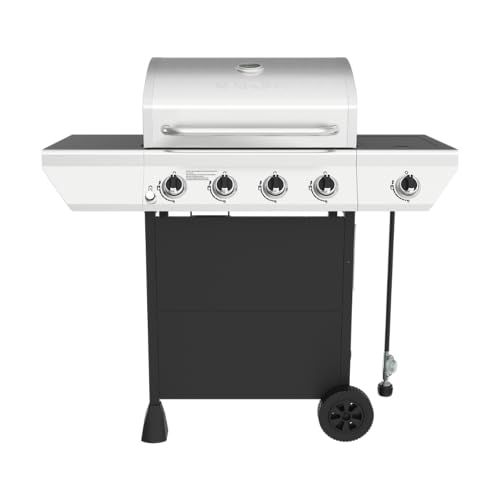
Nexgrill 4-Burner Propane Gas Grill with Side Burner and Stainless Steel Lid (52,000 BTU)
Badge: Best Mid-Size All-Rounder
Strengths
- 526 sq. in. cooking space fits family batches without the big model’s footprint.
- Matte finish cast iron grates hold heat for respectable sear marks.
- Thermometer and electronic ignition included at a mid-tier position.
Trade-offs
- Less headroom than the 626 sq. in. Nexgrill for very large parties.
- Cast iron grate care applies — oil, brush, dry.
- Stainless lid still shows heat tint over seasons of use.
Mini spec box: Fuel: propane. Burners: 4 plus side burner. Output: 52,000 BTU. Cooking space: 526 sq. in. Grates: matte cast iron. Ignition: electronic. Extras: built-in thermometer.
If the 60,000 BTU Nexgrill is the party specialist, this 52,000 BTU sibling is the family all-rounder. Five hundred twenty-six square inches is the quiet sweet spot of the category: a full tray of chicken pieces plus vegetables, or two dozen burgers, without the preheat penalty and patio footprint of the biggest boxes. The matte cast iron grates are the BBQ-relevant upgrade — they store enough heat to mark food properly and recover between flips better than thin steel.
In hybrid terms, this is the grill for households that host sometimes rather than always. Two-zone cooking is comfortable, a smoker tube fits along a burner without crowding the food, and the side burner covers the sauce-and-sides work that makes BBQ a meal instead of a pile of meat. Its limitation is simply the ceiling: at a genuinely large gathering you will cook in batches where its bigger sibling would not. For most families, that trade buys a better-sized, easier-kept grill — and leaves patio room for the charcoal half of the hybrid dream.
Families will also appreciate the running costs of restraint. A mid-size box preheats faster and burns less propane per family dinner than its 626 sq. in. sibling, and over a long season that difference quietly pays for the charcoal kettle that completes the hybrid setup. The stainless lid keeps the presentation smart, the thermometer keeps the cook honest, and the cast iron keeps the grill marks photogenic. It is the least extreme pick in this guide, and for the median household that is exactly the recommendation.
Best for: families wanting one balanced grill with cast iron searing / Not suited for: the largest regular gatherings

Monument Grills Mesa II 4-Burner Propane Gas Grill
Badge: Best Fast Preheat
Strengths
- Advanced Broil Zone concentrates heat for browning and finishing.
- Stainless steel body with foldable side shelves balances durability and storage.
- Designed for rapid preheating — the maker rates it to reach high heat in minutes.
Trade-offs
- Broil-zone layout is a house design; accessory fit differs from legacy brands.
- Fast, fierce heat demands attention — thin foods overcook quickly.
- Newer name than Weber or Charbroil in long-term parts support.
Mini spec box: Fuel: propane. Burners: 4. Body: stainless steel. Model: Mesa II 410FBZ. Extras: Advanced Broil Zone, foldable side shelves.
The Mesa II is built around a single insight: most weeknight grilling fails at the preheat, not the cook. Its Advanced Broil Zone concentrates burner output so the cooking surface reaches fierce, browning heat fast — the manufacturer rates the grill to hit high temperature within minutes — which changes behaviour. You actually use it on a Tuesday. For BBQ purposes the broil zone doubles as a finishing tool: ribs that roasted indirectly can kiss concentrated heat at the end to set the glaze, and burgers get their crust without a long, drying stay over the fire.
The rest of the package is sensibly modern: stainless construction, four burners for zone work, and folding shelves that let a full-size grill live on a modest patio. The cautions are about temperament and ecosystem. Concentrated heat punishes distraction — set a timer for thin chops and asparagus — and a younger brand’s accessory shelf is thinner than Weber’s. Neither flaw is disqualifying. If your hybrid plan leans on gas five nights a week and charcoal for ceremony, a grill that heats this eagerly is a legitimate headline act.
The folding shelves deserve emphasis for apartment and townhouse patios, where a full-size four-burner normally cannot live. Folded, the Mesa II presents a slim stainless profile against the wall; unfolded, it stages trays like any big grill. That storage trick, combined with the fast preheat, makes it the pick most likely to be used on impulse — and in real households, the grill that gets used on impulse is the grill that was worth buying, whatever the spec sheet says about the others.
Best for: weeknight grillers who value speed to temperature / Not suited for: set-and-forget cooks or accessory collectors
Comparison Table
| Pick | Burners | Output | Cooking area | Standout feature | Link |
|---|---|---|---|---|---|
| Charbroil Performance Cabinet | 4 + side | Not listed | Not listed | Enclosed cabinet storage | Check on Amazon |
| Nexgrill 4-Burner (60,000 BTU) | 4 + side | 60,000 BTU | 626 sq. in. | Largest grate, heat recovery | Check on Amazon |
| IdeaMaxx 3-Burner | 3 | 38,200 BTU | Not listed | Cast iron grates, folding shelves | Check on Amazon |
| Weber Spirit E-425 | 4 + sear zone | Not listed | Not listed | Sear zone with boost burners | Check on Amazon |
| Nexgrill 4-Burner (52,000 BTU) | 4 + side | 52,000 BTU | 526 sq. in. | Matte cast iron grates | Check on Amazon |
| Monument Mesa II | 4 | Not listed | Not listed | Advanced Broil Zone | Check on Amazon |
How to Choose the Best Hybrid BBQ Grills
Begin with the BBQ you actually cook. If your menu is burgers, dogs, chicken and the occasional steak — hot and fast — then sear hardware decides your shortlist: a sear zone (Weber), a broil zone (Monument) or cast iron grates (IdeaMaxx, the 52,000 BTU Nexgrill). If your menu leans toward ribs, shoulders and whole birds — low and slow — be honest that charcoal or a dedicated smoker does that job better, and choose the gas grill for control: four burners, a reliable thermometer and a lid that holds gentle heat without drifting. Most households do both styles across a month, which is precisely the hybrid argument: gas for the fast menu and weeknight versions of the slow one, charcoal for the full ceremony.
Size second. Family-of-four cooking fits comfortably in the 450–550 sq. in. band; regular hosting pushes you to the 626 sq. in. Nexgrill class; compact households should protect their patio and pick the IdeaMaxx. Read BTU against area, never alone — concentrated output in a small box sears harder than bigger numbers spread thin. Then grate material: porcelain-coated steel for easy care, cast iron for crust, porcelain-enameled cast iron for the compromise. Finally, plan the second fuel. Leave floor space for a kettle, budget for a chimney starter and a metal ash can, and read Best Hydrid Fuel Grills for the charcoal-side reasoning that pairs with this guide.
How to Get Real BBQ Flavour from a Gas Grill, Step by Step
Step one: preheat longer than feels necessary. Fifteen minutes with the lid down is what turns a warm grill into a searing grill; every pick here rewards that patience. Step two: dry the food. Pat meat with paper towels and salt it ahead of time — surface moisture is steam, and steam is the enemy of crust. Step three: add smoke early. Fill a smoker box or pellet tube with dry wood pellets or chips, place it over a lit burner, and wait for thin blue smoke before the food goes on; smoke sticks best to cold, moist surfaces at the start of the cook. Step four: cook in zones. Sear over the hot side, finish over the cool side, and glaze only in the last minutes so sugars do not burn. Step five: rest everything. Ten minutes of rest is worth more than any sauce.
Troubleshooting, as BBQ cooks actually meet it:
- Problem: pale, steamed-looking burgers → the grate was not fully preheated or the meat went on wet; preheat longer, dry the surface, and stop pressing patties, which squeezes out the juices that create crust.
- Problem: smoke flavour is missing → the box or tube was added too late or the wood burned out in the first ten minutes; start smoke before the food, and use pellets for a longer, steadier smoulder.
- Problem: ribs dry out during an indirect session → the temperature crept too high; run fewer burners, add a water pan over the cool side, and wrap the ribs for the middle portion of the cook.
Cleaning Up After a BBQ Session Without Ruining the Grates
Cleanup is where gas grills quietly live or die, and BBQ sessions are the dirtiest of all because sauces and rendered fat coat everything. While the grate is still warm — not blazing — brush it with a stiff brass or stainless brush, or a balled sheet of foil held in tongs, until the heavy residue releases. Let the grill run on high for five minutes with the lid down to carbonise what remains, then shut it off and, once cool, lift the grates to check the heat plates beneath; sugary sauce drips corrode those plates faster than anything else in the firebox. Empty the grease tray before it becomes a flare-up reservoir, and wipe the lid’s interior so old soot does not season next week’s chicken. Cast iron grates get one extra step: a whisper of high-heat oil while they are still warm, which seasons them a little more with every cook. Ten unhurried minutes after each session is the entire maintenance secret behind grills that still cook like new in year five.
Grilling Is Not Barbecue — and Hybrid Shoppers Should Know the Difference
In much of the world the words are interchangeable, but in American BBQ culture they describe opposite techniques. Grilling is hot and fast, food directly over the fire, minutes per side. Barbecue is low and slow, food beside the fire, hours per cook, smoke as an ingredient. A hybrid shopper usually wants both techniques on one patio, and the fuels split naturally: gas grills excel at grilling and can approximate barbecue with indirect heat and added smoke; charcoal does both but demands time and attention for each. Understanding the distinction prevents the classic disappointment — buying a fast gas grill and expecting pitmaster ribs from it on day one, or buying a kettle and resenting it on weeknights. The techniques in Best Indirect Heat Grills are the bridge: indirect cooking is where the two traditions meet, and every pick in this guide was chosen to do it competently.
Sear Zones, Broil Zones and Cast Iron: Three Roads to a Crust
Manufacturers chase charcoal-style crust with three different tools, all represented here. A sear zone, as on the Weber E-425, adds extra burner output under one section of grate. A broil zone, as on the Monument Mesa II, concentrates the standard burner layout into a smaller, fiercer area and pairs it with fast preheating. Cast iron grates, as on the IdeaMaxx and the mid-size Nexgrill, attack the problem from the storage side: mass that holds heat through the temperature dip when cold food lands. All three work; they differ in temperament. Sear and broil zones are forgiving and fast but localised — you sear in batches on one patch of grate. Cast iron spreads the benefit across the whole surface but asks for care. Hybrid households often end up with one of each across their two grills, which is a happy accident worth planning on purpose.
Game-Day Workflow: Running a Big BBQ on One Gas Grill
Volume cooking is a scheduling problem disguised as a grilling problem. Start an hour before guests arrive: preheat the full grate, then set your zones — sear side hot, middle medium, far side low for holding. Cook in an order that respects resting and holding. Sausages and wings go first, because they tolerate the holding zone gracefully under a loose foil tent. Burgers follow in batches matched to the sear area, not the whole grate, so each batch gets full heat; move them to the holding zone as they finish and start the next batch immediately while the grate is hottest. Steaks and chops, the divas, cook last and rest while you make the final pass on vegetables.
Two habits separate calm hosts from frantic ones. First, keep a clean landing tray and a used tray strictly separate, and never let raw and cooked food share a surface — basic, but game day is when it slips. Second, manage the lid like a resource: every opening costs heat, so batch your peeking, saucing and turning into single lid-lifts per round. On the big Nexgrill this workflow feeds a crowd from one tank without drama; on the mid-size picks it still works, just with one extra batch in the plan. Write the batch order on a sticky note inside the cabinet door if you have to — professional kitchens do exactly this, and a hybrid patio that runs on a simple system will out-cook a fancier one running on memory and hope.
Propane Management for a Heavy BBQ Season
Nothing ends a BBQ like an empty tank at the halfway point, so treat propane as inventory. Keep two tanks in rotation: one on the grill, one full spare stored upright, outdoors, in shade, away from the grill’s heat. Judge the working tank by weight or by the warm-water trick — pour warm water down the tank’s side and feel for the cool line that marks the liquid level. Swap tanks before big events, not during them, and put the partially used tank back into service for weeknight cooks where a mid-cook swap costs nothing.
Each spring, before the season opens, run a two-minute leak test: brush soapy water over the hose connections, open the tank valve with the burners off, and watch for bubbles. Check the hose itself for cracks and the regulator for damage, and clear the burner ports and the cabinet floor of winter debris and any charcoal dust that drifted over from the hybrid patio’s other half. These small rituals are the difference between a grill that lights first time in May and a troubleshooting session while guests hold paper plates. A spare igniter battery and a grill brush in the cabinet complete the kit; everything else is technique.
Where Charcoal Still Wins, Said Plainly
A guide that sells gas grills under a hybrid keyword owes you this section unhedged. Charcoal wins on maximum flavour for long cooks: hours of wood and coal smoke soaking into a shoulder or brisket is a chemistry gas cannot reproduce, only approximate. Charcoal wins on peak radiant heat for certain steak styles, where coals can sit an inch below the grate. And charcoal wins on ritual — the lighting, the tending, the patience — which for many people is not a cost of BBQ but the entire point of it. None of the six picks here should be bought to replace those experiences.
What gas wins is everything around those peaks: the Tuesday dinner, the rainy evening, the precise repeatability, the ten-minute preheat, the clean shutdown. Hybrid households are not indecisive; they are correctly allocating. If you finish this guide and realise your heart is entirely with charcoal, buy the best kettle you can and let gas wait. If you recognise your actual week in these pages — busy, hungry, occasionally festive — then a strong gas anchor like the Weber, Nexgrill or Monument, with charcoal added when life allows, is the honest version of the best hybrid bbq grills idea.
Common Buying Mistakes
- Expecting a gas grill to be a smoker. Indirect heat plus a smoke tube approximates BBQ; it does not replace hours of charcoal and wood. Buy the gas grill for what it is brilliant at.
- Chasing BTU headlines. Output without area context misleads. A concentrated 38,200 BTU compact can out-sear a lazy big box.
- Skipping the preheat. Half of all “gas has no flavour” complaints are really “the grate was never hot” complaints.
- Buying party size for family life. The largest grate is a liability fifty weeks a year if you host twice. Size for the regular cook, batch for the rare one.
- Ignoring grate care. Cast iron and porcelain coatings fail early when they are scraped cold, soaked, or left wet under a cover. Five warm minutes of brushing prevents it.
Final Recommendation
For the strongest all-round BBQ performance on gas, choose the Weber Spirit E-425: the sear zone, boost burners and porcelain-enameled cast iron make it the pick that most narrows the charcoal gap. If your BBQ life is measured in parties, take the Nexgrill 4-Burner (60,000 BTU) and its 626 sq. in. of working room. If speed to temperature decides whether you grill at all on weeknights, the Monument Mesa II and its broil zone deserve the nod. Any of the three anchors a hybrid patio honestly — gas doing the daily work superbly, charcoal welcome whenever the weekend invites it. Whichever you choose, judge it after a month of real dinners rather than a single Saturday: the right grill is the one that quietly becomes the household’s default way of cooking outdoors, and every pick in this guide was selected because owners keep reaching for it long after the novelty of a new appliance has worn off.
Frequently Asked Questions
Are any of these grills true hybrid (gas and charcoal) models?
No. All six picks are propane gas grills. True dual-fuel combos exist as a niche category but none was in the verified pool for this guide, so the article treats these as the gas side of a hybrid setup and never labels a single-fuel grill as a combo.
How do I add smoke flavour on a gas grill?
Use a smoker box or pellet tube filled with wood chips or pellets, placed over a lit burner until it smoulders, and add the food while the smoke is thin and steady. Smoke flavour builds most in the first part of the cook, so start the smoke before the meat goes on.
Which pick sears a steak best?
The Weber Spirit E-425, thanks to its dedicated sear zone with boost burners over porcelain-enameled cast iron. The Monument Mesa II’s broil zone is the closest rival, and the cast-iron IdeaMaxx is the best compact option.
Can I cook ribs low and slow on these grills?
Yes, with indirect heat: light one side, place the ribs on the cool side, hold a gentle temperature and add smoke with a tube. Results are good, though a charcoal kettle or dedicated smoker still wins for the longest cooks — which is the hybrid household’s whole point.
Is a bigger grill always better for BBQ?
No. Bigger grates help parties but preheat slower and burn more propane for small meals. Match the grill to your regular cook, and let batching handle the exceptions.
What does a side burner actually do for BBQ?
It keeps sauces warm, cooks skillet sides like onions and beans, and boils corn without stealing grate space or forcing you back into the kitchen. On BBQ night it is used constantly once you have one. It also lights charcoal in a hybrid household more often than you would expect: a chimney starter placed over a side burner catches quickly and evenly, which is one of those small cross-fuel synergies that make a two-grill patio feel like one designed system rather than two appliances that happen to share a slab. Just keep the chimney stable, keep handles turned away from traffic, and let it cool completely on a non-combustible surface before you store it.


