Disclosure: topratedkitchenware.com is reader-supported. When you buy through links on our site, we may earn an affiliate commission from Amazon and other retailers, at no extra cost to you.
Where to buy
The six models below are the picks in this guide to best large convection ovens. Four carry direct listing links, because their verified listing titles state both convection and a genuinely large capacity. Two are reviewed in full but kept prose-only, because one never states convection and the other never states a capacity, and a guide to large convection ovens should link only where both halves of its title are evidenced.
- VEVOR Commercial Convection Oven, 66L (60Qt)
- Emeril Lagasse 26QT French Door Air Fryer Toaster Oven
- VEVOR Commercial Convection Oven, 47L (43Qt)
- Ninja French Door Premier Air Fry Oven FO101 — convection not stated in its listing title, reviewed prose-only below
- Breville Smart Oven Air Fryer Pro (BOV900) — no capacity stated in its listing title, reviewed prose-only below
- KoolMore 23-Inch Commercial Countertop Convection Oven (KM-CTCO-15)
Read the full guide ↓ for how large capacity is actually measured, which of the linked ovens fits which kind of batch cooking, and how to size an oven to your pans instead of to a headline number.
Best large convection ovens is a search that punishes vague answers, because the word large has no standard in this category. One maker calls an oven large for holding a family pizza; another means a 66-litre commercial cavity that bakes four tiers at once. This guide therefore works from stated evidence only. A pick is linked when its verified listing title states convection and states a capacity or format that is large by any honest reading — tens of quarts, multiple tiers, half-size commercial pans. Picks that fail either half of that test are still reviewed, in full, with the gap named, because several of them are excellent ovens answering a different brief. Readers comparing formats across the whole category will also find the broader survey in Best Of Convection Ovens useful beside this size-focused guide.
What large actually buys you is simultaneity. A standard countertop oven cooks one layer well; a large convection oven cooks several layers, or one very large item, with fan-driven air keeping the corners honest. That is the difference between roasting vegetables while a chicken rests and roasting them after it, between a batch of rolls baked together and the same batch baked in shifts with the first tray cooling while the last one proofs. If your cooking regularly involves a crowd, a celebration calendar, a small food business, or a household that batch-cooks for the week, capacity is not a luxury specification — it is the schedule itself.
The six picks below divide into three honest groups. Two VEVOR commercial ovens and the KoolMore bring tiered, pan-based capacity from the bakery world. The Emeril Lagasse brings the same scale to a family kitchen with French doors and presets. And the Ninja and the Breville, prose-only for stated-evidence reasons explained in their reviews, represent the polished domestic end of the market, where finish and functions compete with raw volume. The buying guide after the reviews turns those differences into measurements you can take in your own kitchen before spending anything.
Key Takeaways
- Large is evidenced, not asserted: the linked picks state capacities of 66L, 47L and 26QT, or a 23-inch half-size pan format, in their listing titles.
- Four linked picks state convection in the title itself; the two prose-only picks each miss one half of the brief — one never states convection, the other never states a capacity.
- Tiered commercial ovens (four racks or tiers) suit batch baking; the French door family oven suits mixed daily cooking at scale.
- Measure pans, not headlines: your largest roasting pan, with handles, with the door closed, is the true capacity test.
- Big cavities need circuit respect: the 1800W class should not share a run with other heavy appliances.
- If you cook large only a few times a year, a smaller oven plus a borrowed pan beats a permanent commercial footprint.
In this guide
Quick Picks
| Pick | Badge | Why it earns its place | Listing |
|---|---|---|---|
| VEVOR Commercial Convection Oven, 66L (60Qt) | Best Overall Large Pick | The largest verified cavity in the pool at 66L, with convection and four tiers stated in the listing itself. | Check on Amazon |
| Emeril Lagasse 26QT French Door Air Fryer Toaster Oven | Best for Families | Extra large interior stated in the listing, French doors, and the deepest preset bench in the guide at 24 one-touch options. | Check on Amazon |
| VEVOR Commercial Convection Oven, 47L (43Qt) | Best for Batch Baking | A 47L, four-tier commercial cavity with convection stated up front, sized for restaurant and bakery trays. | Check on Amazon |
| Ninja French Door Premier Air Fry Oven FO101 | Best Finish, Convection Unstated | A polished 20.3 Qt French door design with ten functions, reviewed in full but not linked, because its title never states convection. | See review |
| Breville Smart Oven Air Fryer Pro (BOV900) | Best Controls, Size Unstated | Thirteen functions and a stated convection setting, but no capacity anywhere in its listing, so it cannot be evidenced as large. | See review |
| KoolMore 23-Inch Commercial Countertop Convection Oven (KM-CTCO-15) | Best for Half-Size Pans | A 23-inch commercial countertop convection oven built around half-size pans and four racks, with an ETL listing stated. | Check on Amazon |
Badges reflect the role each oven plays at large scale, and they are used consistently in the detailed reviews below. Prose-only picks carry badges that name their evidence gap, so the table can be read honestly at a glance.
How These Picks Were Chosen
This guide is research-led. The six picks come from a verified pool for the convection oven category, and each pick’s listing title was read as the primary evidence: capacity, format, power, door style and included equipment were taken only from what the title states, and nothing was imported from reputation, from other models in a brand’s range, or from reviews of earlier versions. Where a title is silent — on convection, or on capacity — the pick is prose-only and the silence is named in its review. That rule costs this guide two famous names in its linked list, and it is kept anyway, because a size guide that guesses sizes is worthless.
Within the linked group, ranking weighed usable capacity first, then rack or tier flexibility, then door design, then guidance features such as presets, then cleanup. Price was deliberately excluded from the ordering, because prices move; each review instead positions its oven qualitatively — commercial-tier, premium-tier or mainstream family-tier — and leaves the live figure for you to check on Amazon at the moment of purchase. No hands-on testing is claimed: this is a structured comparison of stated specifications and category knowledge, written to be checked against the listings themselves.
One scope note deserves emphasis. Every pick here is a countertop oven with a single cavity. Shoppers whose search began with built-in or range formats will find the neighbouring formats surveyed in Best New Range Ovens With Convection, and shoppers who need microwave speed combined with convection should start from Best Microwave Convection Ovens Consumer Reports rather than from this countertop list, because no pick in this pool microwaves.
The 6 Best Large Convection Ovens, Reviewed in Detail

VEVOR Commercial Convection Oven, 66L (60Qt)
Badge: Best Overall Large Pick
Strengths
- Largest stated capacity in this guide: 66L, listed as 60Qt, in a half-size countertop format
- Four tiers, so several trays can bake at once instead of queuing in a single layer
- Convection is stated in the product name itself, and the oven ships with a tray and wire racks
Trade-offs
- Commercial styling and a front glass door design aimed at bakeries, not at blending into a quiet home kitchen
- A 66L countertop box demands serious counter depth and clearance on every side
- 1800W is the top draw class for a standard kitchen circuit, so it should not share an outlet run with other heavy appliances
| Capacity (as listed) | 66L / 60Qt |
| Format | Half-size countertop, 4-tier |
| Power (as listed) | 1800W |
| Door | Front glass door |
| Electrical (as listed) | 120V, 5-15P plug |
| Included (as listed) | Tray and wire racks |
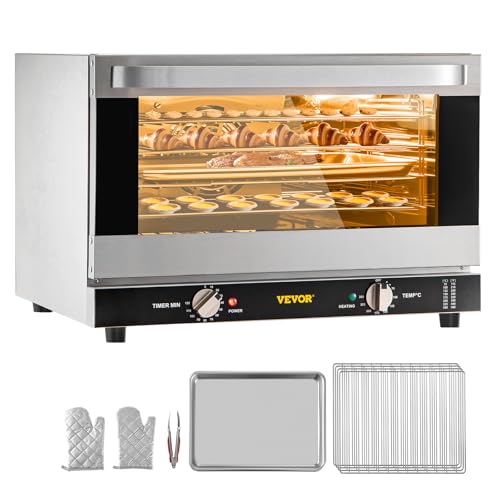
This is the oven this guide is really about. Most countertop ovens that call themselves large are describing a single generous shelf; the VEVOR 66L is built around four tiers inside a 66-litre cavity, which changes the kind of cooking you can plan. A bakery-style session — several trays of rolls, two sheet pans of vegetables and a tray of roasted potatoes — stops being a sequence and becomes one load. The listing states convection in the product name, states the capacity twice in two unit systems, and states the electrical requirement plainly, which is exactly the evidence a large-oven buyer should want before anything else is discussed.
In a home kitchen the same capacity serves a different master: the big gathering. A household that roasts for a crowd a few times a month, bakes bread in batches, or cooks two dishes at two rack positions for one meal will feel the difference immediately, because the constraint in most kitchens is not temperature but simultaneous space. The front glass door matters more at this size than on a small oven, since opening a large door to check the back tray dumps a large volume of hot air; watching through glass protects the bake. The included tray and wire racks mean the four tiers are usable on day one rather than after an accessories order.
The honest limitation is footprint and presence. This is a commercial countertop appliance with a commercial look, and it will dominate a standard counter run. Measure the space with the door open, confirm the clearance the manual asks for, and treat it as a semi-permanent installation rather than something that slides into a cupboard between uses. Buyers who cook large twice a year will be happier with a smaller machine and a borrowed roasting pan; buyers who cook large every week have found their oven.
Best for: cooks who regularly fill several trays at once, home bakers working in batches, and small bakeries / Not suited for: small counters, occasional large meals, or anyone who needs the oven to disappear into storage
Emeril Lagasse 26QT French Door Air Fryer Toaster Oven
Badge: Best for Families
Strengths
- Extra large interior is stated in the listing, with a 26QT capacity figure to plan around
- French doors open with counter space in front of the oven kept usable, helpful in busy family kitchens
- 24 one-touch preset options and six included cooking accessories make it the most guided oven here
Trade-offs
- Preset-led cooking rewards cooks who use the programs and frustrates cooks who want two dials and full manual control
- A 26QT French door cabinet is still a large countertop commitment, even if it is the friendliest shape here
- Air fryer toaster oven hybrids ask for more crumb and grease management than a plain commercial cavity
| Capacity (as listed) | 26QT |
| Door | French door |
| Presets (as listed) | 24 one-touch preset options |
| Interior (as listed) | Extra large interior |
| Included (as listed) | Six cooking accessories |
| Type (as listed) | Countertop convection cooker, multi-function air fryer toaster oven |
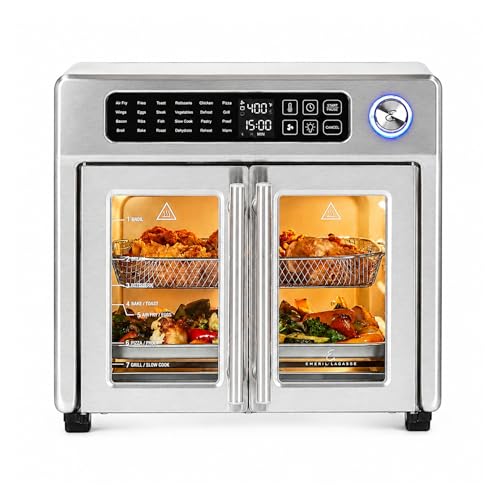
The Emeril Lagasse 26QT is the domestic face of the large convection oven: where the commercial picks in this guide are built around tiers and pans, this one is built around a family and a weeknight. The listing states an extra large interior and gives the capacity as 26QT, states convection in the phrase countertop convection cooker, and then spends its remaining words on guidance — 24 one-touch preset options and six cooking accessories. That emphasis tells you who it is for: a household that wants a big oven to make decisions with them, not a blank commercial box that assumes a trained hand.
French doors are the practical highlight at this size. On a wide oven, a single drop-down door becomes a hot shelf you must reach across; split doors open sideways, keep the front of the counter usable, and make sliding a heavy casserole in and out a shorter, safer motion. For a family oven that will toast in the morning, reheat at lunch, air fry snacks after school and roast at dinner, that daily ergonomics argument outweighs almost any specification. The accessory set supports the same story, covering the common jobs without a separate shopping trip.
The limitation is the preset philosophy itself. Twenty-four programs are only helpful if your cooking matches the programs; experienced cooks who work by eye and probe may find the guided interface slower than the manual control on the commercial picks. It is also, despite the friendly design, a genuinely large appliance. Households of one or two who mostly cook single portions will not use the interior they are giving counter space to, and should read the smaller-format guidance further down instead.
Best for: families who cook several foods a day in one oven and want presets to share the work / Not suited for: strict manual-control cooks, one-person households, or counters that cannot spare a wide, deep bay
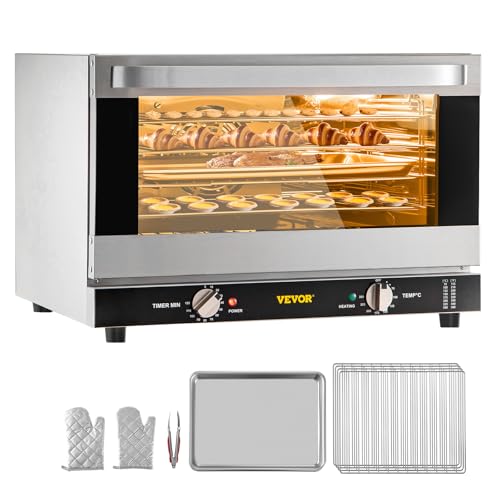
VEVOR Commercial Convection Oven, 47L (43Qt)
Badge: Best for Batch Baking
Strengths
- 47L / 43Qt stated capacity across four tiers, the batch-baking format in a slightly smaller box than the 66L
- Convection and countertop format both stated in the listing, with trays, wire racks and clip gloves included
- 1600W draw is a step gentler on a shared kitchen circuit than the 1800W class
Trade-offs
- Still a commercial appliance in look and layout, with none of the preset guidance of the family pick
- Half-size format assumes half-size trays; favourite full-size home pans may not fit
- Four tiers reward cooks who rotate trays; cooks who never rotate will see uneven results between levels
| Capacity (as listed) | 47L / 43Qt |
| Format | Half-size countertop, 4-tier |
| Power (as listed) | 1600W |
| Door | Front glass door |
| Electrical (as listed) | 120V |
| Included (as listed) | Trays, wire racks, clip gloves |
Think of the 47L VEVOR as the 66L’s argument at a slightly calmer scale. The listing states commercial convection oven in the name, gives the cavity as 47L and 43Qt, confirms the four-tier countertop format, and lists the working kit — trays, wire racks and clip gloves — that a batch cook actually reaches for. For a home baker who sells at a weekend market, a church kitchen, a small café, or a household that bakes in true batches, this is the size where multi-tray convection starts to pay for its counter space without taking over the room.
Four tiers change technique as much as capacity. With convection moving air through the cavity, several trays can bake together, but the honest workflow still includes a rotation: swap top and bottom trays partway through, and turn pans front to back, because no fan fully erases the difference between the tier nearest the element and the tier furthest from it. The clip gloves in the box are a small, telling inclusion — the maker expects hot trays to be handled often. Buyers coming from a single-shelf toaster oven should plan one practice batch of something forgiving, like roasted vegetables, to learn their oven’s tier personalities before a celebration bake depends on them.
The limitation is the same commercial bluntness as its bigger sibling, in miniature: no preset library, no domestic styling, and a pan format that must be checked against the pans you already own. If your cooking is one tray at a time, the tiers are wasted and a simpler oven serves you better. If your cooking is measured in trays per hour, this is the most direct tool in the guide.
Best for: batch bakers, market and café cooks, and households that bake several trays at once / Not suited for: single-tray cooks, preset lovers, or anyone whose pans are all full-size
Ninja French Door Premier Air Fry Oven FO101
Badge: Best Finish, Convection Unstated
Strengths
- French door design in stainless, with a PFAS-free surface stated in the listing
- Ten functions in one unit, with air fry, sear crisp, bake, broil, toast and dehydrate named
- A stated ceiling of 450F and a mid-size 20.3 Qt cavity that suits many households better than the commercial boxes
Trade-offs
- Its listing describes its airflow as cyclonic air and never states convection, so this guide does not link it as a convection pick
- At 20.3 Qt it is the smallest cavity in this guide and does not answer a truly large brief on its own
- French doors on a mid-size oven are pleasant, but the oven still needs side and top clearance like any countertop unit
| Capacity (as listed) | 20.3 Qt |
| Functions (as listed) | 10-in-1, including air fry, sear crisp, bake, broil, toast and dehydrate |
| Temperature (as listed) | 450F cyclonic air |
| Surface (as listed) | PFAS-free |
| Finish (as listed) | Stainless |
| Door | French door |
The Ninja FO101 is the pick that tests this guide’s honesty rule, so it is worth explaining its place carefully. As an oven, it is easy to admire: a French door cabinet in stainless, a stated PFAS-free surface, ten functions with the useful ones named — air fry, sear crisp, bake, broil, toast, dehydrate — and a 450F ceiling delivered, in the maker’s words, by cyclonic air. Plenty of shoppers will read that phrase and reasonably assume a convection fan is doing the work. This guide does not make that leap for them. A pick is linked as a convection oven only when the listing states convection, and this listing does not.
There is a second, simpler reason it sits prose-only in a guide to large ovens: at 20.3 Qt it is the smallest cavity here. That is not a criticism — for a couple, a small family, or a keen cook in a compact kitchen, twenty quarts of well-managed space beats sixty litres of empty air that must be heated for a single portion. The French doors suit exactly that daily rhythm, opening without claiming the counter in front, and the function list covers the week without drama. If your real brief is a capable everyday oven rather than a large one, this machine deserves a place on your own shortlist; it simply cannot be evidenced as either large or convection-stated from its listing.
Judge it, then, on the terms its maker chose: a premium-finished, multi-function air fry oven. Shoppers who want the linked certainty of a stated convection specification should choose from the four linked picks; shoppers who prioritise finish, footprint and functions can consider this oven with open eyes, knowing exactly which claim is and is not in its title.
Best for: smaller households who value finish and functions over raw capacity / Not suited for: buyers who need a stated convection specification or a genuinely large multi-tray cavity
Breville Smart Oven Air Fryer Pro (BOV900)
Badge: Best Controls, Size Unstated
Strengths
- A convection setting is stated in the listing, with the maker quantifying its effect on cook time
- Thirteen functions, the broadest stated function count in this guide, in brushed stainless steel
- A long-established premium countertop oven line, with roast, bake and dehydrate named among the functions
Trade-offs
- Its listing states no capacity at all, so this guide cannot present it as a verified large oven
- Premium-tier positioning in its class, with a control system that rewards reading the manual
- Function breadth can be wasted on cooks who only ever bake, roast and toast
| Functions (as listed) | 13 functions, including roast, bake and dehydrate |
| Convection (as listed) | Convection setting stated; maker states it reduces cook time by up to 30% |
| Finish (as listed) | Brushed stainless steel |
| Type (as listed) | Countertop oven |
| Capacity (as listed) | Not stated in listing title |
The Breville Smart Oven Air Fryer Pro is, by reputation and by its stated function count, one of the most complete countertop ovens a home cook can buy — and it is prose-only in this guide for one narrow, disclosed reason: its listing never states a capacity. Thirteen functions are named as a count, roast, bake and dehydrate are named as examples, a convection setting is stated outright, and the maker even quantifies that setting’s effect on cook time. Everything a controls-led buyer wants is evidenced. The single fact a large-oven guide exists to verify — how much food fits inside — is absent from the title evidence this guide is allowed to use.
That absence matters practically, not just procedurally. Large-oven shoppers plan around pans: the roasting pan that must fit with the door closed, the two dishes that must sit side by side, the tray count for a batch. A function list cannot answer any of those questions, and guessing a cavity size from a model’s reputation is how guides mislead. So the Breville is reviewed here in full, recommended warmly to the buyer whose brief is capability rather than verified volume, and left unlinked so that the linked list remains a list of ovens whose size is stated, not assumed.
For the right kitchen it may still be the best purchase in this article. If your cooking is varied — roasting one night, dehydrating the next, air frying between — and your portions are household-scale rather than batch-scale, its stated convection setting and thirteen functions are a stronger match than a commercial cavity you would rarely fill. Measure your largest pan, confirm the interior dimensions on the listing before ordering, and the one gap in its title evidence closes with your own tape measure.
Best for: capability-led home cooks who will verify interior dimensions themselves / Not suited for: buyers who need stated, verified large capacity from the guide itself

KoolMore 23-Inch Commercial Countertop Convection Oven (KM-CTCO-15)
Badge: Best for Half-Size Pans
Strengths
- Built for half-size pans, the working format of bakeries and cafés, with four racks stated
- Convection, countertop format and 1600W power all stated in the listing title
- ETL listing for safety and sanitation is stated, a credential home ovens rarely carry
Trade-offs
- A 23-inch commercial width is a serious counter allocation, wider than many home ovens
- Sanitation-led commercial design means a plainer interface and no domestic preset library
- Half-size pan discipline is a system: your existing home pans may start a new collection rather than join one
| Width (as listed) | 23 in. |
| Format | Commercial countertop, for half-size pans |
| Racks (as listed) | 4 racks |
| Power (as listed) | 1600W |
| Material (as listed) | Stainless steel |
| Certification (as listed) | ETL listed for safety and sanitation |
The KoolMore KM-CTCO-15 speaks the most professional language of any pick here. Its title leads with a dimension — 23 inches — then states commercial countertop convection oven, names its pan format (half-size), counts its racks (four), gives its power (1600W), its material (stainless steel), and closes with an ETL listing for safety and sanitation. For a buyer equipping a small bakery, a café counter, a food truck, or a very serious home baking station, that is a specification written in the order professionals check things, and every element of the large claim is evidenced: width, format, racks and convection are all stated.
The half-size pan system is the real decision. Commercial kitchens standardise on pan sizes so that any tray fits any oven, any rack, any storage shelf. Adopting that system at home or in a small business makes batch work calm: trays of proofing rolls, roasting vegetables and finished bakes all share one footprint, and the four racks turn the cavity into a small production line. The sanitation credential matters in the same world — an oven that may be inspected, or simply cleaned hard every day, benefits from a design and a listing that assume it.
The limitation is domestic fit. Twenty-three inches of commercial stainless will not flatter a small kitchen, the interface assumes the operator knows what they are doing, and there is no preset to rescue an unfamiliar dish. Home cooks who bake for pleasure a few times a month will find the family pick kinder. Cooks whose output is counted in pans per day will recognise this as the guide’s most businesslike tool.
Best for: small bakeries, cafés, food trucks and production-minded home bakers standardising on half-size pans / Not suited for: casual home cooks, preset-guided cooking, or narrow counters
Comparison Table
| Pick | Badge | Capacity / format (as listed) | Standout stated feature | Listing |
|---|---|---|---|---|
| VEVOR Commercial Convection Oven, 66L (60Qt) | Best Overall Large Pick | 66L / 60Qt, half-size, 4-tier | Convection stated in the product name; tray and racks included | Check on Amazon |
| Emeril Lagasse 26QT French Door Air Fryer Toaster Oven | Best for Families | 26QT, French door | 24 one-touch presets; extra large interior stated | Check on Amazon |
| VEVOR Commercial Convection Oven, 47L (43Qt) | Best for Batch Baking | 47L / 43Qt, half-size, 4-tier | Trays, racks and clip gloves included; 1600W | Check on Amazon |
| Ninja French Door Premier Air Fry Oven FO101 | Best Finish, Convection Unstated | 20.3 Qt, French door | 10-in-1 functions; PFAS-free surface stated; convection not stated | See review |
| Breville Smart Oven Air Fryer Pro (BOV900) | Best Controls, Size Unstated | Not stated in listing title | 13 functions; convection setting stated; size not stated | See review |
| KoolMore 23-Inch Commercial Countertop Convection Oven (KM-CTCO-15) | Best for Half-Size Pans | 23 in. wide, half-size pans, 4 racks | ETL listed stated; stainless steel; 1600W | Check on Amazon |
Read the capacity column as the listing states it, in the listing’s own units: litres and quarts for the tiered ovens, a width and pan format for the KoolMore, and an honest not-stated for the Breville. Converting between systems is easy; inventing a figure the maker never published is not something this table does.
The two prose-only rows are not failures. They are the control group that proves the linked rows earned their links, and for some kitchens — smaller, finish-led, function-led — a prose-only pick will be the right purchase made with full knowledge of which claim its title does not make.
How to Choose a Large Convection Oven
Choosing a large convection oven is mostly an exercise in measuring three things: your pans, your counter, and your calendar. The pans decide the cavity you need, the counter decides the cabinet you can house, and the calendar — how often you truly cook at scale — decides whether large is a tool or a monument. The factors below follow that order.
Start with the pan test, not the litre count
Take the largest pan you actually use — the roasting pan, the big sheet, the casserole with handles — and measure its full footprint including handles and its height with food and a lid where relevant. That rectangle and that height are your minimum interior, with the door closed. Litres and quarts describe volume, but pans are rectangles, and a high-volume cavity with the wrong shape fails the only test that matters. The tiered picks in this guide publish their format honestly: the VEVOR Commercial Convection Oven, 66L (60Qt) speaks in litres, quarts and tiers, and the KoolMore speaks in pan size outright. Prefer whichever language matches how you already cook.
Tiers versus a single tall space
Four tiers and one tall cavity are different kinds of large. Tiers multiply identical items — trays of rolls, cookies, roasted vegetables — and reward a cook who rotates pans between levels. A single tall, wide space swallows the irregular: the big bird, the deep casserole, the two dishes side by side. Batch bakers should weight tiers heavily; celebration roasters should weight unobstructed height and width. Most households do some of both, which is why the family pick pairs a large single interior with French doors: it is the compromise format, and for mixed cooking it is usually the right one.
Doors are a daily decision
A front glass door on a commercial oven is a window first and a door second: it lets you judge browning without dumping heat, which matters more as cavity volume grows. French doors trade that single pane for access, opening sideways so a heavy dish travels inches rather than a foot over a hot drop-down door. Drop-down doors, where fitted, double as a landing shelf and a heat blast. None of these is universally best; the right answer is the one your kitchen’s choreography — who else is in the room, where the hot dish lands, how the cook moves — makes safest.
Power, circuits and heat in the room
Large ovens draw large power: 1800W and 1600W are both stated in this guide’s linked picks, and both deserve a circuit conversation. Run a big oven on a run shared with a kettle or a microwave and you will eventually meet the breaker. Large cavities also return large heat to the room, a genuine benefit in winter and a genuine cost in a summer kitchen already warmed by a range. Ventilation, clearance above and behind the cabinet, and a counter material that tolerates heat are part of the purchase, not afterthoughts. Shoppers at the opposite end of the size scale, for a dorm room or a single shelf, are better served by Best Mini Convection Ovens than by anything in this guide.
Guidance versus blank-canvas control
Finally, decide how much thinking the oven should do. The Emeril Lagasse model in this guide offers 24 one-touch presets; the commercial picks offer essentially none, assuming an operator who works by time, temperature and eye. Neither philosophy is superior — but they suit different cooks, and a mismatch is miserable in both directions. Preset cooks forced onto a blank commercial box feel abandoned; experienced cooks forced through preset menus feel managed. Be honest about which cook you are on a tired Tuesday, because that is the cook the oven will mostly serve.
How to Use a Large Convection Oven Well
A large convection oven rewards a slightly different technique from a small one. The fan, the tiers and the thermal mass all change habits that were formed in a standard oven, and the cooks who get the most from the format adjust four things: loading, rotation, temperature and rest.
Loading and rotation, step by step
First, preheat fully — a large cavity has more air and more metal to bring to temperature, and loading early is the commonest cause of pale first trays. Second, load with air gaps: trays should not touch walls or each other, because convection is only as good as the air paths you leave it. Third, stagger identical trays across tiers rather than clustering them, so each sits in a similar air stream. Fourth, rotate halfway through the cook — swap the top and bottom trays, and turn each pan front to back — even in a fan oven, because tier position still leaves a signature. Fifth, judge doneness per tray, not per timer: in batch work the trays are siblings, not twins, and one may want two minutes more than another.
Temperature and timing adjustments
Convection’s moving air transfers heat faster than still air, so recipes written for a conventional oven usually want a modest temperature reduction or a shorter time — and large loads push the other way, since four cold trays absorb more heat than one. Treat the first cook of any favourite recipe as calibration: note the settings that worked, on which tier, with what load, and write them on the recipe. Within a few sessions a personal conversion table emerges that is worth more than any generic chart, because it describes your oven, your pans and your altitude. The maker of one prose-only pick in this guide quantifies its convection effect on cook time; use such claims as a starting direction, then let your own notes take over.
Cleaning and care at scale
Large ovens collect large evidence of cooking: more splatter area, more rack metal, more crumb territory. Wipe the cavity while it is warm but not hot after heavy sessions, wash racks before residue bakes through several more cycles, and keep the door glass clean enough to remain a useful window — the whole point of glass is defeated by a film you cannot see through. Check door seals for crumbs that break the closure, and vacuum the crumb zones under removable trays weekly in a busy kitchen. A commercial-format oven like the KoolMore 23-Inch Commercial Countertop Convection Oven (KM-CTCO-15) is designed for this harder cleaning rhythm; domestic finishes prefer gentler, more frequent attention.
Troubleshooting: three common problems
Problem: the top tier browns faster than the bottom → the trays are loaded too close together or rotation was skipped; increase air gaps and rotate at the halfway point, swapping tiers. Problem: the whole load cooks slowly and pales → the cavity was overloaded or loaded before preheating finished; reduce the load per session and wait for a full preheat. Problem: one side of every tray is darker → pans are being placed against a wall or the fan outlet side; centre the pans, turn them halfway, and confirm nothing blocks the fan’s air path.
Large Countertop, Built-In, or Range: Placing This Guide
Every pick in this guide sits on a counter and plugs in, which is a deliberate format choice with real consequences. A countertop large oven can be installed in an afternoon, taken to a new home, and replaced without a tradesperson; it also occupies prime counter permanently and caps out below built-in volumes. Households renovating a kitchen around the oven itself should compare the built-in path surveyed in Best New Range Ovens With Convection before committing, because the two formats solve the same cooking problem with opposite costs. Renters, small businesses, and cooks adding capacity to an existing kitchen are exactly who the countertop format serves, and for them the tiered picks here deliver most of the built-in benefit at a fraction of the disruption.
A related fork in the search deserves a direct answer: combination machines. Shoppers who arrived via Best Large Countertop Micorwave Convection Ovens are usually hoping one box will microwave on weekdays and convection-roast on Sundays. That is a legitimate product class, but it is not this pool: no pick here microwaves, and presenting any of them as a microwave substitute would mislead. If combination cooking is the priority, follow the microwave-convection trail, including the undercounter formats in Best Microwave Convection Undercounter Ovens, and treat this guide as the dedicated-oven comparison it is.
What Large Does to Running Costs and Kitchen Rhythm
A large oven used at capacity is efficient in the way that matters: energy per portion falls as the load rises, because one preheat serves four trays. The same oven used for a single small portion is the opposite — a large volume of air and metal heated for a small return. Honest large-oven ownership therefore changes rhythm: cooking consolidates into sessions, leftovers are planned, and the week’s baking happens in one warm afternoon rather than in daily small heats. Households that embrace that rhythm find a big oven liberating and economical in practice; households that cook one fresh small thing at a time will feel the format fighting them, and should size down without embarrassment.
Common Buying Mistakes
Buying litres instead of measuring pans. Volume figures cannot tell you whether your roasting pan fits with the door closed. Measure the pan, handles included, and match it to a stated format — tiers, pan size, or width — before any other comparison.
Assuming every air fryer oven states convection. Several polished ovens describe their airflow in branded language and never state convection at all. If the specification matters to you, require it in the listing, as this guide does, rather than inferring it from a fan you cannot see.
Forgetting the circuit. An 1800W oven sharing a run with a kettle and a microwave is a breaker trip scheduled for a holiday morning. Walk the circuit before the oven arrives, not after.
Paying for tiers you will never load. Four tiers are a production tool. If your real cooking is one tray at a time, the tiers are storage for air, and a smaller, kinder oven will serve you better.
Skipping the practice batch. Every large oven has tier personalities and hot corners. Learn them on roasted vegetables before a celebration meal depends on them.
Final Recommendation
For most readers who truly cook at scale, the first choice is the VEVOR Commercial Convection Oven, 66L (60Qt): the largest stated capacity in the guide, convection stated in its name, four usable tiers, and the working kit included. It is the oven that most completely answers the words large convection oven with evidence.
Choose by your pattern instead if it differs. Batch bakers who want the same tiered logic in a calmer box should take the VEVOR 47L; production cooks standardising on half-size pans should take the KoolMore; families who want scale with guidance should take the Emeril Lagasse 26QT French Door Air Fryer Toaster Oven, whose presets and French doors make a big oven feel domestic. And if the prose-only reviews persuaded you that your real brief is finish or functions rather than verified volume, the Ninja and the Breville are strong ovens — bought, in that case, for what their listings do say, with the gaps named in this guide firmly in mind.
Frequently Asked Questions
What capacity counts as a large convection oven?
There is no regulated threshold, which is why this guide insists on stated figures. In practice the linked picks here start at 26QT for a family oven and rise through 43Qt and 60Qt tiered commercial cavities, plus a 23-inch half-size pan format. Below that range an oven may be excellent, but calling it large is marketing rather than measurement.
Why are two well-known ovens prose-only in this guide?
Each fails one half of the title test on its listing evidence. The Ninja FO101 never states convection, describing its airflow in branded terms instead, and the Breville Smart Oven Air Fryer Pro never states a capacity, so it cannot be verified as large. Both are reviewed in full, and both may suit some kitchens better than the linked picks — they simply cannot be linked under a rule that requires the listing to state what the guide claims.
Do I need to rotate trays in a convection oven?
Yes, in multi-tier cooking, even with a fan. Convection narrows the difference between tiers; it does not erase it. Swapping top and bottom trays and turning pans front to back at the halfway point is the habit that makes batch results uniform, and it costs less than a minute.
Can a large countertop convection oven replace a built-in oven?
For many households, functionally yes: the tiered picks here roast, bake and batch-cook at volumes that cover most family and small-business needs. What a countertop oven cannot do is disappear into cabinetry or reach the largest built-in volumes, and it permanently occupies counter space. The replacement question is therefore about your kitchen’s layout and your largest single item, not about cooking ability.
How much clearance does a large countertop oven need?
Follow the manual for your model, and plan generously: space above for rising heat, space behind and at the sides for vents, and room in front for the door’s full swing plus a hot pan’s landing zone. Measure with the door open before ordering; a large oven that fits only when closed does not fit.
Is a commercial convection oven a good idea in a home kitchen?
It is a good idea when the cooking justifies it — regular batches, a home baking business, a big household — and the ETL-listed, stainless, pan-format design will shrug off hard daily use. It is a poor idea as a status purchase: commercial ovens bring commercial bluntness, minimal guidance and a permanent industrial presence on the counter.
What should I verify on the listing before buying a large convection oven?
Confirm the stated capacity in units you can picture, the interior dimensions against your largest pan, the electrical requirement against your kitchen circuit, what trays and racks are included, and the door style against your counter layout. Then check the latest price on Amazon, since this guide deliberately prints none.