Disclosure: topratedkitchenware.com is reader-supported. When you buy through links on our site, we may earn an affiliate commission from Amazon and other retailers, at no extra cost to you.
Where to buy
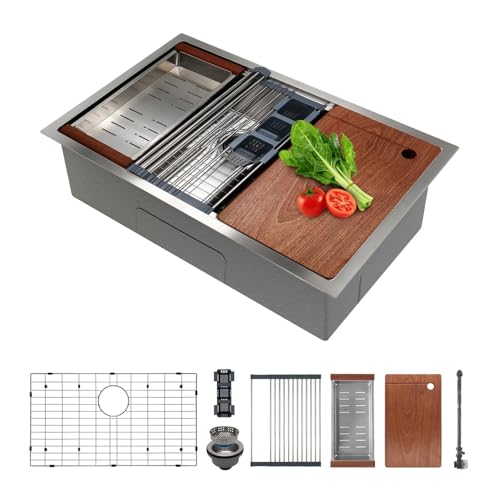
The six sinks below are the pool this guide to best large kitchen sinks was built from. Five are genuinely large bowls — 30 and 32 inches of undermount stainless steel — and link to their Amazon listings so you can check the latest price on Amazon and confirm the dimensions against your cabinet. One pool product, a 28-inch sink, falls below the size class this search means by large, so it is covered honestly in prose only, with no sales link and no image, and its review explains the call.
- KRAUS KWU110-32 Workstation Undermount Sink
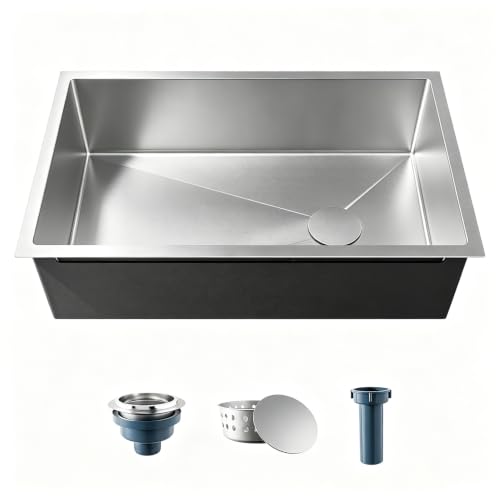
- KRAUS KHU100-32 Undermount Kitchen Sink
- SANYCASA 30 Inch Undermount Workstation Sink
- KRAUS KHU100-30 Undermount Kitchen Sink
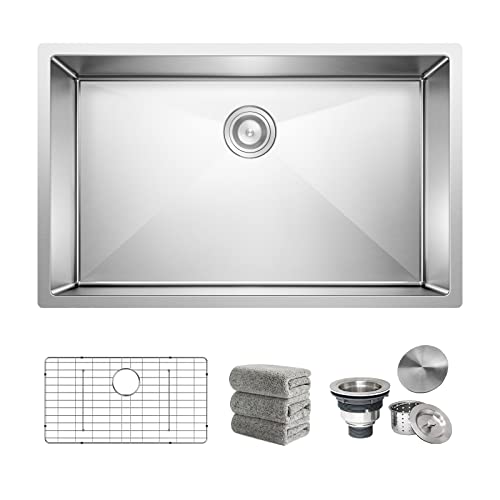
- cozhao 30 Inch Undermount Kitchen Sink
- MAYESAR 28 Inch Undermount Kitchen Sink (covered prose-only in this guide — see its review for why)
Read the full guide ↓ for what “large” should actually mean when you measure it, and for the cabinet maths that decides whether a big bowl will work in your kitchen.
Shopping for the best large kitchen sinks starts with a translation problem. “Large” on a listing is a headline width, but the largeness you live with is interior and three-dimensional: the flat floor area that decides whether a roasting pan lies down or perches, the depth that decides whether a stockpot fills without drama, and the clear opening that decides whether a grill grate goes in at all. A 32-inch bowl with a workstation ledge can offer less clear width than a plain 30-inch bowl; a deep 28-inch sink can hold more water than a shallow 30. This guide therefore ranks by usable size, not by the biggest number — and it is honest about the one pool product whose 28 inches, however deep and well made, do not earn the word large.
The five linked picks are all undermount stainless single bowls in the 30 to 32-inch class, which is where large sinks live for standard American cabinetry: big enough to change how cleanup feels, small enough to install without rebuilding the kitchen. Within that class you will find two distinct philosophies — workstation designs that add a working ledge over the bowl, and plain bowls that give every inch to washing — plus the Kraus drainage and sound engineering that keeps a big steel box from sounding like one. Measure your cabinet and your largest pan before you read the reviews; those two numbers will tell you which philosophy is yours. Readers still calibrating what size their kitchen really is will find the range discussion at Best Large Small Kitchen Sinks a useful companion.
Key Takeaways
- Judge large by usable interior — flat floor area, depth, and clear opening — not by headline width alone.
- The practical large class for standard cabinets is 30 to 32 inches; both sizes appear among the linked picks here.
- Workstation ledges add prep function but narrow the clear opening, so check your widest pan against the space below the ledge.
- Heavy-gauge steel matters more as bowls grow: the 16-gauge picks resist the flex and drum effect that size amplifies.
- A 28-inch sink, even a deep and well-made one, is a compact-class product — the MAYESAR here is covered prose-only for exactly that reason.
- Single bowls make large sinks useful: one unobstructed space takes sheet pans, roasting pans, and tall pots flat.
In this guide
Quick Picks
| Pick | Badge | Size and mount | Standout detail | Link |
|---|---|---|---|---|
| KRAUS KWU110-32 Workstation Undermount Sink | Best Overall | 32 inch, undermount | Integrated ledge, cutting board and roll-up rack included | Check on Amazon |
| KRAUS KHU100-32 Undermount Kitchen Sink | Best for Batch Cooking | 32 inch, undermount | 16 gauge TRU16 steel, channel grooves, NoiseDefend pads | Check on Amazon |
| SANYCASA 30 Inch Undermount Workstation Sink | Best Workstation at 30 Inches | 30 inch, undermount, single bowl | Integrated ledge workstation, 11 gauge (3mm) steel per listing | Check on Amazon |
| KRAUS KHU100-30 Undermount Kitchen Sink | Best for Standard Cabinets | 30 inch, undermount | 16 gauge TRU16 steel, channel grooves, NoiseDefend pads | Check on Amazon |
| cozhao 30 Inch Undermount Kitchen Sink | Best Simple Large Bowl | 30 inch, undermount, single bowl | 304 stainless steel, drain assembly included | Check on Amazon |
| MAYESAR 28 Inch Undermount Kitchen Sink | Deep Compact Alternative | 28 x 18 inch, undermount, single bowl | 16 gauge steel, 9 inch deep handmade bowl | Prose-only in this guide |
How These Picks Were Chosen
Each product in the research pool was verified through the site’s research pipeline against its Amazon listing — brand, dimensions, gauge, mounting type, bowl configuration, and included parts confirmed from the listing itself — and only confirmed details appear in the spec boxes below. The verified pool was then ranked for this specific job: being large in the ways a household can feel. Headline width was the entry ticket, with 30 inches as the floor of the large class for a main kitchen sink; usable interior, depth where the listing states it, steel gauge, drainage design, and sound treatment decided the order among the qualifiers.
One product did not clear the size floor. The MAYESAR measures 28 by 18 inches: a well-specified sink — 16-gauge steel, a full 9 inches of depth, handmade construction — but 28 inches is the compact class, the size bought precisely because a kitchen cannot take a large bowl. Under this site’s standing rule, a pick that fails the keyword’s core attribute is reviewed in full prose without a link or an image, with the reason stated in its review. That is not a punishment; it is how a size-specific guide keeps its promise. Readers who came here with a smaller cabinet than they admitted may find the MAYESAR’s review the most useful one on the page — but they will find it labelled honestly.
Method, plainly: this is research-led guidance from verified specifications and owner-feedback patterns, not from a test kitchen, and no dimension or feature appears here that the listing did not confirm. Where a listing does not state a depth, the spec box omits depth rather than estimating it. The ranking favours the KWU110-32 workstation for most large-kitchen readers because it converts width into workflow, with the plain-bowl KHU100-32 immediately behind it for households that want width for washing alone. If your definition of large is really about presence and finish as much as capacity, the browsing at Best Luxury Kitchen Sinks approaches the same top end of the market from the design side.
The 6 best large kitchen sinks, reviewed one by one
Five large linked picks in ranked order, then the compact alternative covered prose-only. Each review gives confirmed specs, three strengths, three trade-offs, and a verdict.

KRAUS KWU110-32 Workstation Undermount Sink
Badge: Best Overall
Strengths
- A full 32 inches of bowl plus an integrated ledge, so the sink works as prep station and wash basin in one footprint.
- Cutting board and roll-up rack are included — the ledge arrives usable, not theoretical.
- 16-gauge TRU16 steel with NoiseDefend soundproofing keeps a big bowl feeling and sounding substantial.
Trade-offs
- The ledge narrows the clear top opening; measure your widest pan against the space below it.
- Board and rack need cabinet storage on days you want the whole bowl open.
- It asks for a wide cabinet and a cook who will actually use the workstation workflow.
- Mount: undermount
- Material: stainless steel, 16 gauge TRU16
- Size: 32 inch
- Feature: integrated ledge for accessories
- Included: cutting board, roll-up rack
- Sound: NoiseDefend soundproofing
Large sinks earn their footprint in one of two ways: by washing bigger things, or by doing more jobs. The KWU110-32 does both, which is why it leads this guide. The bowl itself is a proper 32-inch single space, but the integrated ledge is the multiplier — the included cutting board rides over the bowl for prep, scraps push straight down, and the roll-up rack turns the far half of the sink into a draining surface for produce and glassware. In a kitchen where the sink run is also the prep run, that workflow reclaims counter you would otherwise surrender to boards and drying towels, and it keeps water and mess over the bowl instead of across the counter.
Kraus builds the concept on the right foundations: TRU16 steel at 16 gauge, so the big flat surfaces do not flex or drum, and NoiseDefend treatment so a bowl this size does not announce every rinse to the whole ground floor. The planning point is the ledge geometry. The clear opening below the ledge is what your largest pan must fit through and sit under, so measure that pan and read the listing’s dimensions with the ledge in mind. Households that prep daily will forgive the small storage question the accessories raise; households that mostly wash up after simple meals may find the plain bowl below simpler. For the cooking-centred kitchen, though, this is the large sink that gives the most back per inch.
Best for: keen cooks with wide cabinets who want prep and washing in one large footprint / Not suited for: buyers who want maximum clear opening and no accessories to store

KRAUS KHU100-32 Undermount Kitchen Sink
Badge: Best for Batch Cooking
Strengths
- Thirty-two unobstructed inches — no ledge, no divider — so the largest pans and trays lie completely flat.
- 16-gauge TRU16 steel with channel grooves that guide water to the drain across a wide floor.
- Rounded corners and NoiseDefend pads keep a big bowl cleanable and quiet.
Trade-offs
- Filling it for a soak uses real water; a big bowl is a commitment every time you run the faucet.
- Needs a wide cabinet and a counter run that can spare the width.
- No accessories headline — check the box contents for drain parts before install day.
- Mount: undermount
- Material: stainless steel, 16 gauge TRU16
- Size: 32 inch
- Drainage: channel grooves
- Corners: rounded, for easy cleaning
- Sound: NoiseDefend pads
If the workstation above is width as workflow, the KHU100-32 is width as capacity, and for many households that is the purer answer. This is the sink for the Sunday sauce pot, the holiday roasting pan with its rack, the preserving kettle, the grill grate in July — the items that define whether a kitchen sink is an appliance or a bottleneck. Everything goes in flat, everything soaks without a balancing act, and a full day of cooking produces a stack the bowl can hold below the counter line while the kitchen stays presentable. The channel grooves matter more at this size than any other: a 32-inch flat floor without drainage shaping holds a sheet of water after every rinse, while a grooved floor quietly sends it home.
The ownership costs are the honest arithmetic of size. Big bowls take longer to fill, longer to wipe, and more storage beneath them disappears into plumbing geometry. A household of one or two that cooks simply may use a tenth of this capacity and feel the rest as echo. But for family kitchens and batch cooks — the readers this search mostly serves — the KHU100-32 is the straightforward pinnacle: the biggest plain bowl in the guide, in the heaviest steel class, with the drainage and sound details handled. It is also the natural reference point for the divider debate at Best Low Divide Kitchen Sinks: this is what you give a divider up to get, and what a divider gives back in exchange.
Best for: family kitchens, batch cooks, and anyone whose largest pans currently perch at an angle / Not suited for: small households or narrow cabinets
SANYCASA 30 Inch Undermount Workstation Sink
Badge: Best Workstation at 30 Inches
Strengths
- Workstation function — integrated ledge, multifunctional set concept — at 30 inches, for cabinets that cannot take the 32-inch Kraus.
- The listing claims 11-gauge (3mm) steel, a thickness beyond the category’s usual heavy class.
- Single bowl layout keeps the washing space unobstructed below the ledge.
Trade-offs
- Thirty inches is the floor of the large class — genuine, but with less margin than the 32-inch picks.
- The ledge narrows the clear opening, as with any workstation design.
- A younger brand in this category, without Kraus’s depth of long-term owner history.
- Mount: undermount
- Material: stainless steel, 11 gauge (3mm) per listing
- Configuration: single bowl
- Size: 30 inch
- Feature: integrated ledge, multifunctional workstation set
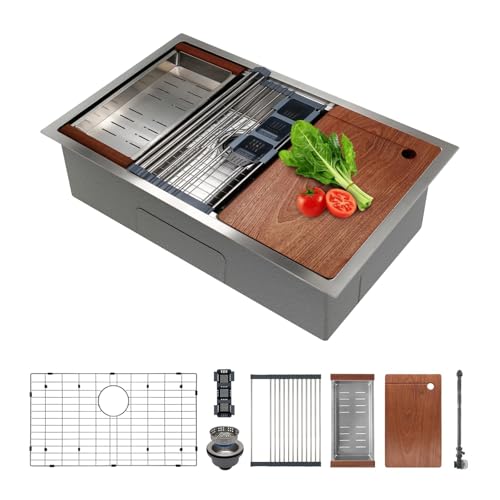
The SANYCASA answers the most common large-sink frustration: the kitchen wants workstation function, but the cabinet is a standard 30-inch-class cabinet and the 32-inch workstations simply do not fit. Its answer is to compress the concept — an integrated ledge and a multifunctional workstation set built around a 30-inch single bowl. The prep-over-the-bowl workflow survives the downsizing intact: board over the bowl, scraps down, rack for draining. For apartment-sized kitchens and standard remodels, that is a real capability gain over a plain bowl of the same size, and the listing’s thickness claim, if it holds in the hand, describes a bowl of unusual solidity.
Hold two cautions alongside the appeal. First, 30 inches with a ledge means the clear washing width below the ledge is the dimension to verify against your widest pan — the workstation trade is always clearest at the smaller size. Second, brand maturity matters in a product you install semi-permanently: Kraus’s long owner record is evidence, and a newer name asks you to weight specification claims more heavily because history is thinner. Neither caution cancels the concept. If your cabinet caps you at 30 and your cooking wants a ledge, this is the pick in the guide designed for exactly that intersection.
Best for: standard-cabinet kitchens that want workstation function at 30 inches / Not suited for: buyers who want the maximum clear bowl width at this size

KRAUS KHU100-30 Undermount Kitchen Sink
Badge: Best for Standard Cabinets
Strengths
- The full Kraus formula — 16-gauge TRU16 steel, channel grooves, rounded corners, NoiseDefend pads — at the size standard cabinets take.
- Thirty inches still crosses the flat-landing threshold for sheet pans and large skillets.
- The most template-friendly large sink here: fabricators and accessory makers build around this class.
Trade-offs
- Two inches narrower than the guide’s leaders — the very largest roasting setups will feel it.
- A bowl-first purchase; confirm drain and accessory contents before install day.
- No ledge, so prep happens on the counter, not over the bowl.
- Mount: undermount
- Material: stainless steel, 16 gauge TRU16
- Size: 30 inch
- Drainage: channel grooves
- Corners: rounded, for easy cleaning
- Sound: NoiseDefend pads
Most large-sink searches end here, and rationally so. Thirty inches is large where it counts — flat sheet pans, tall pots, a family dinner’s worth of dishes stacked below the rim — while remaining the size that the standard American sink cabinet, the standard counter run, and the standard accessory market are all built around. The KHU100-30 executes that size with the category’s most complete specification: heavy TRU16 steel, a grooved floor that dries itself, corners that wipe in one pass, and sound treatment that keeps an open-plan room civilised. There is no experiment in this purchase, and for a component you will use a hundred times a day for fifteen years, that is a compliment.
Its place in this ranking — below the two 32-inch Kraus designs — is purely about the keyword. Asked for large, a guide should lead with the largest capable options, and both 32-inch models are excellent. But plenty of readers will measure their cabinets, find the standard width, and arrive at this sink as the largest they can honestly install; for them it is not the fourth pick but the answer. If that is your kitchen, buy this class with confidence and spend the saved counter width on prep space. The upkeep profile is as simple as the design — the routine at Best Low Maintenance Kitchen Sinks applies to this bowl almost word for word.
Best for: standard-cabinet kitchens that want the largest low-risk bowl and Kraus’s full specification / Not suited for: buyers with wide cabinets who would use the extra two inches daily

cozhao 30 Inch Undermount Kitchen Sink
Badge: Best Simple Large Bowl
Strengths
- 304 stainless steel in a handmade, modern single bowl at the versatile 30-inch size.
- Drain assembly included, removing the most common separate purchase.
- Clean, squared handmade lines suit contemporary kitchens that want the sink to look architectural.
Trade-offs
- 18-gauge steel — lighter and brighter-sounding than the 16-gauge Kraus picks under load.
- No ledge, grid, or sound-treatment headline; it is the plainest specification among the linked picks.
- Squared handmade corners need a touch more attention when wiping than rounded designs.
- Mount: undermount
- Material: 304 stainless steel, 18 gauge
- Configuration: single bowl
- Size: 30 inch
- Included: drain assembly
- Style: handmade, modern
The cozhao is the large sink for minimalists: a 30-inch handmade bowl in 304 stainless, a drain assembly in the box, and nothing else competing for your attention. Its squared geometry gives the fullest flat floor in its size class — handmade walls stand closer to vertical than pressed bowls, so more of the 30 inches is working floor — and the modern lines pair naturally with flat-front cabinets and stone counters. For a household whose washing is ordinary in volume but regular in rhythm, this is large enough, honest enough, and simpler to buy than anything above it in the ranking.
The trade is refinement. At 18 gauge the bowl will sound and feel lighter than the TRU16 Kraus models when heavy cookware lands, and there is no named sound system or drainage groove pattern to compensate — the floor relies on its slope and your wiping. Buyers who run a disposal hard or cook with cast iron daily should weigh the Kraus picks first. Buyers who want the size, the alloy, and the look without paying for engineering they will not notice have found their sink. It is the value-tier expression of large in this guide, stated qualitatively because that is the honest way to state it: check the listing for the current figure and judge the specification against it.
Best for: minimalist kitchens that want a full-size handmade bowl and an included drain, simply specified / Not suited for: heavy-disposal, cast-iron-daily households that need maximum gauge
MAYESAR 28 Inch Undermount Kitchen Sink
Badge: Deep Compact Alternative
Covered prose-only: at 28 inches wide, this sink sits in the compact class rather than the large class this keyword describes, so it carries no Amazon link or image in this guide. It is reviewed in full because depth-seekers with smaller cabinets will want to know it exists.
Strengths
- A full 9 inches of depth — deeper than the headline dimensions of several larger picks — in 16-gauge steel.
- Handmade construction with a brushed finish and rounded corners that clean easily.
- Its depth contains splashing and hides stacked dishes below the counter line in small kitchens.
Trade-offs
- Twenty-eight inches is not large: full-size sheet pans sit at an angle rather than flat.
- Depth trades against reach — shorter users work further down into this bowl.
- It solves a compact-kitchen problem, which is a different problem from this keyword’s.
- Mount: undermount
- Material: stainless steel, 16 gauge
- Configuration: single bowl
- Size: 28 x 18 inch
- Depth: 9 inch
- Finish: brushed, round corner design
There is a version of “large” that means volume rather than width, and the MAYESAR is its best argument in this pool. Nine inches of depth in a 28-inch bowl holds a surprising amount of kitchen: a day of dishes disappears below the counter line, a tall pot fills without spray escaping, and the 16-gauge walls give the whole thing a planted, quality feel that many wider, thinner sinks lack. In a galley kitchen, a condo, or an older home whose cabinets simply refuse a 30-inch bowl, this sink delivers the sensation of capacity that large-sink shoppers are chasing, inside a footprint they can actually install.
But words in a search have to keep their meanings, and by width — the dimension that decides flat-landing for the pans this keyword’s readers own — 28 inches is the compact class. A guide that linked this sink under “large” would be spending the reader’s trust to fill a table. So it stands here in prose, recommended sincerely to the kitchens it fits and labelled clearly as not-large for the kitchens it does not. If your tape measure brought you to this review with relief, your search was never really for a large sink; it was for the most capable compact one, and the retail shelf at Best Lowes Kitchen Sinks is among the places that category is shopped hardest.
Best for: compact kitchens that want maximum depth and heavy-gauge feel in a 28-inch footprint / Not suited for: this keyword’s core need — flat-landing width for large cookware
Comparison Table
| Sink | Badge | Size | Gauge | What stands out | Link |
|---|---|---|---|---|---|
| KRAUS KWU110-32 Workstation | Best Overall | 32 inch | 16 gauge TRU16 | Ledge, board, roll-up rack | Check on Amazon |
| KRAUS KHU100-32 | Best for Batch Cooking | 32 inch | 16 gauge TRU16 | Unobstructed bowl, channel grooves | Check on Amazon |
| SANYCASA 30 Workstation | Best Workstation at 30 Inches | 30 inch | 11 gauge (3mm) per listing | Workstation ledge at standard size | Check on Amazon |
| KRAUS KHU100-30 | Best for Standard Cabinets | 30 inch | 16 gauge TRU16 | Full Kraus specification, standard fit | Check on Amazon |
| cozhao 30 Inch | Best Simple Large Bowl | 30 inch | 18 gauge, 304 steel | Handmade bowl, drain included | Check on Amazon |
| MAYESAR 28 Inch | Deep Compact Alternative | 28 x 18 inch, 9 inch deep | 16 gauge | Depth in a compact footprint | Prose-only |
How to Choose the Right Kind of Large
Start with the two measurements that cannot be argued with later. First, the cabinet: measure its interior width and depth, and remember that an undermount bowl needs mounting room beyond its own footprint, plus space beneath for the drain, a disposal if fitted, and the bins every modern kitchen stores there. As a working rule, the cabinet should be several inches wider than the bowl. Second, the pan: measure the widest item you wash weekly — not the turkey roaster you use twice a year, the tray or skillet that defines your ordinary worst case — and decide whether it must lie flat. Those two numbers bracket your choice: the cabinet sets the ceiling, the pan sets the floor, and the picks in this guide cover the honest range between 30 and 32 inches.
Next, choose your philosophy of large. A plain bowl, like the KHU100-32, gives every inch to washing and soaking; nothing interrupts the space, and nothing helps you organise it either. A workstation, like the KWU110-32 or the 30-inch SANYCASA, trades a slice of clear opening for a ledge that turns the sink into a prep surface — the right trade for cooks who prep where they wash, the wrong one for households whose sink is purely a cleanup zone. A grid, added to any plain bowl, splits the difference by creating a second level for draining without narrowing the opening. There is no philosophy that wins in general; there is only the one that matches the hour of the day your sink works hardest.
Then respect gauge more as size grows. A large bowl is a large resonating surface and a large lever for flex: thin steel that feels acceptable at bar-sink size can feel tinny at 32 inches. The 16-gauge construction of the Kraus picks and the unusual thickness claimed by the SANYCASA are not luxuries at this scale; they are what keep a big bowl feeling like a fixture instead of a container. Sound treatment follows the same logic — the larger the bowl, the more NoiseDefend-style padding earns its place. Finally, plan the faucet with the bowl: a deep, wide sink needs a spout that reaches toward the bowl’s centre and a spray that can sweep the corners, or the far half of your large sink becomes a place you rinse by hand with a cup, which defeats the point of buying it.
How to Install and Live With a Large Undermount Sink
Installation scales with size, and the steps reward care. Confirm the cabinet and support first: a large bowl full of water and cookware is the heaviest load in the kitchen, and it should hang from a proper system of clips, rails, or a cradle tied into the cabinet — never from sealant and optimism. Dry-fit the bowl to the cutout, check the reveal evenly, and verify the drain and disposal geometry before anything is sealed, because correcting plumbing under a 32-inch bowl after the fact is work done in a smaller, darker space than you would choose. Set the bowl, connect everything, fill it, and inspect every joint with a dry hand before the first real load.
Living with a large sink is a rhythm adjustment. You will fill it less often for small jobs — a quick rinse under the faucet replaces the half-full bowl habit — and value it completely when the big jobs arrive. Keep a grid or a small basin for the single-mug moments if the bowl’s scale makes them feel wasteful. Clean with the grain using a soft cloth and mild detergent, work the grooves and corners on a weekly pass, and dry the floor after the last use if your water is hard; large flat floors show mineral film across a wider canvas, so the dry-wipe habit pays double here.
Accessories deserve a plan at this size, because large bowls invite them. A bottom grid sized to the bowl protects the floor from the heavy cookware large sinks attract, and it creates the second level that makes a single bowl feel organised; buy it by the bowl’s flat-floor measurement, not its headline. A roll-up rack — included with the workstation leader in this guide — earns its place over a wide bowl more than anywhere else, turning dead air above the sink into draining space. And a simple in-sink basin for small-item washing keeps a 32-inch bowl from feeling wasteful on a Tuesday night. None of these change the sink; all of them change the week.
Three common problems, and what to do. Problem: water pools in the far corner after rinsing → check the bowl is level on its mounts and clean the drainage grooves; residue film slows water more than slope does. Problem: the bowl feels echoing or drummy → confirm nothing stored beneath presses against the underside, defeating the sound pads, and consider a grid, which damps cookware contact noticeably. Problem: the workstation ledge feels like it steals space → live with the board stored for a week of plain-bowl use; if the bowl works better bare, the ledge still serves as a rest for a draining rack, and the accessories can live in a cabinet without penalty.
Large Sinks and the Rest of the Kitchen
A large sink reorganises its neighbourhood. Counter space on at least one side becomes the landing zone for dirty items entering and clean items leaving, and the dishwasher’s distance from the bowl suddenly matters — a large sink beside the dishwasher is a system; a large sink across the room from it is a commute. Under the counter, the bowl’s depth and the disposal compete with pull-out bins, and in many kitchens choosing the 32-inch bowl means choosing the slimmer bin system. None of these are arguments against size; they are the planning questions size asks, and a household that answers them in advance gets the generous sink of the photographs rather than a large bowl in a kitchen that fights it.
There is also an aesthetic proportion to respect, which is why the finish-led browsing at Best Looking Kitchen Sinks pairs naturally with this guide. A wide bowl under a window or centred on an island reads as the kitchen’s workstation and anchor; the same bowl squeezed between a range and a fridge reads as a crowd. Stainless single bowls carry their size gracefully because their lines are quiet — the bigger the sink, the more that quietness matters, and the more a brushed, well-proportioned bowl outperforms a merely enormous one.
Width, Depth, and Volume: Reading a Large Sink’s Three Numbers
Every large sink is really three numbers wearing one headline, and learning to separate them is the whole skill of shopping this category. Width is the number listings lead with, and it governs flat-landing: whether the sheet pan, the roasting rack, and the grill grate go in level. Depth is the number listings sometimes hide, and it governs containment: whether a day of dishes stacks invisibly, whether a tall pot fills calmly, whether faucet splash stays where it belongs. Volume — the product of the two, tempered by how vertical the bowl’s walls stand — is the number nobody prints, and it governs the feeling owners describe as the sink “swallowing” a cleanup. A handmade bowl with near-vertical walls, like the cozhao in this guide, keeps more of its headline width as working floor than a pressed bowl with sloping sides, which is why two sinks with identical headlines can live very differently.
The practical method is to shop with your three worst items in mind. Name the widest thing you wash weekly and let it set the width floor. Name the tallest thing you fill monthly and let it sanity-check the depth and the faucet height above the bowl. Name the biggest cleanup your household produces — the holiday, the preserving day, the barbecue aftermath — and let it judge whether the bowl’s volume is honest. Run those three tests against every pick in this guide and the ranking mostly performs itself: the 32-inch bowls pass all three for family kitchens, the 30-inch bowls pass them for standard ones, and the deep 28-inch prose-only pick passes the second and third while honestly failing the first. That is not a flaw in the sink; it is the definition of its class.
One more number deserves respect because it is the one that cannot be changed later: the cabinet. Counters can be re-cut only at serious cost, cabinets effectively never, so the large sink you buy is the large sink your cabinet geometry permits — and within that permission, buy the fullest bowl your pans justify. Undersizing a sink to be safe is the quiet regret of this category; oversizing it past the cabinet is the loud one. Measure twice, in the cabinet and at the pan rack, and the middle path picks itself.
Common Buying Mistakes
The first large-sink mistake is measuring the counter instead of the cabinet, and discovering the bowl’s home does not exist. Second is buying headline width while ignoring the ledge: a workstation’s clear opening, not its rim, decides what fits. Third is forgetting depth in both directions — the reach down into the bowl, and the storage and disposal space the bowl consumes below. Fourth is under-speccing gauge at large sizes, where thin steel flexes and drums. Fifth is pairing a wide, deep bowl with a short-reach faucet that cannot serve its far half. Sixth is assuming bigger is automatically better for a small household, and spending counter, water, and cabinet space daily on capacity used monthly. Seventh — the one this guide’s prose-only review exists to prevent — is accepting a compact sink wearing a large headline and discovering the substitution with a roasting pan in your hands.
Large Sinks in Open-Plan Homes
One context has quietly redefined what a large sink is for: the open-plan kitchen, where the sink no longer hides in a work room but performs in the household’s main living space. In that setting a large bowl earns its size socially as much as functionally. During a gathering, the wide single bowl becomes the kitchen’s buffer — glasses, platters, and preparation debris collect below the counter line, out of the sight lines of guests, while the counter stays composed. The workstation leader in this guide extends the idea furthest, letting prep happen over the bowl while conversation happens across the island, with nothing but finished dishes crossing the counter. Hosts who cook for company feel this benefit more than any measurement on a spec sheet.
Open-plan life also raises the standard the sink must meet in the other senses. Sound carries in a joined kitchen-living space, which is why the sound treatment on the Kraus picks is not a luxury at this size — a 32-inch bowl without padding is an instrument the whole room hears. Sight lines matter the same way: a large bowl is visible from the sofa, so its finish, its grid or ledge line, and its state of tidiness are part of the room’s furniture whether you planned it or not. The households that love their large sinks in open plans are the ones that chose them as room elements — proportioned to the island, quiet in construction, and easy to reset to empty and gleaming in one pass at the end of the evening.
Final Recommendation
For most large-kitchen readers, the KRAUS KWU110-32 Workstation is the large sink that gives back the most: 32 inches, heavy TRU16 steel, and a ledge system that turns washing space into working space. If your priority is pure unobstructed capacity, take the KRAUS KHU100-32 instead. If your cabinet is standard width, the SANYCASA 30 Inch Workstation brings the ledge concept down to your size, and the KHU100-30 remains the low-risk Kraus classic at 30 inches. Whichever you choose, let the cabinet and the pan — measured, not guessed — have the final word.
Frequently Asked Questions
What size counts as a large kitchen sink?
In practice, the large class for a main kitchen sink starts at 30 inches and runs through the low thirties: wide enough to lay sheet pans and roasting pans flat, in cabinets of standard or generous width. Below 30 inches you are in compact territory — which is why the 28-inch sink in this pool is covered prose-only rather than linked as a large pick.
Will a 32-inch sink fit my existing cabinet?
Only if the cabinet’s interior width exceeds the bowl by enough to allow mounting hardware and plumbing — as a rule, several inches beyond the bowl. Measure the interior, not the door front, and compare it with the sink’s stated dimensions before ordering. If the interior says no, the 30-inch picks in this guide are the largest honest fit.
Does a workstation ledge make a large sink smaller?
It narrows the clear top opening, because accessories ride on a shelf inside the rim — so the dimension that matters for your widest pan is the clear space below the ledge, not the headline width. In exchange, the ledge adds a prep and draining surface over the bowl. Cooks who prep at the sink gain more than they lose; pure wash-up households may prefer a plain bowl.
Is a single bowl or a double bowl better at large sizes?
Single bowls make large sizes useful: one unobstructed space that takes the largest items flat, which is the entire point of going large. Every linked pick here is a single bowl. Double bowls divide the width into compartments neither of which fits the big items as well, though some households value the separation for soaking and rinsing routines.
Why does gauge matter more in a large sink?
Because size amplifies everything thin steel does badly. A wide, flat floor flexes more under load and resonates more under a faucet or disposal, so the 16-gauge construction of the Kraus picks — and sound padding alongside it — keeps a large bowl feeling solid and sounding calm. At small sizes the difference is subtle; at 32 inches it is the character of the sink.
How deep should a large sink be?
Deep enough to contain your tallest regular items and the splash of your faucet, without forcing a long reach for shorter users. The one depth stated in this pool is the prose-only MAYESAR’s 9 inches, which shows the trade clearly: depth is valuable, but it cannot substitute for width when the job is laying large cookware flat. Judge depth and width together, against your pans and your household’s heights.
What should I check before ordering a large undermount sink?
Cabinet interior width and depth; the support system the bowl will hang from; your widest pan against the bowl’s clear interior (below any ledge); faucet reach against the bowl’s centre; what drain parts are included in the box; and the under-sink space left for a disposal and bins. Every one of those checks is free on paper and expensive in person.