Disclosure: topratedkitchenware.com is reader-supported. When you buy through links on our site, we may earn an affiliate commission from Amazon and other retailers, at no extra cost to you.
Where to buy
The best long lasting kitchen faucets are not the ones with the longest feature lists — they are the ones whose wear parts are standard, whose materials are documented, and whose makers will still answer for them in ten years. The six picks below were ranked on exactly that evidence: body materials, cartridge types, certifications, and the serviceability signals hidden in their verified listings.
- WEWE Touchless Kitchen Faucet with Soap Dispenser Set — Best Overall. Check on Amazon
- GIMILI Matte Black Touchless Kitchen Faucet — Best Touchless Spring Design.
- VFAUOSIT Kitchen Faucet with Pull Down Sprayer — Best Fast Install.
- WEWE High-Arc Pull-Down Kitchen Faucet — Best Documented Durability Stack.
- FORIOUS Kitchen Faucet with Pull Down Sprayer — Best Classic Value.
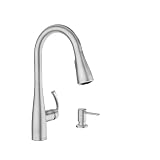
- Moen Essie Pulldown Kitchen Faucet, 87014SRS — Best Brand Support.
Read the full guide ↓
A kitchen faucet is the hardest-worked valve in the house. It cycles on and off dozens of times a day, swings, flexes, heats, cools, and gets cleaned with whatever is under the sink — and the best long lasting kitchen faucets are simply the ones engineered for that arithmetic. Longevity is rarely about a single heroic material. It is a stack of unglamorous decisions: a cartridge that resists wear, a body that shrugs off corrosion, a hose that tolerates flexing, a spray face that can be cleaned instead of replaced, and a maker whose parts and documentation survive as long as the product does.
This guide ranks six current pull-down faucets against that stack, using verified listing data rather than marketing claims. Two are touchless designs, included with their electronic trade-offs stated plainly, because for many households a sensor faucet maintained knowingly will outlast a manual faucet maintained never. One is a mainstream brand model whose real feature is its support network. And two are value-tier designs whose documented materials — stainless bodies, proper certifications — argue they will be repaired rather than replaced when their first wear part tires.
A note on method before the picks: nobody can honestly promise a specific faucet a specific lifespan, and this guide does not. What research can do is identify which faucets are built from the parts that historically survive, sold by makers whose parts stay findable, in formats the industry knows how to service. That is the ranking below. Readers who want the strictest version of the materials argument should apply it as a personal filter while reading: documented metal construction first, everything else second — several picks here pass that stricter test too, and their reviews say so in as many words.
Key Takeaways
- Longevity is a stack: cartridge, body material, hose, spray face, and parts support. A faucet strong at all five outlasts a faucet spectacular at one.
- Ceramic cartridges and stainless bodies recur across this guide’s top picks because they are the best-documented wear answers in the industry.
- Hard water, not age, ends most faucets’ useful lives — through scale. Rub-clean nozzles and descale-friendly designs are longevity features in disguise.
- Brand support is a durability feature: a findable cartridge in year eight is worth more than an extra spray mode in week one.
- Touchless models trade an electronic lifespan for daily convenience. They belong in a longevity guide when their plumbing core is documented — as the top pick’s is.
- Every pick here is a single-handle pull-down, so the comparison is about evidence and serviceability, not format.
In this guide
Quick Picks
The short version, ranked by the durability evidence in each verified listing. Badges match the detailed reviews.
| Pick | Badge | Why it stands out | Listing |
|---|---|---|---|
| WEWE touchless set | Best Overall | SUS 304 body, ceramic cartridge, 360-degree swivel, plus a soap dispenser — the fullest documented stack. | Check on Amazon |
| GIMILI touchless | Best Touchless Spring Design | Sensor operation and a spring-held sprayer; convenience-forward, with electronic trade-offs stated. | Check on Amazon |
| VFAUOSIT pull-down | Best Fast Install | Lead-free with NSF 61/372 and cUPC marks, a 23-inch hose, and a claimed 10-minute tool-free install. | Check on Amazon |
| WEWE high-arc pull-down | Best Documented Durability Stack | SUS 304, ceramic cartridge, 20-inch reach, and rub-clean silicone nozzles for hard water. | Check on Amazon |
| FORIOUS pull-down | Best Classic Value | Stainless construction, classic high arc, and deck-plate flexibility at a value-tier positioning. | Check on Amazon |
| Moen Essie 87014SRS | Best Brand Support | A mainstream brand’s parts and documentation network in a spot-resistant finish. | Check on Amazon |
How These Picks Were Chosen
This is a research-led guide. We compared verified listing data across the current pull-down market and scored each model on the five stations where faucets actually age: the cartridge, the body, the hose system, the spray face, and the maker’s support footprint. Claims counted only when the listing’s own data made them — a stated SUS 304 body, a named ceramic cartridge, a published certification. Where a listing was silent, we said so in the review rather than filling the gap with optimism.
Two judgment calls shaped the list and deserve daylight. First, touchless models were not excluded. A sensor is undeniably one more system with its own lifespan, but a longevity guide that ignored how kitchens are actually being equipped would be preaching to a shrinking choir; instead, the touchless picks are reviewed with their electronic trade-offs explicit, and the top pick earned its place because its documented plumbing core — stainless body, ceramic cartridge — is as strong as any manual rival’s. Second, brand support was scored as a durability input, not a popularity contest. The Moen Essie’s verified data is the sparsest in this guide, yet its maker’s parts network is a real, rational longevity argument, and the review makes that case honestly rather than inflating its specification list.
What did not score: raw feature counts, finish fashion, and any claim a listing did not document. A faucet’s tenth spray mode has never extended its life by a day. Readers cross-shopping the hose-format angle will find the same evidence standards applied in Best Long Lasting Kitchen Pull Out Faucets, and those planning a full sink-area refresh can see how these durability picks sit among the style-led options in Best Looking Kitchen Faucets.
Finally, the honesty clause: all six picks are current-production faucets, and no guide can certify a decade of service for any of them. What we can certify is the evidence — and on the evidence available, these six give an owner the best odds, the best service paths, and the fewest dead ends.
The 6 Best Long Lasting Kitchen Faucets
WEWE Touchless Kitchen Faucet with Soap Dispenser Set
Badge: Best Overall
Strengths
- SUS 304 stainless body and ceramic cartridge — the core durability stack, documented
- Soap dispenser included, simplifying the deck’s daily chemistry
- 360-degree swivel, 3 spray modes, easy-clean nozzles
Trade-offs
- Sensor electronics add a lifespan the manual picks do not carry
- Power management becomes a small standing chore
- Fullest install in the guide — faucet, sensor, dispenser
Key specs (from verified listing data):
- Body: SUS 304 stainless steel
- Cartridge: Ceramic
- Operation: Touchless sensor
- Included: Soap dispenser set
- Swivel: 360 degrees
- Spray modes: 3
- Mounting: 1- or 3-hole fit
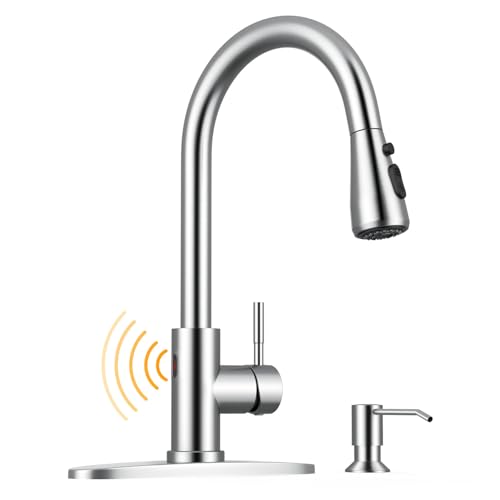
The top pick in a longevity guide has to survive an obvious objection — it is the touchless one — so let us meet it directly. This WEWE set’s verified listing documents a SUS 304 stainless steel body and a ceramic cartridge, which is the same foundational stack as the best manual faucets in this guide. The sensor sits on top of that foundation as a convenience layer. Judge the layers separately and the ranking makes sense: the plumbing is built to the standard this guide demands, and the electronics are a known, bounded trade-off that the review prices in rather than hides.
There is even a longevity argument for the sensor itself, and it is not a stretch. Handles and levers are wear points — they are grabbed with wet, gritty, detergent-filmed hands thousands of times, and their finishes and pivots age accordingly. A faucet that can be run without touching its controls spares its most-handled surfaces on the messiest days, which are precisely the days that age a kitchen fastest. The bundled soap dispenser extends the same logic: one refillable, deck-mounted dispenser replaces the rotating cast of pump bottles that scratch finishes and pool detergent at the faucet’s base.
The rest of the documented package supports daily durability in quieter ways. A 360-degree swivel spreads joint wear around the full circle instead of one habitual arc. Three spray modes cover the work without forcing any single mode into jobs it is bad at. Easy-clean nozzles acknowledge the hard-water reality that scale, not time, is the usual executioner. And the 1- or 3-hole fit means the faucet adapts to the deck you have, avoiding the forced compromises that shorten real-world service.
The costs are stated once more for the record: batteries or an adapter to manage, sensor hardware sharing under-sink space, and an electronic component no owner can service with plumbing parts. If those costs are disqualifying for you, this guide’s manual picks start two reviews down. If they read as a fair price for hands-free operation on a documented stainless core, this is the most complete long-term package in the pool.
Best for: households wanting touchless convenience without surrendering documented durability. / Not suited for: owners who want every component mechanically serviceable forever.
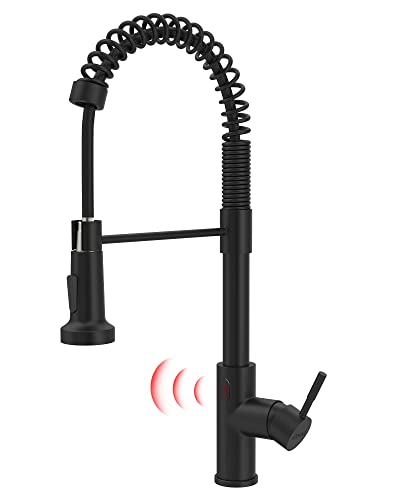
GIMILI Matte Black Touchless Kitchen Faucet
Badge: Best Touchless Spring Design
Strengths
- Spring-held sprayer is always docked at working height — no dock to wear loose
- Hands-free sensor spares the handle on the messiest days
- Matte black finish is a deliberate look that hides water spots well
Trade-offs
- Body material and cartridge type are not stated in the verified data
- Sensor lifespan is electronic, not mechanical
- Single-hole mounting narrows deck compatibility
Key specs (from verified listing data):
- Operation: Motion sensor, hands-free
- Sprayer type: Spring pull-down
- Mounting: Single hole installation
- Finish: Matte black
- Handle: Single
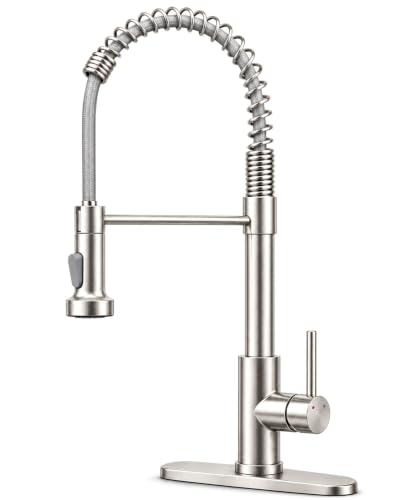
The GIMILI takes a different route to the longevity question, and this review grades it on a curve it sets itself. Its verified data does not document a body material or cartridge type — a real evidentiary gap that keeps it out of the top spot — but its design eliminates two of the most common wear complaints in the category by architecture rather than by materials. There is no sprayer dock to loosen, because the exposed spring is the dock, holding the head at working height indefinitely. And there is minimal handle wear, because the motion sensor runs the water on the days your hands are at their worst.
Think about how pull-down faucets actually age in busy kitchens. The head gets yanked, twisted, and slammed home; docks polish and loosen; the head begins to droop and dangle, and the faucet looks tired years before it leaks. A spring design sidesteps that entire biography. The head hangs in its cradle, visibly ready, and the spring — a simple, exposed, inspectable part — does the holding. Simple and exposed is a legitimate durability philosophy, and in a matte black farmhouse kitchen it happens to look striking while practicing it.
The sensor deserves the same two-sided treatment as the top pick’s, with one addition: because the verified data is thinner here, the sensor represents a larger share of what you are trusting. The listing promises hands-free smart control and single-handle temperature setting; it does not publish the plumbing-core documentation that would let a guide vouch for the decades. Buyers should treat the listing check as mandatory homework for this model — materials and cartridge details, if published anywhere, will be there.
So the GIMILI’s place in this guide is honest and specific: it is the longevity pick for buyers who believe design simplicity and reduced handling outlast specification sheets, in kitchens styled for its matte black finish — a finish, it should be said, that also hides the water spots brushed metals advertise, a point in its favor that the Best Looking Black Kitchen Faucets research makes at length. Everyone else should take the documented stacks above and below it.
Best for: matte black kitchens valuing dock-free, hands-free design simplicity. / Not suited for: evidence-first buyers — its core materials are undocumented in the pool data.

VFAUOSIT Kitchen Faucet with Pull Down Sprayer
Badge: Best Fast Install
Strengths
- Lead-free with NSF 61/372 and cUPC marks documented
- 23-inch retractable hose — generous travel for a compact faucet
- Cold-start safety and a claimed 10-minute tool-free install reduce setup errors
Trade-offs
- Body material and cartridge type are not stated in the verified data
- Sold as a bar sink faucet — compact format, secondary-sink ambition
- Newer-brand support footprint is unproven over a decade
Key specs (from verified listing data):
- Certifications: Lead-free, NSF 61/372, cUPC
- Hose: 23in retractable
- Spray modes: 3
- Safety: Cold-start
- Install: Claimed 10-minute tool-free
- Format: Bar sink faucet (per listing)
Longevity has an underrated first chapter: installation. A striking share of faucets that “fail early” were installed slightly wrong — cross-threaded by force, sealed against a dirty deck, hoses routed into a snag — and the VFAUOSIT’s verified package reads like a direct attack on that chapter. A claimed ten-minute tool-free install, cold-start safety that defaults the water cold, lead-free construction with NSF 61/372 and cUPC documentation: this is a faucet designed to be put in correctly by a non-plumber, which is a real, if unglamorous, durability strategy.
The certifications are the strongest part of its file. NSF 61/372 addresses drinking-water material safety and lead content; cUPC speaks to code compliance. Makers do not collect those marks casually, and their presence tells you the product passed through external testing regimes — the same regimes whose absence this guide notes on thinner listings. For a secondary sink in a bar or pantry, where this faucet is aimed, that paperwork plus a 23-inch retractable hose and three spray modes make a genuinely complete package.
Now the debits, which are about documentation rather than defects. The verified data does not state the body material or cartridge type, so the two longest-lived components are, from a researcher’s chair, unknowns. And the maker’s support footprint over a ten-year horizon is unproven in a way a mainstream brand’s is not. Neither fact makes this a bad faucet; both make it a calculated one, best suited to the secondary-sink role its listing describes, where the stakes of a year-eight parts hunt are a bar sink’s, not the main kitchen’s.
Placed in this guide, the VFAUOSIT is the honest middle: stronger paperwork than its price-class peers, thinner materials documentation than this guide’s leaders, and an installation story that may matter more to its real lifespan than either. If it is destined for a wet bar or a butler’s pantry, buy it with confidence in its documented virtues. If it is destined for the main family sink, the documented stacks elsewhere in this guide are the safer decade bet.
Best for: bar, pantry, and secondary sinks wanting certified, fast-install hardware. / Not suited for: a main-sink decade bet — core materials are undocumented.
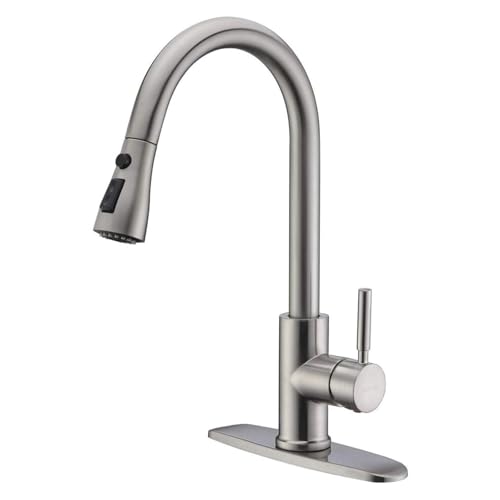
WEWE High-Arc Pull-Down Kitchen Faucet
Badge: Best Documented Durability Stack
Strengths
- SUS 304 body and ceramic cartridge, both documented
- Soft silicone nozzles descaled by touch — attacks the top real-world failure mode
- 20-inch documented reach and 360-degree swivel spread wear intelligently
Trade-offs
- High arc requires vertical clearance
- Brushed nickel shows spots between wipes
- Crowded model family — verify the exact listing before ordering
Key specs (from verified listing data):
- Body: SUS 304 stainless steel
- Cartridge: Ceramic
- Reach: 20-inch pull-down reach (stated)
- Swivel: 360 degrees
- Spray modes: 3
- Nozzles: Soft silicone, rub-clean
- Mounting: 1- or 3-hole fit
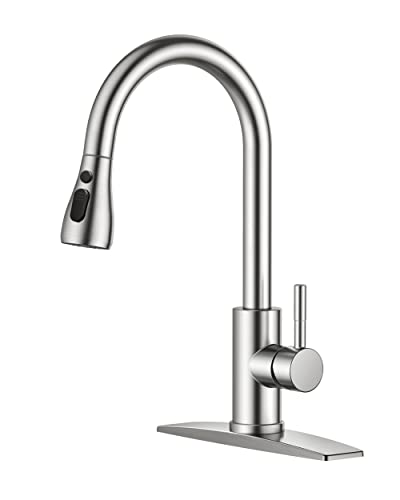
If this guide has a connoisseur’s pick, it is this WEWE high-arc model, because its verified listing documents not just the standard durability stack — SUS 304 stainless body, ceramic cartridge — but the details that decide how a faucet ages in real water. Chief among them: soft silicone nozzles that clear scale with a fingertip rub. Ask what actually ends kitchen faucets’ useful lives and the honest answer, ahead of leaks and drips, is scale-choked spray faces that owners tolerate, resent, and finally replace the whole faucet over. A spray face designed to be descaled in five seconds, mid-task, is a longevity feature of the first rank.
The mechanical documentation is equally complete. A stated 20-inch pull-down reach tells you the hose system was specced generously, and generous hose systems age better: less strain at full extension, a weight with room to travel, a head that docks without being forced the last inch. The 360-degree swivel distributes joint wear around the full circumference rather than engraving one habitual arc into the seals. Three spray modes mean no single mode is abused into every job. Each specification, read carefully, is a sentence about year five.
Daily life with it is straightforward modern pull-down life: single-handle control, a high arc that clears the stockpot, a sprayer that genuinely leaves the sink for the counter pot and the floor bucket. The 1- or 3-hole fit covers most decks, and the overall proportions suit main family sinks without apology — this is not a secondary-sink design moonlighting in the kitchen.
The caveats are practical rather than structural. The high arc needs vertical room beneath shelves and window trim. Brushed nickel shows its water spots honestly between cleanings. And the brand’s model family is crowded with similar names, so the final listing check — confirming this model’s stated reach and nozzles — is a genuine step. Buyers in hard-water districts, especially, should rank this pick at or near the top of their own lists; it is the only model here whose listing reads like it was written by someone who has descaled a faucet at midnight.
Best for: hard-water homes and buyers who rank by documented detail. / Not suited for: low-clearance decks or anyone who will not verify the exact variant.

FORIOUS Kitchen Faucet with Pull Down Sprayer
Badge: Best Classic Value
Strengths
- Stainless steel construction in a classic high-arc format
- Deck plate for 1 or 3 hole decks widens compatibility
- Simple, unfussy design language with fewer novelty systems to age
Trade-offs
- Cartridge type and spray specifics are not detailed in the verified data
- Brushed nickel finish needs ordinary spot care
- Brand support footprint is smaller than the mainstream pick’s
Key specs (from verified listing data):
- Body: Stainless steel
- Finish: Brushed nickel
- Spout: Classic high arc
- Mounting: Deck plate for 1 or 3 hole
- Handle: Single
- Use cases listed: Farmhouse, camper, laundry, RV, bar
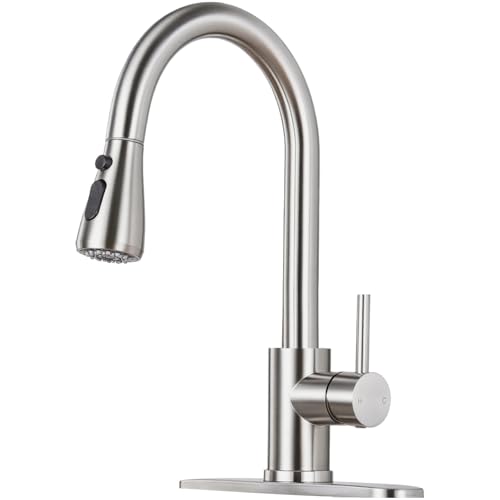
The FORIOUS is this guide’s classicist: a stainless steel, high-arc pull-down in brushed nickel, with a deck plate for 1 or 3 hole decks and a listing that also names farmhouse, camper, laundry, RV, and bar sinks. There is a durability philosophy in that plainness. Every system a faucet does not have is a system that cannot fail, and the FORIOUS’s spec sheet is a study in leaving things out — no sensor, no dispenser bundle, no novelty mechanism — while keeping the structural claim that matters, a stainless body, in writing.
The classic high arc is itself a longevity-friendly shape. It clears tall cookware without drama, keeps the sprayer’s docking geometry simple and vertical, and suits the deep traditional sinks that dominate the installed base. The deck plate extends that compatibility across the two standard deck drillings, which matters for a replacement faucet: the best longevity decision is wasted if the faucet cannot mount on the sink you actually own.
The listing’s spread of named environments deserves a second look, because it cuts both ways and this guide reads it as a net positive. A faucet positioned for campers and laundry rooms is a faucet expected to tolerate vibration, varied water, and light maintenance without complaint. In a main kitchen, that tolerance translates to a design with margin — the opposite of a delicate showpiece tuned for one perfect installation.
The evidentiary debits are real but bounded: the verified data does not detail the cartridge type or spray specifics, and the maker’s parts footprint is smaller than the mainstream brand’s below. Both argue for a careful listing check before ordering and for keeping the documentation afterward. Within those bounds, the FORIOUS is the value-tier classic of this guide — stainless where it counts, simple everywhere else, and priced in spirit for owners who would rather repair than replace. Budget-minded readers will find its philosophy echoed in Best Low Cost Kitchen Faucets, though few there document a stainless body as this one does.
Best for: traditional kitchens wanting stainless simplicity at a value-tier positioning. / Not suited for: buyers who need cartridge and spray details documented upfront.
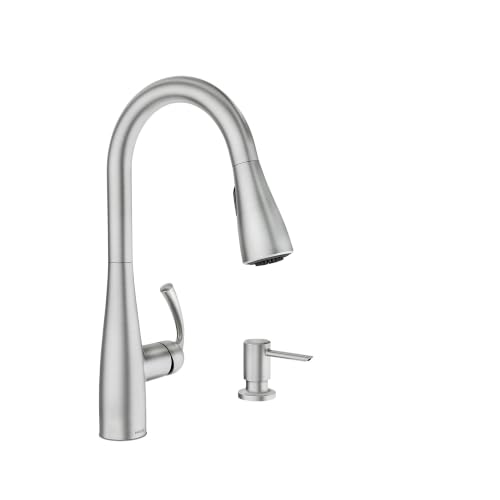
Moen Essie Pulldown Kitchen Faucet, 87014SRS
Badge: Best Brand Support
Strengths
- Mainstream brand parts, documentation, and warranty infrastructure
- Spot Resist Stainless finish minimizes visible spotting between cleanings
- Pulldown format from a maker plumbers know by model name
Trade-offs
- Verified pool data is the sparsest here — materials and cartridge are not spelled out
- Premium-tier positioning relative to the value picks
- Fewer documented modes and extras than the feature-led models
Key specs (from verified listing data):
- Model: Essie 87014SRS
- Finish: Spot Resist Stainless
- Sprayer type: Pulldown
- Brand: Moen
The Moen Essie closes this guide as the institutional pick, and its review is really about what happens in year eight. A drip develops. On an anonymous faucet, that drip begins a research project — identify the cartridge from photographs, find a seller, hope the part is real — and a meaningful share of those projects end in a full replacement because the faucet’s identity dissolved somewhere around year three. On a mainstream Moen, the model number on the box you kept leads to a documented cartridge, sold everywhere, with instructions. That difference is not marketing. Over a long enough life, it is the difference between a faucet that gets repaired and one that gets replaced.
The finish supports the same low-drama ownership. Spot Resist Stainless is formulated to show fewer spots and fingerprints, and while that sounds cosmetic, it changes maintenance behavior in a way that matters: owners clean faucets that look dirty, with whatever cleaner is nearest, and harsh improvised cleaning is a quiet finisher of finishes. A surface that looks clean longer gets cleaned gently, less often, and survives accordingly. Small behavioral loops like that are where real-world longevity is actually decided.
The pulldown format itself is the modern standard, executed by a maker with deep experience in exactly this mechanism — its docks, hoses, and weights are mature technology rather than first-generation experiments. For landlords, property managers, and anyone equipping a kitchen they will not personally maintain, that maturity plus the parts network is often the entire decision, and rationally so.
Honesty requires the counterweight paragraph. The verified pool data for the Essie is the sparsest in this guide: model and finish are confirmed, but body material and cartridge type are not spelled out in the data we were given, and its positioning is premium-tier beside value picks with fuller paperwork. If you shop purely by documented specification, rank it below the WEWE models. If you shop by total ownership — parts, documentation, dealer familiarity, finish behavior — the Essie is the pick that asks the least of the future, and for many kitchens that is the truest definition of long lasting.
Best for: landlords, long-term owners, and anyone who prizes parts support above paperwork. / Not suited for: spec-sheet maximalists — its pool data is the thinnest here.
Comparison Table
Only documented attributes appear here. A dash means the verified pool data does not state the attribute — which is itself information. No prices, no ratings.
| Model | Body (as documented) | Cartridge | Longevity signature | Listing |
|---|---|---|---|---|
| WEWE touchless set | SUS 304 stainless steel | Ceramic | Full stack plus sensor layer | Check on Amazon |
| GIMILI touchless | Not stated | — | Dock-free spring design | Check on Amazon |
| VFAUOSIT pull-down | Not stated | — | NSF 61/372 & cUPC documented | Check on Amazon |
| WEWE high-arc pull-down | SUS 304 stainless steel | Ceramic | Rub-clean nozzles; 20-inch reach | Check on Amazon |
| FORIOUS pull-down | Stainless steel | — | Classic simplicity; deck plate included | Check on Amazon |
| Moen Essie 87014SRS | — | — | Brand parts and support network | Check on Amazon |
How to Choose a Kitchen Faucet That Will Last
Interrogate the wear path, in order. The cartridge moves with every use and meters every drop, so its type is the first specification worth finding — ceramic is the documented durable standard in this class. The body faces your water chemistry for decades, so its material is the second — a stated stainless construction outranks any amount of finish poetry. The hose flexes daily and the spray face meets your water’s mineral content head-on, so reach, routing, and cleanability come third. Whatever is left — modes, finishes, electronics — is preference, and should be shopped only after the wear path is satisfied.
Then price the support, not just the faucet. A model number that leads to a documented cartridge, a maker that publishes parts, a listing that states its certifications — these are longevity assets with real cash value at the first repair. The cheapest faucet is the one you install once; the second cheapest is the one you can repair with a standard part and a free afternoon. The most expensive faucet in the world is a mid-priced one that must be replaced whole at year four because its cartridge is unidentifiable.
Match the faucet to your water while you are at it. Hard water argues for rub-clean nozzles and simple spray faces. High-use households argue for full swivel ranges that spread joint wear. Homes that will be sold or rented argue for mainstream brands whose parts any future plumber will recognize on sight. There is no universal winner in this guide because there is no universal kitchen — there is only the faucet whose documented strengths cover your water, your usage, and your maintenance temperament.
Finally, do the five-minute listing check at the moment of ordering. Confirm the material, the cartridge, the certifications, and the included parts for the exact variant in your cart, because listings evolve and model families are crowded. Keep the confirmation — a screenshot, the box, the manual — with your home records. The faucet you can document is the faucet you can repair, and the faucet you can repair is the one that lasts.
How to Maintain a Kitchen Faucet So It Actually Lasts
Longevity is half purchase and half habit, and the habits are cheap. Keep a soft cloth at the sink and wipe the faucet down as part of the evening reset; detergent film and standing splashes do more finish damage than years of honest use. Never attack brushed metal with abrasive pads or powdered cleansers — the brushed texture is the finish, and scouring erases it in streaks that no later care can restore.
Manage scale before it manages you. At the first wandering jet, rub silicone nozzles clear or soak a standard aerator in vinegar; a spray face cleaned monthly never becomes the reason a sound faucet gets replaced. Exercise the machinery: swing the spout through its full arc and pull the hose through its full travel every week or so, because seals and hoses parked at one angle develop memory, ridges, and stiff spots at exactly that angle.
Once a year, spend ten minutes on the mechanical census. Snug the mounting nut, run a dry hand over every connection, confirm the hose weight has not migrated, and look at the supply lines for the first blush of corrosion. Write down what you find, with the date. That little log, plus the model documentation you kept, is the entire administrative apparatus of a twenty-year faucet.
Troubleshooting, in the order a plumber would. Problem: flow has faded → clean the aerator and spray face before suspecting the faucet. Problem: a drip from the spout → the cartridge is the suspect, and on documented models it is a standard part. Problem: a weep at the base when the spout turns → joint seals, serviceable. Problem: the sprayer droops or will not retract → the hose weight has migrated or the loop is obstructed. Notice the pattern: nearly every symptom has a part-level answer, provided the faucet’s identity and parts survived. Maintenance is mostly the art of keeping that proviso true.
Repair or Replace? A Decision Framework for Aging Faucets
Since this guide exists to extend faucet lives, it should also say when a life is over. Repair when the body is sound, the model is identifiable, and the fault lives in a wear part — cartridge, seals, hose, aerator. That repair buys years at a fraction of replacement cost, and on a documented metal faucet it is almost always the right call. Repair, too, when the finish still pleases you; cosmetic contentment is a legitimate input, because a faucet you like gets maintained and a faucet you resent gets neglected.
Replace when the failure is structural — a cracked body, a stripped mounting, corrosion that has reached the pressure boundary — or when the faucet’s identity has dissolved so completely that no part can be ordered with confidence. Replace, as well, when the deck itself is changing: a new sink with different holes resets the compatibility math, and forcing an old faucet onto a new deck spends the new sink’s warranty goodwill on an old faucet’s remaining life.
The framework has a forward-looking corollary for today’s purchase, and it is really this guide’s thesis. Buy the faucet whose future repairs are already easy: documented materials, a named cartridge, a findable maker, a model number you will keep. Every pick above was ranked by how gracefully it will meet its own repair ledger. Longevity is not the absence of repairs. It is the presence of repairability, all the way down.
Warranty, Documentation, and the Parts Test
Before any faucet in this guide earns your money, put it through the parts test — a two-minute simulation of its first repair. Imagine it is several years from now and the faucet drips. Can you find the model number? Does the maker publish a parts diagram? Is the cartridge a named, orderable item, or a mystery sealed inside a proprietary housing? You cannot run this test perfectly from a listing, but you can run its outline: documented models from identifiable makers pass it by construction, while anonymous listings fail it silently. This guide’s ranking quietly reflects that test at every position.
Warranty paperwork deserves the same unsentimental reading. What matters is not the headline duration but the mechanism: what is covered, what counts as a finish defect versus wear, and how a claim actually gets made. A warranty you can execute — with a model number, a proof of purchase, and a maker that answers — is a longevity asset. A longer promise from a maker you cannot find in five years is a decoration. Keep the receipt and the box end with the model number; together they are the warranty’s working half.
Documentation has a second, quieter value: it disciplines the present purchase. A maker who publishes certifications, materials, and parts information is a maker operating inside systems of accountability, and that posture correlates with everything a researcher cannot see — tolerances, testing, quality control. It is not proof, and this guide never treats it as proof. But when two faucets tie on the wear path, the documented one is the rational bet, every time, because its future is the one you can still act on.
Common Buying Mistakes
The first mistake is shopping the feature list and skipping the wear path — ten spray modes on an undocumented cartridge. The second is treating finish as a durability claim; finishes are surfaces, and the body beneath them is the structure. The third is ignoring your water: hard-water homes that buy intricate spray faces are scheduling their own disappointment.
Fourth, buyers throw away the box, the manual, and the model information, converting every future repair into detective work. Fifth, they install carelessly — grit under the base, a hose loop routed through the cleaning supplies — and blame the faucet for the installation’s biography. And sixth, they wait for failure instead of maintaining on schedule, when ten minutes a year would have caught the loose nut, the migrating weight, and the first scale while all three were still free to fix. Long lasting is a verb as much as an adjective.
Final Recommendation
For most households, the WEWE touchless set is the complete long-term package: a documented SUS 304 body and ceramic cartridge under genuinely useful sensor operation, with a dispenser that simplifies the deck’s daily life. If electronics are a step too far, the WEWE high-arc pull-down carries the same documented core in fully manual form, plus the rub-clean nozzles hard-water homes need most.
Choose the Moen Essie when parts support outranks paperwork, the FORIOUS for stainless classicism at a value-tier positioning, the VFAUOSIT for a certified secondary sink, and the GIMILI when a matte black, dock-free spring design matches your kitchen and your philosophy. Every one of them was ranked on the same evidence — and whichever you choose, keep its documentation. That habit, more than any single specification, is what makes a faucet last.
One closing thought on temperament, because it decides more purchases than any specification: buy for the owner you actually are. If you are a maintainer — the kind of person who genuinely will descale a spray face and log an annual check — the documented value picks in this guide will reward you for decades. If you know, honestly, that maintenance will happen only when something breaks, weight the brand-support pick and the spot-resistant finish more heavily than this ranking does, because your faucet’s survival strategy is repairability after failure rather than prevention before it. Both temperaments can end up with a long lasting faucet. They just need different ones, and a guide that pretends otherwise would fail them both.
Frequently Asked Questions
How long should a good kitchen faucet last?
Honest answer: it depends more on water, usage, and maintenance than on any figure a guide could print. What can be said is structural — faucets built on documented metal bodies and ceramic cartridges, with findable parts, are the ones that stay serviceable across the long haul, because every failure they meet has a part-level answer. That serviceability, not a promised number, is what this guide ranked.
What is the first thing that usually wears out?
In practice, the spray face clogs with scale before anything mechanical fails, which is why cleanable nozzles matter so much. After that, the cartridge is the classic wear part, followed by swivel seals and the pull-down hose. All four are cleanable or replaceable on the documented picks in this guide.
Do touchless faucets last as long as manual ones?
Their plumbing can — the top pick’s documented stainless body and ceramic cartridge match any manual rival here. Their sensor layer has an electronic lifespan and power needs that manual faucets avoid. Whether the trade is worth it depends on how much you value hands-free operation; this guide includes both kinds and states the trade in each review.
Is a famous brand automatically the longest-lasting choice?
No — but brand support is a real longevity asset, because repairs require identifiable parts. The Moen Essie in this guide earns its place on that support argument, while its verified specification data is thinner than the value picks’. Brand and documentation are different virtues; the best outcome is both, and the ranking shows you where each pick stands on each.
How does hard water change what I should buy?
It promotes cleanability to a headline feature. Rub-clean silicone nozzles, simple spray faces, and descale-friendly designs survive hard water; intricate spray faces and undocumented internals suffer first. One pick here — the WEWE high-arc — documents exactly the nozzle design hard-water homes should hunt for.
What should I keep after installation to protect the faucet’s future?
The model number, the manual, the cartridge information, and a note of the install date — ideally with a photo of the under-sink connections. That small file converts every future issue from an investigation into an order. It is the cheapest longevity upgrade available, and it costs one drawer corner.