Disclosure: As an Amazon Associate, topratedkitchenware.com earns from qualifying purchases. Prices and availability change; check Amazon for the latest.
Where to buy
Check the latest price, availability and delivery on Amazon. Orders are placed on Amazon. We may earn a commission from qualifying purchases.
- Best overall: Helix Midnight Luxe Mattress, Queen — Check on Amazon
- Purple Mattress, Queen — Check on Amazon
- Casper Original Hybrid Mattress, Queen — Check on Amazon
- Tuft & Needle Original Hybrid Mattress, Queen — Check on Amazon
See 2 more Amazon options
- Nectar Premier Hybrid 13 Inch Mattress, Queen — Check on Amazon
- DreamCloud Premier Hybrid 13 Inch Mattress, Queen — Check on Amazon
Read the full guide ↓
Disclosure: As an Amazon Associate, topratedkitchenware.com earns from qualifying purchases. Links to Amazon on this page are affiliate links; they cost you nothing extra. Listing details such as price and availability change often, so check the current Amazon listing before you buy.
For a side sleeper, $2,000 is the first budget in this series where the beds actually designed for your position verifiably show up on Amazon. The hero of this guide is the premium version of a mattress line built specifically for side sleepers — zoned coils, a softer landing for the shoulder, a pillow top — and it is joined by a grid mattress that flexes exactly where a shoulder and hip press into it, a zoned hybrid from the original premium name, and the step-up Premier Hybrids from Nectar and DreamCloud. The conditions from our general under-$2,000 guide still apply, though: the hero listing contradicts itself about its own trial; and the traditional luxury shelf — Beautyrest Black, Stearns & Foster through dealers, Saatva direct-only — still does not sell here at this level. Check price on Amazon for each pick below.
This guide re-judges those six verified premium queens through one lens: what happens at your shoulder and your hip, the two narrow points a side sleeper’s whole weight arrives on. That lens changes the ranking logic. At this tier the honest headline is not the price spread but the firmness spread, because a side sleeper’s shoulder can tell the difference between a tester-measured 5–6 out of 10 and a 7.5–8 even when the labels both say medium. Zoning stories, grid physics and foam contour are judged below as what they are — maker descriptions and tester measurements, not medical promises. Nothing in this guide treats shoulder or hip pain, and we say so wherever a listing title implies otherwise.
In this guide
Quick Picks
Short on time, or comparing several options at once? Each row below names a side-sleeper type and the product that suits it, with a link to the listing.
| Buyer type | Pick | Why it stands out | Link |
|---|---|---|---|
| Best overall for side sleepers | Helix Midnight Luxe Mattress, Queen | The purpose-built side-sleeper hybrid, premium build; check price on Amazon | Check on Amazon |
| Best instant-response feel | Purple Mattress, Queen | The GelFlex Grid flexes under shoulder and hip and springs straight back; check price on Amazon | Check on Amazon |
| Best zoned value | Casper Original Hybrid Mattress, Queen | Maker-zoned support, softer at the shoulders; check price on Amazon | Check on Amazon |
| Best for combination sleepers | Tuft & Needle Original Hybrid Mattress, Queen | A responsive surface you can roll across, without the memory-foam trench; check price on Amazon | Check on Amazon |
| Deepest contour | Nectar Premier Hybrid 13 Inch Mattress, Queen | Premier foam over 792 coils; testers land at 5–6 out of 10, the softest read here; check price on Amazon | Check on Amazon |
| Best for heavier side sleepers | DreamCloud Premier Hybrid 13 Inch Mattress, Queen | Support first: testers measure 7.5–8 against a medium-firm label; check price on Amazon | Check on Amazon |
How These Picks Were Chosen
The first filter is the one from our general under-$2,000 guide: verifiability. Every pick below is a queen mattress with an Amazon listing whose ASIN we could confirm from a listing crawl, a price-tracker record or a dated review’s specification table, and a queen positioned at or under the $2,000 budget ceiling. Check price on Amazon for the current figure, because prices at this tier move often.
That filter excluded some famous names, and the exclusions matter more to side sleepers than to anyone. Helix’s core Midnight queen — the same side-sleeper design as our hero, in a simpler build — is genuinely sold on Amazon, but we could not verify its queen ASIN to the standard the six picks meet, so it is named in the text rather than linked; it is the documented first swap-in if that changes. Leesa’s Original is buyable on Amazon again through its parent company’s storefront, but its ASIN likewise could not be verified, and its Amazon return window has been read as 90 days against the brand’s much longer direct trial. Brooklyn Bedding’s Aurora Luxe could only be verified in its RV short queen (60 by 74 inches, not a standard 60 by 80 queen), and Bear’s Elite lines appear in Amazon product tables without a verifiable ASIN. A wrong size or an unverifiable listing does not become a pick by being close.
The second filter is the side-sleeper test. Each pick had to offer a plausible answer at the shoulder: a coil unit zoned to give there, a grid that flexes under point loads, foam deep and soft enough for sustained contour — or, in the DreamCloud’s case, enough support that a heavier side sleeper’s hips do not bottom out, which is its own kind of shoulder answer because a bed that holds the hips up keeps the spine’s line. Where independent testers have measured a pick’s firmness, we print their numbers next to the maker’s label, because the gap between the two is where side sleepers get hurt: one pick below is labeled medium-firm and measured a full step firmer, and that gap is charged at full strength in its review.
Two disciplines run through every review. First, trials: a trial printed in the Amazon listing’s own title or bullets is an in-listing term; a trial from the brand’s own store is a brand-direct term, and the two are never blended. The distinction bites hardest on the hero pick, whose listing contradicts itself — 365 nights in the bullets, 120 in the specification table. Second, fiberglass: we report exactly what each listing states. One pick’s title states “fiberglass free” outright; the other five listings, in the records we checked, do not carry a fiberglass-free statement, and that silence is printed as silence — a thing to confirm with the brand before buying — never as a claim about what is inside the mattress.
We did not sleep on these mattresses. We compared listing specifications, coil counts where the listing publishes them, tracker price histories and dated independent coverage. Comfort claims only, throughout: no mattress in this guide treats shoulder pain, hip pain or any other condition, whatever a listing title says, and pain that persists, radiates, or arrives with numbness or tingling belongs in front of a clinician, not a checkout button.
The 6 Best Mattresses for Side Sleepers Under $2,000
Helix Midnight Luxe Mattress, Queen
Who it suits: Strict and combination side sleepers who want the most deliberately engineered bed Amazon verifiably sells under $2,000 — and who will confirm the trial wording before they pay for it.
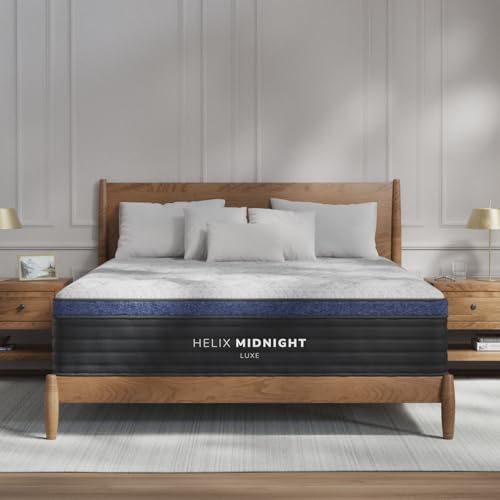
This is the premium version of Helix’s side-sleeper hybrid, and the design brief shows in the construction: 13.5 inches tall, pocketed coils zoned firmer under the lumbar region so the hips stay lifted, three select foam layers above them for the shoulder to sink into, and a quilted TENCEL Euro top finishing the surface. Helix rates the feel 6 out of 10 and calls it medium; independent testers broadly agree, which is not something we get to write about every pick in this series — and for a side sleeper that agreement is the point, because your shoulder needs the top of the bed to yield on schedule while the zoned coils refuse to let your hips drop through. On Amazon it is sold by 3Z Brands, the maker’s own storefront, in sizes from Twin XL to California King, and the queen sits at the premium end of this guide’s tier — check price on Amazon before you buy. A second version of the same queen with a GlacioTex cooling cover, under a separate listing, is a premium variant that can sit over budget, and a reminder that the cover choice alone can push this bed across the line.
What the Luxe buys over its core-model sibling is construction you can feel: the zoned coil unit, the pillow top, and four-sided edge reinforcement in place of the core model’s simpler build. What it does not buy is administrative clarity. The listing’s bullet points promise a 365-night sleep trial; the specification table on the same page says 120 nights. Both numbers are printed in this review because both are printed on the listing, and the only safe reading is the shorter one until the seller confirms otherwise in writing. Helix’s own store currently advertises the longer trial for direct purchases — which is precisely the trap this guide keeps pointing at: brand-direct terms describe the brand’s store, not necessarily your Amazon order. For a side sleeper the stakes are practical, not theoretical: a firmness judgment takes weeks of shoulders, not one night, and the difference between 120 nights and 365 is the difference between a fair test and a rushed one.
- Zoned lumbar coils under a pillow top — the side-sleeper design brief, executed at the premium level.
- Maker’s 6 out of 10 medium rating is corroborated by testers, a rarity in this series.
- Sold on Amazon by the maker’s own storefront (3Z Brands), queen verified; check price on Amazon.
Honest limitation: The listing states its own trial two ways — 365 nights in the bullets, 120 in the spec table — and its premium positioning leaves little headroom under this budget; the GlacioTex-cover version of the same bed sits over budget.
Choose it if you want the premium side-sleeper hybrid and will screenshot the trial terms before ordering. Skip it if a self-contradicting listing makes you nervous — the Purple below keeps its paperwork simpler.
Purple Mattress, Queen
Who it suits: Side sleepers who have tried memory foam and hybrid foam and want a surface that behaves like neither — especially those who run warm on conventional foam or hate waiting for foam to soften.
Purple’s mattress is the only pick here built around something other than foam or springs: a 2-inch GelFlex Grid — a hyperelastic polymer lattice — over foam support layers, 9.25 inches in total. For a side sleeper, the grid’s party trick is precisely aimed: the lattice walls flex and buckle locally under concentrated loads, which is what a shoulder and a hip are, and stay firm where you are light. And unlike foam, the response is instant — there is no slow sink to wait for and no trench to climb out of, which is why combination sleepers who roll from side to back and back again often take to this bed faster than strict side sleepers do. The open lattice also passes air in a way no foam slab can, which is why warm sleepers keep arriving here after foam disappoints them. Purple rates it 4 out of 5 on its own firmness scale, which reads as medium-firm; it is sold on Amazon by Purple Innovation, the maker itself. Check price on Amazon for the queen — it sits in the mid-range of this tier, comfortably inside this budget.
The honest cautions are about feel and about the ladder above it. The grid feel is genuinely polarizing: many side sleepers describe the best pressure relief they have found, and a minority describe a surface they simply cannot get used to — the grid relieves pressure by flexing away under the shoulder rather than by enveloping it, and a sleeper who loves being cradled may read that as a lack of cushion. That disagreement is what the 100-night trial and 10-year warranty — Purple’s brand terms, sold here through the maker’s own storefront — are for. And the ladder matters: the PurplePlus queen and the Restore hybrid line are premium models above this budget, sold direct, so this mattress is the whole of Purple that $2,000 buys on any channel. Buy it as itself, not as a discount on the models above it.
- The GelFlex Grid flexes at exactly the two points a side sleeper loads — shoulder and hip — and responds instantly.
- Sold by the maker (Purple Innovation) on Amazon; check price on Amazon.
- Open grid structure passes air; warm sleepers are this bed’s natural audience.
Honest limitation: At 9.25 inches it is the thinnest pick here, the grid feel divides sleepers sharply, and Purple’s own step-up models sit outside this budget entirely.
Choose it if foam has failed you on heat, on pressure or on the slow climb out of a foam trench. Skip it if you want a tall, plush, enveloping bed — the Nectar Premier Hybrid further down is that shape in a lower tier.
Casper Original Hybrid Mattress, Queen
Who it suits: Side sleepers who want zoned coil support from the original premium name — and who can time a purchase to this listing’s recurring price dips.
Casper’s current entry model, The One, is not sold on Amazon at all — but Amazon’s Casper shelf is not empty. It carries the previous generation: the Original line, and within it this 11-inch hybrid, which pairs Casper’s foam comfort layers with a zoned coil support core — firmer under the hips, softer at the shoulders, in the maker’s description. That zoning is, on paper, exactly the architecture a side sleeper wants: give at the shoulder, hold at the hip. The honest qualifier is that the listing does not publish a coil count or a firmness number — it says medium feel, and that is all you get — so the zoning story rests on the maker’s description rather than a specification sheet, and the trial is your measuring instrument. The listing is unusually plain about the rest of its paperwork: the title itself carries a 100-night trial and CertiPUR-US certification, the warranty is a 10-year limited one, and the bed is sold and shipped by Amazon.com. Its pricing is known to move: this listing has a history of recurring dips, so check price on Amazon and be patient if the current figure looks high — timing a dip can make this the value play of the tier.
One more thing to hold clearly: this is a discontinued-generation product sold through Amazon while Casper’s own store sells its successor. Judged that way, a zoned hybrid with the trial printed in its title, sold by Amazon itself, on its dips, is the value play of this tier for a side sleeper willing to test the maker’s zoning claim with their own shoulder.
- Sold and shipped by Amazon.com, with the 100-night trial printed in the listing title.
- A listing known for recurring price dips — check price on Amazon.
- Maker-described zoning — softer at the shoulders, firmer under the hips — is the design idea Casper built its name on.
Honest limitation: A previous-generation model — Casper’s current line is elsewhere — and the listing publishes neither a coil count nor a firmness figure to check the maker’s medium claim, or its shoulder-zone claim, against.
Choose it if you can wait for one of its recurring dips and check price on Amazon. Skip it if you want the current-generation product from any brand; nothing here is one.
Tuft & Needle Original Hybrid Mattress, Queen
Who it suits: Combination sleepers — the side-to-back rotators — who want coil support under a calmer, less enveloping foam surface, and who find deep memory-foam sink more trap than comfort.
Tuft & Needle’s foam has always been the point of difference: its proprietary Adaptive Foam is a responsive polyfoam that cushions without the slow sink of memory foam, and this hybrid puts it over a pocketed coil base in a listing that describes the feel simply as medium. For a side sleeper, that responsiveness cuts both ways, and this guide prints both edges. In its favor: you are never held in a foam trench, rolling from your side to your back takes no effort, and the shoulder gets a springy cushion rather than a slow swallow. Against it: a strict side sleeper who stays on one side all night needs sustained, deep pressure relief at the shoulder, and a responsive surface that pushes back evenly is the least shoulder-specific design in this guide — it cushions the point load rather than cradling it. It is also, notably, the only Tuft & Needle left on Amazon — price trackers noted in September 2026 that the all-foam Original had left Amazon entirely, leaving this hybrid as the brand’s whole presence there. Its pricing is the most volatile in the guide: the same bed has moved sharply within a few months, through no change in the product — check price on Amazon before judging its value.
That volatility cuts into the terms as well. Tuft & Needle’s own store sells its hybrid line in a lower tier than the Amazon figures often suggest, and the brand’s 100-night direct trial is a brand-store term; we could not verify an equivalent trial printed on the Amazon listing, so an Amazon purchase should be judged inside Amazon’s own return window. That matters more for a side sleeper than for anyone, because this is the pick whose shoulder verdict you most need nights to reach. The brand states that its mattresses contain no fiberglass in any component; the Amazon listing records we checked did not carry that statement, so confirm it on the live listing if it decides your purchase.
- Responsive Adaptive Foam over coils — support without the sink, and the easiest surface here to change position on.
- The brand’s only remaining Amazon mattress, after the foam Original left the platform.
- Has dipped to a lower tier within the last year for patient buyers — check price on Amazon.
Honest limitation: The guide’s most volatile pricing, no in-listing trial could be verified, the brand’s own store sells the line in a lower tier, and its even, responsive surface is the least tailored here to a strict side sleeper’s shoulder.
Choose it if you catch it on a dip and you rotate positions through the night. Skip it if the listing is sitting at its highs, or if you are a strict side sleeper who needs deep contour — the Helix Luxe’s zoned build is the better spend, and the Nectar below contours deeper in a lower tier.
Nectar Premier Hybrid 13 Inch Mattress, Queen
Who it suits: Strict side sleepers who love deep memory-foam contour and want a coil base under it — the deepest sink in this guide, with a year-long trial printed in the title.
The Premier Hybrid takes the 13-inch Premier memory-foam build from our under-$1,000 guide and swaps its foam core for 792 pocketed coils in the queen, which buys back the three things all-foam beds give away: airflow, edge support and an easier surface to move on. For a strict side sleeper, the headline is the feel: Nectar’s queen listing calls it medium — a shade softer than the all-foam Premier’s medium-firm — and testers land around 5 to 6 out of 10, the softest measured read in this guide. That is the right end of the scale for a shoulder that needs to sink and stay sunk: the foam yields at the shoulder and hip and holds the shape, while the coils keep the middle of the bed from sagging into a hammock. It is sold and shipped by Amazon.com, and its title carries the terms outright: 365-night trial and Forever Warranty. Check price on Amazon for the queen — this pick sits in the lower tier of this guide, and Amazon and the brand store have tended to align, so unlike the DreamCloud below, there is no obvious channel penalty or channel bargain here.
The cautions are the family’s usual ones, plus one of discipline. The cooling language in the listing describes fibers and a cover that moderate first contact; a coil base genuinely moves more air than a foam core, but no passive bed actively cools, and deep foam will reach body temperature through the night — this remains the warmest-sleeping pick here. The listing title also carries “Back Pain Relief,” which is marketing, not a finding: this is a comfort product, and it does not treat back pain, shoulder pain or anything else. And keep the models separate in the listing’s size and style selectors — Premier foam, Premier Hybrid and the premium Luxe line above them (direct-only for the Luxe Hybrid queen, with no Amazon price we could verify to standard) are three different beds sharing one brand page’s neighborhood. One practical note for this pick specifically: a bed you sink this deeply into changes your pillow maths — expect to retire the tall pillow, as the pillow section below explains.
- 792 pocketed coils under the Premier foam stack — the deepest contour here, on a real support core.
- Testers rate it 5–6 out of 10, the softest verified read in the guide — the strict side sleeper’s end of the scale.
- 365-night trial and Forever Warranty printed in the listing title; sold by Amazon.com; check price on Amazon.
Honest limitation: The softest hybrid here will still sleep warmer than the Helix or Purple, and the title’s pain-relief language is a claim the mattress cannot cash — buy it for comfort, not treatment.
Choose it if you are a strict side sleeper who wants maximum contour and the longest printed trial to judge it by. Skip it if you sleep hot and change position often; the Luxe’s zoned coils and the Purple’s grid both move air better and let you move freer.
DreamCloud Premier Hybrid 13 Inch Mattress, Queen
Who it suits: Heavier side sleepers, and side sleepers who prefer support over sink — buyers whose hips bottom out on softer beds and who are not light, strict side sleepers.
The Premier Hybrid stretches the Classic Hybrid formula from our cheaper guides to 13 inches and six layers: a quilted CloudQuilt Euro top with cooling fibers, 2 inches of pressure-relieving gel memory foam, adaptive transition foam and 792 individually wrapped coils in the queen — about 108 pounds of mattress. The queen is sold by Amazon itself — check price on Amazon; it sits in the lower tier of this guide. Its listing title is the most complete in this guide: 365-night trial, Forever Warranty, CertiPUR-US — and “Fiberglass Free,” the only explicit fiberglass statement among the six picks. One channel difference carries over from the Classic: DreamCloud’s own store has run promotions folding a free bedding bundle into this price, and the Amazon purchase does not include it.
The feel is where the honesty has to bite, and for this guide’s readers it bites in a specific direction. DreamCloud labels the Premier medium-firm, and its own rating sits around 6.5 out of 10 — but testers who measured it put the experienced firmness at 7.5 to 8, a full step firmer. Who that serves depends on the body on the bed. A heavier side sleeper loads a mattress harder at both points; on a genuinely soft bed their hip can sink through the comfort layers to the coil core, and a bed that measures firmer than its label can be exactly the support that keeps their spine level. A lighter strict side sleeper has the opposite problem: not enough weight to make this surface give at the shoulder, so the shoulder rides on top of the bed instead of settling into it, and the neck angle pays. Same mattress, opposite verdicts — which is why this pick sits last for this guide’s typical reader while remaining a legitimate first choice for the heavier one. It is one of the more accessible ways into this tier’s genuine premium shelf — the step up from the Classic Hybrid buys height, foam depth and the quilted top — and the in-listing 365-night trial is the instrument that settles which side of the firmness gap you land on, so confirm it is still printed on the listing when you order.
- Lower-tier positioning in this guide, sold by Amazon itself — check price on Amazon.
- The only pick whose title states “fiberglass free” outright.
- 13 inches and six layers, with the trial and Forever Warranty in the title — and support that heavier side sleepers may genuinely need.
Honest limitation: Testers measure it a full step firmer than its label — around 7.5–8 against a medium-firm claim — which is the wrong direction for lighter side sleepers, and the brand store’s free bedding bundle does not come with the Amazon purchase.
Choose it if you are a heavier sleeper, a back sleeper, or simply want strong value in this tier. Skip it if you are a light, strict side sleeper; the Helix Midnight Luxe was designed for your shoulder.
Comparison Table
| Product | Type | Side-sleeper read | Link |
|---|---|---|---|
| Helix Midnight Luxe, Queen | Zoned hybrid, 13.5 in | Purpose-built for the position; maker 6/10, testers agree; check price on Amazon | Check on Amazon |
| Purple Mattress, Queen | GelFlex Grid over foam, 9.25 in | Grid flexes at shoulder and hip, responds instantly; check price on Amazon | Check on Amazon |
| Casper Original Hybrid, Queen | Zoned hybrid, 11 in | Maker-zoned softer at shoulders; check price on Amazon | Check on Amazon |
| Tuft & Needle Original Hybrid, Queen | Adaptive foam hybrid | Responsive surface for combination sleepers; check price on Amazon | Check on Amazon |
| Nectar Premier Hybrid, Queen | Memory foam hybrid, 13 in | Deepest contour; testers 5–6/10; check price on Amazon | Check on Amazon |
| DreamCloud Premier Hybrid, Queen | Quilted hybrid, 13 in | Support first; testers 7.5–8 vs medium-firm label; check price on Amazon | Check on Amazon |
How to Choose a Mattress for Side Sleepers Under $2,000
- Start by naming your sleeper type honestly. A strict side sleeper — on one side, all night — needs sustained pressure relief at two points and should shop the soft, contouring end of this guide. A combination sleeper rotates and needs a surface that lets them move: responsiveness matters as much as softness, and a deep foam trench is a cost, not a feature.
- Read firmness as a tester range, not a label. The DreamCloud Premier is labeled medium-firm at about 6.5 and measured at 7.5–8 out of 10 by testers; the Nectar Premier Hybrid is called medium and measured at 5–6. If you are a lighter side sleeper, weight the tester numbers over the label; if you are heavier, the same gap may work in your favor.
- Match sink to body weight. Pressure relief only happens if the surface actually yields under you. Lighter side sleepers need the softer picks to get any shoulder sink at all; heavier side sleepers can bottom out a soft bed’s comfort layers and may sleep more level on the firmer DreamCloud than on the plushest foam here.
- Treat zoning as a claim the trial has to prove. Helix’s zoned coils and Casper’s softer-at-the-shoulders design are maker descriptions — plausible, and in Helix’s case backed by tester agreement on the overall feel, but Casper publishes no firmness figure at all. Buy the zoning story only with a trial long enough to test it with your own shoulder.
- Set the pillow after the mattress, not before. Deep sink — the Nectar’s foam, the Helix’s Euro top — drops your shoulder into the bed and shrinks the gap your pillow must fill, so a tall pillow that suited your old bed will push your head uphill. A firm surface like the DreamCloud’s holds the shoulder high and needs the loft back. Judge the pairing after a few nights, and budget for a pillow change inside a $2,000 purchase.
- Confirm the trial on the listing, in writing. The hero pick’s listing states 365 nights in its bullets and 120 in its spec table. Screenshot the terms before ordering, and where a listing is silent — as the Tuft & Needle’s is — assume only Amazon’s standard return window protects you.
- Separate brand-store terms from Amazon terms. A 365-night trial on a brand’s own website describes a purchase from that website. Bundles are the same story: DreamCloud’s free bedding runs through its store, not its Amazon listing.
- Verify the exact variant on the listing page. Cover versions (the Luxe’s GlacioTex queen sits over budget), sibling models (Premier foam vs Premier Hybrid vs Luxe) and size selectors all change the product or the price. The queen in this guide is 60 by 80 inches; an RV short queen at 60 by 74 is a different mattress.
- Ask the fiberglass question explicitly. Only one title here states “fiberglass free.” For the other five, the listings we checked do not say — so ask the brand, and whatever you buy, never unzip or cut a mattress cover; if a cover is damaged, contact the maker rather than opening it.
- Budget the whole bed, not the mattress. At 13 to 13.5 inches, the hybrids here need deep-pocket sheets, and a worn-out foundation will undermine a premium mattress exactly as fast as a budget one. Keep some of the $2,000 for the platform the bed deserves.
- Do not buy a treatment. No mattress here — at any price — treats shoulder pain, hip pain, back pain or any other condition. Buy for comfort and support you can judge in a trial; take persistent pain, radiating pain, numbness or tingling to a clinician.
Sink Is Not Softness: What a Shoulder Actually Needs
Side sleeping concentrates your weight onto the two narrowest load points your body has — the shoulder joint and the hip — and everything a mattress does for you happens at those two points. Pressure relief is not the same as softness. A surface relieves pressure when it yields locally at the shoulder and hip, spreading the load over more area, while still holding the waist and lumbar up so the spine runs level. A bed can be soft and bad at this — cheap foam that collapses everywhere lets the hip drop deepest and bends the line — and a bed can be medium and excellent at it, if the give is in the right places.
The six picks use three different mechanisms to get the give in the right places, and they are worth distinguishing because they feel nothing alike. Zoned coils — the Helix Luxe’s firmer lumbar section and the Casper’s maker-described zoning — put the variation in the support core itself: coils that yield more readily under the shoulder, coils that refuse under the hip and waist. The GelFlex Grid does it by geometry: the lattice walls buckle under concentrated load and stand firm under distributed load, so the relief is automatic, instant and exactly local — no waiting for material to warm and soften. Deep foam contour — the Nectar Premier Hybrid’s answer — does it by depth: enough soft foam above the coils for the shoulder to sink in and be held there, which is the most enveloping of the three and the warmest, because foam that has wrapped around you is also foam insulating you.
All three are judged in this guide as maker descriptions and tester measurements, not as medical promises — zoning is a design claim, grid physics is a feel, and contour is a preference some shoulders love and others reject. The failure modes are symmetric and worth knowing before you spend: too little give and the shoulder rides on top of the bed, taking the load on the joint itself while the neck bends down toward the mattress; too much give for your weight and the shoulder sinks through the comfort layers to the hard core beneath, which is bottoming out, and feels like the worst of both worlds. Between those two failures sits a band that depends on your weight, your shoulder width and your tolerance — which is why the trial, not the specification sheet, is the final instrument, and why the next two sections matter as much as the reviews.
Your Pillow Is Half the Equation: Loft, Sink and the Gap
On your side, your pillow’s job is to fill the exact gap between the side of your head and the surface your shoulder has sunk to — no more, no less. The mattress decides how big that gap is, which means a premium mattress purchase quietly invalidates your old pillow setup. On a deep-sink bed — the Nectar Premier Hybrid at a tester-measured 5–6 out of 10, or the Helix under its quilted Euro top — your shoulder drops inches into the surface, the gap shrinks, and the tall, firm pillow that kept your neck level on your old firm bed now pushes your head uphill all night. On the DreamCloud Premier, measured at 7.5–8, your shoulder stays high on top of the bed, the gap stays wide, and that same tall pillow becomes correct again. Change one variable at a time.
Two refinements matter at this tier. First, foam beds sink further as they warm: memory foam softens with body heat over the first hour, so the gap you measure lying down at lights-out is not the gap at 3 a.m. — judge pillow loft on how your neck feels in the morning, across several nights, not on the first ten minutes. The grid and the responsive Tuft & Needle foam do not drift this way; what they give at minute one is what they give all night, which is one more reason combination sleepers take to them. Second, build the pillow change into the budget from the start: with a premium mattress, reserving room in the budget for one good adjustable-loft pillow is not an extravagance, it is the second half of the purchase — and a folded towel on top of your current pillow is a free way to test a lower loft for a week before you buy anything. None of this is neck treatment, and a pillow is not a medical device: if you wake with pain that radiates into an arm, or with numbness or tingling in a hand, that is a clinician’s question, not a bedding one.
Above a Certain Price, Firmness Beats Dollars
Here is the honest arithmetic of this tier for a side sleeper. The spread in measured firmness runs from 5–6 out of 10 to 7.5–8 — and for the shoulder doing the sleeping, the second spread is the one that decides the night. A strict side sleeper who needs deep contour will sleep better on the Nectar Premier Hybrid than on the Tuft & Needle bought at the top of its range, not because the Nectar is a better mattress in the abstract but because its firmness is the right one for that body. The Helix Luxe earns its premium positioning the only legitimate way at this tier: not by being expensive, but by being the most considered construction — zoned support, a pillow top, tester-corroborated feel — aimed at exactly this sleeping position. Once a bed is competently built, and every pick here is, extra dollars buy refinements. The firmness choice buys the night.
More money does exist above this guide, and it still does not change the rule. The flagship rung — Helix’s Midnight Elite, PurplePlus and the Purple Restore hybrids, all premium direct models — and the traditional luxury channel — Beautyrest Black, Stearns & Foster through dealers, Saatva direct-only — are either above the line or not verifiably buyable on Amazon at this budget at all, and none of them repeals the physics: a premium bed at the wrong firmness for your shoulder is a worse purchase than a lower-tier bed at the right one. The named-but-unlinked beds from our general guide underline the point from below — the core Helix Midnight is the same side-sleeper design as the hero in a simpler build, excluded only because its queen ASIN could not be verified to standard; if it verifies at publish time, it is the first swap-in, and for many side sleepers it would be the smart buy of the whole tier. Pick the firmness first, then the construction, then the price — in that order — and let the trial settle what the labels could not.
Common Buying Mistakes
- Buying the firmest premium bed because “supportive” sounds like a compliment. Support and softness are different axes: the DreamCloud Premier measures 7.5–8 out of 10, which serves heavier sleepers and strands light side sleepers’ shoulders on top of the bed.
- Assuming the brand’s website trial applies to the Amazon order — the hero pick’s own listing cannot agree with itself (365 vs 120 nights), and Leesa’s Amazon window has been read at 90 days against a year-long direct trial.
- Paying the top of a volatile range: the Tuft & Needle hybrid’s pricing swings sharply within months, and the Casper hybrid dips on a recurring cycle — check price on Amazon before buying either.
- Clicking the wrong variant — the GlacioTex version of the hero queen sits over budget, and the Premier foam, Premier Hybrid and Luxe models sit one click apart in three different tiers.
- Keeping a tall pillow from a firm old bed on a deep-sink new one, then blaming the mattress for a bent neck. Loft is set by the sink; re-judge the pillow after the mattress, across several mornings.
- Judging a foam bed’s shoulder feel in the first ten minutes. Memory foam softens as it warms; the sink at 3 a.m. is deeper than the sink at lights-out, on the first night and every night.
- Treating a listing title’s “Back Pain Relief” as a medical claim. It is marketing copy; no mattress treats shoulder, hip or back pain, or any other condition.
- Skipping the fiberglass question because the price is high: five of these six listings do not state a position, and price is not a substitute for the listing’s words.
- Spending the whole $2,000 on the mattress and putting a 13.5-inch hybrid on a tired frame with standard-pocket sheets that will not stay on it.
Final Recommendation
- Strict side sleepers: Helix Midnight Luxe Mattress, Queen — with the trial terms screenshotted first.
- Deep-contour lovers: Nectar Premier Hybrid 13 Inch Mattress, Queen — the softest verified read, with the longest printed trial.
- Warm sleepers and foam skeptics: Purple Mattress, Queen.
- Combination sleepers: Tuft & Needle Original Hybrid Mattress, Queen — bought near its average, not its highs.
- Patient bargain hunters: Casper Original Hybrid Mattress, Queen — on one of its dips; check price on Amazon.
- Heavier side sleepers: DreamCloud Premier Hybrid 13 Inch Mattress, Queen — the firmness others are warned about may be your support.
Our top two are the Helix Midnight Luxe for the most considered side-sleeper construction Amazon verifiably sells at this level — zoned coils, a real pillow top, a maker-run storefront — bought with its trial contradiction read and screenshotted first, and the Purple for the one genuinely different sleep surface in the tier, whose grid answers a shoulder by flexing rather than sinking, with a listing worth checking against its own brand store. If your body is the strict, light, all-night-on-one-side kind, give the Nectar Premier Hybrid’s deep contour a serious look before either: with a 365-night trial printed in its title, it is the firmness-first purchase this guide keeps arguing for. What $2,000 will not do is also clear, and worth ending on: it will not bring the traditional luxury brands, the flagship Elite and Restore lines, or a direct-only Saatva into your Amazon cart, and it will not make the firmness decision for you. Those choices live above the line, outside the store, or — the one that matters — in the trial nights after the box arrives.
Frequently Asked Questions
What does $2,000 actually buy a side sleeper on Amazon?
For the first time in this series, beds designed for the position: Helix’s Luxe side-sleeper hybrid, Purple’s grid mattress, Casper’s zoned Original Hybrid, Tuft & Needle’s responsive hybrid and both Premier Hybrids — check price on Amazon for each. What it does not buy is the traditional luxury shelf — Beautyrest Black, Stearns & Foster through dealers — or the flagship lines above these models.
Which of these mattresses is softest for a strict side sleeper?
By tester measurement, the Nectar Premier Hybrid: testers land at 5–6 out of 10, the softest verified read in this guide, with deep memory-foam contour over coils. The Helix Midnight Luxe follows at a maker-rated 6 out of 10 that testers corroborate, with a zoned coil unit under the pillow top. At the other end, the DreamCloud Premier Hybrid measures 7.5–8 despite its medium-firm label — the firmest here, and the wrong direction for a light strict side sleeper.
Is the Helix Midnight Luxe’s trial 365 nights or 120?
Its Amazon listing says both: 365 nights in the bullet points, 120 nights in the specification table. Helix’s own store advertises the longer trial for direct purchases, but an Amazon order should be planned around the shorter figure until the seller confirms the longer one in writing. This is the single most important check in the guide — a side sleeper’s firmness judgment takes weeks, and the two figures allow very different tests.
Is the Purple grid actually good for side sleepers?
It is the most polarizing answer in this guide. The GelFlex Grid flexes locally under a shoulder and hip, so pressure relief is real — but it arrives by the surface giving way instantly rather than by enveloping you, and it responds the same at 3 a.m. as at lights-out. Sleepers who love it cite pressure relief and a cooler surface than any foam here; sleepers who return it wanted to sink and never did. The 100-night trial exists for exactly this decision, so the honest answer is: it is worth a trial, not a leap of faith.
Why is the cheaper Helix Midnight not a linked pick here?
Because verification, not merit, is the filter. The core Midnight queen — the same side-sleeper design as the hero, in a simpler build — is genuinely sold on Amazon, but its queen ASIN could not be verified to the standard the six picks meet, so it is named rather than linked. If that ASIN verifies, it becomes the first swap-in, and for many side sleepers the smartest buy in the tier.
Do these mattresses contain fiberglass?
One listing says it does not: the DreamCloud Premier Hybrid’s title states “fiberglass free.” The other five listings, in the records we checked, do not state a fiberglass position — which is not a claim that they contain it. Tuft & Needle states at brand level that its mattresses use no fiberglass in any component. For any pick, confirm on the live listing or with the brand, and never unzip a mattress cover.
Will a $2,000 mattress fix my shoulder or hip pain?
No. A mattress can be more or less comfortable for you, and comfort is a legitimate thing to buy — the right firmness can make a real difference to how you sleep — but no mattress in this guide treats shoulder pain, hip pain, back pain or any other condition, whatever a listing title implies. Pain that persists, radiates into an arm or leg, or comes with numbness or tingling needs a clinician, not a premium upgrade.
What if the price has moved above $2,000 when I check?
It happens at this tier — the hero pick sits near the ceiling and its cover-variant sibling sits over budget. If the live price has crossed the $2,000 budget line, the patient move is to wait for a dip or choose a lower-tier pick, and check price on Amazon again before deciding.