Disclosure: topratedkitchenware.com is reader-supported. When you buy through links on our site, we may earn an affiliate commission from Amazon and other retailers, at no extra cost to you.
Where to buy
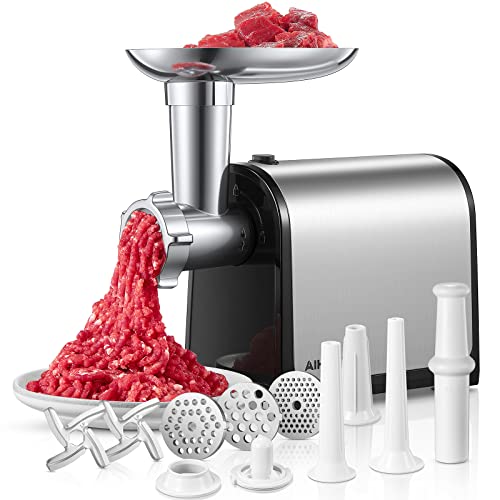
All six grinders in this guide are sold through Amazon, where you can confirm plate sets, blade counts, and head sizes before ordering — worth doing before the holiday bird season, not after the carcass is on the board. The first machine listed, the RVGMBO Electric Meat Grinder, opens the shortlist — Check on Amazon — and the rest follow:
- FOHERE Electric Meat Grinder, #12 Head, 1 HP
- Aiheal Electric Meat Grinder, 3200W Max
- AAOBOSI Electric Meat Grinder with 3-Speed Touch Screen
- AAOBOSI Multifunctional Digital Meat Grinder
- VEVOR Meat Grinder, #12, 750W / 1 HP
Read the full guide ↓ for the piece-by-piece verdict on turkey bones — which parts grind, which parts never should, and which machines handle the ones that do.
The best meat grinders for turkey bones occupy a precise middle ground in the bone world, and getting that ground right is the whole guide. Turkey bones are poultry bones — hollow, comparatively light, and grindable in a strong home machine — but they are the largest and hardest of the poultry class, a clear step up from chicken in density and diameter. Necks and frames from a turkey ask more of a grinder’s torque, gears, and plates than any chicken ever will, while the bird’s drumstick and wing-tip bones approach the boundary where home grinding should stop. The best meat grinders for turkey bones are the machines that work that middle ground honestly: powerful enough for necks and frames in small, cold pieces, equipped with the coarse-to-fine plate progression that makes ground bone safe, and built to survive the shock loading that the biggest poultry bones deliver.
The demand comes from two directions. Raw feeders prize turkey — necks especially — as a staple protein-and-bone source for dogs, bought whole and in bulk when the holiday season makes turkeys abundant. Home cooks meet the same question from the other side: a roasted or raw turkey leaves a frame, and grinding that frame’s meat and soft bone into mince, stock base, or pet food is the difference between using the whole bird and binning a third of it. Both groups need the same knowledge, which this guide organises piece by piece: what grinds, what does not, and the technique that separates the two outcomes. Readers new to bone grinding generally should start with the chicken-sized end of the subject in our Best Meat Grinders That Grind Bones guide, then return here for the turkey-specific escalation.
Key Takeaways
- Turkey necks and frames grind well in strong home machines, cut small and partially frozen, coarse plate first.
- Turkey drumstick bones and any cooked turkey bone are exclusions — too dense, or too brittle, for home grinding and for feeding.
- Turkey is the hardest poultry class: favour continuous-style power (the VEVOR and FOHERE #12 machines) and metal drivetrains.
- The two-pass method is non-negotiable at this bone size: coarse to break down, fine to finish, hand-check for sharp fragments.
- Auto-reverse (AAOBOSI Digital) earns its keep here — turkey frames stall home grinders more than any other poultry.
- Buy turkeys in the holiday season and freeze them whole; the grinder’s turkey workload is seasonal by nature.
In this guide
Quick Picks
| Pick | Badge | Standout detail from the listing | Link |
|---|---|---|---|
| RVGMBO Electric Meat Grinder | Best Spare Cutting Sets | 3500W motor claim, 3 sets of 304 stainless blades and plates | Check on Amazon |
| FOHERE Electric Meat Grinder | Best Throughput for Turkey Batches | #12 head, 1 HP, 600W all-copper motor, 8.8 lbs/min maker rating | Check on Amazon |
| Aiheal Electric Meat Grinder | Best Complete Bundle | 3200W max, 2 blades, 3 plates, 3 sausage tubes | Check on Amazon |
| AAOBOSI 3-Speed Touch Screen Grinder | Best for Raw Pet Food Batches | 3000W max, 4 lbs/min maker rating, raw pet food in the listing | Check on Amazon |
| AAOBOSI Multifunctional Digital Grinder | Best Jam Recovery | 3000W max, 9 presets, auto-reverse | Check on Amazon |
| VEVOR #12 Electric Meat Grinder | Best Overall for Turkey Bones | 750W / 1 HP, throughput quoted at 552 lbs/h, #12 head, ETL listing noted | Check on Amazon |
How These Picks Were Chosen
This is a research-led guide built from manufacturer listings and specifications, filtered for the heaviest poultry workload a home grinder can legitimately face. The filtering was stricter than for chicken: turkey bone punishes marginal machines, so the ranking weighted continuous-style power evidence (horsepower, published throughput, #12 head size) and drivetrain construction (metal gears, copper motors, stainless paths) above peak wattage, which describes a momentary maximum and predicts turkey performance worst of all.
Four filters produced the six. First, torque credibility: every pick either publishes a rate or horsepower figure, or pairs a strong power claim with the accessory depth and heavy-duty positioning that support it. Second, plate progression: the coarse-to-fine two-pass method is mandatory at this bone size, so multi-plate bundles — and the RVGMBO’s three full cutting sets — scored as core equipment. Third, stall management: turkey frames stall home grinders more readily than chicken, so auto-reverse features and spare blades were weighted as working necessities. Fourth, washability: turkey work is raw poultry work at scale, and every pick strips fully for the mandatory wash. Mixer attachments and manual grinders were excluded outright; turkey bone is beyond both. Several of these machines also anchor the wider raw-feeding cluster — see our Best Meat Grinders Raw Feeders roundup — but this page judges them on turkey alone.
The 6 Best Meat Grinders for Turkey Bones

RVGMBO Electric Meat Grinder, 3500W, 3 Blade & Plate Sets
Badge: Best Spare Cutting Sets
Strengths
- Three full sets of 304 stainless blades and plates — turkey bone dulls edges fastest, and fresh sets are always on hand.
- Sets can be dedicated: one coarse set that lives as the turkey-bone set, finer sets kept pristine for meat.
- Kubbe and sausage kit included for the meat half of the bird.
Trade-offs
- The 3500W figure is a peak-style claim; sustained turkey pace is undocumented.
- No gear material, head size, or reverse is stated in the listing.
- Three sets to wash after a raw turkey session is a real sink load.
Mini spec box: Power: 3500W (maker’s “super motor” claim) · Blades and plates: 3 sets, 304 stainless steel · Extras: kubbe and sausage kit · Duty described: home use.
Turkey bone is the most abrasive load in the poultry world, and abrasion is a consumables problem before it is a power problem. A blade that starts a turkey session sharp is measurably tired by the end of it, and a tired blade on bone does not just slow down — it tears, heats, and leaves the bone fraction coarser than the safety of the finished grind allows. The RVGMBO’s three complete cutting sets are the direct answer: swap in a fresh set when the grind tells you to, dedicate the coarsest set to turkey permanently, and send tired steel for sharpening on your schedule instead of the bird’s.
The rest of the machine’s story is thinner on paper — a big peak claim without published drivetrain detail — and the honest review says so. What the RVGMBO offers the turkey grinder is a system: edges as a managed resource. For households whose turkey work is seasonal and heavy — a case of birds broken down across a weekend — that system prevents the classic failure of the whole enterprise, the mid-bird session ground to a halt by dull steel. Pair it with strict piece size and temperature discipline and it is a credible turkey tool with a unique logistical edge.
Best for: seasonal turkey processors who process several birds in a sitting and manage blades as consumables / Not suited for: buyers who want published drivetrain specifications.

FOHERE Electric Meat Grinder, #12 Head, 1 HP
Badge: Best Throughput for Turkey Batches
Strengths
- A #12 head with throughput quoted at 8.8 lbs/min — whole-turkey breakdowns at production pace.
- 600W all-copper motor with 1 HP positioning sustains the torque turkey necks demand.
- Stainless plates with sausage nozzle and kubbe kit for the bird’s meat fraction.
Trade-offs
- The largest machine here; a single Thanksgiving frame does not need it.
- No reverse is stated — a wedged neck section is a manual clear.
- The wash-up after a multi-bird session is correspondingly large.
Mini spec box: Motor: 600W all-copper, 1 HP positioning · Peak: 3600W · Head size: #12 · Throughput: 8.8 lbs/min (maker rating) · Plates: stainless · Extras: sausage nozzle, kubbe kit · Duty described: home use.
Turkey work becomes a volume problem the moment a raw feeder discovers the holiday-season case price, and the FOHERE is the volume answer in this guide. Its #12 head swallows neck sections and frame pieces that smaller heads make you subdivide twice, its all-copper motor holds a published pace through the densest poultry load there is, and a case of birds becomes one organised session — cut, chill, grind, portion, freeze — instead of a weekend of shifts. Pace is also a quality feature here: turkey mixture that moves through quickly stays cold, and cold mixture grinds finer and safer on the second pass.
Technique still governs: necks sectioned small, frames broken down, everything partially frozen, coarse plate first. The FOHERE forgives the occasional optimistic piece that would stall a lesser machine, but it does not repeal the exclusions — drumstick bones and cooked bone stay out, on this machine as on every machine. The honest costs are size and the manual stall clear. For the raw-feeding household whose turkey supply is measured in cases, or the cook who processes birds for an extended family’s dogs, the FOHERE is the throughput pick without rival here.
Best for: case-lot turkey processing and multi-dog raw households / Not suited for: the once-a-year single-bird frame.

Aiheal Electric Meat Grinder, 3200W Max
Badge: Best Complete Bundle
Strengths
- Two blades and three plates in the box — a dedicated turkey-bone blade and the full plate progression, from one order.
- Three sausage tubes included, because a turkey’s meat fraction usually ends as more than mince.
- Stainless grinding components in a hard-wearing black finish.
Trade-offs
- 3200W is a maximum rating; turkey pace depends on piece size and feeding discipline.
- No reverse is listed, so frame stalls mean opening the head.
- No published throughput or head size for planning big sessions.
Mini spec box: Power: 3200W max · Blades: 2 · Plates: 3 · Sausage tubes: 3 · Body/components: stainless steel, black finish · Duty described: heavy duty for home kitchen use.
The Aiheal is the one-box turkey answer for the mainstream case: a household that grinds a few birds a year — the holiday frames, a raw-feeding top-up, a case split with a friend — and wants the method’s equipment complete on arrival. Its bundle is the method in miniature: three plates for the coarse-to-fine progression, a second blade so the edge that meets turkey bone is not the edge that must stay pristine for clean meat, and tubes for the sausage that turkey trim so naturally becomes.
Used with discipline — necks sectioned, frames broken small, all of it hard-chilled, coarse pass first — it handles turkey necks and frames with the steady competence its heavy-duty positioning promises. The honest limitations are informational and mechanical: no published pace, no reverse, and a peak-only power figure, so the operator’s technique carries more of the load than on the #12 machines. For the seasonal, moderate-volume turkey grinder, that is a fair trade, and the Aiheal’s completeness makes it the easiest recommendation in this guide to act on.
Best for: households grinding a few turkeys a year who want the full kit in one purchase / Not suited for: case-lot volume or reverse-assisted clearing.

AAOBOSI Electric Meat Grinder with 3-Speed Touch Screen
Badge: Best for Raw Pet Food Batches
Strengths
- Raw pet food is named in the listing — turkey’s main grinding destination, designed for by name.
- Throughput quoted at 4 lbs/min and three speeds, so turkey batches can be planned and run low and steady.
- Built-in storage and easy-cleanup design suit a raw routine’s mandatory wash.
Trade-offs
- The quoted pace is for meat; turkey bone-in work will run slower.
- 3000W max is a peak claim, and no reverse is listed for frame stalls.
- Touch controls need wiping when hands are in raw turkey work.
Mini spec box: Power: 3000W max · Throughput: 4 lbs/min (maker rating) · Controls: 3-speed touch screen · Storage: built-in · Roles: 3-in-1 sausage, burger, raw pet food · Certification noted: LFGB approved · Cleanup: designed for easy cleanup.
Most turkey bones are ground for dogs, and this AAOBOSI is the only machine in the six whose listing names raw pet food as its purpose. That focus shows where it counts for turkey: a published throughput that lets a raw feeder plan a bird session honestly, and a speed range whose lowest setting is the correct temperament for neck sections — slow, torquey, patient — while the machine’s storage keeps the coarse plate and the bone blade together between sessions.
Plan turkey work at a discount to the quoted pace: the 4 lbs/min figure describes meat, and bone-in turkey is the slowest load in this guide. Section necks small, keep everything hard-chilled, and let the low gear do its work, and the machine repays you with an even coarse grind that finishes beautifully on the second pass. The honest limitations are the missing reverse — a wedged frame piece is a manual clear — and the touch panel’s housekeeping around raw poultry. For the raw feeder whose turkey routine is regular and moderate, this is the tailored pick; British raw feeders will find the same machine assessed in our Best Meat Grinders Uk roundup.
Best for: raw feeders grinding turkey necks and frames in regular, planned batches / Not suited for: case-lot volume or anyone who needs reverse.
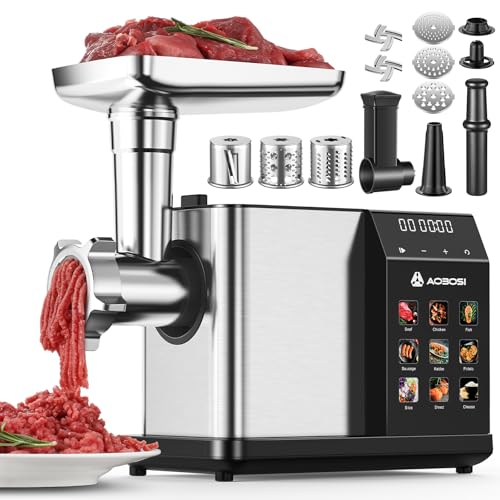
AAOBOSI Multifunctional Digital Meat Grinder
Badge: Best Jam Recovery
Strengths
- Auto-reverse answers the turkey frame stall — the most common interruption in this entire category.
- Nine presets make your dialled-in turkey setting a one-touch routine each season.
- Built-in storage, with kibbe and cheese-grating roles for the machine’s other life.
Trade-offs
- 3000W max is a peak figure; its turkey case rests on session management, not superior torque.
- Electronics-forward design asks for care during the heavy wash raw turkey requires.
- No throughput is published for planning large bird counts.
Mini spec box: Power: 3000W max · Controls: digital touch screen, 9 presets · Reverse: auto-reverse · Storage: built-in · Roles: grinding, sausage, kibbe, cheese grating · Duty described: home use.
Turkey frames stall grinders. The geometry is against you: a frame piece bridges the feed tube, the auger bites and loads, and on a conventional machine the session stops for a slimy excavation with raw poultry in every crevice of the head. The digital AAOBOSI’s auto-reverse exists for exactly this moment — back the piece off, re-present it smaller or discard it, and continue with the batch’s temperature and your patience intact. In a category defined by an unusually stall-prone load, that is not a convenience feature; it is the difference between a routine and an ordeal.
The presets suit turkey’s seasonality in an underrated way: the setting you perfect on this November’s birds is recalled, not rediscovered, next November. Between seasons the machine lives a full domestic life — sausage, kibbe, the household’s ordinary grinding, including the Best Meat Grinders For Venison overflow in hunting households. The honest limitations are the class ones: peak-only power data and electronics that want wiping rather than soaking. For the turkey grinder who has cleared one frame stall too many, this is the quality-of-life pick of the guide.
Best for: turkey grinders whose sessions are regularly interrupted by frame stalls / Not suited for: buyers who want published throughput or purely mechanical controls.

VEVOR Meat Grinder, #12 Electric Meat Mincer, 750W / 1 HP
Badge: Best Overall for Turkey Bones
Strengths
- A continuous-style 750W / 1 HP rating with throughput quoted at 552 lbs/h — sustained turkey torque, honestly specified.
- The #12 head takes neck sections and frame pieces with the least pre-cutting in this guide.
- ETL listing noted, three stuffing tubes and a kibbe kit included, positioned for kitchens or restaurants.
Trade-offs
- Only two plates included; a finer finishing plate may be worth adding for raw feeding.
- The largest footprint here alongside the FOHERE — a serious machine for a seasonal job.
- No reverse is listed; its stalls are rarer but still manual.
Mini spec box: Motor: 750W / 1 HP · Head size: #12 · Throughput: 552 lbs/h (maker rating) · Plates: 2 · Stuffing tubes: 3 · Extras: kibbe kit · Certification noted: ETL listing · Settings: kitchens or restaurants.
The VEVOR is our top pick for turkey bones because turkey is where specification honesty pays hardest. Every other claim in this category is a peak; the VEVOR quotes a horsepower and an hourly rate, the language of a machine expected to work a whole session at load. Its #12 head is the other half of the case: turkey necks and frames are the largest pieces any poultry grinding involves, and a head that accepts them with minimal sectioning keeps the session moving and the mixture cold — which, on the fine second pass, is what makes the finished grind safe and even.
It is not a machine that repeals technique. Necks still get sectioned, frames still get broken down, drumstick bones still stay out, and the two-pass method still governs. What the VEVOR changes is the margin: the optimistic piece that stalls a home machine gets powered through or cleared without drama, and a multi-bird session holds its pace to the last frame. The honest costs are the two-plate bundle — raw feeders may add a finer plate — and sheer size for a job many households do twice a year. If turkey grinding is a serious seasonal commitment, particularly for dogs, the VEVOR is the benchmark; households shopping primarily on price should compare the field in our Best Meat Grinders Under $100 guide before deciding where their own line sits.
Best for: serious seasonal turkey processing, especially raw feeding at volume / Not suited for: the single annual Thanksgiving frame in a small kitchen.
Comparison Table
| Grinder | Power as listed | Head | Plates / Blades | Turkey character | Link |
|---|---|---|---|---|---|
| RVGMBO | 3500W claim | Not stated | 3 sets / 3 sets | Fresh edges for abrasive work | Check on Amazon |
| FOHERE | 600W copper / 1 HP, 8.8 lbs/min | #12 | Stainless / not stated | Case-lot pace | Check on Amazon |
| Aiheal | 3200W max | Not stated | 3 / 2 | Complete one-box kit | Check on Amazon |
| AAOBOSI Touch | 3000W max, 4 lbs/min | Not stated | Not stated | Raw pet food by design | Check on Amazon |
| AAOBOSI Digital | 3000W max | Not stated | Not stated | Auto-reverse for frame stalls | Check on Amazon |
| VEVOR | 750W / 1 HP, 552 lbs/h | #12 | 2 / not stated | Sustained turkey torque | Check on Amazon |
How to Choose a Meat Grinder for Turkey Bones
Start with the piece list, not the bird. Write down what you will actually grind: necks, frames, backs, wing sections. If drumsticks are on your list, cross them off — they are the boundary case this guide excludes — and size the machine for what remains. Necks-and-frames households are the centre of this category; whole-bird fantasies are how grinders get broken.
Demand torque evidence. Turkey is the poultry class where peak wattage lies most fluently. Horsepower, published throughput, #12 head size, metal gearing, and copper windings are the evidence that survives contact with a turkey neck. Rank listings by that evidence, and treat a bare four-digit wattage as an unproven claim.
Equip the two-pass method. At turkey scale the coarse-to-fine progression is the safety system. Three plates in the box, or full spare sets, are core equipment; a single-plate machine cannot do this job properly at any power. Budget a finer finishing plate if your chosen machine ships with two.
Decide your stall doctrine in advance. Turkey frames will stall a home grinder eventually — the only question is whether recovery is a button (auto-reverse) or a routine (unplug, open, clear). Occasional grinders can accept the routine; regular raw feeders should price the button honestly against their patience.
Match the machine to the season’s volume. One bird at Thanksgiving is a bundle-class job (Aiheal). A raw feeder’s case of birds is a #12 job (VEVOR, FOHERE). The middle — a few birds, regularly — is where the AAOBOSI pair earn their place. Turkey grinding is seasonal; buy for your season’s real shape.
How to Grind Turkey Bones, Step by Step
Step 1 — Sort the bird by grindability. Necks, frames, and backs go to the grind pile, sectioned small. Wings are borderline — tips and flats from raw birds grind in strong machines; treat them cautiously. Drumsticks and thigh bones go to the stockpot, whole. Cooked bones of any part go nowhere near the grinder or the dog.
Step 2 — Section small. Cut necks into short sections with shears or a cleaver; break frames into pieces that drop freely down the feed tube. Turkey bone is dense — pieces should be noticeably smaller than your chicken standard.
Step 3 — Chill hard. Freeze the pieces until firm and frosty at the edges. Partially frozen turkey shears at the blade; warm turkey smears, heats, and stalls.
Step 4 — Coarse pass, bone first. Fit the coarsest plate and your designated bone blade. Feed one piece at a time, letting the auger take each fully before the next. Alternate a piece of plain turkey meat if the batch includes it — it helps carry fragments through.
Step 5 — Manage the stall like a professional. If output stops: switch off. Use reverse or auto-reverse if fitted to back the piece out; otherwise unplug, open the head, and clear by hand. Re-feed the piece smaller, or retire it to the stockpot pile.
Step 6 — Fine pass over the whole batch. Mix the coarse grind with the batch’s meat and organ fractions, chill briefly, and pass everything through the fine plate. This pass sets the finished texture and the safety of the bone fraction.
Step 7 — Hand-check the finished grind. Rub a handful between your fingers. It should feel like even, coarse meal with no sharp points. Anything sharp goes back through the fine plate. This check is the raw feeder’s non-negotiable quality gate.
Step 8 — Portion, freeze, wash. Portion and freeze the same session, then strip the head and wash everything in hot soapy water, brush the plates clear, and dry fully. Raw turkey residue is never left standing.
Troubleshooting. Problem: repeated stalls on necks → sections are too long or the meat is too warm; cut shorter and re-chill. Problem: gritty fragments survive the fine pass → the coarse pass pieces were too large for the plate step-down; add an intermediate pass through a medium plate. Problem: the session slows dramatically by the second bird → the bone blade has dulled; swap in the spare set and sharpen the tired one later.
Turkey, Piece by Piece: The Definitive Guide
Necks are the turkey grinder’s home turf — meaty, segmented, and sized by nature for sectioning. Raw necks, cut into short pieces and ground through two passes, are the backbone of turkey-based raw diets and the single most-ground turkey part in home kitchens. Frames and backs — what remains after the breast and legs are taken — grind well once broken down, and they are where the value hides: a frame carries surprising meat along with its soft bone. Wings split by section: the tips are light and grind readily; the flats are denser and belong in strong machines only, well chilled and small.
Drumsticks and thighs are the exclusion zone. These are the bird’s weight-bearing bones — the densest in the carcass — and they sit at or beyond the honest limit of home equipment. Cook them, stock them, or feed the meat boneless; the bones themselves are not a grinding project. Cooked turkey bone, from any part, is the absolute exclusion: cooking makes poultry bone brittle and splinter-prone, and a roasted Thanksgiving frame is a stockpot ingredient, never a grinder ingredient and never a dog treat. The whole turkey map reduces to one sentence: raw, soft, and sectioned grinds; dense, cooked, and weight-bearing does not.
The Holiday Turkey Economy: Buying for the Grinder
Turkey grinding has a calendar, and smart households use it. Birds are at their most abundant and affordable around the winter holidays, which is when raw feeders and whole-bird cooks buy in quantity and freeze whole — a frozen whole turkey is a stored grinding session, keeping better than parts and meeting the grinder months later in perfect condition. A chest freezer turns the holiday bird from an annual event into a year-round supply line.
Plan the freezer like the season it feeds: whole birds at the bottom, portioned ground batches — labelled by recipe and date — in rotation above them. Track what the household actually uses across the year, and next season’s buying becomes arithmetic. The grinder’s role in this economy is conversion: turning the cheapest protein weeks of the year into the most controlled food in the house. It is one more reason the machine should be bought before the season, tested on a chicken, and ready when the birds arrive.
Turkey for the Cook: Using the Whole Bird Beyond the Dog Bowl
Not every ground turkey frame is destined for a dog. The same session that produces raw pet food can produce the cook’s share: boneless turkey meat ground for burgers, meatballs, and sausage that are leaner than their beef counterparts and take seasoning beautifully. The division of labour happens at the cutting board — breast and thigh meat for the table, necks and frames for the bone grind, skin and fat apportioned between them — and one machine, washed between the raw pet batch and the family batch (or equipped with dedicated sets), serves both.
Turkey mince has one culinary rule that grinding enforces: it is lean, so it dries if treated like beef. Grind it cold, consider a fattier partner meat for burgers and sausage, and season assertively. Households that master the whole-bird workflow find the economics quietly transform the holiday: the bird stops being a single roast with leftovers and becomes a week of planned eating plus a freezer of pet food, all from the same purchase.
Grinder Care After Turkey Season
Turkey season is the hardest work a poultry grinder does all year, and the machine should be put away like it matters. After the final session: the full hot wash, every part dried completely, plates inspected for the dulling and micro-damage that bone work leaves, and blades assessed honestly — the set that finished the season tired should be sharpened or replaced in the off-season, not rediscovered next November. Stainless parts forgive storage; carbon-steel edges, where fitted, want to be stored bone dry.
Store the turkey kit as a kit: bone blade and coarse plate together, labelled, with the machine. Write the season’s notes while they are fresh — how many birds, what stalled, what you would section smaller next year — and keep them with the kit. Turkey grinding is an annual skill for most households, and the notes are how an annual skill compounds instead of resetting. The machine that emerges next season sharp, complete, and documented is the machine that makes the work feel easy.
Chicken vs. Turkey: A Side-by-Side Reality Check
Households graduating from chicken to turkey often ask what actually changes, and the honest answer is: everything except the method. The pieces are bigger, so sectioning takes longer and matters more. The bone is denser, so sessions run slower, blades dull faster, and the margin for warm meat disappears entirely. The stalls are more frequent and more stubborn, which is why jam recovery climbs the feature ranking here in a way it never does for chicken. And the volumes are larger — a single turkey yields what several chickens do — so batch planning and freezer space enter the calculation.
What does not change is the discipline: raw only, soft parts only, small and frozen, coarse then fine, hand-checked, washed immediately. A grinder and a grinder-owner that handle chicken beautifully have the foundation; turkey simply examines it harder. That is why this guide’s shortlist overlaps the chicken-bone shortlist but re-ranks it — the same machines, judged by a stricter examiner. If your household grinds both, buy for the turkey and let the chicken feel easy.
Common Buying Mistakes
Assuming turkey is just big chicken. It is a density class up. Technique, piece size, and machine class all escalate; the chicken settings in your head will stall a grinder on turkey necks.
Grinding the drumsticks. The most expensive turkey mistake. Weight-bearing bones are exclusions, and “the machine managed once” is how gearboxes die in instalments.
Grinding the roasted frame. Cooked bone splinters. The Thanksgiving carcass belongs in the stockpot — the mince you want comes from raw birds ground before cooking, or from the cooked meat picked off the frame by hand.
Skipping the fine pass. At turkey scale, coarse-only grinding leaves the bone fraction at its sharpest. The second pass is the safety step, not a texture preference.
Buying in December. Turkey-capable grinders sell into the same season as turkeys. Buy and test in the autumn, and let the holidays be for grinding.
Final Recommendation
For turkey bones, the VEVOR #12 Electric Meat Grinder is the first choice: honest horsepower, a #12 head, and an hourly throughput are the specifications that survive a season of necks and frames. High-volume raw feeders should compare the FOHERE closely, and stall-weary grinders will find their answer in the AAOBOSI Digital’s auto-reverse. Whichever you choose, hold the turkey rules: raw only, necks and frames, sectioned small, frozen firm, two passes, hand-checked — and the biggest poultry bones will grind safely for years.
A closing word on expectations, because turkey attracts exaggeration in both directions. A strong home grinder will not turn a turkey into chicken — the work stays slower, heavier, and more technique-bound than any other poultry grinding — and it does not need to be a commercial bone mill to be genuinely useful. What the six machines here offer is the honest middle: necks and frames ground safely and well, at home, at the scale households actually buy turkeys. Judge them by that standard and the right one identifies itself quickly.
Frequently Asked Questions
Can a home meat grinder grind turkey bones?
Yes — the right ones. Raw turkey necks, frames, and backs, sectioned small and partially frozen, grind well in the strong machines in this guide using a coarse-then-fine two-pass method. Turkey drumstick and thigh bones are too dense for home equipment, and cooked turkey bone must never be ground or fed. Judge every piece by the rule: raw, soft, and sectioned grinds; dense or cooked does not. If you are setting up for your first bird, start with necks only — they are the most forgiving turkey part — and add frames once your sectioning and chilling routine is second nature.
Are turkey necks good for dogs?
Turkey necks are a staple of raw feeding — meaty, bone-rich, and naturally portioned by their segments. Ground through a two-pass method until no sharp fragment remains, they form the bone fraction of many raw diets. Diet proportions are a question for your veterinarian; the equipment’s contribution is the fineness and evenness of the grind, verified by the hand check described in this guide. Whole raw necks are a separate feeding style with their own size-matching rules for individual dogs; this guide covers the ground form, which suits households that want the nutrition without managing whole-bone chewing.
Why do turkey frames stall my grinder?
Frame pieces bridge and wedge more readily than any other poultry part — a flat, awkward piece catches across the feed tube and loads the auger without feeding. Section frames smaller than feels necessary, keep everything hard-chilled, and feed singly. A machine with auto-reverse, like the digital AAOBOSI here, recovers in seconds; on other machines, unplug and clear by hand.
What plate should I use for turkey bones?
Two plates in sequence: the coarsest for the first pass, which breaks neck and frame pieces down without building pressure, and the fine plate for the finishing pass over the whole mixed batch, which sets the safe texture. If fragments survive the fine pass, add a medium pass between the two rather than forcing a bigger step-down.
Can I grind a cooked Thanksgiving turkey frame for my dog?
No. Cooking makes turkey bone brittle and splinter-prone, and cooked bone is dangerous for dogs and hard on grinders. The roasted frame’s correct destination is the stockpot. For the dog, grind raw turkey — bought and portioned for the purpose — and let the holiday bird serve the humans at the table and the stock afterwards.
How is grinding turkey bones different from chicken bones?
Scale and density. Turkey bones are larger in diameter and harder, so pieces must be cut smaller relative to the machine, sessions run slower, blades dull faster, and stalls come more readily. The method is identical — raw, cold, coarse first, fine second — but the machine class matters more: turkey is where marginal grinders are found out, which is why this guide weights horsepower and head size so heavily.
When is the best time to buy turkeys for grinding?
Around the winter holidays, when whole birds are most abundant and affordable. Raw feeders and whole-bird households buy several, freeze them whole, and grind across the following months. Frozen whole birds keep excellently and meet the grinder in perfect condition — buy the season’s supply when the season offers it, and let the freezer do the storing. Thaw each bird in the refrigerator with enough lead time that it reaches the cutting board cold but workable, and plan the grinding session for the day the bird is fully thawed rather than letting it wait.
How many turkey necks can a home grinder handle in a session?
It depends on the machine class and your staging. On the #12 machines, a case-sized session is realistic with rests built into the packaging rhythm. On standard home machines, plan on a few birds’ worth of necks and frames per session, ground in chilled batches with breaks, and split a case across days. The limiting factors are heat — the machine’s and the meat’s — rather than any fixed count, so let temperature and output quality, not ambition, call the end of a session.
Can I grind turkey bones for stock instead of whole bones?
You can, but you usually should not. Whole bones in a stockpot give their flavour and body over a long simmer and strain out cleanly; ground bone in stock makes it cloudy and gritty and is very difficult to separate. Grinding turkey bone earns its effort where the bone itself is the food — raw diets and mineral-rich mince — while stock is better served by the frame simmered whole, exactly as it comes off the bird.
Can these grinders also handle the turkey’s meat for sausage?
Yes — every pick here includes stuffer tubes or a sausage kit, and turkey trim makes excellent sausage, especially blended with a fattier meat since turkey is lean. Grind the meat fraction on the medium plate, keep it cold, season, and stuff as with any sausage. The same session discipline applies: cold ingredients, sharp blades, and a full wash afterwards. Many households run the meat fraction first and the bone fraction last in a combined session, so the family’s food is finished and packed away before the raw pet batch begins.