Disclosure: topratedkitchenware.com is reader-supported. When you buy through links on our site, we may earn an affiliate commission from Amazon and other retailers, at no extra cost to you.
Where to buy
Metal chopsticks are the permanent kind: no splinters, no warping, no staining, no retirement date. The six verified sets below are the best metal chopsticks in our pool right now — stainless steel in named grades and smart constructions, one titanium plated premium pair, engraved and textured grips that answer metal’s one famous weakness, and fleet sizes from a personal two pairs to a household ten. Every set is reusable and listed as dishwasher safe. The reviews judge each on the metal-specific questions: alloy, weight, tip design, finish and feel — because in metal, those details are the whole product.
- Greatamzor Titanium Plated Stainless Steel Chopsticks, 2 Pairs — the premium metal pair, plated in black and silver.
- NEWDRIP Multicolor Metal Chopsticks, 8 Pairs — eight engraved pairs listed for cooking and eating.
- Lazycorner 304 Stainless Steel Chopsticks, 10 Pairs — food grade 304 steel in the largest fleet here.
- IQCWOOD 304 Stainless Steel Chopsticks, 5 Pairs — classic 304 silver at 9.25 inches.
- Greatamzor 18/8 Stainless Steel Chopsticks, 5 Pairs — the flatware alloy, laser engraved, 9 1/4 inches.
- NEWDRIP 18/8 Stainless Steel Chopsticks, 8 Pairs — 18/8 steel in an eight-pair rotation.
Read the full guide ↓ for how to choose among alloys and finishes, the technique that makes metal easy within a week, and an honest account of where metal wins and where wood still has its say.
Every culture that eats with chopsticks has argued about metal. Korea settled the argument generations ago by simply adopting metal for daily life — durable, hygienic, at home with grilled meats and boiling stews. Elsewhere, wood loyalists raise the familiar charges: metal is slippery, heavy, loud, cold. Those charges were fair against the smooth, solid, polished sticks of a generation ago. They are much less fair against the metal chopsticks in this guide, which were designed by people who had heard every one of them: textured and engraved tips for the slipperiness, hollow-core and lightweight builds for the weight, and finishes from plain silver to titanium plate for the feel.
What metal offers in return is the strongest permanence case in the utensil drawer. A metal pair cannot absorb a flavor, stain from a sauce, warp in hot water, splinter at the tip or harbor anything in a grain it does not have. It can be washed any way you like, including the dishwasher after the messiest meal, and it comes out metallurgically identical to how it went in. Buy a good metal set and you are, in a real sense, done buying chopsticks — the remaining decisions are about preference, not replacement.
This guide’s pool is entirely stainless steel — the metal that owns this category — in its main dialects: 304 and 18/8 workhorse alloys, a titanium plated premium construction, engraved and multicolor finishes, and counts from two to ten pairs. The reviews are written for two readers at once: the wooden-pair owner wondering if metal is finally worth it, and the metal owner wondering which metal is best. Both will find their answer, with the trade-offs stated in the open.
Key Takeaways
- Modern metal chopsticks answer the old objections by design: treated tips for grip, lightweight and hollow-core builds for weight, and finishes that warm the metal’s character.
- Named alloys are the specification to shop by: 304 and 18/8 are the proven workhorses here, and titanium plating is the premium surface — the full survey continues under Best Metallic Chopsticks.
- Metal’s permanence is total: no absorption, no warping, no splintering, full dishwasher tolerance — the logic behind calling them Best Permanent Chopsticks in the first place.
- Tip design matters more than alloy for daily happiness; every pick here has a textured, engraved or non-slip treatment.
- Fleet size scales the metal advantage from a personal pair to a whole household standard — eight- and ten-pair sets make metal the house material.
- The learning curve is real but short: a week of meals with a textured pair, using the technique section below, closes most of the gap wood users expect.
In this guide
Quick Picks
| Pick | Badge | Metal character | Link |
|---|---|---|---|
| Greatamzor Titanium Plated Chopsticks, 2 Pairs | Best Premium Metal | Plated finish over a stainless core; the dressed metal pair | Check on Amazon |
| NEWDRIP Multicolor Metal Chopsticks, 8 Pairs | Best Family Metal | Engraved, color-coded, listed for cooking and eating | Check on Amazon |
| Lazycorner 304 Stainless Steel Chopsticks, 10 Pairs | Best Bulk Metal | 304 steel, ten pairs, plain silver permanence | Check on Amazon |
| IQCWOOD 304 Stainless Steel Chopsticks, 5 Pairs | Best Classic Metal | 304 in traditional Korean Japanese proportions | Check on Amazon |
| Greatamzor 18/8 Stainless Steel Chopsticks, 5 Pairs | Best All-Round Metal | 18/8 alloy with grip engraved into the metal | Check on Amazon |
| NEWDRIP 18/8 Stainless Steel Chopsticks, 8 Pairs | Best Metal Rotation | 18/8 across eight plain, unfading pairs | Check on Amazon |
How These Picks Were Chosen
The pool was verified first — every set a genuine metal set with a listing we could read as a specification — and then judged on metal’s own criteria. Alloy: named where possible, because 304 and 18/8 are checkable promises while “metal” alone is not. Tips: treated, because untreated metal is the version of this product that gives the category its slippery reputation. Weight and construction: hollow-core and lightweight builds were credited for answering metal’s weight objection honestly rather than pretending it does not exist. Finish: judged by type — engraving permanent, plating premium, color organizational, plain silver eternal.
We also weighted the metal lifestyle: all six sets are reusable and listed as dishwasher safe, because a metal pair you must hand wash has surrendered half the material’s advantage. Set sizes were treated as genuine product differences, since metal’s permanence compounds with rotation — a fleet of metal pairs is a household that has finished the chopstick question.
This is a research-led guide built on the listings; no grip tests were fabricated and no specifications were imported from other products. Where a listing omits a datum — a length, a grade — the spec box omits it too, and the review says what can and cannot be concluded without it.
The 6 Best Metal Chopsticks

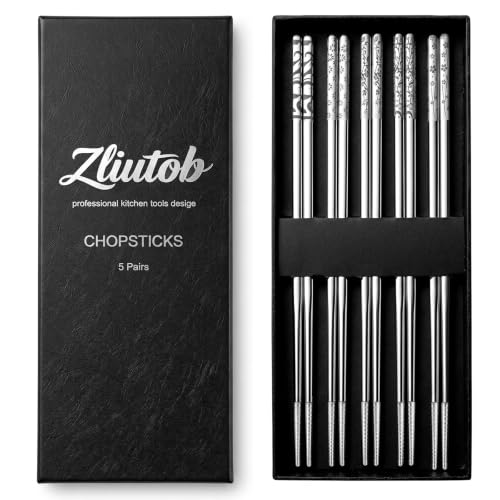
Greatamzor Titanium Plated Stainless Steel Chopsticks, 2 Pairs
Badge: Best Premium Metal
- Material: Stainless steel with titanium plating
- Pairs: 2
- Colors: Black and silver
- Design: Laser engraved, non-slip; Japanese Korean style
- Care: Dishwasher safe (per listing); reusable
- Format: Premium gift set
Strengths
- Titanium plating gives metal a dressed, formal register — black and silver pairs that set a table like cutlery jewelry.
- The stainless core guarantees the metal virtues — hygiene, permanence, dishwasher tolerance — whatever the surface meets.
- Engraved grip keeps the premium pair fully functional on slippery food.
Trade-offs
- Two pairs: a personal or couples’ set, not a household fleet.
- Plating is a surface; it prefers gentle washing to stay at its richest.
- No length or steel grade is stated in the listing.
Metal chopsticks are usually sold as utility. This set is sold as an object — and it earns the register. Titanium plating, borrowed from premium cutlery, gives the stainless core a black and silver presentation with a hard, stable surface, and the two-pair gift format frames it as something kept rather than merely used. For the buyer who wants metal’s permanence without metal’s usual plainness, this is the pool’s answer, and it is a convincing one.
Underneath the presentation, the metal fundamentals are exactly right. The core is stainless, so the pair is non-porous, non-reactive and dishwasher safe per its listing; the laser engraving means the grip is in the metal, not on it, so the working surface cannot peel. It eats like a tool and presents like a gift, which is a rarer combination than the category usually manages.
Treat it as the premium object it is: two pairs will not equip a family, and the plated finish rewards the gentle cycle over the sanitize blast if you want the black to stay deep for years. As the metal pair for a couple, a gift, or a personal set carried to good restaurants, it stands alone in this guide — the pair that makes guests ask where your chopsticks came from.
Best for: buyers who want metal’s permanence in a premium, giftable form / Not suited for: households needing a multi-pair fleet in one purchase

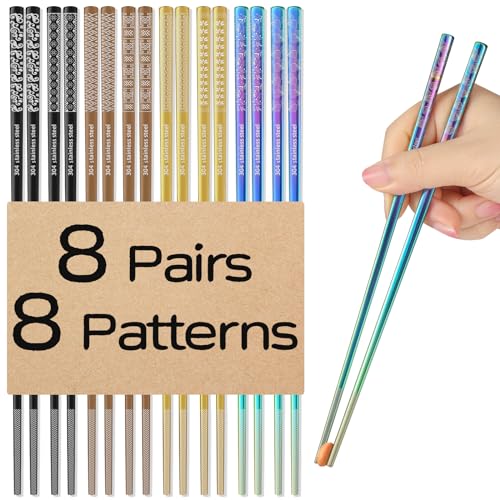
NEWDRIP Multicolor Metal Chopsticks, 8 Pairs
Badge: Best Family Metal
- Material: Stainless steel
- Pairs: 8, in multiple colors
- Length: 9.25 inches (as stated in the listing)
- Design: Laser engraved, non-slip; Japanese Korean Chinese styles
- Care: Dishwasher safe
- Stated uses: Cooking and eating; gift set format
Strengths
- Eight pairs makes metal the household standard in one purchase — every setting, serving pair and lunch bag covered.
- Color coding on metal gives each person a permanent, washable, unmistakable pair.
- Listed for cooking and eating: the same metal works the pan and the plate.
Trade-offs
- Colored finishes mellow over years of washing; the metal beneath is unaffected.
- No steel grade is stated in the listing.
- Eight pairs require real storage to stay organized.
The fastest way to understand metal’s appeal is to watch a household convert to it completely, and this set is the conversion kit. Eight engraved pairs in distinct colors: the table gets its settings, the stove gets its workers, the drawer keeps its spares, and the wooden and disposable eras end in a single delivery. Because every pair is steel, the whole system shares one care rule — everything in the dishwasher — and one performance standard, the engraved grip that is cut into the metal and cannot wear off.
The color system does more on metal than it could on wood. A color on a wooden pair is a dye in a porous surface that fades into the grain’s aging; a color on steel is a finish on an eternal body, so the assignment system it encodes can run for the life of the household. Add the cooking-and-eating listing — a pair can turn food in a steel pan, serve it, eat it and be washed — and the set becomes a small, complete metal ecosystem.
Its compromises are cosmetic and organizational: hues soften over years, the listing names no alloy grade, and eight pairs demand a holder. For a family ready to make metal the house material — the decision this whole guide is really about — those are small prices, and this is the set that makes the decision stick.
Best for: families converting the whole household to metal at once / Not suited for: solo buyers or those who want a named alloy above all

Lazycorner 304 Stainless Steel Chopsticks, 10 Pairs
Badge: Best Bulk Metal
- Material: 304 stainless steel, food grade
- Pairs: 10
- Design: Non-slip, lightweight; heat resistant per listing wording
- Finish: Silver
- Care: Dishwasher safe; reusable for daily meals and gifts
Strengths
- 304 is the professional food alloy — the metal of commercial kitchens and the dishwasher’s own interior.
- Ten pairs is permanence at scale: the metal question, answered for a household for years.
- Plain silver has no applied finish, so there is nothing on the surface that time can take.
Trade-offs
- No length is stated in the listing.
- No color system for assigning pairs.
- Presentation is a working multipack, not a gift format.
If one set in this guide embodies metal’s core promise — buy once, use forever — it is this one. Ten pairs of food grade 304 stainless, the alloy trusted wherever food and washing meet professionally, in plain silver with non-slip tips. There is no decoration to defend and no specification to apologize for; the product is the material, multiplied until it becomes infrastructure.
That scale changes what metal ownership feels like. A ten-pair fleet can be generous — guests, gatherings, lunch bags, spares — without ever risking the household’s own supply, and generosity is what turns a purchase into a standard. The lightweight design keeps the pairs friendly to every hand, including the metal-skeptical, and the dishwasher-safe listing means the fleet’s upkeep is a non-event repeated nightly.
Its limits are presentational: no colors to assign, no stated length, no gift ceremony. Buyers who want those things have richer options above and below. Buyers who want the metal itself, in its proven grade, at the scale where a household simply stops thinking about chopsticks, have found their set — the same set that anchors the practical end of Best Pair Of Chopsticks thinking, where one correct standard serves everyone.
Best for: large households and hosts who want metal as permanent infrastructure / Not suited for: buyers who want color assignment or a gift object

IQCWOOD 304 Stainless Steel Chopsticks, 5 Pairs
Badge: Best Classic Metal
- Material: 304 stainless steel
- Pairs: 5
- Length: 9.25 inches (as stated in the listing)
- Design: Lightweight, non-slip tips; Korean Japanese style
- Care: Dishwasher safe; reusable
Strengths
- The canonical metal chopstick: named 304 steel, traditional proportions, proven daily form.
- Non-slip tips answer the slipperiness charge inside the classic silhouette.
- Lightweight build keeps the classic from feeling heavy.
Trade-offs
- Plain silver only; no pattern, color or plating story.
- Five pairs is a household set, not an entertaining fleet.
- The brand name promises wood and delivers metal — the listing, as always, is the truth.
Some products are interesting; this one is correct. The IQCWOOD set is metal chopsticks in their reference form — 304 stainless, silver, 9.25 inches in the Korean Japanese tradition that made metal a daily material in the first place. If you want to know what the category is when it is not trying to be anything else, this is the specimen, and its correctness is a genuine recommendation: traditional proportions exist because they work, at millions of tables, across lifetimes of meals.
The modern touches are exactly where they should be. Non-slip tips fix the classic form’s one historical flaw without altering its silhouette; the lightweight construction trims the heft that made older metal pairs feel like tools from a workshop; and the dishwasher-safe, reusable listing states the material’s whole lifestyle in two words. Nothing is decorated, and nothing needs to be.
Choose it when you want metal’s substance without a story attached — the set a Korean grandmother and a minimalist chef would both recognize as simply right. Choose elsewhere for color systems, premium plating or party scale. The classic’s quiet confidence is that it will still be the reference when those fashions have cycled, a permanence of design to match the permanence of its material.
Best for: buyers who want the reference metal chopstick, correctly made / Not suited for: buyers who want ornament or a large fleet
Greatamzor 18/8 Stainless Steel Chopsticks, 5 Pairs
Badge: Best All-Round Metal
- Material: 18/8 stainless steel
- Pairs: 5
- Length: 9 1/4 inches (as stated in the listing)
- Design: Laser engraved, non-slip; Japanese Korean style
- Care: Dishwasher safe
- Stated uses: Cooking and eating; gift set format
Strengths
- 18/8 is the flatware alloy — metal with a century of daily washed service behind its recipe.
- Laser engraving makes the grip a permanent property of the metal itself.
- Cooking-and-eating listing: one metal pair for the whole meal’s work.
Trade-offs
- Plain steel color only, in a guide with multicolor options.
- Engraved grooves deserve tips-down loading so the wash reaches them.
- Five pairs is mid-scale for large families.
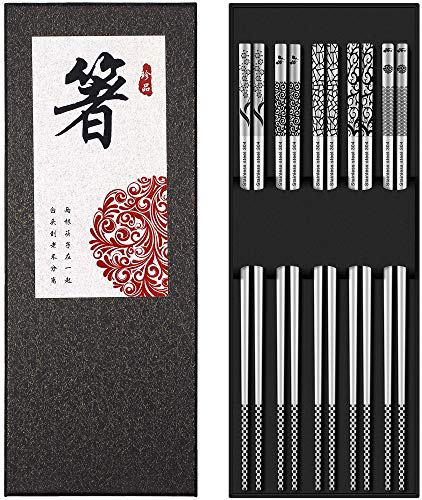
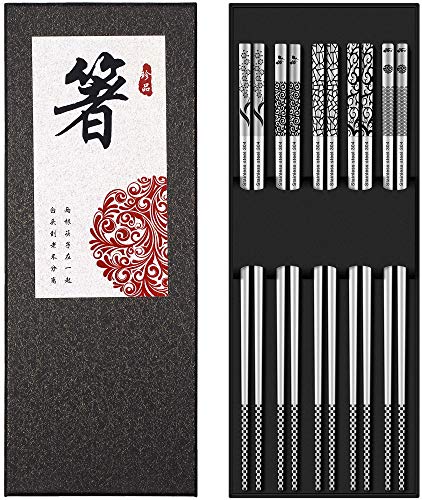
The all-rounder’s case rests on two pillars: the right alloy and the right surface. The alloy is 18/8, the recipe the flatware world standardized on because it survives the exact life a chopstick leads — daily food, daily washing, daily knocking around in drawers — while keeping its brightness. The surface is laser engraved, which in metal terms is the honest way to add grip: not a coating that rents space on the stick, but a pattern cut into the stick itself, as permanent as the pair.
That permanence-of-grip is the detail that converts skeptics. The slippery-metal story is really a smooth-metal story, and an engraved pair simply does not tell it: noodles, dumplings and sauced pieces are held by texture, at ordinary finger pressure, from the first meal. Add the cooking-and-eating listing — the pair can work a pan’s surface, serve, eat and be dishwashed — and the set becomes the single most versatile metal purchase in the guide.
Its compromises are modest: no colors, mid-scale count, and engraving that appreciates being loaded tips-down so the dishwasher reaches the pattern. For a buyer who wants one metal set that does everything well and specifies itself properly, this is the recommendation the rest of the guide keeps circling back to — the pair that even the bar-tool world borrows, as the Best Metal Chopsticks Stirring Cocktails crossover shows.
Best for: buyers who want one metal set that cooks, eats and specifies itself / Not suited for: buyers who want color coding or a ten-pair fleet

NEWDRIP 18/8 Stainless Steel Chopsticks, 8 Pairs
Badge: Best Metal Rotation
- Material: 18/8 stainless steel
- Pairs: 8
- Length: 9.25 inches (as stated in the listing)
- Design: Laser engraved, non-slip; Japanese Korean Chinese styles
- Care: Dishwasher safe
- Stated uses: Cooking and eating; gift set format
Strengths
- Named 18/8 alloy at fleet scale — the specification and the rotation in one set.
- Plain metal finish cannot fade: the eighth year looks like the first.
- Engraved grip and a cooking-and-eating brief across all eight pairs.
Trade-offs
- No color coding; pairs are communal.
- Utilitarian presentation next to the gift-formatted sets.
- Needs a holder sized for eight.
Take the all-rounder’s alloy and engraving, remove the one element time can fade — color — and multiply by eight: that is this set, and it is the most quietly rational purchase in the guide. A household that washes nightly and cooks often gets a named-alloy metal fleet whose every pair performs identically, whose appearance has no countdown attached, and whose rotation depth means no pair is ever overworked. Metal’s permanence, expressed as a system.
The details hold the standard at scale. The engraving is in the metal, so the fleet’s grip does not decay pair by pair; the 9.25-inch length is the versatile dining standard; the cooking-and-eating listing lets the fleet work the stove’s surface as well as the table. In a household that has decided metal is the material, this is the set that makes the decision feel finished — the drawer closes on the subject.
What it surrenders is assignment and ceremony: no colors to call your own, no gift drama in the presentation. Households that need the color system know who they are and have the multicolor NEWDRIP above; everyone else who wants maximum metal with minimum fuss should start here — and will understand why community veterans of the category, in the discussions surveyed under Best Metal Chopsticks Reddit, so often describe exactly this combination as the end of their search.
Best for: families who want named-alloy metal at full rotation with zero finish anxiety / Not suited for: buyers who want color-assigned pairs
Comparison Table
| Pick | Material (as listed) | Pairs | Length (as listed) | Finish / grip | Link |
|---|---|---|---|---|---|
| Greatamzor Titanium Plated | Stainless steel, titanium plated | 2 | Not stated | Black and silver; laser engraved | Check on Amazon |
| NEWDRIP Multicolor | Stainless steel | 8 | 9.25 inches | Multicolor; laser engraved | Check on Amazon |
| Lazycorner | 304 stainless steel | 10 | Not stated | Silver; non-slip | Check on Amazon |
| IQCWOOD | 304 stainless steel | 5 | 9.25 inches | Silver; non-slip tips | Check on Amazon |
| Greatamzor 18/8 | 18/8 stainless steel | 5 | 9 1/4 inches | Steel; laser engraved | Check on Amazon |
| NEWDRIP 18/8 | 18/8 stainless steel | 8 | 9.25 inches | Steel; laser engraved | Check on Amazon |
How to Choose Metal Chopsticks
Shop by specification, in this order. Alloy first: a named grade — 304, 18/8 — is a promise you can verify, and in a product whose whole point is permanence, verifiable promises are the product. Tips second: insist on a treatment — textured, engraved, non-slip — because the difference between metal that grips and metal that skates is the difference between converts and skeptics. Weight third: if you are coming from wood, a lightweight or hollow-core build will ease the transition; if you like authority in the hand, standard builds deliver it.
Finish fourth, with eyes open about aging: engraving is forever, plain silver is the metal itself, plating is premium and finite at the edges, color is organizational and slowly softening. None of these is a wrong answer; each is a different contract with time. Count last: two pairs for the personal and premium life, five for a household, eight to ten for the full conversion. Metal rewards buying at the scale of your actual table, because the set you buy is the set you will still have when every other variable has changed.
One cross-check for the wood-loyal: borrow or buy a single textured pair and give it the week described below before judging the category. Metal is the rare material whose reputation lags its current products by a generation; the listings in this guide, with their treated tips and tuned weights, are what the category actually sells now.
And a note on value, stated qualitatively as this guide states all such things: metal’s arithmetic is front-loaded. The set costs what it costs once, and then the meter stops — no replacement cycle, no consumables, no care products — while every rival material quietly bills you again on its own schedule. Over the years a household actually keeps a set, the metal fleet is very often the cheapest chopstick it has ever owned, measured in anything except the first receipt.
How to Use Metal Chopsticks: The First-Week Technique
Metal asks for a slightly lighter hand than wood, and rewards it quickly. Build the skill in order:
- Set the grip. Lower stick resting in the thumb’s web on the ring finger, held still; upper stick held like a pencil, doing all the moving.
- Let the tips work. Close until the treated tips meet the food and stop there — the texture holds, so the squeeze you used on smooth wood is unnecessary and is what launches dumplings.
- Start with forgiving foods. Chunky stir-fry pieces, sushi rolls and noodles in broth are metal’s friendly territory; save the single sesame seed for week two.
- Use the pair’s precision. Metal’s firmness transmits texture — test noodle doneness, feel a dumpling’s give — information wood muffles.
- Rest them properly. On a rest or the plate’s edge; metal’s ring on ceramic is the sound of a habit forming.
Troubleshooting. Problem: food slides off despite treated tips → the food is wet or your tips close past parallel; dry the bite, open the pair a fraction, and let the tips meet at the food. Problem: hand fatigue by the main course → your grip is too low and too tight; move up the sticks, loosen, and let the lower stick rest rather than be held. Problem: the pair feels cold and alien at a winter table → it is metal being honest; a minute in the hand brings it to you, and many users come to like the cool precision of the first bites.
Where Metal Wins, and Where It Does Not
The wins are structural. Hygiene: a non-porous surface with no grain, fully dishwasher safe, is the cleanest eating tool in the drawer. Permanence: no mechanism of decay in normal use. Consistency: the pair handles identically in year five because nothing about its surface or shape has changed. Heat tolerance at the table and the pan’s edge. And a certain precision — metal’s firmness and fine tips make it the connoisseur’s instrument for sushi, grilled dishes and anything sauced.
The honest losses deserve equal clarity. Metal is the loudest material against ceramic and the coolest in the hand. It conducts, so it is not the tool to leave resting in a hot pot. Its weight, even tuned, exceeds bamboo’s. And its smoothness, where a maker has skimped on tip treatment, is a genuine flaw — which is why this guide contains no untreated pick. A buyer who weighs those losses and still chooses metal — as the whole Korean dining culture did — chooses with the full picture, and tends to choose for life, a versatility the Best Multi Use Chopsticks perspective celebrates.
Metal Around the World: How Three Dining Cultures Specify It
Metal chopsticks are not a modern invention looking for a tradition; they are a tradition that modern manufacturing caught up with. In Korea, metal is simply what chopsticks are: flat-ish, medium-length, textured at the tip, built for a cuisine of grilled meat, boiling stews and slick noodles, and for a washing culture that runs everything through serious cleaning. The Korean specification — durable alloy, grippy end, nothing decorative that cannot survive — is visible all over this guide’s pool, whose listings repeatedly invoke Korean styling because that styling is a functional dialect, not a fashion.
Japan’s metal story is more selective. The everyday Japanese pair is traditionally wood or bamboo, shorter and finer, but metal appears where precision and hygiene lead: in professional kitchens, in bento culture, and in the personal-pair tradition where a kept object is carried for years. Japanese influence in this pool shows in the finer lengths and the gift presentation — the idea that a pair can be an object of regard. China’s metal story runs through celebration and service: metal and metal-toned pairs for hot pot, where the tool lives half its life in boiling broth that would destroy lesser materials, and for the serving roles where a host’s pair must be impeccable and obviously clean.
The modern pool in this guide is what happens when those three dialects meet factory production: Korean functionalism, Japanese presentation, Chinese hot-pot toughness, rendered in laser engraving, titanium plating and named alloys. Understanding the dialects helps a buyer read any metal listing — including future ones beyond this pool — and hear which tradition a given pair is speaking, and therefore what it will be good at.
Living With Metal: Sound, Temperature and the Table
A week with metal teaches three small lessons no specification sheet mentions. The first is sound. Metal on ceramic has a voice — a bright tick where wood gives a hush — and households divide honestly over it. Some find it crisp and restaurant-like; others, especially at quiet breakfasts, find it wearing. The mitigations are real: rests keep pairs off plates between bites, wooden or silicone-tipped serving pieces can handle the shared dishes, and the lighter builds in this pool ring less than heavy ones. But a buyer who knows they are sound-sensitive should weigh the classic silver sets’ calm against, frankly, keeping a wooden pair for the quiet meals — a mixed drawer is a legitimate endpoint.
The second lesson is temperature. Metal arrives at the table cool and honest: it tells your fingers the broth is hot before your lips learn it, which experienced diners count as information, not rudeness. It also means a pair left in a steaming bowl becomes a warm pair — the work-and-rest rhythm from the technique section applies at the table as much as at the stove. The third lesson is social: metal reads as deliberate. Guests notice a matched metal setting the way they notice real glassware — as evidence the host owns actual equipment — and the fleets in this guide exist to make that impression effortless at any headcount.
None of these lessons reverses the material’s verdict. They refine it: metal for the meals where precision, hygiene and permanence matter — which is most meals — with the self-knowledge to keep a quiet wooden pair for the ones where hush matters more. A guide that cannot say that much is selling something; this one is content to specify.
Metal vs the Field, One Last Comparison
Compress the whole category into a paragraph per material and the choice architecture clears. Wood: warm, light, grippy, quiet — and mortal, killed slowly by the washing that hygiene requires. Bamboo: wood’s virtues at half the weight and half the lifespan, the honest semi-disposable. Plastic and melamine: cheap, light, forgiving for learners — and barred from real heat, prone to warp and scuff into early old age. Fiberglass: the engineer’s composite, heat-tolerant and dishwasher-proof, with a character some find soulless and tips that tire over long service. Metal: permanent, hygienic, precise, dishwasher-indifferent — paying for it with weight, sound, coolness and the need for treated tips.
Notice that metal’s costs are all addressable at purchase: weight by construction, sound by habit, coolness by acclimation, tips by specification. The other materials’ costs are mostly addressed by replacement. That asymmetry — fixable at buying versus fixable only by re-buying — is the deepest reason this guide’s pool is metal from end to end, and why the category keeps converting households that give it one honest week.
Care and Feeding of a Metal Fleet
Metal’s care routine is the shortest in the utensil world, which is precisely why fleets survive. Wash everything, any way: all six sets here are listed as dishwasher safe, and the machine’s heat and detergent are a full reset for a non-porous material. Load tips-down and un-nested so the eating ends get the wash they deserve. Dry when you unload if your water is hard — the spots that hard water leaves are mineral film, and a ten-second towel pass is the difference between a fleet that gleams and a fleet that merely endures.
Storage is the second half of care. A holder or divided tray keeps pairs together, prevents the metal-on-metal rattling that is the main source of cosmetic wear, and makes the fleet’s completeness visible at a glance — you notice a missing pair in a holder; you never notice one in a pile. Once in a while, a paste of baking soda and water on a soft cloth restores plain silver’s brightness completely, and an engraved pair appreciates a soft brush through its pattern after a run of saucy meals. Plated and colored pairs ask only for the gentle end of the same routine: regular cycles rather than the hottest, and storage that does not grind them against heavier cutlery.
That is the entire liturgy. No oiling, no seasoning, no refinishing, no retirement schedule — the care profile of a material that was chosen, in the end, because it asks for almost nothing and returns almost everything. Households that have maintained wooden sets with hand washing and upright drying will feel the difference in their evenings within the first week.
Common Buying Mistakes
- Buying smooth, polished metal for looks. Untreated tips are the category’s one real flaw; texture is not optional.
- Judging metal by a cheap first pair. Unnamed alloy, mirror tips and clumsy weight are a bad product, not a bad material.
- Ignoring the alloy. In a permanence purchase, a named grade is the specification that matters most.
- Squeezing like it is wood. Metal’s treated tips hold at light pressure; force is the beginner’s tax.
- Buying two pairs for a family conversion. Metal becomes a standard at fleet scale; size the set to the table.
- Expecting colored finishes to be as eternal as the metal. The body is forever; the palette is a finish, with a finish’s lifespan.
Final Recommendation
Start with the titanium plated Greatamzor pair if metal, for you, must also be beautiful; the NEWDRIP multicolor fleet if your household is converting together; or the Lazycorner ten-pair 304 set if you want the material as pure infrastructure. The IQCWOOD is the classic reference, the engraved Greatamzor 18/8 the all-rounder, and the NEWDRIP 18/8 the rational fleet. Whichever you choose, give metal its fair week with the technique above before judging it — the category’s converts are made in days, and its permanence lasts, quite literally, as long as you keep track of the pairs.
A final perspective for the undecided: every other utensil in your kitchen already made this decision. Your knives, forks, spoons and pans are metal, chosen for the same permanence and hygiene, and nobody describes a fork as cold or loud with a straight face. The chopstick is simply the last utensil to complete the set — and with treated tips and tuned weights, its modern form has run out of good reasons to wait.
Frequently Asked Questions
Are metal chopsticks harder to use than wooden ones?
Briefly, for most people. Metal is smoother and heavier than wood, and the first meals can feel slippery — which is why every pick in this guide has treated tips and why the technique section teaches a lighter grip. Most users are comfortable within a week, and many end up preferring metal’s precision, especially for sushi, grilled foods and noodles.
What is the best metal for chopsticks?
Stainless steel owns the category, and within it the named food grades — 304 and 18/8, both present here — are the proven standard for corrosion resistance and daily washing. Titanium plating, on the premium pick, is a surface upgrade over a stainless core rather than a different base metal.
Do metal chopsticks get hot in soup or at the stove?
They warm where they touch heat, because metal conducts. At the table this is a non-issue — rest the pair on the bowl’s rim between bites. At the stove, use the work-and-rest rhythm: brief contact, then rest the pair out of the pan. Sustained deep-pot work belongs to long insulating cooking pairs, not dining-length metal.
Will metal chopsticks damage my bowls or cookware?
Metal is harder than ceramic glaze and nonstick coatings, so treat both with ordinary respect: no energetic scraping of nonstick, and set pairs down rather than dropping them into bowls. On steel, iron and stoneware in normal dining use, metal pairs are entirely at home — as entire dining cultures demonstrate daily.
Are metal chopsticks hygienic?
They are the hygiene benchmark of the category: non-porous, non-absorbent, and dishwasher safe in every listing here, so a full hot wash resets them completely. It is one of the reasons metal became the standard in Korean daily dining and in professional settings where utensils are washed constantly.
Why do some metal chopsticks feel so light?
Construction. Hollow-core designs — and lightweight builds generally — remove the mass that gave old metal pairs their heaviness, while keeping the steel surface. If you are switching from wood or bamboo, a lightweight metal pair is the gentlest bridge; if you prefer heft, standard solid-feeling builds provide it.
How long do metal chopsticks last?
Long enough that the honest answer is: until you lose them. The steel has no wear-out mechanism in dining use; finishes age at different rates (engraving slowest, color fastest), and pairs go missing long before they wear out. Fleet depth and a storage habit are therefore the real longevity features, which is why this guide includes sets up to ten pairs.
Are metal chopsticks a good choice for beginners?
Yes, with the right specification — and the specification is the tip. A beginner on a textured or engraved pair, like every pick in this guide, learns on a surface that forgives: the texture holds food at light pressure while the hand learns its angles. Beginners struggle with metal only when the pair is mirror-smooth, which is a product flaw, not a category verdict. Start with noodles and chunky dishes, use the first-week technique in this guide, and expect competence in days.
Can children use metal chopsticks?
Comfortably, once they are past the trainer stage. The lightweight builds in this pool suit smaller hands, the durability survives the treatment children give utensils, and the hygiene of a fully dishwashable pair is a genuine parental relief. Many families assign each child a color from a multicolor set, which turns the metal pair into personal property — the surest way to have it used, kept and learned on.