Disclosure: topratedkitchenware.com is reader-supported. When you buy through links on our site, we may earn an affiliate commission from Amazon and other retailers, at no extra cost to you.
Where to buy
The six hand mixers below are the verified picks for this guide to best milk shake mixers, and the approach deserves one honest sentence: the classic diner milk shake is made on a spindle drink mixer, but the machine most home kitchens can justify, store, and use weekly is a good hand mixer — and with softened ice cream, a tall jar, and the right speed discipline, it makes a genuinely excellent shake. Each review judges its mixer on shake work specifically. Each name links to its Amazon listing, where you can check the latest price on Amazon before you order.
- LILPARTNER Hand Mixer
- KitchenAid 5-Speed Hand Mixer, Contour Silver
- Cuisinart Power Advantage Plus 9-Speed Hand Mixer
- WEPSEN 5-Speed Hand Mixer Set
- KitchenAid 5-Speed Hand Mixer, Black Matte
- Hamilton Beach 6-Speed Hand Mixer
Read the full guide ↓ for the reasoning behind each pick, the honest trade-offs, and the checks that matter more than the label.
The search for the best milk shake mixers starts at a soda fountain. The classic milk shake — two words, diner spelling — is a specific drink: ice cream loosened with milk and syrup into something pourable, frothy, and cold enough to fog the glass, traditionally blended on a spindle mixer that aerates as it mixes. Home kitchens rarely have counter space or shake volume to justify that single-purpose machine, which is why this guide answers the keyword the practical way: with the hand mixers that actually make shakes in real kitchens, judged on the shake-relevant virtues of low-speed control, whisk and beater geometry, motor manners under load, and cleanup.
A hand mixer makes a good milk shake for a structural reason. The drink is not a smoothie — there is no ice to crush and no frozen fruit to pulverise — so brute power is nearly irrelevant. What matters is folding softened ice cream, milk, and flavouring into a uniform, aerated pour without melting the body out of it or spraying the walls. That is a job of gentle, controllable speed, attachments that reach the bottom of a tall vessel, and a motor that does not surge. Every pick here was assessed on those terms, including the honest ceiling: for ice-cream-parlour thickness, a blender or a dedicated spindle machine still exists, and the reviews say where that line falls.
You will find the working method too: the softening window that decides texture, the two-stage speed technique, the vessel choice that prevents the famous hand-mixer geyser, and the fixes for shakes that come out thin, icy, or flat. Dessert readers building a full station may also enjoy our Best Milkshake Mixers guide, which takes the thicker, one-word dessert shake as its brief — a close cousin, but not the same drink.
Key Takeaways
- A milk shake needs control, not power: softened ice cream, gentle speeds, and aeration decide the result more than motor size.
- Hand mixers are the practical home answer — the LILPARTNER’s whisk attachments and 7 speeds suit the shake method best overall.
- Start on the lowest speed, in a tall jar, with the beaters submerged before the motor starts: that sequence prevents the classic spray.
- The Hamilton Beach 62636J’s whisk and stronger motor handle the thickest starting mixtures here.
- For parlour-thick, scoop-shop shakes, know the honest limit: a spindle drink mixer or blender is the specialist tool.
In this guide
Quick Picks
Six hand mixers ranked for shake work — speed control, attachments, and behaviour in a tall jar — with badges matched to the detailed reviews.
| Pick | Badge | Best for | Link |
|---|---|---|---|
| LILPARTNER Hand Mixer | Best Overall | Home shake makers wanting whisk-led aeration and gentle control | Check on Amazon |
| KitchenAid 5-Speed Hand Mixer, Contour Silver | Best Classic | Reliable, everyday shake making with easy-clean beaters | Check on Amazon |
| Cuisinart Power Advantage Plus 9-Speed Hand Mixer | Best Control | Precise makers who want the finest speed gradations | Check on Amazon |
| WEPSEN 5-Speed Hand Mixer Set | Best Complete Kit | New kitchens that need the mixer and the bowls in one purchase | Check on Amazon |
| KitchenAid 5-Speed Hand Mixer, Black Matte | Best Compact Classic | Small kitchens wanting the classic mixer in a discreet finish | Check on Amazon |
| Hamilton Beach 6-Speed Hand Mixer | Best for Thick Starts | Makers who start from firmer ice cream and denser mixtures | Check on Amazon |
How These Picks Were Chosen
This guide is research-led. The verified pool for this keyword is a set of electric hand mixers, so each was assessed from its listing on the attributes that decide shake-making: number and spacing of speeds, whether the lowest speed is genuinely gentle, attachment sets (whisks fold and aerate a shake better than beaters alone), storage and cleanup design, and any anti-splatter engineering. No hands-on testing is claimed, and no mixer is described as a spindle drink machine — the method sections exist precisely to bridge that honest gap with technique.
Two filters shaped the ranking. The first was the start: a shake begins as a semi-solid mass that punishes a mixer whose lowest speed is already fast, flinging ingredients before they combine. Models with gradual speed systems and anti-splatter starts ranked up. The second was the finish: a milk shake wants air folded in at the end, so whisk attachments and higher, stable top speeds for a brief final whip counted for more than headline wattage, which matters far less in this drink than buyers assume.
The 6 Best Milk Shake Mixers
Read each review for its shake behaviour — how it starts, how it aerates, and where its ceiling sits — rather than for its general baking reputation.

LILPARTNER Hand Mixer
Badge: Best Overall
The LILPARTNER takes the overall badge on attachment logic. A milk shake is finished with air, and this is the mixer here that arrives with whisks among its five stainless accessories — swap from beaters for the combining stage to a whisk for the final thirty seconds and the drink gains the light, frothy body that defines the diner original. Seven speeds also matter at the other end of the process: the climb from a softened scoop mass to a pourable shake can be walked up gradually instead of lurched through.
Its limits are shared and cosmetic. Shared: no hand mixer, this included, should be asked to attack rock-hard ice cream — soften first, always. Cosmetic: the light pink finish is a commitment to a look. Neither touches the shake it makes, which is the most complete home version in this guide.
Strengths
- Whisk attachments fold air into the finish, which is the shake texture
- Seven speeds give a genuinely gradual start for semi-solid mixtures
- Dishwasher-safe attachments make a sticky job effortless to clean
Trade-offs
- A fashion colour that will not suit every kitchen
- Accessory breadth matters less if shakes are your only job
- Like all hand mixers, it needs the ice cream softened first
Key specs from the listing
- Speeds: 7
- Attachments: 5 stainless steel accessories
- Care: Dishwasher-safe attachments
- Colour: Light Pink
Best for: Home shake makers wanting whisk-led aeration and gentle control / Not suited for: Anyone mixing very stiff, just-scooped ice cream straight from a deep freeze

KitchenAid 5-Speed Hand Mixer, Contour Silver
Badge: Best Classic
KitchenAid’s KHM512 is the mixer most shake makers will picture, and its details suit the job quietly well. The Turbo Beaters are shaped to move through soft mixtures without clogging, which in shake terms means softened ice cream combines evenly instead of riding up the shafts. The lockable swivel cord sounds trivial until you are working one-handed in a tall jar while the other hand steadies it — then a cord that stays where you put it is a genuine feature.
The honest gap is the whisk. The aerated finish this guide recommends is achievable with beaters and a brief top-speed pass, but a whisk does it better, and this box is beater-led. Buyers who make shakes weekly and nothing else should weigh the LILPARTNER; buyers who want one classic mixer for the whole kitchen, shakes included, will be served for years by this one.
Strengths
- Turbo Beaters are designed to avoid clogging in soft mixtures
- The swivel cord locks left or right, keeping it out of the jar
- One-button beater release makes sticky cleanup quick
Trade-offs
- No whisk attachment listed for the aeration stage
- Five speeds give coarser steps than the 7- and 9-speed picks
- A classic at a classic’s positioning in its class
Key specs from the listing
- Speeds: 5
- Model: KHM512
- Attachments: Turbo Beaters
- Features: Lockable swivel cord, easy-release button
- Care: Dishwasher-safe beaters
Best for: Reliable, everyday shake making with easy-clean beaters / Not suited for: Makers who want a whisk in the box for the aerated finish

Cuisinart Power Advantage Plus 9-Speed Hand Mixer
Badge: Best Control
If one feature in this guide was designed by someone who has made a milk shake, it is Cuisinart’s SmoothStart: a gentle ramp at switch-on that exists to stop soft mixtures from leaving the vessel. In shake work that is the difference between a calm combine and a redecorated counter. Behind it, nine speeds give the finest gradations here — a slow fold for combining, a middle range for loosening, and headroom for the final aeration, each a small step rather than a jump.
The counter-argument is simplicity. A shake is a two-minute drink, and some makers will never explore nine speeds when three would do. But control you ignore costs nothing, while control you lack cannot be improvised mid-shake. For makers who value the process as much as the pour, this is the connoisseur’s pick.
Strengths
- SmoothStart is the anti-geyser feature, engineered for exactly the shake start
- Nine speeds give the finest control steps in this guide
- The snap-on case keeps attachments and mixer together in the drawer
Trade-offs
- Control depth exceeds what a simple shake strictly needs
- A storage case is one more object to house
- White finish shows every splash of chocolate syrup
Key specs from the listing
- Speeds: 9
- Model: HM-90S
- Feature: SmoothStart anti-splatter
- Storage: Snap-on storage case
Best for: Precise makers who want the finest speed gradations / Not suited for: Anyone who finds nine speeds of choice more burden than benefit

WEPSEN 5-Speed Hand Mixer Set
Badge: Best Complete Kit
The WEPSEN is the starter-kit answer: a 5-speed hand mixer with whisks and beater, four stainless nesting bowls, and measuring cups and spoons in one box. For shake making specifically, two parts of that kit earn their place — the whisks, for the aerated finish this guide keeps recommending, and a tall-sided bowl from the set, which contains the combining stage far better than the shallow vessels new kitchens tend to own. Measured ratios also stop being aspirational when the measures are in the drawer.
Equipped kitchens should read the value differently: for them the kit duplicates what they own, and the mixer alone faces strong competition above. This pick is for the first-apartment and fresh-start buyer, for whom one purchase that covers shakes, bakes, and the bowls to make them in is a genuinely efficient answer.
Strengths
- Whisks included for the aerated shake finish
- The bowl set solves the vessel problem for new kitchens
- Measuring kit supports repeatable shake ratios
Trade-offs
- You are buying a kit — redundant if your kitchen is equipped
- Five speeds, with steps sized for general baking
- Nesting bowls nest in cupboards you may not have spare
Key specs from the listing
- Speeds: 5
- Attachments: Whisks and beater
- Included: 4 stainless nesting bowls, measuring cups and spoons
Best for: New kitchens that need the mixer and the bowls in one purchase / Not suited for: Established kitchens buying a mixer alone

KitchenAid 5-Speed Hand Mixer, Black Matte
Badge: Best Compact Classic
Honesty about what this pick is: the same KHM512 as the Contour Silver model above, in black matte. That is worth a place in the guide rather than an apology, because colour is a real buying factor for a tool that lives in a drawer beside matching appliances — and because its shake-relevant behaviour bears repeating in its own right: beaters that do not clog in soft mixtures, a cord that locks out of the way, and an easy release that makes a sticky cleanup a one-button job. In matte black it also forgives the visible evidence of chocolate shakes past.
Choose between this and its silver sibling on finish alone, and between the pair of them and the whisk-carrying picks on method: beater-only makers who keep the shake classic and pourable lose nothing here. Makers chasing maximum froth should take the whisk route above.
Strengths
- The proven KHM512 shake behaviour in a finish that hides splashes
- Turbo Beaters combine softened ice cream evenly
- Compact, drawer-friendly format for small kitchens
Trade-offs
- The same mixer as the Contour Silver pick — choose on colour, not performance
- No whisk listed for the finishing stage
- Matte finishes show oily fingerprints more than gloss
Key specs from the listing
- Speeds: 5
- Model: KHM512
- Attachments: Turbo Beaters
- Features: Lockable swivel cord, easy-release button
- Colour: Black Matte
Best for: Small kitchens wanting the classic mixer in a discreet finish / Not suited for: Makers set on a whisk attachment in the box
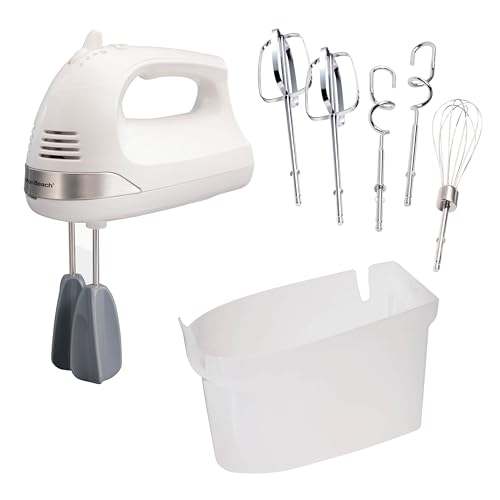
Hamilton Beach 6-Speed Hand Mixer
Badge: Best for Thick Starts
The Hamilton Beach is the thick-start specialist. Its 275-watt motor is the strongest here, and while this guide insists power is not the shake’s main virtue, there is one moment it matters: the first twenty seconds, when the mixture is at its firmest and a weaker mixer bogs, strains, or rides up out of the jar. This one pushes through that window with authority — and then, crucially, it also carries a whisk for the opposite end of the process, the gentle aeration that finishes the drink.
Authority needs discipline. Run this mixer at full speed too early and it will melt the body out of the shake with friction and enthusiasm. Used at low speeds to combine and briefly at the top to aerate, it covers both ends of the method better than any single-virtue rival — which is why it closes, rather than opens, arguments about motor size.
Strengths
- The strongest motor here for firmer starting mixtures
- A whisk is in the box for the aerated finish
- Easy Clean beaters and a snap-on case tidy the whole job
Trade-offs
- Power must be disciplined — full speed early melts and sprays
- A fuller attachment set to store
- White finish, with the same splash visibility as any light colour
Key specs from the listing
- Speeds: 6
- Model: 62636J
- Motor: 275 watts
- Attachments: Traditional beaters, dough hooks, whisk
- Storage: Snap-on storage case
Best for: Makers who start from firmer ice cream and denser mixtures / Not suited for: Delicate, thin diner-style shakes where its strength is surplus
Comparison Table
Speeds, attachments, and the one feature each mixer hangs its shake reputation on — the comparison in a single view.
| Pick | Badge | Format | Standout trait | Link |
|---|---|---|---|---|
| LILPARTNER Hand Mixer | Best Overall | 7-speed hand mixer | Five stainless accessories, including whisks for aeration | Check on Amazon |
| KitchenAid 5-Speed Hand Mixer, Contour Silver | Best Classic | 5-speed hand mixer | Turbo Beaters and a lockable swivel cord | Check on Amazon |
| Cuisinart Power Advantage Plus 9-Speed Hand Mixer | Best Control | 9-speed hand mixer | SmoothStart anti-splatter and a snap-on storage case | Check on Amazon |
| WEPSEN 5-Speed Hand Mixer Set | Best Complete Kit | 5-speed hand mixer set | Four nesting bowls plus measuring kit included | Check on Amazon |
| KitchenAid 5-Speed Hand Mixer, Black Matte | Best Compact Classic | 5-speed hand mixer | The KHM512 in black matte, with Turbo Beaters | Check on Amazon |
| Hamilton Beach 6-Speed Hand Mixer | Best for Thick Starts | 6-speed hand mixer | 275-watt motor, whisk included, snap-on case | Check on Amazon |
How to Choose a Mixer for Milk Shakes
Choose by the start, not the finish. Every mixer here can stir a finished shake; the differences live in the first thirty seconds, when softened-but-firm ice cream meets milk and syrup. A gentle lowest speed — or an anti-splatter start like Cuisinart’s SmoothStart — keeps the mixture in the vessel and combining evenly. A mixer whose slowest speed is already vigorous will teach you that lesson on your shirt. If you remember one criterion from this guide, make it the quality of the slowest speed.
Choose attachments by texture ambition. Beaters combine; whisks aerate. The classic milk shake’s light, frothy body comes from air folded in at the end, which is whisk work — beaters can approximate it with a brief high-speed pass, but makers who chase the diner texture weekly should buy a box with a whisk in it. Dough hooks, by contrast, are shake-irrelevant; value them only if bread is also in your life.
Treat wattage as a threshold, not a ranking. A shake contains nothing that needs crushing, so beyond the strength to push through the firm first seconds — the Hamilton Beach’s territory — extra power buys melting friction, not quality. The same threshold logic appears across the small-appliance shelf; our Best Mini Mixers guide applies it to compact baking, where control likewise beats headline numbers.
Finally, choose for cleanup, because shakes are sticky and frequent. Dishwasher-safe beaters, an easy-release button, and a storage case that keeps the sticky parts together decide whether the mixer gets used twice a week or twice a summer. The best milk shake mixer is the one that is clean, assembled, and reachable when the craving arrives — which is a storage decision as much as a motor decision.
How to Make a Diner-Style Milk Shake with a Hand Mixer
Technique is the bridge between a hand mixer and the soda-fountain original. This sequence works with every pick in the guide.
- Soften the ice cream for ten to fifteen minutes. It should yield to a spoon with gentle pressure — scoopable, not soupy. This window decides the texture more than any equipment.
- Chill the vessel and the glasses. A tall jar or deep bowl, cold from the fridge or freezer, keeps the shake’s body while you work.
- Combine at the lowest speed, beaters submerged before starting. Ice cream, a modest measure of milk, and syrup first; thirty slow seconds until the mass loosens uniformly.
- Walk the speed up one step at a time. Each step should look smoother, not splashier. Add milk a spoonful at a time if the shake resists pouring.
- Finish with air. Swap to the whisk if your mixer has one and give the shake a brief top-speed pass — just until it lightens and froths at the surface.
- Pour immediately, into the cold glasses. A milk shake waits for no one; its froth and chill are at their peak in the first minute.
Ratios are a starting point to personalise: roughly three scoops to a small glass of milk builds the classic pourable shake, and every household should adjust once, write the result down, and stop re-deciding. Syrup and mix-ins go in at the combining stage, never after aeration, which they would collapse.
Troubleshooting
Problem: the shake sprays the counter at switch-on → the vessel is too shallow or the speed too high for the start; move to a tall jar, submerge the beaters fully before starting, and begin at the lowest speed or use the anti-splatter start if your mixer has one.
Problem: the shake comes out thin and milky → the ice cream was over-softened or the milk measure too generous; next time shorten the softening window, add milk by spoonfuls, and remember a shake can always be loosened but never re-thickened.
Problem: the texture is icy or grainy instead of smooth → the ice cream was too hard and broke into shards instead of combining; soften properly, combine longer at low speed, and let the final aeration pass unify the texture.
Milk Shake vs Milkshake: Two Drinks, Two Briefs
The two spellings hide two drinks. The milk shake of the soda fountain is the lighter build: ice cream loosened generously, aerated, pourable through a straw without effort, served as a refreshment. The one-word milkshake of the modern dessert menu is the heavier build: dense, spoon-threatening, a dessert that happens to arrive in a glass. This guide serves the first drink — hence its emphasis on gentle starts, aeration, and pourable body — while our companion guide serves the second, weighting motor strength and thickness tolerance more heavily.
Neither is the correct one; they are answers to different cravings, and most households want both across a summer. The practical consequence is equipment logic: a mixer chosen for the light drink’s control will still make the heavy drink with patience, while a setup chosen only for thickness will bully the light drink into soup. If one mixer must cover both, buy for control and borrow patience for thickness.
Flavour Building: Syrups, Malt, and Mix-Ins That Survive Mixing
A shake’s flavour must survive dilution by milk and aeration by whisk, which punishes delicate ingredients. Chocolate, coffee, and malt deepen under mixing and are the reliable foundations; malt powder in particular is the soda fountain’s own amplifier, adding body and a toasted depth that reads as ‘more chocolate’ even in a vanilla shake. Fruit flavours need concentration — syrups and preserves survive where fresh fruit turns watery and pale — and anything carbonated or sparkling belongs in a different glass entirely.
Mix-ins divide by timing. Sauces and syrups go in at combining, so they distribute. Solid pieces — cookie crumbs, chocolate chips — go in after aeration, folded with a spoon, because beaters will either pulverise them or fling them. Serve the shake at its simplest the first time you make a flavour, then adjust one variable: sweetness, concentration, or texture. Shake recipes, like the drinks in our Best Mimosa Mixers guide, improve by single, recorded changes rather than by inspiration at the counter.
The Vessel Question: Jars, Bowls, and the Geyser Problem
More home shakes are ruined by the vessel than by the mixer. A hand mixer displaces mixture upward and outward; a shallow, wide bowl gives that energy nowhere to go but the counter. The correct vessel is tall and narrow relative to its volume — a large preserving jar, a deep measuring jug, or the tallest mixing bowl you own — filled no more than two-thirds, so the combining stage has headroom to climb and settle. The WEPSEN set’s taller bowls exist in this guide partly for this reason.
Glass and steel both work; steel chills faster and forgives drops, glass lets you watch the texture form, which teaches ratio judgement faster than any recipe. Whichever you choose, chill it. A room-temperature vessel starts melting the shake’s body on contact, and no amount of whisking puts that body back.
The Soda Fountain Inheritance: What the Original Method Teaches
The spindle mixer of the soda fountain was not a quaint limitation; it was a tuned instrument. Its spindle aerated while it mixed, its cup was tall and narrow, and its operator worked with softened ice cream and cold milk in practised proportions. Every element of that system survives translation to the hand mixer: the tall vessel, the softening window, the brief aerating finish. Home makers who copy the system’s logic, rather than mourning its hardware, get ninety percent of the fountain result from a drawer tool — the argument this whole guide is built on.
The fountain also teaches service: the shake was made to order, in front of the customer, in about the time this guide’s method takes, and served the moment it was finished. Nothing was batched, held, or reheated. Home shake making improves the day it adopts the same discipline — glasses chilled and waiting, ingredients staged, the drink poured at its peak rather than when the maker gets around to it. Even the room’s soundtrack played a role in the ritual; a small speaker running a playlist, set up with the care described in our Best Mini Audio Mixers guide, is the modern jukebox and just as much a part of the serve.
Ice Cream Literacy: Reading a Tub Like a Shake Maker
Not all ice cream shakes alike, and the differences are readable before the tub is opened. Dense, premium ice creams carry more flavour per scoop and build thicker shakes, but they start firmer and punish impatience in the first minute of mixing. Lighter, everyday ice creams soften faster, combine kindly, and make a more forgiving — if less intense — drink. Flavoured bases behave differently again: chocolate ice cream is structurally firmer than vanilla at the same temperature, and fruit flavours soften fastest of all, which is why a mixed household should temper by flavour, not by the clock alone.
The practical habit is a house standard: pick the tub your household actually buys, learn its softening window across two or three shakes, and write the window on the recipe card beside the ratio. From then on, the variable is controlled and every shake starts from a known material. Makers who change ice cream brands weekly are re-calibrating weekly, and their inconsistent results are a shopping pattern, not a mixer verdict.
Sweetness, Salt, and the Architecture of a Classic Flavour
A classic shake’s flavour is built in layers that mixing reveals in order. The base sweetness comes from the ice cream itself; the syrup’s job is character, not sugar — chocolate syrup brings cocoa, strawberry brings fruit, and both are dosed for identity rather than sweetness. Malt, where used, sits underneath as body and toasted depth. And a pinch of salt, invisible in the finished drink, sharpens every one of those notes the way it does in the melon drinks elsewhere in this catalogue: sweetness tastes less sugary and flavour tastes more itself.
Build new flavours by changing one layer at a time and tasting at the combining stage, when adjustment is still possible. A shake that tastes perfect before aeration will taste slightly softer after it, because air and cold mute perception — season a fraction bolder than the spoon suggests. That single calibration, learned once, is worth more than any recipe collection: it converts every future flavour experiment from a gamble into a procedure.
Shake Night Economics: Cost, Waste, and the Case for the Drawer Tool
The home shake’s economics quietly justify this guide’s whole equipment philosophy. A shake made at home from a shared tub costs a fraction of its parlour equivalent, and the ingredients — ice cream, milk, syrup — are household staples with other uses, so nothing is bought solely for shake night and nothing expires waiting for it. The equipment follows the same logic: a hand mixer that also makes cakes, creams, and batters amortises itself across the kitchen’s whole life, while a dedicated shake machine must justify its counter space on shakes alone, at parlour frequency, which few households honestly sustain.
Waste discipline completes the picture. Make shakes to order in the quantity the moment wants — a hand mixer’s small-batch fluency is perfect for two glasses — rather than batching a jug that separates while it waits. Leftover shake does not re-aerate; it becomes a sweet, flat reminder. The drawer tool’s speed from storage to glass is what makes to-order practical, and to-order is what makes home shakes taste like an event instead of a leftover.
Malt: The Ingredient That Explains the Diner Taste
Ask a soda-fountain veteran what home shakes lack and the answer is one word: malt. Malt powder — the same family of ingredient that malts a milkshake into a ‘malted’ — adds a toasted, biscuity depth and a subtle thickening that reads to the palate as richness rather than as any identifiable flavour. It is the difference between a chocolate shake and a chocolate malted, and the latter is the drink most people are actually remembering when they chase the diner taste at home. A spoonful per shake is the starting dose; the ingredient is forgiving and keeps indefinitely in a sealed jar.
Malt also teaches the general principle of shake building: body and flavour are separate dials. Body comes from the ice cream’s temperature and the milk’s restraint; flavour comes from concentrated additions — malt, syrups, a pinch of salt — that cost the body nothing. Makers who try to fix a flavour problem with more ice cream, or a body problem with more syrup, chase their tails. Name the dial that is wrong, turn only that one, and the shake converges in two attempts instead of six.
Coffee, Mocha, and Other Grown-Up Shakes
The coffee shake is the milk shake family’s argument that it belongs at the adult table. Built on vanilla or coffee ice cream with a concentrated coffee addition — never a mug of brewed coffee, whose water destroys the body — it lands somewhere between dessert and digestif, and it tolerates the hand mixer’s method beautifully because its ingredients combine at the same temperatures as the classic. Mocha splits the difference with chocolate, and both benefit from the salt pinch this guide recommends for chocolate work generally.
Spirits-adjacent variations — a coffee shake with a whisper of coffee liqueur for the adults, served in smaller glasses — follow the same construction with one caution: alcohol lowers the freezing behaviour of the mixture and thins it faster, so build these shakes a fraction thicker than the family standard and serve them immediately. The method’s discipline — soften, combine low, aerate last — survives every variation in this section, which is the sign of a method worth keeping.
Shakes for Kids, Shakes for Crowds: Scaling the Ritual
Children’s shakes are a flavour negotiation the maker should win gracefully: the classic flavours at classic ratios, served in smaller glasses, with the aerated finish doing the delight-work that extra sweetness does in lesser recipes. The hand mixer’s small-batch nature is the advantage — a child’s shake can be its own two-minute build, at its own ratio, rather than a ladle from an adult batch. Sprinkles and garnishes, applied by the drinker, convert the serve into participation, which children experience as the entire point.
Crowds invert the method into the station model this series recommends for thick shakes as well: ingredients staged, glasses chilled in a row, shakes built to order in two-glass units by a maker who becomes part of the party’s entertainment. A short menu — chocolate, vanilla, and the house special — keeps the station fast. The maker who attempts a long menu discovers that variety is a parlour’s luxury, staffed by more than one pair of hands.
Cleaning and Storing the Shake Kit
Shake ingredients are dairy, sugar, and time — a combination that punishes delayed washing. The kit’s discipline is immediate: beaters released into hot, soapy water while the shakes are being carried to the table, the bowl rinsed before anything dries, the mixer body wiped before the sugar sets into its seams. Dishwasher-safe attachments, which most picks in this guide offer, convert that discipline from a chore into a reflex, and the reflex is what determines whether shake night happens weekly.
Storage should keep the ritual assembled: mixer, attachments, the tall vessel, and the syrups within one cupboard’s reach of each other. A kit that must be gathered from three rooms has a setup cost that quietly cancels cravings. The parlour keeps its station assembled permanently; the home equivalent is a single shelf, and it is worth rearranging a cupboard to create. Tools that live together get used together — the storage version of this guide’s permanence principle.
A Brief History of the Milk Shake, from Soda Fountain to Kitchen Drawer
The milk shake began as something else entirely — a flavoured milk drink, sometimes with eggs, sometimes with spirits — before the soda fountain, electric blending, and commercial ice cream converged in the early twentieth century to create the drink this guide describes. The fountain era standardised its architecture: ice cream for body, milk for pour, syrup for identity, aeration for lightness, and a tall glass with a straw and a spoon. Every home method since, including this one, is a negotiation with that architecture using domestic equipment.
The negotiation has a happy ending the fountain’s inventors would recognise. The hand mixer in a tall, chilled vessel reproduces the spindle’s essential actions — combining and aerating a softened base — with equipment that also makes the birthday cake. What the home maker adds is choice: any flavour, any ratio, any hour. The diner shake survives not as nostalgia but as a formula, and formulas, unlike fountains, fit in a drawer.
Common Buying Mistakes
- Skipping the softening window. Rock-hard ice cream defeats every hand mixer here and produces icy shards, not a shake.
- Starting at high speed. The geyser is a technique error, not a mixer flaw — submerge, start low, walk up.
- Adding all the milk at once. Milk is the loosening dial; add it by spoonfuls so the shake stops at pourable.
- Aerating before combining. Air folded into an unmixed mass just makes lumpy foam; combine first, whisk last.
- Judging mixers by wattage for this job. Beyond the firm first seconds, control and attachments decide the shake — power mostly melts.
- Making the shake ahead. Froth and chill peak immediately; a waiting shake is a separating one.
Final Recommendation
For most home shake makers, the whisk-carrying, gently geared pick at the top of this list is the decision that survives a whole summer. Start with the LILPARTNER Hand Mixer if you want the safest all-round choice in this list.
Choose the Cuisinart if splatter-free starts matter most, and the Hamilton Beach if your ice cream lives in a very cold freezer and your shakes start firm. If your priorities lean the other way, the KitchenAid 5-Speed Hand Mixer, Contour Silver and the Cuisinart Power Advantage Plus 9-Speed Hand Mixer cover the two most common alternative briefs in this guide.
Whichever mixer you take home, keep the method with it: soften, chill the vessel, start low and submerged, aerate last, pour at once. A milk shake is a two-minute drink whose quality is decided by two habits — and habits, unlike equipment, are free to upgrade tonight.
Frequently Asked Questions
Can a hand mixer really make a good milk shake?
Yes, with the right method. A milk shake contains nothing to crush — it is softened ice cream, milk, and flavouring that need combining and aerating, which is hand-mixer work. Soften the ice cream, combine at low speed in a tall vessel, and finish with a brief aeration pass, ideally with a whisk attachment.
What is the difference between a milk shake and a milkshake?
Traditionally, emphasis: the two-word milk shake is the lighter, frothier soda-fountain drink, pourable and refreshing. The one-word milkshake has come to mean the thicker dessert build. This guide optimises for the lighter drink; the method still produces the thicker one with less milk and a shorter aeration.
Why did my shake turn out thin?
Almost always the softening window or the milk. Ice cream left too long starts the shake half-melted, and milk added all at once overshoots pourable. Soften ten to fifteen minutes, add milk by spoonfuls, and serve immediately — a shake also thins as it sits.
Do I need a whisk attachment for shakes?
Not strictly — beaters can aerate with a brief top-speed finish — but a whisk folds air more efficiently and gives the classic light body with less melting. If shakes are a weekly habit, a mixer with a whisk in the box, like the top pick here, is the better buy.
How do I stop the mixer spraying everywhere?
Use a tall, narrow vessel filled no more than two-thirds, submerge the beaters before switching on, start at the lowest speed, and raise speed in steps. An anti-splatter start feature, as on the Cuisinart pick, automates the gentle beginning.
What is the specialist alternative to a hand mixer?
The spindle drink mixer is the soda-fountain original, built solely for shakes and malteds, and a blender is the thickness specialist. Both are single-purpose counter commitments. The hand mixer is the multi-purpose home answer — which is why this guide exists, and why its method sections matter.


