Disclosure: topratedkitchenware.com is reader-supported. When you buy through links on our site, we may earn an affiliate commission from Amazon and other retailers, at no extra cost to you.
Where to buy
The six hand mixers below are the verified picks for this guide to best milkshake mixers. One framing note, honestly stated: the thickest dessert shakes are blender territory, but the classic home milkshake — dense, creamy, scoop-driven — is made weekly in real kitchens with hand mixers, and that is the brief these reviews judge: torque through firm ice cream, control at the combining stage, whisk options for body, and cleanup that does not punish a two-minute dessert. Each name links to its Amazon listing, where you can check the latest price on Amazon before you order.
- Cuisinart Power Advantage Plus 9-Speed Hand Mixer
- WEPSEN 5-Speed Hand Mixer Set
- KitchenAid 5-Speed Hand Mixer, Black Matte
- Hamilton Beach 6-Speed Hand Mixer
- Cuisinart 9-Speed Hand Mixer, Brushed Chrome
- Proctor Silex Easy Mix 5-Speed Hand Mixer
Read the full guide ↓ for the reasoning behind each pick, the honest trade-offs, and the checks that matter more than the label.
The best milkshake mixers are chosen for a dessert, not a drink. The modern milkshake — one word, no apology — is thick enough to stand a straw up in, built from firm scoops, a reluctant splash of milk, and flavourings that must distribute through a mass that resists them. That brief reverses several hand-mixer virtues: where the light diner shake prizes gentleness, the dessert milkshake prizes the strength to keep turning in a dense mixture, the low-end torque to combine without stalling, and attachments that can pull heavy ingredients from the bottom of the bowl to the top.
This guide therefore ranks its six verified hand mixers on dessert terms. Motor strength matters here in a way it does not for lighter work — two picks state their wattage in their listings, and both earn attention for it. Speed range matters as control under load, not as delicacy. And the whisk question returns in a new form: in a thick shake, aeration is seasoning rather than structure, a brief finish that lightens the surface without thinning the body your scoops built. Each review names its mixer’s thickness ceiling plainly, including where a blender remains the honest tool.
Method carries the rest: the firmer softening window a thick shake demands, the scrape-down rhythm that keeps flavour even, the order for mix-ins, and the rescue for a shake that sets up thinner than intended. Readers who prefer the lighter soda-fountain build will find its dedicated method in our companion guide to the two-word classic; this article stays with the spoon-standing end of the family.
Key Takeaways
- A dessert milkshake is a torque job: firm scoops and minimal milk punish weak motors and reward the wattage-stated picks here.
- The Cuisinart HM-90S leads on control under load, with SmoothStart and nine speeds; its brushed-chrome sibling is the same platform in a premium finish.
- Soften less than you think: a thick shake starts from ice cream that barely yields, and milk is measured in spoonfuls.
- Whisk work is a finish, not a stage — a few seconds to lighten the surface, never long enough to thin the body.
- Know the ceiling: for frozen mix-ins and parlour-density shakes, a blender is the honest specialist, and the reviews mark that line.
In this guide
Quick Picks
Ranked for thickness: motor manners under load first, then control, attachments, and cleanup. Badges match the detailed reviews.
| Pick | Badge | Best for | Link |
|---|---|---|---|
| Cuisinart Power Advantage Plus 9-Speed Hand Mixer | Best Overall | Thick-shake makers who want maximum control under load | Check on Amazon |
| WEPSEN 5-Speed Hand Mixer Set | Best Complete Kit | New dessert makers who need bowls and measures with the mixer | Check on Amazon |
| KitchenAid 5-Speed Hand Mixer, Black Matte | Best Gentle Control | Makers who combine slowly and value an uncluttered tool | Check on Amazon |
| Hamilton Beach 6-Speed Hand Mixer | Best for Thick Shakes | Maximum-density shakes and firm starting mixtures | Check on Amazon |
| Cuisinart 9-Speed Hand Mixer, Brushed Chrome | Best Premium Finish | Makers wanting the leading platform in a premium finish and 6-piece set | Check on Amazon |
| Proctor Silex Easy Mix 5-Speed Hand Mixer | Best Budget Compact | Occasional shake makers and small kitchens on a tight brief | Check on Amazon |
How These Picks Were Chosen
This guide is research-led, and its pool is the verified set of electric hand mixers assigned to this keyword. Each listing was read for dessert-relevant facts: stated motor wattage where published, speed count and start behaviour, attachment sets, and storage and cleaning design. No hands-on testing is claimed, and no mixer is credited with blender abilities — where a shake brief exceeds hand-mixer physics, the reviews say so and name the right tool instead.
The ranking logic differs deliberately from lighter shake work. First came sustained effort: a thick shake loads a mixer continuously for a minute or more, so stated wattage and a reputation-class platform counted heavily. Second came start behaviour under density — an anti-splatter ramp is also an anti-stall courtesy when the mass is firm. Third came the supporting cast: whisks for the finish, cases for storage, beaters that release sticky mixtures cleanly. Two picks here are near-identical Cuisinart platforms in different finishes; they are reviewed as such, honestly, rather than disguised as different machines.
The 6 Best Milkshake Mixers
Judge each mixer by its thickness ceiling and its behaviour in the firm first minute — that is where dessert shakes are won and lost.

Cuisinart Power Advantage Plus 9-Speed Hand Mixer
Badge: Best Overall
The HM-90S leads this guide because thick shakes are a control problem wearing a power problem’s clothes. Yes, the mass is dense — but the winning behaviour is metering: a SmoothStart that engages the firm scoops without a jolt, then nine speeds that let you add effort exactly as the mixture loosens, never spinning fast enough to melt the body you are trying to preserve. By the time the shake pours — slowly, reluctantly, correctly — you have used perhaps four of those speeds, each at the right moment.
Its case and finish are supporting arguments: snap-on storage keeps beaters with the machine in a dessert-making household, and the white body is the honest price of the platform’s popularity. Makers who want this exact performance with a different look should read the brushed-chrome review below rather than buying twice.
Strengths
- Nine speeds meter effort precisely as a thick shake loosens
- SmoothStart begins gently even against a firm mass
- The storage case keeps the whole kit together between desserts
Trade-offs
- Control depth is more than a simple shake strictly needs
- White finish records every chocolate incident
- A platform shared with its chrome sibling below — buy one, not both
Key specs from the listing
- Speeds: 9
- Model: HM-90S
- Feature: SmoothStart anti-splatter
- Storage: Snap-on storage case
Best for: Thick-shake makers who want maximum control under load / Not suited for: Minimalists who prefer three speeds and no decisions

WEPSEN 5-Speed Hand Mixer Set
Badge: Best Complete Kit
Thick shakes reward repeatability — the same scoops, the same spoonfuls of milk, the same bowl — and the WEPSEN kit is built around that virtue. The mixer itself is a capable 5-speed with whisks and beater, but the supporting cast does the distinctive work: a tall stainless bowl from the nesting set contains the dense combining stage without spray, and the included measures turn ‘a splash of milk’ into a ratio you can hit every Friday. For a household building its dessert kit from zero, that completeness is the product.
Established kitchens should discount accordingly: they are buying duplicates. And five speeds, while adequate, step less finely under load than the 9-speed leaders. This is the right purchase for the new shake maker who wants the whole station in one box and a recipe that repeats.
Strengths
- A tall bowl from the set contains the thick combining stage
- Whisks included for the brief aerated finish
- Measures make a house shake ratio repeatable
Trade-offs
- Kit value collapses if your kitchen is already equipped
- Five speeds step more coarsely under load
- The mixer alone faces stronger rivals above and below
Key specs from the listing
- Speeds: 5
- Attachments: Whisks and beater
- Included: 4 stainless nesting bowls, measuring cups and spoons
Best for: New dessert makers who need bowls and measures with the mixer / Not suited for: Equipped kitchens paying for a kit they already own

KitchenAid 5-Speed Hand Mixer, Black Matte
Badge: Best Gentle Control
The KHM512’s shake virtue is temperament. Its Turbo Beaters are shaped to keep moving through soft, dense mixtures rather than packing them around the shafts, and its five speeds behave predictably — the quality a maker leaning over a bowl of barely-yielding scoops actually needs. The lockable swivel cord keeps the cable out of the mixture while both hands work, and the easy-release beaters go straight into the dishwasher when the dessert is served.
Its ceiling is the firm start. With no wattage headline and a gentle character, it asks for the full softening window and a patient first minute on the thickest shakes; makers who routinely start from deep-frozen, premium-dense ice cream should take the Hamilton Beach’s stronger hand. For the standard home shake, its calm is a feature.
Strengths
- Turbo Beaters move through dense soft mixtures without clogging
- A calm, predictable speed character under steady work
- Dishwasher-safe beaters simplify a sticky cleanup
Trade-offs
- No stated wattage headline for the firmest starts
- No whisk in the box for the finishing pass
- Five speeds, honestly sized for general kitchens
Key specs from the listing
- Speeds: 5
- Model: KHM512
- Attachments: Turbo Beaters
- Features: Lockable swivel cord, easy-release button
- Care: Dishwasher-safe beaters
Best for: Makers who combine slowly and value an uncluttered tool / Not suited for: Maximum-thickness shakes started from very hard scoops
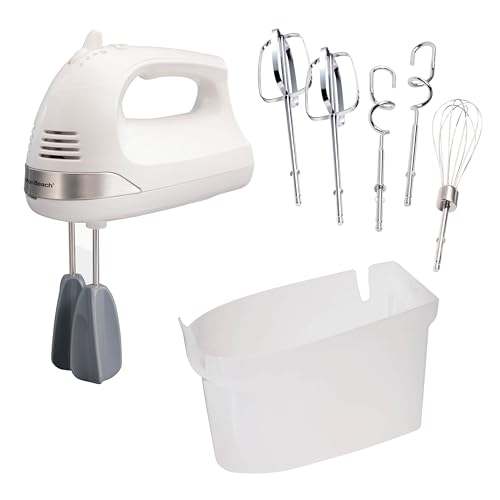
Hamilton Beach 6-Speed Hand Mixer
Badge: Best for Thick Shakes
This is the thickness pick, and its listing states the reason in numbers: a 275-watt motor, the strongest stated here, driving traditional beaters through the phase where milkshakes are actually decided. Firm scoops, minimal milk, a dense mass that climbs the beaters — the Hamilton Beach keeps turning where gentler mixers complain, and its whisk then handles the brief finishing pass that keeps the surface creamy rather than pasty. The snap-on case keeps that whole sticky arsenal in one place.
Governance is the owner’s job: this much strength, run long and high, generates the friction that thins a shake from inside. Work low, work patiently, and finish briefly. Makers whose freezer runs very cold, or whose house style is extra-thick, will find this is the only pick that never makes them apologise for the recipe.
Strengths
- The strongest stated motor here, for the firmest first minute
- Whisk included for the finishing lightening
- Easy Clean beaters shed sticky mixtures readily
Trade-offs
- Strength must be governed — sustained top speed melts body
- The fullest attachment set to store
- A workhorse aesthetic rather than a design object
Key specs from the listing
- Speeds: 6
- Model: 62636J
- Motor: 275 watts
- Attachments: Traditional beaters, dough hooks, whisk
- Storage: Snap-on storage case
Best for: Maximum-density shakes and firm starting mixtures / Not suited for: Light, frothy diner-style shakes where its strength is wasted

Cuisinart 9-Speed Hand Mixer, Brushed Chrome
Badge: Best Premium Finish
Think of the HM-90BCS as the flagship trim of this guide’s leading platform: the same nine speeds and SmoothStart behaviour as the HM-90S, here with a stated 220-watt motor, a brushed chrome finish, and a 6-piece set in the snap-on case. For thick shakes the specification that matters is the combination — a real motor figure behind genuinely graduated control — and on paper this is the most completely specified mixer in the guide.
The honest note is duplication: households should choose between this and the white HM-90S on finish, set contents, and which listing’s configuration suits them, not imagine they are different classes of machine. Chosen once, it is arguably the most satisfying object here — the one that lives on the counter, wipes clean, and makes the Friday shake feel like an occasion.
Strengths
- A stated 220-watt motor behind the nine-speed control
- SmoothStart protects the firm combining stage
- Brushed chrome finish suits display-worthy kitchens
Trade-offs
- The same platform as the HM-90S — an alternative, not an upgrade path
- Premium finish pricing for a working tool
- Chrome shows water spots without a wipe-down habit
Key specs from the listing
- Speeds: 9
- Model: HM-90BCS
- Motor: 220 watts
- Feature: SmoothStart anti-splatter
- Finish: Brushed chrome
- Set: 6-piece with snap-on storage case
Best for: Makers wanting the leading platform in a premium finish and 6-piece set / Not suited for: Anyone who already owns the HM-90S — it is the same platform

Proctor Silex Easy Mix 5-Speed Hand Mixer
Badge: Best Budget Compact
The Proctor Silex closes the list as the honest occasional-use pick: compact, lightweight, five speeds, a stated 215 watts of peak power, and one quietly brilliant feature — a bowl rest that lets the mixer sit on the bowl’s edge during the scrape-down pause every thick shake needs, instead of dripping across the counter. For the household that makes shakes a few times a summer, in a kitchen where storage is the scarcest ingredient, this is the rational purchase.
Its limits are duty and density. Peak power is a sprint figure; sustained work in extra-thick mixtures is where it will feel its size, and daily dessert service is beyond its brief. Buy it for the real pattern of your summers and it will never disappoint; buy it as a parlour machine and it will tell you so, politely, by slowing down.
Strengths
- The lightest, most storable mixer here
- A bowl rest lets you pause mid-shake without a sticky counter
- Stated peak power covers standard home shakes
Trade-offs
- Peak power is not sustained power — the firmest shakes will test it
- A basic attachment story beside the fuller sets
- Built for occasional duty, not a dessert parlour schedule
Key specs from the listing
- Speeds: 5
- Model: 62511
- Power: 215 watts peak
- Features: Bowl rest
- Build: Compact and lightweight
- Colour: Black
Best for: Occasional shake makers and small kitchens on a tight brief / Not suited for: High-volume or extra-thick shake routines
Comparison Table
Motor figures where the listings state them, speeds, and the attachment story — the dessert-relevant facts, side by side.
| Pick | Badge | Format | Standout trait | Link |
|---|---|---|---|---|
| Cuisinart Power Advantage Plus 9-Speed Hand Mixer | Best Overall | 9-speed hand mixer | SmoothStart and nine speeds over a proven platform | Check on Amazon |
| WEPSEN 5-Speed Hand Mixer Set | Best Complete Kit | 5-speed hand mixer set | Bowls, whisks and measures included for repeatable shakes | Check on Amazon |
| KitchenAid 5-Speed Hand Mixer, Black Matte | Best Gentle Control | 5-speed hand mixer | Turbo Beaters and a cord that locks out of the way | Check on Amazon |
| Hamilton Beach 6-Speed Hand Mixer | Best for Thick Shakes | 6-speed hand mixer | 275-watt motor with whisk and storage case included | Check on Amazon |
| Cuisinart 9-Speed Hand Mixer, Brushed Chrome | Best Premium Finish | 9-speed hand mixer | 220-watt motor, SmoothStart, brushed chrome 6-piece set | Check on Amazon |
| Proctor Silex Easy Mix 5-Speed Hand Mixer | Best Budget Compact | 5-speed hand mixer | Compact, lightweight, with a bowl-rest feature | Check on Amazon |
How to Choose a Mixer for Thick Milkshakes
Start from your ice cream, not from the mixer shelf. Dense, premium, low-overrun ice cream from a cold freezer is the hardest starting material in home dessert work; soft, everyday ice cream is among the easiest. If your household buys the dense kind and freezes it hard, motor strength is a real criterion and the wattage-stated picks deserve their ranking. If your scoops are forgiving, control and attachments matter more, and nearly every pick here will serve you — buy the one whose cleanup and storage suit your kitchen.
Read power figures like an adult. A stated motor wattage describes sustained work; a peak-power figure describes a moment. Both are honest when labelled, and the listings here label them, but they are not the same currency — compare sustained with sustained and peak with peak. Then remember the ceiling on the whole discussion: friction melts. The strongest mixer, run at top speed for minutes, will thin a shake more surely than a weak mixer ever could, which is why the how-to layer below disciplines even the strongest pick.
Value the start and the scrape. SmoothStart-style ramps protect the firm combining stage from jolts and spray. A bowl rest, storage case, and easy-release beaters protect the pauses and the cleanup, which in a sticky dessert are half the labour. These unglamorous features decide whether the mixer is used weekly — the same permanence logic our Best Mini Mixers guide applies to compact baking stations, where the reachable tool beats the theoretical one. The small audio desks in our Best Mini Audio Mixers guide are bought on the identical principle.
Finally, be honest about the blender line. A hand mixer cannot crush ice, frozen fruit, or frozen mix-ins, and a shake brief built on those belongs to a blender without apology. The hand mixer’s kingdom is the scoop-built shake — ice cream, milk, syrups, soft additions — and inside that kingdom it is not a compromise but the traditional home tool, with better texture judgement than a blender’s brute force usually allows.
How to Make a Thick Milkshake with a Hand Mixer
Thickness is built by restraint: less softening, less milk, less speed, in that order. The sequence below assumes firm scoops and a dessert brief.
- Soften briefly — five to ten minutes only. The scoops should dent under firm spoon pressure and no more. Every extra minute is thickness leaving.
- Work in a cold, tall bowl. Chill the bowl while the ice cream tempers; a warm bowl is a melting bowl.
- Start at the lowest speed with beaters buried. Break the scoops down in place, letting the mass loosen gradually. Use the anti-splatter start if your mixer offers one.
- Add milk by the spoonful, only as needed. The shake should move reluctantly. Stop adding the moment it turns as one mass.
- Scrape down twice. Pause — on the bowl rest if you have one — and fold the edges and bottom into the centre, so flavour and texture are uniform.
- Add mix-ins last, folded by spoon. Crumbs, chips, and pieces keep their identity when the beaters never meet them.
- Finish with seconds, not minutes, of whisk or beater work. Just enough to lighten the surface. Then serve immediately, with the spoon the drink deserves.
If the shake still sets up thin, the correction is upstream, not in the bowl: colder ice cream, a shorter temper, one less spoonful of milk next time. Write the working ratio on the recipe card after the first success — thick shakes are a repeatable formula, not a nightly improvisation.
Troubleshooting
Problem: the mixer strains and slows in the first minute → the ice cream is too hard for the tool; stop, temper five more minutes, and restart low — forcing a stalled mixer overheats it and melts the shake unevenly.
Problem: the shake is thick at the bottom and thin at the top → the scrape-downs were skipped; pause twice during combining and fold the bowl’s edges and base into the centre before continuing.
Problem: the finished shake tastes sweet but flat → aeration and temperature are the missing notes; give it a few seconds of whisk work at the end and serve it colder, in a chilled glass, before adjusting the recipe.
Building Flavour That Survives Thickness
Density dilutes perception: a thick shake tastes less sweet and less flavoured than the same recipe made thin, because cold and fat coat the palate and the mixture reaches you slowly. Compensate at the recipe stage, not the glass: syrups and sauces a shade more concentrated than instinct suggests, a pinch of salt in chocolate shakes to sharpen the cocoa, and malt powder as the classic body-and-flavour amplifier. Vanilla shakes benefit most from patience — real vanilla needs the brief combining rest to bloom through the fat.
Layered shakes deserve a structural note. Two flavours in one glass hold their boundary only if both are built to the same thickness; a thin layer poured over a thick one will slump and merge within a minute. Build both to the spoon-standing standard, pour the denser first, and serve at once. Presentation is a texture property before it is a visual one.
The Blender Line: Knowing When to Switch Tools
Every tool category has an honest border, and the hand mixer’s is frozen mass. Ice cubes, frozen berries, frozen banana, and hard frozen mix-ins are blender work — asking beaters to do it risks the mixer, the mixture, and the maker’s patience. The same honesty runs the other way: a blender making a scoop-built shake tends to over-process, warming and thinning the very body the dessert exists for, which is why parlours guard their spindle machines and why this guide’s tool wins its own kingdom.
Households that live on both sides of the line should own both tools without guilt and route each shake by its ingredients list: scoops and syrups to the hand mixer, frozen anything to the blender. The routing takes five seconds and ends the two classic disappointments — the strained mixer and the soupy blender shake — in a single habit. Our Best Mini Analog Mixers guide makes the same point for audio gear, in almost the same words: the right tool, honestly bounded, beats the universal tool every time.
Glass, Straw, and Spoon: Serving a Thick Shake Properly
A thick shake is served, not poured, and its equipment should admit it. A chilled, wide glass gives the shake room to be spooned as well as sipped; a wide straw respects the density instead of defeating the drinker; and a long spoon is not an accessory but a co-equal utensil, because the last third of a great shake is eaten. Whipped cream and garnishes sit on top of a properly thick shake — if they sink, the shake has told you something about its build.
Temperature discipline continues at the table: serve on a cold saucer, keep spare shakes in the freezer for the few minutes between making and serving rather than on the counter, and never hold a finished shake in the mixing bowl ‘to set’ — it does not set, it melts, from the outside in.
Scoop Science: Temperature, Density, and the First Minute
The first minute of a thick shake is a negotiation between the mixer and the ice cream’s temperature, and it can be managed scientifically. Ice cream leaves a home freezer far colder than its serving temperature; the tempering window exists to bring it to the narrow band where it deforms under the beaters instead of resisting or collapsing. That band arrives at different times for different tubs — dense premium ice cream takes longest, light everyday ice cream least — and the spoon test in the how-to section is the reliable instrument: firm denting, no pooling, no shine of melt at the edges.
Makers who want consistency should treat the freezer as part of the recipe. A freezer running extremely cold extends every temper; one crowded with warm additions fluctuates. The shake maker’s countermeasures are boring and effective: temper by the spoon test rather than the timer, keep the working bowl chilled to buy margin, and standardise the household’s ice cream so the window becomes a habit instead of a measurement. Thickness, in the end, is temperature management with a mixer attached.
Sauces and Syrups: Concentration Is the Whole Game
A thick shake dilutes flavour twice — once with its small milk addition and once with the palate-coating effect of cold fat — so its flavourings must arrive concentrated. Chocolate sauce built for ice-cream sundaes works; drinking-chocolate strength does not. Fruit preserves outperform fresh fruit, whose water thins the body it was meant to flavour. Coffee belongs in the shake as a concentrated shot or a strong syrup, never as a mug of coffee, which would turn the dessert into a drink and the exercise into a different recipe entirely.
Dose by stages and taste at the combining pause, when the mixture is uniform but unfinished. The target at that moment is slightly too intense — the finished shake, colder and aerated at the surface, will read a step softer. Makers who season to perfection mid-bowl serve a shake that tastes polite; makers who season a fraction bold serve the one people describe afterwards. Keep notes per flavour: the spoonful counts that worked are the household’s real recipe collection.
The Whipped Finish and Other Controlled Contradictions
A thick shake is a study in managed contradictions, and the whipped finish is the prettiest of them: a dessert whose body is density, crowned with the lightest thing in the kitchen. Whipped cream on a milkshake is not decoration but a second texture, and it should be whipped to soft peaks so it folds into the first sips rather than sitting as a separate course. The mixers in this guide whip that cream in the same bowl-washing cycle as the shake itself, which is part of the hand mixer’s quiet case: one tool, both textures, one wash.
Other contradictions reward the same thinking. Warm sauce on a cold shake — a ribbon of hot fudge poured at the table — creates a temperature contrast no single-temperature dessert can match, and the shake’s density holds the ribbon in suspension instead of letting it sink. A salted garnish on a sweet shake sharpens it. Serve these contrasts deliberately and immediately; they are perishable effects, measured in the first two minutes at the table.
From Two Glasses to a Party: Scaling the Thick Shake
Thick shakes scale badly by batch and beautifully by station. A single bowl multiplied fourfold defeats the hand mixer’s geometry and the maker’s temperature control; a station — scoops tempering in sequence, measured milk and sauces laid out, glasses chilled in a row — produces glass after glass at identical quality, because each shake is still a two-glass build executed by a practised hand. Parties should therefore be run like the parlours run them: to order, in small builds, with a short menu of three flavours whose ingredients are staged and whose ratios are already proven.
Staffing the station is a social decision as much as a culinary one: the shake maker becomes part of the entertainment, and guests reliably prefer watching their dessert built to finding it waiting. Keep the menu short, the ratios card visible, and the mix-ins in bowls for the folding finish. The last shake of the night will match the first — which is the definition of a successful station, and a claim no pre-batched jug has ever honestly made.
Chocolate Milkshakes: A Concentrated Discipline
Chocolate is the milkshake flavour against which all others are judged, and its discipline is concentration at every layer. Cocoa-forward sauces outperform sweet chocolate syrups, because the shake’s cold and fat mute sweetness less than they mute cocoa depth. A chocolate ice cream base plus a measured sauce addition beats either alone — the base provides the body of the flavour, the sauce its top notes. And the pinch of salt, recommended throughout this guide, does its most visible work here, sharpening cocoa the way it does in baking.
Temperature plays a supporting role unique to chocolate: a sauce warmed just to pourability distributes through the cold mixture in ribbons if folded late, or uniformly if added at combining — two different drinks from one ingredient, chosen by timing. The ribbon version, folded after aeration, is the house special that guests describe as tasting ‘more chocolate’, although the chocolate quantity never changed. Technique, again, masquerading as ingredients.
Fruit Milkshakes Without the Watery Failure
Fresh fruit is the thick shake’s most seductive failure: beautiful in the bowl, watery in the glass, because fruit brings water that the recipe never budgeted for. The corrections are concentration and compensation. Concentration means preserves, roasted fruit, or fruit cooked briefly into a compote — each trades water for intensity. Compensation means the base shake is built a fraction thicker than standard, banking body against the fruit’s contribution, so the finished drink lands at the target instead of below it.
Banana is the honourable exception that teaches the rule: ripe banana thickens as it flavours, which is why banana shakes succeed casually where strawberry shakes fail carefully. Berry seeds and citrus zest belong to the finish, folded in or grated over, where their texture reads as craft rather than as an accident the beaters failed to finish. A fruit shake made with these disciplines tastes like the fruit; one made without them tastes like the idea of the fruit, diluted.
Protein, Breakfast, and Other Functional Shakes — An Honest Boundary
Searches for milkshake mixers often hide a second intent: the breakfast or protein shake, built on powders, nut butters, and yoghurt rather than ice cream. The hand mixers in this guide can combine those mixtures — they are soft, scoop-free builds — but honesty requires naming the better tool for the daily version of that habit: a personal blender, whose sealed cup and blade geometry exist for exactly that routine, and whose cleanup is a rinse. The hand mixer is the dessert instrument; borrowing it for a daily functional routine is possible and, over months, annoying in the specific way that erodes habits.
The boundary matters because equipment disappointment is usually boundary confusion. A reader who buys from this guide for Friday’s dessert shake will be delighted for years. A reader who buys from it for a twice-daily protein routine will blame the mixer for a mismatch this paragraph exists to prevent. Name the job honestly, as this guide has tried to name every job, and the tool follows.
The Tasting Panel of One: Calibrating Your House Recipe
Every household should calibrate its shake recipe the way this guide’s method implies: by controlled tasting. Make the standard build, taste it critically at the table — not at the bowl, where warmth and haste flatter it — and change exactly one variable for the next build: a spoonful less milk, a spoonful more sauce, thirty seconds more tempering. Record the change and the verdict on the recipe card. Three iterations of that discipline produce a house recipe calibrated to your ice cream, your freezer, your mixer, and your palate — a combination no published recipe can match, because no published recipe has met your kitchen.
The panel-of-one method generalises across this entire catalogue, from melon sours to mimosa ratios: single-variable changes, recorded verdicts, house standards that emerge from evidence. It is slower than inspiration and faster than frustration, and it converts cooking from a sequence of purchases into a practice. The mixer is the instrument; the card is the memory; the palate, trained by the card, is the actual product being built.
Serving Temperatures and the Last Five Degrees
A milkshake’s final texture is set in a temperature band only a few degrees wide, and the last five degrees are where home shakes are won. Too cold and the shake is a solid that defeats the straw; too warm and it is a sauce that defeats the spoon-standing standard this guide prizes. The band is reached by the tempering discipline upstream, but it is preserved by service discipline downstream: glasses chilled so they do not donate heat, the shake served within a minute of its finish, and any holding done in the freezer, in the glass, for minutes rather than on the counter at all.
Hosts serving a table should stagger builds rather than batch them, two glasses at a time, so no shake waits through another’s making. The rhythm feels slower and is, in elapsed minutes, identical — while every glass arrives inside the band instead of half of them outside it. Temperature is the invisible ingredient in every recipe in this guide; these last five degrees are simply where it becomes visible.
Common Buying Mistakes
- Tempering the ice cream like it is a light shake. Thick shakes start firm; the long softening window belongs to the other drink.
- Pouring the milk in one measure. Spoonfuls are the thickness dial — overshoot cannot be undone in the bowl.
- Running the strongest mixer at full speed throughout. Friction is heat, and heat is thinness; strength is for the first minute, not the whole job.
- Beating the mix-ins. Pieces go in last, folded by spoon, or they become flavour dust and broken texture.
- Skipping the scrape-downs. Unmixed pockets at the bowl’s edge are why one sip tastes perfect and the next tastes like plain ice cream.
- Blaming the mixer for a blender brief. Frozen ingredients are the border; route them to the right tool instead of straining the wrong one.
Final Recommendation
For most dessert households, the controlled nine-speed platform at the top of this list is the milkshake decision that keeps being right. Start with the Cuisinart Power Advantage Plus 9-Speed Hand Mixer if you want the safest all-round choice in this list.
Take the Hamilton Beach if your freezer and your ice cream are both uncompromising, and the Proctor Silex if shakes are a few-times-a-summer pleasure in a small kitchen. If your priorities lean the other way, the WEPSEN 5-Speed Hand Mixer Set and the KitchenAid 5-Speed Hand Mixer, Black Matte cover the two most common alternative briefs in this guide.
Whichever mixer earns the drawer space, keep the discipline beside it: firm scoops, spoonfuls of milk, low speeds, two scrape-downs, mix-ins folded last. A great milkshake is a formula executed calmly — and once your household has its formula, the mixer in this guide will execute it for years. Readers furnishing the drinks side of the same kitchen will find the brunch station in our Best Mimosa Mixers guide runs on identical principles.
Frequently Asked Questions
What makes a mixer good for thick milkshakes specifically?
Sustained strength for the firm first minute, graduated speeds that add effort as the mixture loosens, and beaters that keep moving through dense, soft mixtures without clogging. Stated motor wattage, where a listing publishes it, is the most useful comparison figure — read peak-power claims as momentary, not sustained.
Can a hand mixer handle premium, dense ice cream?
Yes, with a brief temper and patience: five to ten minutes out of the freezer, the lowest speed to start, and time for the mass to loosen gradually. The strongest pick here, the Hamilton Beach with its stated 275-watt motor, is the comfortable choice for the densest scoops and coldest freezers.
Why is my milkshake always thinner than I want?
Work the three restraints in order: soften the ice cream less, add milk by spoonfuls instead of a single measure, and spend less time at high speed, where friction melts the body. Thickness is decided before the whisk ever comes out — and it cannot be added back in the bowl.
Should I buy the Cuisinart HM-90S or the HM-90BCS?
They are the same nine-speed platform. The BCS listing adds a stated 220-watt motor figure, a brushed chrome finish, and a 6-piece set; the HM-90S is the white version of the same idea. Choose on finish and set contents — and buy one, not both.
When should I use a blender instead?
When the recipe includes frozen mass: ice, frozen fruit, frozen mix-ins. A hand mixer cannot crush those, and forcing it strains the motor and ruins the texture. For scoop-built shakes — ice cream, milk, syrups, soft additions — the hand mixer is not the compromise but the better-judged tool.
How do I keep mix-ins from sinking or disappearing?
Build the shake to full thickness first, then fold pieces in by spoon at the very end. Thickness suspends them; beaten-in pieces either sink in a thin shake or get pulverised in a thick one. Serve immediately, before gravity files its report.


