Disclosure: topratedkitchenware.com is reader-supported. When you buy through links on our site, we may earn an affiliate commission from Amazon and other retailers, at no extra cost to you.
Where to buy
All six picks in this guide to best mixers for baking cakes are listed on Amazon, where you can check the latest price on Amazon, confirm the exact model and finish, and read the current listing details before ordering. Bundles and colours change, so match the full model name on the listing to the pick reviewed below before you buy.
- Best Overall for Cakes: KitchenAid 5 Ultra Power Speed Hand Mixer, KHM512, Black Matte — Check on Amazon
- Hamilton Beach 6-Speed Electric Hand Mixer with Easy Clean Beaters, 62636J — Check on Amazon
- Cuisinart 9-Speed Electric Hand Mixer with Storage Case, HM-90BCS — Check on Amazon
- Proctor Silex Easy Mix 5-Speed Electric Hand Mixer with Bowl Rest, 62511 — Check on Amazon
- Cuisinart Stand Mixer, 12 Speed, 5.5 Quart, White Linen, SM-50NAS — Check on Amazon
- Cuisinart Stand Mixer, 12 Speed, 5.5 Quart, Onyx, SM-50BK — Check on Amazon
Read the full guide ↓
Cake is the most technique-sensitive thing most of us bake, and the best mixers for baking cakes are the ones that respect that technique: creaming butter and sugar into a pale, airy base, adding eggs without splitting the mixture, whipping whites or cream when the recipe asks for lift, and folding flour in so gently that the air you built survives to the oven. A mixer for cakes is not judged by its most violent setting. It is judged by its manners at the exact moments a cake is won or lost.
This guide compares six verified machines for that specific job: four hand mixers from KitchenAid, Hamilton Beach, Cuisinart and Proctor Silex, and two finishes of the Cuisinart SM-50 stand mixer for bakers who make cakes often or in quantity. Every pick was cross-checked against its verified listing, and only listed specifications are quoted: speed counts, published wattage where the brand provides it, included attachments, and practical features like storage cases, bowl rests and splash guards. There are no prices and no ratings here, because neither tells you whether a machine creams properly, and both change too often to print.
The hand-versus-stand question runs through the whole guide, and the honest answer for cakes is friendlier to hand mixers than you might expect. Most cake batters are light mixtures that a hand mixer handles beautifully, in any bowl, with fast clean-up. The stand mixers earn their place for double batches, celebration cakes, whipped-egg sponges and bakers whose hands tire. Read each review for the cake styles it suits, and for the broader baking picture beyond cakes, see our general guide to Best Mixers For Baking.
Key Takeaways
- Cake mixing is about control: gentle flour work, steady creaming and reliable whipping matter more than top speed.
- The KitchenAid KHM512 leads the hand mixers for cakes with efficient Turbo Beaters, a swivel cord and dishwasher-safe parts.
- The Cuisinart HM-90BCS offers nine speeds, SmoothStart and a published 220 W motor for bakers who want the finest control.
- The two Cuisinart SM-50 stand mixers suit frequent and large-scale cake baking: 5.5 quart bowls, twelve speeds, whisk and paddle included.
- The Hamilton Beach 62636J adds a whisk and the strongest published hand-mixer power figure for whipped components and varied bakes.
- The Proctor Silex Easy Mix covers small cakes and everyday bakes in a compact, lightweight format.
In this guide
Quick Picks
The shortlist below separates the everyday cake tools from the batch-baking machines. Badges are repeated in the detailed reviews so you can move between the table and the reviews without losing your place.
| Badge | Pick | Why it is here | Link |
|---|---|---|---|
| Best Overall for Cakes | KitchenAid KHM512 Hand Mixer, Black Matte | Turbo Beaters and simple five-speed control for classic cakes. | Check on Amazon |
| Most Versatile for Layer Cakes | Hamilton Beach 6-Speed Hand Mixer, 62636J | Whisk included for whipped components; 275 watt motor. | Check on Amazon |
| Best Premium Hand Mixer | Cuisinart 9-Speed Hand Mixer, Brushed Chrome | Nine speeds with SmoothStart and a six-piece set. | Check on Amazon |
| Best Budget Pick | Proctor Silex Easy Mix 5-Speed Hand Mixer | Lightweight mixer for small cakes and quick bakes. | Check on Amazon |
| Best Stand Mixer for Cakes | Cuisinart SM-50 Stand Mixer, White Linen | Stand mixer with 5.5 quart bowl for big and frequent cakes. | Check on Amazon |
| Best for Frequent Bakers | Cuisinart SM-50 Stand Mixer, Onyx | The SM-50 platform in onyx for regular celebration baking. | Check on Amazon |
How These Picks Were Chosen
All six picks were verified against Amazon listing data through the Creators API, and the sources file for this article records each ASIN, listing title and image from that check. Specifications are quoted only from those listings: the SM-50 stand mixers’ twelve speeds, 5.5 quart stainless bowls and whisk, paddle and dough hook set; the HM-90BCS’s nine speeds and 220 W motor; Hamilton Beach’s published 275 watts; Proctor Silex’s 215 watts of peak power. Where a listing is silent, this guide is silent too.
Ranking for cakes weighted the cake-making sequence. Creaming came first, because a pale, well-aerated butter and sugar base is the foundation of most cakes and needs sustained, controllable medium speed. Whipping came second, for egg whites, sponges and cream. Gentle finishing came third, because flour must be incorporated with minimal mixing. Batch capacity and hands-free running decided the stand mixers’ positions, and everyday practicality, weight, storage and washing, separated the hand mixers. Beginners will find the same machines introduced more gently in Best Mixers For Beginners.
This is a research-led guide and does not claim hands-on testing that did not happen. Its judgements rest on verified specifications, machine design, and established cake technique: creaming times, egg addition, foam folding and the well-documented ways cakes fail when each stage is rushed or overworked.
The 6 Best mixers for baking cakes
Each review names the cake styles the machine suits, explains how it behaves at the critical stages, and gives one honest limitation. If you bake one style of cake almost exclusively, let that style choose your pick.

KitchenAid 5 Ultra Power Speed Hand Mixer, KHM512, Black Matte
Badge: Best Overall for Cakes
Strengths
- Turbo Beaters pull mixtures together quickly and resist clogging
- Lockable swivel cord can be pinned to either side for left- or right-handed use
- Dishwasher-safe beaters and a compact body make it an easy everyday grab
Trade-offs
- Five speeds gives less fine control than the nine-speed Cuisinart models
- No storage case is listed, so beaters live loose in a drawer
- Not the tool for heavy, stiff doughs, which are stand-mixer territory
Mini spec box
- 5 speed settings
- Turbo Beaters included
- Lockable swivel cord
- Easy-release beater button
- Dishwasher-safe beaters
- Finish: Black Matte
- Model: KHM512
The KHM512 takes the top badge for cakes because it does the classic cake sequence calmly and well. The Turbo Beaters cream butter and sugar efficiently, the five speeds map neatly onto cake work, low for flour, medium for creaming, high for whipping cream, and the lockable swivel cord stays out of the batter whichever hand you favour. The easy-release button is a small mercy when you are moving between batter and frosting with sticky fingers, and the beaters go straight into the dishwasher afterwards.
It suits the centre of cake baking: butter cakes, layer cakes, cupcakes, traybakes and buttercream, in standard single batches. The limitations are the listed ones: beaters only in the box, so a dedicated whisk attachment is a separate purchase for serious meringue work, and five speeds give less finesse than nine when a recipe is delicate. For most cake bakers, most of the time, this is the machine that will quietly do everything asked of it.
Best for: classic butter cakes, layer cakes and everyday baking / Not suited for: serious meringue work without adding a whisk attachment
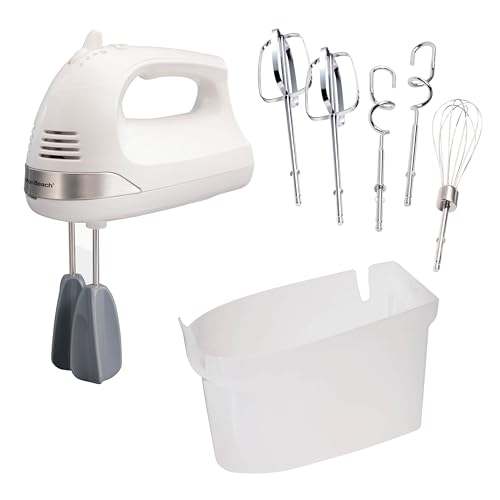
Hamilton Beach 6-Speed Electric Hand Mixer with Easy Clean Beaters, 62636J
Badge: Most Versatile for Layer Cakes
Strengths
- The most complete attachment set among the hand mixers here: beaters, dough hooks and a whisk
- A verified 275 watt motor, the strongest figure listed for a hand mixer in this guide
- Snap-on case stores everything together, and the easy-clean beaters rinse down fast
Trade-offs
- Six speeds is plenty, but the nine-speed Cuisinart models offer finer low-end control
- White finish shows turmeric, cocoa and berry stains over time
- Dough hooks help with soft doughs, yet stiff dough still belongs in a stand mixer
Mini spec box
- 6 speed settings
- 275 watt motor
- Traditional beaters, dough hooks and whisk included
- Easy-clean beaters
- Snap-on storage case
- Finish: White
- Model: 62636J
The 62636J is the layer-cake all-rounder. Its published 275 watt motor is the strongest figure among the hand mixers here, which shows up as steadiness when a batter thickens or a batch of buttercream needs to come together smoothly. Uniquely in this hand-mixer set, the verified box includes a whisk alongside beaters and dough hooks, and for cakes that whisk matters: whipped cream for filling, egg whites for a lighter sponge, and meringue toppings are all in this machine’s range without extra purchases.
The easy-clean beaters and snap-on case keep the celebration-cake workflow tidy, which anyone who has baked a three-layer cake in a small kitchen will appreciate. Its trade-offs are modest: six speeds rather than nine, so flour work needs a gentle hand at the start, and a white finish that records cocoa and food colouring faithfully. If your cakes involve whipped components as often as batters, this is arguably the first pick in the guide.
Best for: layer cakes with whipped fillings and varied cake styles / Not suited for: the finest low-speed finesse; nine-speed models edge it

Cuisinart 9-Speed Electric Hand Mixer with Storage Case, HM-90BCS
Badge: Best Premium Hand Mixer
Strengths
- Nine speeds plus SmoothStart make delicate and heavy jobs easier to manage
- A 220 W motor is a clear, verified figure in a class where many listings hide wattage
- The six-piece set and snap-on case keep attachments organised between uses
Trade-offs
- Brushed chrome shows fingerprints and batter smears more than matte finishes
- Heavier feature set than a once-a-month baker needs
- The case is convenient but not small, so measure your drawer
Mini spec box
- 9 speed settings
- 220 W motor
- SmoothStart anti-splatter technology
- Snap-on storage case
- 6-piece set
- Finish: Brushed Chrome
- Model: HM-90BCS
The HM-90BCS is the control connoisseur’s hand mixer: nine speeds, SmoothStart anti-splatter technology, a verified 220 W motor, a six-piece set and a snap-on case. For cakes, its gift is precision at the fragile moments. Icing sugar for buttercream can be started without a sweet cloud across the kitchen. Flour can be folded in at a genuine crawl. Creaming can sit at exactly the medium pace that builds air without warming the butter past its best.
Frequent cake bakers who decorate will feel the difference most, because frosting work is where fine low speeds pay rent every single time. The costs are the format’s usual ones plus a finish that shows fingerprints: brushed chrome needs a wipe to look its best, and the case needs storage room. It is a premium-tier hand mixer and should be bought by people whose cake habit justifies it; occasional bakers can step down this list without losing cake quality.
Best for: frequent bakers and decorators who live in buttercream / Not suited for: tiny kitchens short on storage for its case

Proctor Silex Easy Mix 5-Speed Electric Hand Mixer with Bowl Rest, 62511
Badge: Best Budget Pick
Strengths
- Compact and lightweight, which matters more than raw power for quick, small jobs
- Bowl rest keeps the mixer parked on the bowl instead of dripping on the counter
- A simple five-speed layout that anyone can use without reading a manual
Trade-offs
- 215 watts of peak power is the gentlest figure in this guide, so thick mixtures slow it down
- No storage case or extra attachments are listed
- Best treated as a light-duty mixer rather than a daily workhorse
Mini spec box
- 5 speed settings
- 215 watts of peak power
- Bowl-rest feature
- Compact, lightweight design
- Finish: Black
- Model: 62511
The Easy Mix is the small-cake specialist, and there is no condescension in that badge. A huge share of home cake baking is a single loaf cake, a small batch of cupcakes, a quick sponge for two, or whipped cream for a dessert, and for those jobs a compact, lightweight five-speed mixer with a bowl rest is not a compromise, it is the right tool. It comes out of the drawer in seconds, parks on the bowl rim while you add ingredients, and washes up before the cake is out of the oven.
Its published figure is 215 watts of peak power, the gentlest here, and its honest limits follow: thick, large or double batches will slow it down, and no extra attachments or case are listed. Buy it for the cakes you bake weekly in a small kitchen, not for a wedding-cake sideline, and it will be a pleasure rather than a disappointment. New bakers comparing starting points may also like Best Mixers For Beginners Matching And Mastering for how this cluster’s guides fit together, though that guide covers a different corner of the mixer world.
Best for: small cakes, loaf cakes and quick everyday bakes / Not suited for: large, thick or double batches

Cuisinart Stand Mixer, 12 Speed, 5.5 Quart, White Linen, SM-50NAS
Badge: Best Stand Mixer for Cakes
Strengths
- Stand-mixer power and a 5.5 quart bowl for big, frequent batches
- Whisk, paddle and dough hook cover the full range of baking jobs
- Splash guard with pour spout keeps flour and batter in the bowl
Trade-offs
- Needs a permanent home on the counter
- White linen finish shows splashes until wiped
- For one small cake, a hand mixer is quicker to set up and wash
Mini spec box
- 12 speed settings
- 5.5 quart stainless steel bowl
- Chef’s whisk, mixing paddle and dough hook included
- Splash guard with pour spout
- Finish: White Linen
- Model: SM-50NAS
The white linen SM-50 is where this guide’s centre of gravity shifts from convenience to capacity. A stand mixer changes cake baking in three ways: the 5.5 quart bowl takes double batches and tall celebration mixtures without crowding; the machine creams and whips hands-free, so you can line tins and weigh ingredients while it works; and the included chef’s whisk and mixing paddle cover the two attachments cake work actually uses, with a splash guard and pour spout that make adding flour and liquid mid-mix civilised. Twelve speeds run from a fold to a fast whisk.
For genoise and other whipped-egg sponges, the whisk and the big bowl are a genuine advantage, because those cakes are mostly air management. The limitations are the stand-mixer constants: counter space, weight, and a machine that is overkill for a single small cake, where the hand mixers above are quicker to deploy and wash. Bakers who make cakes weekly, or sell them, will not regret the footprint.
Best for: double batches, celebration cakes and whipped-egg sponges / Not suited for: single small cakes where a hand mixer is faster overall
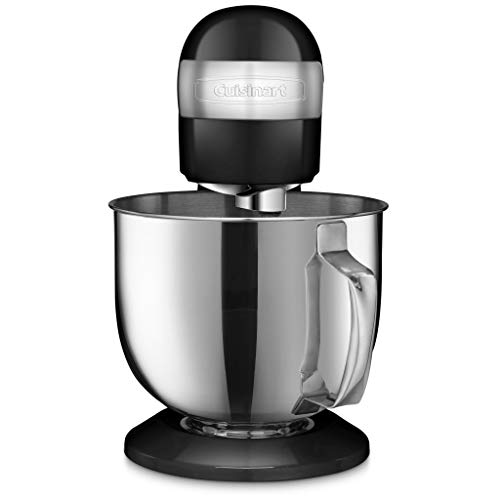
Cuisinart Stand Mixer, 12 Speed, 5.5 Quart, Onyx, SM-50BK
Badge: Best for Frequent Bakers
Strengths
- The SM-50 stand platform in a dark onyx finish that hides everyday marks
- Twelve speeds, from a gentle fold to a fast whisk, in one dial
- Hands-free running frees you to grease pans and weigh ingredients
Trade-offs
- Same machine as the other SM-50 colours, so this is a finish choice
- Large footprint compared with any hand mixer here
- Heavier to lift for anyone storing it in a low cupboard
Mini spec box
- 12 speed settings
- 5.5 quart stainless steel bowl
- Chef’s whisk, mixing paddle and dough hook included
- Splash guard with pour spout
- Finish: Onyx
- Model: SM-50BK
The onyx SM-50 is the same stand-mixer platform as the white linen model, twelve speeds, 5.5 quart stainless bowl, whisk, paddle and dough hook, splash guard with pour spout, in a dark finish that hides the evidence of frequent baking better between wipes. We list it as its own pick because it is a separate verified listing, and because frequent bakers, the audience for this badge, are exactly the people who care about a finish that forgives a busy kitchen.
Choose between the two SM-50 finishes on looks and listing details, not performance, because the machines are the same. What this pick adds to the guide is a clear recommendation for the regular celebration baker: hands-free creaming for big buttercream batches, a whisk for sponges and meringues at volume, and a bowl that swallows a doubled layer-cake recipe. Its limitation is shared with its sibling, size, and the honest note that owning both finishes would be owning the same mixer twice.
Best for: frequent bakers who want the SM-50 platform in a forgiving dark finish / Not suited for: anyone who already owns an SM-50; it is the same machine
Comparison Table
The table separates the six by the cake jobs they are really for. The two SM-50 rows are one platform in two finishes; the hand mixers differ in control, attachments and size.
| Pick | Badge | Speeds / format | Standout point | Link |
|---|---|---|---|---|
| KitchenAid KHM512 Hand Mixer, Black Matte | Best Overall for Cakes | 5 speed settings | Turbo Beaters, swivel cord, dishwasher-safe beaters | Check on Amazon |
| Hamilton Beach 6-Speed Hand Mixer, 62636J | Most Versatile for Layer Cakes | 6 speed settings | Whisk, beaters and hooks included; 275 watt motor | Check on Amazon |
| Cuisinart 9-Speed Hand Mixer, Brushed Chrome | Best Premium Hand Mixer | 9 speed settings | 220 W motor, SmoothStart, six-piece set with case | Check on Amazon |
| Proctor Silex Easy Mix 5-Speed Hand Mixer | Best Budget Pick | 5 speed settings | Compact and lightweight, bowl rest | Check on Amazon |
| Cuisinart SM-50 Stand Mixer, White Linen | Best Stand Mixer for Cakes | 12 speed settings | Stand format; whisk, paddle and hook, splash guard | Check on Amazon |
| Cuisinart SM-50 Stand Mixer, Onyx | Best for Frequent Bakers | 12 speed settings | Stand format in onyx; same platform as white linen | Check on Amazon |
How to Choose Among the best mixers for baking cakes
Decide first whether your cake baking is a hand-mixer life or a stand-mixer life. Count your real behaviour: how many cakes a month, what batch sizes, and whether your hands or wrists complain during long creaming. One or two standard cakes a month is hand-mixer territory, and the format’s speed of set-up and washing will make you bake more, not less. Weekly cakes, doubled recipes, or a small celebration-cake sideline argue for the SM-50 stand mixers and their 5.5 quart bowls.
Within the hand mixers, choose by the cake stage you care about most. If buttercream and frosting dominate, fine low-speed control is your feature, and the nine-speed Cuisinart HM-90BCS with SmoothStart is built for it. If whipped components, cream, whites, meringue, appear constantly, the Hamilton Beach 62636J’s included whisk is decisive. If you want the calm, proven all-rounder, the KitchenAid KHM512 is the balanced choice, and if your cakes are small and your kitchen smaller, the Proctor Silex is honestly sufficient.
Power figures, where brands publish them, support those roles rather than overturning them: 275 watts for the Hamilton Beach, 220 W for the Cuisinart HM-90BCS, 215 watts of peak power for the Proctor Silex. Cake batters are not heavy loads, so do not buy a cake mixer on wattage alone. Speed range, attachment coverage and how the machine starts are the specifications that show up in the crumb.
Attachments deserve a final check against your repertoire. The stand mixers include whisk and paddle, the two cake attachments, plus a dough hook you may rarely use. The Hamilton Beach includes a whisk among the hand mixers. The KitchenAid and Proctor Silex listings are beater-focused, which is fine for most cakes and limiting for foam-based ones. And a cluster note for readers arriving from other searches: guides such as Best Mixers For Bands, Best Mixers For Barcadi, Best Mixers For Beer and Best Mixers For Beginners Mooching And Mastering concern audio or drinks mixers, not cake equipment.
How to Mix a Cake Properly: Creaming, Eggs, Flour and Foam
Stage one: cream with patience. Butter should be soft enough to dent easily but not greasy, and it should be beaten with the sugar at a steady medium speed until the mixture is noticeably paler and lighter. This is where a cake’s rise begins, and it cannot be hurried at top speed without warming the butter and losing the emulsion. Scrape the bowl down halfway through; hand-mixer users can work in a wide bowl, which makes this easier, and stand-mixer users should still stop and scrape, because paddles leave a ring.
Stage two: eggs gradually. Add beaten egg a little at a time, letting each addition mix in before the next. Cold eggs or fast additions split the mixture; if it starts to curdle, a spoonful of the recipe’s flour usually restores it, and the finished cake is seldom harmed. Vanilla and other liquids belong in this stage, added with the same gradual respect.
Stage three: flour with restraint. Sift or whisk the dry ingredients, then add them in two or three portions, alternating with milk or other liquid where the recipe directs, mixing at the lowest speed only until each addition disappears. Finish the last portion by hand with a spatula, folding from the bottom of the bowl. The batter should look smooth but not worked; every unnecessary second of mixing at this stage trades tenderness for toughness.
Stage four: foams and finishing. For whipped-egg sponges and cakes lightened with whites, whip in a scrupulously clean bowl to the stage the recipe specifies, then fold into the batter by hand in additions, keeping the air. Get cakes into the oven promptly once the raising agents meet liquid. Afterwards, wash beaters, whisks and paddles straight away, use the dishwasher where the listing allows, wipe the machine body with a damp cloth, and store attachments with the mixer so the next cake starts cleanly.
Troubleshooting
Problem: the cake domed and cracked → the oven was likely hot and the batter possibly over-creamed, but mixing-wise, check that flour was not overworked, which tightens the crumb and exaggerates doming. Mix flour minimally and level the batter in the tin.
Problem: the sponge is dense and rubbery → the egg foam was under-whipped or knocked out during folding. Whip to the full ribbon or peak stage the recipe asks for, and fold by hand with a spatula, never with the machine.
Problem: buttercream is soft and greasy → the butter was too warm or the frosting was beaten too fast. Chill the bowl briefly and re-beat slowly; for the next batch, start icing sugar at the lowest speed and keep the pace moderate.
Cake Styles and the Machines That Suit Them
Butter cakes and pound-style cakes reward steady creaming and are every pick’s home ground. Chiffon and angel-style cakes reward whipping and gentle folding, which favours machines with a whisk: the SM-50 stand mixers and the Hamilton Beach hand mixer. Genoise sponges reward bowl size and whisk efficiency, the stand mixers’ clearest win. Fruit cakes and dense, filled batters reward steadiness as the mixture thickens, where published power figures become relevant again.
Frosting is a cake style of its own. American buttercream needs a slow start and sustained beating; cream-cheese frosting needs restraint so it stays spreadable; ganache and whipped toppings need temperature awareness more than power. Bakers who decorate seriously should weight the frosting stage as heavily as the batter stage when choosing, which is why the nine-speed Cuisinart hand mixer ranks so high here despite the stand mixers’ capacity advantage.
Scaling Up: Double Batches and Celebration Cakes
Doubling a cake recipe is not just twice the batter; it is a deeper bowl, a longer creaming time, and more opportunities for unmixed pockets. This is the scenario where hand mixers start to feel their format: your arm is in the bowl for every second, and a deep, dense mixture in a big bowl is slow work. The SM-50 stand mixers, with 5.5 quart bowls and hands-free running, turn a doubled layer cake or a stacked celebration bake into a calm process, and the splash guard earns its keep when flour goes into a full bowl.
Scaling also changes timing discipline. A big batter should not sit while tins are prepared, so set tins, oven and cooling racks up before mixing starts, whichever machine you use. Bake layers in rotation if oven space is limited, and keep uncooked batter cool rather than warm. The machine choice and the organisation together decide whether a celebration cake is a pleasure or a rescue operation.
Reading a Cake Recipe Before You Touch the Mixer
Cake recipes reward a full read-through more than almost any other kind of cooking, because their stages are sequential and unforgiving of improvisation. Before choosing a speed, identify which family the cake belongs to. Butter cakes are built on creaming and tolerate a sturdy approach. Sponge cakes are built on whipped eggs and tolerate almost no roughness after the foam stage. Chiffon and angel cakes split the difference, with whipped whites folded into a base. The recipe’s verbs tell you the family: cream, whip, fold and stir are instructions about air, and each maps to a different mixer behaviour.
Check the ingredient temperatures the recipe assumes, because they are rarely stated loudly and they decide outcomes. Butter for creaming should be pliable, eggs whip and emulsify best at room temperature, and cream for whipping should be properly cold. Then check the tin: size, preparation and whether the recipe’s batter volume matches it, because a perfect batter in the wrong tin bakes at the wrong depth and no mixer can rescue the result. Finally, note the order of operations and set out everything in sequence, so the mixing can flow without pauses while you hunt for the vanilla.
Scaling deserves its own moment of thought. Halving a cake recipe is usually safe; doubling is where bowl capacity, creaming time and even baking change character. If you double regularly, that fact alone may settle the hand-versus-stand question this guide keeps posing, in favour of the stand mixers and their 5.5 quart bowls. If you halve recipes for a small household, the compact hand mixers come into their own, with the practical note that very small quantities whip and cream best in a narrow, deep bowl where the beaters stay submerged.
Tins, Temperature and Timing: The Half of Cake Baking That Is Not Mixing
A mixer produces a batter; the tin and oven decide whether it becomes a cake. Tin material changes baking more than most recipe notes admit: dark tins absorb heat and brown faster, glass holds heat and keeps cooking after removal, and light metal is the neutral default most recipes silently assume. Lining the base with parchment is cheap insurance for release, and preparing the tin before mixing begins is essential, because a finished batter should never wait while you grease and line.
Oven temperature is the second half of the contract. Home ovens routinely run hotter or cooler than their dials claim, and cakes, with their delicate foams and emulsions, are the bakes that notice most. An inexpensive oven thermometer, checked once, explains years of mysterious doming, sinking or over-browning. Position matters too: the centre rack is the default for a reason, and crowding multiple tins changes airflow and baking time. None of this diminishes the mixer’s role; it simply means the best machine in this guide still needs a truthful oven to finish the job.
Timing discipline ties the halves together. Start the oven before the mixing, set out cooling racks before the tins go in, and set a timer for the earliest plausible finish rather than the stated one, because your oven and tin combination is its own system. Judge the cake by its signals, spring, colour, edges and skewer, not by the clock alone. Cooled correctly, frosted patiently and stored airtight, a well-mixed cake keeps its quality for days, which is the final argument for taking the mixing seriously in the first place.
Storing, Freezing and Transporting the Cakes You Bake
A cake’s life after the oven is part of baking it well. Unfrosted layers cool completely, then wrap tightly and keep at room temperature for short storage or freeze for longer; frozen layers are actually easier to trim and frost, because a firm crumb cuts cleanly and the cold cake tames soft buttercream. Thaw wrapped, so condensation forms on the wrapping rather than the crumb. Frosted cakes keep best in a covered container that does not touch the frosting, and cream-based fillings and toppings belong in the refrigerator, brought back toward room temperature before serving so flavours and textures return.
Transport is where good cakes go to be humbled, so plan it like a stage of the recipe. A flat, non-slip surface in the car, a box or carrier that fits the cake board closely, and a cool interior will defeat most journeys. Tall or stacked cakes travel best chilled and firm, with dowelling and assembly decisions made by the recipe’s structure rather than optimism. If the destination matters, a trial bake of an unfamiliar recipe is not fussiness; professionals do exactly this, because a new recipe, a new tin and an audience is a risky combination.
Leftovers deserve the same respect as the bake. Cut with a hot, dry knife for clean slices, store cut surfaces protected from air, and refresh a tired slice gently rather than expecting it to be what it was. Cakes made with the care this guide describes, properly creamed, gently folded, honestly baked, are worth storing properly, and the bakers who develop these habits find their mixer earning its place more with every month.
A Short Word on Decorating for Non-Decorators
Many cake bakers avoid decorating because it looks like a separate profession, but the mixers in this guide already cover the techniques that matter for simple, handsome finishes. A smooth buttercream, beaten at a controlled pace and applied in a thin crumb coat before the final layer, hides most sins. Whipped cream and ganache ask for temperature judgement rather than artistry. Even a naked cake, with frosting scraped thin enough to show the layers, is a deliberate style rather than a failure, and it suits the home baker’s reality perfectly.
The practical rules are few. Frost a fully cool cake, on a board or plate it can stay on. Use an offset spatula if you own one and a dinner knife if you do not. Turn the cake, not yourself, where possible, and accept that the first cake will look homemade, because it is, which most guests read as a compliment rather than a flaw. Skill here is repetition, and a mixer that makes frosting calmly, at a pace you control, shortens the learning curve more than any decorating gadget.
When a Cake Goes Wrong: A Calm Rescue Guide
Even well-mixed cakes occasionally misbehave, and most failures have a remedy short of the bin. A sunken centre can be levelled, filled with frosting and served without apology; a dry crumb improves under a simple syrup brushed on while the layers are warm; a split buttercream usually recovers with temperature adjustment and slow re-beating, chilled briefly if it is greasy, warmed gently if it is stiff. A cake that sticks can be patched with frosting on the served side and remembered as a lesson in lining tins.
The habit worth building is diagnosis before the next bake. Was the problem in the mixing, the tin, the oven or the timing? Each leaves different evidence: toughness points to over-mixing, a pale soggy base to under-baking or a cold oven, a cracked dome to heat and depth. Write the suspicion on the recipe itself. Cakes reward cooks who treat a failure as information, and the bakers who improve fastest are simply the ones who refuse to waste a mistake.
One final habit completes the cake baker’s routine: taste and judge honestly at the table, then feed that judgement back into the next bake. Was the crumb tender or tight, the frosting balanced or sweet to a fault, the layers even or lopsided? The answers point at specific stages, mixing, portioning, baking, and each one is adjustable. Cakes are a craft of small corrections, and the cooks who make them well are not the ones who never err; they are the ones whose errors shrink, bake by bake, because each cake teaches the next.
Common Buying Mistakes
- Creaming at top speed. It warms the butter and breaks the emulsion. Steady medium speed builds the air a cake needs.
- Adding eggs all at once. The classic route to a split mixture. Add gradually, and keep a spoonful of flour ready as insurance.
- Machine-mixing the flour to smoothness. Smooth is over-mixed for most cakes. Stop when the flour disappears and finish by hand.
- Folding foam with the mixer. Minutes of whipping can be undone in seconds. Foam always goes in by hand.
- Buying capacity you never use. A stand mixer for two small cakes a year is counter space spent on a ornament; match the machine to your real baking rhythm.
- Skipping the scrape-down. Every format leaves a ring of unmixed batter. Scrape at every stage or accept streaks and dense patches.
Final Recommendation
For most cake bakers, the KitchenAid KHM512 in black matte is the recommendation: calm five-speed control, efficient Turbo Beaters and an easy ownership routine that suits cakes from butter layers to cupcakes. Start with the KitchenAid KHM512 Hand Mixer, Black Matte if you want the safest all-round choice. If that does not fit your kitchen or your habits, the Hamilton Beach 6-Speed Hand Mixer, 62636J is the alternative we would look at next. Decorators and frequent bakers should look at the Cuisinart HM-90BCS for frosting control, the Hamilton Beach 62636J if whipped components are constant, and the SM-50 stand mixers, in white linen or onyx, when batch size and frequency justify a machine that lives on the counter. The Proctor Silex remains the honest small-kitchen answer.
Cakes are unforgiving of the wrong tool at the wrong moment, but they are generous to the right one. Choose for the stage you care about, creaming, whipping, folding or frosting, and the cakes will show it.
Frequently Asked Questions
Which mixer is best for buttercream frosting?
The Cuisinart HM-90BCS, because nine speeds and SmoothStart let you start icing sugar without a cloud and beat steadily to a smooth finish. The KitchenAid KHM512 is a close, simpler alternative. Whichever you use, start slow; frosting technique matters as much as the machine.
Can a hand mixer really make good layer cakes?
Yes. Standard layer-cake batters are light mixtures, and hand mixers cream, combine and finish them very well in any suitable bowl. Where hand mixers lose ground is double batches and very large celebration cakes, which is where the SM-50 stand mixers in this guide take over.
Do I need a whisk attachment for cakes?
Only for foam-based work: whipped egg whites, meringues, chiffon-style cakes and large volumes of whipped cream. Beaters handle classic butter cakes and most frostings. The Hamilton Beach 62636J includes a whisk among the hand mixers, and both SM-50 stand mixers include a chef’s whisk.
Why did my cake sink in the middle?
Common mixing causes are under-creamed batter, foam folded too roughly, or the oven door opened early; over-mixing after adding flour can also weaken structure. Cream fully, fold gently by hand, and give the cake undisturbed time to set its crumb before checking.
What is the difference between the two SM-50 stand mixers here?
Finish and listing only. Both are the Cuisinart SM-50 platform with twelve speeds, a 5.5 quart stainless bowl, whisk, paddle and dough hook, and a splash guard with pour spout, one in white linen and one in onyx. Choose the colour that suits your kitchen.
How do I stop flour flying everywhere when I start mixing?
Use a deep bowl, start at the lowest speed, add flour in portions, and bury the beaters gently before raising speed. Machines with a soft-start feature, like the Cuisinart’s SmoothStart, automate the gentle launch, but technique alone solves most of it.


