Disclosure: topratedkitchenware.com is reader-supported. When you buy through links on our site, we may earn an affiliate commission from Amazon and other retailers, at no extra cost to you.
Where to buy
All six picks in this guide to best mixers for baking are listed on Amazon, where you can check the latest price on Amazon, confirm the exact model and finish, and read the current listing details before ordering. Bundles and colours change, so match the full model name on the listing to the pick reviewed below before you buy.
- Best Overall: Cuisinart Power Advantage Plus 9-Speed Hand Mixer, HM-90S — Check on Amazon
- WEPSEN 5-Speed Electric Hand Mixer with 4 Large Mixing Bowls Set — Check on Amazon
- KitchenAid 5 Ultra Power Speed Hand Mixer, KHM512, Black Matte — Check on Amazon
- Hamilton Beach 6-Speed Electric Hand Mixer with Easy Clean Beaters, 62636J — Check on Amazon
- Cuisinart 9-Speed Electric Hand Mixer with Storage Case, HM-90BCS — Check on Amazon
- Proctor Silex Easy Mix 5-Speed Electric Hand Mixer with Bowl Rest, 62511 — Check on Amazon
Read the full guide ↓
Baking asks a mixer to do a little of everything, and the best mixers for baking are the ones that cream butter properly, whip egg whites without drama, fold flour in without spraying it across the kitchen, and still have something left for a soft dough or a thick cookie mixture. That range is why this category rewards control over raw drama: most baking failures that involve a mixer come from starting too fast, mixing too long, or using a machine whose attachments do not match the job in the bowl.
All six verified picks in this guide are hand mixers, from Cuisinart, KitchenAid, Hamilton Beach, WEPSEN and Proctor Silex. That is a deliberate, practical focus: for the majority of home baking, cakes, cookies, muffins, brownies, frostings and whipped toppings, a good hand mixer is the tool that gets used, because it works in any bowl, stores in a drawer and washes in a minute. Each pick was cross-checked against its verified listing, and only listed specifications are quoted here: speed counts, the wattage figures some brands publish, the attachments each box contains, and storage features. No prices, no ratings, just an honest matching of machines to baking jobs.
The differences that matter are easy to miss in a listing. Nine speeds versus five changes how gently you can start flour. A whisk in the box changes whether meringue is realistic. Dough hooks change whether soft doughs are on the menu at all. A snap-on case changes whether the beaters are findable on a busy Saturday morning. The reviews below take those differences one pick at a time, and if your baking leans specifically toward cakes, our companion guide to Best Mixers For Baking Cakes applies the same machines to that narrower job.
Key Takeaways
- All six picks are hand mixers, the format most home baking actually uses: any bowl, drawer storage, fast clean-up.
- The Cuisinart HM-90S leads with nine speeds and SmoothStart, the control that prevents flour clouds and over-mixing.
- The Hamilton Beach 62636J is the versatility pick: beaters, dough hooks and a whisk in the box, with a verified 275 watt motor.
- The WEPSEN bundle adds four nesting bowls and measuring tools, a genuine starter kit for new bakers.
- KitchenAid’s KHM512 is the compact, proven option with Turbo Beaters and dishwasher-safe parts.
- Check the attachment list before buying: for baking, what is in the box decides what you can make.
In this guide
Quick Picks
Six hand mixers, six different answers to the same question. The badges below summarise each one; the detailed reviews explain exactly which baking jobs sit behind each badge.
| Badge | Pick | Why it is here | Link |
|---|---|---|---|
| Best Overall | Cuisinart Power Advantage Plus 9-Speed Hand Mixer | Nine speeds and SmoothStart for controlled, splash-free baking. | Check on Amazon |
| Best Value Set | WEPSEN 5-Speed Hand Mixer and Bowl Set | Mixer plus four bowls and measuring tools in one bundle. | Check on Amazon |
| Best Compact Pick | KitchenAid KHM512 Hand Mixer, Black Matte | Compact KitchenAid with Turbo Beaters for everyday bakes. | Check on Amazon |
| Most Versatile | Hamilton Beach 6-Speed Hand Mixer, 62636J | Beaters, dough hooks and whisk included; 275 watt motor. | Check on Amazon |
| Best Premium Hand Mixer | Cuisinart 9-Speed Hand Mixer, Brushed Chrome | Nine speeds, 220 W motor and a six-piece set in brushed chrome. | Check on Amazon |
| Best Budget Pick | Proctor Silex Easy Mix 5-Speed Hand Mixer | Lightweight five-speed mixer with a bowl rest for small jobs. | Check on Amazon |
How These Picks Were Chosen
Every pick was verified against its Amazon listing data through the Creators API before writing, and the sources file records the ASIN, listing title and image for each one. Specifications in this guide come only from those verified listings. Where a brand publishes wattage, Hamilton Beach lists 275 watts for the 62636J, Cuisinart lists 220 W for the HM-90BCS, Proctor Silex lists 215 watts of peak power, we quote it. Where a listing does not state wattage, we do not estimate it.
The ranking for baking weighted four things. First, low-speed control, because flour, cocoa and icing sugar punish a violent start. Second, attachment coverage, because baking spans whisking, beating and light dough work. Third, everyday practicality: weight in the hand, storage, and how the parts wash. Fourth, honesty about ceiling: a hand mixer is not a stand mixer, and picks were credited for the baking they do well rather than forgiven for the heavy dough work that belongs to another format. Cake-specific performance is treated in depth in the companion guide mentioned above, while doughier work is covered in Best Mixers For Baguettes.
This guide is research-led. It does not claim hands-on testing that did not take place. Its judgements come from verified specifications, the documented design of each machine, and standard baking technique: creaming needs sustained medium speed, egg whites need clean equipment and steady pace, and most batters are ruined by enthusiasm rather than by insufficient power.
The 6 Best mixers for baking
Each review covers the machine’s baking range, its best jobs, and one honest limitation, with the badge from the Quick Picks table repeated so the two sections are easy to cross-reference.

Cuisinart Power Advantage Plus 9-Speed Hand Mixer, HM-90S
Badge: Best Overall
Strengths
- Nine speeds give the finest control of any hand mixer in this guide
- SmoothStart eases the beaters up to speed, which cuts down on flour clouds and splatter
- The snap-on case stores the mixer and its pieces together, cord included
Trade-offs
- More speeds than casual cooks will ever use, and the control takes a little learning
- The storage case adds bulk in a shallow drawer
- Still a hand mixer, so thick dough work is limited by your grip and patience
Mini spec box
- 9 speed settings
- SmoothStart anti-splatter feature
- Snap-on storage case
- Finish: White
- Model: HM-90S
The HM-90S is the hand mixer we would recommend first for general baking, and the reason is control. Nine speeds sound like a luxury until you have started a bowl of flour at the wrong pace and worn half of it. SmoothStart brings the beaters up gently, and the fine steps let you cream butter and sugar at a true medium, add flour at a crawl, and finish a batter without developing it into toughness. For cakes, muffins and frostings, that control is the difference between a recipe working and nearly working.
The snap-on storage case is the second half of its appeal: mixer, beaters and cord stored as one unit, ready in seconds. Baking is often spontaneous, and a tool that is findable gets used. The limitations are real but mild: the control layout takes a session or two to learn, the case needs drawer depth, and like every hand mixer here it is the wrong tool for stiff bread dough. As an all-round baking hand mixer, it is the most complete package in this guide.
Best for: regular home bakers who want control for cakes, batters and frostings / Not suited for: stiff bread dough or anyone wanting attachments beyond the listed set

WEPSEN 5-Speed Electric Hand Mixer with 4 Large Mixing Bowls Set
Badge: Best Value Set
Strengths
- The bundle includes four nesting stainless bowls, so mise en place and multi-bowl jobs are covered out of the box
- Whisks as well as a beater are included, which suits egg whites and cream
- Measuring cups and spoons round out a starter-friendly kit
Trade-offs
- A bundle brand, so the mixer itself is less proven than KitchenAid or Cuisinart equivalents
- Five speeds is a basic range
- Four bowls are useful but they do take cupboard space, even nested
Mini spec box
- 5 speed settings
- 4 large stainless steel nesting bowls included
- Whisks and beater included
- Measuring cups and spoons included
- Bowls nest for storage
The WEPSEN set answers a different problem: the new baker who owns no suitable bowls, no measuring set and no mixer. The bundle includes a five-speed hand mixer, four large stainless steel nesting bowls, whisks and a beater, and measuring cups and spoons. For baking, the bowls are not a gimmick. Recipes routinely need a dry bowl, a wet bowl and a third for whipped cream or egg whites, and nesting stainless bowls handle all of it while storing in one stack.
The mixer itself is a straightforward five-speed unit, capable for batters, cookie dough of ordinary stiffness, whipped cream and egg whites with the included whisks. Set expectations by its role: it is a bundle from a lesser-known brand, the speed range is basic, and heavy daily baking will eventually argue for one of the established names above it in this list. As a first baking kit that covers the whole workflow in one purchase, it is the smartest value play here.
Best for: new bakers who need bowls, measures and a mixer together / Not suited for: heavy daily baking or buyers who prioritise an established brand

KitchenAid 5 Ultra Power Speed Hand Mixer, KHM512, Black Matte
Badge: Best Compact Pick
Strengths
- Turbo Beaters pull mixtures together quickly and resist clogging
- Lockable swivel cord can be pinned to either side for left- or right-handed use
- Dishwasher-safe beaters and a compact body make it an easy everyday grab
Trade-offs
- Five speeds gives less fine control than the nine-speed Cuisinart models
- No storage case is listed, so beaters live loose in a drawer
- Not the tool for heavy, stiff doughs, which are stand-mixer territory
Mini spec box
- 5 speed settings
- Turbo Beaters included
- Lockable swivel cord
- Easy-release beater button
- Dishwasher-safe beaters
- Finish: Black Matte
- Model: KHM512
The black matte KHM512 is the compact classic of the group. KitchenAid’s Turbo Beaters are efficient in batters and soft mixtures, the five speeds are simple enough to operate with buttery hands, and the lockable swivel cord keeps the cable on the side you choose, away from the bowl and the hob. The beaters go in the dishwasher, the body stores in a drawer, and the whole routine from cupboard to washed-up takes minutes, which is why machines like this end up baking more than bigger, better equipment that is a hassle to deploy.
Its baking range covers the centre of home baking: layer cakes, traybakes, muffins, brownies, buttercream and whipped cream. The limits are the listed ones: beaters only in the box, so whisk and hook work means separate attachments, and five speeds offer less finesse at the gentle end than the Cuisinart models. Bought for everyday baking, it is a proven, satisfying tool that will outlast trends in finishes and features.
Best for: everyday baking in a compact, drawer-friendly machine / Not suited for: whisk and dough-hook work straight out of the box
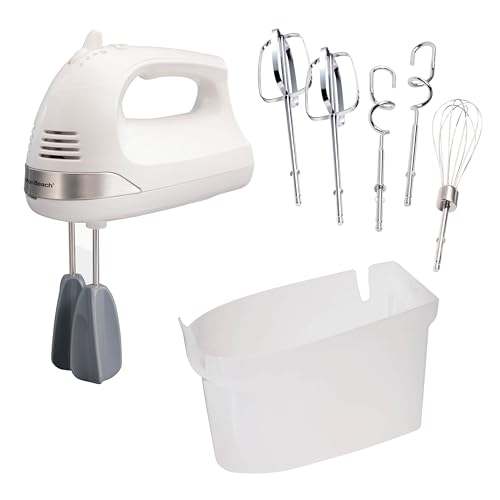
Hamilton Beach 6-Speed Electric Hand Mixer with Easy Clean Beaters, 62636J
Badge: Most Versatile
Strengths
- The most complete attachment set among the hand mixers here: beaters, dough hooks and a whisk
- A verified 275 watt motor, the strongest figure listed for a hand mixer in this guide
- Snap-on case stores everything together, and the easy-clean beaters rinse down fast
Trade-offs
- Six speeds is plenty, but the nine-speed Cuisinart models offer finer low-end control
- White finish shows turmeric, cocoa and berry stains over time
- Dough hooks help with soft doughs, yet stiff dough still belongs in a stand mixer
Mini spec box
- 6 speed settings
- 275 watt motor
- Traditional beaters, dough hooks and whisk included
- Easy-clean beaters
- Snap-on storage case
- Finish: White
- Model: 62636J
The 62636J is the versatility champion of this guide, and for bakers who wander beyond cakes it is arguably the first pick. The verified box contents are the fullest here: traditional beaters, dough hooks and a whisk, driven by a 275 watt motor, the strongest figure published for any hand mixer in this list. That combination covers creaming and batters, whipped egg whites and meringues with the whisk, and soft doughs, enriched doughs and pizza bases at home scale with the hooks.
The easy-clean beaters and snap-on case keep the practical side tidy. Its trade-offs are smaller than most: six speeds rather than nine, so the gentlest starts need a little more care, and a white finish that will record every encounter with cocoa and turmeric. If your baking includes bread-adjacent projects and you want one hand mixer that attempts everything honestly, this is the one. Heavy, stiff dough still belongs to a stand mixer, and this guide will keep saying so.
Best for: bakers who also make soft doughs and want whisk, beaters and hooks included / Not suited for: the finest low-speed control; the nine-speed models edge it there

Cuisinart 9-Speed Electric Hand Mixer with Storage Case, HM-90BCS
Badge: Best Premium Hand Mixer
Strengths
- Nine speeds plus SmoothStart make delicate and heavy jobs easier to manage
- A 220 W motor is a clear, verified figure in a class where many listings hide wattage
- The six-piece set and snap-on case keep attachments organised between uses
Trade-offs
- Brushed chrome shows fingerprints and batter smears more than matte finishes
- Heavier feature set than a once-a-month baker needs
- The case is convenient but not small, so measure your drawer
Mini spec box
- 9 speed settings
- 220 W motor
- SmoothStart anti-splatter technology
- Snap-on storage case
- 6-piece set
- Finish: Brushed Chrome
- Model: HM-90BCS
The HM-90BCS is the premium expression of the hand-mixer idea in this guide: nine speeds, a verified 220 W motor, SmoothStart anti-splatter technology, a six-piece set and a snap-on storage case, finished in brushed chrome. For baking, it behaves like its white sibling, the HM-90S, with the same fine control for flour work and creaming, plus the reassurance of a published wattage figure and a fuller accessory set in the box.
Choose it if you bake often and want the hand-mixer format at its most complete, or if the chrome finish suits a kitchen where the mixer lives on the counter. The honest costs are that brushed chrome shows every fingerprint and smear, the case is bulky, and frequent bakers who regularly make large or heavy batches may still outgrow the format entirely and end up wanting a stand mixer. Within its format, though, there is nothing here left to wish for except a bigger bowl, and hand mixers let you bring your own.
Best for: frequent bakers wanting the most complete hand-mixer set / Not suited for: kitchens short on storage, or anyone who hates fingerprints on chrome

Proctor Silex Easy Mix 5-Speed Electric Hand Mixer with Bowl Rest, 62511
Badge: Best Budget Pick
Strengths
- Compact and lightweight, which matters more than raw power for quick, small jobs
- Bowl rest keeps the mixer parked on the bowl instead of dripping on the counter
- A simple five-speed layout that anyone can use without reading a manual
Trade-offs
- 215 watts of peak power is the gentlest figure in this guide, so thick mixtures slow it down
- No storage case or extra attachments are listed
- Best treated as a light-duty mixer rather than a daily workhorse
Mini spec box
- 5 speed settings
- 215 watts of peak power
- Bowl-rest feature
- Compact, lightweight design
- Finish: Black
- Model: 62511
The Proctor Silex Easy Mix is the small-jobs specialist: compact, lightweight, five speeds, 215 watts of peak power, and a bowl rest that parks the mixer on the rim of the bowl between additions. For baking, that profile suits muffins for two, a single batch of cookies, whipped cream, pancake and waffle batters, and the hundred small mixing tasks that make up most home baking by volume.
Its virtues are ease and honesty. It is simple enough that nobody needs instructions, light enough that holding it is never the issue, and quick to wash and put away. Its limits follow from its size: thick cookie doughs and double batches will slow it, no case or extra attachments are listed, and it is a light-duty machine that should be bought as one. For small households and occasional bakers, it may be the most-used mixer in this entire guide.
Best for: small batches, small households and occasional bakers / Not suited for: thick doughs, double batches or daily heavy use
Comparison Table
Side by side, the six separate cleanly: control at the Cuisinart end, versatility at the Hamilton Beach end, bundle value from WEPSEN, compactness from KitchenAid, and simplicity from Proctor Silex.
| Pick | Badge | Speeds / format | Standout point | Link |
|---|---|---|---|---|
| Cuisinart Power Advantage Plus 9-Speed Hand Mixer | Best Overall | 9 speed settings | Nine speeds, SmoothStart, snap-on case | Check on Amazon |
| WEPSEN 5-Speed Hand Mixer and Bowl Set | Best Value Set | 5 speed settings | Four nesting bowls and measuring tools included | Check on Amazon |
| KitchenAid KHM512 Hand Mixer, Black Matte | Best Compact Pick | 5 speed settings | Turbo Beaters, lockable swivel cord | Check on Amazon |
| Hamilton Beach 6-Speed Hand Mixer, 62636J | Most Versatile | 6 speed settings | Beaters, dough hooks and whisk; 275 watt motor | Check on Amazon |
| Cuisinart 9-Speed Hand Mixer, Brushed Chrome | Best Premium Hand Mixer | 9 speed settings | 220 W motor, six-piece set, snap-on case | Check on Amazon |
| Proctor Silex Easy Mix 5-Speed Hand Mixer | Best Budget Pick | 5 speed settings | Compact and lightweight with bowl rest | Check on Amazon |
How to Choose Among the best mixers for baking
Start by listing what you bake in a normal month. If it is cakes, muffins, cookies and frostings, every pick here qualifies, and your decision should turn on control and convenience. If soft doughs, enriched breads or pizza bases appear regularly, the attachment list becomes decisive and the Hamilton Beach 62636J, with hooks and whisk included, moves to the front. If you are starting from an empty kitchen, the WEPSEN bundle solves bowls and measures at the same time, which no other pick attempts.
Speed control deserves more weight than speed count headlines suggest. What matters is the bottom of the range: a gentle first gear that folds flour in without a cloud, and a steady medium for creaming. Nine-speed models give the finest steps, and SmoothStart on the Cuisinart pair automates the gentle launch. Five- and six-speed models are fine in practiced hands, especially if you add dry ingredients gradually and let the machine start before it touches the mixture deeply. Top speed matters mainly for egg whites and cream, and every pick here can whip.
Published power figures help where they exist. Hamilton Beach lists 275 watts for the 62636J, Cuisinart lists 220 W for the HM-90BCS, and Proctor Silex lists 215 watts of peak power for the Easy Mix, and those numbers roughly track the jobs each machine is aimed at. Several listings do not publish wattage at all, and it is better to judge those machines by their speed range, attachments and intended role than to guess. In hand mixers, technique, starting slow, scraping down, resting thick mixtures, protects a modest motor far better than a bigger number on a box.
Finally, weigh the unglamorous factors, because they decide whether the mixer gets used: weight in the hand over a three-minute cream, whether the parts are dishwasher safe, whether there is a case or the beaters will live loose in a drawer, and whether the machine fits the storage you actually have. New bakers comparing routes into the hobby will also find useful context in Best Mixers For Beginners, and note that several other guides in this cluster, such as Best Mixers For Bands, Best Mixers For Barcadi and Best Mixers For Beer, use the word mixer for audio and drinks equipment rather than baking tools.
How to Use a Hand Mixer for Baking: Creaming, Whipping and Folding
Creaming first, because it decides cakes. Butter should be soft but not melted, and sugar should be beaten with it at a steady medium speed until the mixture pales and lightens. Rushing this step at top speed warms the butter and breaks the emulsion you are trying to build. Scrape the bowl down once or twice; hand mixers let you work in any bowl, and a wide bowl makes scraping and folding far easier than a narrow one.
Eggs and liquids come next, added gradually. Add eggs one at a time and let each disappear before the next, or the mixture can split; a spoonful of the recipe’s flour added with the eggs helps it stay together. If a mixture does split, it is not ruined: a gentle warm bowl and steady mixing usually bring it back, and the finished bake is rarely affected.
Flour is folded in at the lowest speed, or by hand. Start the mixer before the beaters are buried, run it only until the flour just disappears, and finish with a spatula to catch the pockets at the bottom. Every extra ten seconds of machine mixing at this stage develops gluten and costs tenderness. For whipped egg whites, use scrupulously clean beaters and bowl, whip at a steady medium-high pace, and fold the foam in by hand in two or three additions. For cream, keep everything cold and stop the moment the cream holds soft peaks; overwhipped cream turns grainy quickly and butter not long after.
Care is brief but matters. Eject beaters with the release button where one is fitted, wash or soak them promptly, and use the dishwasher where the listing says the parts allow it. Wipe the body with a damp cloth, never immerse it, keep the vents clear of flour dust, and store the machine with its attachments together, in a case where provided, so the next bake starts without a search.
Troubleshooting
Problem: flour or icing sugar erupts from the bowl → the start was too fast or the bowl too shallow. Start at the lowest speed, use a deeper bowl, and add dry ingredients in stages.
Problem: cake batter curdles when the eggs go in → the eggs were cold or added too quickly. Add them gradually at room temperature, with a spoonful of flour, and keep mixing steadily until the batter comes back together.
Problem: the finished cake is tough and tunneled → the batter was over-mixed after the flour went in. Mix only until the flour disappears and finish by hand with a spatula.
Matching the Mixer to the Bake: A Job-by-Job Map
Layer cakes and sponges reward control: gentle flour work and reliable creaming, which is Cuisinart territory in this guide. Cookies reward steadiness through a stiffening mixture, where the Hamilton Beach models’ published power figures are reassuring. Meringues and whipped toppings reward clean, efficient whipping, where a whisk attachment or KitchenAid’s Turbo Beaters earn their keep. Frostings reward a slow start more than anything, because icing sugar is the most explosive ingredient in baking.
Brownies, muffins and traybakes are the forgiving centre of baking and every pick here handles them easily, which is worth remembering before overspending on features. The bakes that separate these machines are the ones at the edges: big double batches, stiff cookie doughs, soft bread doughs and delicate foams. Buy for your edges if you bake them often; buy for your centre if you do not.
Hand Mixer Habits That Improve Every Bake
Bring ingredients to the temperature the recipe assumes, because a mixer cannot fix cold butter or cold eggs, it can only work around them badly. Weigh dry ingredients where you can, since scooped flour varies enough to change a batter’s behaviour under the beaters. Scrape down more often than feels necessary; hand mixing leaves pockets, and a spatula pass between stages is the cheapest quality upgrade in baking.
Work in the right bowl. A deep, wide bowl gives the beaters room, reduces splashing and makes folding possible in the same vessel. Keep the beaters moving through the mixture rather than parked in one spot, and tilt the bowl slightly for small quantities so the beaters stay submerged. None of this requires a better machine, and all of it shows up in the crumb.
The Science in the Bowl: Air, Emulsions and Gluten
Baking mixing looks simple and is quietly scientific, and understanding three ideas will improve your results with any machine in this guide. The first is aeration. Creaming butter and sugar traps air in the fat, whipping eggs or whites builds a foam, and those air cells are where a bake’s lightness begins; raising agents expand gas that must already have somewhere to go. This is why creaming deserves real time at a steady medium speed and why foams are folded, never beaten, into batters. A mixer is fundamentally an air-management tool, and its speed control is really a set of choices about how much air to add, and how gently.
The second idea is the emulsion. Cakes and many batters are mixtures of fat and water-based ingredients that would rather separate. Eggs, added gradually to a creamed base, hold the two together. Rush the eggs, or use them cold, and the emulsion breaks into a curdled-looking mixture that bakes up uneven. The fix is process, not power: room-temperature ingredients, gradual additions, and steady mixing. No wattage figure in any listing can compensate for a broken emulsion, and every machine here can maintain a good one if the cook respects the sequence.
The third idea is gluten. Wheat flour forms an elastic network when hydrated and worked, which is structure in bread and toughness in cakes. Nearly every mixing instruction in baking is secretly a gluten instruction: mix bread dough thoroughly, mix cake batter barely, keep muffin mixtures lumpy rather than smooth. A hand mixer makes it easy to overshoot on tender bakes because it will happily keep mixing forever. The discipline of stopping, when the flour disappears, when the cream holds soft peaks, when the dough comes together, is the real skill, and the best machine is the one whose controls make stopping at the right moment easy.
Setting Up a Baking Station That Makes Mixing Easy
Good baking is mostly organisation, and a few habits around the mixer repay themselves every session. Read the recipe fully before anything comes out of the cupboard, because mixing stages follow each other quickly and there is no pause button once butter and sugar are creaming. Weigh and arrange ingredients in the order they will be used, with eggs cracked into a jug, dry ingredients whisked together in their own bowl, and tins prepared before batter exists to fill them. Bakers call this mise en place, and it is the difference between a calm bake and a floury improvisation.
Bowl choice is the station’s quiet centre. A deep, wide bowl suits hand mixing best: beaters stay submerged, splashing falls, and there is room to fold with a spatula in the same vessel. Very small bowls crowd the beaters and fling mixture; very large bowls spread a small batter too thin to whip. Stainless steel is light and unbreakable, glass lets you see unmixed pockets at the base, and either beats a shallow ceramic bowl for mixing work. Keep a flexible spatula within reach for the scrape-downs this guide keeps insisting on, because they are where even mixing actually happens.
Finally, plan the landing before take-off. Know where the filled tins will go, whether the oven is preheating, and where finished bakes will cool. Put the mixer’s cord where it will not drag through batter, keep a damp cloth for the inevitable smear, and wash beaters immediately after use while mixtures are still soft. None of this is glamorous, and all of it is what experienced bakers actually do differently from beginners.
From Batter to Tin: Portioning, Levelling and Timing
Mixing ends before baking does, and the handover matters. Fill tins promptly once batter is mixed, because raising agents begin working on contact with liquid and a batter that waits loses lift. Portion cupcake and muffin cases evenly, a scoop makes this fast and consistent, and level cake tins with a gentle shake or a spatula pass rather than packing the batter down. For layer cakes, dividing batter by weight between tins is the reliable route to even layers that bake in the same time and stack without surgery.
Oven discipline completes the job the mixer started. Preheat fully, position the rack before the oven is hot, and resist opening the door during the first and most fragile part of the bake, when a rush of cool air can stall a rising sponge. Rotate tins only if your oven has known hot spots, and judge doneness with the full set of signals: colour, a slight spring when pressed, edges just pulling from the tin, and a skewer emerging clean or with the moist crumbs the recipe intends.
Cooling is a stage, not an afterthought. Most cakes want a short rest in the tin so the crumb sets enough to handle, then turning out onto a rack so steam escapes instead of condensing into sogginess. Frost only when fully cool, or buttercream will slide. These steps sit outside the mixer’s job description, but they decide whether the mixing you did so carefully survives to the plate, which is why this guide treats them as part of the same craft.
Teaching Someone Else: Baking With Children and Beginners
A hand mixer is often the first powered tool a new baker touches, and the picks in this guide behave differently as teaching tools. Simple five-speed layouts forgive exploratory hands, bowl rests and storage cases reduce the chaos that puts beginners off, and a lightweight machine like the Proctor Silex can be held by smaller hands without a struggle. The jobs worth teaching first are the forgiving ones: muffins, traybakes and whipped cream, where the technique points, start slow, scrape down, stop when it comes together, can be learned without a ruined bake as tuition.
The deeper lesson a mixer teaches is sequence. Baking rewards doing things in order and punishes improvisation mid-stage, and a beginner who learns to read a recipe fully, set out ingredients, and respect the stages has learned most of baking, with the machine merely enforcing the discipline. If you are buying partly to bake with family, weight those teaching qualities, simplicity, lightness, tidiness, as heavily as any specification, because the best mixer for a shared kitchen is the one nobody is nervous to use.
Keeping a Simple Baking Log
One habit separates bakers who improve quickly from bakers who repeat the same mysteries for years: a short log. After each bake, note the recipe, the mixer and speed you used for the key stages, anything that splashed, split or surprised you, and how the result ate. Three lines are enough. Within a month the log becomes personalised evidence no guide can give you: which of your bowls suits whipping, which speed your machine creams best at, and which recipes your household actually requests again.
The log also protects purchases. When a mixer eventually wears out or a household outgrows it, the log shows exactly which jobs grew, batch sizes, dough work, decorating, and which stayed small, turning the next buying decision from guesswork into arithmetic. It takes less time than washing the beaters, and it compounds.
One last piece of station craft: keep the mixer’s landing zone clear before you start. A hand mixer mid-bake gets set down wherever there is space, usually onto batter smears, and a small clear patch of counter with a folded cloth on it becomes the machine’s home for the whole session. It sounds trivial until the first time you park a running-speed accident in waiting on a clear surface instead of into the flour bin. Good stations are built from exactly these unglamorous decisions, repeated until they are automatic, and they are worth more than a surprising amount of equipment.
Common Buying Mistakes
- Starting flour at high speed. The single most common hand-mixer mistake. Start low, always, and let control features like SmoothStart do their job.
- Over-mixing after the flour goes in. Tough cakes are usually mixed, not baked, into toughness. Stop when the flour disappears.
- Buying by top speed. Baking lives at low and medium speeds. The gentle end of the dial matters more than the dramatic end.
- Ignoring the attachment list. Beaters, whisks and hooks do different work. If your baking needs a whisk or hooks, confirm they are in the box.
- Skipping the scrape-down. Unmixed pockets at the bowl’s base become streaks and dense patches in the finished bake.
- Storing the mixer and beaters separately. A case, or at least a dedicated spot, is the difference between a tool that gets used and a tool that gets replaced.
Final Recommendation
For most home bakers, the Cuisinart HM-90S is the recommendation: nine speeds, SmoothStart, and a storage case make it the most controlled and convenient hand mixer here for cakes, batters and frostings. Start with the Cuisinart Power Advantage Plus 9-Speed Hand Mixer if you want the safest all-round choice. If that does not fit your kitchen or your habits, the WEPSEN 5-Speed Hand Mixer and Bowl Set is the alternative we would look at next. Bakers who also make soft doughs should take the Hamilton Beach 62636J for its hooks, whisk and published power; new bakers should look at the WEPSEN bundle; and small households will be perfectly served by the KitchenAid KHM512 or the little Proctor Silex. The HM-90BCS is the premium version of the winning idea for frequent bakers who like the chrome finish.
Baking rewards the mixer you reach for without thinking. Choose the one whose controls, attachments and storage fit your kitchen and your repertoire, and it will quietly improve everything you bake with it.
Frequently Asked Questions
Is a hand mixer enough for home baking, or do I need a stand mixer?
For most home baking, a hand mixer is enough: cakes, cookies, muffins, brownies, frostings and whipped cream are all hand-mixer jobs. A stand mixer earns its place for heavy bread dough, very large batches and hands-free mixing. This guide covers hand mixers honestly within that boundary.
How many speeds do I actually need for baking?
Most baking uses three zones: very low for flour, medium for creaming, and high for whipping. Five speeds cover those zones; nine speeds refine them, especially at the gentle end. More speeds help control, but technique, starting slow and scraping down, matters more than the count.
Which pick is best if I also make bread dough?
The Hamilton Beach 62636J, because its verified box includes dough hooks alongside beaters and a whisk, and its published 275 watt motor is the strongest figure here. Keep expectations realistic: soft and enriched doughs at home scale are its territory, while stiff doughs belong to a stand mixer.
Why did my buttercream come out grainy or split?
Usually temperature: butter too cold, or liquid added too fast. Beat the butter until smooth first, add icing sugar gradually at a low speed, and let the finished frosting mix slowly until it comes together. A few minutes of patience fixes most buttercream problems.
Are the included bowls in the WEPSEN set worth it?
If you are starting out, yes. Baking constantly needs separate bowls for dry ingredients, wet ingredients and whipped elements, and the set’s four nesting stainless bowls cover that while storing compactly. Experienced bakers with a full cupboard will value the bundle less.
How do I keep a hand mixer working for years?
Do not force thick mixtures continuously, work in bursts and let the motor rest, wash beaters promptly, keep vents free of flour dust, and store attachments with the machine. Hand mixers usually fail from being pushed through jobs beyond their format, not from ordinary baking.


