Disclosure: topratedkitchenware.com is reader-supported. When you buy through links on our site, we may earn an affiliate commission from Amazon and other retailers, at no extra cost to you.
Where to buy
If you are shopping for the best mixers for cookie dough and frosting, the six machines below are the shortlist this guide is built around. The pairing in the keyword is the whole challenge: cookie dough is the stiffest mixture in home baking and frosting is one of the most delicate, so a mixer that serves both must be strong at the bottom of its dial and gentle at the top of its range. Two picks are Cuisinart stand mixers, four are hand mixers, and each is assessed against both jobs, not just the one it finds easier. Prices and availability change often on Amazon, so use the links to check the current listing before you buy.
- Best Overall: Cuisinart Stand Mixer, 12 Speed, 5.5 Quart, Periwinkle Blue (SM-50) — Check on Amazon
- Best Hand Mixer for Both Jobs: LILPARTNER Hand Mixer Electric, 7-Speed, Light Pink — Check on Amazon
- Best Statement Finish: Cuisinart Stand Mixer, 12 Speed, 5.5 Quart, Ruby Red (SM-50) — Check on Amazon
- Best Hand Mixer for Dough-First Bakers: Hamilton Beach 6-Speed Electric Hand Mixer, White (62682G) — Check on Amazon
- Best for Frosting Detail: KitchenAid 5 Ultra Power Speed Hand Mixer, Empire Red (KHM512) — Check on Amazon
- Best for Small Kitchens: KitchenAid 5 Ultra Power Speed Hand Mixer, Contour Silver (KHM512) — Check on Amazon
Read the full guide below for the detailed reviews, the comparison table, the two-job technique sections, the make-ahead scheduling advice and the frosted sugar cookie test that audits every pick ↓
The best mixers for cookie dough and frosting have to pass a test most mixers never face: two opposite examinations in the same afternoon. Cookie dough examines torque and restraint — a stiff, chip-loaded mass that must be creamed thoroughly, folded at the lowest speed, and never overworked once the flour lands. Frosting examines aeration and control — buttercream beaten to silk without warming into soup, cream cheese frosting kept low and slow so it stays spreadable, colours mixed in small exact batches, whipped toppings taken to peaks and not one second beyond. A machine can be brilliant at one examination and merely adequate at the other, and for the baker whose signature is a frosted cookie — sandwich cookies, thumbprints, frosted sugar cookies, whoopie pies — adequate at either one is a failed recipe.
This shortlist is graded on both papers. The two Cuisinart SM-50 stand mixers bring the paddle for dough and the whisk for frosting in one listing, with twelve speeds to travel between the two jobs and a bowl big enough for a full batch of each. Among the hand mixers, the LILPARTNER’s listing names dough among its jobs and backs it with a five-piece accessory set; the Hamilton Beach brings a stated 250 watt motor and a burst button; and the two KitchenAid KHM512 finishes bring compact, cord-managed tidiness that frosting detail work quietly depends on. Every review below carries two verdicts — one for dough, one for frosting — because that is the honest shape of the question.
Key Takeaways
- Dough wants a paddle, low speeds and restraint; frosting wants aeration, speed control and small-batch agility. Grade every pick on both papers, and be suspicious of any review — including careless ones elsewhere — that grades it on only one.
- The Cuisinart SM-50 platform is the two-job champion: paddle for dough, whisk for frosting, twelve speeds between them.
- The LILPARTNER is the hand-mixer two-job pick — its listing names dough and includes five stainless accessories.
- Frosting colour batches are hand-mixer work even in stand-mixer kitchens; the KitchenAid pair’s tidy handling suits them best.
- Temperature discipline beats machinery: softened butter for dough, cool-but-pliable butter for buttercream, and never a warm bowl for whipped frosting — a truth every review in this guide repeats, because every failed batch of either job can be traced back to it more often than to any machine.
- The two SM-50 finishes are one machine; choose by colour. The two KHM512 finishes likewise.
- Scheduling is the free upgrade: dough on the quiet day, frosting on the busy day, and a single machine suddenly covers a workload that looked like it needed two.
In this guide
Quick Picks
| Pick | Badge | Format | Speeds | Dough verdict | Frosting verdict |
|---|---|---|---|---|---|
| Cuisinart Stand Mixer, Periwinkle Blue (SM-50) | Best Overall | Stand mixer | 12 | Paddle, full batches | Whisk + paddle, full control |
| LILPARTNER Hand Mixer Electric, Light Pink | Best Hand Mixer for Both Jobs | Hand mixer | 7 | Dough named in listing; small batches | Accessory range covers creams |
| Cuisinart Stand Mixer, Ruby Red (SM-50) | Best Statement Finish | Stand mixer | 12 | Same platform as the leader | Same platform as the leader |
| Hamilton Beach 6-Speed Hand Mixer (62682G) | Best Hand Mixer for Dough-First Bakers | Hand mixer | 6 | 250 W + QuickBurst for pockets | Competent; bowl rest helps stop-start work |
| KitchenAid KHM512, Empire Red | Best for Frosting Detail | Hand mixer | 5 | Small soft batches | Colour batches and touch-ups with tidy cleanup |
| KitchenAid KHM512, Contour Silver | Best for Small Kitchens | Hand mixer | 5 | Small soft batches | Same detail talents, neutral finish |
How These Picks Were Chosen
This guide is research-led and built from verified listings; every specification used comes from the listing itself, and listings’ silences are reported as silences. The selection lens was the double job. For dough we asked: is there a paddle, or — among hand mixers — a stated motor figure and attachments that suit stiff mixtures in small batches? For frosting we asked: is there a whisk, a speed range fine enough for both silky buttercream and careful cream cheese work, and handling that suits small colour batches? Machines were then ranked by how completely they answer both sets of questions, which is why a stand-mixer platform with a confirmed paddle-and-whisk pairing leads, and why the hand mixers are ordered by two-job balance rather than by either job alone.
Colour variants are identified as such wherever they appear: the two SM-50s are one platform, the two KHM512s are one platform, and the guide says so in every relevant review. We claim no hands-on testing; the assessments rest on verified specifications and on the well-established mechanics of dough and frosting, which agree with each other about almost everything in this article.
One more selection note deserves stating, because readers of a two-job guide often arrive with a one-job machine already in the kitchen. Nothing in this guide asks you to discard a working mixer. A hand mixer you already own becomes the detail tool the moment a stand mixer arrives; a stand mixer you already own makes the hand-mixer half of this shortlist a menu of finishing specialists rather than necessities. The grades below are written for a from-zero purchase, but they read just as usefully as a gap analysis: find the job your current machine fails, and buy the pick that passes exactly that paper.
The 6 Best Mixers for Cookie Dough and Frosting, Reviewed
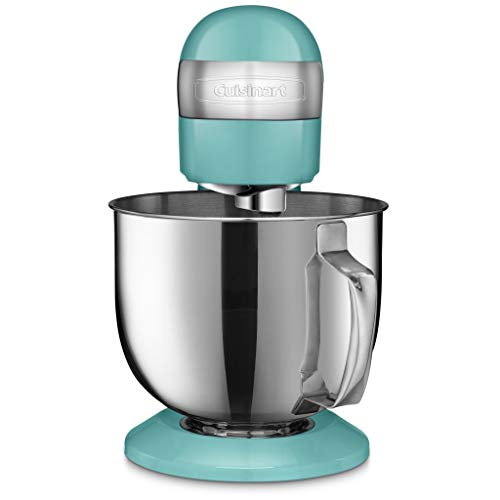
Cuisinart Stand Mixer, 12 Speed, 5.5 Quart, Periwinkle Blue (SM-50)
Badge: Best Overall
Strengths
- The listing confirms both key attachments: a mixing paddle for dough and a chef’s whisk for frosting — the complete two-job toolkit.
- Twelve speeds span the whole assignment, from a stir for flour to a whip for meringue frosting.
- The 5.5-quart stainless bowl and splash guard with pour spout suit full batches of dough and frosting alike.
Trade-offs
- One machine means one bowl at a time: dough and frosting queue rather than overlap, unless a hand mixer assists.
- The stand format’s footprint is a real cost in a small kitchen.
- Periwinkle Blue is a décor commitment; its red sibling below makes the same cookies and frostings.
Mini spec box
- Format: stand mixer
- Speeds: 12
- Bowl: 5.5 quart stainless steel
- Attachments named in listing: chef’s whisk, mixing paddle, dough hook
- Features: splash guard with pour spout
- Colour: Periwinkle Blue
- Model: SM-50TQNAS
For the double job, the SM-50 is less a mixer than a small system. Morning: the paddle creams butter and sugar hands-free while you weigh flour; the dough folds at a stir; the bowl goes to chill with the dough in it. Afternoon: the same bowl, washed, takes a full batch of buttercream — paddle again for the dense beginning, whisk if the recipe wants a lighter whip — while the splash guard keeps the icing sugar event inside the bowl where it belongs. Twelve speeds is not a vanity figure in this workflow; it is the distance between the two jobs, travelled on one dial.
Its honest limitation is singleness. A frosted-cookie production line wants dough and frosting in motion together, and one stand mixer serialises them — which is precisely why this guide’s hand mixers matter even to readers who buy the SM-50 first. As a single purchase for a baker who does both jobs at home scale, though, nothing else in the pool covers the whole assignment in one listing, and the Periwinkle finish makes the platform a pleasure to leave on the counter where both jobs happen.
Best for: bakers who make frosted cookies as a single, regular practice and want one machine for both jobs / Not suited for: kitchens with no counter or storage room for a stand mixer

LILPARTNER Hand Mixer Electric, 7-Speed, Light Pink
Badge: Best Hand Mixer for Both Jobs
Strengths
- Its listing names whipping dough, cream and cake — the two jobs of this guide plus their neighbours, in the maker’s own words.
- Five stainless steel accessories is the broadest hand-mixer attachment set in this pool.
- Seven speeds give a workable spread for dough’s low gears and frosting’s aeration.
Trade-offs
- Hand-mixer dough rules apply in full: small batches, softened butter, no doubled loads.
- No wattage is stated in the listing, so its motor cannot be ranked against the Hamilton Beach’s figure.
- Light pink is the only finish in this listing.
Mini spec box
- Format: electric hand mixer
- Speeds: 7
- Accessories: 5 stainless steel accessories
- Listing-named jobs: whipping dough, cream, cake
- Attachments: dishwasher safe
- Colour: Light Pink
Among hand mixers, the LILPARTNER is the only pick whose listing was plainly written for this guide’s exact double life. Dough is a named job. Cream — frosting’s close cousin — is a named job. The five-piece stainless accessory set exists to move between them, and seven speeds give the movement gradations: low for the flour stage of a small dough, middle for creaming, higher for the creams and light frostings. In a drawer-sized format, that is the most complete two-job answer available here.
The limits are the format’s limits, stated once more because they decide real purchases: dough batches stay small and butter starts softened, and a full stand-mixer-scale batch of either dough or frosting belongs to the SM-50 above. Within the hand-mixer envelope — which is where a great deal of home frosted-cookie baking actually lives — the LILPARTNER is the balanced choice, and its dishwasher-safe attachments ease the two-job cleanup, which involves both the stickiest dough and the greasiest frosting in the same afternoon.
Best for: drawer-kitchen bakers whose frosted cookies come in small, frequent batches / Not suited for: full or doubled batches of dough, or production-scale frosting
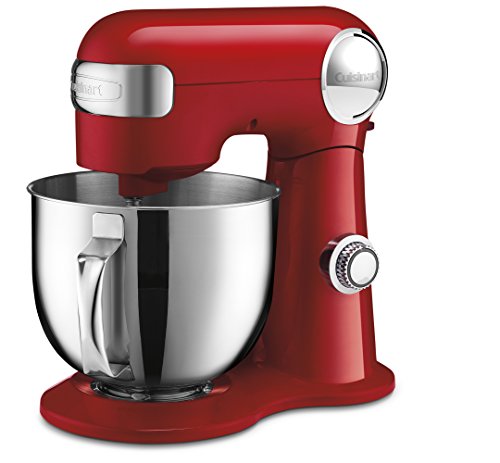
Cuisinart Stand Mixer, 12 Speed, 5.5 Quart, Ruby Red (SM-50)
Badge: Best Statement Finish
Strengths
- The identical SM-50 platform: paddle, whisk, dough hook, twelve speeds, 5.5-quart bowl.
- All two-job strengths of the guide leader, in the boldest finish.
- A counter presence that suits bakers whose kitchen is also their content backdrop or their joy.
Trade-offs
- No mechanical difference from the Periwinkle model exists; buy it for the colour or not at all.
- Red displays flour and icing sugar brightly between wipe-downs.
- Same footprint and one-bowl queue as its sibling.
Mini spec box
- Format: stand mixer
- Speeds: 12
- Bowl: 5.5 quart stainless steel
- Attachments named in listing: chef’s whisk, mixing paddle, dough hook
- Features: splash guard with pour spout
- Colour: Ruby Red
- Model: SM-50R
The Ruby Red SM-50 receives the same honest treatment as every colour variant in this programme: it is the Best Overall platform in a different finish, and its dough and frosting assessments are the leader’s assessments. Creaming hands-free, flour at a stir, buttercream under a splash guard, meringue frosting under the whisk — identical. What the colour changes is the room: red is the finish bakers choose deliberately, live with daily, and photograph often. If that is your kitchen, this is your SM-50, and the cookies and frostings will be exactly as good as the Periwinkle ones, which is to say very good indeed.
Best for: bakers who want the two-job platform in a bold, deliberate finish / Not suited for: anyone expecting a specification difference from the other SM-50

Hamilton Beach 6-Speed Electric Hand Mixer, White (62682G)
Badge: Best Hand Mixer for Dough-First Bakers
Strengths
- A stated 250 watt motor — the strongest confirmed figure among the hand mixers here, and dough notices.
- QuickBurst clears the last dry pockets in dough and gives frosting a final smoothing push.
- The bowl rest suits the two-job afternoon: park on the dough bowl, park on the frosting bowl.
Trade-offs
- Traditional beaters only, per the listing — frosting aeration is beater-paced, not whisk-paced.
- Six speeds is a coarser dial for delicate cream-cheese frosting work.
- Small dough batches only; the stand mixers own the full batches.
Mini spec box
- Format: electric hand mixer
- Speeds: 6, plus QuickBurst
- Motor: 250 watts
- Attachments named in listing: traditional beaters
- Features: bowl rest, snap-on storage case
- Colour: White
Bakers divide into dough-first and frosting-first temperaments, and the Hamilton Beach is the hand mixer for the dough-first. Its case rests on the stated motor and the burst button: cookie dough in small batches is a sequence of resistances — creaming, flour pockets, chip fold-ins — and a machine with honest power plus a short extra push handles that sequence with less coaxing than its rivals. The snap-on case keeps the whole tool together between the two jobs, and the bowl rest, as noted in the strengths, turns out to be a two-job feature: frosting work is as stop-start as dough work, and a mixer that parks on the rim keeps both bowls’ drips where they belong.
On the frosting paper it is competent rather than brilliant: beaters make perfectly good buttercream with patience, but the aeration ceiling is lower than a whisk’s, and six speeds give less finesse for the cream-cheese frostings that punish speed. Dough-first bakers will accept that trade without blinking; frosting-first bakers should look at the LILPARTNER’s accessory range or the SM-50’s whisk.
Best for: dough-first bakers making small batches who want confirmed hand-mixer power / Not suited for: frosting-led bakers who need whisk aeration and fine low speeds
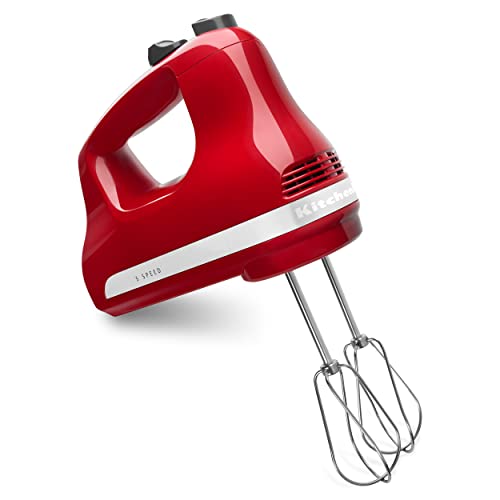
KitchenAid 5 Ultra Power Speed Hand Mixer, Empire Red (KHM512)
Badge: Best for Frosting Detail
Strengths
- Turbo Beaters push through thick buttercream without clogging — detail batches stay smooth.
- The lockable swivel cord stays out of finished frosting and away from decorated cookies.
- One-button release plus dishwasher-safe beaters make colour-batch turnaround fast and clean.
Trade-offs
- Dough work is its weaker paper: small, soft batches only, on a compact five-speed platform.
- No whisk is named in the listing; whipped frostings are beater-made.
- Empire Red is a strong colour for a detail tool.
Mini spec box
- Format: electric hand mixer
- Speeds: 5
- Attachments named in listing: Turbo Beaters
- Features: lockable swivel cord, easy-release button, dishwasher-safe beaters
- Colour: Empire Red
Frosting detail is a category of work the big machines do badly: the quarter-batch of royal-red buttercream, the single colour for a dozen sandwich cookies, the touch-up whip when a frosting has sat and slackened. The KHM512 owns that category in this pool. It deploys from a drawer in seconds, its Turbo Beaters keep thick frosting moving instead of packing, its cord locks away from finished surfaces, and when the colour is done the beaters eject into the dishwasher with one button — so the next colour starts clean, fast, and uncontaminated. In a frosted-cookie workflow, that turnaround is not a convenience; it is the difference between three colours and one.
Its dough paper is the honest weak side: compact, five speeds, beaters — small soft batches, softened butter, no heroics. Bakers whose frosted cookies start with a big dough production should pair it with a stand mixer, as the two-machine section below describes; bakers whose batches are small throughout will find it a charmingly sufficient only machine.
Best for: colour batches, touch-ups and detail frosting in any size of kitchen / Not suited for: production dough work or large frosting batches

KitchenAid 5 Ultra Power Speed Hand Mixer, Contour Silver (KHM512)
Badge: Best for Small Kitchens
Strengths
- The same KHM512 detail platform — Turbo Beaters, swivel cord, one-button release — in a neutral finish.
- Contour Silver disappears into shared and rental kitchens where a red appliance argues with the room.
- Dishwasher-safe beaters keep the two-job cleanup at rinse-and-rack level.
Trade-offs
- Identical dough ceiling to its red sibling: small soft batches only.
- Identical frosting profile: detail excellence, no named whisk.
- Buying both finishes buys the same machine twice.
Mini spec box
- Format: electric hand mixer
- Speeds: 5
- Attachments named in listing: Turbo Beaters
- Features: lockable swivel cord, easy-release button, dishwasher-safe beaters
- Colour: Contour Silver
The silver KHM512 is the red one’s platform in the finish that suits kitchens where appliances are expected to be quiet about themselves. Every assessment transfers: frosting detail excellence built on tidy handling and fast beater turnaround; dough competence bounded by small batches and softened butter. It is listed and reviewed separately because the pool includes it and because a reader comparing the two listings deserves a straight answer — they are the same machine, and the choice is a colour choice, to be made with your eyes and your kitchen’s scheme.
Best for: small and shared kitchens wanting the detail platform in a neutral finish / Not suited for: anyone expecting different performance from the Empire Red model
Comparison Table
| Pick | Format | Speeds | Dough strength | Frosting strength | Link |
|---|---|---|---|---|---|
| Cuisinart SM-50, Periwinkle Blue | Stand | 12 | Paddle, full batches | Paddle + whisk, full batches | Check on Amazon |
| LILPARTNER 7-Speed | Hand | 7 | Dough named; small batches | Accessory range; creams named | Check on Amazon |
| Cuisinart SM-50, Ruby Red | Stand | 12 | Paddle, full batches | Paddle + whisk, full batches | Check on Amazon |
| Hamilton Beach 62682G | Hand | 6 + QuickBurst | 250 W; small batches | Beater buttercream, patient pace | Check on Amazon |
| KitchenAid KHM512, Empire Red | Hand | 5 | Small soft batches | Detail and colour batches | Check on Amazon |
| KitchenAid KHM512, Contour Silver | Hand | 5 | Small soft batches | Detail and colour batches | Check on Amazon |
How to Choose the Best Mixers for Cookie Dough and Frosting: Grade Both Papers
Begin by grading your own baking, not the machines. If your frosted cookies are an occasional sandwich-cookie afternoon, almost any pick here passes both papers and you should buy on kitchen fit. If frosted cookies are your signature — the bake sale table, the holiday boxes, the orders from neighbours — then the double grade becomes strict: dough capacity and frosting control must both be production-grade for your scale, and that points at the SM-50 platform, ideally with a hand mixer in support. The most common buying error in this category is grading on the job you enjoy and discovering the other job’s ceiling in the middle of a deadline.
Then read the listings with the two-job lens. For dough: a paddle named in the listing, or a stated motor figure on a hand mixer. For frosting: a whisk named in the listing, or an accessory set broad enough to cover creams, plus speeds fine enough to keep cream-cheese frosting slow. The SM-50’s listing is the only one here that answers both sets of questions with named attachments, which is the entire reason it leads. Finally, weigh the workflow features the double job multiplies: you will eject and wash attachments between dough and frosting every single bake, so release mechanisms and dishwasher-safe parts are not details — they are the job, twice a day. The generalist assessments in our Best Mixers For Cooks guide cover several of these machines in a wider kitchen role for readers whose baking is one department among many.
How to Run a Frosted-Cookie Session: Dough First, Frosting Second, One Cleanup
- Make the dough first, always: it improves with chilling while frosting only waits. Cream, fold at the lowest speed, stop at the vanishing flour streak, and get the dough into the cold.
- While the dough chills, wash the paddle or beaters and bowl completely. Frosting made with dough residue in the bowl carries crumbs and colour into the finish — the one unforgivable shortcut of the double job.
- Portion and bake the cookies; let them cool fully. Warm cookies melt frosting into glaze, which is delicious when intended and a defect when not.
- Make the frosting in the batch structure the design needs: one main batch at production scale, colours in small hand-mixer batches after.
- For buttercream, beat at a steady middle speed until silky; for cream cheese frosting, stay low and stop early — it slackens with warmth and overwork, and a cool bowl buys you margin.
- Assemble, then do the single cleanup properly: attachments rinsed before anything dries, because dough and frosting together harden into the worst residue in baking.
Troubleshooting. Problem: buttercream is grainy → the sugar needed more beating time at a steady speed, or the butter began too cold; keep beating, and let the machine’s patience do what your impatience wants to skip. Problem: frosting slides off the cookies → the cookies were warm, or the frosting is too soft; chill both briefly and reassemble. Problem: colours bleed between batches → the beaters were not fully washed and dried between colours; the KitchenAid pair’s fast eject-and-dishwasher turnaround exists for exactly this failure.
The Two-Machine Answer: Why Frosted-Cookie Bakers End Up with Both Formats
Watch a committed frosted-cookie baker work and you will usually see the arrangement this guide’s picks naturally form: the stand mixer running the production line — dough in the morning, the main frosting batch after — and a hand mixer living at the finishing bench for colours, touch-ups and the small whips that are beneath the big bowl’s dignity. The overlap is the insurance: either machine can, at a pinch, do a small batch of the other’s job, so a breakdown rearranges the afternoon instead of cancelling it.
If you are equipping from zero, buy in the order your scale dictates. Small batches throughout: the LILPARTNER covers both jobs in one drawer and the stand mixer can wait. Production dough with detail frosting: the SM-50 first, the KitchenAid detail tool second. Dough-first with occasional frosting: the Hamilton Beach covers more of the assignment than its price of admission suggests. What the two-machine pattern really teaches is that “best” in this category is a pairing, not a product — and the six picks above are best read as the components of three good pairings at three scales.
Frosting Types and the Speeds They Demand
American buttercream wants the middle of the dial held patiently — the stage where a stand mixer’s hands-free running pays for itself, because your hands are sifting, scraping and judging consistency. Cream cheese frosting wants the bottom of the dial and an early stop; it is the frosting most often ruined by enthusiasm, and fine low gears are its insurance. Royal icing wants sustained beating to precise peaks and a bowl deep enough to contain it; it also dries on attachments like cement, which returns us to the rinse-immediately rule that this entire double job keeps teaching from different directions. Whipped frostings and meringues want the whisk and the top of the dial, taken to peaks and stopped on the instant — the SM-50’s whisk or, in small batches, beater work at full attention. Ganache wants gentleness: low speed, brief contact, no incorporated air. A mixer wardrobe that covers this whole map needs either the SM-50’s attachment pair or a hand mixer with a broad accessory set — which is, in one sentence, the podium of this guide, and the reason the frosting map and the dough map, drawn separately, keep leading back to the same two or three machines.
A Note on the Word “Mixer”
The word also mixes drinks, sometimes in the same household and occasionally for the same party. Readers planning a bar alongside the baking may want the Best Mixers For Crown Apple, the Best Mixers For Crown Peach or the Best Mixers For Craft Cocktails — beverage guides about what pairs with spirits. Here, the only mixing that matters happens in a bowl, at both ends of the stiffness scale, and usually with a tray of cookies cooling somewhere nearby on the wire cooling rack.
Make-Ahead Logic: Dough and Frosting Run on Different Clocks
The double job becomes dramatically easier once you notice that its two halves keep different time. Cookie dough is a make-ahead food: it improves with a night of chilling, freezes portioned for weeks, and asks nothing of the mixer after its first ten minutes. Frosting is a make-today food: buttercream holds for a while and revives with a brief re-beat, but it is at its best — its texture, its colour, its piping behaviour — within hours of making. The baker who mixes dough on the quiet day and frosting on the busy day has, in effect, doubled the value of one machine, because the queue that makes a single stand mixer feel insufficient mostly evaporates — and the cookies, rested and chilled as all good dough should be, are better for the arrangement too.
This is also where the hand mixer’s frosting role sharpens. Re-beating a rested buttercream to working silkiness is a two-minute, small-tool job; waking the stand mixer for it is like driving to the corner shop. Colour batches, as the KitchenAid reviews argue, belong to the same logic. The mature frosted-cookie kitchen is therefore not defined by owning everything, but by scheduling the big machine for the two production moments and letting the small machine absorb the dozen small ones in between. Plan the clocks, and the equipment in this guide is not merely sufficient — it is comfortable.
Ergonomics of the Double Job: Hands, Arms and the Long Afternoon
A frosted-cookie session is one of the longer mixing afternoons in home baking, and it audits your equipment’s kindness to your body. The stand mixer’s contribution is absence: during its long creaming and beating stages, your hands are free, your shoulders are down, and the fatigue budget is spent on the work that actually needs hands — portioning, piping, assembling. The hand mixer’s contribution is presence: you feel the dough tighten and the frosting lighten through the handle, which is information, but every minute of it is a minute your arm is the machine’s stand.
Choose with that audit in mind, and choose honestly, because a frosted-cookie habit is measured in years and hundreds of batches. Bakers with any wrist, shoulder or grip complaints should weight the stand mixer heavily and treat the hand mixer as a detail tool used in minutes, not sessions. Bakers who love the tactile side can run the hand-mixer route happily at small scale, with two habits protecting them: keep the bowl at a height that lets the arm hang naturally rather than hover, and alternate the mixing hand during long creaming stages — a small, unfashionable technique that doubles endurance. Either way, the right machine is partly a medical decision, and it is no indulgence to treat it as one.
The Frosted Sugar Cookie: One Bake That Tests Everything
If you want a single recipe to audition any mixer for this guide’s double job, bake frosted sugar cookies and watch the whole examination unfold. The dough is a creaming test — butter and sugar to pale fluffiness, eggs without curdling, flour at a whisper — and then a patience test, because it must chill before it can be rolled. The frosting is a control test: royal icing or buttercream beaten to an exact consistency, divided, coloured in small batches, and held at piping texture while you work. The assembly is a turnaround test, because beaters and bowls cycle between colours and the cleanup discipline decides whether the red stays out of the white.
Run that bake mentally against each pick and the guide’s ordering explains itself. The SM-50 passes every stage at production scale and queues only at the colour step. The LILPARTNER passes every stage at small scale with the broadest hand-held toolkit. The Hamilton Beach aces the dough stages and manages the frosting. The KitchenAid pair manage the dough in miniature and own the colour step outright. There is no trick ending: the best mixer for cookie dough and frosting is the one whose weakest stage is the one your baking can most easily forgive — and now you know how to find it, grade it and schedule around whatever remains.
Common Buying Mistakes
Mistake one: grading a mixer on dough alone and discovering its frosting ceiling at a birthday deadline — or the reverse. Mistake two: making frosting in an unwashed dough bowl, seasoning the finish with crumbs. Mistake three: overbeating cream cheese frosting because the machine makes power feel like progress; with frosting, stopping is a skill, and the bakers who master it produce better frosting on a five-speed hand mixer than careless bakers produce on the finest stand mixer in this guide. Mistake four: buying both finishes of a platform as if variety in colour were variety in capability. Mistake five: mixing colours in production batches, wasting ingredients and storage on frosting shades needed by the spoonful. Mistake six: letting the dough-plus-frosting residue dry on attachments — the single worst cleanup in the home kitchen, and entirely avoidable with a sink of warm water at the right moment. Mistake seven: scheduling dough and frosting for the same frantic hour when the dough would happily have been made the day before; the calendar is a mixing tool, and the bakers who use it need less machinery than the bakers who do not.
Final Recommendation
For the complete double job in one purchase, choose the Cuisinart SM-50 — Periwinkle Blue or Ruby Red, the platform is identical — because its listing confirms the paddle-and-whisk pairing the assignment demands. For the double job in a drawer, choose the LILPARTNER 7-Speed, the hand mixer whose listing names both halves of the work. Dough-first bakers take the Hamilton Beach; detail-first bakers take a KitchenAid; and bakers who do both jobs often will end up, happily, with a stand mixer and a hand mixer sharing the afternoon — which is not indecision but the correct final form of this kitchen.
Whichever you choose, run the frosted sugar cookie test from this guide within your first month of owning it. One bake will teach you your machine’s creaming patience, its flour-stage manners, its frosting ceiling and its cleanup character more honestly than a season of casual use — and if a stage disappoints, you will know exactly which second machine, from this same shortlist, fills the gap. That is how a guide like this is meant to be used: not as a verdict, but as a map you verify against your own baking, one frosted cookie at a time, until the map and the kitchen agree with each other.
Related guides
Frequently Asked Questions
What type of mixer is best for both cookie dough and frosting?
A stand mixer with a confirmed paddle and whisk — in this pool, the Cuisinart SM-50 — because dough needs the paddle’s folding power and frosting needs the whisk’s aeration and the paddle’s control, all at full batch scale. Hand mixers serve both jobs at small-batch scale, led here by the LILPARTNER, whose listing names dough and cream among its work.
Can I make frosting in the same bowl I made the dough in?
Only after a full wash and dry. Dough residue — flour, crumbs, colour, fat in the wrong state — contaminates frosting’s texture and appearance, and frosting is the part of the cookie everyone sees. The wash between jobs is a fixed step of the double workflow, which is why this guide weighs cleanup features so heavily.
Why does my buttercream come out dense instead of fluffy?
Usually the butter began too cold, the beating was too brief, or the speed was too low to incorporate air. Beat at a steady middle speed for longer than feels necessary, scrape once halfway, and let the mixture visibly lighten before judging it. A stand mixer’s hands-free running makes this patience easy; with a hand mixer, commit the minutes anyway.
How do I keep cream cheese frosting from going runny?
Keep everything cool, mix at the lowest speeds, and stop as soon as it unifies. Cream cheese frosting slackens with warmth and with beating itself, so it punishes both a warm kitchen and an enthusiastic dial. A chilled bowl buys margin, and a machine with fine low gears — the stand mixer’s stir end of the dial — is its best friend.
Are the two stand mixers in this guide different?
No. The Periwinkle Blue and Ruby Red models are the same Cuisinart SM-50 platform with identical speeds, bowl and attachments, as their listings confirm. The same is true of the two KitchenAid KHM512 finishes. This guide reviews each finish separately for honesty and chooses between them by colour alone.
How should I divide one frosting batch into several colours?
Make the full batch uncoloured first — in the stand mixer if you own one — then divide it by weight or by eye into small bowls and colour each with a hand mixer or a spatula. Small bowls, small tools: a hand mixer’s beaters reach a quarter-batch properly where a stand mixer’s paddle would smear it around a big bowl. Gel colours, added gradually, keep the consistency you worked for; liquid colours thin the frosting a drop at a time, so compensate by starting the main batch a shade stiffer than the design needs. Work from the palest colour to the darkest across your bowls, and a single set of beaters, rinsed between bowls, will carry the whole palette without cross-contamination.
Which frosting benefits most from a stand mixer?
American buttercream, because its defining stage is long, patient beating that a stand mixer performs hands-free while you sift sugar and scrape. Swiss and Italian meringue buttercreams benefit too — their meringue stage wants the whisk and sustained speeds. Cream cheese frosting, by contrast, gains least from the big machine and can be overworked by it; its low-and-slow discipline suits a hand mixer’s attended control just as well.
Can the hand mixers here make royal icing?
Yes, in the small batches royal icing is usually coloured and used in. Beat at a steady speed to the consistency the design needs — stiff for outlining, thinned for flooding — and keep the bowl covered with a damp cloth between uses, because royal icing crusts on contact with air and dries on beaters faster than any other frosting in this guide. Rinse the beaters the moment a colour is finished.
Do I really need two mixers for frosted cookies?
Not to begin with. One well-chosen machine — the SM-50 for scale, the LILPARTNER for small batches — covers both jobs in sequence, especially if you use the scheduling trick this guide recommends: dough made ahead on its own clock, frosting made fresh on the day. The second machine becomes valuable when the jobs want to happen simultaneously, or when colour detail multiplies: that is a workflow upgrade, not an entry requirement, and most bakers add it happily rather than desperately.


