Disclosure: topratedkitchenware.com is reader-supported. When you buy through links on our site, we may earn an affiliate commission from Amazon and other retailers, at no extra cost to you.
Where to buy
If you are shopping for the best mixers for cookie dough, the six machines below are the shortlist this guide is built around. Four are the same Cuisinart stand-mixer platform in four finishes — and this guide will explain why a stand mixer, with a paddle doing the work hands-free, is the natural home of cookie dough — while two are hand mixers that handle smaller, softer batches. Prices and availability change often on Amazon, so use the links to check the current listing before you buy.
- Best Overall: Cuisinart Stand Mixer, 12 Speed, 5.5 Quart, White Linen (SM-50) — Check on Amazon
- Best Hand Mixer for Cookie Dough: Hamilton Beach 6-Speed Electric Hand Mixer, White (62682G) — Check on Amazon
- Best Stealth Finish: Cuisinart Stand Mixer, 12 Speed, 5.5 Quart, Onyx (SM-50) — Check on Amazon
- Best Compact Pick: KitchenAid 5 Ultra Power Speed Hand Mixer, Empire Red (KHM512) — Check on Amazon
- Best Colour Pick: Cuisinart Stand Mixer, 12 Speed, 5.5 Quart, Periwinkle Blue (SM-50) — Check on Amazon
- Best Statement Finish: Cuisinart Stand Mixer, 12 Speed, 5.5 Quart, Ruby Red (SM-50) — Check on Amazon
Read the full guide below for the detailed reviews, the comparison table, the cookie technique sections and the advice on doubling, freezing and running a two-machine cookie kitchen ↓
The search for the best mixers for cookie dough is a search for a machine that respects what cookie dough actually is: one of the stiffest mixtures in home baking. A cookie dough at full flour, loaded with chips or oats, resists the spoon, the spatula and — if you choose badly — the mixer. It asks three things of a machine. It asks for torque delivered steadily at low speed, because the creaming stage sets the cookie’s texture and the flour stage must be thorough without being violent. It asks for a tool shaped for the job, which in practice means a paddle that sweeps the bowl and folds the mass over itself, rather than wires that slice through it or pack with dough. And it asks for hands-free patience, because cookie dough rewards a baker who can portion the previous batch, line the next tray, or simply scrape the bowl properly while the machine works.
That is why this shortlist is led by a stand mixer — specifically the Cuisinart SM-50, whose listing confirms a mixing paddle, a 5.5-quart stainless bowl and twelve speeds — and why it appears in four finishes, which the reviews treat as what they are: one excellent cookie platform in four colours, with the choice between them made on kitchen and preference, not performance. The two hand mixers are not consolation prizes. The Hamilton Beach, with a stated 250 watt motor and a burst button for the last dry pockets, and the compact KitchenAid, with beaters designed to push through thick mixtures, both make honest cookie dough in small batches with softened butter — and for many bakers, small batches are the whole story. This guide will tell you, pick by pick, where each machine’s cookie ceiling sits.
Key Takeaways
- Cookie dough is stiff dough: a stand mixer’s paddle, bowl and hands-free running make it the category’s natural tool.
- The Cuisinart SM-50 platform leads — 12 speeds, 5.5-quart stainless bowl, and a mixing paddle confirmed in the listing.
- The four SM-50 picks are one machine in four finishes; choose by colour and availability, not by imagined performance differences.
- Hand mixers make good cookie dough in small batches with properly softened butter — the Hamilton Beach’s stated 250 watts and QuickBurst suit the flour stage.
- Stop mixing when the flour disappears: overmixed cookie dough bakes up tough, whatever machine you own, and the paddle’s efficiency means that moment arrives sooner than your instincts expect.
- Chilling is part of mixing discipline — a rested, chilled dough portions cleaner and spreads less in the oven.
- Freezing portioned dough turns either format into an on-demand cookie supply, and quietly argues for whichever machine matches your freezer rhythm.
In this guide
Quick Picks
| Pick | Badge | Format | Speeds | Cookie dough role |
|---|---|---|---|---|
| Cuisinart Stand Mixer, White Linen (SM-50) | Best Overall | Stand mixer | 12 | Paddle-driven creaming and folding for full batches |
| Hamilton Beach 6-Speed Hand Mixer (62682G) | Best Hand Mixer for Cookie Dough | Hand mixer | 6 | Small batches; 250 W motor and QuickBurst for dry pockets |
| Cuisinart Stand Mixer, Onyx (SM-50) | Best Stealth Finish | Stand mixer | 12 | Same platform; hides flour dust between wipes |
| KitchenAid KHM512, Empire Red | Best Compact Pick | Hand mixer | 5 | Turbo Beaters for small, soft batches in tight kitchens |
| Cuisinart Stand Mixer, Periwinkle Blue (SM-50) | Best Colour Pick | Stand mixer | 12 | Same platform in a distinctive finish |
| Cuisinart Stand Mixer, Ruby Red (SM-50) | Best Statement Finish | Stand mixer | 12 | Same platform in the boldest finish |
How These Picks Were Chosen
This guide is research-led and built from verified listings. Every specification in the spec boxes — speeds, bowl size, named attachments, stated wattage — comes from the listing itself, and silence in a listing is reported as silence. For cookie dough that discipline concentrates on one question above all: does the listing confirm a paddle? A paddle is the cookie attachment, sweeping and folding a stiff mass; beaters and whisks serve other stages and other mixtures. The SM-50’s listing confirms its mixing paddle outright, which is the single most important fact in this guide.
We weighted the picks by the cookie workflow: creaming capacity and patience, low-speed control for the flour stage, bowl size against realistic batch sizes, and the cleanup reality of a dough that clings. Colour variants of the SM-50 are identified as the same platform wherever they appear — a reader deserves to know that four of these six picks differ in finish, not in a single cookie they can make. We claim no hands-on testing; the judgements rest on verified specifications and the settled mechanics of cookie dough, which are unusually consistent about what the mixture needs.
A word about why a single platform fills four of the six slots, since a reader is entitled to ask. The assignment pool for this guide centred on the SM-50, and rather than disguise that by inventing distinctions, we have reviewed the platform once at full depth, then assessed each finish for the only thing that genuinely varies — how it lives in a kitchen. If your decision is the platform, the guide’s first review is your review; the finish sections exist so that the colour choice, which is real, gets its honest paragraph instead of a paragraph of manufactured mechanics.
The 6 Best Mixers for Cookie Dough, Reviewed

Cuisinart Stand Mixer, 12 Speed, 5.5 Quart, White Linen (SM-50)
Badge: Best Overall
Strengths
- The mixing paddle is confirmed in the listing — the correct tool for creaming and for folding a stiff, chip-loaded dough.
- Twelve speeds give a true stir for the flour stage and patient middle gears for creaming, all hands-free.
- The 5.5-quart stainless bowl swallows a full family batch with room for the additions.
Trade-offs
- A stand mixer’s footprint and lift are real costs in a small kitchen, paid for capacity some bakers never use.
- The whisk and dough hook in the box are for other jobs; cookie work lives on the paddle alone.
- White Linen shows cocoa and molasses splashes until wiped.
Mini spec box
- Format: stand mixer
- Speeds: 12
- Bowl: 5.5 quart stainless steel
- Attachments named in listing: chef’s whisk, mixing paddle, dough hook
- Features: splash guard with pour spout
- Colour: White Linen
- Model: SM-50NAS
Watch the SM-50 make a batch of chocolate chip cookie dough and you see the whole argument for this guide in four minutes. The paddle creams butter and sugar at a steady middle speed while your hands are free — free to weigh flour, free to line the tray, free to scrape the bowl once, properly, at the halfway point where home bakers usually skip it. Eggs go in through the splash guard’s pour spout without stopping the machine. Flour arrives at the lowest speed, the paddle sweeping the bowl’s contours and folding the mass instead of cutting it, and the chips fold through in the final seconds without being smashed against the bowl by wires. The dough that comes out is uniform — no flour pockets, no butter streaks — and uniformity is what makes the twenty-fourth cookie bake like the first.
Its limitations are the format’s, not the model’s: it wants counter space or a strong shelf, and it is more machine than a twice-a-year cookie baker needs. Within its class it is the complete cookie instrument — the dough hook even extends the same purchase into the enriched doughs and breads that surround cookie baking, and the whisk covers the meringue cookies and whipped fillings at the repertoire’s light end.
Best for: regular cookie bakers and full family batches, creamed and folded hands-free / Not suited for: bakers with no counter or storage room for a stand mixer

Hamilton Beach 6-Speed Electric Hand Mixer, White (62682G)
Badge: Best Hand Mixer for Cookie Dough
Strengths
- A stated 250 watt motor — honest power for a hand mixer, and cookie dough notices the difference at the flour stage.
- The QuickBurst button delivers a short extra push for the last stubborn pockets of dry flour.
- The bowl-rest feature parks the mixer on the bowl rim while you scrape or portion — cookie dough is stop-start work.
Trade-offs
- Traditional beaters, per the listing — no paddle — so the dough must be guided by hand movement more than a stand mixer’s bowl sweep.
- Small batches only: a doubled, chip-heavy dough will make it labour and heat.
- Butter must be properly softened; cold butter and a hand mixer are enemies, and the mixer loses.
Mini spec box
- Format: electric hand mixer
- Speeds: 6, plus QuickBurst
- Motor: 250 watts
- Attachments named in listing: traditional beaters
- Features: bowl rest, snap-on storage case
- Colour: White
The Hamilton Beach is the hand mixer we would hand a cookie baker, and the reasons are printed in its listing: a real wattage figure instead of peak-power fog, and a burst button that turns out to be a cookie feature in disguise. Cookie dough’s flour stage always leaves two or three dry pockets hiding under the mass, and chasing them with sustained mixing overworks the dough; a short QuickBurst, aimed by moving the beaters into the pocket, clears them in a second and lets you stop. The bowl rest completes the picture — portioning, scraping and tray-lining all happen with the mixer parked on the bowl rim, dripping inward.
The discipline is batch and butter. Keep batches single, let butter soften until it yields to a finger, add flour in two additions, and move the mixer slowly through the dough rather than holding it still and letting the beaters dig a hole. Treated that way, it produces genuinely good cookie dough — evenly mixed, not overworked — in the quantities most weeknight baking actually involves. Treated as a stand-mixer substitute for a doubled oatmeal-raisin batch, it will tell you about the mistake through its motor note, and it will be right.
Best for: small-batch cookie bakers who want a drawer-stored machine with honest power / Not suited for: doubled batches, cold butter, or very stiff, loaded doughs
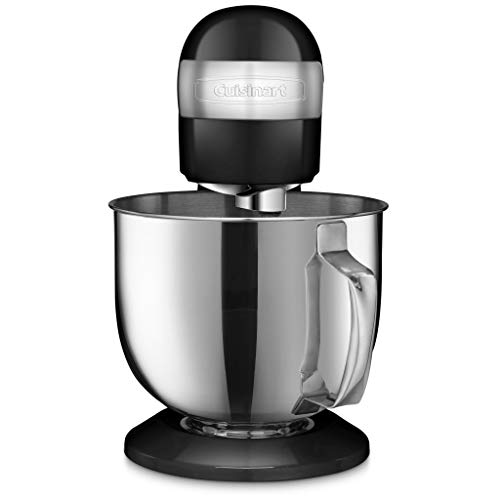
Cuisinart Stand Mixer, 12 Speed, 5.5 Quart, Onyx (SM-50)
Badge: Best Stealth Finish
Strengths
- The identical SM-50 platform — paddle, whisk, hook, twelve speeds, 5.5-quart bowl.
- Onyx is the working finish: flour dust and cocoa smears read as a light dusting, not a disaster.
- All the cookie virtues of the platform leader, in the colour most likely to live happily on a counter.
Trade-offs
- No performance difference from the White Linen model exists to justify buying both.
- The same footprint and storage considerations apply in full.
- A dark finish shows dried dough pale against it — wipe-downs remain part of the routine.
Mini spec box
- Format: stand mixer
- Speeds: 12
- Bowl: 5.5 quart stainless steel
- Attachments named in listing: chef’s whisk, mixing paddle, dough hook
- Features: splash guard with pour spout
- Colour: Onyx
- Model: SM-50BK
We list the Onyx SM-50 separately because the pool does and because finish is a legitimate deciding factor for a machine that lives on a counter — but the cookie assessment is the platform’s assessment, word for word. It creams hands-free, folds at a stir, and portions its power across twelve speeds exactly as the White Linen model does. What Onyx adds is purely practical camouflage: a baking day writes itself across a stand mixer in flour and cocoa, and on black it reads as atmosphere rather than mess, which matters in open-plan kitchens where the mixer is always on display. If the platform is your choice and your kitchen runs dark, this is your finish.
Best for: bakers choosing the SM-50 platform for a dark or open-plan kitchen / Not suited for: anyone expecting a different machine from the other finishes
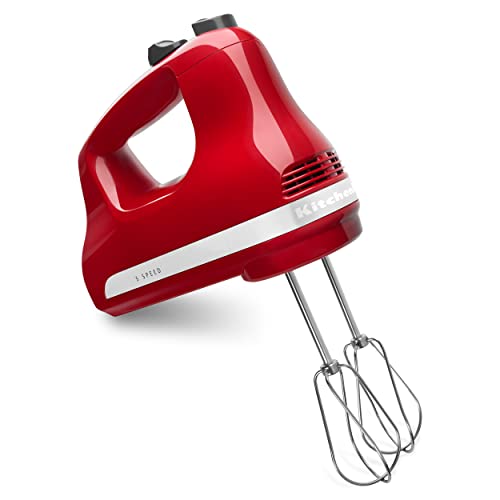
KitchenAid 5 Ultra Power Speed Hand Mixer, Empire Red (KHM512)
Badge: Best Compact Pick
Strengths
- Turbo Beaters are designed to move through thick mixtures without clogging — cookie dough is the thick mixture in question.
- The lockable swivel cord keeps the cable out of a sticky dough and locks to your working side.
- One-button release and dishwasher-safe beaters simplify the stickiest cleanup in baking.
Trade-offs
- Five speeds on a compact motor set a clear ceiling: small batches, softened butter, no heroics.
- No paddle, obviously — the dough must be walked through the bowl by hand movement.
- Empire Red is a commitment of a colour for a drawer tool.
Mini spec box
- Format: electric hand mixer
- Speeds: 5
- Attachments named in listing: Turbo Beaters
- Features: lockable swivel cord, easy-release button, dishwasher-safe beaters
- Colour: Empire Red
The KHM512 is the cookie mixer for the smallest kitchens and the smallest batches — a half-batch of chocolate chip for two, a quick dozen of peanut butter, the test batch of a new recipe you are not ready to commit ingredients to. Its Turbo Beaters earn their name here: plain beaters pack with cookie dough and start pushing it around the bowl in a lump, while the Turbo design keeps the mass moving and mixing. The swivel cord matters more than usual because cookie dough is sticky — a cable dragged through it comes out wearing the recipe.
Respect the ceiling and it is a delight: soften the butter, keep the batch small, add flour gradually, and stop the moment the dough unifies. Ignore the ceiling — a full batch of loaded oatmeal dough, butter from the fridge — and the compact motor will labour audibly. It is the right second mixer for a stand-mixer household, too: the quick tool for the quick batch, while the big machine stays cased.
Best for: small households, half batches and recipe testing in tight kitchens / Not suited for: full or doubled batches, or stiff doughs with cold butter
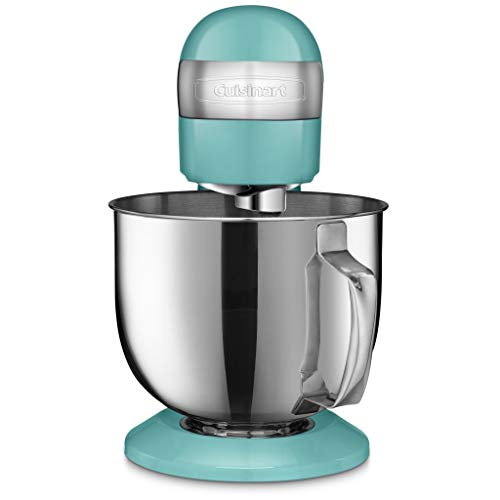
Cuisinart Stand Mixer, 12 Speed, 5.5 Quart, Periwinkle Blue (SM-50)
Badge: Best Colour Pick
Strengths
- The full SM-50 platform: paddle for dough, whisk for the light end, twelve speeds, 5.5-quart bowl.
- A finish with genuine personality — the mixer as the kitchen’s deliberate accent.
- All platform strengths apply: hands-free creaming, stir-speed folding, pour-spout additions.
Trade-offs
- Colour is the only difference from its three siblings; the cookies cannot tell them apart.
- A distinctive finish dates with your décor in a way black and white do not.
- Same footprint, same storage questions as every SM-50.
Mini spec box
- Format: stand mixer
- Speeds: 12
- Bowl: 5.5 quart stainless steel
- Attachments named in listing: chef’s whisk, mixing paddle, dough hook
- Features: splash guard with pour spout
- Colour: Periwinkle Blue
- Model: SM-50TQNAS
Periwinkle Blue is the finish for the baker who wants the machine to be seen — and there is a real argument that a mixer you love looking at is a mixer you bake with more. The cookie mechanics are, for the third time in this guide, the platform’s mechanics: paddle, bowl, twelve speeds, hands-free patience. We repeat the specification in full in each finish’s review because a reader who lands on this section alone deserves the whole picture — but we will not pretend the colour changes a single cookie. Choose it because it makes your kitchen yours; the dough will be equally well made in any of the four.
Best for: bakers who want the SM-50 platform as a deliberate kitchen accent / Not suited for: buyers seeking any performance difference from the other finishes
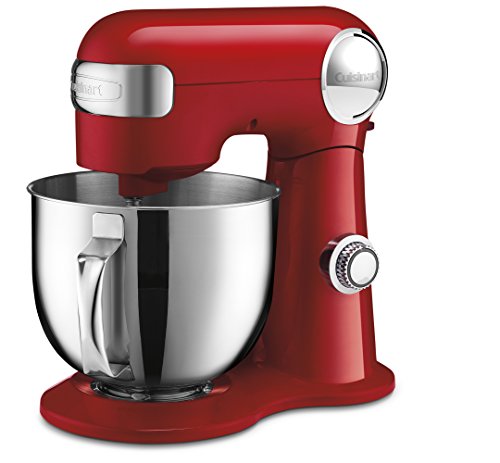
Cuisinart Stand Mixer, 12 Speed, 5.5 Quart, Ruby Red (SM-50)
Badge: Best Statement Finish
Strengths
- The complete SM-50 platform in the boldest finish of the four.
- Paddle-driven, hands-free cookie production identical to the guide leader’s.
- A colour that anchors a kitchen’s whole palette — bakers who choose it, choose it on purpose.
Trade-offs
- Identical mechanics to its siblings; the premium here is purely visual.
- Red shows flour dust brightly — the wipe-down habit is non-negotiable.
- Same stand-mixer footprint and storage trade-offs as the rest of the platform.
Mini spec box
- Format: stand mixer
- Speeds: 12
- Bowl: 5.5 quart stainless steel
- Attachments named in listing: chef’s whisk, mixing paddle, dough hook
- Features: splash guard with pour spout
- Colour: Ruby Red
- Model: SM-50R
Ruby Red closes the platform’s colour range with the same honest paragraph its siblings received: this is the SM-50 — twelve speeds, stainless 5.5-quart bowl, whisk, paddle and dough hook confirmed — in the finish that makes a statement. For cookie dough it creams, folds and finishes exactly as the Best Overall pick does, because it is the Best Overall pick in red. Bakers building a kitchen around a colour, or replacing a beloved red machine of another era, will find the whole platform waiting in this finish. Everyone else should choose among the four by the room the mixer will live in, and then never think about the decision again — the cookies are identical, and they are very good.
Best for: bakers who want the platform’s performance in a bold, deliberate colour / Not suited for: anyone hoping the colour signals a different specification
Comparison Table
| Pick | Format | Speeds | Key tool for dough | Batch guidance | Link |
|---|---|---|---|---|---|
| Cuisinart SM-50, White Linen | Stand | 12 | Mixing paddle | Full batches | Check on Amazon |
| Hamilton Beach 62682G | Hand | 6 + QuickBurst | Traditional beaters | Small batches | Check on Amazon |
| Cuisinart SM-50, Onyx | Stand | 12 | Mixing paddle | Full batches | Check on Amazon |
| KitchenAid KHM512, Empire Red | Hand | 5 | Turbo Beaters | Small and half batches | Check on Amazon |
| Cuisinart SM-50, Periwinkle Blue | Stand | 12 | Mixing paddle | Full batches | Check on Amazon |
| Cuisinart SM-50, Ruby Red | Stand | 12 | Mixing paddle | Full batches | Check on Amazon |
How to Choose the Best Mixers for Cookie Dough: Paddle, Power and Batch Size
Choose by attachment first. Cookie dough is paddle work: the paddle creams without shredding, folds without cutting, and sweeps a stiff mass around a bowl in a way wires cannot. Any stand mixer you consider for cookies should confirm a paddle in its listing, as the SM-50 does. Hand mixers enter the conversation with beaters, which is why their cookie role is honestly smaller — small batches, softened butter, and a baker’s hand supplying the sweeping motion the bowl cannot.
Choose by batch second. A standard home batch — the quantity in most cookbook cookie recipes — is stand-mixer territory and hand-mixer overtime. Half batches and test batches reverse the verdict: the hand mixer is faster to deploy and to wash than the stand mixer is to set up. Know your default batch and buy for it, not for the holiday bake-a-thon you host once a year; renting capacity with a hand mixer for one weekend beats owning a footprint you resent for fifty weeks. And choose by speed character third: cookie work lives at the bottom half of the dial, so a machine whose low speeds are genuinely low — and whose creaming gear can be held patiently — beats a machine advertising a dramatic top speed you will never use on dough. Bakers whose cookies share the counter with frosted projects will find the companion assessment in our Best Mixers For Cookie Dough And Frosting guide, which weighs these same machines by their second job.
How to Mix Cookie Dough Properly, with Any Machine
- Soften the butter until it yields to a pressed finger but is not glossy or melting. This single variable decides more cookie outcomes than any mixer specification.
- Cream butter and sugars at a steady middle speed until paler and fluffy — several minutes in a stand mixer, where you can scrape once halfway; in shorter, attended bursts with a hand mixer.
- Add eggs one at a time, mixing until each just disappears, then the vanilla.
- Add the dry ingredients in two additions at the lowest speed. Mix only until the last flour streak vanishes — then stop, even if the dough looks like it wants ten more seconds. It does not; those seconds are where toughness is made.
- Fold chips, nuts or oats through at the lowest speed for a few seconds, or by hand with a spatula for the heaviest additions.
- Rest and chill the dough as the recipe directs — thirty minutes at minimum transforms portioning and tames spread.
- Portion with a scoop for uniformity, so every cookie bakes on the same schedule, and clean the paddle or beaters promptly; dried cookie dough is a scrubbing event.
Troubleshooting. Problem: cookies spread into lace → the butter was too warm at creaming, or the dough skipped its chill; chill the portioned dough and start cooler next batch. Problem: cookies are tough and bready → the flour stage was overmixed; stop at the vanishing streak and finish by hand. Problem: dry pockets survive mixing (hand mixer) → aim a short burst directly into the pocket, or fold the last pockets in with a spatula rather than running the whole batch longer.
The Science in the Bowl: Creaming, Gluten and Chill
Three quiet mechanisms decide a cookie, and each maps to a mixer behaviour. Creaming is aeration: sugar crystals cutting through butter trap air, and those pockets become the cookie’s lift and fine crumb — which is why creaming deserves minutes at a patient speed and why a machine that can hold that speed hands-free is worth its footprint. Gluten is the enemy you invite at the flour stage: flour plus liquid plus motion develops the network that makes bread chewy and cookies tough, so the flour stage should be the shortest, slowest mixing of the whole recipe. Chill is time doing three jobs at once — firming butter so cookies spread slowly and bake thick, hydrating flour so the dough handles cleanly, and melding flavours so day-two cookies taste deeper than day-one. A mixer cannot chill for you, but the discipline of stopping the machine — at the right moment, without “one last mix” — is a mixer skill, and it is the one this guide most wants to teach.
Cleanup and Storage: The Cookie Dough Tax
Cookie dough is the stickiest substance in the home baking repertoire, and every machine in this guide collects a cleanup tax proportional to its design. The stand mixer’s tax is concentrated: one paddle, one bowl, both large enough to wash without fiddling, and a splash guard that keeps the machine’s head cleaner than the work would suggest. Its storage tax is the footprint, paid daily. The hand mixers invert the deal: no footprint, but beaters whose wires trap dough in their intersections, and a body that must be wiped before it goes back in the drawer or it will glue itself to whatever it touches. The KitchenAid’s dishwasher-safe beaters and one-button release are, in this light, not conveniences but the difference between a thirty-second cleanup and a five-minute one — multiplied by every batch you will ever make.
Two habits cut the tax for everyone. The first is the immediate rinse: dough that has not dried releases under warm water almost politely, while dough left through dinner becomes a soaking-and-scraping project. The second is the flour-dust wipe: stand mixers collect a fine dusting around their hinges and heads over a season of baking, and a monthly wipe keeps the machine moving freely and looking like the appliance you meant to own. Neither habit is glamorous; both are the difference between a mixer that stays in service for a decade and one that quietly becomes unpleasant to use in year three.
Cookie Styles and the Machines They Reward
Drop cookies — chocolate chip, oatmeal, peanut butter — are the paddle’s home crowd and the hand mixers’ small-batch territory. Slice-and-bake doughs, stiff and butter-rich, reward the stand mixer’s steady low-speed power and punish cold butter in a hand mixer more than any other style. Meringue-based cookies abandon the paddle entirely for the whisk — the SM-50’s second attachment takes over, and the hand mixers’ beaters serve in small batches. Sandwich cookies and thumbprints add a frosting or filling stage, which is where a second, smaller machine earns its drawer: the KitchenAid whipping a filling while the stand mixer’s bowl is still chilling dough is a small kitchen ballet that two-machine households perform without thinking. Read your repertoire against this map before you buy, and the right pick usually names itself.
A Note on the Word “Mixer”
The drinks world claims this word too. If your search was actually about glasses rather than dough — the Best Mixers For Crown, the Best Mixers For Crown Apple or the Best Mixers For Craft Cocktails — those are beverage guides. Everything here is about machines and dough, and the only crown in this article is a well-risen cookie’s own — though the bakers who also keep a home bar will find those guides useful on the evenings when the cookies are for the grown-ups.
Doubling, Freezing and Make-Ahead: Where Batch Size Meets Real Life
Cookie dough is the most freezer-friendly mixture in baking, and that fact reorganises the mixer question for many households. A stand-mixer baker can mix a full batch on a quiet afternoon, portion it into scoops, freeze them on a tray, and bake two warm cookies on a Tuesday night with no mixer involved at all — the machine’s capacity is spent once, in advance, at leisure. A hand-mixer baker plays the same game at half-batch scale, freezing smaller lots more often. Both strategies beat the alternative — mixing under time pressure on the day — and both argue for buying the machine that suits your freezer rhythm rather than your most ambitious single day.
Doubling deserves its own warning label, because cookie recipes invite it and mixers answer it differently. A doubled batch in the SM-50’s 5.5-quart bowl is a legitimate workload: cream in the same patient way, add flour in three additions instead of two, and give the paddle an extra scrape-down, because a deeper mass hides dry pockets at the bowl’s base. A doubled batch in a hand mixer is a different proposition — the beaters must be dragged through twice the resistance, the motor’s note will tell you so, and the honest move is two sequential single batches, which also lets you vary the second batch’s additions. Bakers who double weekly are, once again, describing stand-mixer ownership; this guide keeps returning to that sentence because it keeps being true.
The Two-Machine Cookie Kitchen
Households that bake cookies often tend to converge on the same arrangement, and it is worth describing because it reframes what “best” means in this guide. The stand mixer owns production: full batches, holiday volume, the stiff slice-and-bake doughs. The hand mixer owns immediacy: the half batch, the test recipe, the filling whipped while the dough chills, the quick batch mixed in the bowl the cookies will be served from at a friend’s house. Neither machine is the backup for the other; they are specialists whose territories overlap just enough to cover a breakdown.
If that is your future, the purchase order matters. Buy the stand mixer first if full batches are your present reality — it is the capacity everything else hangs from. Buy the hand mixer first if your present reality is small batches in a small kitchen, and let the stand mixer arrive when the baking proves it needs one; the hand mixer loses none of its value when it does. What you should not do is buy a mid-sized compromise hoping it will be both — in cookie dough, the compromise is usually a hand mixer strained at production work or a stand mixer resented for its footprint, and this guide’s six picks are more useful read as two specialists and a colour choice than as a ladder.
Reading a Cookie Dough Listing: The Three Lines That Matter
Listings for mixers run long, but for cookie dough only three lines carry the decision, and learning to find them will serve you beyond this guide. The first line names the attachments: look for the word paddle, in writing, as the SM-50’s listing provides. A machine whose listing offers only beaters and whisks is telling you its dough ambitions are modest, whatever the photographs show it beside. The second line gives the bowl: capacity in quarts for a stand mixer, because cookie dough is mixed in a mass and a small bowl turns a full batch into a flour-management exercise. The third line states the motor — and here the reading skill is distinguishing a plain wattage from a peak-power figure, the former describing a pace the motor can hold through a creaming stage, the latter a moment it can touch. The Hamilton Beach’s plain 250 watts is the honest style of claim; treat vaguer listings with correspondingly vaguer confidence.
Everything else on the page — speed counts beyond a workable low range, colour names, lifestyle photographs — is secondary for this particular job. Cookie dough was being made well before twelve-speed machines existed; what the modern listing adds is not capability so much as information, and the reader who extracts the three lines above has extracted nearly all of it.
Common Buying Mistakes
Mistake one: buying a hand mixer for doubled, loaded doughs and learning about motor strain from the smell. Mistake two: treating the four SM-50 finishes as four different machines and agonising over a performance difference that does not exist. Mistake three: overmixing the flour stage because the machine makes it easy — the paddle’s efficiency means the vanishing-streak moment arrives sooner, not later. Mistake four: creaming with fridge-cold butter and blaming the mixer for a dense, greasy dough. Mistake five: skipping the chill and then shopping for a new mixer to fix a spread problem that was never the mixer’s. Mistake six: letting dough dry on the paddle or beaters, converting the easiest rinse in baking into an archaeological dig. Mistake seven: portioning warm, unchilled dough and blaming the oven for the spread that the skipped chill guaranteed. Mistake eight: shopping by top speed, when every important cookie moment — creaming, folding, finishing — happens in the bottom half of the dial.
Final Recommendation
For cookie dough as a habit, buy the platform: the Cuisinart SM-50 in whichever finish suits your kitchen — White Linen, Onyx, Periwinkle Blue or Ruby Red are the same excellent cookie machine in four colours. For small batches in a small kitchen, the Hamilton Beach 62682G is the hand mixer to own, with the KitchenAid KHM512 as the compact alternative for half batches and test bakes. Choose the format by your batch size, the finish by your eyes, and then attend to the butter temperature — your cookies will credit the mixer, but you will know the truth.
One last word for the baker still torn between the formats: think about your hands. A stand mixer asks nothing of them beyond scraping and portioning, and on a long baking day that mercy is the product. A hand mixer asks for a steady grip and a guiding arm, and returns a closeness to the dough — you feel it tighten, hear the load change — that many bakers genuinely love. Neither answer is the correct one in the abstract; both are correct in a particular kitchen, and this guide’s job was to make yours easy to recognise.
Related guides
Frequently Asked Questions
Is a stand mixer or a hand mixer better for cookie dough?
A stand mixer, for full batches: its paddle folds a stiff dough evenly, its bowl contains the mass, and its hands-free running lets you scrape and portion as you go. A hand mixer makes good cookie dough in small batches with softened butter, and for half batches and test bakes it is often the more practical tool. Batch size, not ideology, decides — and the baker who answers the batch question honestly will be happy with either format, while the baker who answers it aspirationally will be annoyed by both.
Why do four of the six picks look the same?
Because they are the same machine — the Cuisinart SM-50 — in four finishes: White Linen, Onyx, Periwinkle Blue and Ruby Red. Their listings confirm identical speeds, bowl and attachments. This guide reviews each finish honestly as a colour choice on one platform rather than pretending they differ mechanically.
Can a hand mixer really handle cookie dough?
Yes, within limits that this guide states in each review: single or half batches, butter properly softened, flour added gradually, and mixing stopped the moment the dough unifies. The Hamilton Beach’s stated 250 watt motor and QuickBurst suit the work best among the hand mixers here; the KitchenAid’s Turbo Beaters suit smaller, softer batches.
What speed should cookie dough be mixed at?
Cream at a steady middle speed; mix the flour stage at the lowest speed available, and only until the last streak disappears. High speeds at the flour stage develop gluten and toughen cookies, and they fling flour besides. Cookie dough is a low-speed dough from the moment flour enters the bowl.
Why did my cookies come out tough even with a good mixer?
Almost certainly the flour stage ran long, or the butter began too warm and the dough was mixed extra to compensate. Toughness is a technique outcome, not an equipment failure: shorten the flour mixing to the vanishing-streak moment, finish the last folds by hand, and chill the dough before portioning.
How long should I cream butter and sugar for cookies?
Longer than most bakers do: several minutes at a steady middle speed, until the mixture has visibly paled and turned fluffy. Under-creamed butter and sugar is the quiet cause of dense, greasy cookies that no later stage can fix. In a stand mixer the time costs you nothing — the machine works while you prepare the dry ingredients — which is one of the format’s real, if unglamorous, advantages for this job.
Can I freeze cookie dough made in these mixers?
Yes — dough from any pick here freezes beautifully. Portion it into scoops or a sliceable log, freeze solid on a tray, then bag. Bake from frozen with a small time allowance, or thaw slice-and-bake logs just enough to cut. Freezing is also the hand-mixer baker’s equaliser: small batches made often, frozen in portions, supply cookies on demand without ever asking the machine for a production batch.
Should I use the paddle or the whisk for cookie dough?
The paddle, always, for the dough itself — it is the attachment shaped for creaming and folding stiff mixtures, and it is the one the SM-50’s listing confirms for this work. The whisk is for the repertoire’s light end: meringues, whipped creams and fillings that accompany cookies rather than compose them.


