Disclosure: topratedkitchenware.com is reader-supported. When you buy through links on our site, we may earn an affiliate commission from Amazon and other retailers, at no extra cost to you.
Where to buy
The six picks below are the verified mixers for this guide to the best mixers for making pizza dough, and the framing is honest from the first line: every verified pick in this pool is a hand mixer. That shapes the whole guide. A good hand mixer genuinely can mix and lightly knead small batches of pizza dough — one or two pizzas at a time — and for many home cooks that is the batch that matters. What a hand mixer cannot honestly promise is stand-mixer work: large, stiff, low-hydration doughs kneaded for ten hands-free minutes. Each review below judges its machine on the pizza-dough work it can really do, including where its limit sits. Each name links to its Amazon listing, where you can check the latest price on Amazon before you order.
- Hamilton Beach 6-Speed Electric Hand Mixer, White
- KitchenAid 5-Speed Ultra Power Hand Mixer, Empire Red
- LILPARTNER Hand Mixer Electric, 7-Speed, Light Pink
- KitchenAid 5-Speed Ultra Power Hand Mixer, Contour Silver
- Cuisinart Power Advantage Plus 9-Speed Hand Mixer, White
- WEPSEN 5-Speed Electric Hand Mixer with Mixing Bowls Set
Read the full guide ↓ for how each mixer handles flour, water, and yeast in practice, and for the technique that lets a hand mixer succeed at dough instead of stalling in it.
Choosing the best mixers for making pizza dough with a hand mixer is really about matching ambition to batch size. Pizza dough is the most demanding common job a hand mixer faces: flour hydrates into a sticky mass, gluten develops into elastic resistance, and the motor feels every second of it. Yet the job is also forgiving in one specific way — pizza dough does not need all of its kneading from a machine. A hand mixer that brings the dough together cleanly, develops it partway, and hands over to a short rest or a few minutes of hand kneading has done honest, useful work, and the pizza will not know the difference.
So this guide evaluates six hand mixers on dough-relevant grounds: low-speed torque and control for the shaggy first minute, speed range for moving from combining to kneading, attachments that cope with a thickening mass, and the storage and cleanup details that decide whether the machine gets used on pizza night or left in the cupboard. If your household makes dough for a crowd every week, read the limits sections carefully — they will tell you when to scale the recipe down rather than push the machine. The same match-the-tool thinking applies across the mixer family, from the cosmetics bench to the drink station covered by Best Mixers For Malibu Rum; dough simply makes the stakes easiest to taste.
Key Takeaways
- All six verified picks are hand mixers, and all six suit small pizza-dough batches — roughly one to two pizzas — rather than bakery-scale dough.
- Technique matters as much as the motor: start slow, let the flour hydrate, and rest the dough instead of forcing a full knead.
- More speeds help dough work because the job changes character minute by minute, from splashy combining to resistant kneading.
- The Hamilton Beach’s stated 250-watt motor and QuickBurst, and the Cuisinart’s nine speeds with SmoothStart, are the most dough-specific features in the pool.
- Keep hydration moderate and batches small, and a hand mixer produces pizza dough that bakes indistinguishably from stand-mixer dough.
- For frequent large or stiff doughs, no hand mixer is the right long-term answer — scale the recipe to the tool you own.
In this guide
Quick Picks
Badges separate the six hand mixers by the dough job each does best, and the same badges appear in the detailed reviews.
| Pick | Badge | Best for | Link |
|---|---|---|---|
| Hamilton Beach 6-Speed Hand Mixer, White | Best Overall | Small dough batches with a stated 250-watt motor | Check on Amazon |
| Cuisinart Power Advantage Plus 9-Speed Hand Mixer | Best Control | Nine speeds and SmoothStart for splash-free starts | Check on Amazon |
| KitchenAid 5-Speed Hand Mixer, Empire Red | Best for Beginners | Simple, forgiving first doughs | Check on Amazon |
| LILPARTNER 7-Speed Hand Mixer, Light Pink | Most Versatile | Five stainless accessories for dough and beyond | Check on Amazon |
| WEPSEN 5-Speed Hand Mixer Bowls Set | Best Complete Kit | New bakers who also need bowls and measures | Check on Amazon |
| KitchenAid 5-Speed Hand Mixer, Contour Silver | Best Second Mixer | A drawer-friendly backup in a neutral finish | Check on Amazon |
How These Picks Were Chosen
This guide is research-led and makes no claim of hands-on testing that did not happen. The six picks come from the verified pool for the mixers group, with each product’s speeds, attachments, and stated features confirmed against its listing data before inclusion. Where a specification appears in this guide — a speed count, a stated motor wattage, an included case or bowl set — it comes from that verified data and nowhere else. Prices and ratings are not asserted anywhere in the guide, because they change and because neither one tells you whether a mixer stalls in dough.
Selection weighted dough-specific factors. First, low-speed behaviour: dough begins as loose flour and water that a violent start throws across the kitchen, so gentle starts and fine low-end control ranked highly. Second, sustained mid-range strength, because minutes two through five of dough mixing are a steady pull, not a sprint. Third, attachments and accessories as listed — beaters that clear a bowl, accessory sets that add options, a storage case that keeps everything findable on pizza night. Fourth, the honest ceiling: every pick was assessed for the batch size at which a sensible cook should stop, rest the dough, or split the recipe, and those ceilings are stated in the reviews rather than hidden.
One scope note deserves emphasis. A stand mixer with a dough hook remains the conventional recommendation for pizza dough at scale, and nothing in this guide pretends otherwise. This pool is a hand-mixer pool, so the guide answers the question those machines can honestly answer: which hand mixer, used with which technique, makes the best small-batch pizza dough? Cooks who already know they need stand-mixer capacity should treat this guide as a second-mixer reference instead.
The 6 Best Mixers for Making Pizza Dough
Each review states what the machine is, where it is strong with dough, where its honest limit sits, and who should choose it. Work through them with your typical batch size in mind.

Hamilton Beach 6-Speed Electric Hand Mixer, White (62682G)
Badge: Best Overall
Strengths
- The listing states a 250-watt motor — the only explicit wattage in this pool — with a QuickBurst feature for short pushes of extra power.
- Six speeds span the dough sequence from gentle combining to steady kneading pace.
- The bowl rest and snap-on storage case make mid-recipe pauses and pizza-night setup tidy.
Trade-offs
- It ships with traditional beaters; dough work relies on beater technique rather than a dedicated dough hook.
- QuickBurst is for seconds, not minutes — it will not turn a stiff dough into an easy one.
- Like all hand mixers, it asks your arm to hold position against a resistant dough.
Mini spec box: Type: hand mixer · Speeds: 6, plus QuickBurst · Motor: 250 watts (as stated in the listing title) · Attachments: traditional beaters · Extras: bowl rest, snap-on storage case · Colour: White · Model: 62682G
The Hamilton Beach earns Best Overall for pizza dough because it is the only pick whose listing puts a number on the motor, and dough is the job where that number stops being marketing and starts being information. In practice, work it like this: combine flour, water, yeast, and salt at the lowest speed until no dry flour remains, rest the shaggy mass for ten minutes while the flour hydrates, then mix at a low-middle speed in short stretches, letting the beaters pull the dough into a smoother, elastic ball. The bowl rest is genuinely useful mid-recipe — set the mixer on the bowl’s edge while you oil a proofing bowl or flour the counter, and the beaters drip into the dough instead of onto your work surface.
The honest ceiling is batch size and stiffness. A dough built on roughly two to three cups of flour at moderate hydration is this machine’s comfortable country. Push toward a double batch or a stiff, low-hydration dough and you will feel the beaters labour and the dough climb; the correct responses are to split the batch, add a rest, or finish by hand — not to hold QuickBurst and hope. Treated within its limits, it produces dough that proofs and bakes exactly as pizza dough should, and its snap-on case means the whole kit is one grab from the cupboard when pizza night is declared.
Best for: households making one or two pizzas at a time / Not suited for: double batches or very stiff doughs

Cuisinart Power Advantage Plus 9-Speed Hand Mixer, White (HM-90S)
Badge: Best Control
Strengths
- Nine speeds give the finest control steps in this pool, from a crawl for first combining to a brisk finish.
- SmoothStart is designed to prevent splattering — exactly the failure mode of flour meeting water at speed.
- A snap-on storage case keeps the mixer and its beater together between uses.
Trade-offs
- Control is not torque: nine speeds do not raise the hand-mixer ceiling for large, stiff doughs.
- More speed steps mean more dial to manage with floury hands.
- The listing frames it as a cake and hand mixer first; dough success still depends on your technique.
Mini spec box: Type: hand mixer · Speeds: 9 · Feature: SmoothStart anti-splatter start · Attachments: beater (as listed) · Extras: snap-on storage case · Colour: White · Model: HM-90S
If dough with a hand mixer fails, it usually fails in the first thirty seconds: the beaters hit loose flour at full enthusiasm and the kitchen wears the recipe. The Cuisinart’s SmoothStart attacks precisely that moment, ramping up gently so flour and water meet as a paste instead of a cloud. From there, nine speeds let you walk the dough through its stages with unusual precision — a touch more pace as it comes together, a touch less as it begins to resist and climb the beaters. For a cook who makes dough often and values a calm, controlled process over raw push, this is the most refined tool in the pool.
Its limitation is the category’s limitation, and the nine speeds can disguise it: fine control helps you feel the dough’s resistance earlier, but it does not remove the resistance. Keep batches in the same small range as the Hamilton Beach, use rests generously, and let this mixer’s real talent — smooth transitions — carry the combining and early kneading. The snap-on case completes a pizza-night-friendly package: everything in one case, out of the cupboard in one motion, back in one motion, with no beater hunt through the utensil drawer while the oven heats.
Best for: frequent dough makers who value a controlled, splash-free start / Not suited for: cooks expecting stand-mixer capacity from a hand mixer
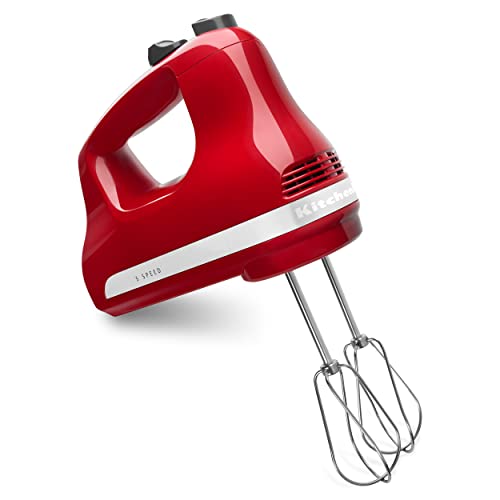
KitchenAid 5 Ultra Power Speed Hand Mixer, Empire Red (KHM512)
Badge: Best for Beginners
Strengths
- Five speeds keep the control scheme simple while learning dough stages.
- Turbo Beaters are designed for efficient mixing with less build-up on the beaters.
- The lockable swivel cord and easy-release, dishwasher-safe beaters make cleanup after sticky dough straightforward.
Trade-offs
- Five speeds mean wider steps; the jump between settings is more noticeable in the delicate first minute.
- No dough hook is listed, so kneading is beater work plus rests and hand finishing.
- Sticky dough will still climb and cling more than it would on a stand mixer’s hook.
Mini spec box: Type: hand mixer · Speeds: 5 · Attachments: Turbo Beaters · Features: lockable swivel cord, easy-release button, dishwasher-safe beaters · Colour: Empire Red · Model: KHM512
Beginners do not need the most features; they need the fewest ways to go wrong, and this KitchenAid’s simplicity is its dough virtue. Five speeds map cleanly onto the beginner’s script: lowest to combine, second to bring the dough together, middle in short stretches to develop it, then stop, rest, and finish with a few folds by hand on a floured counter. The Turbo Beaters shed sticky dough better than plain beaters tend to, which matters because a beginner’s dough is often slightly under- or over-hydrated and clings accordingly. When it does cling, the easy-release button drops the beaters into the sink without a wrestling match, and they go in the dishwasher while the dough proofs.
Expect to finish kneading by hand, and understand that this is not a failure of the mixer or the cook — it is the normal hand-mixer method, and many experienced bakers prefer the feel of the final minute anyway. What this machine gives a beginner is a reliable, unintimidating way to get dough started and mostly developed, in a size that stores in a drawer. Pair it with a forgiving, moderately hydrated recipe for your first pizzas, and graduate to firmer doughs only as your rests-and-folds technique settles in. The same forgiving logic is why simple tools win in other corners of the guide cluster, from Best Mixers For Malibu Coconut Rum pours to weeknight dough.
Best for: first-time dough makers and small households / Not suited for: bakers who want to knead entirely by machine

LILPARTNER Hand Mixer Electric, 7-Speed, Light Pink
Badge: Most Versatile
Strengths
- Seven speeds give fine-grained control through dough’s changing resistance.
- Five stainless steel accessories are included, and the listing explicitly names whipping dough among its jobs.
- Accessories are dishwasher safe, simplifying cleanup after sticky dough work.
Trade-offs
- The listing’s dough framing sits alongside cream and cake; it remains a hand mixer with a hand mixer’s ceiling.
- Five accessories mean more parts to wash and store after every session.
- Accessory variety helps only if you match the right end to the dough stage.
Mini spec box: Type: hand mixer · Speeds: 7 · Accessories: 5 stainless steel accessories · Care: dishwasher-safe accessories · Colour: Light Pink
The LILPARTNER is the pool’s generalist, and dough is one stop on its tour. Seven speeds let you creep up on a hydrating dough rather than lurching between settings, and five stainless accessories mean you can choose a working end suited to the moment — beaters to combine, and the broader set for the mixing and whipping jobs around pizza night, from sauce-adjacent prep to whipped toppings for dessert. Stainless accessories also tolerate the hot, soapy soak that dried dough residue demands, and they go in the dishwasher when the soaking is done.
Judge it as a versatile hand mixer, not a dough specialist. Its dough ceiling matches the group’s: small batches, moderate hydration, rests built into the method. Within that ceiling it is arguably the most adaptable pick here, because the same machine that starts your dough also handles the rest of the meal’s mixing without a second appliance. If your kitchen makes pizza as part of a varied cooking life rather than as a single-minded pursuit, that adaptability is worth more than a marginal difference in any one job. Keep the accessories together in one container from day one; a five-piece set scattered across three drawers is a one-piece set in practice.
Best for: varied home cooks who want one mixer for dough and everything else / Not suited for: single-purpose dough specialists

WEPSEN 5-Speed Electric Hand Mixer with 4 Large Mixing Bowls Set
Badge: Best Complete Kit
Strengths
- The bundle includes four large stainless steel nesting bowls, measuring cups, and spoons — the supporting cast dough making requires.
- Five speeds cover combining through early kneading for small batches.
- Nesting bowls store compactly, suiting small kitchens.
Trade-offs
- The mixer itself is a 5-speed hand mixer; the kit’s breadth does not raise its dough ceiling.
- Bowl suitability for dough depends on working in the largest bowl and keeping batches small.
- More pieces mean a bigger wash-up after pizza night.
Mini spec box: Type: hand mixer with bowls set · Speeds: 5 · Included: hand mixer with whisks/beater, 4 large stainless steel nesting bowls, measuring cups and spoons
New dough makers often own a mixer before they own the bowls dough needs: a wide bowl for mixing, a clean bowl for proofing, a small bowl for toppings. The WEPSEN bundle closes that gap in one purchase. Mix in the largest stainless bowl, where the beaters have room to pull the dough around, then transfer to a second, lightly oiled bowl for the rise — the classic two-bowl rhythm — while the measuring cups handle flour and water with repeatable accuracy, which is how a recipe becomes your recipe instead of a new experiment each week.
The mixer itself should be judged plainly: five speeds, hand-mixer strength, hand-mixer limits. It will combine and develop a small dough with the rest-and-fold method used throughout this guide, and it will not enjoy a stiff double batch. Buy this set for the system, not for extra power — the bowls, measures, and mixer as a coordinated starter kit for a kitchen that currently has none of them. Established bakers with bowls they love should look to the Hamilton Beach or Cuisinart instead and spend nothing on duplicates.
Best for: new bakers equipping a kitchen from scratch / Not suited for: bakers who already own good bowls and want maximum dough focus

KitchenAid 5 Ultra Power Speed Hand Mixer, Contour Silver (KHM512)
Badge: Best Second Mixer
Strengths
- The same verified 5-speed Turbo Beater platform as the Empire Red model, in a neutral silver finish.
- Drawer-sized and quick to deploy for a single-pizza dough on a weeknight.
- Dishwasher-safe beaters and an easy-release button keep the dough-to-dinner cleanup short.
Trade-offs
- No functional difference from the Empire Red colourway; the choice is finish and availability.
- Shares the model’s beater-only kneading and small-batch ceiling.
- As a second mixer, it duplicates rather than extends a kitchen that already owns the red one.
Mini spec box: Type: hand mixer · Speeds: 5 · Attachments: Turbo Beaters · Features: lockable swivel cord, easy-release button, dishwasher-safe beaters · Colour: Contour Silver · Model: KHM512
Many dough-capable kitchens are two-mixer kitchens: a main machine for weekend batches and a light hand mixer that lives in a drawer for the single weeknight pizza. The Contour Silver KHM512 is cast for that supporting role. It is quick out, quick through a small dough — combine low, develop briefly, rest, fold — and quick away, with the beaters in the dishwasher before the dough has finished proofing. The swivel cord locks to the side away from your bowl, a small mercy when the counter also holds a scale, a flour bin, and a topping station.
There is no reason to own both colourways of this mixer for dough alone; choose this one if silver matches your kitchen or if it is the finish available when you buy, and expect exactly the performance described for the red model. Its presence in the guide reflects a real buying pattern — a dependable, undemanding second machine — rather than a sixth distinct dough philosophy. If it will be your only mixer, the same verdict holds with one adjustment: learn the rest-and-fold method from the start, because with any 5-speed hand mixer, technique is half the kneading.
Best for: a drawer-friendly second mixer or a silver-kitchen main mixer / Not suited for: buyers seeking a step up from the Empire Red model
Comparison Table
| Pick | Speeds | Dough-relevant features | Badge | Link |
|---|---|---|---|---|
| Hamilton Beach Hand Mixer, White | 6 + QuickBurst | 250-watt motor (stated); bowl rest; snap-on case | Best Overall | Check on Amazon |
| Cuisinart Power Advantage Plus, White | 9 | SmoothStart anti-splatter; snap-on case | Best Control | Check on Amazon |
| KitchenAid Hand Mixer, Empire Red | 5 | Turbo Beaters; swivel cord; dishwasher-safe beaters | Best for Beginners | Check on Amazon |
| LILPARTNER Hand Mixer, Light Pink | 7 | 5 stainless accessories; dough named in listing | Most Versatile | Check on Amazon |
| WEPSEN Hand Mixer Bowls Set | 5 | 4 nesting bowls, measuring cups and spoons included | Best Complete Kit | Check on Amazon |
| KitchenAid Hand Mixer, Contour Silver | 5 | Turbo Beaters; swivel cord; dishwasher-safe beaters | Best Second Mixer | Check on Amazon |
How to Choose a Hand Mixer for Pizza Dough
Begin with your real batch. Count the pizzas you make on a normal night and the flour your recipe uses for them. If the answer is one or two pizzas from a few cups of flour, every pick in this guide can serve you with the right technique, and you should choose on control, cleanup, and storage. If the answer is four pizzas every Friday, be honest that you are shopping in the wrong category and need a stand mixer’s capacity — no badge in this guide changes that arithmetic, and the kindest advice a buying guide can give is to say so before you spend.
Within the hand-mixer field, prioritise the first minute and the fifth minute. The first minute rewards gentle starts and fine low speeds — the Cuisinart’s SmoothStart and nine steps, the LILPARTNER’s seven — because flour containment is a control problem. The fifth minute rewards steady, sustainable pace and beaters that shed dough — the KitchenAid Turbo Beaters, the Hamilton Beach’s stated wattage and QuickBurst for brief pushes. Then weigh the ownership details: a snap-on case if your storage is a cupboard jumble, dishwasher-safe beaters if pizza night is a weeknight, a bowl set if your kitchen lacks the basics. Finally, budget your learning alongside your money: whichever machine you choose, your first doughs should be small, moderately hydrated, and rested often, because the method in the next section is worth more than any single feature. Cooks who plan menus across the cluster will recognise the pattern from Best Mixers For Margaritas — the right choice is the one matched to the serve you actually make.
How to Make Pizza Dough with a Hand Mixer, Step by Step
Work in a wide, sturdy bowl — the largest WEPSEN bowl, or your widest mixing bowl — and keep the batch small. Combine most of the flour with the water, yeast, and salt, holding a little flour back. Mix at the lowest speed until the mass is uniformly shaggy and no dry flour remains; this should take about a minute, and SmoothStart or a gentle first speed keeps the flour in the bowl. Now stop. Cover the bowl and rest the dough for ten to twenty minutes. This rest — bakers call it an autolyse-style pause — lets the flour hydrate and gluten begin forming on its own, doing work your motor would otherwise have to do.
After the rest, mix at a low-middle speed in stretches of about a minute, resting a minute between stretches, adding the held-back flour gradually if the dough is very sticky. Watch the dough, not the clock: it is ready for the next stage when it pulls together into a smoother, elastic mass that stretches without immediately tearing. Tip it onto a lightly floured counter and finish with a minute or two of hand kneading and a few stretch-and-folds, then place it in a clean, lightly oiled bowl, cover, and proof as your recipe directs. Total motor time stays modest, which is precisely why the method suits hand mixers.
Troubleshooting, in the pattern worth remembering:
- Problem: the dough climbs the beaters and stalls → it is too dry or the batch is too big; stop, rest it, add a spoon of water if the recipe allows, and finish by hand rather than forcing the motor.
- Problem: the dough stays sticky and smears around the bowl → it needs hydration time or a little more flour; rest it ten minutes, then mix again briefly, adding flour a spoon at a time.
- Problem: flour erupts at the start → the speed was too high for loose flour; start at the lowest setting, tilt the bowl slightly, and bring the beaters up through the mixture gradually.
Hydration, Flour, and Rest: The Three Levers That Decide Success
Hydration — the water weight relative to the flour — is the lever that most decides whether a hand mixer copes. Wetter doughs mix more easily but stay stickier and demand the rest-and-fold method; drier doughs feel tidier but resist the beaters and climb. For hand-mixer dough, aim for the middle of the range your recipe tradition uses, and adjust in small spoonfuls rather than pours. Flour choice matters at the margins: finer, softer flours hydrate faster and feel gentler on the motor in the first minute, while coarser, thirstier flours reward a longer initial rest. Neither requires a different mixer; both reward patience.
Rest is the third lever and the cheapest. A ten-minute pause after combining does more for gluten development than several extra minutes of motor time, and it does it without heat, noise, or wear. Build rests into your pizza-night timeline — combine the dough before you prepare toppings, and the dough will be developing while you chop. By the time the oven is hot, a hand-mixer dough made this way will stretch, proof, and blister like any other, which is the only verdict that counts at the table. The same respect for process over power runs through the wider cluster, whether the project is dough or the pours in Best Mixers For Masking Vodka Taste.
Proofing, Shaping, and Baking: What Happens After the Mixer Stops
A hand mixer only owns the first act of pizza making, and judging dough at the bowl stage misleads beginners. Straight from mixing, good dough looks merely smooth and elastic; its quality declares itself later. Proof it covered, in the lightly oiled second bowl, until it has visibly risen and springs back slowly when pressed with a floured finger, leaving a shallow dent. Under-proofed dough fights shaping and bakes up dense; over-proofed dough shapes easily but can collapse and taste flat. Neither fault belongs to the mixer — both belong to timing and temperature, which is why this guide keeps returning responsibility to method.
Shaping rewards the same gentleness as mixing. Turn the proofed dough onto a lightly floured surface, press from the centre outward to keep a puffy rim, and stretch by hand rather than rolling, which crushes the very air the proof created. If the dough snaps back stubbornly, rest it, covered, for ten minutes and return — gluten relaxes on its own schedule, and forcing it tears the surface. Top lightly: a wet, heavy topping load will sog any crust, whatever mixed the dough. Bake on the hottest, most thoroughly preheated surface your oven offers, a stone, steel, or heavy inverted tray, so the base sets before the top dries. When the crust is blistered at the rim and firm underneath, the hand-mixer method has delivered everything it promised.
Keep notes across your first several bakes: flour amount, water amount, mixing stretches, rest lengths, proof time, and the result in plain words. Dough making is a feedback loop, and the note from last week is the adjustment for this week. Within a month, most cooks find their dough becomes consistent — and consistency, not equipment, is what separates pizza night from pizza roulette.
Pizza Night Workflow: Organising the Kitchen Around a Small Mixer
Because a hand mixer asks for rests and short stretches rather than one long knead, pizza night organises itself naturally into parallel tracks. Start the dough first: combine, rest, develop, and set it to proof. While it proofs, prepare toppings, grate cheese, and put the oven on to preheat with its stone or tray inside — the oven needs longer than your impatience suggests, and the dough’s proof conveniently covers the wait. The mixer’s snap-on case or drawer spot matters here: a machine that comes out in one motion and goes away in one motion keeps a small counter clear for shaping, which is the stage that actually needs the space.
For two-pizza nights, stagger rather than double. Shape and bake the first pizza while the second portion of dough rests portioned and covered; the brief extra rest harms nothing and the workflow stays calm. For guests, consider making the dough earlier in the day and letting it proof slowly in a cool spot or the refrigerator, bringing it back to room temperature before shaping — a slower proof develops flavour that no mixer, at any price in any category, can manufacture in an hour. Dessert and drinks can share the same small-mixer logic, as the cluster’s other guides show, from whipped toppings to the pours in Best Mixers For Mango Rum night-cap planning — one modest machine, many calm evenings.
Finally, clean as you go, in the literal minute the dough starts proofing. Rinse the beaters before residue dries, wipe the bowl, and put the mixer away while the oven does its work. The bakers who keep making pizza weekly are not the ones with the strongest motors; they are the ones whose process — mixing, resting, cleaning, noting — stays light enough to repeat without dread.
Scaling a Recipe Down (and Knowing When Not To)
Most published pizza recipes are written for stand mixers and family volumes, so the hand-mixer cook’s core skill is scaling. Halving a recipe is straightforward arithmetic for flour, water, yeast, and salt, and a half batch of a four-pizza recipe lands exactly in the comfort zone of every mixer in this guide. Two cautions apply. First, scale by weight where you can: a scale makes halving precise, and dough forgives small errors in everything except wild swings in water. Second, watch the yeast when you change timelines as well as quantities — a scaled-down batch left for a long, slow proof may need no less yeast patience, just the same schedule watched more closely.
There is also a legitimate point where scaling down stops being the answer. If pizza night regularly means a crowd, if you want to bake for neighbours or a freezer stock of par-baked bases, the honest purchase is capacity, not another hand mixer. Nothing in this guide will pretend a 5-speed drawer machine is a bakery. Buy the hand mixer for the life you live weekly; let the occasional feast borrow a second batch, a friend’s machine, or a good bakery’s dough without guilt.
Storing Dough and Planning the Week Around One Small Mixer
Dough’s flexibility is the hand-mixer owner’s best friend. A batch mixed on a quiet afternoon can proof slowly in the refrigerator and bake a day or two later, which spreads the work across the week instead of concentrating it on Friday night. Portion the dough after its first rise, coat each ball lightly with oil, and store them covered and separated so they do not merge into one mass. Bring a portion back to room temperature before shaping; cold dough snaps back and tears, while rested dough stretches willingly.
Freezing works too, and it converts one mixing session into several future pizzas. Freeze portioned balls after the first rise, thaw them in the refrigerator overnight, then rest at room temperature before shaping. The texture after freezing is very slightly less lively than fresh dough, a difference most home eaters will not detect under sauce and cheese. Keep a simple rotation: label each portion with its mixing date using tape, use the oldest first, and let the freezer — not a bigger mixer — absorb the peaks in your pizza demand.
Common Buying Mistakes
- Buying a hand mixer for stand-mixer batches. The category error, not the brand, is what disappoints; size the recipe to the tool or change the tool.
- Kneading nonstop at high speed. Heat, climbing dough, and a strained motor follow; short stretches and rests develop better dough.
- Skipping the hydration rest. Ten covered minutes do free gluten work that no wattage in this pool can match.
- Judging by top speed. Dough lives at the low and middle settings; a gentle, controllable start beats a dramatic maximum.
- Ignoring cleanup. Dried dough on beaters is concrete; rinse or soak attachments immediately and pizza night stays pleasant.
Final Recommendation
For most small-batch pizza makers, start with the Hamilton Beach 6-Speed hand mixer: its stated 250-watt motor, QuickBurst, and bowl rest make it the most dough-ready all-rounder in the pool. If a calm, splash-free start matters most, choose the Cuisinart Power Advantage Plus 9-Speed and let SmoothStart and fine control carry your first minute. Beginners and second-mixer shoppers are well served by either KitchenAid KHM512 colourway, while the LILPARTNER suits generalists and the WEPSEN set suits anyone equipping a kitchen from scratch. Keep batches small, rest the dough, and any of the six will put real pizza on the table.
Frequently Asked Questions
Can a hand mixer really knead pizza dough?
It can mix and substantially develop small batches, especially with rests built in. The reliable method is to combine at low speed, rest the dough so hydration and gluten formation do part of the work, mix in short stretches, and finish with brief hand kneading. Large or stiff doughs exceed what a hand mixer should be asked to do.
How much pizza dough can a hand mixer handle at once?
As a working guide, a batch built on roughly two to three cups of flour — enough for one or two pizzas — at moderate hydration is the comfortable range for the mixers in this guide. If your recipe is larger, split it into two batches rather than doubling in one bowl.
What speed should I use for pizza dough?
Use the lowest speed to combine until no dry flour remains, then a low-middle speed in short stretches to develop the dough. High speeds throw flour at the start and overheat and strain the motor later; dough rewards the gentle end of the dial.
Why does my dough climb up the beaters?
Climbing usually means the dough is dry, stiff, or the batch is large for the bowl. Stop, rest the dough, and finish by hand on a floured counter. A spoon of water can help if your recipe’s hydration allows it, and a wider bowl gives the dough somewhere to go besides up.
Do I need a dough hook attachment for pizza dough?
It helps on a stand mixer, but none of the verified picks in this pool is listed with one, and the rest-and-fold method in this guide is designed around beaters. If entirely machine-kneaded dough is your priority at larger sizes, that requirement points to a stand mixer rather than to any hand mixer here.
Can I make dough ahead of time with a hand mixer?
Yes, and the method suits hand mixers well. Mix and develop the dough as described in this guide, let it complete its first rise, then portion it and refrigerate it for a slow second proof, or freeze portions for later weeks. Bring refrigerated dough back to room temperature before shaping so it stretches instead of snapping back. Making dough ahead separates the mixing work from the baking evening entirely, which is the easiest way to keep a small mixer at the centre of a regular pizza habit. It also improves the crust: a slow, cold proof develops flavour and a more open texture that fast same-day dough rarely matches, so the make-ahead habit is a quality upgrade as well as a scheduling one.
How do I clean beaters after dough?
Soak or rinse them immediately — dried dough hardens quickly — then wash in hot soapy water or the dishwasher where the listing says the beaters are dishwasher safe. Pick off any residue in the beater joints before it dries, and dry the attachments fully before storing them in their case.
For neighbouring projects on the same counter, see Best Mixers For Mezcal and the other cluster guides linked throughout this article.


