Disclosure: topratedkitchenware.com is reader-supported. When you buy through links on our site, we may earn an affiliate commission from Amazon and other retailers, at no extra cost to you.
Where to buy
Hunting for the best narrow measuring spoons that actually fit inside your spice jars? The six sets below are this guide’s recommendations, in review order. Each name links to its Amazon listing, where you can check the latest price on Amazon and confirm the design details.
- Rena Chris 6-Piece Heavy Duty Stainless Steel Measuring Spoons Set — Check on Amazon
- Spring Chef Stainless Steel Magnetic Measuring Spoons Set of 8, Black
- TILUCK Stainless Steel Measuring Cups and Spoons Set of 10
- TILUCK Stainless Steel Measuring Cups and Spoons Set of 6 with Coffee Scoop
- THLHKD 6-Piece Stainless Steel Measuring Spoons Set
- Spring Chef Nesting Stainless Steel Measuring Spoons Set of 7 with Leveler
Read the full guide ↓ to see which sets state a jar-fitting or slim design in their own listings, which earn their place on compactness and storage, and where the honest limits of each set sit.
Every cook knows the moment: the recipe needs a teaspoon of cumin, the cumin lives in a standard spice jar, and the round spoon in your hand is a fraction too wide to enter it. So the spice gets shaken, guessed, or spilled across the counter, and the recipe quietly becomes approximate. The best narrow measuring spoons exist to end that moment. A narrow spoon is defined by its head: slim, rectangular, or small-profile bowls that pass through jar mouths and narrow canisters, on handles long enough to reach the bottom. This guide compares six stainless steel sets through that lens, and it is strict about evidence. Sets whose listings state a jar-fitting, rectangular, or small-tablespoon design are credited with it directly. Sets whose listings make no narrow claim are still reviewed, because they are strong measuring sets that many readers will compare, but their reviews say plainly that the narrow property is not stated, so you can weigh a proven slim design against a general set with open eyes. If jar access is your whole reason for shopping, the final set in this guide is the one built for it; if you need narrow spoons as part of a bigger measuring system, the kits here cover that too. The guide closes with a five-minute audit you can run on your own containers before and after buying, because in this category the right answer depends on your jars more than on any specification sheet, and an honest fit test beats a confident guess every single time.
Key Takeaways
- Narrow is a head-shape property: rectangular and slim profiles enter spice jars and narrow containers that stop round spoons at the mouth.
- One set here states the full narrow package in its listing: rectangular heads, fits in spice jars, and a long handle for deep containers.
- Dual-sided spoons give each spoon two profiles, which helps when one end must reach into a container and the other must level cleanly.
- A small-tablespoon design is a compact everyday profile for cooks whose measuring happens in small jars and canisters.
- Not every good set is a narrow set: two kits here are reviewed for completeness, with their standard profiles stated honestly as a trade-off.
- Measure your jar mouths before buying if you can; the narrowest spoon only helps if it clears the jars you actually own.
- Keep the narrow set where the spices live: a jar-fit spoon stored across the kitchen will be skipped, and the shaking habit it was bought to end will quietly return within a week.
- Leveling at the jar mouth, so the excess falls back into the jar, is the technique that makes narrow measuring both tidier and more accurate than leveling over the bowl.
In this guide
Quick Picks
| Pick | Badge | Set size | Profile evidence from the listing | Link |
|---|---|---|---|---|
| Rena Chris Spoons Set of 6 | Best Compact Profile | 6 spoons | Small tablespoon design, metric and US measurements | Check on Amazon |
| Spring Chef Magnetic Set of 8 | Best Dual-Sided Design | 8 spoons plus leveler | Dual sided spoons with magnetic nesting | Check on Amazon |
| TILUCK Set of 10 | Best Complete Nesting Kit | 10 pieces, cups and spoons | Nesting steel system; narrow profile not stated | Check on Amazon |
| TILUCK Set of 6 | Best Compact Kit | 6 pieces | Cups, spoons, and coffee scoop; narrow profile not stated | Check on Amazon |
| THLHKD Spoons Set of 6 | Best Everyday Set | 6 spoons | Clear markings, 1/8 tsp to 1 tbsp; narrow profile not stated | Check on Amazon |
| Spring Chef Nesting Set of 7 | Best for Spice Jars | 7 spoons plus leveler | Rectangular heads, fits in spice jars, long handle | Check on Amazon |
How These Picks Were Chosen
This is a research-led guide, and its method is deliberately strict. Each set’s listing was read for profile evidence: words like rectangular, fits in spice jars, small, dual sided, and long handle. Only evidence actually stated in a listing is credited to that set in its spec box and review. Sets with explicit jar-fit or slim-profile statements anchor the guide. Sets without them were included when they are strong, popular-format measuring sets that narrow-spoon shoppers realistically cross-shop, and they are labeled honestly so the comparison stays truthful. All six sets are stainless steel, all are listed for dry and liquid ingredients unless the listing focuses on cooking and baking generally, and prices are not printed because they change; check the latest price on Amazon via the links. For related angles, the guide to Best Nesting Measuring Cups Spoons Mixing Bowl Set covers storage-first combinations, and Best Professional Measuring Spoons looks at sets built for heavy daily use.
The 6 Best Narrow Measuring Spoons

Rena Chris 6-Piece Heavy Duty Stainless Steel Measuring Spoons Set
Badge: Best Compact Profile
Strengths
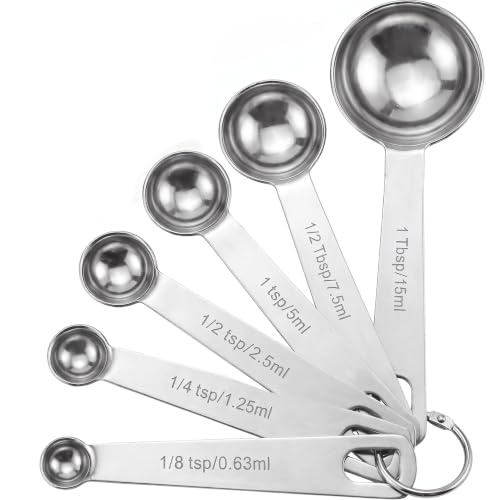
- The listing describes a small tablespoon design, a compact head profile suited to small jars and containers.
- Metric and US measurements on the handles serve cooks working from international recipes.
- Heavy duty stainless steel keeps slim heads from bending, which is the failure mode of thin narrow spoons.
Trade-offs
- The listing does not use the words narrow or spice-jar fit, so jar clearance depends on your containers.
- Six pieces is a focused set without intermediate specialty sizes.
- No leveler or cups are included.
Mini spec box
- Material: stainless steel, heavy duty
- Pieces: 6
- Design note: small tablespoon
- Measurements: metric and US
- Use: dry and liquid ingredients
Narrow spoons live or die on a paradox: the head must be slim enough to enter small containers, yet strong enough not to flex when it gets there. Rena Chris answers with a heavy duty build around a small-tablespoon profile, which is why it leads this guide’s compact category. In daily use, a compact head profile covers most of the narrow use cases short of the tightest jar mouths: small canisters, narrow spice bottles, coffee bags, and supplement tubs. The dual metric and US markings add a second audience, cooks measuring small quantities from international recipes, where the amounts are often given in milliliters and a compact spoon is already in hand. The honest limit is terminology: the manufacturer does not claim a jar-fit or narrow design in so many words, so if your specific jars defeat standard spoons today, the Spring Chef rectangular set at the end of this guide is the guaranteed answer, and this set is the strong generalist with a compact lean.
Best for: compact everyday measuring in small containers / Not suited for: the very narrowest jar mouths, where a stated jar-fit design is safer

Spring Chef Stainless Steel Magnetic Measuring Spoons Set of 8, Black
Badge: Best Dual-Sided Design
Strengths
- Dual-sided spoons put two ends on every spoon, doubling the profiles available for containers and ingredients.
- Magnetic nesting keeps the set in one slim stack, a storage profile as narrow as the spoons themselves.
- An included leveler supports clean, repeatable dry measuring.
Trade-offs
- The listing does not state jar fit explicitly, so the tightest mouths are not guaranteed.
- Both ends of a spoon need washing after use.
- The black finish is a style commitment.
Mini spec box
- Material: stainless steel
- Pieces: 8, dual sided, plus leveler
- Finish: black
- Storage: magnetic nesting
- Care: dishwasher safe
- Use: dry and liquid ingredients
Dual-sided design is the cleverest answer to the narrow problem short of a fully rectangular head. Each spoon carries two ends, so the set effectively offers two profiles per size: one for general measuring and one oriented toward reaching into containers and handling the second ingredient in a sequence. For the narrow shopper, that means more chances that one end clears a given jar, plus the practical benefit of measuring a dry spice and a liquid without a wash in between. The magnetic nesting deserves mention in a narrow guide for a different reason: the whole eight-spoon set stores as a single slim stack, which suits the small drawers that usually accompany small-jar kitchens. The leveler keeps dry measuring honest. The caveat mirrors the Rena Chris set: jar fit is not stated outright in the listing, so treat this as a versatile, compact, dual-profile system rather than a guaranteed jar specialist, and choose the rectangular Spring Chef set below when jar access must be certain.
Best for: cooks who want two profiles per spoon and slim storage / Not suited for: buyers who need jar fit guaranteed in the listing

TILUCK Stainless Steel Measuring Cups and Spoons Set of 10
Badge: Best Complete Nesting Kit
Strengths
- A complete cups-and-spoons system in nesting stainless steel for cooking and baking.
- Nesting keeps ten pieces in a compact footprint, which suits small kitchens generally.
- One material and one maker across cups and spoons keeps the measuring kit consistent.
Trade-offs
- The listing states no narrow, rectangular, or jar-fit design for the spoons; treat the profiles as standard.
- Buyers shopping purely for jar access should choose a stated jar-fit set instead.
- Cups add bulk that a spoons-only shopper does not need.
Mini spec box
- Material: stainless steel
- Pieces: 10, cups and spoons
- Storage: nesting
- Use: cooking and baking
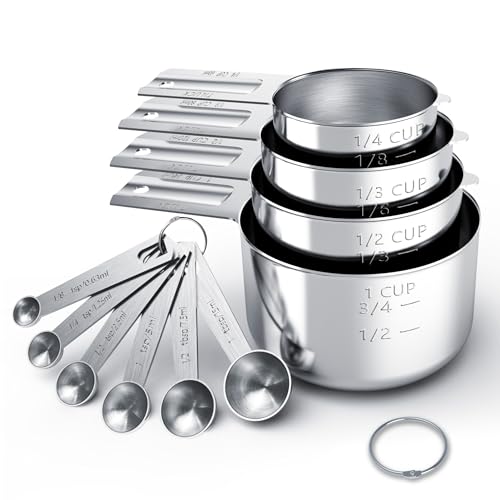
This kit is in the guide for completeness, and its review is deliberately plain: TILUCK does not claim a narrow design for these spoons, and this guide will not claim one on its behalf. What the kit offers a narrow-curious shopper is a well-organized measuring system whose spoons handle general work while its nesting format respects small storage. Many kitchens solve the jar problem by decanting their most-used spices into wider jars, and for those kitchens a standard-profile system like this is entirely sufficient, with the jar-fit question removed by the container rather than the spoon. If that is your kitchen, this is a sensible, tidy buy. If your spices stay in their original narrow jars, and they are the heart of your cooking, skip ahead to the Spring Chef rectangular set, which was designed for exactly those jars, and consider this kit only as a companion system. Honest labeling is the point of this guide: a good kit, standard profiles, no narrow claim made or implied by its maker.
Best for: decanters and general bakers wanting one nesting system / Not suited for: measuring directly from narrow original spice jars

TILUCK Stainless Steel Measuring Cups and Spoons Set of 6 with Coffee Scoop
Badge: Best Compact Kit
Strengths
- Six pieces keep the whole system compact, and compact kits suit the small kitchens where narrow tools matter.
- A coffee scoop spoon is included, useful for bags and canisters with narrow openings.
- Stainless steel cups and spoons cover daily cooking and baking in one purchase.
Trade-offs
- No narrow or jar-fit profile is stated for the measuring spoons themselves.
- Six pieces is the least coverage here for bakers who need many sizes.
- No leveler is mentioned in the listing.
Mini spec box
- Material: stainless steel
- Pieces: 6, cups and spoons, coffee scoop spoon included
- Use: cooking and baking
The smaller TILUCK kit earns its mention on compactness and on one narrow-adjacent tool: the coffee scoop. Coffee bags and canisters are narrow-opening containers too, and a dedicated scoop that lives with them is the same design philosophy as a jar-fit spoon, applied to the morning routine. The six-piece scale of the kit also respects the small-kitchen context in which narrow questions arise. Beyond that, honesty applies as with its larger sibling: the measuring spoons’ profiles are not described as narrow or jar-fitting in the listing, so this is a compact general kit, not a jar specialist. Pair it with decanted spice jars, or pair it in the same drawer with the rectangular Spring Chef set for jar work, and the combination covers both the system and the specialty. Bought alone for a narrow-jar problem, it would be the wrong tool; bought as a compact everyday system, it is a reasonable one, and this guide would rather tell you that than stretch a claim the manufacturer never made.
Best for: compact kitchens and coffee routines / Not suited for: solving a narrow spice-jar problem on its own

THLHKD 6-Piece Stainless Steel Measuring Spoons Set
Badge: Best Everyday Set
Strengths
- Clear size markings and a stated range from 1/8 teaspoon to 1 tablespoon cover daily measuring with readable handles.
- Listed for coffee, spices, and protein powder as well as general dry and liquid work, a pantry-friendly brief.
- Six stainless steel spoons keep the set light and simple.
Trade-offs
- No narrow, rectangular, or jar-fit design is stated in the listing.
- No leveler is included.
- Spoons only, without cups.
Mini spec box
- Material: stainless steel
- Pieces: 6
- Size range stated: 1/8 tsp to 1 tbsp
- Markings: clear size markings
- Use: dry and liquid ingredients, coffee, spices, protein powder
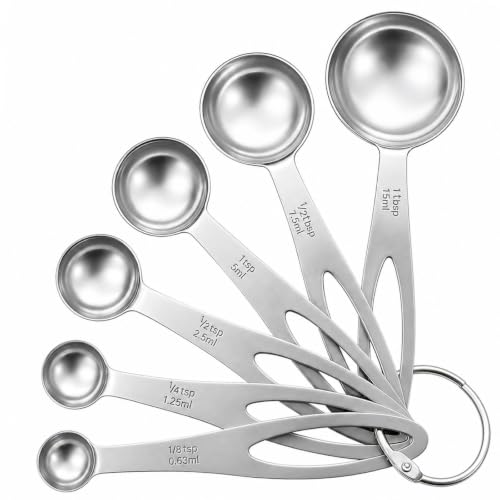
THLHKD’s six-piece set is the everyday contender in this guide: readable markings, a useful stated range that reaches down to 1/8 teaspoon, and a listing that explicitly includes spices among its uses. For cooks whose spice storage is a mix of jars, tins, and bags, a slim standard metal spoon often gets into more containers than the chunky plastic set it replaces, simply because metal can be made thinner at the rim while staying rigid. That said, this guide will not upgrade often into always: the listing states no jar-fit or rectangular design, so the tightest standard jar mouths may still defeat it, and the buyer whose kitchen is defined by those jars should choose the set built for them, reviewed next. Where this set shines is as the readable, durable, all-purpose spoon set for a pantry that is mostly cooperative, with the small 1/8 teaspoon size handling the fine end of everyday seasoning. Material-focused readers can also review the steel discussion in Best Non Toxic Measuring Spoons.
Best for: everyday pantry measuring with clear markings / Not suited for: guaranteed entry into the narrowest jar mouths
Spring Chef Nesting Stainless Steel Measuring Spoons Set of 7 with Leveler
Badge: Best for Spice Jars
Strengths
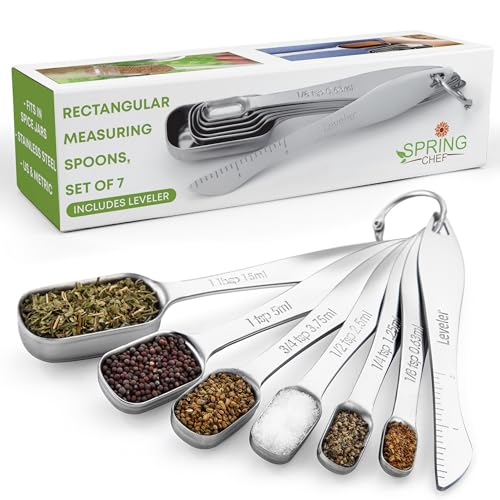
- Rectangular heads are stated in the listing, the head shape designed to pass through standard spice jar mouths.
- Fits in spice jars is stated outright, so the narrow claim is the manufacturer’s, not this guide’s inference.
- A long handle reaches the bottom of deep jars and canisters, and a leveler is included for repeatable dry measures.
Trade-offs
- Rectangular bowls are slightly less forgiving for liquids than deep round bowls.
- Seven spoons only; no cups are included.
- Nesting storage works best when the set is kept together.
Mini spec box
- Material: stainless steel
- Pieces: 7 spoons plus leveler
- Head shape: rectangular
- Storage: nesting
- Handle: long handle
- Use: dry and liquid ingredients; fits in spice jars
This is the set the narrow search is actually for. Every element of the listing speaks to the jar problem: rectangular heads that fit in spice jars, stated in plain words; a long handle that reaches deep containers instead of forcing your fingers into the mouth; nesting storage that keeps the seven spoons together; and a leveler, because measuring at the jar only helps if the measure itself is repeatable. In a spice-forward kitchen, this set changes behavior: instead of shaking spices over the pot and hoping, you measure at the jar, level, and add exactly what the recipe intends, which improves seasoning consistency more than any other single upgrade in this category. The trade-off is the shallow rectangular bowl’s slightly less secure feel with liquids, solved by measuring liquids over the bowl. If narrow is your headline requirement, this is the first choice in the guide regardless of its position in the review order, and it is the set against which the others’ honest trade-offs were written. Shoppers comparing where to buy it can consult Best Place To Get Measuring Spoons.
Best for: spice-jar measuring, deep canisters, and seasoning precision / Not suited for: cooks who mainly measure liquids and prefer deep round bowls
Comparison Table
| Set | Pieces | Narrow evidence in listing | Storage | Link |
|---|---|---|---|---|
| Rena Chris 6 | 6 | Small tablespoon design | Standard ring or drawer | Check on Amazon |
| Spring Chef Magnetic 8 | 8 plus leveler | Dual sided profiles | Magnetic nesting | Check on Amazon |
| TILUCK 10 | 10 | Not stated | Nesting | Check on Amazon |
| TILUCK 6 | 6 | Not stated; coffee scoop included | Standard | Check on Amazon |
| THLHKD 6 | 6 | Not stated | Standard ring or drawer | Check on Amazon |
| Spring Chef 7 | 7 plus leveler | Rectangular; fits in spice jars; long handle | Nesting | Check on Amazon |
How to Choose Narrow Measuring Spoons
Start with your containers, not with the spoons. Gather the jars and canisters you measure from most, and note the tightest mouth among them; that opening is your specification. If standard round spoons already fail there, only a stated jar-fit or rectangular design is a safe buy, and in this guide that means the Spring Chef set of seven. If your containers are mixed, with a few tight mouths among cooperative ones, a compact-profile set like the Rena Chris, or a dual-sided set that doubles your profile options, covers most days, with decanting as the backup for the worst jars. Consider handle length next: deep canisters and tall jars need reach, and a long handle keeps knuckles out of the spice. Then decide scope: a spoons-only narrow set for jar work, possibly alongside an existing general set, is often the smartest purchase, because narrow is a specialty property and your current set may be fine for everything else. The kits in this guide make sense when the whole measuring system is being replaced anyway. Finally, weigh the liquid trade-off: narrow and rectangular heads are optimized for dry goods and jars, so heavy liquid measurers may keep a round set for extracts and oils. Tiers in this category are about design intent, not luxury materials, so pay for the profile that matches your jars.
How to Measure from Narrow Jars Without Spills
Work at the jar with the lid fully off and the jar on the counter, never held over the pot, so a bump costs a counter spill rather than a ruined dish. Insert the narrow spoon vertically, scoop gently against the inside wall, and lift straight out; angling a rectangular head on exit is what catches rims and flicks spice. Level at the jar mouth using the leveler or a knife, letting the excess fall back into the jar instead of onto the counter, which is both tidier and more accurate than leveling over the bowl. For nearly empty jars, tip the jar toward the spoon rather than chasing the last spice around the bottom, and use the long handle rather than your fingers to reach. Measure potent spices last in a sequence when you can, and rinse and dry the spoon before it touches a mild ingredient, because residue transfer is proportionally huge at teaspoon scale. Keep a small funnel with the jars for refills, and decant bulk spices into your working jars over the sink. Store the narrow set beside the spice storage, not across the kitchen; tools get used when they live at the point of need, and a measuring spoon that is within reach at the moment of seasoning is the one that actually gets used every time.
Troubleshooting
Problem: the narrow spoon fits the jar but spills on exit → the head is being angled against the rim; lift vertically, level at the mouth, and let excess fall back into the jar.
Problem: spice clings inside a deep jar and the spoon comes out short → the jar is nearly empty or the spice is compacted; tip the jar toward the spoon and loosen the surface with the spoon’s edge before scooping.
Problem: flavors cross between spices measured in sequence → residue is transferring; rinse and fully dry between potent and mild ingredients, or use the second end of a dual-sided spoon.
Problem: the spoon fits but the last spice in the jar is unreachable → the handle is too short for the jar’s depth; switch to the long-handled set for that container, or decant the remainder into a shallow working jar.
Beyond Spice Jars: Bottles, Canisters, and Coffee Bags
Spice jars get the headlines, but narrow measuring happens across the pantry. Extract and oil bottles have small mouths, though there the spoon receives rather than enters. Flour and sugar canisters with scoop-sized openings reward slim heads and long handles. Coffee bags are effectively deep, narrow containers where a dedicated scoop or a slim spoon reaches the bottom without a hand disappearing into the bag. Supplement and protein powder tubs have wide mouths but deep walls, where handle length matters more than head width. Even baking soda boxes, with their small cardboard openings, are narrow-container problems that a rectangular spoon solves neatly. The general principle is that a kitchen’s containers define its measuring tools, and most real kitchens are a museum of narrow openings accumulated over years. A stated jar-fit set handles the worst of them, a compact or dual-sided set handles most of the rest, and the honest standard-profile sets handle everything stored in cooperative containers. Auditing your own containers before buying, as the buying guide suggests, is worth more than any single product feature, because it converts a vague hope that a spoon will fit into a specification you can actually shop against.
Narrow by Design vs Narrow by Decanting: Two Valid Systems
There are two legitimate philosophies for the jar problem. The first buys the tool for the container: rectangular, jar-fit spoons that meet spices where they live. It preserves original packaging, labels, and freshness seals, and it works in kitchens where decanting twenty spices is an afternoon nobody has. The second changes the container for the tool: decanting spices into uniform, wide-mouth jars that accept any spoon, which also makes labeling, stacking, and inventory easier, at the cost of the decanting session and the loss of original packaging. Many good kitchens run a hybrid: everyday spices decanted into a uniform row, specialty and bulk spices left in original jars with a narrow set standing by. The product implication is simple. If you will decant, buy the best general system, such as the nesting TILUCK kit or the THLHKD everyday set, and spend your effort on jars. If you will not, buy the stated jar-fit design and let the spoon do the adapting. What fails is the middle path of buying a standard set, keeping narrow jars, and shaking spices into recipes for years while meaning to solve the problem. This guide exists so that the decision, whichever way it goes, is a decision rather than a default. Readers building the full system can see the quality-focused comparison in Best Quality Measuring Cups And Spoons.
How Narrow Spoons Change Seasoning Habits
Equipment quietly edits behavior. When the spoon cannot enter the jar, cooks season by shaking, and shaken seasoning is unmeasured by definition: the first dish gets a dusting, the next gets a dump, and recipes become unrepeatable even when every other step is careful. The most common symptom is the home cook who insists a recipe is inconsistent, when in fact only the seasoning step was ever uncontrolled. A jar-fit spoon reverses the habit at almost no cost. Measuring at the jar takes seconds, returns the excess to the jar when you level at the mouth, and produces the same teaspoon every time, which means a successful seasoning can be written down and repeated. Over months, that repeatability compounds into something more valuable than any single recipe: a personal seasoning record. Cooks with narrow spoons learn their own numbers, how much cumin their household likes in a pot of beans, how much heat a rub can carry, because the tool finally lets the numbers exist. This is the deeper reason the narrow category matters beyond its modest hardware. It is not about owning a differently shaped spoon; it is about converting the most improvised step in everyday cooking into a measured one, and every other improvement in a cook’s seasoning builds on that conversion.
The habit change extends to shopping and storage as well. Cooks who measure at the jar start buying spices in jars they can measure from, refilling them with a funnel from bulk bags, and arranging the row so the daily spices sit at the front. The narrow set becomes the fixed point around which the spice system organizes itself, much as a good knife organizes a prep station. None of this requires the most elaborate set; it requires the spoon to fit, the handle to reach, and the cook to use it where the spices live. That is why this guide weighed stated jar fit so heavily and treated every other virtue, finish, piece count, even included cups, as secondary to the single question of access.
Testing Fit at Home: A Five-Minute Audit Before and After Buying
Before ordering, run the audit this guide keeps recommending, in its concrete form. Line up the containers you measure from at least weekly: spice jars, canisters, coffee bags, supplement tubs. Try your current spoons in each and note which containers defeat them, and whether the failure is head width, head shape, or handle length. That note is your buying specification. A head-width failure calls for a rectangular or slim design; a handle-length failure calls for a long handle; a shape failure at an oval or flanged mouth may be solved by a dual-sided set’s alternate end. After the new set arrives, repeat the audit immediately, while returns are painless, and test with the actual spices rather than empty jars, because a spoon that enters an empty jar can still misbehave against a packed, caked surface. Check the leveling too: level one spoon of your most-used spice at the jar mouth and see whether the excess falls back cleanly. Five minutes of this tells you more than any review can, including this one, because jar collections are personal. The reviews above exist to get the right candidates into your kitchen; the audit confirms the marriage between the set and your specific containers, and it is the step that turns a good purchase into the right one.
Caring for Slim and Rectangular Spoons
Narrow spoons ask for the same care as any stainless steel set, with two emphases. First, keep the rims true: leveling depends on a straight, undamaged rim, and rectangular heads present more edge to protect, so store the set nested or hung rather than loose under heavy utensils that can bend a slim head or handle. A bent narrow spoon fails twice, once in volume and once in fit. Second, wash spice residue promptly and dry fully; ground spices pack into the corners of rectangular bowls more than into round ones, and yesterday’s paprika in today’s baking soda is a flavor error that looks like a measuring error. A soft brush handles corners without scratching. Sets whose listings state dishwasher-safe construction can take the machine; for others, the top rack or a quick hand wash is the cautious path. With those two habits, rim care and corner cleaning, a narrow set keeps both of its defining properties, its volume and its fit, for the long life stainless steel promises.
Narrow Spoons in Small and Shared Kitchens
Narrow tools disproportionately serve small kitchens, and small kitchens are disproportionately common: apartments, dorms, RVs, shared houses, and the compact kitchens of older homes. In those spaces, spice storage is rarely a generous rack of wide jars; it is a single cabinet of original jars, stacked and crowded, exactly the environment where round spoons fail and jars get shaken. A narrow set is therefore one of the highest-leverage purchases a small kitchen can make, because it upgrades every seasoning moment without consuming the one resource the kitchen lacks, space. The nesting and magnetic formats in this guide extend the same philosophy to storage: seven or eight spoons occupying the footprint of one. Shared kitchens add a second argument, consistency between cooks. When several people season the same household dishes, a shared jar-fit set with a leveler gives them a common measure, ending the situation where one cook’s teaspoon is another’s guess. If your kitchen is small, shared, or both, weight the narrow property and the storage format above every other consideration in this guide, including piece count; a compact set that fits your jars and your drawer will be used daily, while a larger, more complete set that fits neither becomes clutter with handles.
There is also a travel and second-kitchen angle worth a sentence: a slim nesting set is the easiest measuring kit to pack for a rental kitchen, a camper, or a workplace kitchenette, where the provided tools are usually a bent spoon and optimism. Cooks who split time between two homes often keep the jar-fit set at the smaller kitchen and the complete system at the main one, which is a sensible division of labor between the sets reviewed here.
What Narrow Cannot Do: Knowing the Limits of the Shape
Honesty about a shape’s limits prevents the second purchase. A narrow spoon measures small dry quantities from tight containers superbly, but it is not the best tool for everything its owner will meet. Large-volume dry measuring still belongs to cups. Viscous liquids like honey coat a shallow rectangular bowl and release slowly, so a deep round spoon or a quick oil coating serves better. Flour for baking should be spooned into cups and leveled, not chased with any teaspoon. And the very smallest decorative jars, spice tins with flanged lids, and containers with internal shoulders can defeat even a rectangular head, at which point a funnel and a pour, or decanting that one spice, is the correct answer rather than a different spoon. Recognizing these edges is not a criticism of the category; it is what lets a buyer assemble a small, coherent kit instead of a drawer of overlapping hopes. The coherent kit, for most kitchens, is a jar-fit narrow set for the spice row, the household’s existing cups for volume, and round spoons retained for liquids if they already exist. New buyers starting from zero can approximate the same kit with one of the combined sets here plus the rectangular Spring Chef set, which together cost little and cover the full map of measuring situations described in this guide.
Common Buying Mistakes
- Assuming any slim-looking spoon fits your jars without checking the listing for a stated jar-fit or rectangular design.
- Ignoring handle length, then measuring from deep canisters with your knuckles in the spice.
- Buying a complete kit to solve a jar problem the kit’s spoons were never designed to solve.
- Forgetting the liquid trade-off: rectangular heads are for jars and dry goods first.
- Leveling over the mixing bowl instead of at the jar mouth, losing the excess and the accuracy.
- Storing the narrow set across the kitchen from the spices, guaranteeing it will not be used.
Final Recommendation
For the narrow job itself, choose the Spring Chef Nesting Set of 7: it is the only set here whose listing states the complete narrow package of rectangular heads, spice-jar fit, and a long handle, and it adds a leveler for repeatability. For compact versatility, the Rena Chris Set of 6 and the dual-sided Spring Chef Magnetic Set of 8 cover small containers well. The THLHKD set is the readable everyday option, and the TILUCK kits are honest general systems for decanters and small kitchens. Match the spoon to your jars, and the shake-and-guess era of your seasoning ends. Run the five-minute container audit the week the set arrives, keep the set beside the spices rather than across the kitchen, and level at the jar mouth so the excess returns to the jar. Those three small habits, more than any finish or piece count, are what convert a narrow set from a purchase into a permanent improvement in how your kitchen seasons food.
Frequently Asked Questions
What makes a measuring spoon narrow?
Head shape and width. Rectangular heads and slim profiles are designed to pass through the mouths of standard spice jars and other narrow containers, where round bowls jam. The clearest evidence is in the listing itself: sets that state a rectangular shape or jar fit, like the Spring Chef set of seven here, are making the narrow claim explicitly.
Will a narrow spoon fit every spice jar?
No spoon fits every container ever made, which is why this guide recommends checking your tightest jar before buying and treating stated jar-fit designs as the safest bet for standard spice jars. Unusually small or decorative containers may still require decanting or a funnel-and-pour approach.
Are rectangular spoons worse for liquids?
Slightly less forgiving, because the shallower profile holds a meniscus less securely than a deep round bowl. They are still listed for liquid use; the practical adjustment is to fill and pour over the mixing bowl. Cooks who measure liquids constantly often keep a round set alongside the narrow set.
Do dual-sided spoons help with narrow containers?
They give you two ends, and therefore two profiles, per spoon, which increases the chance one end suits a given container and lets you measure two ingredients without washing between. They are a versatility answer to the narrow problem rather than a dedicated jar-fit design.
Should I decant my spices instead of buying narrow spoons?
Either system works. Decanting into wide, uniform jars makes any spoon usable and organizes storage, but costs time and packaging. Narrow spoons preserve your existing jars and labels. Many kitchens do both: decant daily spices, keep a jar-fit set for everything else.
Can I use narrow spoons for baking, or are they only for spices?
They are full measuring spoons, listed for dry and liquid ingredients, and they bake as accurately as any set when leveled properly. The narrow property only adds jar access; it does not subtract anything from ordinary measuring. Bakers who work from spice jars and small canisters often find a jar-fit set becomes their only set, while bakers with decanted, wide-mouth storage may never notice the difference. Choose based on your containers, and the baking takes care of itself.
What if my spice jars are the tiny decorative kind?
Very small or ornamental containers can defeat any spoon, narrow included, because their mouths are designed for appearance rather than access. For those, decant the spices you use weekly into plain, measurable jars and keep the decorative set for display or for finishing pinches, or use a small funnel to pour a rough amount into a standard spoon and level it there. The five-minute container audit described in this guide will tell you quickly which of your jars are in this category.
Why does handle length matter for narrow measuring?
Because narrow containers are often deep. A long handle reaches the bottom of a tall jar or canister while keeping your fingers out of the opening, which a short spoon cannot do. It is the second half of the jar-fit design, after head shape.