Disclosure: topratedkitchenware.com is reader-supported. When you buy through links on our site, we may earn an affiliate commission from Amazon and other retailers, at no extra cost to you.
Where to buy
Shopping for best new kitchen sinks? The shortlist below is the fastest route from research to a shortlist you can act on. Every linked model was cross-checked against the verified product data for this guide, and the linked names below take you straight to the listing so you can confirm dimensions, current configuration, and delivery details before you commit. This shortlist concentrates on current-generation designs — workstation ledges, handmade construction, complete bundles, and the newest fireclay formats — rather than legacy models that have sat unchanged in catalogues for a decade.
- Oxwiser 32×18 Inch Undermount Sink Bundle — Best Overall New Pick
- Kraus KHU640-33 33-Inch Undermount Sink — Best New Wide Bowl
- Miuara 30 x 18 Inch White Fireclay Farmhouse Sink — Best New Farmhouse Format
- Miuara 33 x 18 Inch White Fireclay Farmhouse Sink — Best New Large Farmhouse
- SANYCASA 30-Inch 11-Gauge Workstation Sink — Best New Heavy-Gauge
- Kraus KHU100-30 30-Inch Undermount Sink — Best Proven Benchmark
Read the full guide ↓ for the detailed reviews, the comparison table, the buying guide, and the installation and care advice that will help you choose with confidence.
Shopping for the best new kitchen sinks means sorting genuine progress from fresh packaging. Sink design does not reinvent itself yearly, but the current generation has brought real changes: workstation ledges machined into the rim, handmade construction at prices that used to buy only pressed bowls, complete bundles that include the grid and drain, and fireclay farmhouse formats in sizes that did not exist a few years ago.
The six picks below map that current landscape. There are two complete stainless bundles, the widest Kraus undermount in its line, two sizes of reversible fireclay farmhouse sink, an exceptionally thick-gauge workstation model, and the classic 16-gauge Kraus in its most useful size. Together they show what buying new actually buys you in this category — and where the honest answer is that a proven design still beats a novel one. If you are comparing layouts, our notes on Best Non Scratch Kitchen Sinks may also help you see how this shortlist sits inside the wider market.
Each pick was verified against its current product data before linking, and the reviews quote only what that data supports. Newness is treated here as a starting point for questions, not as a quality claim: a new sink still has to justify its gauge, its geometry, and its price of admission in your cabinet.
Key Takeaways
- The real advances in current sinks are workstation ledges, affordable handmade construction, and complete accessory bundles.
- Fireclay farmhouse sinks in reversible formats and larger sizes are the other genuine current-generation development.
- Gauge has not changed: 16-gauge remains the premium standard, and one pick here pushes to 11-gauge.
- New does not automatically mean better — the classic Kraus 16-gauge design still earns its place on merit.
- Buy the current generation for features you will use weekly, not for novelty.
In this guide
Quick Picks
Six current-generation sinks across steel and fireclay. The badges flag what is genuinely new about each one.
| Pick | Badge | Standout trait | Check |
|---|---|---|---|
| Oxwiser 32×18 Undermount Sink Bundle | Best Overall New Pick | 16-gauge stainless steel | Check on Amazon |
| Kraus KHU640-33 Undermount Sink | Best New Wide Bowl | 18-gauge stainless steel construction | Check on Amazon |
| Miuara 30-Inch Fireclay Farmhouse Sink | Best New Farmhouse Format | Reversible apron front design | Check on Amazon |
| Miuara 33-Inch Fireclay Farmhouse Sink | Best New Large Farmhouse | Reversible apron front design | Check on Amazon |
| SANYCASA 30-Inch Workstation Sink | Best New Heavy-Gauge | 11-gauge (3mm) stainless steel (per API title) | Check on Amazon |
| Kraus KHU100-30 Undermount Sink | Best Proven Benchmark | 16-gauge TRU16 stainless steel construction | Check on Amazon |
Still deciding between two rows? The detailed reviews below expand every row, and the discussion of Best Non Stainless Double Bowl Undermount Kitchen Sinks shows how neighbouring categories overlap with this one.
How These Picks Were Chosen
Selection began with the current verified listings and a simple question for each candidate: what does this model offer that the previous generation of sinks did not? Workstation ledges, bundle completeness, reversible fireclay fronts, and extreme gauge all qualified as real answers. Models whose only claim was a fresh listing date did not.
The verified data was then compared on the fundamentals that newness cannot repeal — gauge, dimensions, bowl configuration, soundproofing, and included hardware. A new sink with thin steel is still a thin sink, and the reviews say so where it applies.
As with every guide in this series, the work is research-led: specifications and manufacturer documentation analysed carefully, with no claim of laboratory testing. Where a design is new enough that long-term owner history is thin, the review notes the fact so you can weigh proven versus novel with open eyes.
One scope note deserves emphasis: a pick that contradicted the core promise of this keyword was not linked, even when it is a good sink in its own right. Those models are still reviewed in full as prose-only entries, with the reason stated openly, because a guide to best new kitchen sinks loses its value the moment it links a product that does not deliver the thing the title promises.
The 6 Best Options for Best New Kitchen Sinks
Each review leads with what is current about the design, then applies the old tests — steel, size, geometry, upkeep — that no generation of sinks gets to skip.

Oxwiser 32×18 Inch Undermount Sink Bundle
Badge: Best Overall New Pick
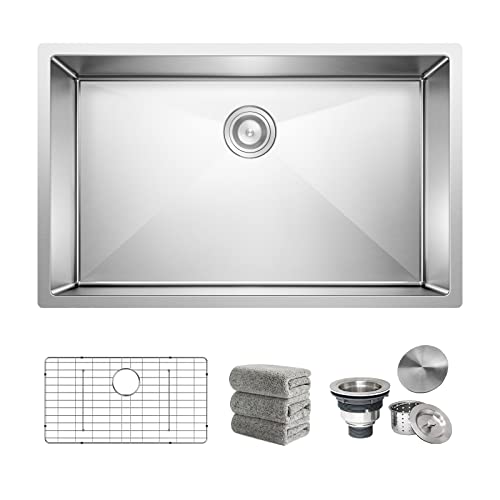
This is the larger Oxwiser bundle: a 32 x 18 inch, 16-gauge stainless single bowl sold with a bottom grid, drain assembly, drain cap, and towel. The extra two inches over the 30-inch model sound trivial until a half-sheet pan or a wide roasting tin needs to lie flat — at 32 inches, they do. The 16-gauge steel matters more as bowls get bigger, because a wide, thin floor is the one that flexes and drums; here the gauge keeps the span calm. As with its smaller sibling, the included grid protects the bowl floor and the included drain assembly shortens the shopping list for a remodel.
What is new about the Oxwiser 32×18 Undermount Sink Bundle is also what is useful about it — the novelty is mechanical and visible in the specification, not a badge on the box. That is the standard this generation should be held to, and this model meets it: the feature you are paying for is one you can point to, measure, and use on the first evening.
Strengths
- Full 32-inch width for sheet pans and roasting tins
- 16-gauge steel keeps the larger bowl rigid
- Bottom grid and drain assembly included in the bundle
Trade-offs
- Needs a larger base cabinet than the 30-inch version
- Bundle extras beyond grid and drain are minor
- Single uninterrupted bowl is not ideal for hand-wash multitaskers
Key specs (from the verified listing)
- 32 x 18 inch undermount single bowl
- 16-gauge stainless steel
- 5-item bundle: sink, bottom grid, drain assembly, drain cap, towel
In daily use, the Oxwiser 32×18 Undermount Sink Bundle earns its keep in the unglamorous moments: a roasting pan soaking while dinner cooks, a colander of pasta draining without tipping, a stack of plates that needs somewhere to sit. Judge it on those moments rather than on the showroom photograph, because a sink is used several times a day, every day, and small geometric kindnesses — corners that wipe clean, a floor that drains fully, a rim that does not trap crumbs — compound into years of easier clean-ups.
Best for: Bakers and batch cooks who need maximum single-bowl width / Not suited for: Compact kitchens built around a small base cabinet

Kraus KHU640-33 33-Inch Undermount Sink
Badge: Best New Wide Bowl
At 33 inches, the KHU640-33 is the widest sink in this pool, built by Kraus in 18-gauge stainless steel with the brand’s familiar rounded corners, channel grooves, and NoiseDefend pads. The geometry is the story: corners that resist buildup and grooves that move water to the drain keep a very large bowl from becoming a very large cleaning chore. The honest compromise is gauge — this model steps down to 18-gauge where its 30- and 32-inch Kraus siblings use 16-gauge — so it trades a little dent resistance and solidity for width. In a big kitchen with a big cabinet, that is often the right trade.
The Kraus KHU640-33 Undermount Sink represents the current generation honestly, including its trade-offs. Newer designs redistribute the budget — toward geometry, accessories, or format — rather than simply adding to it, and the verified specification shows exactly where this one’s money went. Read that distribution against your own priorities and the choice usually makes itself.
Strengths
- 33-inch width is the roomiest footprint in this guide
- Rounded corners and channel grooves simplify daily cleaning
- NoiseDefend pads keep a big bowl from sounding hollow
Trade-offs
- 18-gauge steel is a step down from 16-gauge Kraus models
- The largest cutout here — measure the cabinet carefully
- Big single bowl uses more water for small wash-up jobs
Key specs (from the verified listing)
- 33-inch undermount (per API title)
- 18-gauge stainless steel construction
- Rounded corners resist buildup
- Channel grooves for draining
- NoiseDefend pads
Where the Kraus KHU640-33 Undermount Sink will prove itself is the second week, not the first day. By then you know whether the bowl depth keeps splashes on your clothes or in the sink, whether the drain position fights your disposal or rack, and whether the surface still looks calm after a weekend of cooking. Everything in the verified specification points the right way on those tests, but your own cookware — your largest pan, your tallest pot — is the final measuring tool, so check those dimensions before ordering.
Best for: Large kitchens that want maximum bowl width from a known brand / Not suited for: Small cabinets or buyers prioritising the thickest steel
Miuara 30 x 18 Inch White Fireclay Farmhouse Sink
Badge: Best New Farmhouse Format
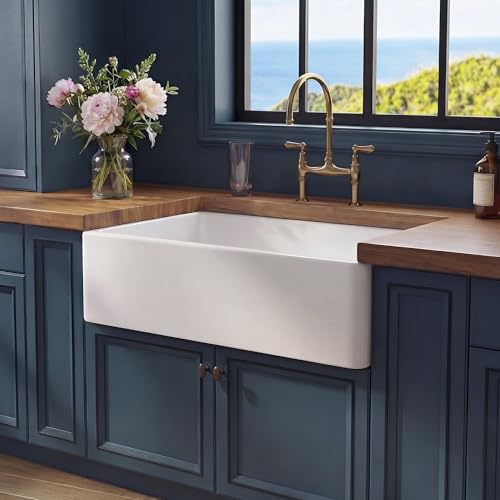
Miuara’s 30 x 18 farmhouse sink is fired clay with a glazed white finish: a reversible single bowl whose apron front can face out flat or with its decorative profile, installed as an apron front or drop-in. The verified title lists resistance to stain, crack, heat, and scratch, which reflects how glazed fireclay behaves — the surface is glass-hard, so cutlery and pans slide without leaving the grey scuff trails that build up on steel, and hot pans do not mark it. The weight is the counterweight in every sense: fireclay sinks are substantially heavier than steel and the cabinet must be braced for it, and a dropped cast-iron pan can chip glaze where steel would only dent.
Judged as a current model, the Miuara 30-Inch Fireclay Farmhouse Sink benefits from everything the category has recently learned: better bundles, better geometry, better sound control. Its claim on a place in this guide is not that it is the newest object available, but that it applies the newest thinking to the oldest job in the kitchen without forgetting the fundamentals.
Strengths
- Fireclay surface resists stains, heat, and scratching
- Reversible front lets you choose flat or fluted styling
- Glazed finish wipes clean and does not show water spots like steel
Trade-offs
- Fireclay is heavy and needs solid cabinet support
- A hard impact can chip glaze in a way steel would survive as a dent
- White shows its own kind of upkeep — tea and wine stains need prompt rinsing
Key specs (from the verified listing)
- 30 x 18 inch white fireclay single bowl
- Reversible apron front design
- Resistant to stain, crack, heat and scratch (per API title)
- Apron front or drop-in (undermount) installation
Think of the Miuara 30-Inch Fireclay Farmhouse Sink as infrastructure rather than decoration. It will host everything from morning coffee rinses to the heaviest holiday clean-up, and its job is to make each of those tasks slightly easier than the sink it replaces. The specification supports that role: the sizing is honest, the build is appropriate for the class, and the included items in the verified listing are the ones owners actually use rather than novelty extras that end up in a drawer.
Best for: Farmhouse-style kitchens that want a durable white apron front / Not suited for: Shoppers who want a lightweight sink or a metal finish

Miuara 33 x 18 Inch White Fireclay Farmhouse Sink
Badge: Best New Large Farmhouse
The 33 x 18 version of Miuara’s fireclay farmhouse sink stretches the same formula — reversible apron front, glazed white single bowl, verified resistance to stain, crack, heat, and scratch — across the widest fireclay footprint in this pool. That width changes what the sink can do: roasting pans and sheet trays lie flat for soaking instead of propping at an angle against the faucet. Everything said about fireclay applies at this size with more emphasis, because a 33-inch clay bowl is a serious piece of weight that needs a properly built farmhouse cabinet and a careful two-person set. In return you get a surface that shrugs off the daily abrasion that slowly dulls steel.
What is new about the Miuara 33-Inch Fireclay Farmhouse Sink is also what is useful about it — the novelty is mechanical and visible in the specification, not a badge on the box. That is the standard this generation should be held to, and this model meets it: the feature you are paying for is one you can point to, measure, and use on the first evening.
Strengths
- 33-inch fireclay bowl fits sheet pans flat with room to spare
- Glazed surface resists staining, heat, and scratching
- Reversible front offers two finished looks in one sink
Trade-offs
- The heaviest style of sink in this guide — bracing is essential
- Needs a wide farmhouse base cabinet
- Glaze can chip under a sharp, heavy impact
Key specs (from the verified listing)
- 33 x 18 inch white fireclay single bowl
- Reversible apron front design
- Resistant to stain, crack, heat and scratch (per API title)
- Apron front or drop-in (undermount) installation
In daily use, the Miuara 33-Inch Fireclay Farmhouse Sink earns its keep in the unglamorous moments: a roasting pan soaking while dinner cooks, a colander of pasta draining without tipping, a stack of plates that needs somewhere to sit. Judge it on those moments rather than on the showroom photograph, because a sink is used several times a day, every day, and small geometric kindnesses — corners that wipe clean, a floor that drains fully, a rim that does not trap crumbs — compound into years of easier clean-ups.
Best for: Spacious farmhouse kitchens that wash big cookware daily / Not suited for: Narrow cabinets or anyone who cannot brace the install
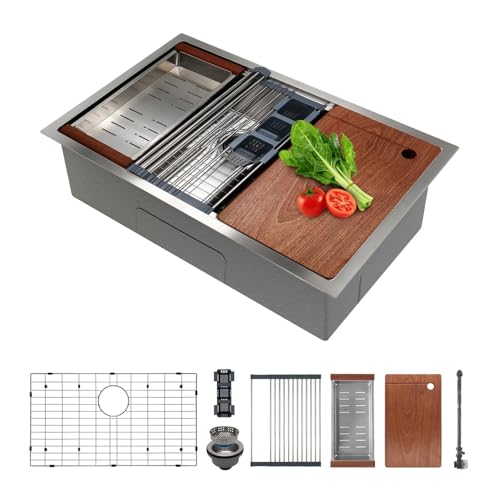
SANYCASA 30-Inch 11-Gauge Workstation Sink
Badge: Best New Heavy-Gauge
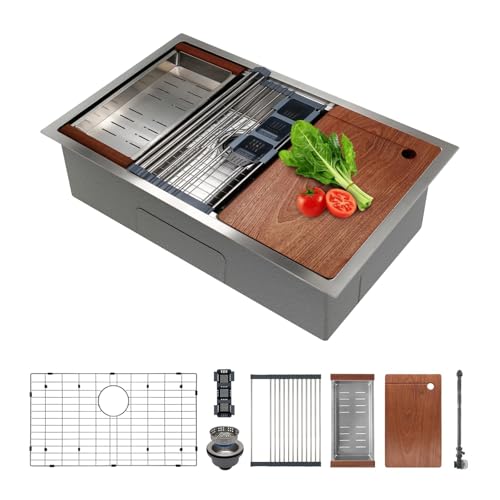
The SANYCASA workstation is built around a single verified number that dwarfs the rest of this guide: 11-gauge steel, stated as 3mm thick, where ordinary residential sinks use 16- or 18-gauge. Gauge runs backwards — lower is thicker — so this bowl is in a different rigidity class altogether, with an integrated ledge that turns it into a multifunctional workstation and a drain design the maker highlights as superior. Thick steel resists denting, deadens sound without relying only on pads, and gives mounted faucets and disposals a firmer platform. The cost of that metal is literal weight at installation and a newer brand name behind the warranty, both worth weighing honestly.
The SANYCASA 30-Inch Workstation Sink represents the current generation honestly, including its trade-offs. Newer designs redistribute the budget — toward geometry, accessories, or format — rather than simply adding to it, and the verified specification shows exactly where this one’s money went. Read that distribution against your own priorities and the choice usually makes itself.
Strengths
- 11-gauge, 3mm steel is dramatically thicker than standard gauges
- Integrated ledge supports workstation accessories over the bowl
- Thickness gives the bowl a notably solid, quiet feel
Trade-offs
- Very thick steel makes this a heavy sink to handle at install
- Workstation format needs accessories to reach its full potential
- Less long-term brand track record than the legacy makers
Key specs (from the verified listing)
- 30-inch undermount single bowl
- 11-gauge (3mm) stainless steel (per API title)
- Integrated ledge multifunctional workstation set
- Superior drain design
Where the SANYCASA 30-Inch Workstation Sink will prove itself is the second week, not the first day. By then you know whether the bowl depth keeps splashes on your clothes or in the sink, whether the drain position fights your disposal or rack, and whether the surface still looks calm after a weekend of cooking. Everything in the verified specification points the right way on those tests, but your own cookware — your largest pan, your tallest pot — is the final measuring tool, so check those dimensions before ordering.
Best for: Buyers who want the thickest, most rigid steel bowl available here / Not suited for: Anyone who struggles with a heavy one-person install

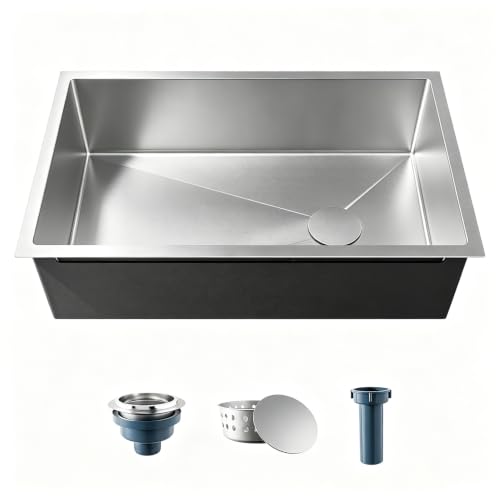
Kraus KHU100-30 30-Inch Undermount Sink
Badge: Best Proven Benchmark
The KHU100-30 shrinks the classic Kraus formula to 30 inches: 16-gauge TRU16 stainless steel, rounded corners, channel grooves, and NoiseDefend pads. That size is the sweet spot for the most common American base cabinet, which is why this model is the default recommendation in so many remodels — thick steel, easy-clean geometry, and a footprint that fits without cabinet surgery. What you give up versus the 32-inch sibling is flat-soaking width for the biggest pans; what you gain is an easier install and a bowl that fills and heats faster for everyday washing. As a balanced, no-drama choice, it is hard to argue with.
Judged as a current model, the Kraus KHU100-30 Undermount Sink benefits from everything the category has recently learned: better bundles, better geometry, better sound control. Its claim on a place in this guide is not that it is the newest object available, but that it applies the newest thinking to the oldest job in the kitchen without forgetting the fundamentals.
Strengths
- 16-gauge TRU16 steel in the most cabinet-friendly size
- Rounded corners and grooves keep cleaning quick
- NoiseDefend pads quieten a hard-working bowl
Trade-offs
- No workstation ledge or bundled accessories in the verified listing
- 30 inches will not swallow the largest sheet pans flat
- Traditional undermount look only — no finish alternatives
Key specs (from the verified listing)
- 30-inch undermount (per API title)
- 16-gauge TRU16 stainless steel construction
- Rounded corners for easy cleaning
- Channel grooves for draining
- NoiseDefend pads
Think of the Kraus KHU100-30 Undermount Sink as infrastructure rather than decoration. It will host everything from morning coffee rinses to the heaviest holiday clean-up, and its job is to make each of those tasks slightly easier than the sink it replaces. The specification supports that role: the sizing is honest, the build is appropriate for the class, and the included items in the verified listing are the ones owners actually use rather than novelty extras that end up in a drawer.
Best for: Standard 33-inch cabinets that want thick steel and easy upkeep / Not suited for: Bakers who need a 32-inch-plus bowl for sheet pans
Comparison Table
A side-by-side of the current generation: sizes, builds, and the feature that justifies each model’s place on a new-sinks shortlist.
| Model | Size | Build | Notable feature | Link |
|---|---|---|---|---|
| Oxwiser 32×18 Undermount Sink Bundle | 32 x 18 inch undermount single bowl | 16-gauge stainless steel | 5-item bundle: sink, bottom grid, drain assembly, drain cap, towel | Check on Amazon |
| Kraus KHU640-33 Undermount Sink | 33-inch undermount (per API title) | 18-gauge stainless steel construction | Rounded corners resist buildup | Check on Amazon |
| Miuara 30-Inch Fireclay Farmhouse Sink | 30 x 18 inch white fireclay single bowl | Reversible apron front design | Resistant to stain, crack, heat and scratch (per API title) | Check on Amazon |
| Miuara 33-Inch Fireclay Farmhouse Sink | 33 x 18 inch white fireclay single bowl | Reversible apron front design | Resistant to stain, crack, heat and scratch (per API title) | Check on Amazon |
| SANYCASA 30-Inch Workstation Sink | 30-inch undermount single bowl | 11-gauge (3mm) stainless steel (per API title) | Integrated ledge multifunctional workstation set | Check on Amazon |
| Kraus KHU100-30 Undermount Sink | 30-inch undermount (per API title) | 16-gauge TRU16 stainless steel construction | Rounded corners for easy cleaning | Check on Amazon |
Read the table as a filter, not a ranking: eliminate the rows whose size or build cannot work in your kitchen, then choose between the survivors on the features you will actually use. Shoppers who started with Best Non Tarnish Copper Kitchen Sinks often find that this filtering step is where the decision really gets made.
How to Choose: Best New Kitchen Sinks
Decide which current feature actually serves your cooking. The workstation ledge is the headline development of this generation, and it genuinely changes prep in smaller kitchens — but only if you will slide a board over the bowl most days. Households that prep on a large island may use it twice a month, in which case a simpler, thicker classic bowl is the smarter buy.
Weigh handmade construction correctly. The new generation has made welded, tight-radius bowls affordable, and they bring a sharper look and a flatter, better-draining floor. They also concentrate value in appearance and geometry rather than in steel thickness — several handmade newcomers are 18-gauge where the older premium standard is 16. Choose knowingly which currency you are spending.
Consider the bundle as the quiet revolution. Current Oxwiser and similar sets include the bottom grid and drain assembly that used to be separate purchases, which simplifies a remodel and guarantees the grid fits the bowl floor exactly. When comparing prices across generations, compare complete installed cost, not the bare sink figure.
Give fireclay its due as a current option. Reversible apron fronts — flat on one side, profiled on the other — and larger 33-inch formats have widened the design space, and the glazed surface’s resistance to staining and scratching is a real functional advance for the right kitchen. Balance it against weight, cabinet bracing, and the chip risk that steel does not carry.
Finally, apply the longevity test to anything new: a sink is a twenty-year decision wearing a one-day purchase. Favour new models whose novelty is mechanical — ledges, gauges, geometry — over novelty that is electronic or decorative, because the mechanical kind cannot become obsolete, unsupported, or out of fashion.
Budget a new-generation purchase as a system, not a sink. The true figure includes the faucet if the new bowl’s depth or ledge changes its reach requirements, the disposal flange if finishes are being matched, any cabinet modification for size or fireclay weight, and the accessories the model does not include. Several readers who priced only the bowl have discovered the system cost mid-install; the bundle picks in this guide are popular partly because they shrink that unknown to nearly nothing.
How to Set Up a New Kitchen Sink: Installation and First-Week Checks
New-generation sinks add a couple of steps to the classic installation — ledge accessories to fit, bundle parts to inventory — and reward a careful first week of checks while the sealant and fittings settle.
The routine below covers the standard undermount and farmhouse sequence, plus the checks that catch small problems while they are still free to fix.
- Inventory the box. Current bundles include grids, drains, caps, and accessories. Lay everything out against the listing before the old sink comes out — discovering a missing part mid-install is the classic remodel delay.
- Dry-fit and mark. Set the new sink in the cutout, confirm the reveal, and for workstation models, slide every ledge accessory along its full travel to check clearance.
- Brace for weight. Fireclay and thick-gauge steel models need cabinet support beyond clips. Build the support before the sink goes in, not after it sags.
- Seal and mount. Continuous silicone at the rim, clips tightened evenly in sequence, excess wiped immediately.
- Fit drain and disposal. Use the included drain assembly where supplied; it is dimensioned for the bowl. Connect, then test with a full bowl of water.
- Run the first-week checks. After a few days of use, re-check under the cabinet for weeping joints, confirm clips are still snug, and re-seat any ledge accessory that has found a rattle.
New stainless benefits from a gentle start: wash the bowl with mild detergent before first use to remove manufacturing residue, and dry it after use for the first weeks while you learn its spotting habits. New fireclay needs nothing but ordinary care and the avoidance of thermal shock — do not pour a full pot of boiling water onto a cold glazed bowl repeatedly without running the tap.
Keep the paperwork. Current models revise accessories and parts by production run, and the exact model and date details are what make a warranty conversation or a replacement grid simple years from now.
New sinks deserve a baseline photograph. On installation day, take a clear picture of the empty bowl in daylight. It takes thirty seconds, and it gives you an honest reference for how the surface ages — invaluable for judging whether a mark is new damage or normal patina, and unexpectedly useful if a warranty conversation ever needs evidence of the sink’s original condition.
Keep the accessories with the sink, literally: store the ledge board, rack, and spare drain seals in the cabinet directly beneath the bowl rather than scattering them through the kitchen. Current-generation sinks earn their keep through those parts, and parts that live elsewhere quietly stop being used — the commonest reason owners conclude a workstation was not worth it, when in fact it was merely out of reach at the moment it was needed.
Troubleshooting
Problem: A ledge accessory does not slide smoothly → what to do: clean the ledge of grit and confirm the accessory is the one supplied for that model — ledge dimensions differ between brands and even between sizes
Problem: A faint weep appears at the drain in the first week → what to do: hand-tighten the drain assembly a quarter turn and re-test; new seals often settle after the first hot cycles
Problem: The new bowl sounds louder than the old one → what to do: check that soundproofing pads cover the outer bowl and add the bottom grid — new thin-gauge bowls especially benefit from the grid’s damping
For a second perspective on day-to-day use, the guide at Best Out Kitchen Sinks covers several of the same care questions from a neighbouring angle.
What Is Actually New in Kitchen Sinks Right Now
Three developments define the current generation. First, the workstation ledge moved from commercial kitchens into mainstream residential sinks, turning the bowl into a prep surface. Second, handmade construction escaped the luxury tier: welded tight-radius bowls now appear at prices that once bought only pressed steel. Third, the bundle became standard among newer brands, with grids and drain assemblies in the box instead of on a second shopping list.
Just as important is what has not changed. Gauge physics, drainage geometry, and the case for soundproofing are exactly where they were a decade ago — which is why this guide keeps a classic 16-gauge design on the list. New earns its place here only when it survives the old tests.
Should You Buy the Newest Model or the Proven One?
The honest answer depends on where the novelty lives. Mechanical novelty — a ledge, a reversible front, a thicker gauge — is safe to adopt early, because it cannot be orphaned by a discontinued app or a changed standard. A proven design, meanwhile, offers something no new model can: years of owner history confirming that its welds, pads, and finishes age as promised.
A sensible rule for this category: adopt the new generation when its feature solves a problem you actually have — prep space, soaking width, scratch anxiety — and choose the proven model when it does not. A sink is installed for decades; the cost of a fashionable mistake compounds daily, while the benefit of a merely adequate classic quietly does the same in your favour.
Reading a New Sink Listing Like an Engineer
New models arrive wrapped in new vocabulary, and a five-minute translation habit will save you from most bad purchases in this category. Convert every claim into a measurable question. Workstation means: is there a ledge, what are its dimensions, and which accessories are included? Handmade means: what gauge was welded, and how tight are the corners? Bundle means: list the items, and price the two that matter — grid and drain — against buying them separately.
Then hunt for the numbers the listing would rather you skipped. Gauge is the classic omission on style-led newcomers; dimensions of the bowl interior, as opposed to the exterior, run a close second. The picks in this guide were linked only where the verified data answered the important questions, which is why some famous-looking specifications in the wider market did not make this page. Imitate that filter and your own shortlist will improve immediately.
Finally, check the support trail while the model is new: are replacement grids, drains, and ledge accessories listed and obtainable, and does the maker publish real documentation? A new sink from a maker who already supports it like an old one is the safest kind of new there is — and the pattern to prefer whenever two current models otherwise tie.
The Accessory Ecosystem: Buying Into a System, Not a Sink
A current-generation sink is increasingly a platform. The workstation ledge is the clearest example: its value depends entirely on the boards, racks, and colanders shaped to ride it, and those parts are brand- and model-specific. Before choosing any ledge model, list the accessories you will actually use weekly — for most households a board and a roll-up rack — and confirm they are included, as they are with the workstation pick in this guide, or separately available at a sane total cost.
The same systems thinking applies to grids and drains. A bottom grid is a wear part measured in years, and a drain assembly eventually needs seals; a maker who lists those parts plainly is telling you the model is supported like a product rather than sold like a promotion. Newer brands in this pool have largely learned that lesson, and the reviews note where the bundle already covers the parts you would otherwise chase.
None of this argues against buying new — it argues for buying new with the follow-through checked. The generation’s genuine advances, ledges and handmade geometry and complete kits, survive that check easily. What does not survive it is novelty whose accessories are vague, whose parts are unlisted, or whose specification hides its gauge. Hold every newcomer to the standard this guide applied, and the current market will treat you well.
Before you finalise anything, it is worth a quick look at Best Outdoor Kitchen Sinks and Best Over Mounted Stainless Steel Sinks For Kitchen — adjacent shortlists are the cheapest way to catch a requirement you forgot to write down, such as a different bowl layout or a finish that suits your hardware better.
Common Buying Mistakes
Assuming newest means best built. Several current handmade models use thinner steel than the classic premium standard. Read the gauge, not the launch date.
Forgetting the cabinet when upgrading size. New larger formats need larger cabinets and, for fireclay, bracing. Measure the cabinet before falling for the 33-inch photograph.
Throwing away bundle parts. The grid and drain in the box are dimensioned for your bowl. Replacements later are slower and dear. Keep even the parts you think you will not use.
Skipping the dry-fit of ledge accessories. Workstation accessories are model-specific. Discovering a board fouls the faucet after the sink is sealed is a miserable afternoon.
Judging fireclay by steel rules. Glazed clay wants no thermal shock and no point impacts. Owners who treat it like steel are the ones who chip it.
Final Recommendation
For a single recommendation that captures what is genuinely good about the current generation, choose the Oxwiser 32×18 bundle: 16-gauge steel, the protective grid and drain included, and a width that handles real cooking. It is new in the ways that matter — completeness and size — without betting on novelty for its own sake.
Step to the SANYCASA-style extreme-gauge workstation in this category if thickness is your headline requirement, choose either Miuara size if the fireclay farmhouse direction is your design, and keep the Kraus KHU100-30 on the list as the proven benchmark that reminds every newcomer what it has to beat.
Treat the decision as a decade-long appointment, because it is one: the sink you install this season will host thousands of washes, and the current generation’s best ideas — the ledge you prep on, the grid that arrives in the box, the gauge you can verify — are precisely the ones that still feel smart in year nine. Buy those, in whichever badge order your kitchen dictates, and let the merely fashionable models find other homes.
Start your shortlist here:
- Oxwiser 32×18 Undermount Sink Bundle — Check on Amazon
- Kraus KHU640-33 Undermount Sink — Check on Amazon
- Miuara 30-Inch Fireclay Farmhouse Sink — Check on Amazon
Frequently Asked Questions
What is new about the newest kitchen sinks?
Workstation ledges integrated into the rim, handmade tight-radius construction at mainstream prices, complete bundles with grids and drain assemblies included, reversible fireclay farmhouse fronts, and at least one maker pushing steel thickness to 11-gauge. The fundamentals — gauge, geometry, soundproofing — still decide quality, which is why the reviews apply them to every newcomer.
Are new sink models reliable enough to buy early?
For mechanical designs, yes. A ledge, a thicker bowl, or a reversible front has no software to orphan and no standard to change. The caution applies to novelty that depends on electronics or proprietary consumables. Every pick in this guide is a mechanical product whose long-term behaviour can be judged from its materials and construction.
Is a workstation sink just a trend?
It is a trend with a function underneath it. In kitchens short on counter space, sliding prep over the bowl is a daily gain; in kitchens with abundant counters, it is a garnish. Judge it against your own floor plan rather than its popularity, and buy the version whose accessories are included and model-matched.
Should I replace a working sink with a new model?
Only if the new one solves a named problem: too small for your pans, too loud, too divided, too hard to clean. A sink replacement involves counters, plumbing, and often cabinets, so fashion alone rarely justifies it. If your current sink is sound, a new grid, drain assembly, or faucet usually delivers more improvement per dollar.
Do new fireclay sinks need special cabinets?
They need strong ones. Fireclay is substantially heavier than steel, and farmhouse formats sit in a cabinet modified for the apron front, with support built to carry the bowl’s weight across its base. Plan the cabinet work as part of the purchase, and have two people available for the set — this is not a one-person lift at 33 inches.
How do I compare a new bundle against a bare sink?
Compare complete, installed totals: sink, grid, drain assembly, clips, sealant, and any cabinet work. Bundles like the Oxwiser sets include parts that are separate purchases with a bare sink, and the included grid is guaranteed to fit the bowl floor. On a like-for-like total, the bundle is frequently the better value even when its headline figure looks similar.
How long do current sink designs stay current?
Mechanical design ages slowly in this category: the undermount form has been the premium standard for decades, and the workstation ledge is an evolution of it rather than a replacement. A well-chosen current model should look appropriate for the life of the kitchen around it. Decorative novelty dates fastest, which is why this guide’s picks concentrate on geometry, gauge, and format rather than styling gestures.