Disclosure: topratedkitchenware.com is reader-supported. When you buy through links on our site, we may earn an affiliate commission from Amazon and other retailers, at no extra cost to you.
Where to buy
Some toilets clog on a schedule, and their owners plan around them: the plunger lives beside the bowl, guests get a quiet warning, and everyone knows which bathroom to avoid. The best nonclog toilets end that arrangement with engineering, not luck — fully glazed trapways that waste cannot grip, flush systems tested under standardized loads, and bowl rinses that leave nothing behind to start the next blockage. Four of the six models below carry either a published MAP 1000g flush result or an explicit anti-clog design claim in their listings; the other two earn their places on proven flush architecture. Start with our top pick and check the latest price on Amazon: Check on Amazon.
- BayRoll One-Piece Round Toilet, Dual Flush 0.9/1.28 GPF, MAP 1000g — Best Overall
- Casta Diva Elongated One-Piece Toilet, 17-Inch Chair Height — Best Comfort-Height Pick
- TOTO Drake Two-Piece Elongated 1.6 GPF with CEFIONTECT — Best Proven Flush Platform
- MAXSA 15-Inch Elongated Two-Piece Toilet, 1.28 GPF — Best Value Pick
- HOROW 17-Inch Comfort Height Dual Flush Toilet, MAP 1000g — Best for Busy Family Bathrooms
- Gerber Maxwell Crest Elongated Two-Piece Toilet — Best Trapway Design
Read the full guide ↓
Clogging feels random, but it is almost always mechanical. A toilet clogs when the load it is given exceeds what its flush momentum and trapway geometry can move in one exchange — and both sides of that equation have been getting better. On the engineering side, the modern nonclog toilet delivers its water through a larger flush valve so the siphon starts fast and pulls hard, shapes the trapway wide and smooth, and glazes that trapway completely so friction stays low for the life of the fixture. On the evidence side, MAP testing now gives buyers a standardized number — the grams of test media a toilet clears in a single flush — so a claim of clog resistance can be checked rather than merely believed. When a listing in this guide states MAP 1000g, that is the top band of that test: a kilogram of media, cleared, under protocol conditions that do not care about marketing.
This ranking weighs that evidence first, then the supporting cast: dual-flush systems that rinse the trapway frequently for liquid waste, one-piece skirted bodies whose smooth exteriors make the whole fixture easier to keep in service, chair heights that stop users from rushing and overloading, and the legacy platforms whose flush designs have been clearing bowls reliably for years. We also spend real time on the boundary of what a toilet can do — the wipes, cotton products, and grease that defeat any trapway ever molded — and on the diagnostic question that saves the most money in this category: whether your clogs are actually your toilet’s fault, or your drain line’s. Shoppers cross-shopping the one-piece branch of this category will find these same finalists organized by format in Best One Piece Dual Flush Toilets and Best One Piece Comfort Height Toilets; this guide ranks them purely on staying unclogged.
Key Takeaways
- A wide, fully glazed trapway plus a fast-starting siphon is the nonclog formula; water volume alone is not.
- The BayRoll one-piece is our top pick: MAP 1000g in its listing, dual flush 0.9/1.28 GPF, fully skirted, at a 17-inch ADA height.
- The HOROW 17-inch matches the MAP 1000g figure in an elongated two-piece with a soft-close seat for family bathrooms.
- The TOTO Drake 1.6 GPF brings the most proven flush platform here, with CEFIONTECT glaze keeping the bowl slick.
- The Gerber Maxwell Crest states the trapway case explicitly — glazed to prevent clogs — and includes its install kit.
- No toilet survives wipes and cotton products; nonclog engineering buys a wide margin, not immunity.
In this guide
Quick Picks
| Pick | Badge | Flush | Design / Height | Link |
|---|---|---|---|---|
| BayRoll One-Piece Round | Best Overall | Dual flush 0.9/1.28 GPF, MAP 1000g | One-piece fully skirted / 17-inch ADA | Check on Amazon |
| Casta Diva Elongated One-Piece | Best Comfort-Height Pick | Dual flush 1.1/1.6 GPF | One-piece / 17-inch chair height | Check on Amazon |
| TOTO Drake Elongated 1.6 GPF | Best Proven Flush Platform | 1.6 GPF TORNADO FLUSH | Two-piece / Universal Height | Check on Amazon |
| MAXSA 15-Inch Elongated | Best Value Pick | 1.28 GPF siphonic flush | Two-piece / 15-inch height | Check on Amazon |
| HOROW 17-Inch Dual Flush | Best for Busy Family Bathrooms | Dual flush 1.1/1.6 GPF, MAP 1000g | Two-piece / 17-inch ADA | Check on Amazon |
| Gerber Maxwell Crest Elongated | Best Trapway Design | Efficient siphonic, glazed trapway | Two-piece / elongated | Check on Amazon |
Read the table as two strategies. The tested-power strategy — BayRoll and HOROW, both publishing MAP 1000g — wins on evidence. The proven-platform strategy — TOTO’s TORNADO FLUSH Drake and Gerber’s glazed-trapway design — wins on track record and engineering logic. The MAXSA and Casta Diva fill the value and comfort-height one-piece roles respectively. Which strategy suits you depends on how burned you feel by your current toilet: the worse the experience, the more weight most buyers give the published test number, and we think that instinct is sound.
How These Picks Were Chosen
Our method is research-based and we state its limits plainly: we did not bench-test these toilets with media loads ourselves. Instead we compared what can be verified — the flush figures and design claims in each manufacturer’s listing, the trapway and rinse architecture each model describes, construction type, height and rough-in fit, and the maturity of the platform behind the name. Where a listing publishes a MAP score, we treat it as the strongest available evidence, because MAP is a standardized third-party-style protocol rather than a brand’s internal claim; where a listing makes a specific engineering claim, such as a glazed trapway that prevents clogs, we credit the claim as stated and say so; where a listing offers neither, we rank on flush architecture and installed track record and label the confidence accordingly in the review.
Clog resistance carried the majority of the weight, split between peak clearing ability (can it move a large load once?) and resistance to gradual narrowing (will it still clear in year eight?). The second half matters more than most guides admit: the majority of chronic clogging is not a toilet that was always weak, but a toilet whose trapway roughened with scale and residue until ordinary loads started catching. That is why glazing, rinse coverage, and glazes that shed residue — TOTO’s CEFIONTECT among them — score in a nonclog guide and not only in a cleaning guide. The remainder of the weight went to ownership fit: dual-flush water savings for high-traffic homes, heights from 15 inches to chair height, round versus elongated footprints, one-piece versus two-piece serviceability, and parts ecosystems. We excluded nothing for lacking a MAP score, but no model without one outranks a model with one on flush claims alone — the unmeasured picks here earn their positions on other, stated merits.
The 6 Best Nonclog Toilets

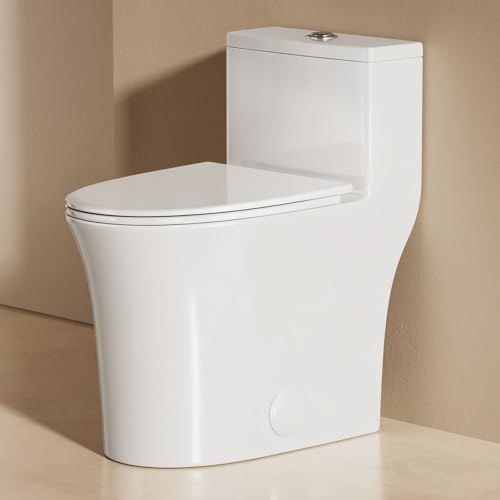
BayRoll One-Piece Sleek Modern Toilet, Round, Dual Flush
Badge: Best Overall
Strengths
- MAP 1000g in the listing — top-band standardized clearing evidence, rare at any flush volume.
- Dual flush 0.9/1.28 GPF achieves that evidence while using less water per cycle than any rival here.
- Fully skirted one-piece body at a 17-inch ADA height, with a soft-close seat and a compact round footprint.
Trade-offs
- Round bowl gives less seating room than elongated models; larger adults notice the difference.
- The light 0.9 GPF cycle must be reserved for liquid waste — button discipline matters.
- BayRoll is a smaller brand; confirm parts availability for the dual-flush valve when you buy.
Mini spec box: One-piece round toilet; dual flush 0.9/1.28 GPF; MAP 1000g in the listing; 17-inch ADA chair height; fully skirted compact design; soft-close seat; 12-inch rough-in.
The BayRoll leads this guide because it holds the strongest hand of evidence in the most efficient package. Start with the number: a MAP 1000g result means that under the standardized protocol, this toilet cleared a kilogram of test media — several times a realistic household load — in a single flush. Then notice the volumes at which it does its daily work: a 0.9 GPF light cycle for liquids and a 1.28 GPF full cycle, both below every other pick here. The old assumption that clog resistance must be bought with water simply does not survive this specification. What makes it possible is the modern formula executed completely: a flush valve that dumps the tank fast enough to build a real siphon, and a trapway shaped and finished to let that siphon carry its load out without friction losses.
The one-piece, fully skirted construction supports the mission in quieter ways. There are no exterior contours collecting the damp dust that eventually migrates, on cleaning day, into places it should not be; the whole exterior wipes in seconds, which means it actually gets wiped. The 17-inch ADA chair height suits most adults, and the round bowl — the honest compromise — fits bathrooms where an elongated model would crowd the door or the vanity. That shape is the main reason to pause: adults who know they prefer elongated seating should take the HOROW or Casta Diva instead and give up nothing on evidence that matters. For everyone else, and especially for smaller bathrooms, the BayRoll is the most completely argued nonclog toilet in this guide: tested at the top band, frugal every day, and shaped to be maintained.
Best for: Smaller bathrooms and evidence-first buyers who want tested clearing at minimal water use / Not suited for: Adults who require elongated seating room

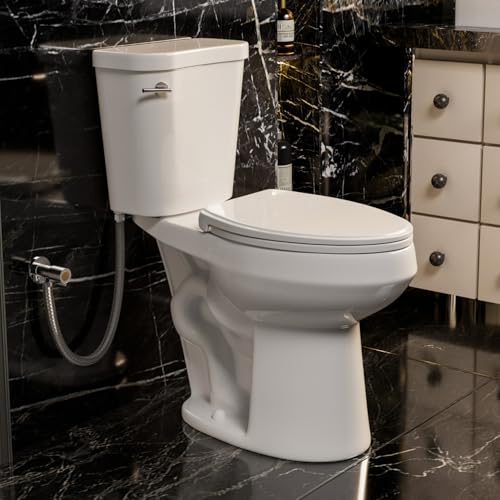
Casta Diva Elongated One-Piece Toilet with 17-Inch Chair Height
Badge: Best Comfort-Height Pick
Strengths
- Elongated one-piece body at a 17-inch chair height — the format most adults prefer, in seam-free construction.
- Dual flush 1.1/1.6 GPF high-efficiency system gives a full-power cycle for solid loads and a rinse-light cycle for liquids.
- Compact footprint for an elongated toilet, suiting standard bathrooms without extra clearance.
Trade-offs
- No MAP figure in the listing, so its clearing ceiling is a design judgment rather than a published result.
- One-piece weight makes installation a two-person job.
- Smaller brand footprint than TOTO or Gerber for long-term support depth.
Mini spec box: One-piece elongated toilet; dual flush 1.1/1.6 GPF; 17-inch comfort chair height; compact design; 12-inch rough-in; white bowl.
The Casta Diva is the comfort-first route out of clog trouble. Its elongated bowl and 17-inch chair height match the body geometry of the widest range of adults, and that fit is not merely about comfort — users who sit naturally do not rush, and unhurried users split loads and use paper sensibly, which is where a large share of real-world clog prevention actually happens. The one-piece construction removes the tank seam and presents a smooth exterior that is quick to clean, keeping the fixture in the kind of condition where small problems get noticed during a wipe-down rather than discovered during a flood.
Its dual-flush system follows the pattern this guide favors: the 1.1 GPF light cycle handles the liquid majority and keeps the trapway rinsed frequently — frequent rinsing being the everyday enemy of the gradual buildup that narrows trapways — while the 1.6 GPF cycle provides the full exchange for solid waste. What the listing does not provide is a MAP score, and we will not invent one: a buyer whose current toilet clogs weekly and who wants the hardest published evidence should choose the BayRoll or the HOROW and accept their shapes. A buyer whose clogging is occasional, whose bathroom is standard-sized, and whose household wants elongated chair-height comfort in a clean one-piece form will find the Casta Diva the most livable answer here. It is also, not incidentally, the natural anchor for readers browsing the wider Best One Piece Low Profile Toilets category, where compact one-piece footprints are the theme.
Best for: Comfort-first households with occasional clogging and a standard bathroom / Not suited for: Chronic-clog households that want a published MAP result before buying
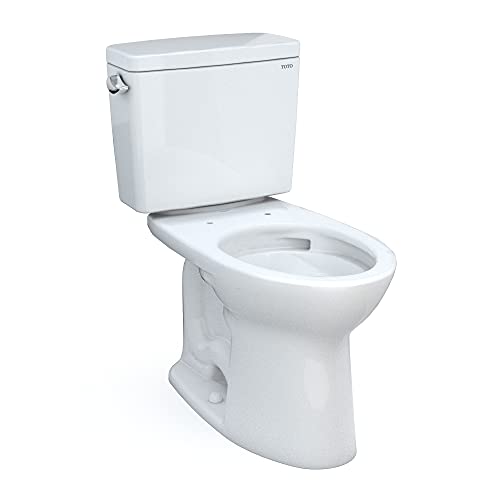
TOTO Drake Two-Piece Elongated 1.6 GPF with CEFIONTECT
Badge: Best Proven Flush Platform
Strengths
- TORNADO FLUSH rim jets drive a rotating rinse that scours the full bowl and delivers contents to the trapway already moving.
- 1.6 GPF volume provides generous flush momentum for households that distrust low-volume designs.
- CEFIONTECT glaze keeps the bowl surface slick, slowing the residue buildup that precedes chronic clogging; parts are available everywhere.
Trade-offs
- Highest water use in this guide — the price of the volume-based approach.
- No MAP figure in this listing, despite the platform’s reputation.
- Traditional two-piece, exposed-trapway styling rather than a modern skirted look.
Mini spec box: Two-piece elongated toilet; 1.6 GPF TORNADO FLUSH; CEFIONTECT glaze; Universal Height; Cotton White finish.
Some buyers have been burned by low-flow toilets once already — usually by the first-generation designs that simply starved an old flush of water — and for them, no test score fully restores trust. The Drake is their toilet. Its TORNADO FLUSH system is one of the most widely installed flush architectures in the modern market: twin rim jets set the bowl water spinning, which scrubs the entire bowl circumference on every flush and organizes the bowl contents into a rotating mass that the siphon then removes decisively. At 1.6 GPF it also carries the most water momentum in this guide, delivered through a platform whose valves, flappers, and gaskets are stocked in every plumbing aisle in the country. When something eventually wears — everything wears — the fix is a part and twenty minutes, not a special order.
The CEFIONTECT glaze is the long-game feature. Clogging in year eight is usually narrowing in years one through seven: residue films the bowl and the trapway entrance, scale roughens the surface, and loads that once cleared begin to catch. A glaze engineered to shed residue slows that timeline materially, which is why a toilet can be a nonclog pick partly on its surface. The trade-offs are the visible ones: this is the thirstiest model here, its styling is traditional, and TOTO does not publish a MAP figure in this listing, so its ranking rests on architecture and track record rather than a score. For the buyer who values exactly those things — and there are many, with reason — the Drake remains the safest pair of hands in the category.
Best for: Buyers who trust proven platforms and generous flush volume over test scores / Not suited for: Water-conservation priorities or design-led bathrooms

MAXSA 15-Inch Elongated Two-Piece Toilet
Badge: Best Value Pick
Strengths
- 1.28 GPF siphonic flush — a conventional, effective architecture that empties the bowl by siphon rather than by rinse.
- Soft-close seat included, protecting the rim and hardware from slam wear.
- Standard 12-inch rough-in elongated format drops into most bathrooms without modification.
Trade-offs
- No MAP figure or explicit trapway claim in the listing; clog resistance is a design expectation.
- 15-inch bowl height is low for tall users and anyone who prefers chair height.
- Smaller brand, so keep a spare flapper and fill valve on hand from day one.
Mini spec box: Two-piece elongated toilet; 1.28 GPF siphonic flush; soft-close seat; 12-inch rough-in; white ceramic; 15-inch bowl height.
The MAXSA occupies the honest end of this guide: a conventional siphonic toilet, at a standard height, with no published test figure — and a clear-eyed role. Not every clogging toilet needs replacing with a top-band tested model. If your current toilet clogs because it is a genuinely weak early low-flow design, or because its trapway was never glazed properly in the first place, then a sound modern siphonic flush at 1.28 GPF is already a large step up: the siphon does the work, the water volume is adequate, and the design contains no exotic parts to fail. The MAXSA delivers exactly that, with a soft-close seat in the box and an elongated bowl on a standard rough-in.
What we will not do is dress it in evidence it does not have. There is no MAP score in its listing and no specific trapway claim, so a household in open war with a chronic clogger should spend its money on the BayRoll or HOROW, where the clearing power is published. The MAXSA is for the household whose problem is mild — a slow flush every few weeks, a plunger used monthly rather than weekly — and whose users are of average or shorter height, for whom the 15-inch bowl is a fit rather than a compromise. Bought with a spare flapper stored in the vanity, it is a sensible, serviceable answer at the value end, and a reminder that in this category the honest mid-tier beats the exaggerated claim every time.
Best for: Mild, occasional clogging in average-height households on a budget / Not suited for: Chronic-clog households or tall users

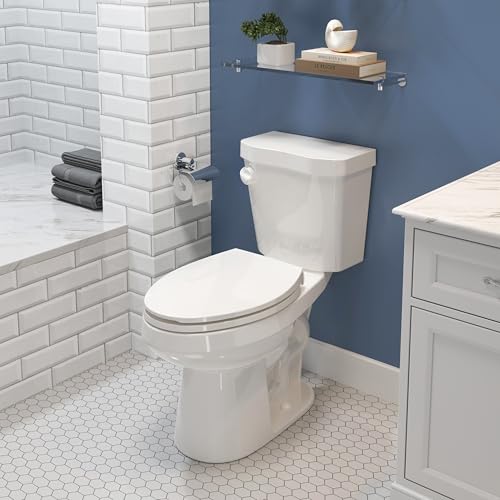
HOROW 17-Inch Comfort Height Dual Flush Toilet
Badge: Best for Busy Family Bathrooms
Strengths
- MAP 1000g in the listing — the same top-band published evidence as the top pick, in an elongated two-piece.
- Dual flush 1.1/1.6 GPF keeps the trapway rinsed on the light cycle while reserving full power for solids.
- 17-inch ADA chair height and soft-close seat fit the widest range of family users, from grandparents to tall teens.
Trade-offs
- Dual-flush valve has two actuation paths to keep in adjustment over the years.
- Two-piece, exposed-trapway design needs more exterior wiping than the skirted BayRoll.
- Newer brand than the legacy names for parts depth.
Mini spec box: Two-piece elongated toilet; dual flush 1.1/1.6 GPF; MAP 1000g in the listing; 17-inch ADA chair height; soft-close seat; 12-inch rough-in.
If the BayRoll is the evidence champion in a compact round body, the HOROW is the evidence champion in the shape family bathrooms actually ask for: elongated, chair height, two-piece serviceability, and a soft-close seat that survives children. Its listing carries the same MAP 1000g figure, which means the flush at the heart of the family bathroom — the most-used, most-abused toilet in the house — has published, standardized proof of its clearing ability. In a household where the toilet serves school-morning rushes, guests who were never taught the courtesy flush, and the full creative range of children’s paper usage, that proof is not a luxury; it is the specification.
The dual-flush system earns its complexity in this setting. Family bathrooms flush constantly, and routing the liquid majority through the 1.1 GPF cycle keeps the trapway exchanged and rinsed far more often than a single-volume toilet would be for the same water spend — and frequent complete rinsing is the mechanism that prevents the slow narrowing behind most chronic clogging. The full 1.6 GPF cycle is one clearly marked button away when the load demands it. The costs are modest and known: a dual-flush valve deserves a glance at the annual check, and the exposed trapway collects dust the skirted BayRoll shrugs off. Families comparing formats should also glance at Best One Piece Bidet Toilets if a bidet upgrade is on the household roadmap, since seat compatibility is easier to plan before installation than after. For the main bathroom of a busy house, though, this HOROW is the pick we would defend first.
Best for: The primary bathroom of a busy household that wants published flush evidence / Not suited for: Owners who want a skirted one-piece exterior or the simplest single-flush valve

Gerber Maxwell Crest Elongated Two-Piece Toilet
Badge: Best Trapway Design
Strengths
- Glazed trapway that the listing states prevents clogs — the friction argument, made by the manufacturer itself.
- Efficient flush positioned to clear the bowl with ease, from a brand built on professional plumbing trade sales.
- Tool-free install kit with wax ring included supports the square, aligned installation a trapway needs to perform as designed.
Trade-offs
- No MAP score published, so peak clearing is argued from design rather than measured.
- Conventional styling and standard-height elongated format.
- Two-piece construction keeps the usual tank seam and joints to maintain.
Mini spec box: Two-piece elongated toilet; efficient siphonic flush; glazed trapway; soft-close seat; tool-free install kit with wax ring included; white finish.
The Gerber closes this guide with the purest statement of the trapway philosophy. Every other pick argues about flush power, test loads, or rinse patterns; the Maxwell Crest’s listing argues about the surface the waste travels over. A glazed trapway stays slick for the life of the fixture, so the friction term in the clogging equation stays low and constant — no gradual roughening, no residue footholds at the bends, no year-four decline from a toilet that tested well when new. For the very common pattern in which a toilet clogs more each year despite nothing obviously breaking, that surface permanence is not a detail; it is the diagnosis and the cure in one.
Gerber’s trade background shows in the supporting choices: an efficient flush tuned for easy clearing rather than spectacle, and an install kit that includes the wax ring and tool-free hardware, because a trapway can only perform as designed if the bowl is seated squarely and aligned with the drain — a crooked install manufactures a ledge at the outlet that no glaze can overcome. The limitation remains measurability: without a MAP figure, a buyer comparing peak-load evidence will rank the BayRoll and HOROW above it, fairly. But a buyer whose clogs are the slow, worsening kind — and who values a professional brand’s engineering judgment — may reasonably conclude that the toilet designed around never narrowing is the one that will still be clearing in a decade. That is a bet on the right variable.
Best for: Households whose clogging worsens gradually year over year / Not suited for: Buyers who want a published MAP figure as their deciding evidence
Comparison Table
| Model | Flush | Published Test | Design | Nonclog Strength | Link |
|---|---|---|---|---|---|
| BayRoll One-Piece Round | Dual 0.9/1.28 GPF | MAP 1000g in listing | One-piece skirted, 17-inch | Top-band evidence at lowest volumes | Check on Amazon |
| Casta Diva Elongated | Dual 1.1/1.6 GPF | Not published | One-piece, 17-inch | Comfort format, frequent light rinsing | Check on Amazon |
| TOTO Drake 1.6 GPF | 1.6 GPF TORNADO FLUSH | Not published | Two-piece, Universal Height | Proven rotating rinse, residue-shedding glaze | Check on Amazon |
| MAXSA 15-Inch | 1.28 GPF siphonic | Not published | Two-piece, 15-inch | Sound conventional siphon at value tier | Check on Amazon |
| HOROW 17-Inch Dual Flush | Dual 1.1/1.6 GPF | MAP 1000g in listing | Two-piece, 17-inch ADA | Published evidence in family format | Check on Amazon |
| Gerber Maxwell Crest | Efficient siphonic | Not published | Two-piece elongated | Fully glazed trapway resists narrowing | Check on Amazon |
How to Choose a Nonclog Toilet
Shop in the order the physics works. First, the trapway: is it fully glazed, and is it generously sized? This hidden passage decides both today’s clearing and next decade’s, because an unglazed trapway narrows with residue while a glazed one holds its diameter. Second, the evidence: does the manufacturer publish a MAP score? A 1000g result — carried by two models here — is the strongest standardized claim in the category, and its absence is not disqualifying but should move a model down your list when clogging is your primary pain. Third, the flush architecture: a siphonic design with fast water delivery, whether expressed as a named system like TORNADO FLUSH or as a tested dual-flush valve, is what converts water in a tank into momentum in a trapway. Volume comes a distant fourth, and mostly as a tiebreaker for buyers who simply prefer it.
Then fit the choice to your household’s reality. Count the users and their heights: chair height around 17 inches serves most adults, 15 inches serves shorter households, and a mismatch manufactures the rushed overloading that clogs any toilet. Decide between one-piece and two-piece on maintenance temperament — one-piece for the wipe-and-done exterior, two-piece for the easiest tank service — and between round and elongated on measured space, not preference in the abstract. Check the rough-in before ordering (12 inches throughout this guide) and, just as importantly, check your drains: if the tub and sinks are slow too, or the toilet gurgles when the washer drains, spend your first money on the line, because the finest nonclog toilet ever molded empties into the same pipe. Finally, for homes away from municipal plumbing entirely — well-and-septic houses are fine with everything here, but truly unplumbed cabins are a different category, surveyed under Best Off Grid Toilets For Residential Use — confirm the toilet type matches the infrastructure before falling for a flush specification.
How to Keep Any Toilet Clog-Free: Habits, Care, and Troubleshooting
Engineering sets the ceiling; habits decide how close to it you live. The rules are short and absolute. Only human waste and toilet paper go in the bowl. Wipes — including every product labeled flushable — do not disintegrate in the trapway or the line and are the leading cause of modern blockages; cotton balls, swabs, floss, paper towels, and hygiene products join them in the bin. Teach the courtesy flush in busy homes: splitting a large load into two flushes is not wasteful, it is the mechanism working as intended. Keep a flange plunger — the bell-shaped kind made for toilets — in the bathroom, and use it early, while a blockage is partial and the water is still moving. And once a month, give the toilet one deliberate full flush and watch it: a healthy nonclog flush is fast, swirling, and complete, and any drift toward lazy or partial is information you want early.
Care focuses on the surfaces the flush depends on. Keep the bowl glaze slick with non-abrasive cleaning; a scratched glaze accumulates the residue that narrows the trapway entrance. In hard-water homes, descale the rim jets when the rinse pattern weakens on one side, because an uneven rinse leaves one arc of the bowl unwashed and drying — the seed of both stains and buildup. Keep the tank water level at its marked line and the flapper sealing fully; a tank that sits low delivers a weak flush that masquerades as a clogging toilet. These are five-minute jobs, and together they are the difference between a nonclog toilet at year ten and a merely expensive one.
Troubleshooting, in the pattern that matters:
- Problem: The bowl rises and drains slowly without clearing → a partial trapway obstruction. Plunge with a flange plunger using a good seal and firm, steady strokes. If it persists, a closet auger reaches the trapway bend safely. Keep chemical drain openers out of toilets; they endanger seals, glaze, and whoever works on the fixture next.
- Problem: Every flush seems weak, even with small loads → check the tank water level, then the flapper’s drop timing, then the rim jets for scale. Weak delivery imitates clogging and is fixed in the tank, not the trapway.
- Problem: A specific object is suspected — a toy, a phone, a deodorizer cage → do not keep flushing, which wedges it tighter. An auger may retrieve it; otherwise the toilet comes off and the object comes out from below. This is the one common case where removing the toilet is the first move, not the last.
Why Toilets Start Clogging After Years of Good Service
The most misunderstood pattern in this category is the toilet that flushed perfectly for five years and then began plugging monthly. Owners assume the toilet wore out, but gravity toilets have almost nothing to wear out in the flush path — no pump, no blades, no motor. What changes is surface and scale. In the trapway, microscopic residue accumulates on any surface that is not fully glazed, each layer making the next more likely, until the effective diameter has narrowed enough that ordinary loads catch at the bend. Under the rim, mineral scale chokes individual jets, weakening and skewing the rinse so residue survives each flush to join the buildup. In the tank, a flapper that has begun to drop early or a water level set low quietly shortens every flush. The encouraging conclusion is that most late-onset clogging is reversible with an auger, a descaling, and a flapper — and the strategic conclusion for buyers is the one this guide keeps returning to: choose the toilet whose surfaces cannot narrow, the fully glazed trapway and the residue-shedding bowl, and the five-year decline simply has no mechanism to begin.
High-Traffic Bathrooms: Rentals, Offices, and Dorm-Style Living
Everything in this guide so far assumes a household that can be taught habits. High-traffic bathrooms — rentals, small offices, shared houses, dorm-style living — cannot make that assumption, and their nonclog strategy shifts accordingly. When you cannot control what goes into the bowl, you buy margin: the widest published evidence of clearing power, the simplest flush interface, and the most serviceable platform, in that order. That logic favors the two MAP-published models here for shared bathrooms, favors single-button or clearly differentiated dual-flush controls over anything subtle, and favors two-piece construction, because the tank of a shared toilet will eventually need service and a two-piece tank lifts off without disturbing the bowl’s seal. Landlords should standardize: one model across every unit means one spare flapper, one fill valve, and one auger conversation with every tenant, and it converts a clog call from an investigation into a routine.
Two operational habits matter more in shared settings than any specification. The first is signage that works — a small, polite note in the bathroom itself listing what must not be flushed outperforms any clause buried in a lease, because it reaches the guest, the cleaner, and the new tenant at the moment of decision. The second is a scheduled check: a quarterly visit in which someone runs a full flush, watches it complete, checks the tank level, and confirms the plunger is present and the right type. Ten minutes, four times a year, catches the weak flapper and the slow rim jets before they become the emergency call on a holiday weekend. Finally, a boundary worth stating for property owners browsing this category: a toilet that clogs because tenants flush wipes is a behavior problem wearing a hardware costume, and the honest fix is the note, the bin placed within reach of the bowl, and the tested-margin toilet — in combination. Owners furnishing properties without conventional plumbing at all, such as off-grid rentals, are shopping a different shelf entirely; start with Best Off Grid Toilets and return here only for plumbed units.
The One Tool Every Nonclog Household Should Own: A Closet Auger
A buying guide for nonclog toilets should end its practical advice with the tool that handles the exceptions, because even the best-engineered toilet will meet a dropped toy or an impossible load once in its life. That tool is the closet auger — a short, hand-cranked snake built specifically for toilets, with a protective sleeve that guides its cable through the trapway’s bends without scratching the porcelain glaze. It differs from a general drain snake in exactly the way that matters here: a bare drain cable whipped around inside a bowl will score the glaze, and scored glaze is the beginning of the residue buildup this entire guide exists to prevent. The auger reaches the trapway bend where plungers lose their pressure, which is where most stubborn obstructions actually sit, and it either breaks them through or hooks and retrieves them — retrieval being the correct outcome for anything solid, since pushing a toy deeper converts a bathroom job into a drain-line job.
Technique is simple and worth learning before you need it. Seat the auger’s curved end at the bottom of the bowl, extend the cable gently until it meets resistance, then crank slowly while maintaining light forward pressure; if you hook something, reverse the process and draw it back rather than forcing it onward. Rinse and disinfect the cable afterward, dry it, and store it where the bathroom’s users can find it — an auger in the garage is an auger that arrives after someone has already flushed six times and overflowed the bowl. Between the plunger for partial blockages and the auger for stubborn ones, a household with a toilet from this guide is equipped for essentially every clog that is genuinely the toilet’s to solve, and can recognize the rest — the house-wide, downstream kind — by the fact that neither tool changes anything.
Common Buying Mistakes
- Shopping by gallons per flush. Momentum, trapway size, and glazing clear bowls; volume is the weakest predictor of the four.
- Dismissing test scores as marketing. A published MAP result is a standardized measurement. When clogging is your core problem, prefer the models that submit to it.
- Flushing wipes because the package invites it. Flushable describes what leaves the bowl, not what clears your line. Wipes are the leading modern blockage cause.
- Replacing the toilet before checking the drain. House-wide slow drains or gurgling mean the line or vent is at fault. Diagnose downstream first.
- Installing on the wrong rough-in. A mis-seated bowl leaves a ledge at the drain joint that catches paper for the life of the installation. Measure, then buy.
- Scrubbing the glaze with abrasives. A dulled, scratched bowl accumulates residue faster, seeding the buildup that narrows the trapway entrance. Clean gently.
Final Recommendation
Our first choice is the BayRoll one-piece round toilet: top-band MAP 1000g evidence, the lowest water volumes in the guide, a fully skirted body, and a 17-inch height — the most complete nonclog argument available, provided a round bowl suits your space. If your household needs the elongated family format with the same published evidence, take the HOROW 17-inch dual flush instead. The TOTO Drake is the proven-platform answer for buyers who trust track record and flush volume, the Gerber Maxwell Crest is the trapway purist’s pick for clogging that worsens with age, the Casta Diva brings elongated one-piece comfort, and the MAXSA covers mild problems at standard height and value tier. Install whichever you choose on a fresh seal, retire the wipes the same day, and keep the plunger only as a souvenir.
Frequently Asked Questions
What does nonclog actually mean in a toilet?
It means the toilet is engineered to clear realistic loads reliably and to keep doing so as it ages: a fast-starting siphonic flush, a wide trapway, and a fully glazed trapway surface that residue cannot narrow. The strongest evidence is a published MAP test score; two models in this guide carry the top-band 1000g figure in their listings.
Is a higher GPF toilet less likely to clog?
Not by itself. Clearing depends on how fast the water is delivered and how the trapway is shaped and finished. The BayRoll clears its published kilogram test load with a 1.28 GPF full cycle, while plenty of older higher-volume toilets clog because their water arrives too slowly and their trapways are rough. Judge by test evidence and trapway design first.
Why does my toilet clog more often than it used to?
Usually gradual narrowing: residue accumulating on an unglazed trapway, mineral scale choking the rim jets and weakening the rinse, or a flapper dropping early and shortening every flush. An auger, a descaling of the jets, and a fresh flapper restore most such toilets; a fully glazed trapway model prevents the pattern from starting.
Are flushable wipes really a problem for a nonclog toilet?
Yes — for every toilet. Wipes do not break apart like toilet paper; they pass the bowl intact and mat together in the drain line, causing the most stubborn and expensive blockages. Nonclog engineering provides margin against waste and paper loads, not against materials that were never designed to disintegrate. Bin all wipes.
Dual flush or single flush for a clog-prone household?
Either can work, and the tested models here are dual-flush. The light cycle’s frequent, complete rinsing actively discourages buildup, while the full cycle handles solid loads. The discipline required is simply using the full cycle for solids. Households that doubt that discipline should choose a strong single-flush design instead.
How do I know if the clog is in my drain line instead of the toilet?
Look for company: slow tubs and sinks, gurgling sounds when other fixtures drain, or several fixtures backing up together all point downstream to the line or vent. A toilet-only problem, in a house where everything else drains freely, belongs to the toilet. A plumber’s camera inspection settles it before you spend on the wrong fix.
Can a plunger damage a toilet?
Used correctly, no: a flange plunger with a proper seal and steady pressure is the right first tool. What damages toilets is forcing — plunging violently against a complete blockage, or using chemical openers that attack seals and glaze. If plunging and a closet auger both fail, the blockage is a job for removal or a professional, not for more force.